
Intuitive processing is rapid cognitive processing that can combine cues, prior experience, learned patterns, associations, emotion, and sometimes bodily information without requiring you to consciously work through every intermediate step. The result can arrive in awareness as a judgment, impression, preference, image, feeling, or quiet sense that something fits—or does not.
How we perceive a situation can shape our intuitive response. The distinction between intuition and perception helps separate what we notice from the judgment we form.
Quick answer
Intuitive processing is not the absence of thinking. It is a way information can be integrated when you do not have conscious access to every operation involved. What you experience is often the compact output: “this looks wrong,” “this option fits,” “slow down,” “ask one more question,” or simply “I know.”
That does not make intuition magical or automatically correct. A convincing intuitive signal can reflect relevant expertise, a useful emotional or bodily cue, a familiar pattern, a heuristic, bias, anxiety, wishful thinking, or several of these at once. The practical skill is learning when the signal deserves trust, when it needs verification, and what feedback should change your internal model.
What Is Intuitive Processing?
Intuitive processing is a way the mind forms a usable impression or judgment without requiring conscious, step-by-step reasoning through every piece of information involved. It is often experienced as fast, associative, and low-effort. But “fast” describes how quickly the result may become available to you—not necessarily how long the learning that made the judgment possible took to develop.
A useful distinction is to separate the process from the experience of the result. You may become aware of a conclusion in a second while the capacities that produced it were shaped by months or years of exposure, memory, feedback, pattern learning, emotional learning, and repeated decisions. This is one reason intuition can feel mysterious: awareness receives a compressed answer without receiving a complete transcript of how that answer was assembled.
In that sense, the intuitive process is broader than the moment you notice it. An intuitive thought is one possible conscious output; intuitive behavior is an action that may follow from that output. The processing includes the cue integration and learned pattern activation that connect what you encounter with what you eventually think, feel, or do.
This makes intuitive processing different from simply “having a feeling.” A feeling can be one output or one input. Intuition can also appear as a mental image, a directional preference, an urge to check something, a sense of familiarity, a sense of mismatch, or a judgment that emerges before you can state the reasons. For a broader explanation of the thinking mode itself, see intuitive thinking.
It is also useful to distinguish intuition from instinct. Instinct refers more strongly to biologically prepared tendencies, while intuition is often shaped by learning and context. The difference is explored in intuition vs instinct.
How Intuitive Processing Works
No single diagram captures every theory of intuition, but a useful working model is to think of intuitive processing as a sequence in which cues activate learned patterns, patterns begin to cohere, a prediction or interpretation forms, and the result reaches awareness as a candidate judgment. Conscious reasoning can then accept it, test it, modify it, or reject it.
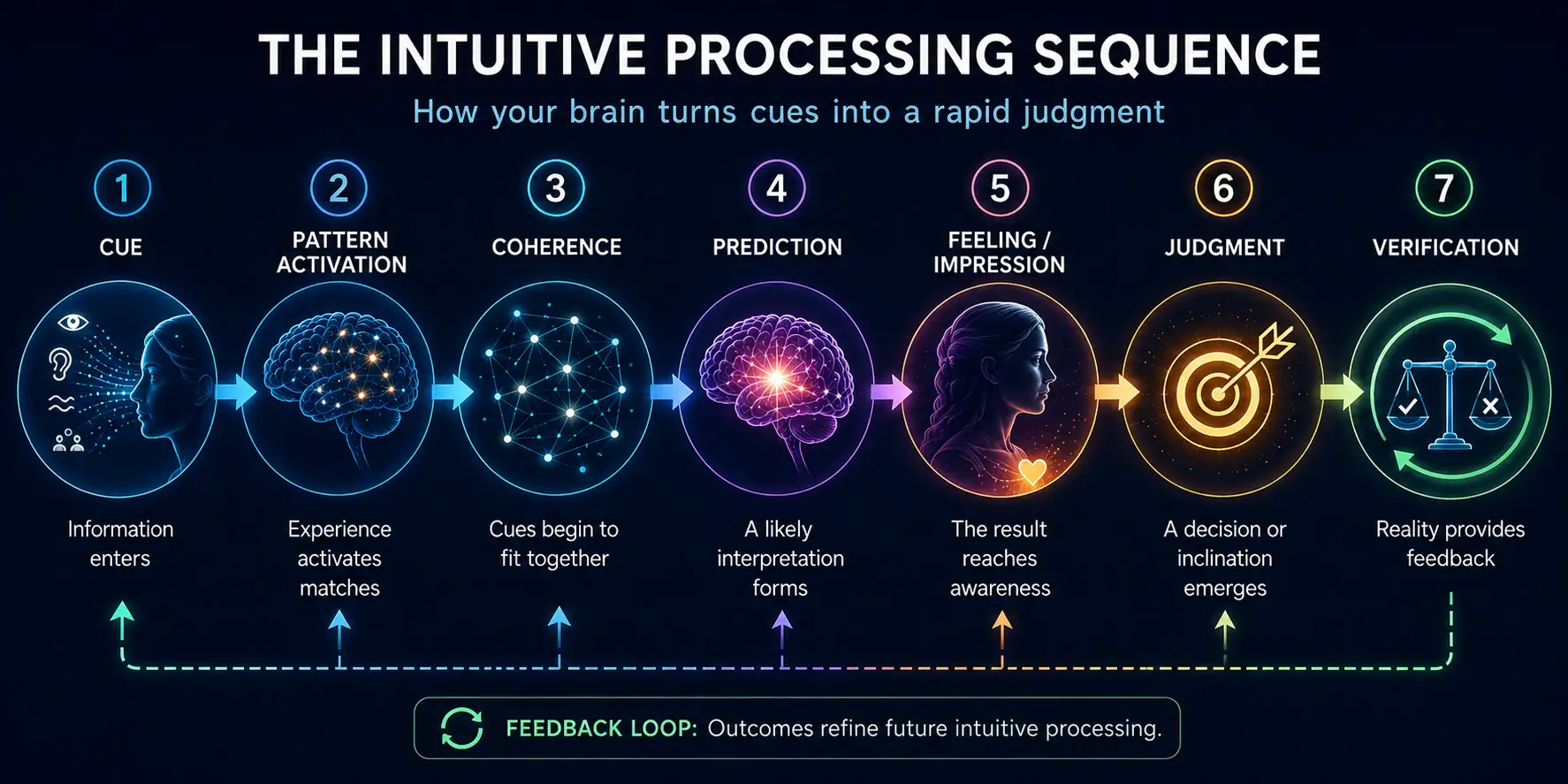
1. Cues enter
You take in more information than you deliberately discuss with yourself. A conversation carries words, timing, tone, facial movement, pauses, context, prior history, expectations, and your own internal state. A work problem contains explicit data but also patterns in how people respond, what has changed, what is missing, and which signals resemble earlier situations.
2. Relevant patterns activate
Current cues can activate memories, associations, categories, emotional learning, and previously learned regularities. This does not mean the brain retrieves a perfect record of the past. Memory is selective and reconstructive. What matters is that previous learning changes which features become salient and which interpretations become available.
This is why pattern recognition under uncertainty is central to many useful intuitions. In a familiar domain, one small cue may activate a large amount of stored structure.
3. Coherence begins to emerge
Multiple weak signals can begin to fit together into one interpretation. You may not yet know why the interpretation feels plausible. The important point is that a sense of coherence can precede an explicit explanation of the cues that produced it.
4. A prediction or interpretation forms
The mind continually anticipates what is likely to happen next. In intuitive processing, a candidate interpretation can emerge before you deliberately compare every alternative. This connects with the idea explored in cognitive intuition and prediction: prior learning influences what the current situation seems to imply.
5. The result reaches awareness
What reaches consciousness may be compact: a preference, hunch, bodily shift, image, sense of rightness, hesitation, or a thought such as “check that again.” The compression is useful because you do not need conscious access to every memory or cue before a response becomes available.
6. Judgment becomes a decision candidate
An intuition is best treated as a candidate judgment, not a command. Sometimes the signal is sufficient for immediate action because the stakes are low and the environment is familiar. Sometimes the right move is to slow down and ask what evidence would confirm or contradict it.
7. Reality provides feedback
Outcomes matter because intuition can be shaped by learning. If you repeatedly predict, act, and receive clear feedback, useful patterns can become easier to recognize. If feedback is noisy, delayed, ambiguous, or ignored, confidence can grow without a corresponding gain in accuracy.
Why Intuition Can Feel Instant
One contributor is implicit learning: acquiring patterns without full conscious awareness of what you have learned. This helps explain why a familiar situation can prompt a judgment before you can describe the underlying rule. It does not, by itself, establish that the judgment is correct.
The subjective experience of intuition can be sudden even when the learning behind it is not. You may become aware of the result only after several streams of information have interacted. That does not require the claim that a fully formed decision was secretly made by an all-powerful unconscious mind. A more defensible description is that some relevant processing and integration may not be available to conscious report while they occur.
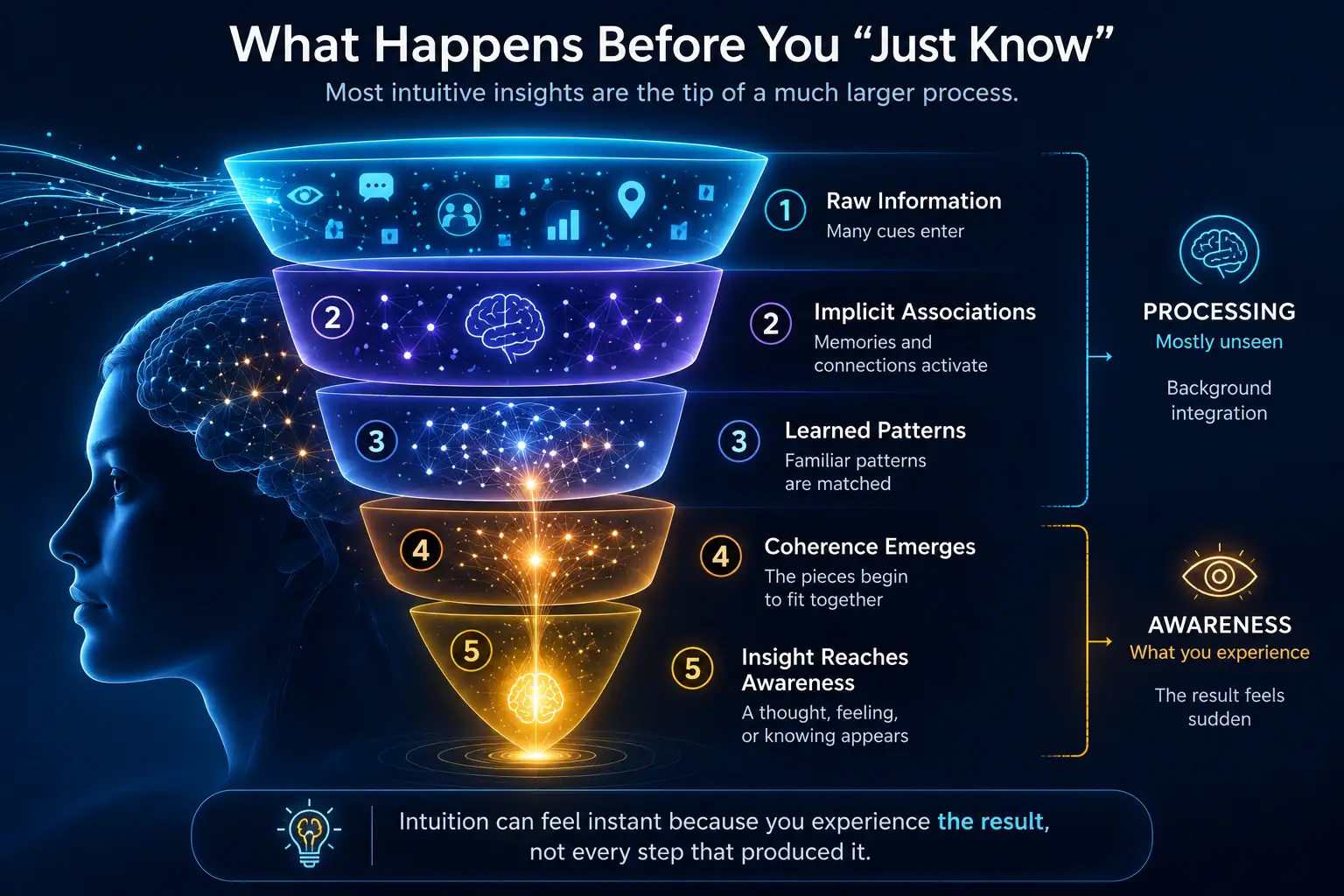
This distinction matters because popular explanations often attribute too much to “unconscious decision making.” A critical review by Ben Newell and David Shanks argued that evidence for strong unconscious control of complex decisions has frequently been overstated and that awareness is difficult to measure cleanly. In practical terms, it is safer to say that people often lack full conscious access to the cues and intermediate operations behind an intuitive judgment than to claim that a separate unconscious agent makes the entire decision for them.
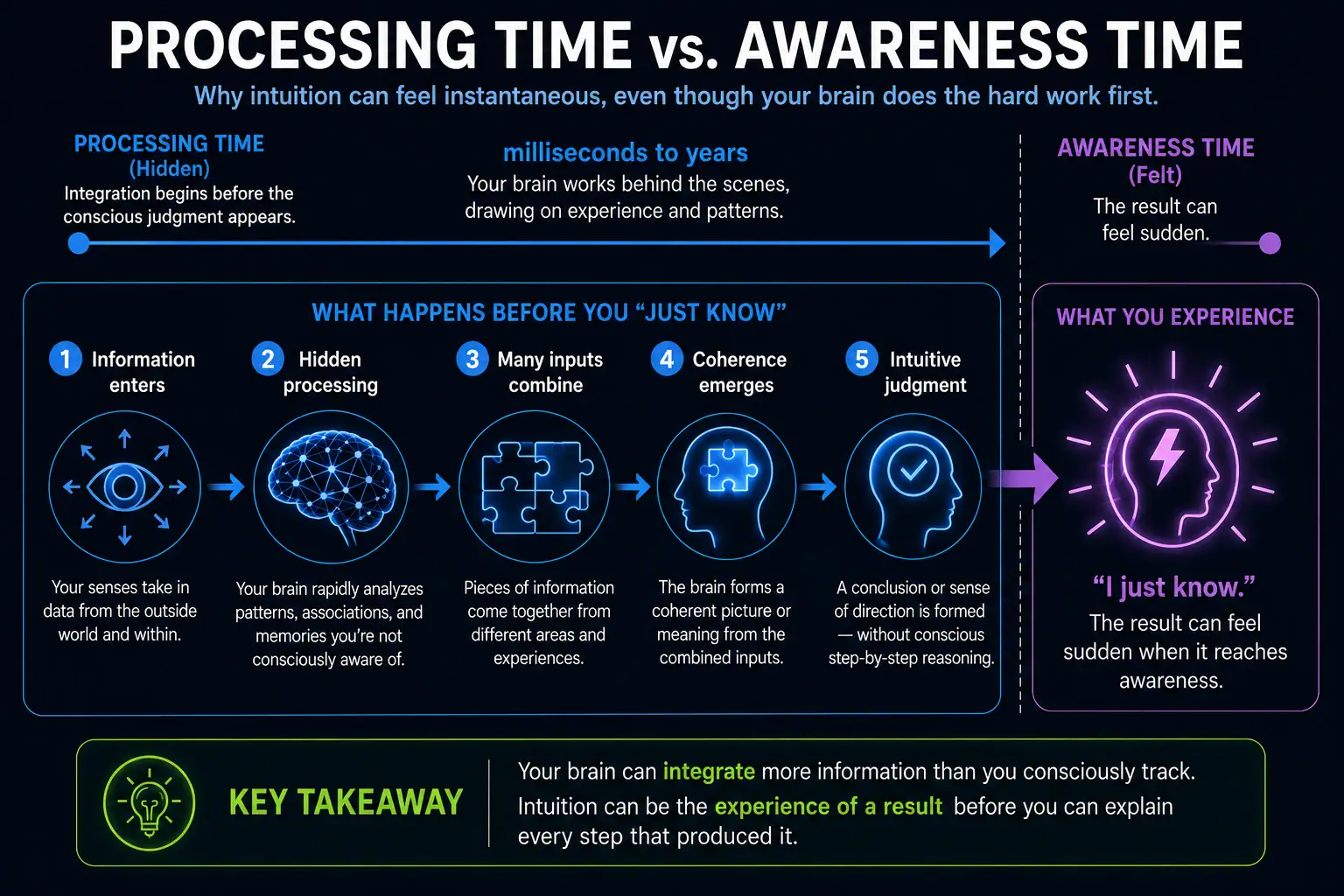
The useful takeaway is simple: sudden awareness does not imply zero processing. The conscious moment is the moment you notice the result. The knowledge that makes that result possible may have been built over a much longer period.
Intuitive Processing vs Analytical Processing
Intuitive and analytical processing are often presented as opposites: fast versus slow, feeling versus logic, irrational versus rational. That framing is too simple. Dual-process models remain useful, but contemporary work increasingly warns against treating “System 1” and “System 2” as two literal brain modules. A 2025 perspective by Wim De Neys argues that deliberation serves several complementary functions—including response control, generation, justification, and regulation—rather than merely acting as a slow correction mechanism.
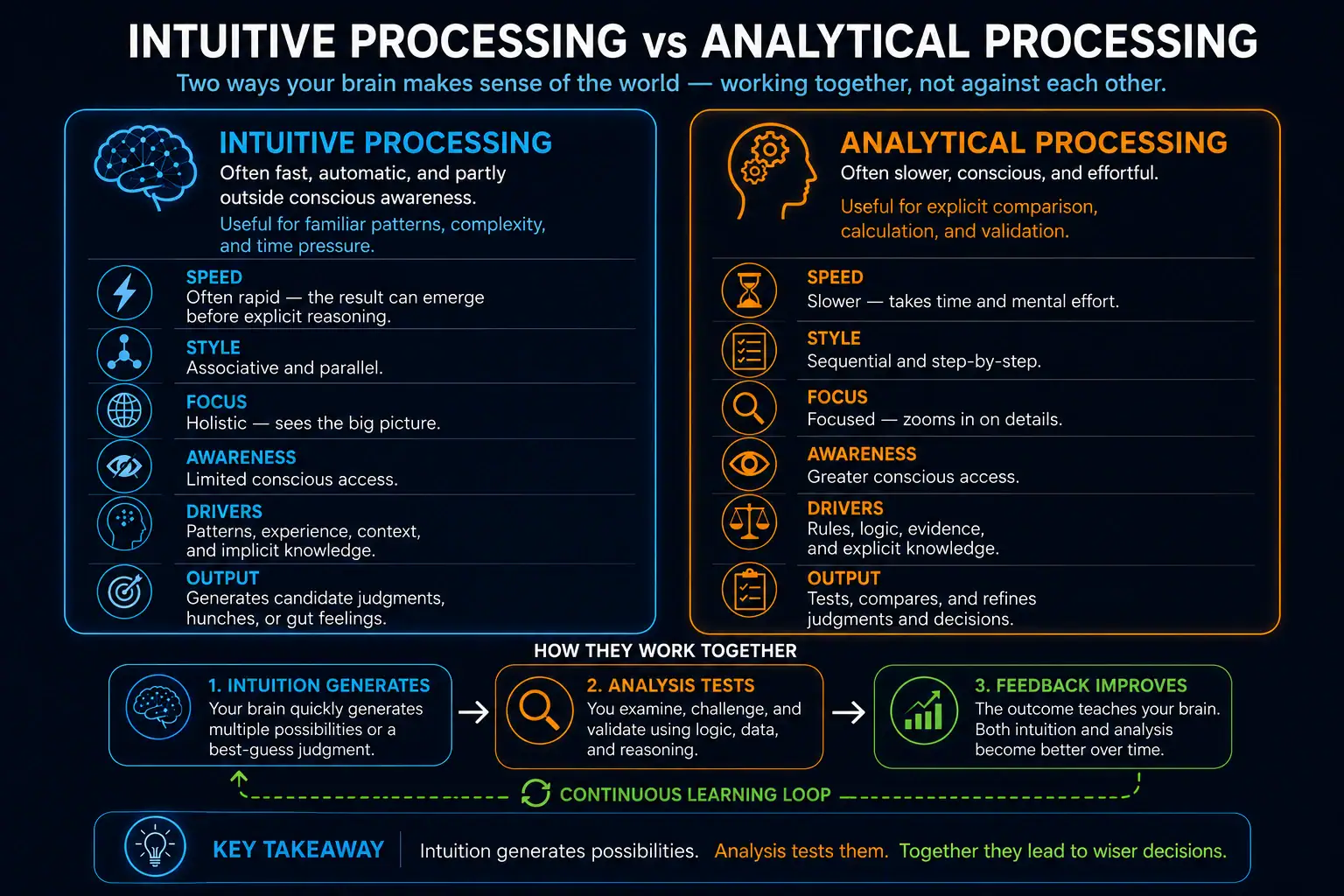
| Dimension | Intuitive processing | Analytical processing |
|---|---|---|
| Typical experience | A conclusion or direction appears with limited access to intermediate steps. | You consciously work through reasons, evidence, calculations, or alternatives. |
| Speed | Often rapid at the point of judgment. | Often slower because steps are explicitly represented and compared. |
| Representation | Associative, pattern-based, contextual, sometimes affective or embodied. | Sequential, rule-based, verbal, numerical, or explicitly comparative. |
| Strength | Efficient integration of familiar patterns under complexity or time pressure. | Transparent checking, calculation, comparison, and justification. |
| Risk | Bias, anxiety, outdated patterns, overconfidence, or misleading familiarity can feel convincing. | Overanalysis, false precision, cognitive overload, or focusing on what is measurable rather than what matters. |
| Best relationship | Let intuition generate a candidate signal; use analysis when novelty, stakes, reversibility, or uncertainty justify verification. | |
The practical goal is not to become “more intuitive” at the expense of reasoning. It is to become better at knowing which mode the situation needs. If the problem is familiar and patterns are learnable, intuitive processing can be efficient. If the decision is novel, irreversible, numerically complex, or especially vulnerable to bias, deliberate checking becomes more valuable.
What Feeds Intuitive Processing?
Intuition does not emerge from a single inner channel. It can integrate several classes of information at once, and the relative importance of each source depends on the decision.
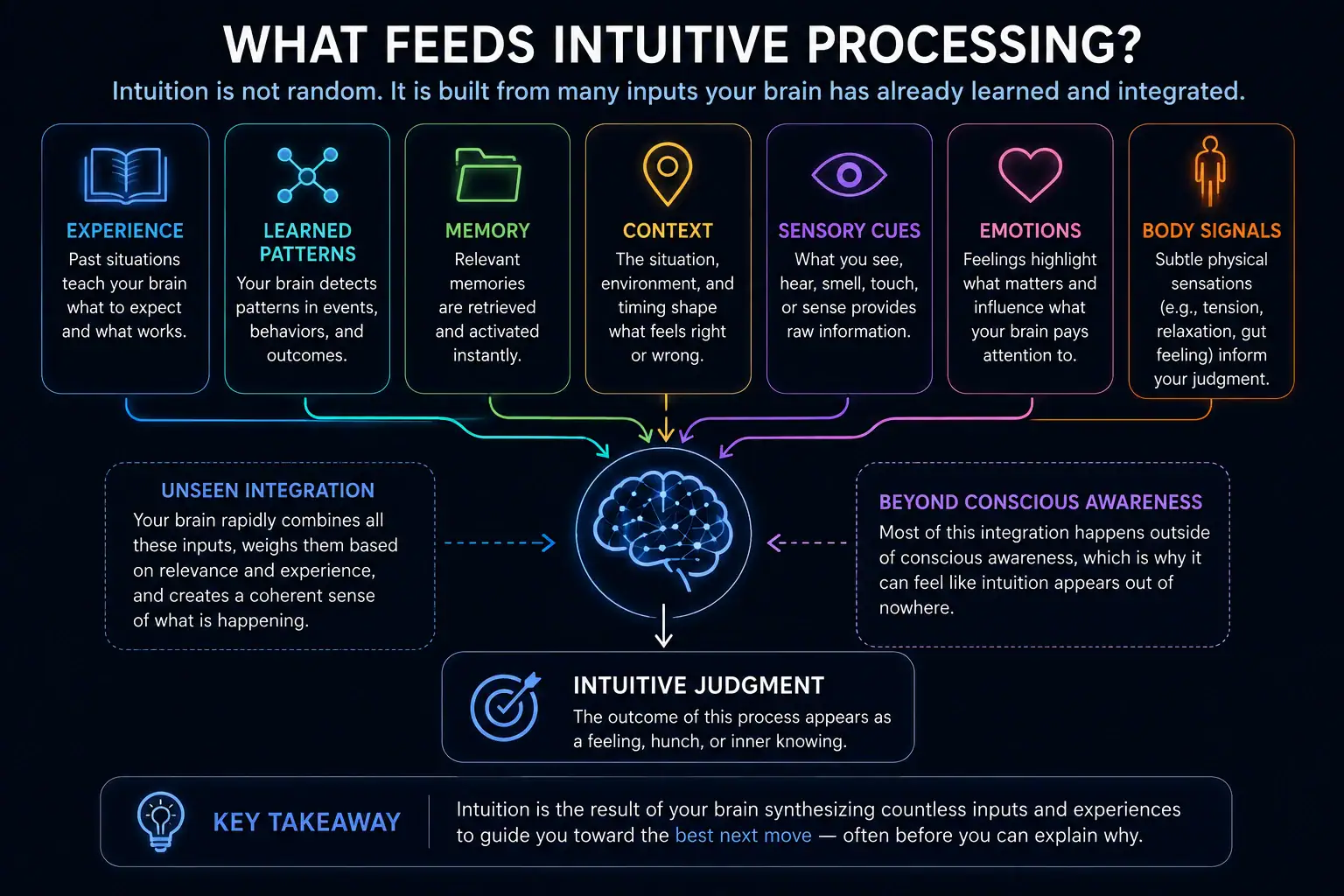
Experience
Experience gives the mind examples of what tends to happen, what matters, what precedes success or failure, and which cues deserve attention. But experience alone does not guarantee expertise. Repetition can reinforce a mistaken rule if the environment is unpredictable or feedback is poor.
Learned patterns
Patterns allow a complex situation to be represented efficiently. An experienced person may perceive structure where a novice sees separate details. That does not mean experts are always right; it means experience can change what is noticed and how quickly a situation is categorized.
Memory and association
Current cues can activate related memories and concepts. You may not retrieve the full chain consciously, but the activated structure can still change what feels familiar, unusual, risky, or promising.
Context
The same cue can mean different things in different environments. Timing, goals, constraints, relationships, prior events, and base rates all shape interpretation. Useful intuition is therefore often domain-specific rather than a general superpower.
Sensory information
Vision, hearing, touch, smell, and other sensory channels contribute to rapid judgments. A driver may react to motion before verbalizing the danger; a technician may notice a subtle sound; a manager may detect a shift in group interaction before describing the pattern explicitly.
Emotion
Affect can influence attention, perceived importance, and the experience of coherence. Research on intuitive coherence judgments has found psychophysiological differences between instructed intuitive and deliberate strategies, while also showing that the intuitive-versus-deliberate distinction should not be reduced to “emotion versus no emotion.” Emotion and intuition interact, but they are not identical.
Body signals
Internal bodily states—often discussed under the broader concept of interoception—can contribute information about arousal, effort, threat, attraction, fatigue, or physiological need. Reviews of interoception and decision making describe brain-body signals as potentially relevant to valuation and choice, although the exact mechanisms and their reliability depend on context. A bodily sensation is therefore not automatically a trustworthy intuition. For that distinction, see intuition vs gut feeling.
How the Brain Builds an Intuitive Judgment
It is tempting to ask where intuition “lives” in the brain, but that question can mislead. Intuitive judgment is better understood as distributed processing rather than a single intuition center. Perception, memory, association, affect, context, prediction, and control can all contribute depending on the task.
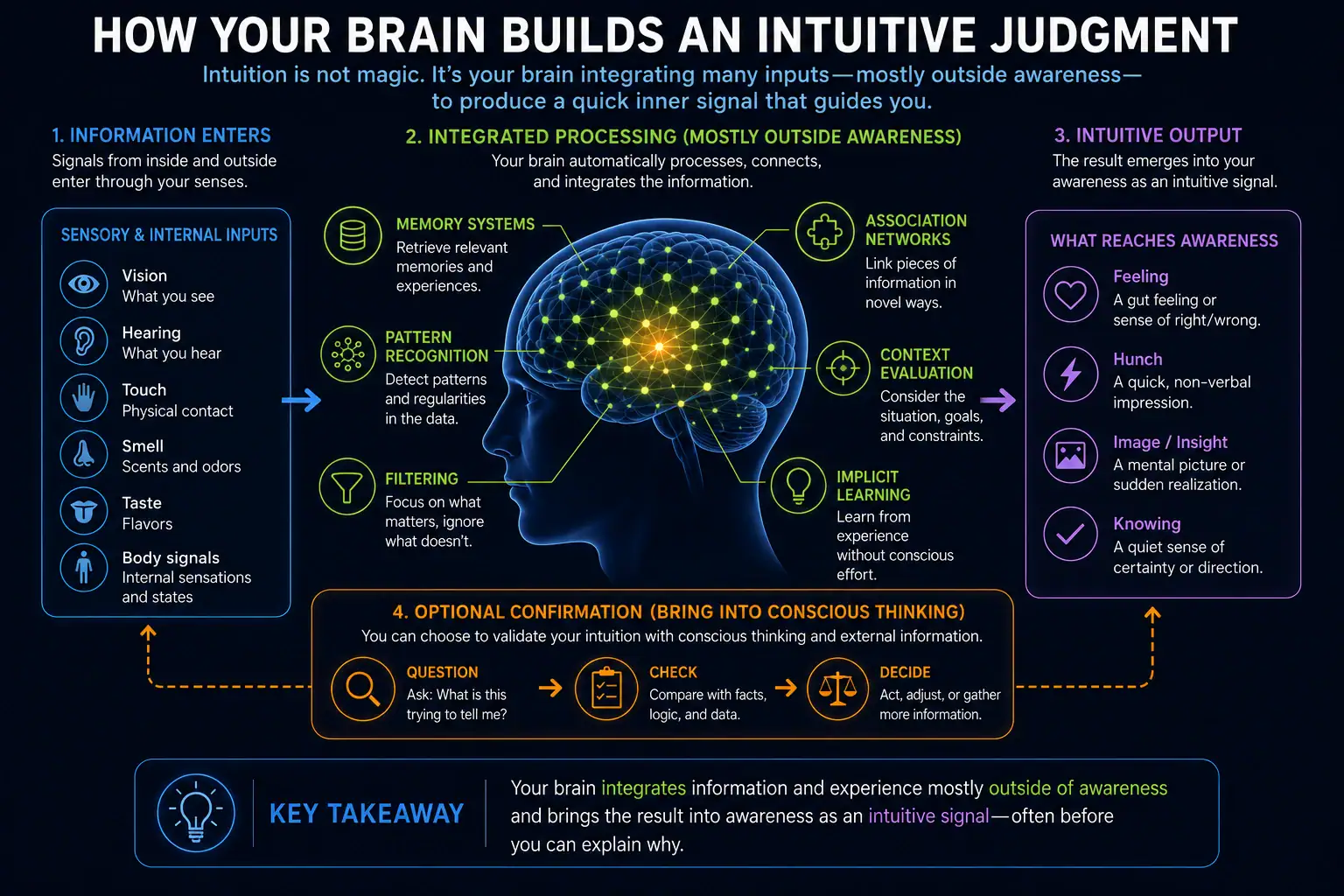
Neuroscience studies of intuitive coherence do identify particular regions that can contribute in specific tasks. For example, an MEG study of visual coherence judgments reported early orbitofrontal activity associated with intuitive judgments. That is useful evidence about one experimental paradigm, not proof of a single “intuition area.” The safer conclusion is that intuitive processing recruits networks appropriate to the information being integrated.
This distributed view also explains why intuition can arrive in different forms. One person may notice a bodily tension, another a visual image, another a verbal thought, and another a simple directional preference. The form of the output is less important than the question: what information could have produced it, and how trustworthy is that information in this environment?
If you want a deeper treatment of awareness itself, see intuition and consciousness. For the broader idea that perception and prediction depend on internal models, see the internal model of reality.
Is Intuitive Processing the Same as a Heuristic?
No. A heuristic is typically a simplifying rule or strategy that reduces the effort required to make a judgment. Intuitive processing is broader. It can involve heuristics, but it can also reflect pattern recognition, associative integration, tacit knowledge, emotional learning, context, or expertise.
For example, a recognition heuristic uses recognition itself as a cue while ignoring other information. An experienced professional who notices that a situation “doesn’t look right” may instead be responding to a configuration of subtle learned cues that cannot initially be verbalized. Both judgments can feel intuitive, but they are not necessarily produced in the same way.
This distinction matters because “intuitive” should not become a label for every fast judgment. Some fast judgments are rules of thumb. Some are habits. Some are conditioned responses. Some are skilled recognition. Some are biases. The dedicated comparison in intuition vs heuristics goes deeper into that boundary.
Examples of Intuitive Processing
An experienced clinician notices a mismatch
A clinician may feel that a presentation is atypical before being able to name the exact cue. The intuition could reflect a configuration of timing, appearance, movement, speech, history, or other features learned across many cases. The appropriate response is not necessarily to “trust the gut” and stop reasoning; it may be to investigate the mismatch more carefully.
A driver slows down before explaining why
Traffic decisions involve motion, spacing, speed, peripheral cues, vehicle behavior, road conditions, and learned expectations. A driver can react to an emerging risk before consciously narrating every cue. Later, the driver may realize that another vehicle drifted slightly or that the pattern of movement looked unstable.
A manager senses a project is beginning to slip
The dashboard may still look acceptable, but small changes can form a recognizable pattern: delayed answers, more dependencies, ambiguous ownership, repeated “temporary” workarounds, or a drop in the quality of status updates. Experienced delivery judgment can integrate these weak signals before any single metric proves there is a problem.
A designer rejects an option before verbalizing the criteria
Experts can develop sensitivity to balance, proportion, hierarchy, rhythm, and fit. A design can feel wrong before the designer has articulated which relationship is causing the problem. Analysis is then useful for identifying and communicating the reason.
A conversation feels subtly inconsistent
Words, facial expression, timing, tone, and prior context may not align. The resulting feeling of mismatch can be useful—but it can also be shaped by prior expectations or anxiety. The right next step is often curiosity rather than accusation: identify what you noticed and seek additional evidence.
For more concrete situations, see intuitive thinking examples.
When Does Intuitive Processing Become Reliable?
The most important answer is not “when you feel confident.” Subjective confidence is a poor standalone measure of intuitive accuracy. Daniel Kahneman and Gary Klein, writing about the conditions for intuitive expertise, concluded that the likely quality of intuitive judgment depends heavily on the predictability of the environment and the opportunity to learn its regularities through practice. They also explicitly warn that subjective experience is not a reliable indicator of accuracy.
That gives us a practical reliability test:
- Are there real patterns to learn? Some environments contain stable cue-outcome relationships. Others are dominated by noise, hidden variables, or extreme unpredictability.
- Have you seen enough relevant cases? Familiarity with a broad domain is not the same as experience with this specific class of decision.
- Did you receive timely, clear feedback? You cannot calibrate a prediction if you rarely learn what actually happened.
- Is the current situation similar to the environment in which you learned? A pattern that worked in one organization, relationship, market, culture, or technical system may fail after the environment changes.
- Can you separate confidence from accuracy? Feeling certain is information about your internal state, not proof that the external world matches it.
A useful rule: expertise does not simply mean “trust yourself more.” It means your internal model has had repeated opportunities to be corrected by reality.
When Intuitive Processing Goes Wrong
The same properties that make intuition efficient can also make errors feel compelling. If an interpretation emerges without an explicit chain of reasoning, you may have fewer visible steps to inspect for mistakes.
Bias can masquerade as pattern recognition
Stereotypes, availability, confirmation bias, anchoring, and other learned shortcuts can produce immediate impressions. The fact that an impression arrived quickly does not tell you whether it came from valid expertise or a misleading association. See intuition vs bias for a dedicated framework.
Anxiety can make threat feel informative
Heightened arousal can increase attention to possible danger and make uncertainty harder to tolerate. That does not mean every anxious signal is false; it means the signal may be amplified by a state that changes what feels salient. The distinction is explored in intuition or anxiety.
Wishful thinking can create coherence too easily
If you strongly want an outcome, confirming cues can become easier to notice and contradictory cues easier to discount. A smooth internal story can feel like intuition even when it is mostly preference.
Experience can become outdated
Pattern recognition is only as useful as the match between learned conditions and current conditions. A manager who developed excellent intuition in one business model may carry the same confidence into a different environment where the old cues no longer predict the same outcomes.
Poor feedback can create an illusion of skill
If outcomes are delayed, ambiguous, selectively remembered, or impossible to verify, intuition cannot calibrate reliably. Repetition under those conditions can strengthen confidence without strengthening accuracy.
How to Use Intuition Without Blindly Trusting It
The most useful relationship with intuition is neither obedience nor suppression. Treat the signal as information that deserves an appropriate level of scrutiny.
Notice → Name → Trace → Test → Learn
Notice. What appeared first—hesitation, attraction, discomfort, confidence, an image, a thought, or a bodily shift?
Name. Describe the signal without turning it into a fact. “I have a sense this plan is fragile” is different from “this plan will fail.”
Trace. Ask what cues could be producing it. What changed? What feels familiar? What pattern does this resemble?
Test. Decide how much verification the decision deserves. Look for disconfirming evidence, base rates, data, another perspective, a reversible experiment, or a short delay.
Learn. Record the outcome. Was the intuition useful? Which cue mattered? What did you miss? Update the pattern rather than merely remembering that you “had a feeling.”
The amount of testing should depend on the decision. If the cost of being wrong is small and the action is reversible, a modest intuitive preference may be enough. If the decision is high-stakes, novel, difficult to reverse, or likely to affect other people, the threshold for evidence should rise.
How to Improve Intuitive Processing
You improve intuition less by trying to “feel more” and more by improving the learning conditions beneath the feeling. The goal is calibration: a better relationship between the confidence of the signal and how often the signal predicts reality.
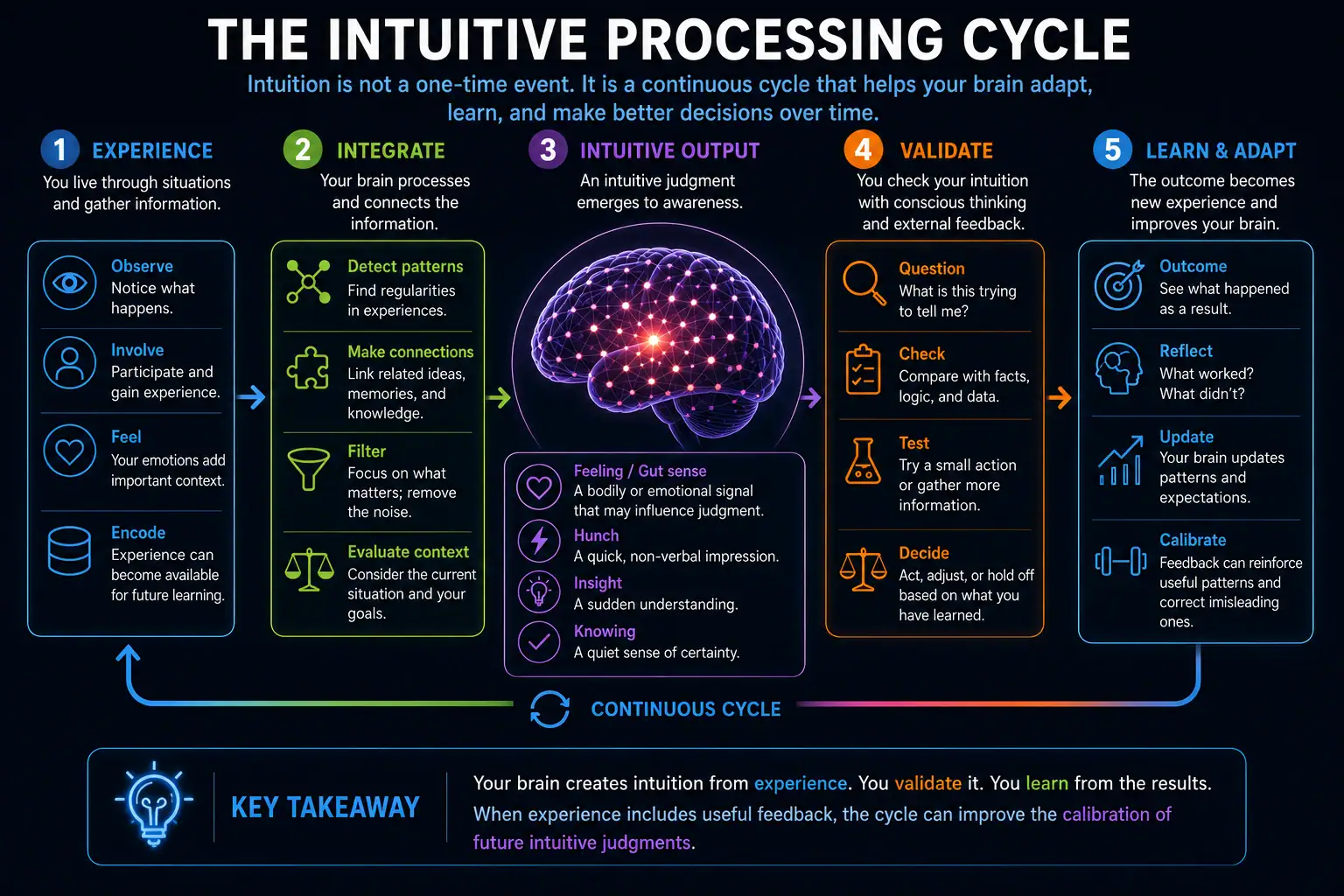
A practical improvement loop looks like this:
- Build relevant experience. Practice within the domain in which you want better intuition rather than assuming intuition transfers perfectly across domains.
- Make predictions explicit. Before the outcome is known, write down what you think will happen and how confident you are.
- Seek fast, unambiguous feedback where possible. Compare the prediction with what actually happened.
- Study errors, not only successes. Ask which cue misled you and what evidence you ignored.
- Use small reversible experiments. When certainty is low, test the intuition in a way that produces information without committing too much.
- Separate familiarity from validity. Something can feel familiar because you have seen it before without being predictive of the outcome you care about.
- Keep analysis available. Good intuition is not threatened by verification. When the stakes justify it, analysis is part of calibration.
If you want a structured practice approach, continue with how to train your intuition.
Related: What Is Intuitive Thinking? · Intuitive Reasoning · Types of Intuition · Intuitive Thinking Skills
See also: Creative Intuition: Why Your Best Ideas Come When You Stop Forcing Them
Frequently Asked Questions About Intuitive Processing
What is intuitive processing?
Intuitive processing is cognitive processing that produces a judgment, impression, feeling, or direction without requiring conscious access to every intermediate step. It can draw on learned patterns, associations, context, memory, emotion, sensory information, and prior experience.
Is intuitive processing unconscious?
Parts of the information integration involved in an intuitive judgment may occur outside conscious access, but it is safer not to treat intuition as a completely separate unconscious system. You can be conscious of cues, feelings, partial reasons, and the final judgment even when you cannot report the full chain that produced it.
What is an example of intuitive processing?
An experienced driver may slow down because another car’s movement feels dangerous before consciously identifying the exact cue. The judgment can reflect rapid integration of speed, distance, trajectory, previous experience, and context.
What is the difference between intuitive and analytical processing?
Intuitive processing often produces a compact candidate judgment rapidly and with limited access to intermediate steps. Analytical processing makes more of the comparison explicit through reasoning, rules, evidence, calculation, or deliberate evaluation. They can work together rather than competing.
Is intuitive processing the same as a heuristic?
No. A heuristic is a simplifying decision rule. Intuitive processing can use heuristics, but it can also reflect complex pattern recognition, expertise, association, emotion, context, and learned relationships among multiple cues.
Can intuitive processing be trained?
It can improve when the environment contains learnable patterns and you have repeated opportunities to practice with useful feedback. Repetition without valid cues or corrective feedback can increase confidence without increasing accuracy, so calibration matters more than mere experience.
Research Basis
This article uses a deliberately cautious interpretation of intuition. It does not assume that every gut feeling is expertise, that intuitive and analytical processing correspond to two literal brain systems, or that everything people cannot verbally explain is controlled by a powerful unconscious decision maker.
- Kahneman & Klein (2009), “Conditions for intuitive expertise: a failure to disagree” — environmental predictability, learning opportunities, feedback, and the unreliability of subjective confidence as a measure of accuracy.
- De Neys (2025), “Defining deliberation for dual-process models of reasoning” — a more nuanced account of deliberation and the limits of simplistic System 1/System 2 interpretations.
- Newell & Shanks (2014), “Unconscious influences on decision making: A critical review” — caution about inflated claims concerning unconscious control of complex decisions.
- Zander et al. (2017), “Scrutinizing the Emotional Nature of Intuitive Coherence Judgments” — psychophysiological evidence relevant to intuitive versus deliberate coherence judgments.
- Ohira (2015), “Interoception and decision-making” — review of brain-body interactions and the possible role of interoceptive signals in decision making.
- “Feeling before knowing why: The role of the orbitofrontal cortex in intuitive judgments” — MEG evidence from a visual coherence task, illustrating why intuition is better treated as task-dependent distributed processing than a single “intuition center.”
The Main Idea
Intuition is not the absence of processing. It is often the experience of a result whose full intermediate path is not available to conscious inspection. That result can be highly useful when it is built from valid patterns, relevant experience, and corrective feedback. It can also be misleading when the environment is noisy, the pattern is outdated, emotion distorts salience, or confidence grows without verification.
The goal is therefore not to choose intuition over reasoning. It is to build a decision system in which intuition can surface information quickly, analysis can test what deserves testing, and feedback continuously improves the patterns you rely on. That is how an unexplained feeling becomes something more valuable: a signal you know how to evaluate.