Most people try to improve intuition by trusting their feelings more. That is the wrong place to start. How to train your intuition?
Intuition is not a mysterious gift that some people possess and others lack. It is the conscious experience of a prediction generated by your mind before deliberate reasoning reconstructs every step. Sometimes that prediction is remarkably accurate. Sometimes it is distorted by fear, noise, habit, social pressure, fatigue, or an outdated understanding of reality.
That is why the useful question is not simply, “Should I trust my intuition?” The better question is:
What kind of Internal Model produced this intuition, and how well has that model learned from reality?
What Is Intuition?
Intuition is a rapid prediction produced by your Internal Model of Reality from patterns, experience, context, memory, and incoming signals. It often reaches awareness as a feeling before you can explain the reasoning that produced it.

This article explains how intuition works, how it differs from instinct, emotion, anxiety, bias, and analysis, why experts often appear to “just know,” why intuition sometimes fails, and how to train it through better signals, calibration, reflection, and model refinement.
Why Intuition Feels Mysterious
Every day you make decisions without complete information. You decide whether to trust a person, pursue an opportunity, accept a risk, speak up, wait, leave, invest, commit, or change direction. You rarely possess every relevant fact before action becomes necessary.
- Should I trust this person?
- Is this opportunity worth pursuing?
- Does this plan contain a hidden risk?
- Is the discomfort I feel intuition or anxiety?
- Should I act now or wait for more evidence?
These questions seem different, but they arise from the same condition: you must act before you know everything.
Every important decision is an attempt to reduce uncertainty before certainty becomes available.
Intuition feels mysterious because the conclusion reaches awareness before the full reasoning does. Your mind may notice a shift in tone, an unusual pause, a familiar operational pattern, a subtle inconsistency, or a bodily response. It then compares those signals with previous experience and generates a prediction. Conscious reasoning often arrives afterward and tries to explain why the conclusion felt immediate.
The Real Problem Is Uncertainty
Imagine driving through dense fog. You cannot see the full road. You cannot predict every obstacle. Yet you continue moving by combining partial signals: the edge of the lane, the speed of another vehicle, the curve of the road, the sound of the tires, and your memory of similar conditions.
Your mind is not waiting for certainty. It is continuously reducing uncertainty.
The same process appears in medicine, leadership, relationships, investing, negotiation, parenting, aviation, emergency response, software engineering, and ordinary daily decisions. Reality rarely provides complete information before demanding action.
In Short
You do not need intuition because reality is magical. You need intuition because reality is incomplete at the moment a decision must be made.
The Theory of Understanding™
To understand intuition, we need a deeper explanation of understanding itself.
Understanding is the progressive reduction of uncertainty through increasingly accurate, coherent, and useful models of reality.
This definition changes the standard. Understanding is not the amount of information you possess. It is the quality of the model you can use to interpret reality, anticipate consequences, and adapt when your predictions fail.
A person may know thousands of facts and still make poor decisions because those facts are not organized into a useful model. Another may know less but predict better because their model captures the relationships that matter.
How Understanding Develops
- Reality produces signals.
- Attention selects a fraction of them.
- Perception assigns meaning.
- The Internal Model of Reality compares the present with previous patterns.
- The model generates a prediction.
- The prediction becomes conscious as intuition.
- A decision produces action.
- Reality produces an outcome.
- Feedback updates—or fails to update—the model.
- Understanding improves as uncertainty decreases.
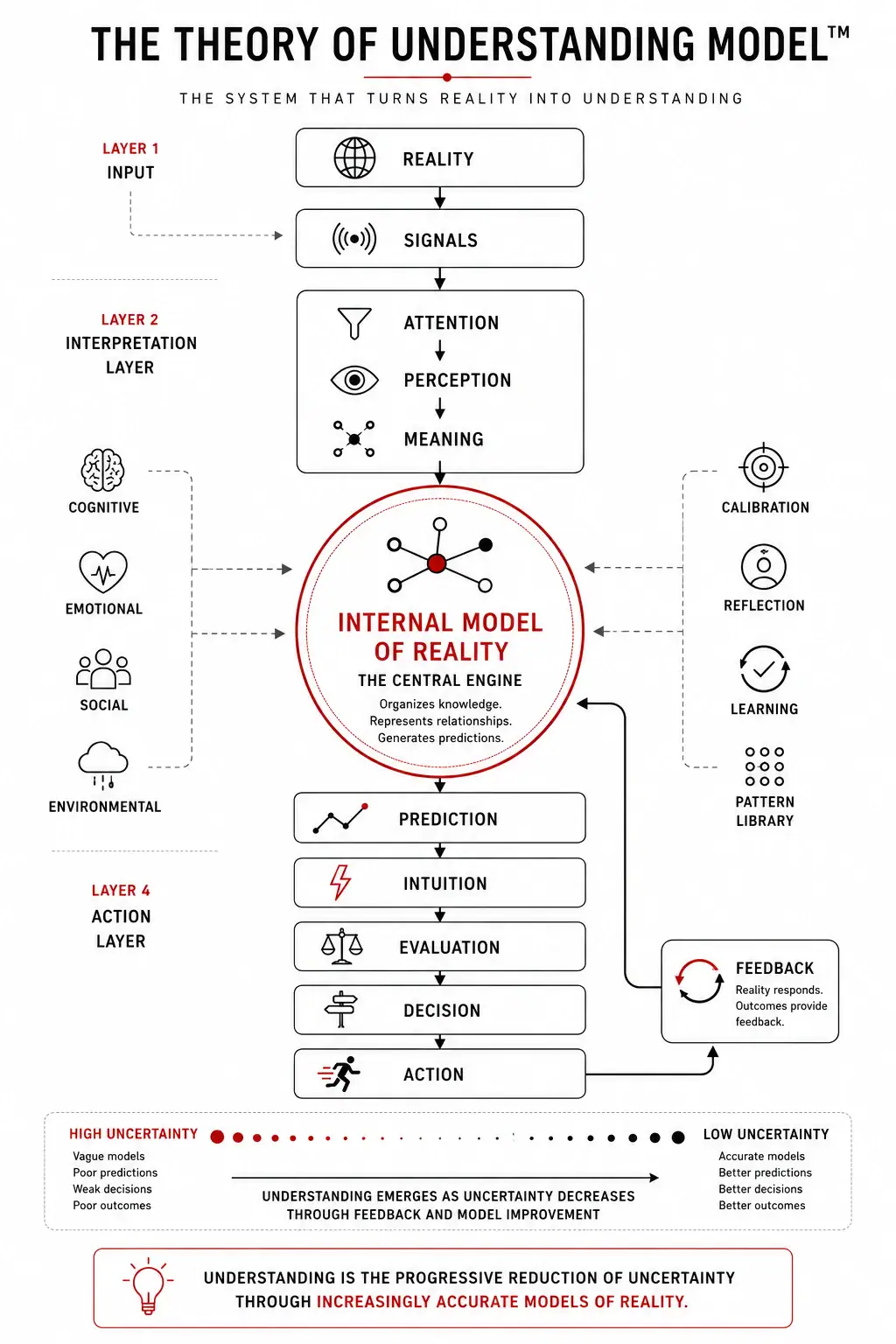
Intuition is not the opposite of rationality. It is compressed prediction produced by an Internal Model before conscious reasoning reconstructs the full explanation.
Intuition vs Instinct, Emotion, Anxiety, Bias, and Analysis
| Concept | What it is | How it differs from intuition |
|---|---|---|
| Instinct | Largely innate biological tendencies | Intuition is shaped much more by learned patterns and experience |
| Emotion | Affective information about threat, reward, needs, and meaning | Emotion can influence intuition but is not identical to it |
| Anxiety | A threat-focused state that amplifies uncertainty and urgency | Intuition often points toward a specific prediction; anxiety often multiplies possible threats |
| Analysis | Conscious, step-by-step evaluation | Intuition produces a rapid prediction; analysis can test and refine it |
| Bias | A systematic distortion in judgment | Bias can become embedded in the model and generate misleading intuition |
| Heuristic | A simplifying rule used to make decisions quickly | Heuristics may contribute to intuition, but they can also create predictable errors |
The strongest decisions do not force intuition and analysis to compete. They use intuition to generate a promising hypothesis and analysis to test whether that hypothesis deserves confidence.
The Internal Model of Reality™: The Hidden System Behind Intuition
What Is an Internal Model of Reality?
An Internal Model of Reality is the mind’s working representation of the world. It combines experience, memory, beliefs, goals, emotion, language, and feedback to interpret the present and predict the future.
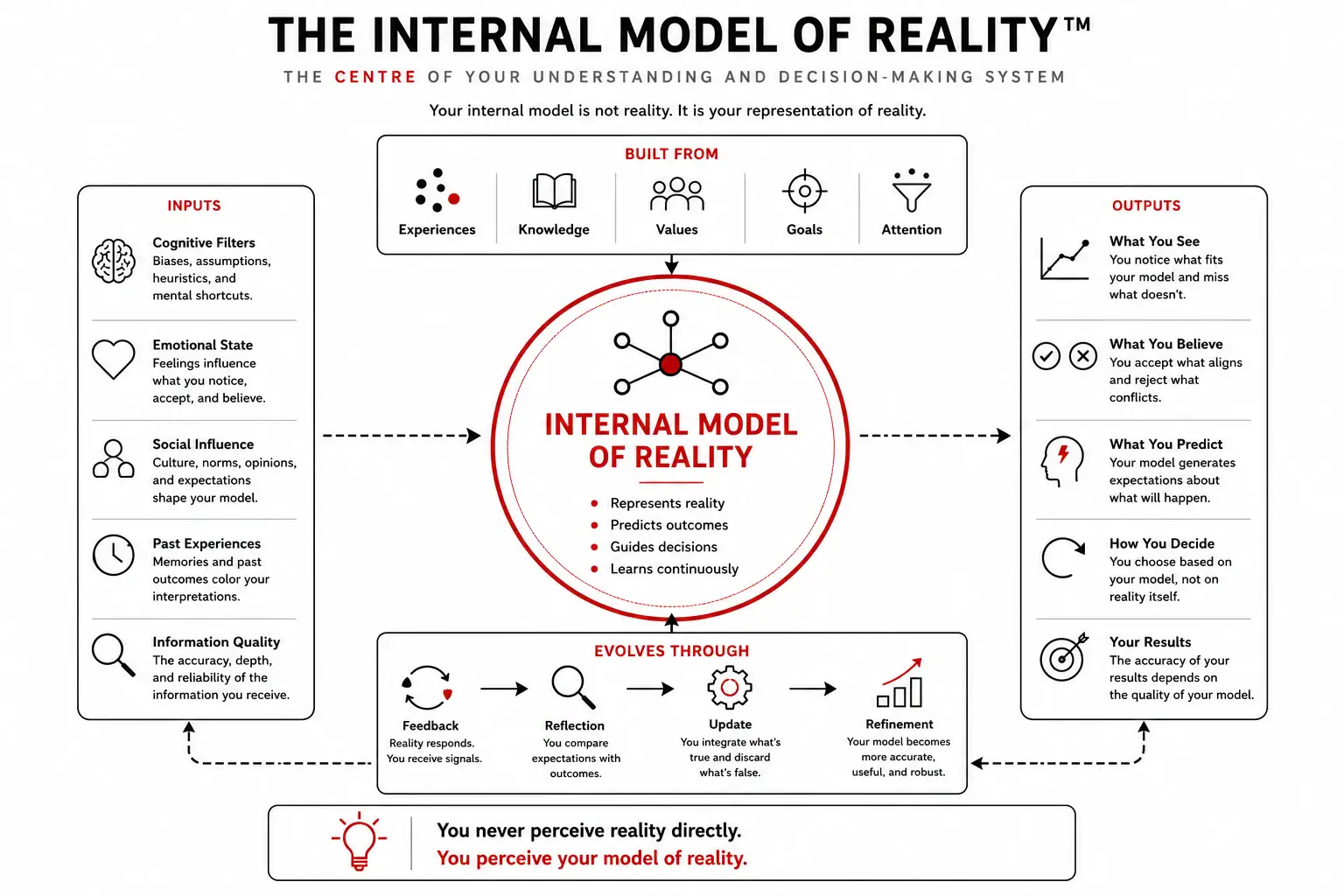
You Never Perceive Reality Without Interpretation
Your senses receive signals, but your mind decides what those signals mean. A quiet room may feel peaceful to one person and threatening to another. A delayed reply may suggest busyness, rejection, caution, or technical trouble depending on the model interpreting it.
You do not act on reality directly. You act on your current model of reality.
This is why two intelligent people can observe the same evidence and reach different conclusions. Their reasoning may be logical, yet the assumptions, memories, and patterns inside their models are not identical.
What Builds the Internal Model?
- Direct experience: what has repeatedly happened to you.
- Knowledge: what you learn from education, observation, and other people.
- Memory: which events remain available and how they are reconstructed.
- Values and goals: what the mind treats as important, desirable, or threatening.
- Emotion: how safety, fear, anger, hope, and shame influence interpretation.
- Culture and language: the categories through which events become meaningful.
- Feedback: the evidence that confirms, weakens, or corrects previous predictions.
The model is therefore never neutral and never complete. It is a compressed representation designed to help you act quickly enough under uncertainty.
Four States of an Internal Model
| Model state | Meaning | Likely effect on intuition |
|---|---|---|
| Accurate | Captures the variables and relationships that matter | Predictions are often useful and appropriately confident |
| Incomplete | Important information or relationships are missing | Intuition may be directionally useful but unreliable in detail |
| Outdated | The environment has changed while the model has not | Old patterns are applied to new conditions |
| Distorted | Bias, fear, misinformation, or overload repeatedly misread reality | Intuition may feel strong while being systematically inaccurate |
This distinction explains why intuition can be excellent in one domain and poor in another. A surgeon may have a highly refined model of a clinical pattern but a weak model of financial risk. Expertise is usually local before it becomes transferable.
The quality of your intuition cannot exceed the quality of the model producing it.
For a deeper exploration, read Internal Model of Reality.
Signal vs Noise™: What Enters the Model? How to train your intuition
Signal vs Noise Definition
A signal is information that improves the model or changes a prediction. Noise is information that consumes attention without improving understanding.
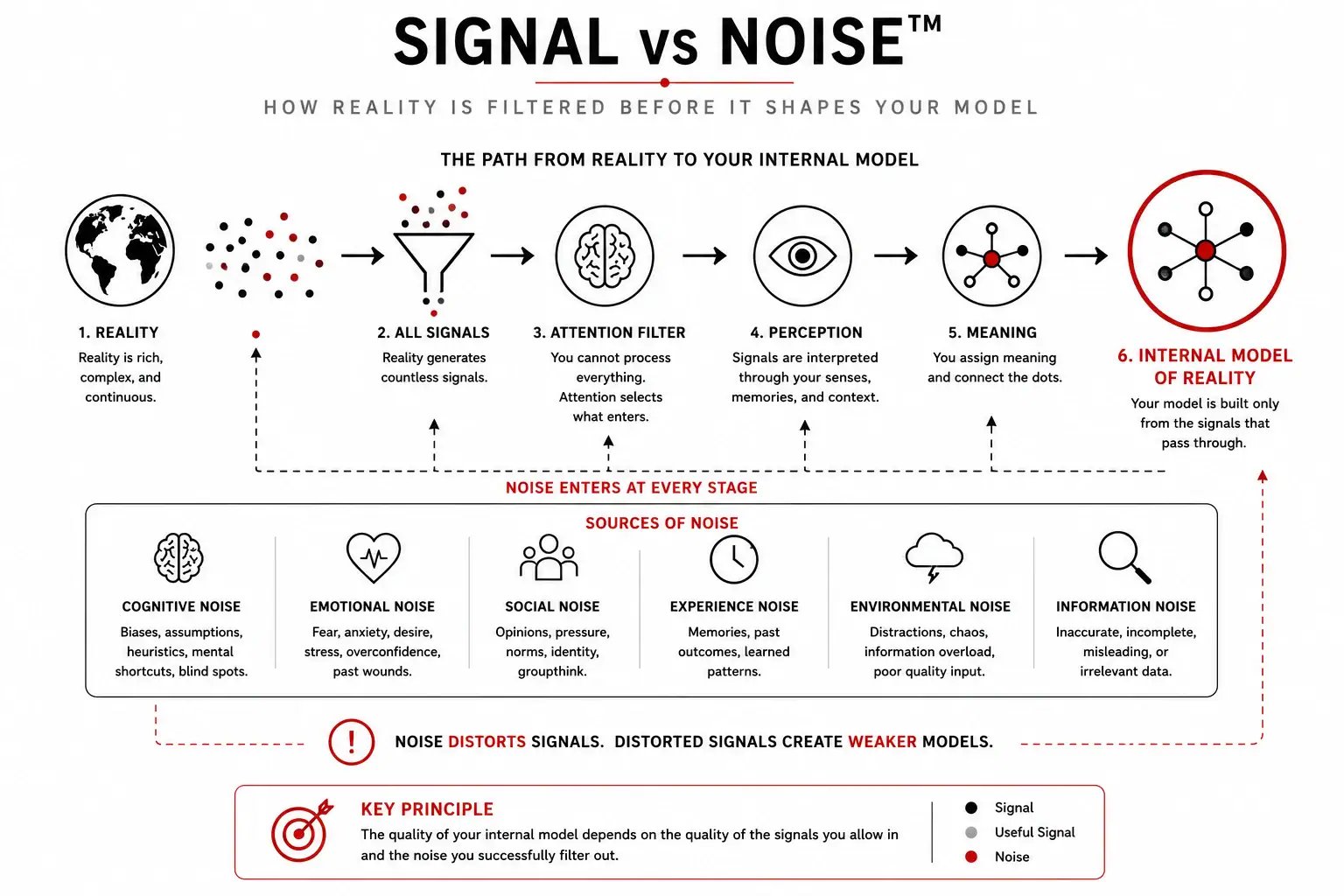
Why More Information Can Make Decisions Worse
More information helps when it adds a missing variable or challenges an incorrect assumption. Beyond that point, additional input can increase contradiction, delay action, and fragment attention.
This is especially important during cognitive overload. When working memory is saturated, relevant signals become harder to distinguish from noise. The problem is not reduced intelligence; it is reduced processing capacity.
Related reading: Cognitive Overload Recovery and Decision Fatigue Symptoms.
Five Common Sources of Noise
- Cognitive noise: overload, unfinished tasks, assumptions, and constant task-switching.
- Emotional noise: fear, anger, shame, excitement, and wishful thinking.
- Social noise: conformity, authority, group expectations, and approval-seeking.
- Environmental noise: notifications, interruptions, and artificial urgency.
- Memory noise: old patterns projected onto situations that are meaningfully different.
The Signal-to-Noise Principle™
The Signal-to-Noise Principle™ states that intuitive reliability depends on how much decision-relevant information survives distortion before reaching the Internal Model.
Signal quality shapes model quality. Model quality shapes prediction quality. Prediction quality shapes decision quality.
How Signals Become Intuition: The Signal Recognition Loop™
How Does Intuition Work?
Intuition works when the mind notices meaningful signals, compares them with patterns stored in the Internal Model of Reality, generates a prediction, and presents that prediction to awareness as a feeling or immediate judgment.
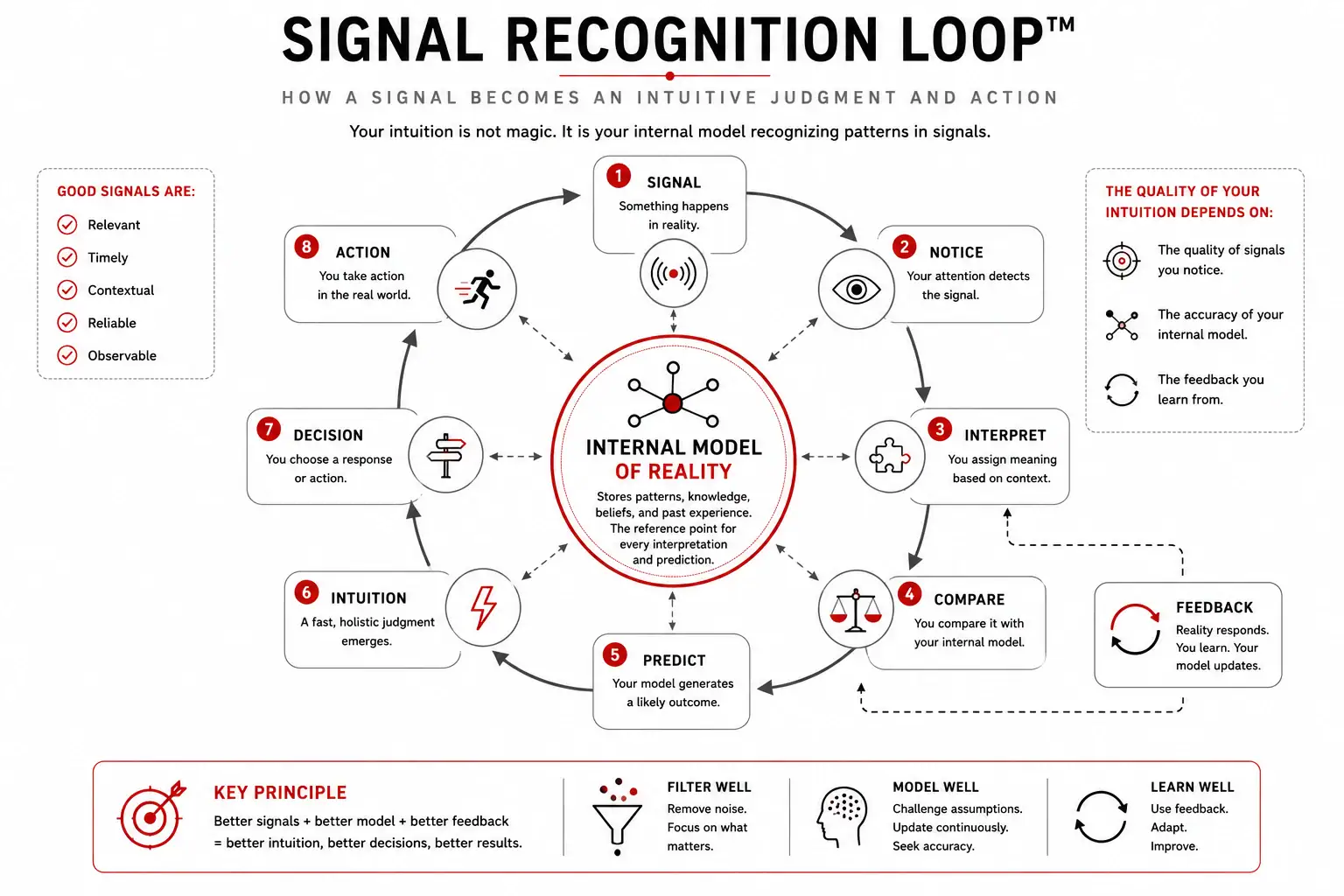
The Brain Predicts Before It Explains
The brain does not wait passively for reality to unfold. It continuously generates expectations about what is likely to happen next and compares those expectations with incoming evidence. When the prediction is generated before conscious reasoning reconstructs every intermediate step, it appears as intuition.
Prediction comes first. Explanation usually comes later.
The Recognition Cycle
- A meaningful signal is detected.
- The Internal Model searches for related patterns.
- Context determines which pattern fits best.
- A prediction is generated.
- The prediction reaches conscious awareness as intuition.
- Reality confirms or corrects the prediction.
Why Experts Seem to “Just Know”
An experienced physician may notice deterioration before test results arrive. A firefighter may sense a structural danger before collapse. A chess grandmaster may recognize a losing position immediately. Their speed is not the absence of reasoning. It is reasoning compressed by thousands of previous prediction-feedback cycles.
Expert intuition is compressed experience organized into accurate prediction.
Examples Across Different Domains
Medicine: A clinician notices a combination of pallor, breathing pattern, and unusual behavior that does not fit the expected recovery path. The intuition is not magical; it is a rapid prediction based on pattern mismatch.
Aviation: A pilot senses that an instrument reading does not fit the aircraft’s behavior. The feeling becomes useful only when checked against systems, procedures, and environmental conditions.
Negotiation: A negotiator notices that the other party suddenly agrees too quickly. The signal may indicate urgency, hidden constraints, or a strategic shift. Experience helps generate hypotheses; analysis tests them.
Software engineering: An experienced developer suspects that a “small” defect comes from a deeper architectural issue because the symptoms resemble previous failure patterns. The prediction becomes valuable when tested rather than assumed.
Parenting: A parent may sense that a child’s anger is masking fear or exhaustion. The intuition becomes more reliable when the parent checks context instead of reacting only to surface behavior.
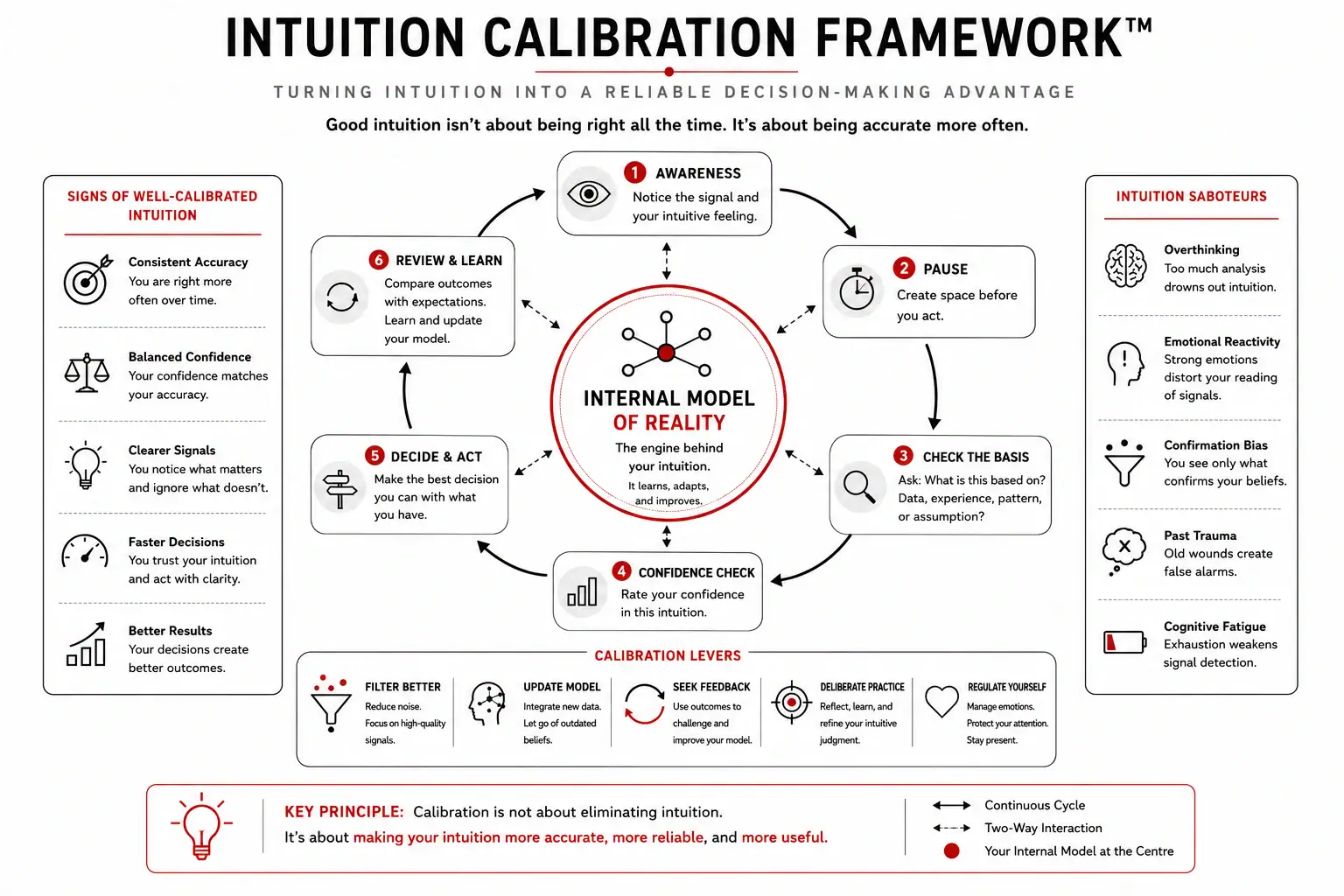
How to Improve Intuition: The Intuition Calibration Framework™
What Is Calibration?
Calibration is the process of comparing predictions with reality and updating the Internal Model of Reality so future predictions become more accurate.
Confidence Is Not Accuracy
A confident prediction can be wrong if it is built on an incomplete or distorted model. A cautious prediction may be highly accurate. Confidence is a psychological state. Accuracy is a relationship between prediction and reality.
The goal is not to feel more certain. The goal is to become more accurate.
The Calibration Cycle
- Notice the intuitive prediction.
- Identify the signals supporting it.
- Consider alternative explanations.
- Act deliberately.
- Observe the outcome.
- Compare reality with the prediction.
- Refine the Internal Model.
Three Calibration Questions
- Which observable signals produced this prediction?
- What evidence would change my mind?
- What outcome would show that my model is incomplete?
Calibration does not weaken intuition. It strengthens the model that produces it.
Decision Reflection™: How Experience Becomes Wisdom
What Is Decision Reflection?
Decision Reflection™ is the deliberate comparison of a prediction with reality to identify which assumptions were accurate, which failed, and how the Internal Model should evolve.
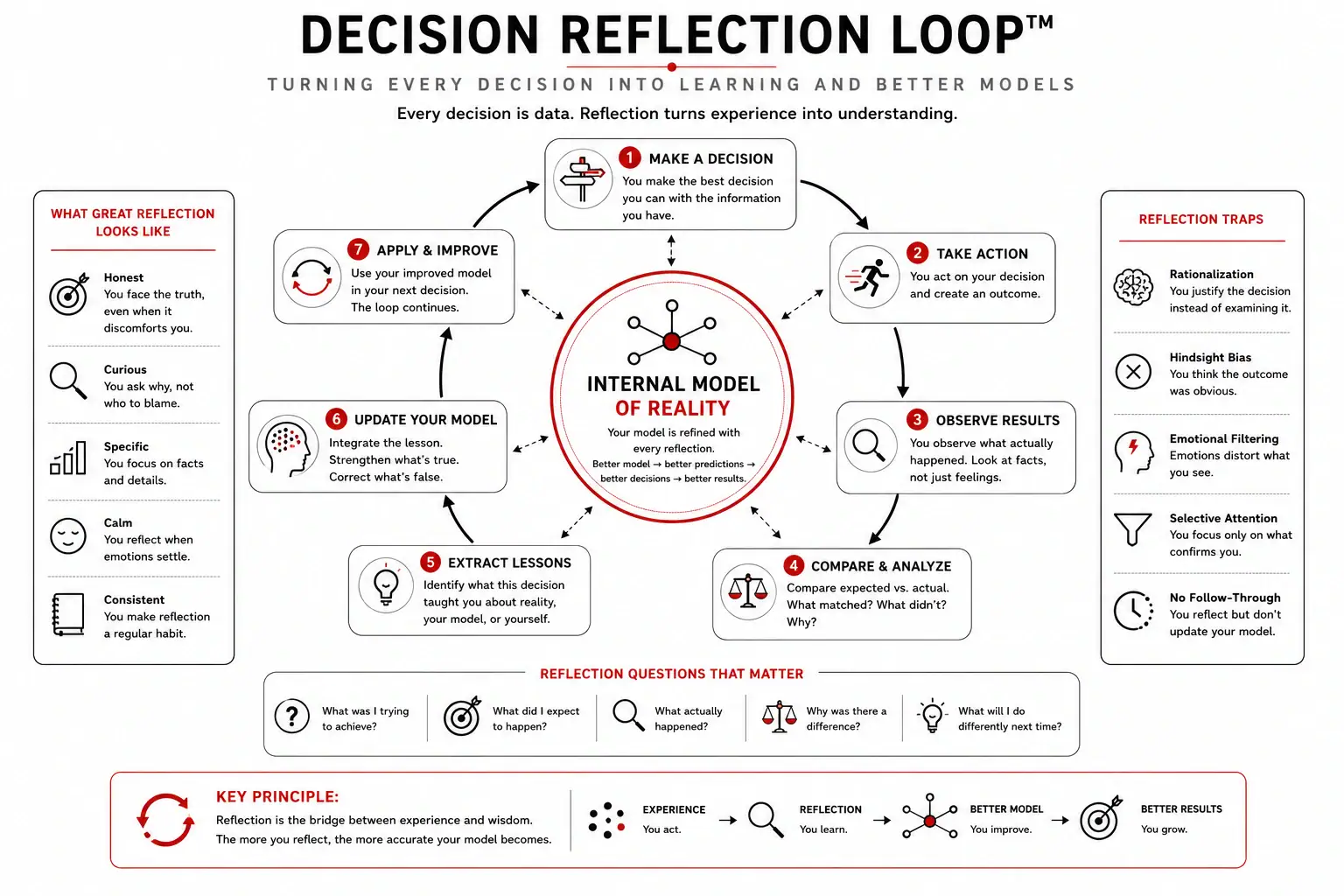
Experience accumulates automatically. Understanding does not. Two people can live through similar situations and develop very different judgment because only one consistently reflects on the difference between prediction and outcome.
Experience is automatic. Learning is optional.
The Decision Reflection Loop™
- Recall the original prediction.
- Observe the actual outcome.
- Compare expectation with reality.
- Identify which assumptions were accurate.
- Identify which assumptions failed.
- Update the Internal Model.
- Apply the improved model to future decisions.
Common Reflection Traps
- Outcome bias: judging a decision only by its result.
- Hindsight bias: believing the result was obvious after it occurred.
- Confirmation bias: noticing only evidence that supports existing beliefs.
- Defensiveness: protecting identity instead of improving understanding.
- Rushing on: moving to the next decision without extracting lessons.
The quality of tomorrow’s intuition depends on the honesty of today’s reflection.
Model Evolution™: How Understanding Continues to Improve
What Is Model Evolution?
Model Evolution™ is the continuous refinement of the Internal Model of Reality through prediction, feedback, reflection, and adaptation.

Expertise Is an Evolving Model
Experts usually possess better-organized information, not merely more information. Their models capture relationships, exceptions, causal patterns, and context that novices rarely notice.
Expertise is not the accumulation of facts. It is the evolution of an increasingly accurate Internal Model of Reality.
Four Stages of Model Evolution
- Novice: depends mainly on explicit rules.
- Pattern learner: begins recognizing recurring situations.
- Predictive thinker: anticipates outcomes with increasing reliability.
- Adaptive expert: continually updates the model as reality changes.
The final stage matters because reality never stops changing. A model that was accurate five years ago may now be incomplete or outdated.
The purpose of learning is not to defend yesterday’s model. It is to improve tomorrow’s.
When Intuition Fails: The Sources of False Intuition™
Why Does Intuition Fail?
False intuition usually reflects a distorted, incomplete, outdated, or overloaded Internal Model of Reality rather than a failure of intuition itself.
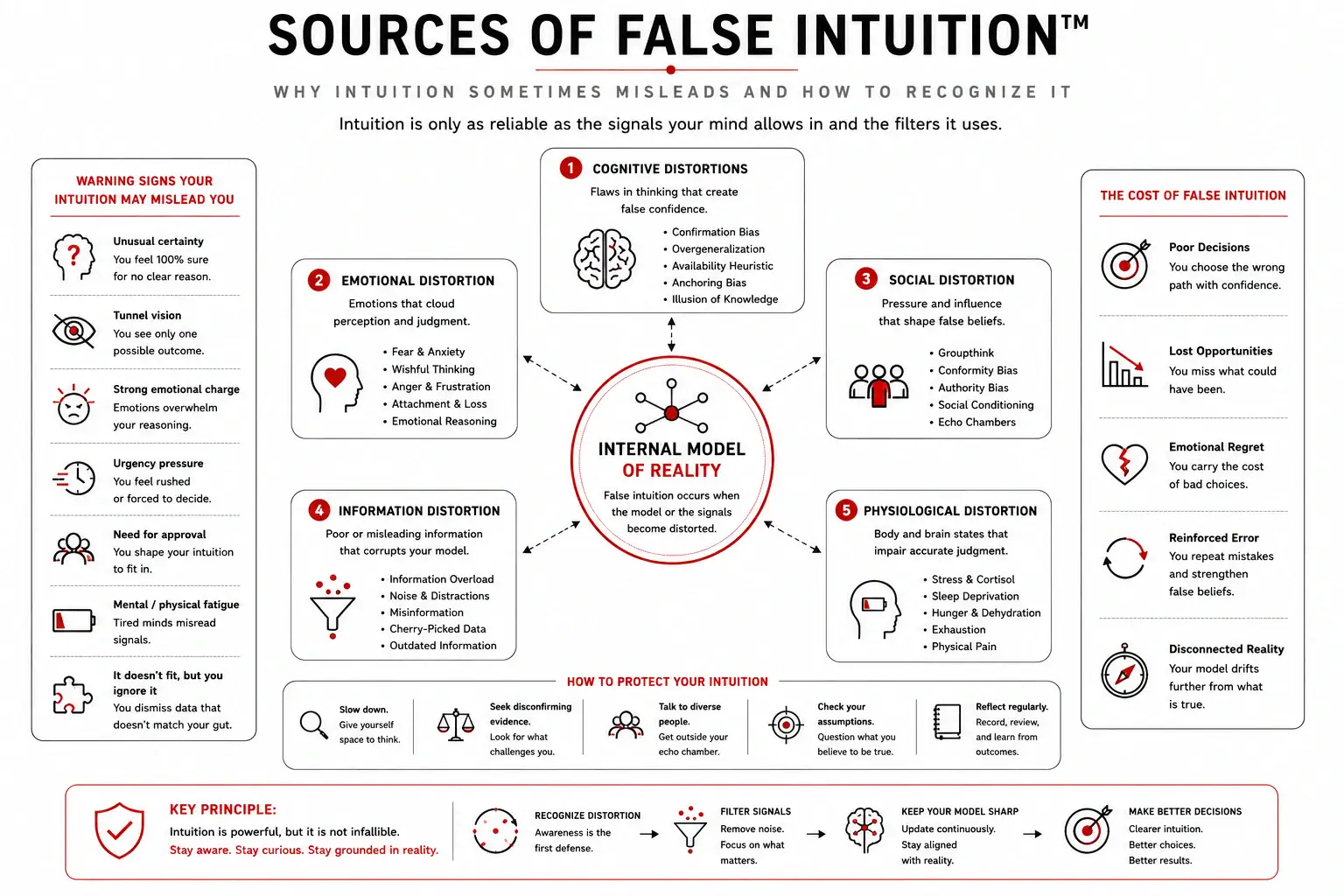
Five Sources of False Intuition
- Cognitive distortion: biases, oversimplification, missing variables, premature certainty.
- Emotional distortion: fear, anger, shame, grief, excitement, wishful thinking.
- Social distortion: authority, conformity, identity, group expectations.
- Informational distortion: misinformation, fragmented attention, sensational input, persistent noise.
- Physiological distortion: sleep deprivation, chronic stress, illness, fatigue, hunger, reduced capacity.
Warning Signs of Unreliable Intuition
- Complete certainty despite little evidence.
- Urgency that discourages verification.
- Ignoring contradictory observations.
- Repeating identical interpretations across different situations.
- Making major decisions while mentally exhausted.
Confidence measures how strongly you believe a prediction. Reality measures whether it was correct.
The Four Laws of Reliable Intuition™
1. The Law of Model Primacy™
You never act directly on reality. You act on your Internal Model of Reality. Improve the model before demanding better decisions from yourself.
2. The Law of Signal Economy™
The value of information depends on how much uncertainty it removes, not on how much attention it consumes.
3. The Law of Predictive Understanding™
Understanding becomes useful when it improves prediction. A model that cannot guide expectation, action, or correction is not yet sufficiently practical.
4. The Law of Recursive Calibration™
Every prediction creates feedback that can improve future prediction. Decisions are therefore not endpoints; they are training data for the Internal Model.
A Practical Intuition Diagnostic™
Before trusting an important intuitive judgment, evaluate five dimensions:
| Dimension | Question |
|---|---|
| Signal quality | What did I actually observe? |
| Model quality | Do I have relevant experience in this domain? |
| Context quality | Is this situation genuinely similar to the pattern I recognize? |
| State quality | Am I calm, rested, and cognitively capable? |
| Feedback quality | Have I tested similar predictions before? |
The more dimensions that are weak, the less confidence the intuition deserves. This does not mean ignoring the feeling. It means treating it as a hypothesis that requires more verification.
How to Train Your Intuition: A Six-Step Practice
- Notice the prediction. Ask what you expect to happen before acting.
- Separate observation from interpretation. Record facts before explaining them.
- Improve signal quality. Remove distractions, urgency, and irrelevant input.
- Test the prediction. Ask what evidence would change your mind.
- Compare prediction with reality. Observe outcomes honestly.
- Update the Internal Model. Carry the lesson into future decisions.
A Simple Weekly Practice
Once a week, select one meaningful decision and write five short answers:
- What did I predict?
- What signals influenced me?
- What actually happened?
- Where was the model accurate or incomplete?
- What will I notice differently next time?
This practice creates an external record, reduces hindsight distortion, and turns ordinary decisions into deliberate learning.
Create cognitive space for insight
Insight rarely appears under pressure. It tends to appear when processing has had time to complete. Walk without input, schedule thinking space, and pause after gathering data. This is not inactivity, it is integration: the system needs room to connect what you have already noticed.
Common Misconceptions About Intuition
“Intuition is always emotional.”
Emotion may carry part of the signal, but intuition can also arise from visual, relational, operational, linguistic, or statistical pattern recognition.
“Analysis is always more reliable.”
Analysis is valuable, but it depends on the variables you include and the assumptions you use. A poor model can produce poor analysis just as easily as poor intuition.
“Experts should always trust their gut.”
Experts should trust domain-specific intuition most when the environment contains learnable patterns and provides clear feedback. Expertise can become dangerous when the context changes or feedback is weak.
“More experience always improves intuition.”
Experience helps only when prediction is compared with reality and the model is updated. Repetition without correction can strengthen error.
How Intuition Relates to Established Cognitive Concepts
The Theory of Understanding™ is a practical synthesis. It connects intuition with several established ideas without reducing intuition to any single one of them.
Predictive Processing
Predictive processing describes the mind as continuously generating expectations and comparing them with incoming sensory evidence. In practical terms, the Internal Model predicts what should happen, and differences between prediction and reality create opportunities for correction.
Pattern Recognition
Pattern recognition allows the mind to identify meaningful configurations without analysing every detail separately. This is central to expert intuition: the expert sees relationships that the novice still experiences as disconnected information.
Implicit Learning
People often learn regularities without being able to state the rule consciously. Intuition may therefore reflect knowledge that is real and useful even when it cannot yet be verbalized.
Dual-Process Thinking
Fast and slow thinking are often presented as opposites. A more useful view is cooperative: rapid intuition generates candidate interpretations, while deliberate analysis tests, compares, and revises them.
Metacognition
Metacognition is the ability to observe and evaluate your own thinking. Calibration and reflection are metacognitive practices because they examine not only what you concluded but how the conclusion was produced.
Bayesian Updating
Bayesian updating offers a useful analogy: begin with a prior expectation, observe new evidence, and revise confidence accordingly. You do not need formal mathematics to apply the principle. Good judgment changes in proportion to the quality of new evidence.
When to Use Intuition and When to Slow Down
Intuition is most useful when the environment contains stable, learnable patterns and when you have received repeated, reasonably accurate feedback. It deserves less confidence when the situation is novel, highly political, emotionally charged, or structurally unpredictable.
| Trust intuition more when | Slow down and verify when |
|---|---|
| You have deep experience in the exact domain | The situation is outside your expertise |
| The environment provides clear feedback | Feedback is delayed, ambiguous, or absent |
| The pattern has repeated many times | The context has changed significantly |
| You are calm and cognitively capable | You are exhausted, frightened, angry, or rushed |
| The intuition is specific and testable | The feeling is vague, catastrophic, or impossible to falsify |
| The consequences are reversible | The stakes are high and the decision is hard to reverse |
This is not a rule that intuition is good and analysis is safe. Analysis can also fail when it uses the wrong variables, false assumptions, or manipulated data. The best process combines fast pattern recognition with deliberate verification appropriate to the stakes.
How Intuition Works in Real Decisions
Leadership and Hiring
A leader may feel that a candidate is not right for a role. That feeling may reflect meaningful signals—evasiveness, inconsistent examples, or a mismatch between claimed values and observed behavior. It may also reflect similarity bias, status expectations, or personal preference. The correct response is neither blind trust nor dismissal. Convert the intuition into testable questions, structured evidence, and independent perspectives.
Investing
An investor may sense that enthusiasm around an asset has detached from fundamentals. Experienced pattern recognition can be valuable, but financial environments are noisy and feedback can be misleading. The intuition should trigger a disciplined review of assumptions, downside exposure, incentives, and alternative scenarios rather than an impulsive trade.
Relationships
You may feel that a conversation has changed even when the words remain polite. Tone, timing, responsiveness, and inconsistency may form a coherent signal. Yet previous rejection or betrayal can produce the same alarm. Ask what you observed, what story you added, and what direct conversation could clarify the model.
Creative Work
Writers, designers, and product builders often know that something “does not work” before they can explain why. That intuition may reflect an internalized sense of rhythm, coherence, usability, or audience expectation. The next step is to locate the mismatch and test whether others experience it too.
Emergency Decisions
Under time pressure, there may be no opportunity for exhaustive analysis. Training matters because it builds patterns before the emergency. Checklists, simulations, after-action reviews, and repeated feedback improve the Internal Model so rapid judgment becomes more reliable when seconds matter.
A 30-Day Intuition Training Plan
Intuition improves through repeated, visible prediction and feedback. The following plan turns that principle into a manageable practice.
Week 1: Observation
- Record one intuitive impression each day.
- Write the observable signals separately from your interpretation.
- Note your emotional and physical state.
- Do not judge accuracy yet; build awareness of the process.
Week 2: Prediction
- Turn each intuition into a specific prediction.
- Assign a confidence level such as 55%, 70%, or 90%.
- Write what evidence would change your mind.
- Avoid vague predictions that cannot be evaluated.
Week 3: Feedback
- Compare previous predictions with outcomes.
- Look for overconfidence and underconfidence.
- Identify which signals were genuinely useful.
- Notice recurring sources of noise.
Week 4: Model Update
- Write three assumptions that changed.
- Define one domain where your intuition is reliable.
- Define one domain where it is weak.
- Create a rule for when to slow down and seek more evidence.
The purpose is not to prove that you have good intuition. It is to discover where the model is strong, where it is weak, and how quickly it learns.
The Intuition Journal™
A simple journal can make calibration concrete. Use one page per significant decision:
- Situation: What decision or uncertainty am I facing?
- Observed signals: What did I directly notice?
- Interpretation: What do I think those signals mean?
- Prediction: What do I expect to happen?
- Confidence: How confident am I?
- Alternative: What else could explain the same signals?
- Outcome: What actually happened?
- Model update: What should change in future judgment?
This record protects against selective memory. Without a written prediction, people often remember themselves as more accurate than they were or reinterpret the original belief after the outcome becomes known.
Ethical Limits of Intuition
Intuition should never become a justification for stereotyping, discrimination, or unaccountable authority. A leader who says, “I just know,” may be expressing expertise—or hiding bias from examination.
The more a decision affects other people, the more important transparency becomes. High-impact intuition should be translated into observable evidence, explicit assumptions, and reviewable reasoning whenever possible.
Intuition may begin the decision, but accountability must remain conscious.
Why Better Intuition Is Not the Final Goal
It is tempting to treat intuition as another ability to optimize. But stronger intuition without better calibration can simply create stronger confidence. The deeper aim is a mind that notices relevant signals, maintains coherent models, predicts carefully, learns honestly, and updates itself when reality disagrees.
That is why the Theory of Understanding™ places intuition inside a larger system. Intuition matters because it reveals what the Internal Model predicts. Decisions matter because they test the prediction. Feedback matters because it can improve the model. Understanding matters because it reduces uncertainty across future situations.
Related: How to Develop Intuition: A Practical Guide · 30 Days to Enhance Your Intuition · Practical Exercises to Strengthen Your Intuition
Frequently Asked Questions About Intuition
Can intuition be trained?
Yes. Intuition improves when the Internal Model becomes more accurate through better signals, deliberate practice, reflection, and repeated feedback.
Is intuition scientific?
Intuition is commonly studied through pattern recognition, implicit learning, expertise, heuristics, and predictive processing. The Theory of Understanding™ integrates those ideas into one practical model.
Is intuition always subconscious?
Most of the processing occurs outside conscious awareness. What reaches awareness is usually the prediction or felt conclusion rather than every step that produced it.
Can intuition be wrong?
Yes. Intuition becomes unreliable when the Internal Model is incomplete, outdated, distorted, or overwhelmed by noise.
How can I tell intuition from anxiety?
Intuition often points toward a specific prediction. Anxiety often multiplies possible threats and repeats them without resolution. Checking observable signals, context, bodily state, and alternative explanations helps distinguish them.
Should I always trust my intuition?
No. Treat intuition as an important prediction. The higher the stakes and the weaker the feedback history, the more verification it deserves.
Does intuition improve with age?
It can, but only when experience is combined with feedback and model refinement. Age alone does not guarantee better intuition.
Can children develop intuition?
Yes. Children build intuitive expectations through repeated experience. The quality of those expectations depends on the patterns, feedback, safety, and guidance available to them.
Can experts overtrust intuition?
Yes. Expertise can become overconfidence when the environment changes, feedback becomes weak, or success protects the model from correction.
Can artificial intelligence have intuition?
AI systems can recognize patterns and generate predictions, but they do so through computational models rather than human subjective experience. The comparison is useful, but the mechanisms and experiences are not identical.
Can intuition be measured?
Not as a single universal trait, but intuitive performance can be evaluated by comparing predictions, confidence, context, and outcomes across repeated decisions.
Is intuition faster than reasoning?
It is usually faster than conscious step-by-step analysis because pattern matching and prediction begin before the full explanation becomes conscious.
Does memory affect intuition?
Yes. Intuition depends heavily on learned patterns stored through memory. Inaccurate, selective, or emotionally distorted memory can therefore produce misleading predictions.
Why does intuition fail under stress?
Stress narrows attention, increases urgency, and reduces cognitive capacity. This makes it harder to distinguish meaningful signals from noise and easier to rely on oversimplified patterns.
Key Takeaways
- Intuition is a prediction, not magic.
- The Internal Model of Reality determines intuitive quality.
- Signals reduce uncertainty; noise consumes attention.
- Calibration and reflection improve future predictions.
- Expertise is the evolution of a better model.
- False intuition usually reflects distortion in the model or its inputs.
- Better understanding produces better intuition and better decisions.
Conclusion. How to train your intuition
We began with a familiar question: Can intuition be trusted?
The deeper answer is that intuition reflects the quality of the Internal Model of Reality that produces it. Better models generate better predictions. Better predictions support better decisions. Honest feedback improves the model again.
The ultimate goal is not stronger intuition. The ultimate goal is better understanding.
Understanding grows through the progressive reduction of uncertainty using increasingly accurate, coherent, and useful models of reality. Improve that process, and intuition improves naturally.
Continue exploring:
- Internal Model of Reality™
- Signal vs Noise™
- Why Can’t I Trust Myself Anymore?
- Cognitive Overload Recovery
- Decision Fatigue Symptoms
Trust intuition. Verify assumptions. Update your model.