Overconfidence bias occurs when your assessment of your ability, relative performance, or certainty goes beyond what is justified. You might expect to complete more work than you can, assume you outperform comparable peers, or feel too certain that your explanation is correct. These are related errors, but they are not the same error.
Imagine a team saying, “We are 90% confident we will deliver on Friday.” That forecast may be reasonable. The useful question is what supports it: comparable deliveries, resolved dependencies, acceptance criteria, or simply a reassuring feeling? Checking that distinction makes confidence more useful in decision-making.

What Is Overconfidence Bias?
Overconfidence is a mismatch between an assessment and the standard used to evaluate it. Depending on the question, that standard might be actual performance, a relevant peer group, or the accuracy of judgments made with a particular level of confidence.
Being decisive, optimistic, or willing to act does not automatically make someone overconfident. You can commit to a course of action while acknowledging uncertainty. Equally, a quietly expressed judgment can be much more certain than the evidence warrants.
Before applying the label, ask what the person predicted, what they knew at the time, and how the assessment could be checked. A disappointing result is a reason to review a judgment, not an automatic diagnosis of bias.
The Three Forms of Overconfidence
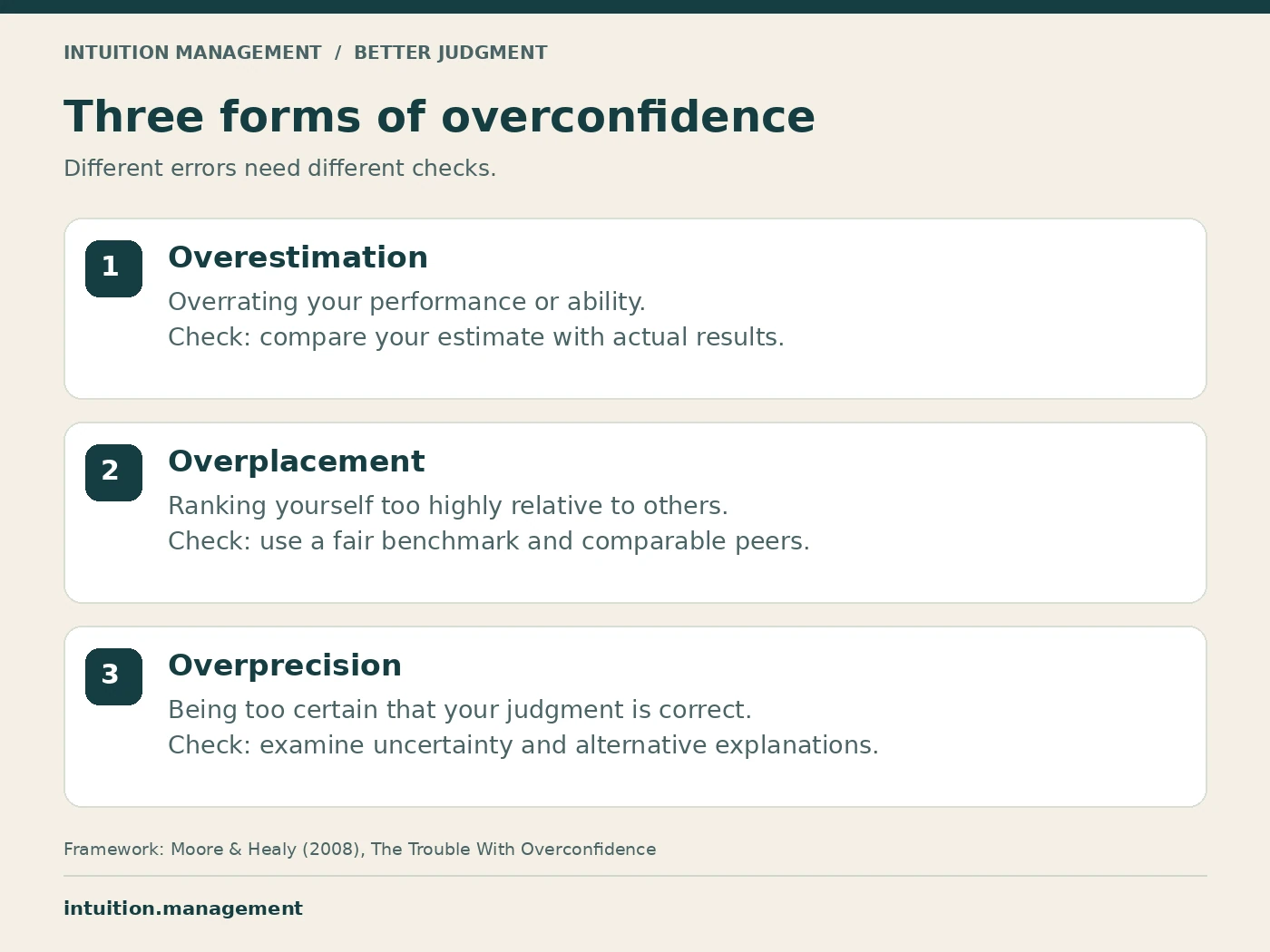
Moore and Healy distinguish overestimation, overplacement, and overprecision. Their work also shows why a blanket claim that people always overrate themselves is misleading: results differ with the task and the form being measured. Read the research on the three forms of overconfidence.
| Form | Meaning | Illustrative claim |
|---|---|---|
| Overestimation | Overrating your actual performance or ability. | “I can complete ten of these tasks today,” when your demonstrated capacity is substantially lower. |
| Overplacement | Ranking yourself too highly relative to others. | “My forecasts are better than most colleagues’,” without a comparable record supporting that ranking. |
| Overprecision | Expressing excessive certainty about the accuracy of your beliefs. | “The answer must be between 48 and 50,” when the available information supports much greater uncertainty. |
The remedy should fit the question. Compare estimated output with actual output, relative performance with a fair benchmark, and certainty with an appropriate record of accuracy. Simply telling someone to “be less confident” does not specify what to improve.
Overconfidence Bias Examples in Everyday Life and Work
These examples are hypothetical. Each describes a possible mismatch to investigate, rather than proof that a particular person is biased.
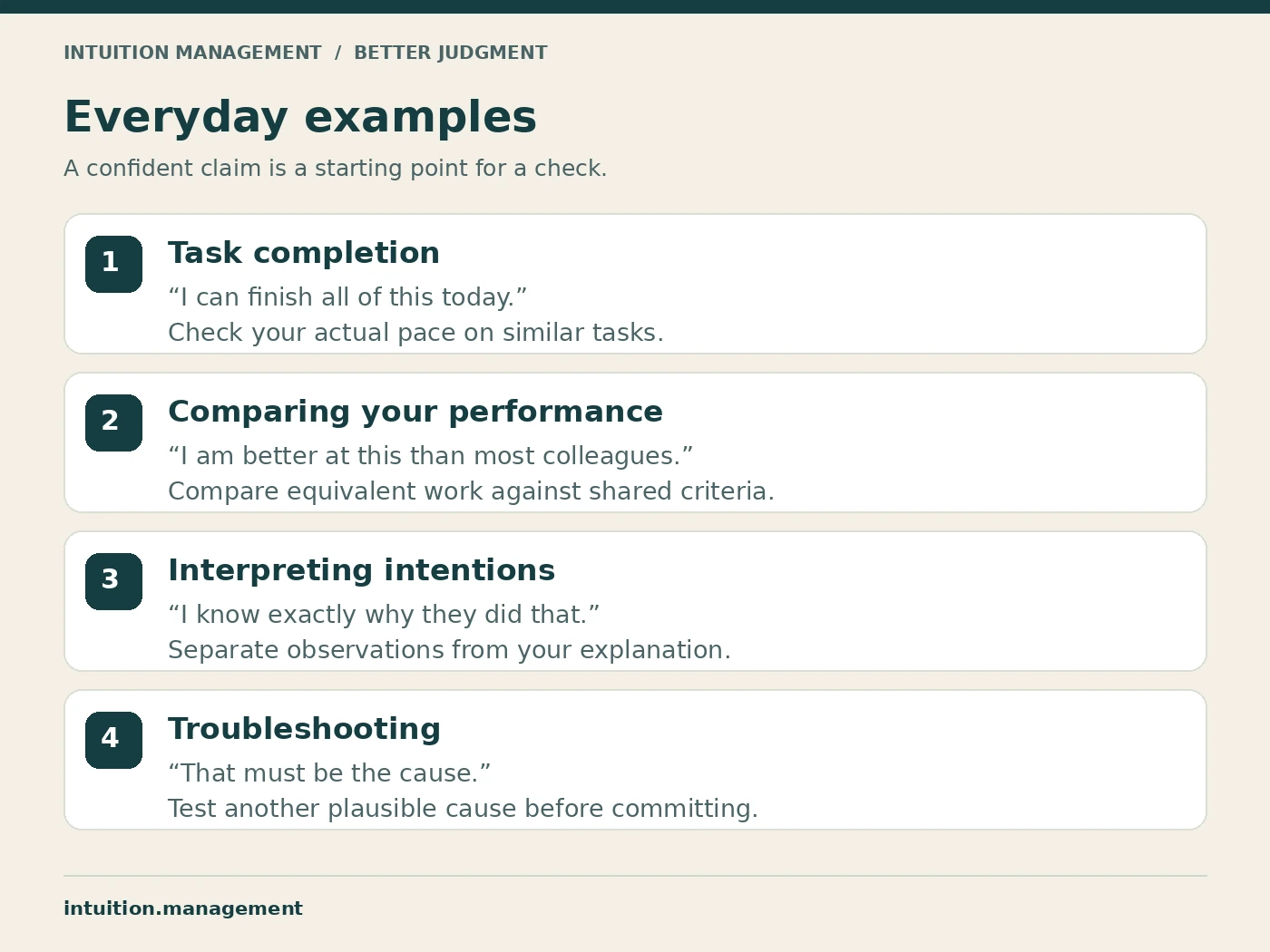
1. Planning more work than you can complete
You schedule a full day as though every task will take its best-case duration. Compare the plan with recent days involving similar work, including interruptions and rework. If your estimates repeatedly exceed what you accomplish under comparable conditions, revise the assumptions behind them.
2. Assuming you are a better interviewer than your peers
You remember several successful hires and conclude that your judgment is unusually accurate. A fair comparison needs shared criteria, comparable roles, and outcomes from other interviewers. Personal success stories alone do not establish a relative ranking.
3. Feeling certain about someone’s intentions
A colleague answers briefly, and you conclude that they dislike your proposal. Their response is observable; the motive is an interpretation. Ask a neutral follow-up question before making a consequential decision based on that explanation.
4. Settling too quickly on a technical diagnosis
A familiar symptom suggests a familiar fault. That is a useful hypothesis, but another fault could produce the same symptom. Identify a test that separates the explanations before authorizing an expensive repair or disruptive change.
5. Giving a precise project forecast with incomplete information
A team commits to a delivery date before a supplier confirms availability. Ask whether the forecast includes that uncertainty. A specific date can still be necessary for planning, but its status as a target should be distinguished from the probability of meeting it.
Overconfidence Versus Reliable Expert Intuition
Expertise can support fast judgments, but the feeling of certainty is not a test of expertise. Kahneman and Klein emphasize the importance of an environment with learnable regularities and opportunities to learn them. Their analysis explains why subjective confidence alone is an unreliable guide to accuracy.
For a particular decision, ask whether the person has encountered comparable situations, received useful feedback, and demonstrated relevant accuracy. Experience in one setting may not transfer cleanly to another. A strong record with a stable production process does not automatically establish forecasting skill for a new product with unfamiliar dependencies.
Our guide to expert judgment develops this distinction further. The practical aim is to give experience appropriate weight while keeping the judgment open to correction.
Overconfidence, Confirmation Bias, and Anchoring
Several biases can affect the same decision. Distinguishing their roles helps you choose a useful check.
- Overconfidence: your assessment is too high or too certain relative to an appropriate standard. Ask, “What justifies this level of confidence?”
- Confirmation bias: you favor evidence supporting a belief while treating contrary evidence less fairly. Use a confirmation bias check to examine how you selected and evaluated information.
- Anchoring bias: a starting value pulls your judgment toward it. The anchoring bias guide explains how independent estimates and comparison cases can help.
For example, a proposed Friday deadline can become an anchor. A team may then emphasize favorable progress reports and express more certainty than the unresolved work supports. These are distinct concerns, even when they appear together.
Worked Example: “We Are 90% Confident We Will Deliver on Friday”
This scenario is hypothetical and illustrates a review process, not a validated forecasting model.
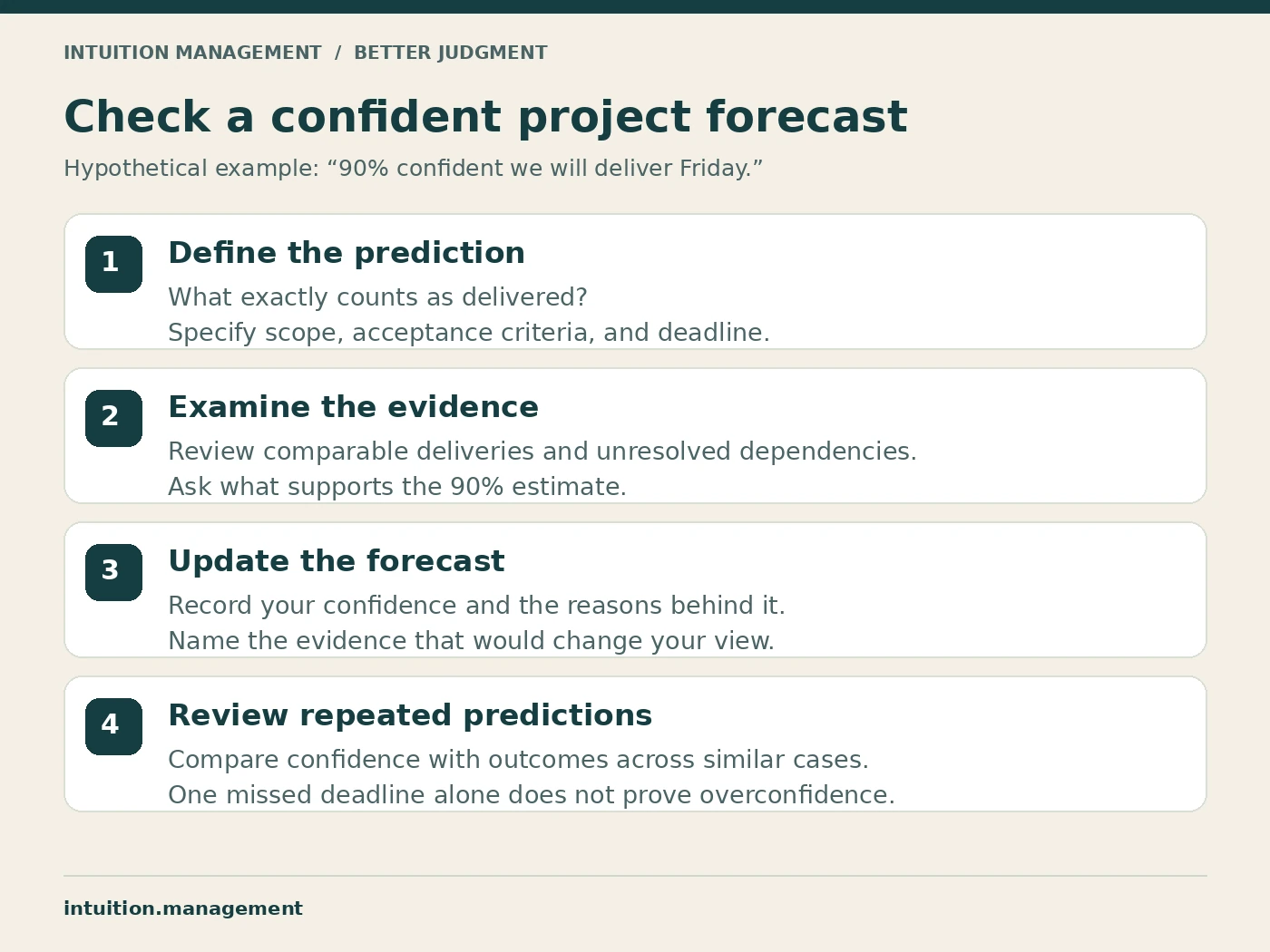
Define the prediction
The team first clarifies “delivered”: the agreed scope must pass acceptance testing and be available to the customer by Friday at 17:00. Finishing development alone would not count. A forecast needs a stable definition if its outcome is to teach you anything.
Examine the evidence
Suppose the team reviews ten reasonably comparable deliveries and finds that six met the same kind of deadline. It also identifies an unconfirmed supplier dependency and unfinished acceptance tests. That record does not mechanically make the current probability 60%: the sample is small, and the present case may differ. It does, however, require the team to explain why 90% is justified now.
Update the forecast and the action
The team records the comparison, checks supplier availability, and asks the test lead for an independent assessment. If the evidence does not support 90%, it revises the forecast with an explicit rationale. It may also reduce scope, prepare a fallback, or change the customer commitment. Any new percentage should follow from the assessment rather than being invented to look cautious.
Review a series of forecasts
A 90% forecast allows for failure. One missed Friday is therefore compatible with a well-calibrated forecast. Across a sufficiently large set of comparable predictions made at roughly 90% confidence, you would expect about nine in ten to occur, with sampling variation. Persistent, substantial shortfalls would prompt a calibration review.
Keep the original forecast alongside its outcome in a decision journal. Record later revisions separately so you can see what changed and why.
How to Reduce Overconfidence Bias
The following practices make judgments easier to test and revise. They are practical review prompts, not a guarantee that bias will disappear.
1. Write a checkable claim before the outcome
Replace “This will go well” with a defined event, threshold, or result and a review date. Record confidence at the time of the decision. Otherwise, later knowledge can change your recollection of how certain you were.
2. Start with relevant comparison cases
Ask what usually happens in sufficiently similar situations. Explain which differences make the current case easier or harder. Do not select only the examples that make your preferred conclusion look plausible.
3. Obtain independent judgments before discussing the answer
Ask reviewers to record their initial estimates and assumptions before hearing the most senior person’s view. Then discuss the reasons for disagreement. Agreement is more informative when it does not simply repeat the first number offered.
4. Identify evidence that could change the conclusion
Specify a competing explanation or a failure condition. Ask, “What finding would make me revise this?” A claim that absorbs every possible result as confirmation cannot be meaningfully checked.
5. Use uncertainty ranges honestly
When a range is appropriate, explain what it represents and which uncertainties it includes. An extremely broad range is not automatically a good forecast; useful estimates should be both informative and appropriately uncertain.
6. Review accuracy over time
Group genuinely comparable predictions and examine whether outcomes match stated confidence. Look for patterns by task and context rather than branding yourself as generally good or bad at intuition. The intuition calibration guide offers a practical way to organize that learning.
A Five-Question Overconfidence Checklist
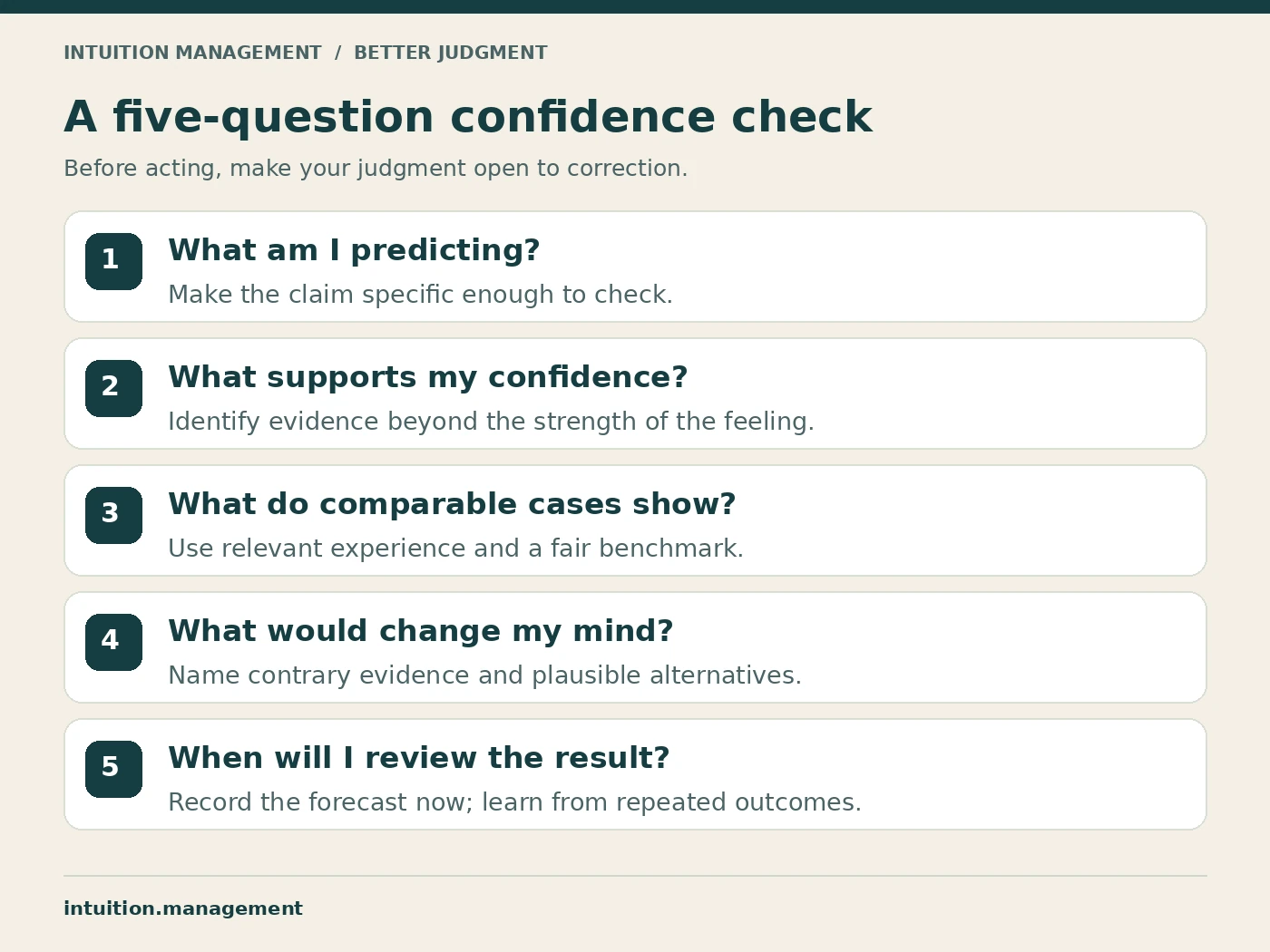
- What am I predicting? Define the claim and what would count as success or failure.
- What supports my confidence? Identify evidence beyond the intensity of the feeling.
- What do comparable cases show? Use relevant experience and a fair benchmark.
- What would change my mind? Name contrary evidence and plausible alternatives.
- When will I review the result? Record the forecast now and revisit it consistently.
Copyable confidence-check worksheet
Decision or prediction: ____________________
Outcome definition and deadline: ____________________
Confidence and its basis: ____________________
Relevant comparison cases: ____________________
Main uncertainty or alternative explanation: ____________________
Evidence that would change my mind: ____________________
Next action: ____________________
Review date: ____________________
Actual outcome and lesson: ____________________
A reflection aid, not a validated psychological test. Preserve the original entry when adding updates.
Frequently Asked Questions
What is overconfidence bias in simple terms?
It means rating your performance, standing relative to others, or certainty more highly than is justified. The key issue is the mismatch, not whether you sound confident.
What is a simple example of overconfidence bias?
Someone repeatedly expects to finish ten comparable tasks in a day but usually completes four, without adjusting for that record. This illustrates possible overestimation, provided the tasks and working conditions are meaningfully comparable.
Can experts be overconfident?
Yes. Relevant expertise does not make every judgment reliable. Check whether the current task resembles the expert’s demonstrated experience and whether feedback has allowed them to learn what works.
Is confidence itself a problem?
No. Confidence can accompany a well-supported judgment. The aim is to match confidence to evidence while making a proportionate decision, rather than waiting for impossible certainty.
Does a wrong prediction prove overconfidence?
No. An uncertain event can fail to occur even when its probability was reasonably assessed. Review the information available beforehand and the accuracy of repeated comparable predictions.
Can overconfidence bias be eliminated completely?
There is no universal checklist that guarantees this. Recording judgments, checking alternatives, and reviewing outcomes can make errors more visible and support better calibration.
Research References and Scope
- Moore, D. A., & Healy, P. J. (2008). The Trouble With Overconfidence. Psychological Review, 115(2), 502–517. Source for the distinction between overestimation, overplacement, and overprecision.
- Kahneman, D., & Klein, G. (2009). Conditions for Intuitive Expertise: A Failure to Disagree. American Psychologist, 64(6), 515–526. Source for the discussion of environments, learning, and the limits of subjective confidence.
This is an educational guide. The workplace scenarios, review process, and worksheet are illustrative applications, not findings from a study of a particular team or a diagnostic assessment of an individual.
For your next consequential judgment, write down what you expect, why you expect it, and what would change your view. That creates something you can learn from, whether the outcome is favorable or disappointing.