A decision journal records what you chose, why you chose it, and what you expected before you know the outcome. You return later to compare the result with your original reasoning. The point is to preserve a fair record of your thinking, including uncertainty, rather than relying on what you remember after events unfold.
Use the free template below for a meaningful work or everyday decision. The two completed examples show how to record an initial impression, check the evidence, accept a trade-off, and review a mixed result without turning it into a verdict on your ability.
Jump to the free decision journal template

Tap any diagram to open it at full size. The template and examples are also available as text below.
Free Decision Journal Template
Copy this template into a notebook, notes app, or document. The text is free to use and requires no signup. Keep your first entry brief; expand the details when the stakes or complexity justify it.
Copyable decision-journal entry
BEFORE THE OUTCOME

Decision and date:
What must I choose, and by when?

Goal and constraints:
What matters? What limits my options?

Options and trade-offs:
What could I do, including waiting? What would each option cost?

Observation and first impression:
What did I notice? What do I think it means?
What other explanation fits?

Evidence and unknowns:
What supports or challenges my interpretation?
What important information is missing?

Chosen action and reason:
What will I do? Which trade-off am I accepting?

Prediction and timeframe:
What observable result do I expect, and by when?
Probability of that specific result, if useful:

Review plan:
When will I review? What would justify reconsidering sooner?

AT REVIEW — KEEP THE ORIGINAL ENTRY

Actual result and review date:
What happened? What remains unresolved?

Changes and interventions:
What new information or action affected the result?

Reasoning review:
Was my choice reasonable given what I knew then?
Did I overlook something I could reasonably have checked?

Lesson and next adjustment:
What will I keep, change, or test next time?
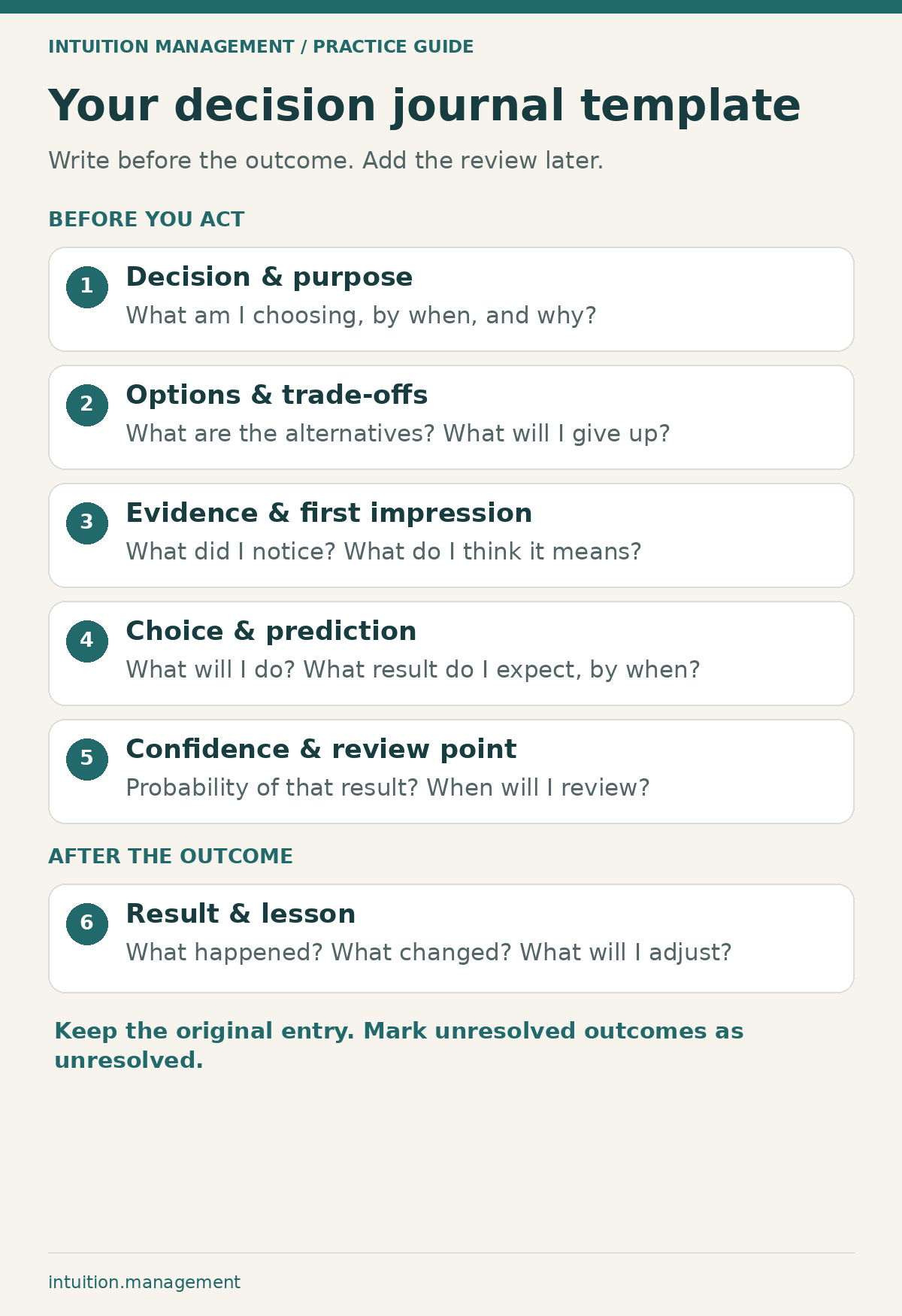
A probability belongs to a defined prediction, such as “all ten customers will complete setup by Friday.” It does not measure whether your choice is morally right or whether a feeling is authentic. If a number would be arbitrary, explain the uncertainty instead.
How to Keep a Decision Journal
- Choose one decision worth reviewing. Start with a choice involving meaningful uncertainty, a trade-off, or a recurring situation. You do not need an entry for every routine task.
- Write before the result is known. Record the evidence and your reasons when choosing. If an urgent situation prevents this, label any later reconstruction honestly; it is not a contemporaneous record.
- Make the prediction inspectable. Replace “this will go well” with a specific result and timeframe. Separate the outcome you want from what you actually expect.
- Set a review point. Choose a date when useful feedback should exist. Define earlier triggers such as a failed test, changed requirement, or revised priority.
- Append the review. Preserve the original wording. Add what happened, what you learned, and one practical change.
For a short entry, try five sentences: the choice, the strongest evidence, the main uncertainty, the expected result, and the review date. Add detail only when it helps you decide or learn. The journal should support action, not become another requirement for feeling completely certain.
This fits the broader approach to intuition in decision-making: use an impression to identify a question, examine the evidence, act proportionately, and stay willing to revise.
Decision Journal Example: A Project Launch
This is an illustrative scenario, not a reported case study. The probability is a hypothetical estimate, not measured project data. A manager must choose how to release a product while two integrations remain untested.
| Field | Entry |
|---|---|
| Decision and goal | Monday: choose the release approach for Friday. Learn about readiness while limiting customer disruption. |
| Options | Full launch; a ten-customer pilot with rollback; or delay until integration testing is complete. |
| Observation | Two integrations are untested. The core setup flow has passed its checks. Support can monitor a limited pilot. |
| Initial impression | A full launch feels risky. That concern needs testing; untested integrations are a specific uncertainty, not proof that the launch will fail. |
| Chosen action | Run a ten-customer pilot after confirming rollback and support readiness. Accept a slower rollout. |
| Prediction | Estimate a 70% chance that all ten customers complete setup without a critical error by Friday. |
| Review trigger | Review Friday. Stop the pilot and use the rollback plan if a critical error occurs. |
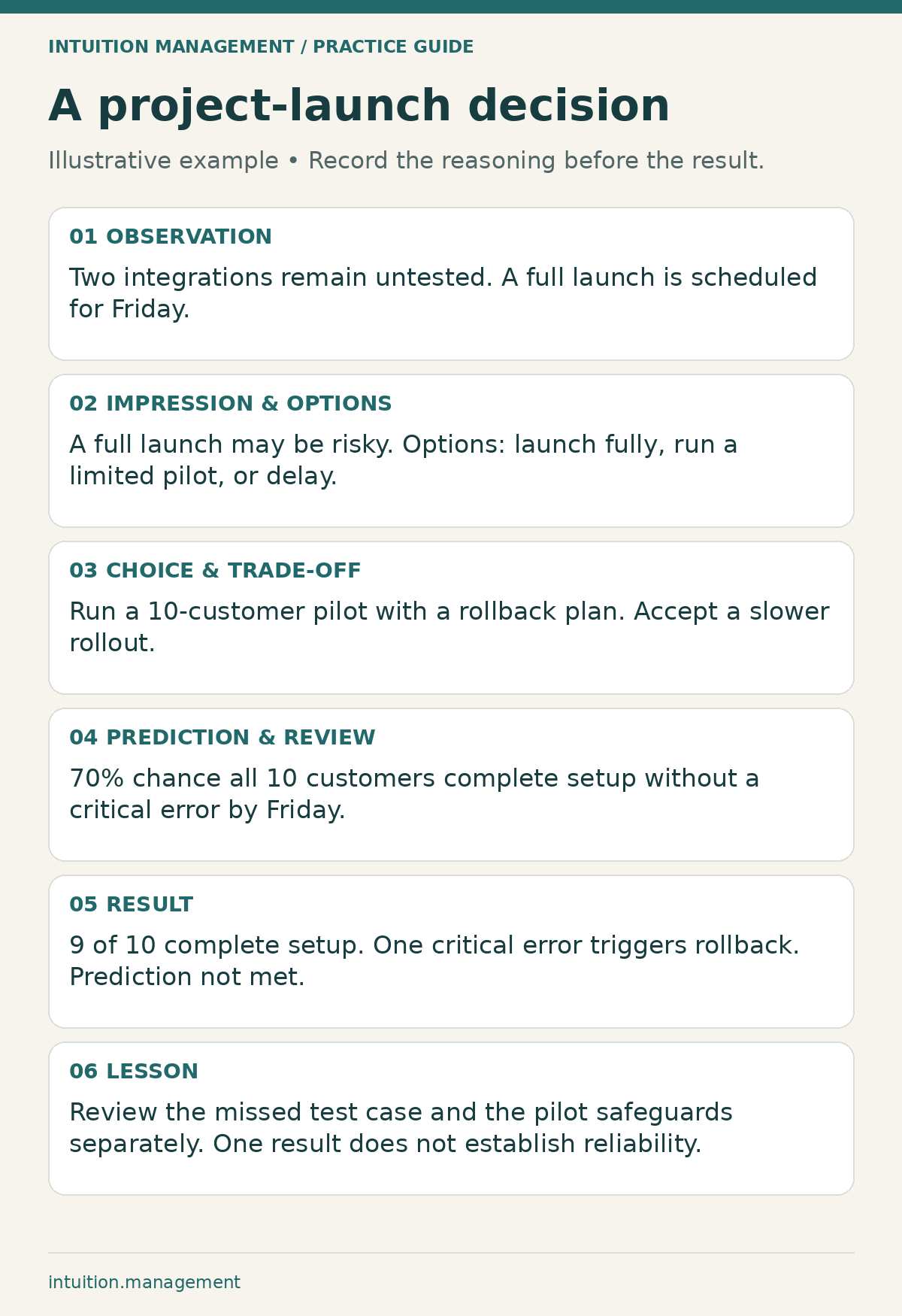
The review
Nine customers complete setup. One encounters a critical error that triggers rollback. The stated prediction was not met, even though most customers completed the process. Record both facts instead of changing the target afterward.
The review asks whether the test gap was reasonably discoverable before the pilot, whether the exposure was justified, and whether the safeguards worked. If an available integration test was skipped without good reason, that is a process issue. A rollback that limited disruption is a separate observation about execution.
The next adjustment is to add the missed integration case to the readiness checklist. One unsuccessful 70% prediction does not establish poor calibration: a probability estimate allows for failure. Reliability requires a suitable set of comparable predictions and outcomes.
Decision Journal Example: Choosing a Course
This everyday scenario is also illustrative. A reader wants to learn spreadsheet analysis for a recurring work task. A well-known course is appealing, but its reputation does not establish that it suits the task or available time.
| Field | Entry |
|---|---|
| Goal and constraints | Build a working monthly-report prototype within six weeks. Maximum study time: three hours a week. Budget: $200. |
| Options | A broad certificate course; a focused project course; or free tutorials with a self-designed practice plan. |
| Evidence and impression | The certificate feels reassuring. The project course has a relevant sample lesson and an assignment using similar data. |
| Chosen action | Take the focused course. Give up the broader certificate in exchange for closer task relevance. |
| Prediction and review | Expect to build the prototype within six weeks. Review progress after week two and the completed work at week six. |
| Actual result | A prototype is completed in week six, but two formulas require help from a colleague. The project is usable; independent mastery remains incomplete. |
| Lesson | The course supported the immediate goal. Before choosing another, check whether practice exercises include the specific skills still needing help. |
This review avoids two extremes: calling the course a failure because help was needed, or claiming mastery because a usable report exists. Keep the original success criterion, record the limitation, and decide what additional practice is worthwhile.
How to Review a Decision Fairly
Assess the reasoning using information available at the time, then examine the outcome and what it teaches you. Outcomes matter, but one result cannot fully explain the quality of a decision.
In Baron and Hershey’s outcome-bias experiments (1988, PDF), participants evaluated thinking more favorably when a decision had a favorable result, despite having the relevant decision information. This supports caution about judging reasoning by results alone.
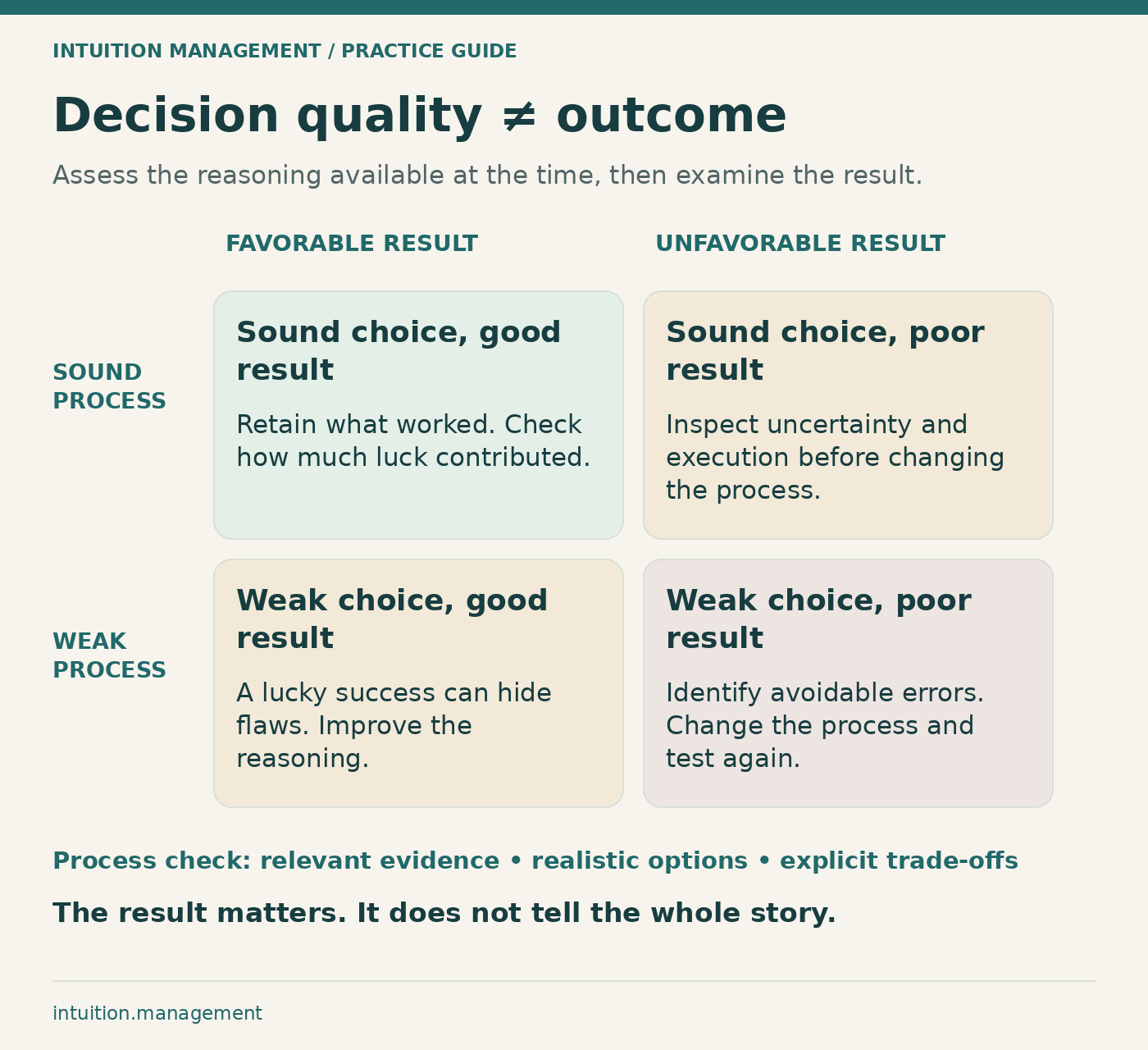
| Combination | Review question |
|---|---|
| Sound process, favorable result | What worked, and how much did favorable circumstances contribute? |
| Sound process, unfavorable result | Was this an accepted risk, an execution problem, or a missing assumption? |
| Weak process, favorable result | What flaw could this success conceal? |
| Weak process, unfavorable result | Which avoidable error should change the next decision? |
Check for hindsight too. Fischhoff’s research (1975, PDF) found that knowing an outcome affected judgments of its prior likelihood and the relevance of information. Your dated entry gives you something concrete to compare with the story that now seems obvious.
These studies explain review pitfalls; they do not validate this particular template or guarantee that journaling improves performance. The template, examples, and checklist are original practical aids.
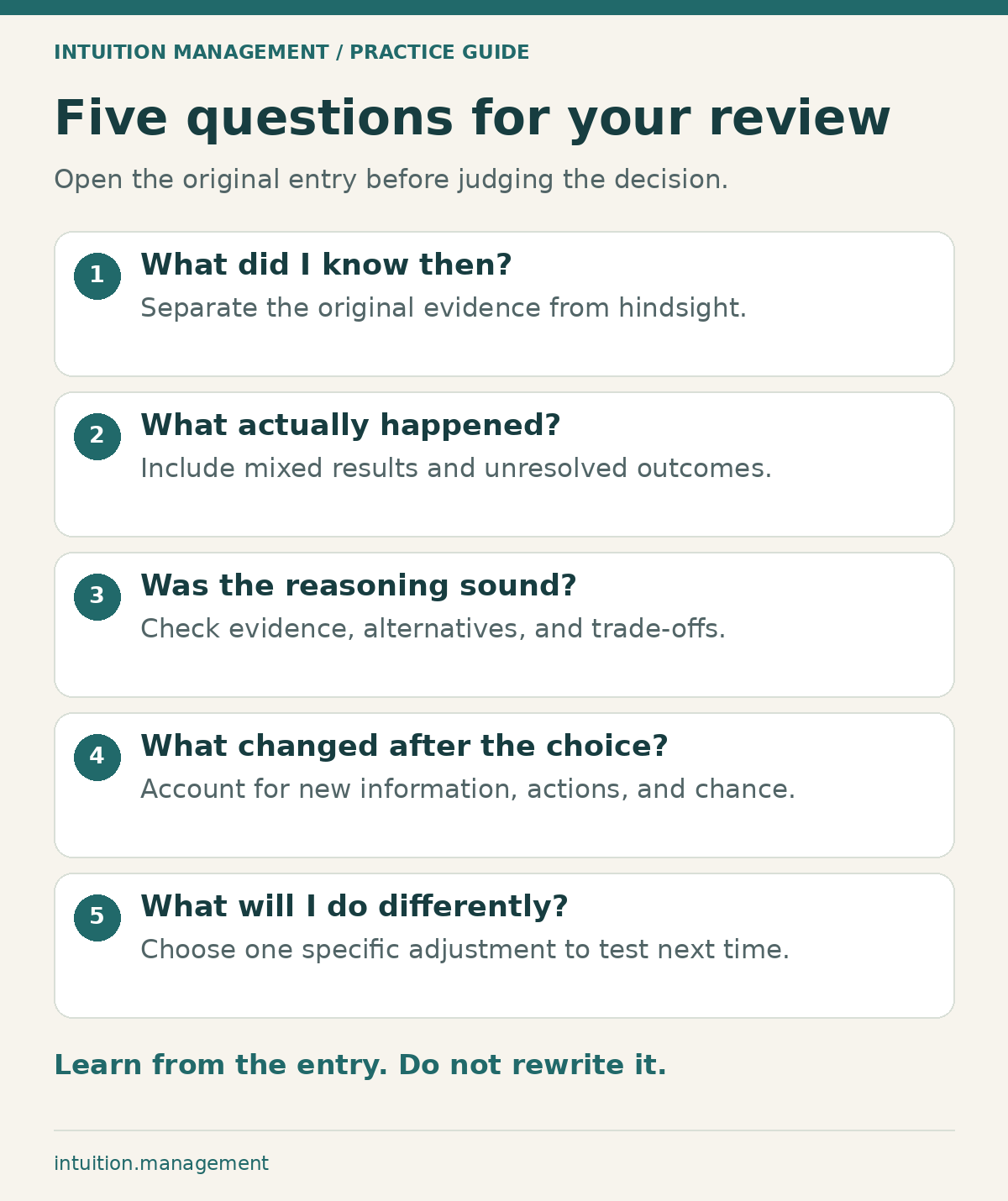
Five questions for your decision review
- What did I know then? Separate the original evidence from hindsight.
- What actually happened? Include mixed results and unresolved outcomes.
- Was the reasoning sound? Check evidence, alternatives, and trade-offs.
- What changed after the choice? Account for new information, actions, and chance.
- What will I do differently? Choose one specific adjustment to test next time.
Finish with one specific adjustment. “Be more careful” is hard to test. “Confirm the dependency owner before approving the next release” is observable. Keep unresolved results open rather than forcing them into a success or failure category.
Recording Intuition Without Treating It as Proof
Give the impression a place in the journal without giving it automatic authority. Write “I feel the schedule may slip” separately from “two dependency owners have not confirmed dates.” Then record another explanation: perhaps the reporting is incomplete rather than the work being late.
For more examples of that separation, see intuition vs perception. A feeling can prompt investigation; its intensity or calmness does not establish accuracy.
Record impressions that proved misleading as well as useful. Also note interventions: if your concern leads you to fix a dependency and the project finishes on time, the successful outcome alone does not show that the concern was mistaken. You changed the situation being predicted.
A decision journal documents individual choices and their reasons. Intuition calibration examines patterns across repeated predictions. Use that guide when you have enough comparable entries to start examining how confidence relates to outcomes.
Common Decision Journal Mistakes
- Writing only after the result. Label retrospective notes and keep them separate from entries made before outcomes were known.
- Recording only memorable successes. Decide in advance which category of decisions you will track, then include misses and ordinary results.
- Using vague forecasts. Specify what you expect, by when, and what would count as meeting the prediction.
- Editing the original explanation. Add dated corrections instead of replacing earlier reasoning.
- Scoring yourself by one outcome. Review the process, execution, and circumstances before drawing a lesson.
- Turning the journal into endless checking. Use a planned review date and relevant triggers rather than rereading the same entry for reassurance.
If you repeatedly reopen choices without learning anything new, the guide to second-guessing decisions offers a way to distinguish a useful review from repeated doubt. Changed priorities, a reasoning error, or relevant evidence can justify reconsideration; the journal should not lock you into a choice.
Frequently Asked Questions
What is the difference between a decision journal and a diary?
A diary can record any experience or reflection. A decision journal focuses on a specific choice, the evidence and reasoning available beforehand, the expected result, and a later review. It can be one section of an ordinary notebook.
How often should I write in a decision journal?
Use it when a decision is important enough to learn from. Start with one relevant choice and a scheduled review. A daily entry is optional; the frequency should fit your decisions rather than create unnecessary work.
When should I review an entry?
Choose a point when meaningful feedback should be available. That might be the end of a pilot or several weeks into a course. Review earlier if a defined trigger occurs. If the outcome remains unclear, note that and set a new review date.
Do I need confidence percentages?
No. They are useful when you can define an observable prediction and explain your estimate. A percentage expresses the estimated probability of that event, not the overall quality of the choice. Do not add a precise number just to make the entry look analytical.
Can I use a notes app instead of a spreadsheet?
Yes. A notebook, notes app, or document is enough. Keep entries dated, easy to retrieve, and unchanged after the outcome; append the review. A spreadsheet becomes useful when you want to compare many similarly structured entries.
Can a team use a decision journal?
Yes. Record the decision owner, options, evidence, disagreements, action, and review date. Preserve uncertainty instead of rewriting the entry as unanimous confidence. Include only information appropriate for the people who can access the record.
Start With One Decision
Choose a decision you are currently making. Copy the template, record your reasons and expected result, and set a review date. Keep the entry short enough to finish before you act. At review, aim for a specific lesson rather than a flattering or punishing story.
Sources and scope
- Baron, J., & Hershey, J. C. (1988). Outcome bias in decision evaluation. Journal of Personality and Social Psychology, 54(4), 569–579. DOI: 10.1037/0022-3514.54.4.569.
- Fischhoff, B. (1975). Hindsight ≠ foresight: The effect of outcome knowledge on judgment under uncertainty. Journal of Experimental Psychology: Human Perception and Performance, 1(3), 288–299. DOI: 10.1037/0096-1523.1.3.288.
The research supports the discussion of review biases. The journal format, diagrams, and hypothetical scenarios are educational material, not a validated assessment of decision-making ability.