The availability heuristic is a mental shortcut in which you judge how common or likely something is by how easily relevant examples come to mind. It can provide a useful first impression, but a vivid memory is not necessarily representative of the wider pattern. A recent outage, a dramatic news story, or one unforgettable complaint can make an event feel more frequent than the wider evidence suggests.
Imagine reading a detailed account of a laptop failing during an important presentation. Later, that story comes back instantly when you consider buying the same model. It tells you that a failure is possible. It does not, by itself, tell you how often the model fails.
The practical question is: Does this feel likely because the evidence supports it, or because an example is easy to remember? This guide explains the distinction through everyday examples, a workplace decision, and five questions you can use before acting.

What is the availability heuristic?
Amos Tversky and Daniel Kahneman described availability in their 1973 paper on judgments of frequency and probability. The central idea is that people can use the ease of bringing examples or scenarios to mind as a basis for an estimate. Their work also explains why that shortcut can produce systematic errors. Read the original research.
Here, “available” means mentally accessible. It does not mean that information has been independently verified, that all relevant information is present, or that a product is in stock. A story can be accessible because you encountered it yesterday, retold it several times, or found it emotionally striking.
Availability belongs to the broader family of heuristic thinking: ways of reaching judgments without examining every possible piece of evidence. To identify this particular shortcut, look for a leap from “I can readily remember examples” to “this must happen often.”
How the availability heuristic works
A useful way to notice the process is to separate three moments:
- A question arises: How likely is a failure, delay, disagreement, or other outcome?
- An example comes to mind: You retrieve a relevant experience or imagine a scenario.
- Recall shapes the estimate: The example’s accessibility contributes to how common or plausible the outcome feels.
The question to investigate is what makes the example accessible. Repeated reports may describe one incident, not many independent incidents. A recent event may reflect a genuine change, or it may simply be easier to remember. A dramatic story may highlight an important hazard while leaving its frequency uncertain. Each possibility calls for a different check.

Ease of recall is not just the number of examples
In a 1991 study, Norbert Schwarz and colleagues asked participants to recall examples of their own assertive or unassertive behavior. Recalling twelve examples was harder than recalling six, and this experienced difficulty affected self-ratings. The findings show why the feeling of retrieval can matter alongside what is retrieved. They do not mean that recalling more examples always reverses a judgment. Read the author-uploaded paper.
For a practical check, record your impression before investigating it. “I think this happens frequently” is a starting claim. An incident log, a representative sample, or an independent comparison can help you evaluate it.
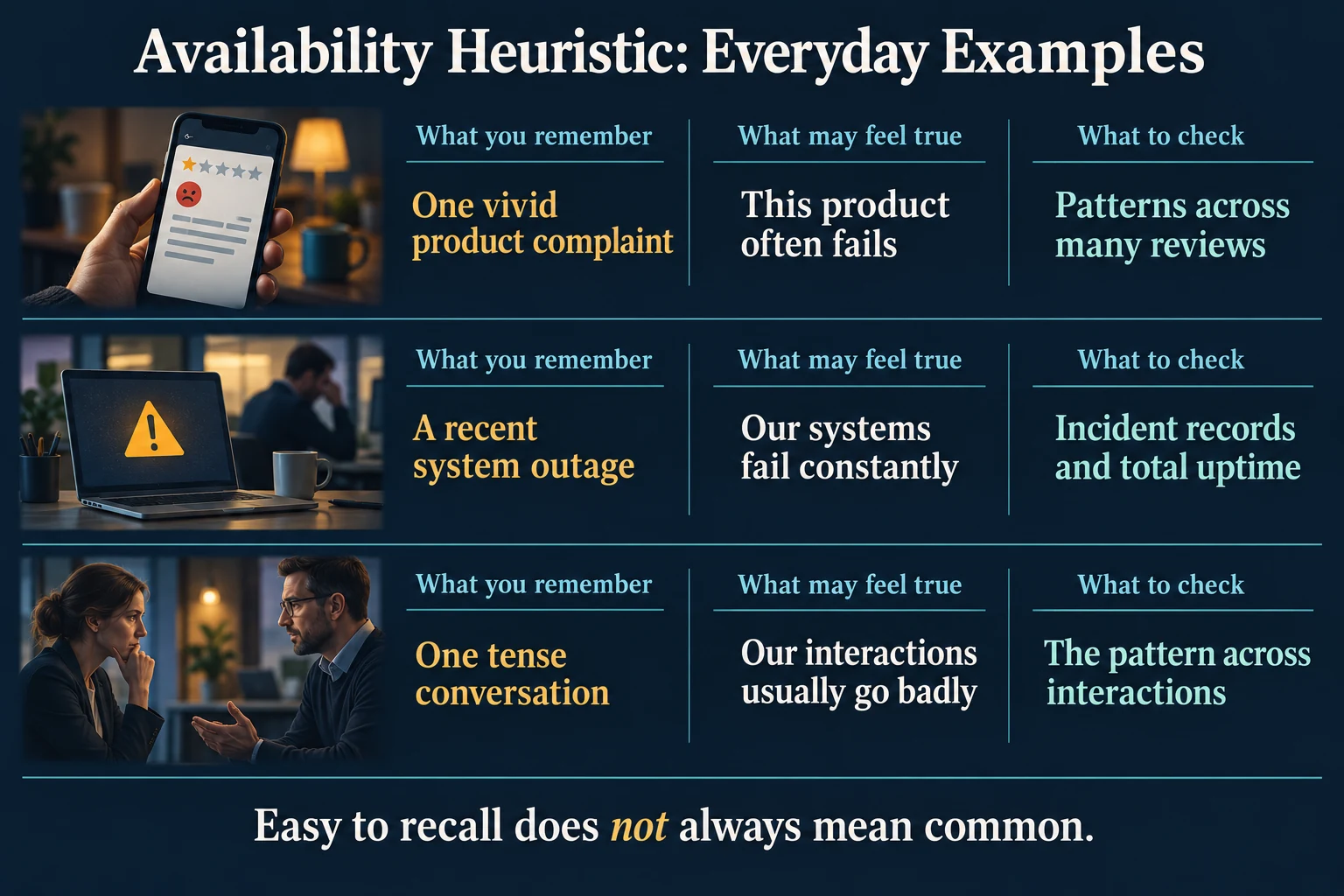
Availability heuristic examples in everyday life
The following are illustrative scenarios, not diagnoses of the people involved. Each shows how a readily recalled example could influence an estimate and what evidence could clarify it.
1. News coverage makes an event feel widespread
You see several reports about burglaries and start believing that burglaries have sharply increased in your area. First check whether the reports concern separate events, the locations involved, and comparable local figures over time. Increased coverage and increased incidence are different possibilities; either could be true.
2. One product review dominates a purchase
A detailed negative review stays with you while dozens of ordinary reviews fade. Before deciding that the defect is common, examine whether complaints recur across independent sources and comparable product versions. Reviews are self-selected, so even a large review collection is not necessarily a reliable estimate of the failure rate among all owners.
3. A recent outage defines a system’s reputation
After a stressful service outage, “our systems constantly fail” feels obvious. Check the incident record, downtime, and exposure over a defined period. Also examine severity: an infrequent failure can still justify urgent prevention if its consequences are substantial.
4. A memorable mistake overshadows a review period
A manager remembers one missed deadline and concludes that an employee is usually unreliable. Review agreed commitments across the whole period, including completed work and relevant dependencies. A recent mistake may require action, but a broad performance judgment needs broader evidence.
5. One tense conversation predicts the next one
An uncomfortable conversation becomes the example you retrieve whenever you consider raising an issue. You expect the next discussion to go badly too. Look at the pattern of interactions and what has changed. Considering the wider pattern does not require dismissing a serious incident or ignoring a boundary.
Availability heuristic vs availability bias
The heuristic is the shortcut; the bias is a systematic distortion that can result from relying on it. The terms are often used interchangeably in everyday writing, but the distinction is useful. An easily recalled event is not automatically misleading, and a correct conclusion does not prove that the reasoning was reliable.
Suppose you regularly handle the same service requests and recall password problems quickly because they actually make up a large share of the workload. That impression may be useful. If a single unusual security incident crowds out those routine cases, your impression of what happens most often may become distorted.
The correction is to check the relationship between recall and the question you are answering. “What could go wrong?” and “What usually goes wrong?” require different evidence. One real incident can help answer the first; the second needs a suitable set of cases.
Availability vs recognition, representativeness, and confirmation bias
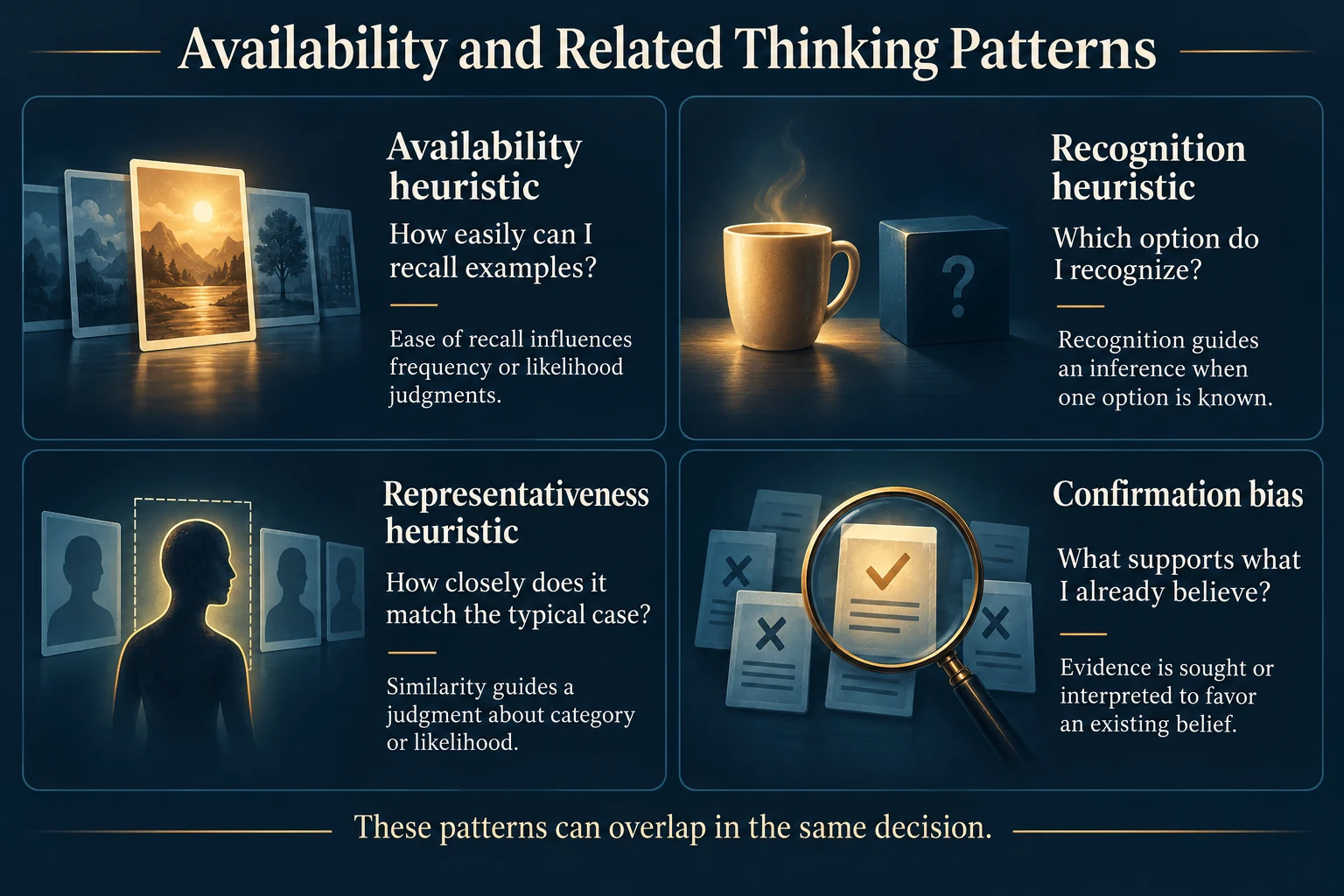
These patterns can occur in the same decision. The table separates their defining questions; it is not a checklist for assigning every mistake to one category.
| Pattern | Defining question | Illustrative example |
|---|---|---|
| Availability heuristic | How easily can I recall examples? | A memorable outage makes failure feel frequent. |
| Recognition heuristic | Which of two options do I recognize? | Recognizing one city but not another guides a population estimate. |
| Representativeness heuristic | How closely does this match a typical case? | A project resembles a past success, so success feels likely. |
| Confirmation bias | What supports what I already believe? | A manager favors reports that support an existing view. |
| Recency effect | How much weight am I giving recent information? | Last week’s results dominate a judgment about the year. |
The recognition heuristic has a specific comparative use: if one option is recognized and another is not, recognition can guide an inference about a criterion. It is more specific than simply preferring a familiar brand. Availability concerns accessible examples; representativeness concerns resemblance. Confirmation bias concerns favoring an existing belief.
Recency can contribute to availability, but an old event can remain highly accessible too. The patterns describe overlapping influences, not interchangeable names.
When availability helps—and when to check it
Treat a readily recalled example as a useful prompt to investigate. It can suggest a failure mode, remind you of a relevant question, or help you locate a previous solution. Those uses do not require treating the example as a frequency estimate.
If you want to use experience to estimate what is likely, ask whether it covers comparable situations and whether you have seen both successes and failures. Check whether the environment has changed. A person who handles escalations may have excellent knowledge of failure mechanisms while seeing a disproportionate number of difficult cases.
This is a practical connection to expert judgment: ask what the person’s experience allows them to assess, then request the evidence behind the estimate. A strong impression can be informative without settling the decision.
For readers exploring System 1 and System 2 thinking, the useful habit here is to pause when a quick impression becomes a consequential claim. Thinking longer is not enough by itself. Spend that time checking the sample, the comparison, or the missing denominator.
Worked example: one memorable failure changes a team’s priorities
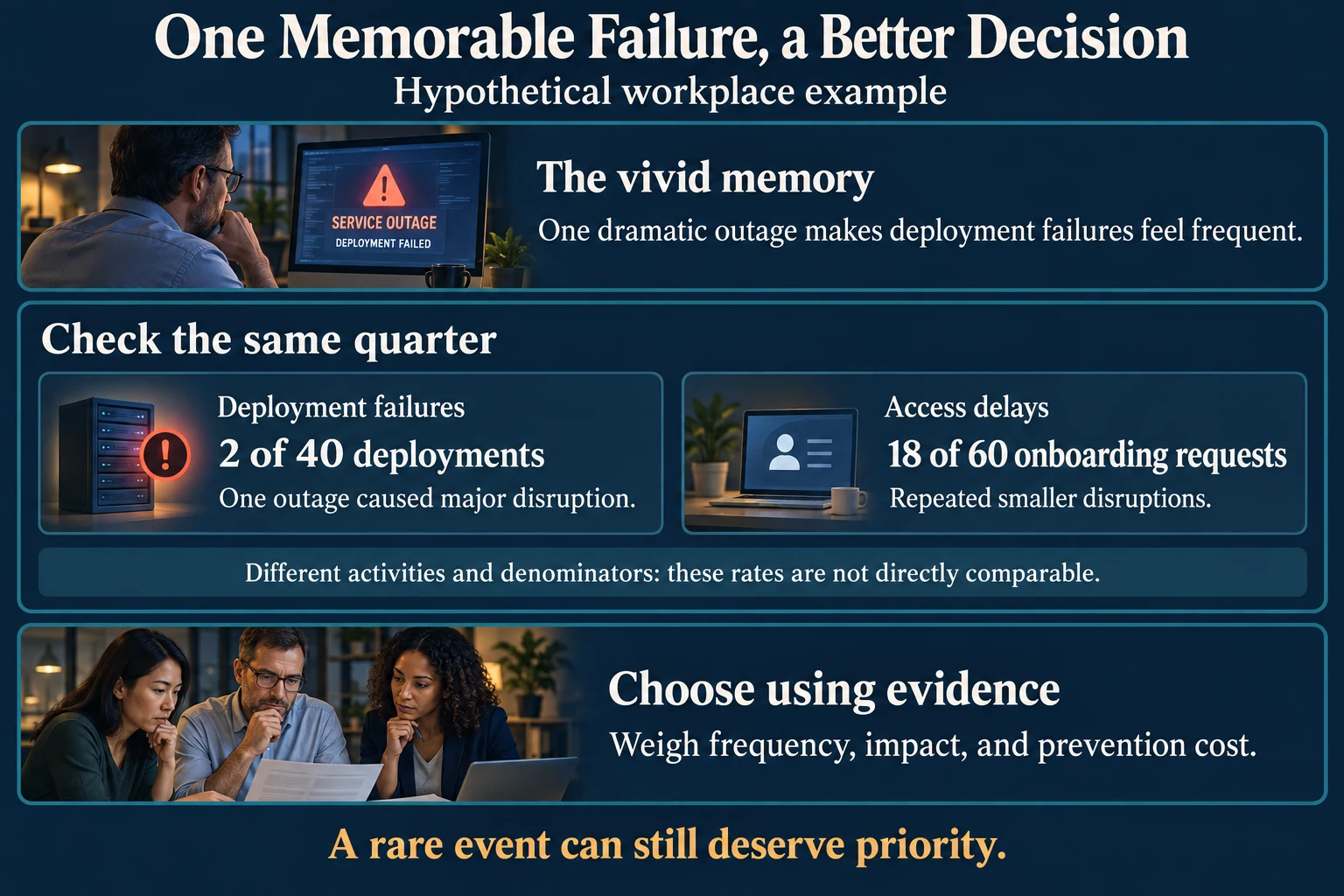
This is a hypothetical example. All figures below are invented for illustration, not research findings or industry benchmarks.
A manager wants to put all improvement capacity into deployment controls after a dramatic outage. During the same quarter, the team recorded 2 failures across 40 deployments and 18 access delays across 60 onboarding requests. The outage caused major disruption; the access delays caused smaller, repeated interruptions.
These are 5% of deployments and 30% of onboarding requests. They use different denominators and describe different activities. The second percentage does not establish that access delays are six times the business risk. Neither percentage alone gives the expected cost of the next event.
Add impact and prevention effort
For this exercise, suppose the deployment failures caused 120 staff-hours of disruption in total, while access delays caused 72. Assume a deployment safeguard would take 16 staff-hours to implement and an access-process fix would take 8. These additional assumptions allow a more concrete discussion, but they still do not establish how much harm either change will prevent.
The team checks the failure causes and finds that the proposed safeguard addresses the mechanism behind the major outage. It schedules that safeguard first, assigns an owner to the access fix, and reviews both after implementation. This is a defensible illustrative decision because it considers severity, a plausible corrective action, and implementation effort—not merely which problem is easiest to remember.
The next review should compare recurrence and disruption, allowing for changes in activity volume. Historical losses are not guaranteed future losses, and an intervention may be less effective than expected. Customer impact, contractual commitments, and other consequences would also matter in a real decision.
The lesson: a rare event can still deserve priority. Checking availability does not mean choosing the most frequent problem. It means making the reason for your choice explicit enough to examine and revise.
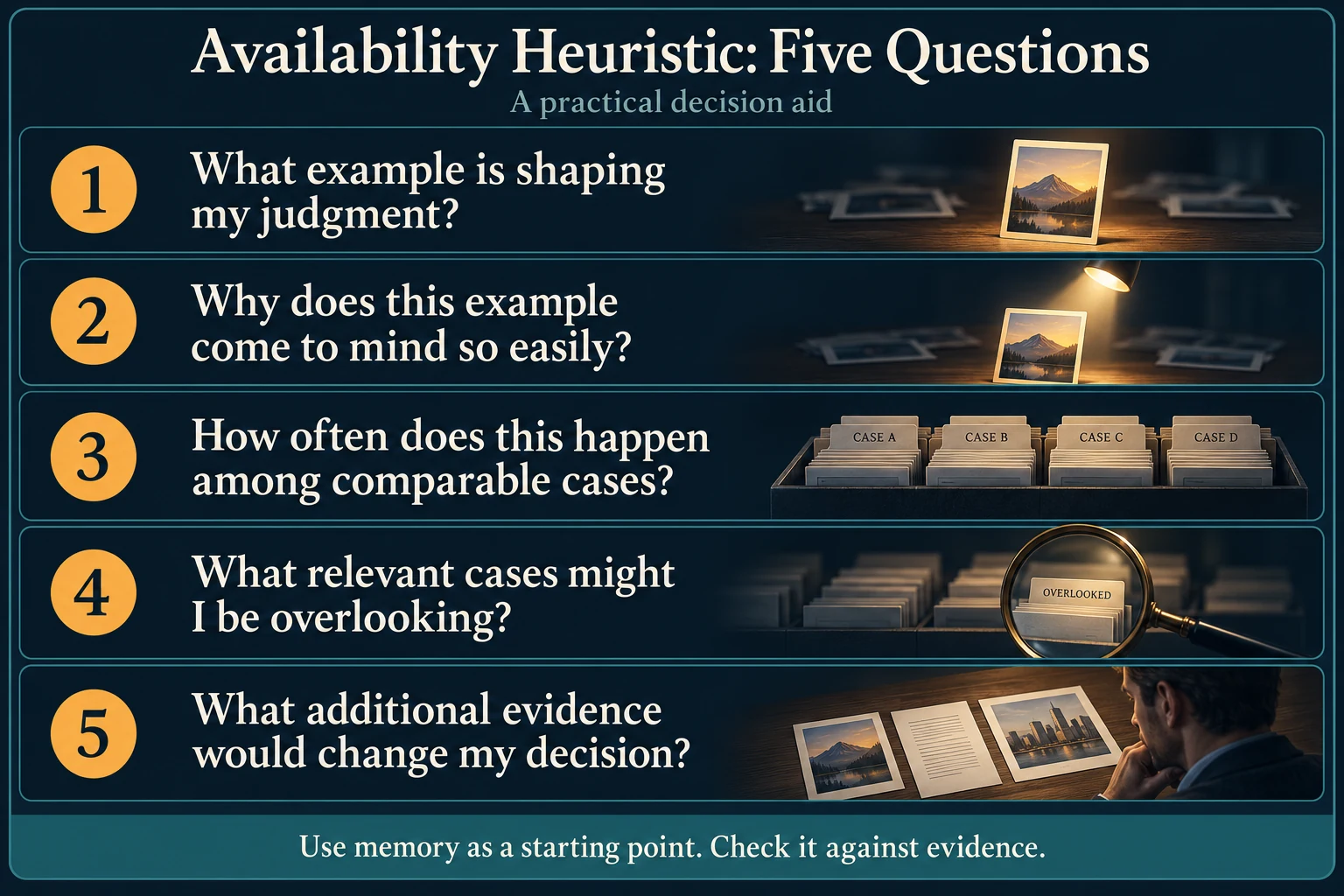
How to reduce availability bias: five questions before deciding
Use this as a practical decision aid, not a validated psychological test. It is designed to direct attention toward evidence; it cannot guarantee an unbiased judgment.
1. What example is shaping my judgment?
Name the specific incident, story, or image. Then write down the conclusion you are drawing from it. Separating “this happened” from “this happens often” makes the inference visible.
2. Why does this example come to mind so easily?
Consider recent exposure, emotional intensity, repetition, or personal involvement. None makes the example false. The question is whether its accessibility tells you anything reliable about the frequency you want to estimate.
3. How often does this happen among comparable cases?
Look for a denominator and a defined period: failures out of deployments, delays out of requests, or missed commitments out of all commitments. Use similar cases and consistent definitions. If suitable data are unavailable, keep the uncertainty explicit instead of inventing a precise probability.
4. What relevant cases might I be overlooking?
Look for ordinary outcomes, successful cases, and events outside your usual information stream. Ask whether several accounts repeat the same source. Seek a broader sample rather than collecting anecdotes until you find one that supports your preferred answer.
5. What additional evidence would change my decision?
Specify a useful check before continuing: a recent incident log, another period of observations, or an independent assessment. Decide what result would change the action. Match the effort to the stakes so that checking does not become endless delay.
Try it now: choose one decision and complete this sentence: “The example I keep remembering is ____. Before I treat it as typical, I will check ____.” For a broader decision process, continue with how to make the right decision.
Frequently asked questions
What is a simple example of the availability heuristic?
After hearing a vivid account of a parcel being lost, you assume deliveries frequently go missing. The story makes the outcome easy to imagine, but estimating its frequency requires relevant delivery records or another suitable comparison.
Is the availability heuristic the same as availability bias?
The terms are often used together. More precisely, the heuristic is a shortcut based on accessible examples, while availability bias refers to the distortion it can produce. Using the shortcut does not necessarily make a conclusion wrong.
How does availability differ from representativeness?
Availability involves how easily examples come to mind. Representativeness involves how closely something resembles a typical case. Judging a project risky because a recent failure is vivid differs from judging it risky because it resembles a familiar type of unsuccessful project.
Can the availability heuristic be useful?
Yes. Easily recalled experience can suggest relevant possibilities and sometimes support a reasonable estimate. Before relying on it for a consequential decision, check whether your experience represents comparable cases and whether current evidence supports the impression.
Research and sources
- Tversky, A., & Kahneman, D. (1973). Availability: A heuristic for judging frequency and probability. Cognitive Psychology, 5(2), 207–232. DOI: 10.1016/0010-0285(73)90033-9.
- Schwarz, N., Bless, H., Strack, F., Klumpp, G., Rittenauer-Schatka, H., & Simons, A. (1991). Ease of retrieval as information: Another look at the availability heuristic. Journal of Personality and Social Psychology, 61(2), 195–202. DOI: 10.1037/0022-3514.61.2.195.