The representativeness heuristic is a mental shortcut in which you judge how likely something is by how closely it resembles a familiar category, example, or pattern. Resemblance can offer a useful clue, but it can also distract you from how common an outcome is and whether the similarities actually predict it.
A project proposal looks like a previous success: the presentation is polished, the team sounds confident, and the delivery plan feels familiar. You begin to expect the same result. Before accepting that impression, ask whether those features distinguished successful projects from unsuccessful ones.

What is the representativeness heuristic?
Representativeness means judging by a perceived match. A person seems typical of a profession, a proposal resembles a winning idea, or a short sequence looks like what you expect randomness to look like. The match becomes a basis for estimating category membership or likelihood.
Kahneman and Tversky described this approach in their 1972 paper on subjective probability and representativeness. Their 1974 account of heuristics and biases placed it alongside availability and anchoring.
The heuristic is the shortcut; a bias is a systematic error it may produce. Similarity is not automatically irrelevant. The problem arises when a compelling resemblance receives more weight than its predictive value warrants. For the broader concept, see heuristic thinking.
How resemblance becomes a probability judgment
Consider an illustrative sequence in a project review:
- Notice a match: “This team presents its plan like our strongest team did.”
- Form an expectation: “This project will probably succeed too.”
- Skip a check: nobody asks how often weak projects used the same presentation style.
The first observation can be accurate while the conclusion remains poorly supported. Presentation style might matter, or it might be incidental. Delivery capacity, dependencies, scope stability, and decision speed could be more informative.
A useful question is: “Would I see this feature just as often if the outcome were different?” If so, the feature provides little help distinguishing the outcomes.
Five representativeness heuristic examples
The following scenarios are teaching examples, not reports of individual research participants or real organizations.
1. Hiring: a candidate resembles a previous high performer
A candidate shares a successful colleague’s confidence, vocabulary, or career path. That resemblance encourages an optimistic prediction. Check job-relevant work samples and consistent assessment criteria across candidates. A familiar style does not establish the same ability.
2. Project forecasting: a familiar plan suggests a familiar outcome
A delivery plan resembles one that worked last year. Before predicting success, compare constraints: team capacity, technical uncertainty, external dependencies, and the definition of “done.” The resemblance becomes more useful when it concerns conditions that affected the outcome.
3. Product evaluation: an idea looks like a category winner
A new product has the interface and positioning of a popular service. It therefore feels commercially promising. Examine customer demand, distribution, and retention evidence, including similar products that failed. A recognizable appearance is not a complete explanation of adoption.
4. Customer judgments: one customer fits a familiar profile
A prospect resembles previous customers who bought quickly, so the team assumes a short sales cycle. Check budget, buying authority, urgency, and the full record for comparable prospects. Include those who never purchased, rather than remembering only successful matches.
5. Random sequences: a mixed pattern looks more probable
For six independent fair coin tosses, the exact sequence H-T-H-T-T-H and the exact sequence H-H-H-H-H-H each have probability 1/64. The mixed sequence may look more representative of randomness, but appearance does not change those probabilities. The broader category “mixed sequences” is more likely than “all heads”; that is a different comparison from two specified sequences.
Representativeness vs availability vs confirmation bias
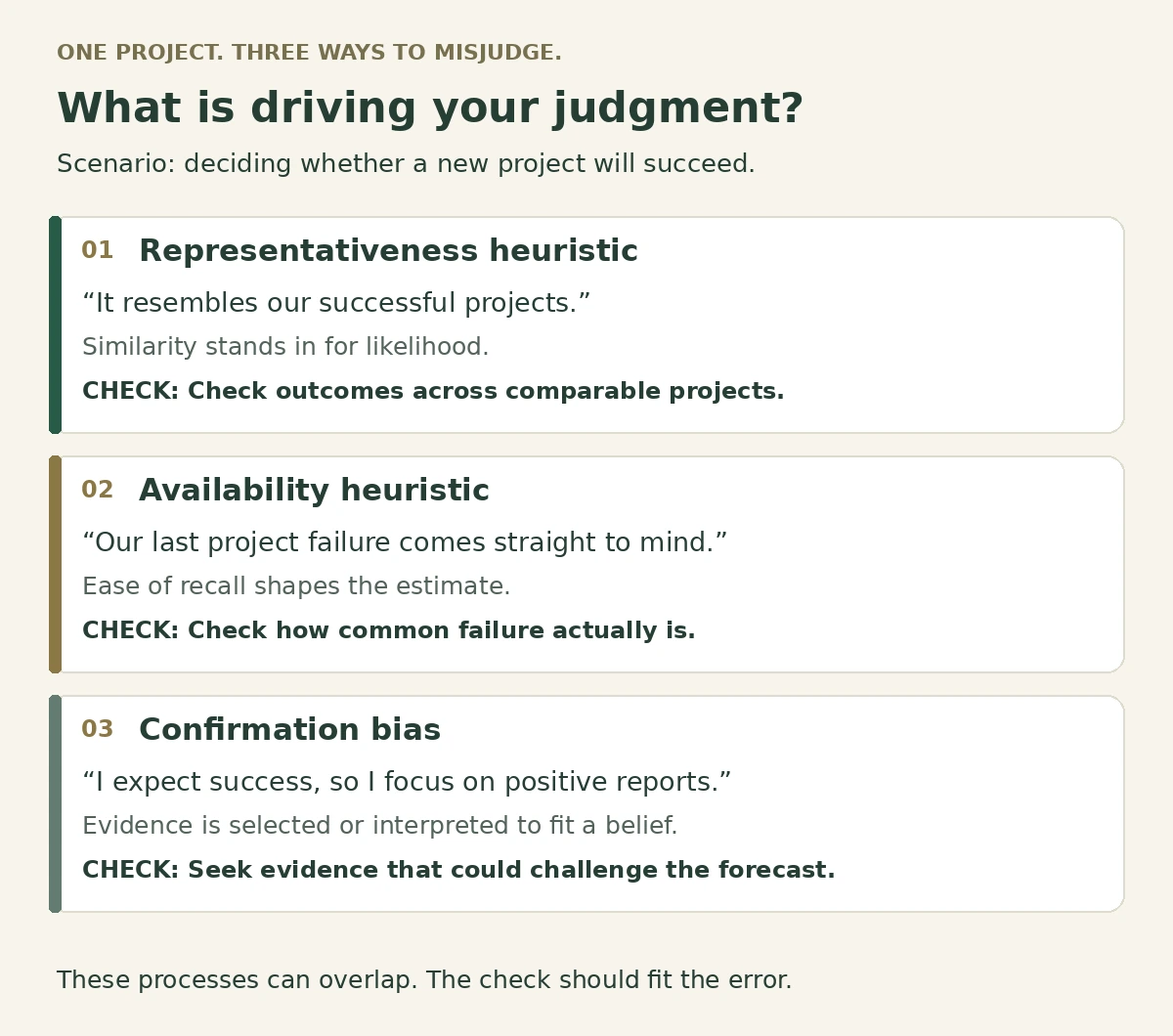
The same forecast can be influenced by several processes. Identify what is driving the judgment before choosing a correction.
| Process | Illustrative thought | Useful check |
|---|---|---|
| Representativeness heuristic | “It resembles our successful projects.” | Compare outcomes for projects with and without the relevant features. |
| Availability heuristic | “Our last failure comes straight to mind.” | Check the full record, rather than relying on what is easiest to recall. |
| Confirmation bias | “I expect success, so I focus on positive reports.” | Seek and fairly assess evidence that could challenge the forecast. |
Explore the availability heuristic for the role of recall, and confirmation bias for how existing beliefs can shape evidence selection and interpretation. These processes can overlap.
Base-rate neglect: a worked project example
A base rate is the frequency of an outcome in a relevant reference group. Base-rate neglect means giving this background information too little weight. It can occur when a vivid description or familiar pattern dominates the assessment.
Suppose a manager notices an early warning pattern and thinks, “This looks like our delayed projects.” To test the impression, consider this fictional record:
| Actual outcome | Projects | Warning present | Warning absent |
|---|---|---|---|
| Finished late | 20 | 16 | 4 |
| Finished on time | 80 | 24 | 56 |
| Total | 100 | 40 | 60 |
Overall, 20 of 100 projects finished late: 20%. Among projects showing the warning, 16 finished late and 24 finished on time. The observed delay rate in that group is therefore 16 ÷ (16 + 24) = 40%.
It would be a mistake to reason that because 16 of the 20 delayed projects showed the warning, a project with the warning has an 80% delay probability. That reverses the condition: the denominator must include all projects with the warning.
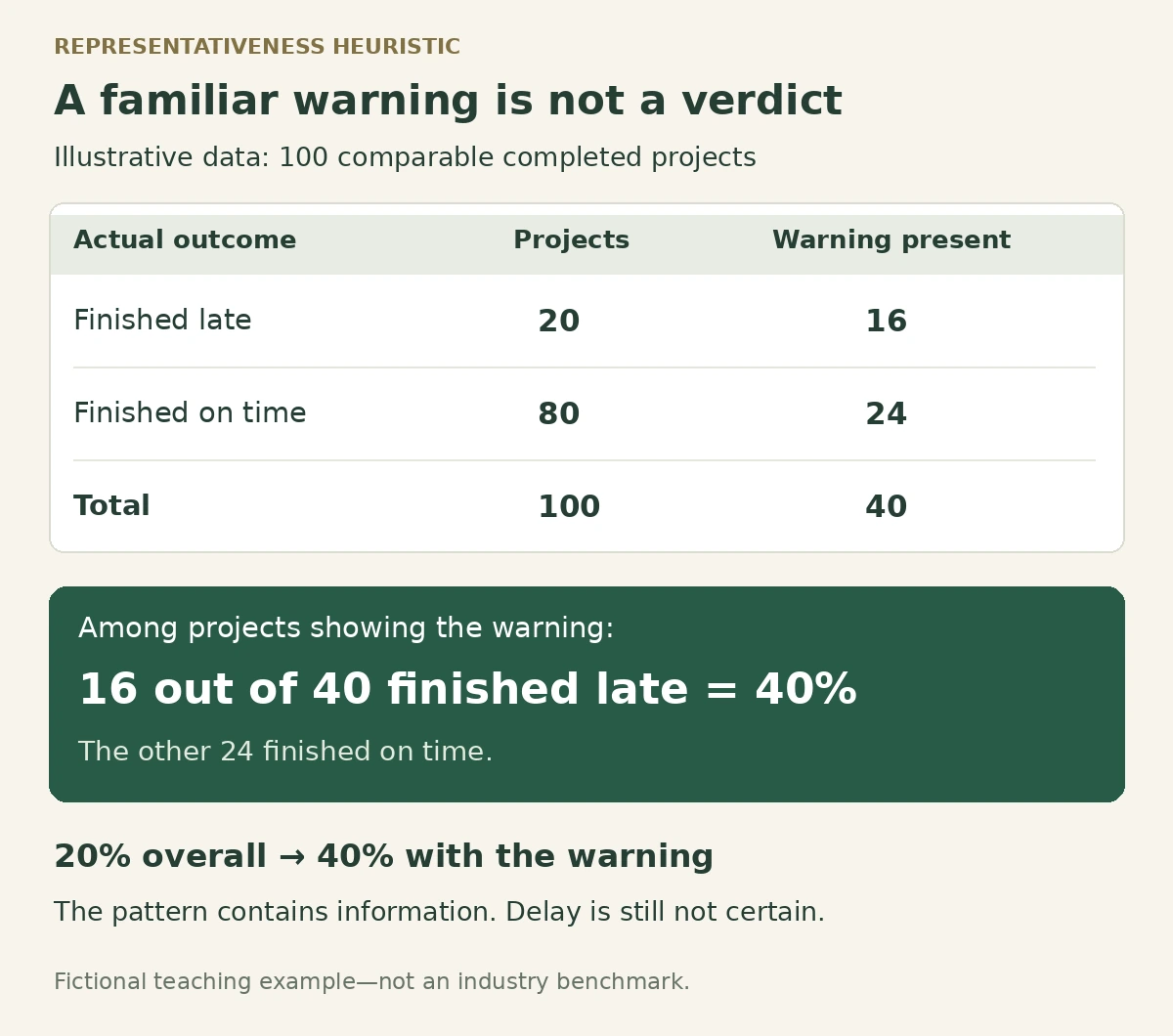
The warning is informative: the observed delay rate doubles relative to the overall group. It is still not a verdict. Whether to intervene depends on the consequences of delay, the cost of the response, and other evidence.
Representativeness vs expert intuition
Recognizing a familiar pattern does not by itself distinguish expertise from a misleading resemblance. Ask what was learned, from which situations, and with what feedback.
Kahneman and Klein’s review of intuitive expertise emphasizes an environment with learnable regularities and sufficient opportunities to learn them. Subjective confidence alone does not establish accuracy.
For a practical review, compare two claims: “This looks professional” and “This dependency pattern has repeatedly preceded missed milestones in comparable projects.” The second names a potentially testable cue. It still needs a record that includes misses and false alarms.
Read expert intuition for the wider learning conditions. Also distinguish representativeness from the recognition heuristic: recognizing a name is different from judging resemblance to a category.
Five questions before trusting the pattern
- Name the resemblance. What exactly does this situation resemble? Describe the feature rather than saying only that it “feels familiar.”
- Check relevance. Which similarities matter for the outcome? Separate appearance from evidence about performance.
- Find the base rate. How common is that outcome among comparable cases? Choose the reference group for relevant reasons, not because it supports your preference.
- Look for exceptions. How often does this pattern appear without that outcome? Include false alarms and overlooked cases.
- Test your judgment. What evidence would change your initial view? Identify one observation or small test that could distinguish competing explanations.
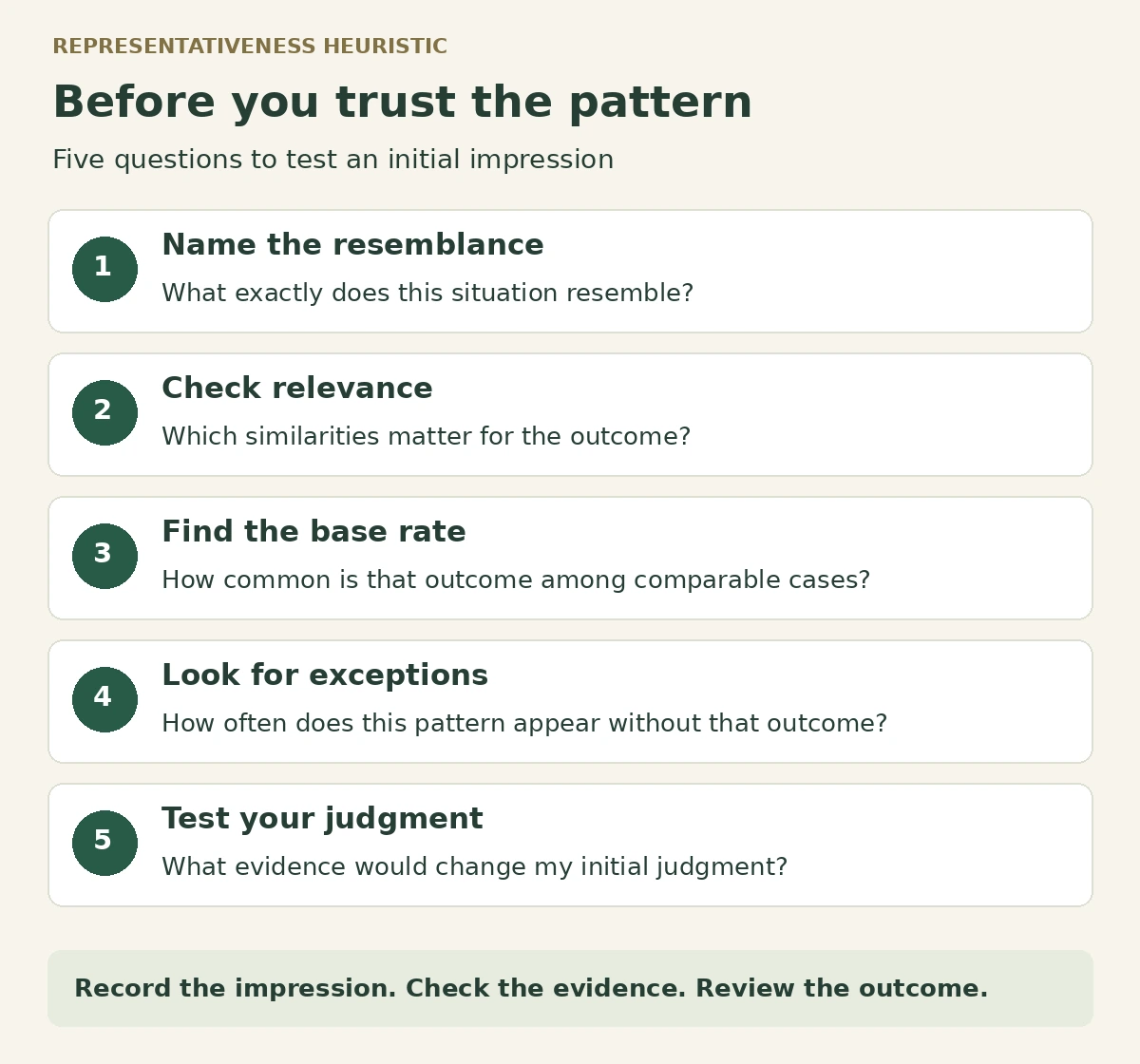
Record your initial impression, supporting cues, alternative explanation, and confidence before the result is known. Then review what happened. A decision journal provides a practical place to keep that record.
If reliable base-rate information is unavailable, say so. Seek a defensible comparison group, use a range where appropriate, and avoid replacing missing evidence with a precise-looking invented percentage.
Frequently asked questions
What is a simple example of the representativeness heuristic?
Expecting a candidate to perform well because they resemble a successful colleague is one example. The resemblance may suggest questions to investigate, but job-relevant evidence is needed to support the prediction.
What is the difference between representativeness and availability?
Representativeness concerns a match to a category or pattern. Availability concerns how readily examples come to mind. A memorable failure can influence a forecast even when the new project does not resemble it.
Is representativeness bias the same as base-rate neglect?
No. Base-rate neglect concerns underweighting background frequencies. Representativeness is a similarity-based judgment process that can contribute to that error, but the terms describe different things.
Is the representativeness heuristic always wrong?
No. Similarity can carry relevant information. The question is whether the features genuinely distinguish outcomes and whether other important evidence has been included.
How can I reduce representativeness bias?
Specify the resemblance, check comparable outcomes, examine cases where the pattern was misleading, and record predictions before reviewing results. These checks improve the basis of the judgment; they do not eliminate uncertainty.
Research and sources
This article combines established research concepts with original illustrative scenarios and a practical checklist. The checklist is an educational aid, not a validated psychological assessment.
- Kahneman, D., & Tversky, A. (1972). Subjective probability: A judgment of representativeness. Cognitive Psychology, 3(3), 430–454.
- Tversky, A., & Kahneman, D. (1974). Judgment under Uncertainty: Heuristics and Biases. Science, 185(4157), 1124–1131.
- Kahneman, D., & Klein, G. (2009). Conditions for intuitive expertise: A failure to disagree. American Psychologist, 64(6), 515–526.