Confirmation bias is the tendency to seek or interpret evidence in ways that favor a belief you already hold. You might search for reasons your preferred plan will work, accept supportive examples quickly, and scrutinize objections much more harshly. The problem is the unequal treatment of evidence, even when the original belief turns out to be correct.
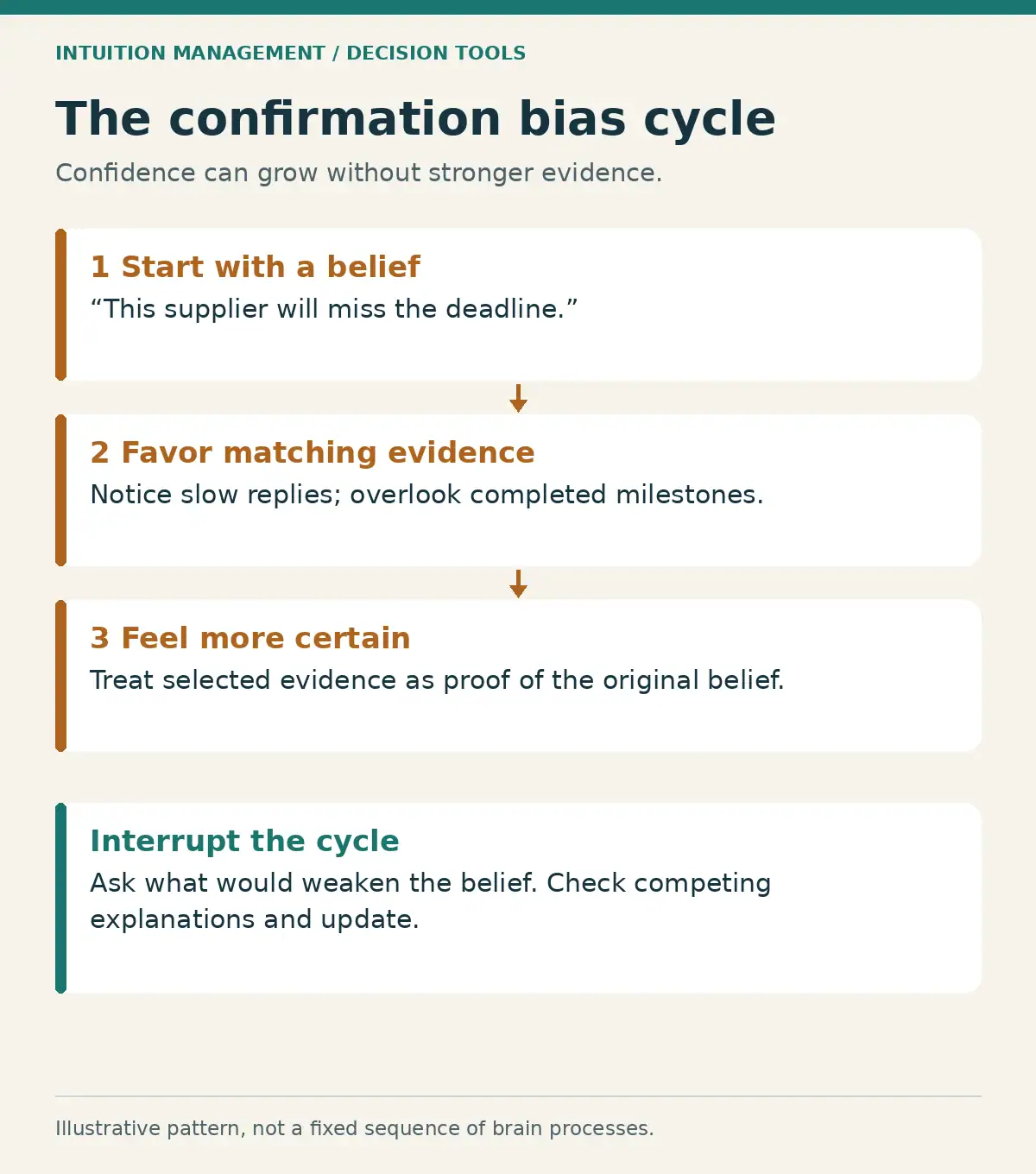
Imagine deciding that a supplier is unreliable. Two late email replies stand out, while completed milestones receive little attention. Your concern feels increasingly well supported, but you may have assembled a selective picture. This guide explains confirmation bias through everyday examples and shows how to test a first impression before using it to make a decision.

What Is Confirmation Bias?
Confirmation bias concerns how we handle information once we have an expectation, explanation, or preferred answer. It can appear in the questions we ask and in how we evaluate the answers. Raymond Nickerson’s review describes a broad family of ways evidence can be handled in favor of existing beliefs or hypotheses. Read Nickerson’s review of confirmation bias.
A useful distinction is between having a hypothesis and protecting it from a fair test. A hypothesis gives an investigation direction. It becomes difficult to learn when every observation is treated as support and no possible finding could count against it.
For example, “This process creates delays” is a claim you can examine. You can compare delayed and timely cases, identify where waiting occurs, and check alternative causes. “Every delay proves the process is bad, while every timely case is an exception” makes the claim much harder to challenge fairly.
Confirmation Bias Examples in Everyday Life
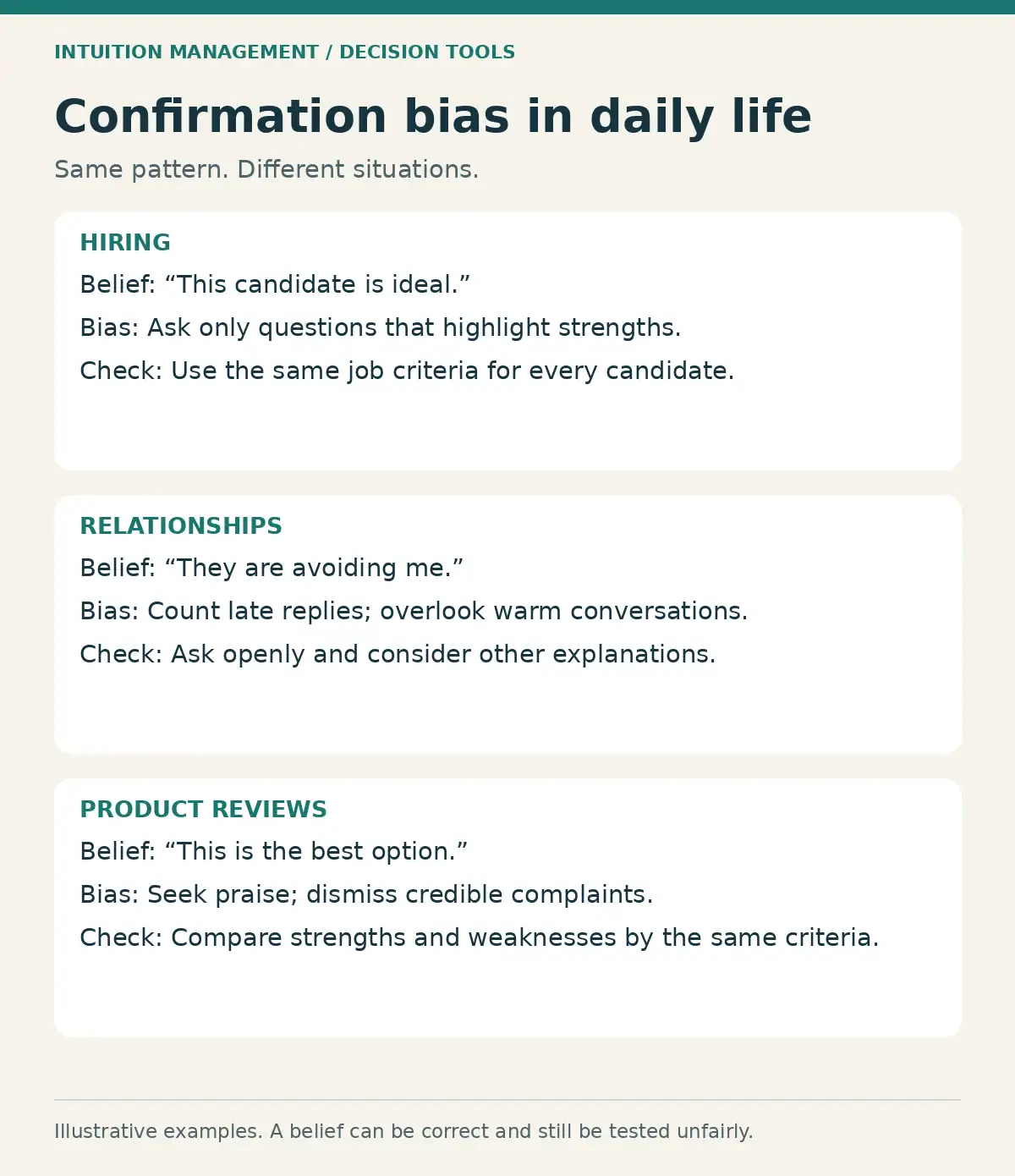
The following examples are illustrative. They show what an uneven evidence check can look like, rather than proving that a particular person is biased.
1. Hiring a candidate you already like
You form a favorable impression during an interview. You ask encouraging questions about the candidate’s successes, while asking another candidate mainly about weaknesses. The resulting comparison reflects different tests as well as different applicants. A better check uses the same job-related criteria and comparable questions for everyone.
2. Reviewing a project you expect to fail
You suspect a launch will slip. Every unresolved issue enters your mental list, but completed work barely registers. The concern might be right. To assess it, examine the remaining critical work, dependencies, and available capacity together, rather than counting only warning signs.
3. Interpreting a slow reply in a relationship
You believe a friend is avoiding you. A late response seems meaningful, while a recent friendly conversation is dismissed as politeness. Before assigning a motive, consider what you actually know and ask an open question. Response speed alone does not reveal another person’s intentions.
4. Researching a purchase you already want
You search for positive reviews of a device, then reject negative reports because their authors “probably used it incorrectly.” Check whether you would accept that explanation for a competing product. Compare credible reports against your actual needs, including limitations you would have to live with.
5. Evaluating an online claim
A claim matches your view, so a confident summary feels sufficient. A conflicting claim prompts demands for detailed evidence. Use comparable standards: inspect the original source, the methods where relevant, and whether the conclusion follows. Agreement with your view is not itself a measure of source quality.
How Confirmation Bias Reinforces a First Impression
Consider this practical pattern: a belief directs your search, the search produces mostly matching information, and that information increases your confidence. You then approach the next observation with an even stronger expectation. The cycle diagram below illustrates this pattern; it is not a fixed sequence of brain processes.
Suppose your question is “Why is this plan unrealistic?” You are likely to collect a different set of answers than if you ask “What would have to be true for this plan to work, and what could prevent it?” The second question makes room for both feasibility and risk.
Watch for a specific warning sign: you can explain away every possible challenge but readily accept weak support. Pause and name an observation that would make you reconsider. If none exists, clarify whether you are investigating a claim or expressing a preference.
Confirmation Bias vs Intuition
Intuition describes an immediate judgment whose reasoning is not consciously available step by step. Confirmation bias describes a tendency in how evidence is sought or interpreted. They are not competing labels for the same thing: an intuitive impression can be useful, mistaken, fairly investigated, or selectively reinforced.
The question is therefore not simply “Was it intuition?” Ask, “What happened after the impression arrived?” Did you examine relevant evidence, consider another explanation, and allow the judgment to change? Or did you gather reasons to defend it?
Start by separating a cue from the meaning you assign to it. “The estimate changed twice” is more specific than “The team has no idea what it is doing.” Our guide to intuition vs perception explores that distinction. The comparison of intuition and heuristics also explains why a mental shortcut is not automatically an error.
Confirmation Bias vs Hindsight Bias, Outcome Bias, and Selective Perception
These concepts can overlap. The table identifies the main question each helps you examine, rather than assigning every decision to a single category.
| Concept | Main issue | Illustrative thought |
|---|---|---|
| Confirmation bias | Favoring evidence that fits an existing belief. | “These two delays prove I was right about the supplier.” |
| Hindsight bias | Seeing the outcome as more predictable after it happens. | “The missed deadline was obvious all along.” |
| Outcome bias | Letting the result unduly determine the evaluation of a decision. | “The launch succeeded, so approving it was a good decision.” |
| Selective perception | Expectations and attention shaping what is noticed or interpreted. | “I noticed the late replies but barely registered the completed milestones.” |
For retrospective reviews, read the guides to hindsight bias and outcome bias. Confirmation bias can shape an investigation before the result is known and can also affect how people interpret evidence afterward.
Worked Example: “This Supplier Will Miss the Deadline”
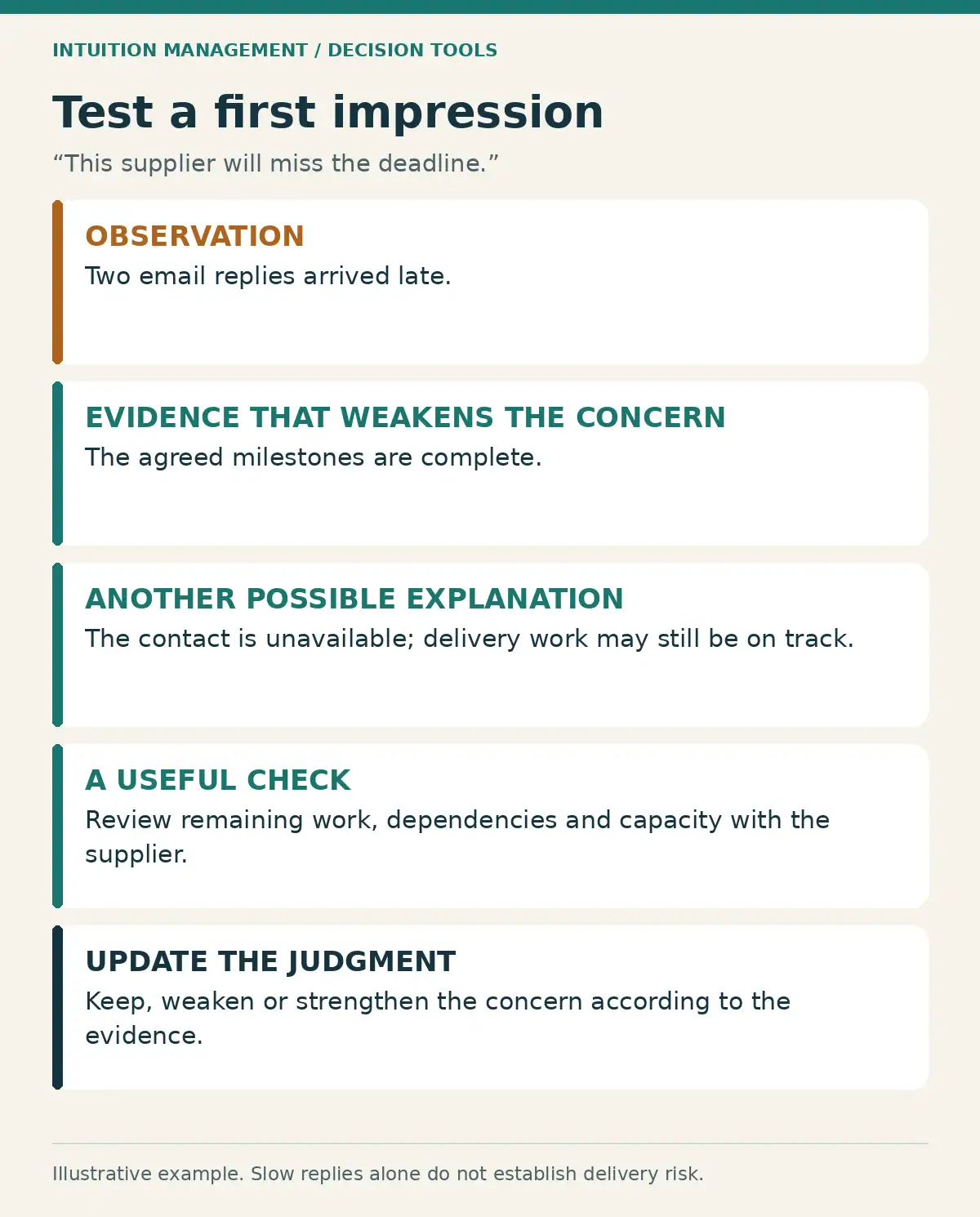
Imagine a delivery manager reviewing a supplier two weeks before launch. This fictional example shows a checking process, not a formula for forecasting delivery.
The first impression
The supplier has answered two emails late. The manager feels that the delivery is in trouble and starts collecting examples of poor communication. A review meeting is scheduled around the question, “Why are they failing?”
What the initial story leaves out
The agreed milestones are complete. The contact person may be unavailable even though the delivery team is progressing. Neither point proves that the deadline is safe, but both matter. Communication reliability and delivery readiness should be examined separately before assuming one establishes the other.
A more useful test
The manager asks for the remaining work, current blockers, dependency owners, and capacity through launch. They compare this information with the agreed acceptance criteria and seek evidence of completed work. This check is more relevant to the deadline than email speed alone.
How the judgment changes
If a critical dependency has no owner and testing has not started, the concern becomes stronger for concrete reasons. If the remaining work is small and verified, the delivery concern weakens, while the communication issue still needs attention. The goal is an appropriately updated judgment, not a positive verdict.
How to Reduce Confirmation Bias
1. Write the belief before collecting more evidence
Use a specific statement that could be challenged. “This launch will miss its agreed date” is easier to examine than “Something is wrong.” Record what led to it, what remains unknown, and when you need to decide. A decision journal gives you a place to preserve that starting point.
2. Name a plausible competing explanation
Ask how the same observation could occur if your initial explanation were wrong. In the supplier example, delayed communication and delayed delivery are different possibilities. Choose alternatives that fit the situation; you do not need an endless list of unlikely stories.
In two experiments, Lord, Lepper, and Preston found that prompting people to consider the opposite corrected studied judgment biases more effectively than general instructions to be fair and unbiased. That supports a concrete alternative-explanation exercise, but does not show that it removes bias from every real-world decision. Read the study summary.
3. Look for a finding that would distinguish the explanations
More information is not always more useful information. Ask what you would expect to observe under each explanation. For the supplier, verified work and unresolved dependencies are more informative about readiness than another opinion about whether the supplier “seems committed.”
4. Apply comparable standards to both sides
Check relevance, reliability, and independence whether evidence supports or challenges you. Five people repeating one unverified report are not five independent confirmations. At the same time, fairness does not require giving a weak claim equal weight to strong evidence.
5. Invite a specific challenge
Instead of asking a colleague “Do you agree?”, ask “Which part of this explanation is least supported?” or “What have I left out?” Give them access to the same information. Their disagreement is an input to examine, not an automatic reason to reverse your decision.
6. Decide, record, and review
Set a reasonable limit on checking based on the stakes and time available. Record your decision, its evidence, and what would trigger reconsideration. Afterward, compare the result with the original record. This keeps the exercise focused on learning rather than repeatedly defending or doubting yourself.
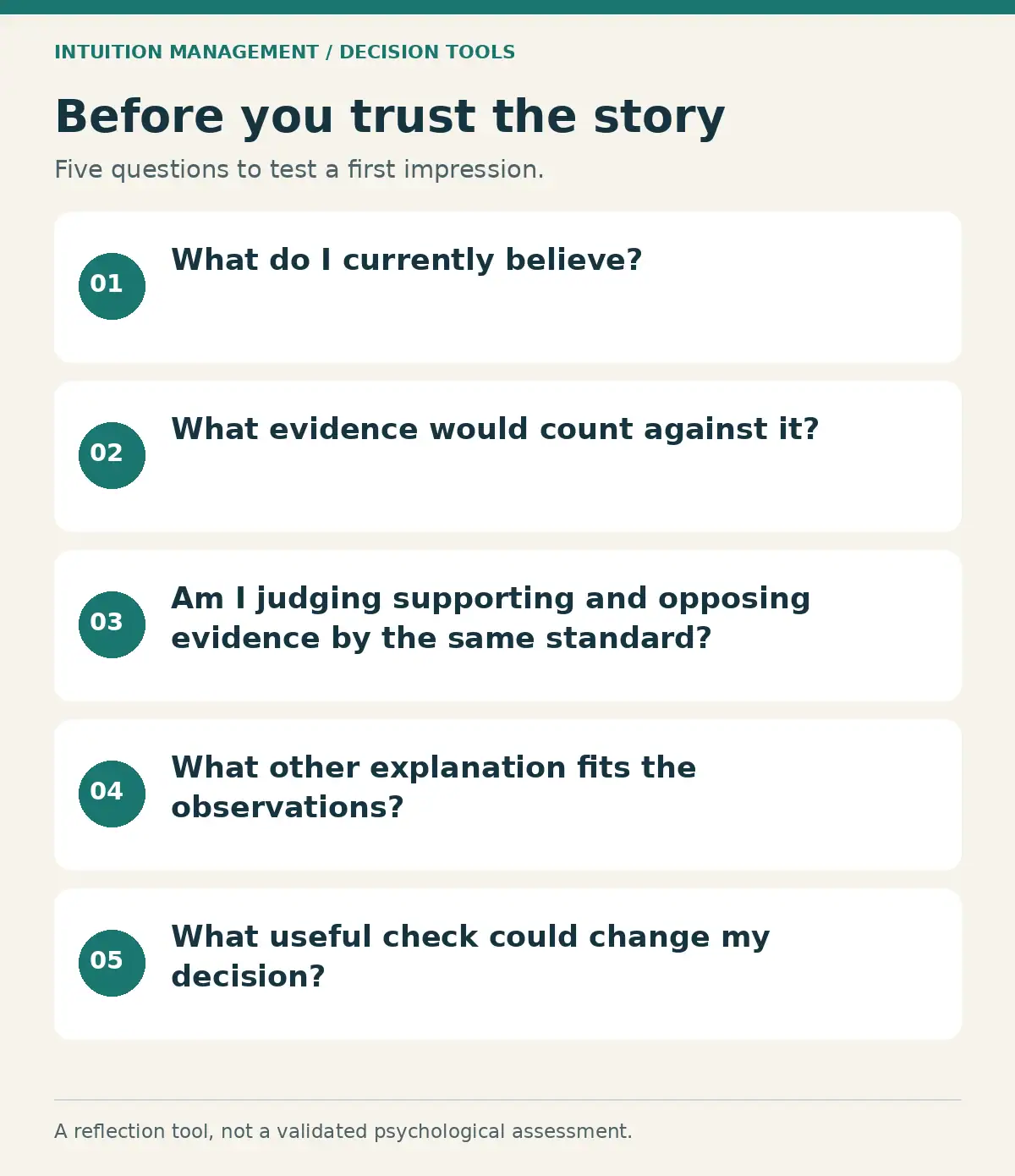
A Five-Question Confirmation Bias Checklist
- What do I currently believe?
- What evidence would count against it?
- Am I judging supporting and opposing evidence by the same standard?
- What other explanation fits the observations?
- What useful check could change my decision?
Copyable first-impression worksheet
Decision and deadline: What must I decide, and by when?
My current belief: What do I think is happening?
Supporting evidence: What observations support it?
Evidence that weakens it: What does not fit?
Another plausible explanation: What else could account for this?
Next useful check: What can I verify?
Update condition: What finding would change my view?
Decision and review: What will I do, and when will I revisit it?
Try the worksheet on one manageable decision. A few honest sentences are enough to reveal a missing check. For a fuller record, use the decision journal template and worked examples.
Frequently Asked Questions
What is confirmation bias in simple terms?
It means giving an existing belief an unfair advantage when looking for or interpreting evidence. You may readily accept support while applying much tougher standards to information that challenges the belief.
What is a simple example of confirmation bias?
You believe a product is excellent, read only positive reviews, and dismiss credible negative reviews without examining them. A fairer comparison checks both strengths and limitations against the same requirements.
Is confirmation bias the same as intuition?
No. Intuition is a way a judgment can arise. Confirmation bias concerns how evidence is treated. An intuitive impression can be followed by either a fair check or a selective search for support.
Can confirmation bias occur when your belief is correct?
Yes. A correct conclusion does not demonstrate that the investigation was fair. You could reach the right answer while ignoring relevant contrary evidence. Assess the reasoning process as well as the conclusion.
Does considering alternatives mean ignoring expertise?
No. Relevant experience can inform the initial judgment and the choice of useful checks. The aim is to make the judgment responsive to evidence, including evidence that would reveal a mismatch with the present situation.
Can you eliminate confirmation bias completely?
A checklist cannot guarantee that. A practical goal is to make selective reasoning easier to notice and correct. Specific questions, consistent evaluation criteria, and a record of the original judgment create opportunities to update.
Sources and Scope
- Nickerson, R. S. (1998). Confirmation Bias: A Ubiquitous Phenomenon in Many Guises. Review of General Psychology, 2(2), 175–220.
- Lord, C. G., Lepper, M. R., & Preston, E. (1984). Considering the Opposite: A Corrective Strategy for Social Judgment. Journal of Personality and Social Psychology, 47(6), 1231–1243.
The research references support the definition and the discussion of considering alternatives. The everyday scenarios, supplier example, diagrams, checklist, and worksheet are original educational illustrations and practical suggestions, not findings from those studies or validated assessment instruments.