Outcome bias is the tendency to judge a decision by how it turned out, rather than by the information and reasoning available when it was made. A favorable result can make a risky choice look wise. An unfavorable result can make a reasonable choice look careless.
Imagine a manager approving a limited pilot after checking readiness and agreeing on a backup plan. If everything runs smoothly, the manager is praised. If an unexpected supplier outage interrupts the pilot, the same choice is criticized. The result has changed—but has the quality of the original reasoning changed with it?
This guide explains outcome bias with everyday examples, distinguishes it from hindsight bias, and offers a practical way to review decisions fairly. The workplace scenarios and checklist are original educational aids, not reported case studies or validated assessment tools.

What is outcome bias?
Outcome bias occurs when knowledge of a result distorts our evaluation of the decision that produced it. We replace the question “Was this choice justified at the time?” with the easier question “Did it work?”
In research by Jonathan Baron and John C. Hershey, participants evaluated decisions made under uncertainty. Favorable outcomes led to more favorable evaluations, even when participants had the relevant information available to the decision-maker. A later preregistered replication with 692 participants also found that outcomes affected evaluations in medical scenarios. These studies support the distinction between a decision’s result and how people judge its quality; they do not validate the workplace checklist below. See the original study and the replication and extensions.
Outcome bias can appear in praise as well as blame. “It succeeded, so skipping the checks was sensible” is just as questionable as “It failed, so the person must have been incompetent.” In each case, the result substitutes for examining the choice.
A fair review asks two questions: What happened? And was the decision reasonable given what could have been known and done at the time?
Those questions belong together. A good explanation of the original reasoning does not remove responsibility for preventable errors.
Outcome bias examples
The following examples are fictional. Each shows why a result alone is an incomplete basis for evaluating a choice.
A rushed release succeeds
A team skips an available compatibility check to meet a launch date. No customer reports a problem, so the team treats the shortcut as proven good practice.
The review question: Was skipping the check justified by its cost, urgency, and the foreseeable exposure? A trouble-free release does not establish that the unchecked risk was acceptable. Equally, the mere existence of a skipped check does not settle the question without considering its relevance.
A carefully selected hire struggles
A hiring team checks relevant experience and uses a realistic work sample. After the person joins, a reorganization changes the role substantially. Performance suffers, and the original hiring decision is labeled a mistake.
The review question: Did the selection process assess the job that existed, and was the later change reasonably foreseeable? The outcome may reveal a selection gap, a change in requirements, an onboarding problem, or several factors together.
A well-researched purchase disappoints
You compare a laptop’s specifications, warranty, and independent reviews before buying it. Your unit develops a fault. You conclude that choosing that model was obviously foolish.
The review question: Was there a warning you could reasonably have found, or did an uncertain risk materialize? The fault matters for what you do next. By itself, it does not establish that the original comparison was careless.
Outcome bias vs hindsight bias
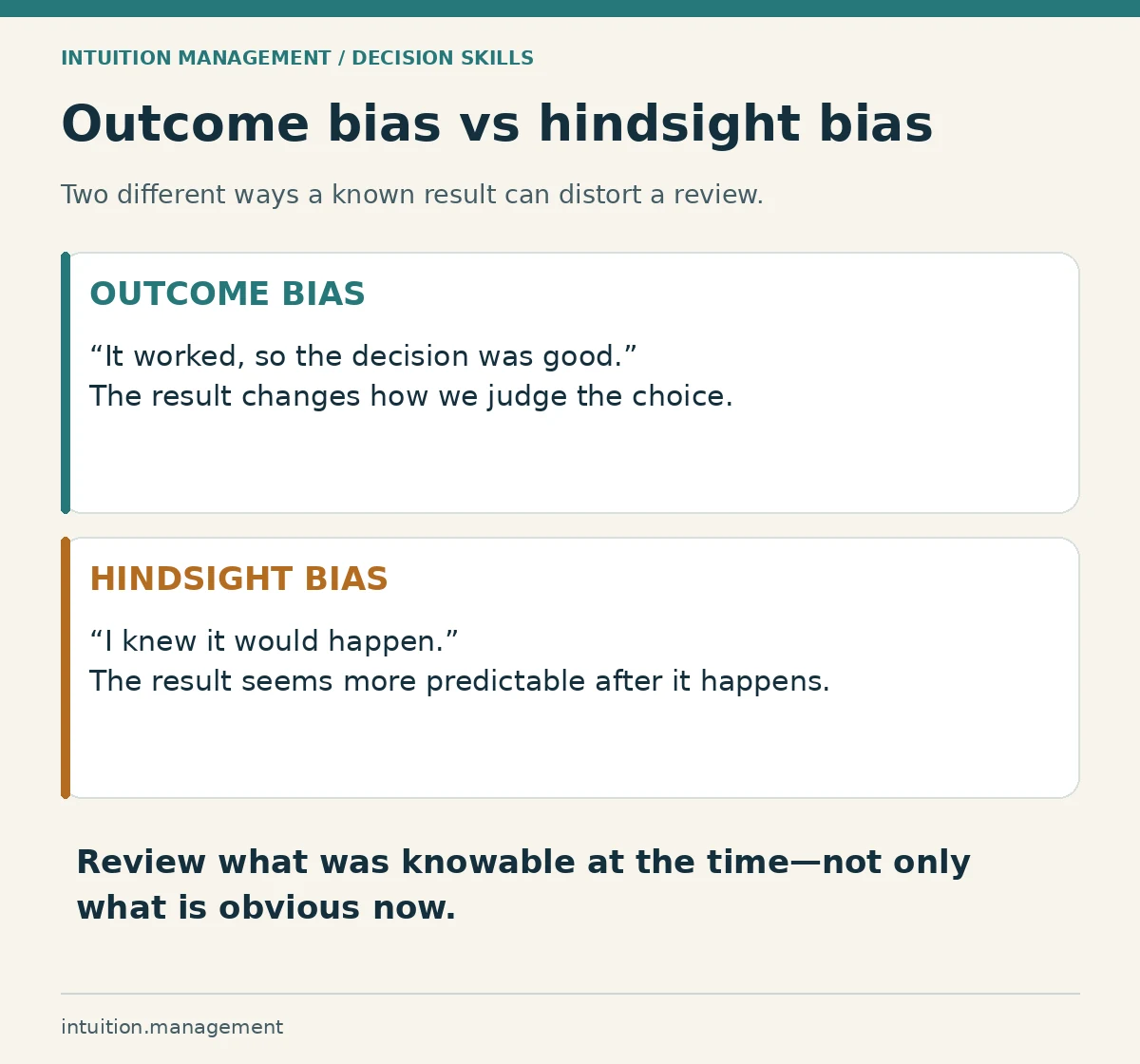
The distinction is between evaluating a choice and judging how predictable an event was. Both can occur in the same review, but they are not interchangeable.
| Bias | Typical statement | What becomes distorted? |
|---|---|---|
| Outcome bias | “It worked, so the decision was good.” | The evaluation of the decision. |
| Hindsight bias | “I knew it would happen.” | Memory of earlier beliefs, or how predictable the event seems. |
You can accept that an outage was difficult to predict and still judge a manager more harshly because it occurred. That illustrates outcome bias without necessarily claiming that the event was obvious beforehand. For the broader problem of reconstructing what you knew, see the guide to hindsight bias.
Decision quality vs outcome: four combinations
For this practical guide, sound reasoning means considering relevant evidence, feasible alternatives, foreseeable risks, and the constraints of the choice. It does not mean collecting unlimited information or guaranteeing success. A decision made under urgent conditions may reasonably involve fewer checks than one made with weeks available.
| Reasoning | Outcome | Useful review |
|---|---|---|
| Sound | Favorable | Identify useful practices and what else contributed. |
| Sound | Unfavorable | Check assumptions, execution, and new events before assigning blame. |
| Weak | Favorable | Investigate skipped checks; success does not erase an avoidable exposure. |
| Weak | Unfavorable | Identify preventable errors and a specific improvement. |
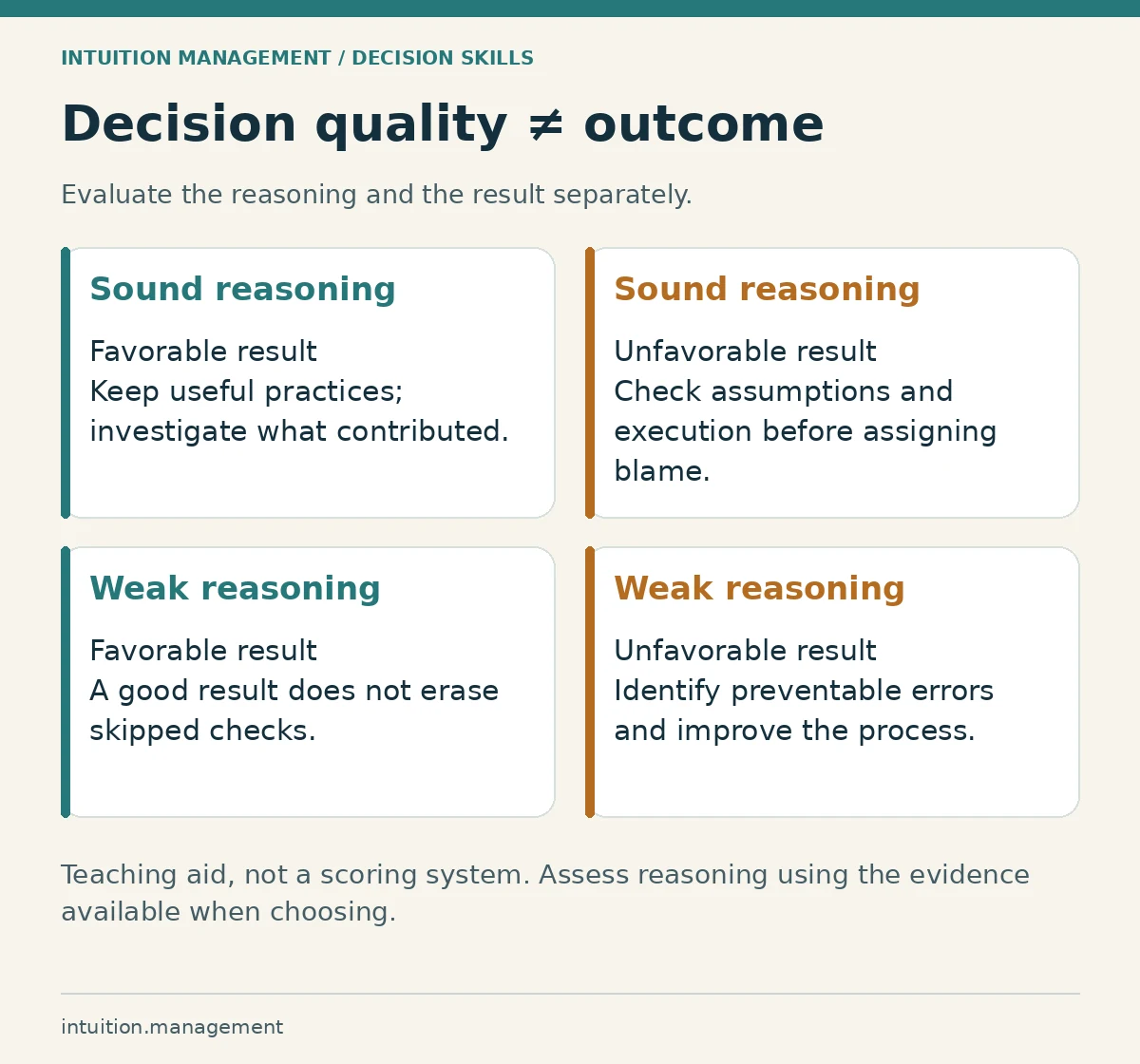
The difficult part is establishing the quality of the reasoning independently of the result. A decision record helps. So does asking what would count as an adequate check before anyone knows how the situation ends.
Worked example: one delivery decision, two outcomes
A delivery manager must decide whether to proceed with a limited pilot that depends on a supplier. The team has checked supplier readiness, confirmed a backup, and agreed on a stop trigger. Remaining uncertainty is documented. The manager approves the limited pilot rather than a full release.
This fictional example holds the initial evidence, choice, and safeguards constant. Only subsequent events change.
Outcome A: the supplier remains available
The pilot finishes on time. A stakeholder says, “You were right to proceed.” That may be a fair conclusion—but the successful result alone cannot establish whether the readiness check was adequate or the exposure proportionate.
Outcome B: an unexpected outage occurs
The supplier experiences an outage. The team follows the stop trigger and postpones the pilot. A stakeholder says, “You should never have approved it.” That conclusion also needs evidence. Was the outage reasonably foreseeable? Did the backup work as intended? Was a relevant warning ignored?
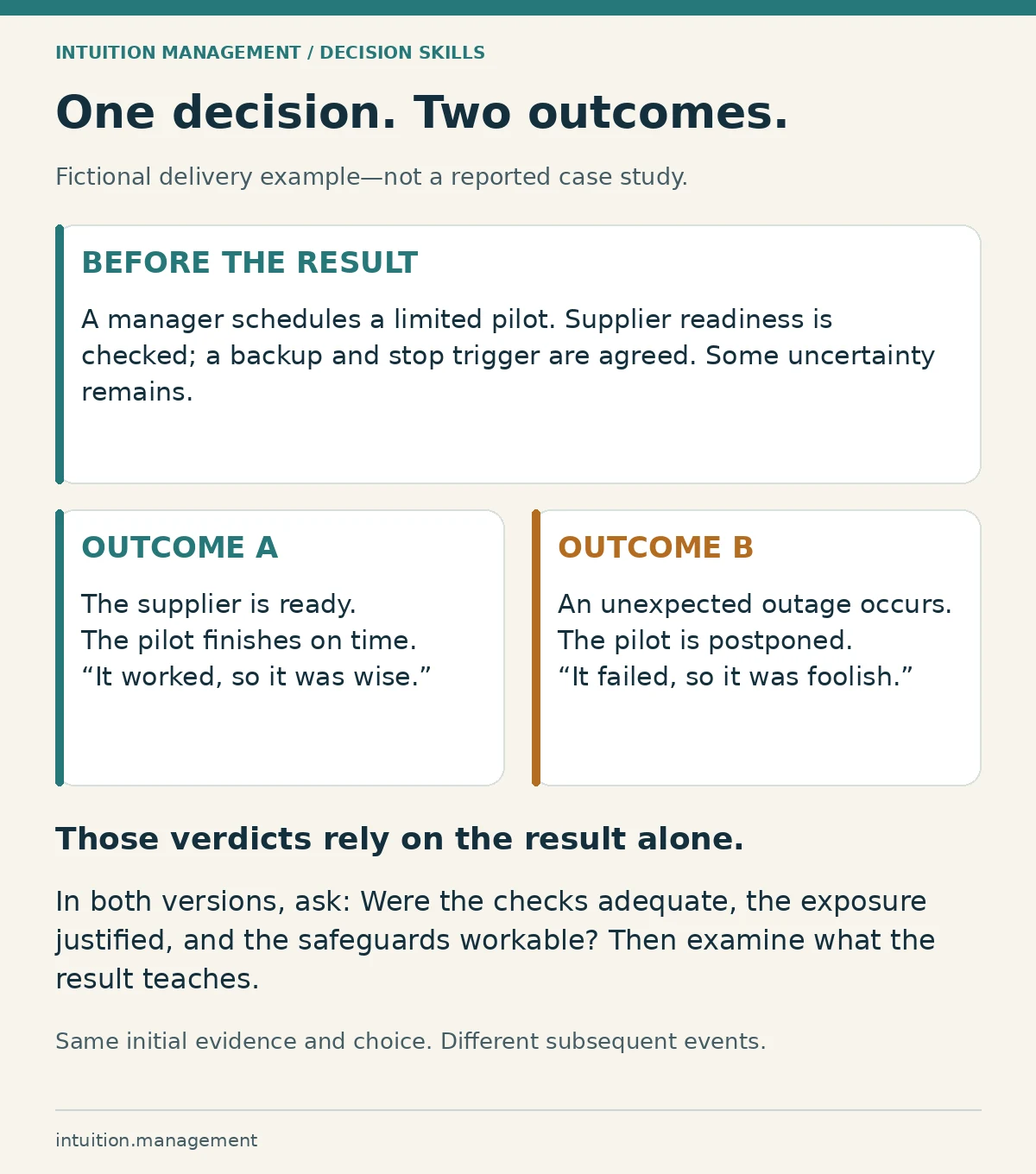
A fair review of both versions
Begin with the same criteria: the scope of the readiness check, the foreseeable consequences, the available alternatives, and the feasibility of the safeguards. Then examine execution and the new information supplied by the result.
If a supplier warning was available and ignored, that is relevant evidence against the reasoning—even if the pilot succeeded. If the readiness checks were proportionate and an unforeseeable event occurred, the interruption alone does not prove poor judgment. Do not declare the process sound merely because the manager documented it: inspect the substance of the record.
When specialist assessments support a choice, preserve what each expert actually claimed and the assumptions attached to it. The guide to expert judgment explains how to make those assessments inspectable.
How to reduce outcome bias in decision reviews
The following practices structure a fairer review. They are practical recommendations, not a promise to eliminate bias.
- Record the reasoning before the result. Note the choice, relevant evidence, alternatives, uncertainty, and review trigger. Use the decision journal template and worked examples if you need a starting point. Label later reconstructions honestly.
- Agree on review criteria in advance. Specify what counts as adequate evidence and an acceptable exposure for this decision. Avoid inventing a new standard only after something goes wrong.
- Separate the initial choice from execution. A reasonable plan can be poorly implemented. An initially weak plan can be rescued by later interventions. Record both instead of assigning one label to the entire episode.
- Try the opposite-outcome question. Ask whether you would praise the same reasoning if the result were favorable, or criticize it if the result were unfavorable. A changed answer is a reason to inspect your criteria, not proof of bias by itself.
- Look for patterns across comparable decisions. Repeated results can reveal weak assumptions or ineffective practices. Compare similar situations and account for changes in conditions; do not use “bad luck” to dismiss a persistent problem.
Learn from outcomes without letting them rewrite the past. A result can reveal a missing dependency, a failed safeguard, or an assumption that needs revision. Ask whether that information was reasonably available beforehand and how it should change the next decision.
Five questions for a fair decision review
Copy these questions into a retrospective or personal review. Answer them against the original record wherever possible.
- What was known? What information was available when the decision was made, and what became known only afterward?
- What was considered? Were reasonable alternatives, foreseeable risks, and relevant constraints examined?
- What was missed? Was important evidence ignored, or was a useful and feasible check skipped?
- Would my verdict change? Would I judge the same reasoning differently if the outcome had been reversed?
- What can we learn? What specific change does the result support, and what remains uncertain?
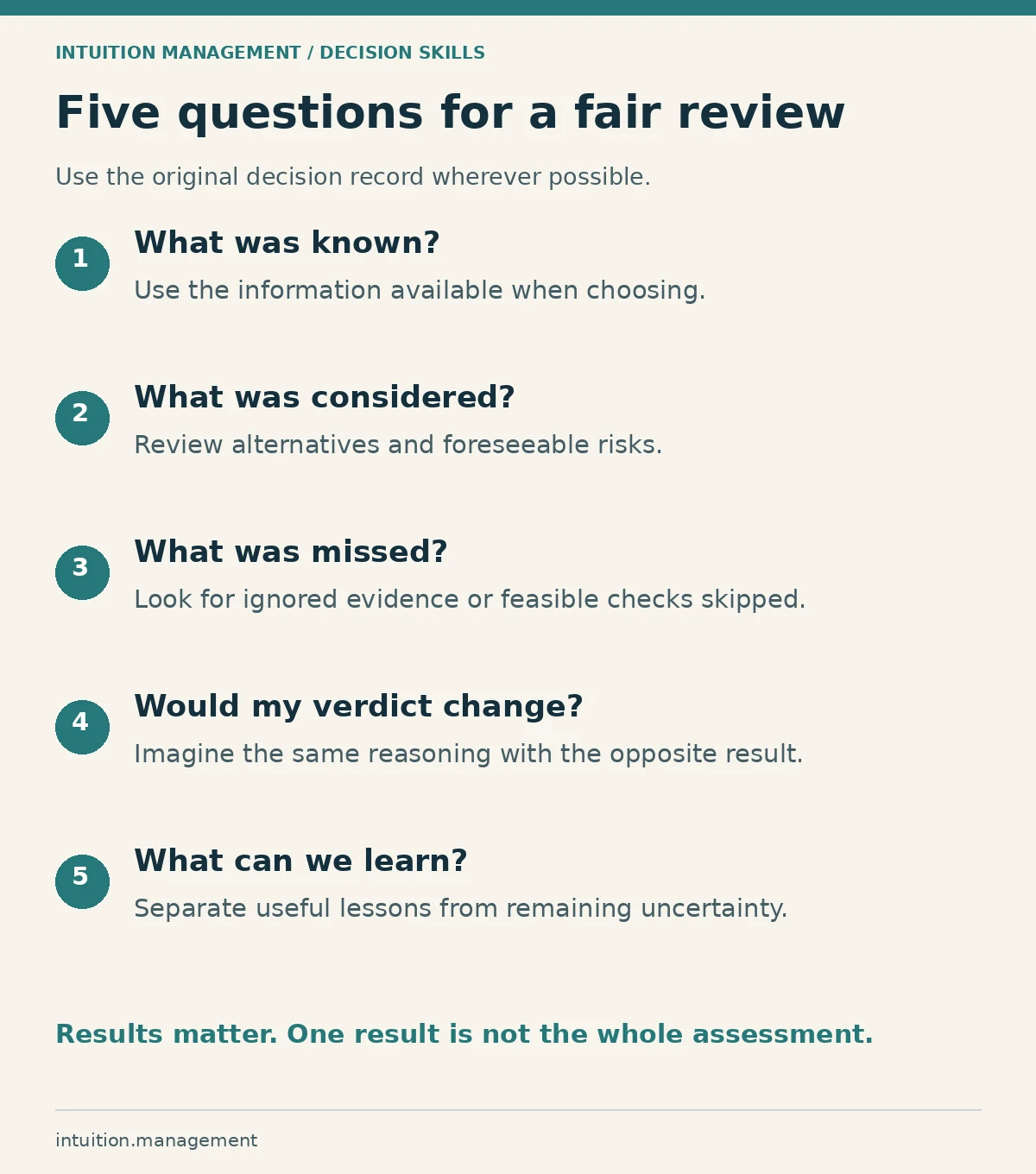
Finish with one concrete adjustment: add a missing check, clarify an assumption, change a safeguard, or collect evidence across more comparable decisions. “Trust my gut more” and “never trust my gut again” are usually too broad to be useful lessons from a single event.
Frequently asked questions
Can a good decision have a bad outcome?
Yes. A choice can be reasonable given the available evidence and still turn out badly because uncertainty remains. But a disappointing result deserves investigation: it may reveal a preventable error, weak execution, or information that improves future decisions.
Does avoiding outcome bias mean ignoring results?
No. Results matter for learning, accountability, and assessing whether a process works over time. The aim is to avoid treating the result as the complete explanation of the original decision’s quality.
Is outcome bias the same as hindsight bias?
No. Outcome bias concerns how the result affects your evaluation of a choice. Hindsight bias concerns how knowing the result changes your memory of earlier beliefs or makes the event seem more predictable. They can occur together.
How can outcome bias affect trust in intuition?
A successful intuitive choice may tempt you to trust every similar feeling. A failed choice may tempt you to dismiss intuition altogether. A more useful review records what you noticed, what evidence supported the interpretation, and whether the situation resembled ones in which you had relevant experience. One result cannot establish the reliability of all your intuitions.
What if no decision record exists?
Use dated messages, notes, and other contemporaneous evidence to reconstruct what was available. Distinguish those records from later recollections, and mark gaps as unknown. Start recording important decisions prospectively rather than presenting a reconstruction as an original entry.
Sources and further reading
The studies below support the research discussion. The delivery example, four-combination teaching aid, and checklist are original educational material.
- Baron, J., & Hershey, J. C. (1988). Outcome bias in decision evaluation. Journal of Personality and Social Psychology, 54(4), 569–579. DOI: 10.1037/0022-3514.54.4.569.
- Outcomes Affect Evaluations of Decision Quality: Replication and Extensions of Baron and Hershey’s (1988) Outcome Bias Experiment 1. A preregistered replication and extension using medical decision scenarios.
Put the idea into practice: choose one recent decision, locate the evidence available at the time, and answer the five review questions. For your next meaningful choice, record the reasoning before the outcome arrives.