Hindsight bias is the tendency to see an outcome as more predictable after it happens than it seemed beforehand. Often called the “knew-it-all-along” effect, it can change how you remember your earlier judgment. What was once a possibility starts to feel like something you always expected.
A project misses its deadline. Someone says, “We all knew this would happen.” Yet the original plan described several possible outcomes, and the same person had supported the launch date. The result has become clear; the earlier uncertainty has become harder to remember.
This matters when you evaluate intuition. A later feeling of certainty is weak evidence of what you actually predicted. The useful comparison is between your original expectation, the information available then, and what happened next.

What Is Hindsight Bias?
Hindsight bias concerns the gap between how foreseeable an event was before it occurred and how foreseeable it appears afterward. It does not mean that every correct prediction was imagined later. The issue is whether knowing the result has inflated your account of what you or someone else could have known.
In foundational experiments, Baruch Fischhoff found that receiving outcome information changed participants’ estimates of an event’s earlier likelihood and the relevance of the information describing it. Participants were largely unaware of that influence. The original work appeared in 1975; the linked paper is its 2003 reprint.
A useful everyday distinction is between “I considered that possibility” and “I predicted that result.” If you listed four possible explanations, the fact that one proved correct does not mean you confidently selected it beforehand.
Hindsight Bias Examples in Everyday Life
The following examples are fictional illustrations. Each compares an uncertain situation with a later claim that it had been obvious.
A project deadline
Before a release, a team sees a manageable schedule with a supplier risk. After the supplier misses a milestone, the delay is described as inevitable. A fair review retrieves the original assessment and asks whether the team responded appropriately to the risk it could identify.
A hiring decision
An interview panel records both strengths and concerns. When the new hire struggles, one interviewer remembers an ambiguous answer as a decisive warning. Revisit the scorecards: was that concern documented, how much weight did it receive, and what evidence pointed the other way?
An exam result
A student is unsure whether they passed. After receiving a low mark, they say, “I knew I had failed.” They may accurately remember some difficult questions while overlooking the answers they originally felt confident about. The useful lesson lies in identifying knowledge gaps, not treating the final mark as proof of earlier certainty.
A sports prediction
Before a match, a fan says either team could win. Afterward, the winning team’s advantage seems obvious. Comparing the later explanation with a message sent before the match makes the shift easier to examine.
In each example, ask one specific question: What evidence establishes the earlier expectation? If there is no record, acknowledge that uncertainty instead of confidently declaring either foresight or bias.
Why Outcomes Seem Obvious Afterward
Roese and Vohs’s review of hindsight bias distinguishes three aspects: distorted memory of a prior judgment, a belief that the outcome was inevitable, and a belief that one could have foreseen it. These can overlap; they are not a compulsory sequence.
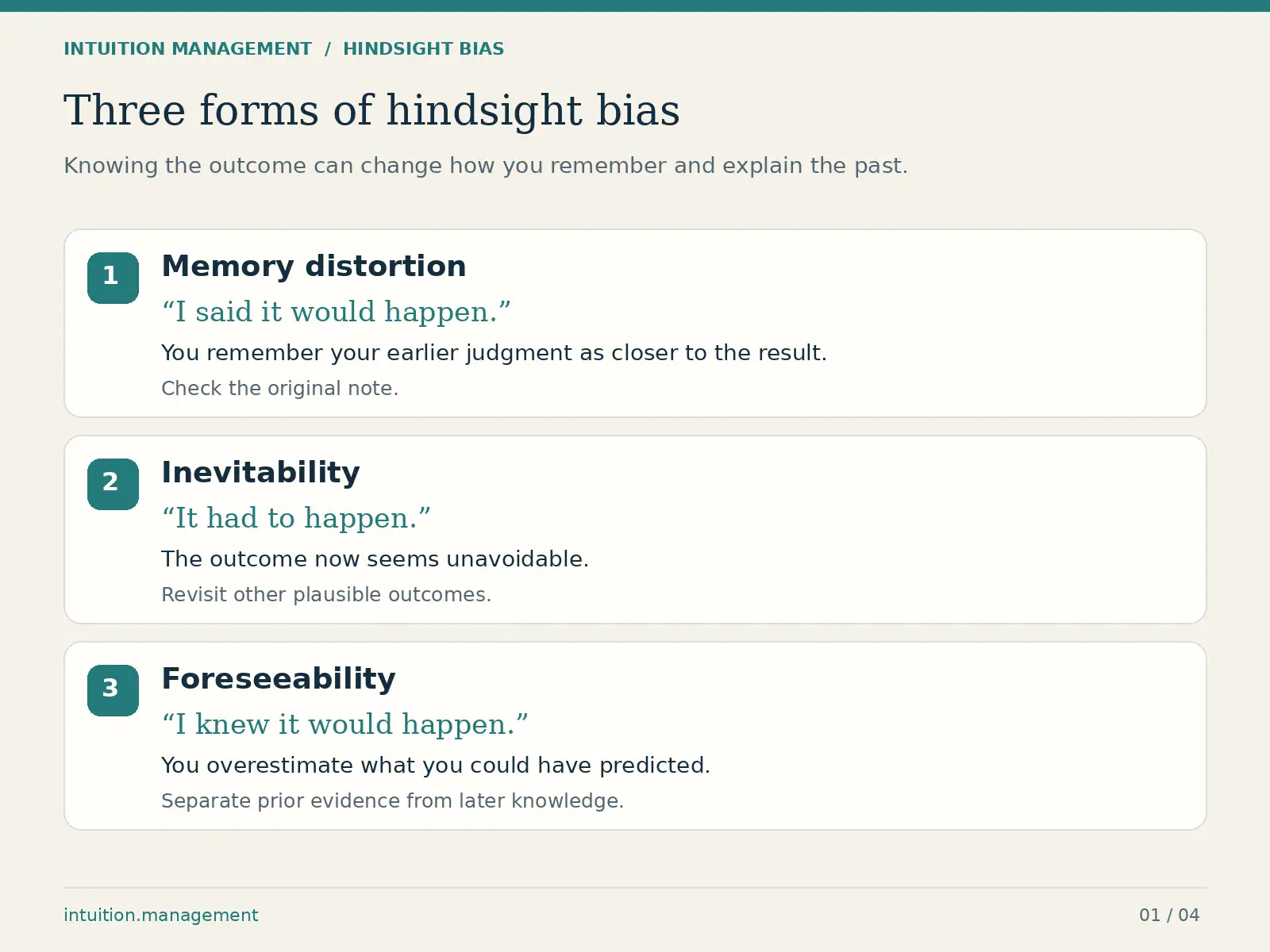
- Memory distortion: “I said it would happen.” Your recollection moves closer to the eventual result.
- Inevitability: “It had to happen.” Other plausible paths disappear from your explanation.
- Foreseeability: “I knew it would happen.” You overestimate what you could have predicted.
The review describes several contributors, including selective recall and the construction of a coherent explanation after the event. When a result becomes easy to explain, that ease can be mistaken for evidence that it was easy to foresee.
For a practical review, keep two separate questions visible: “What explains the outcome now?” and “What could we reasonably infer then?” Both are useful, but they use different information.
Hindsight Bias vs Confirmation Bias vs Outcome Bias
These biases can appear in the same review, but they distort different judgments. Naming the specific error helps you choose a useful check.
| Bias | What changes | Illustrative statement | Useful check |
|---|---|---|---|
| Hindsight bias | Your assessment of past predictability. | “The delay was obvious all along.” | Compare that claim with the original prediction. |
| Confirmation bias | Which evidence you seek, emphasize, or accept. | “These negative updates prove my view; the positive ones do not count.” | Examine relevant evidence that challenges your explanation. |
| Outcome bias | Your evaluation of the decision based on its result. | “The launch slipped, so approving the plan was a bad decision.” | Assess the process using the information available at the time. |
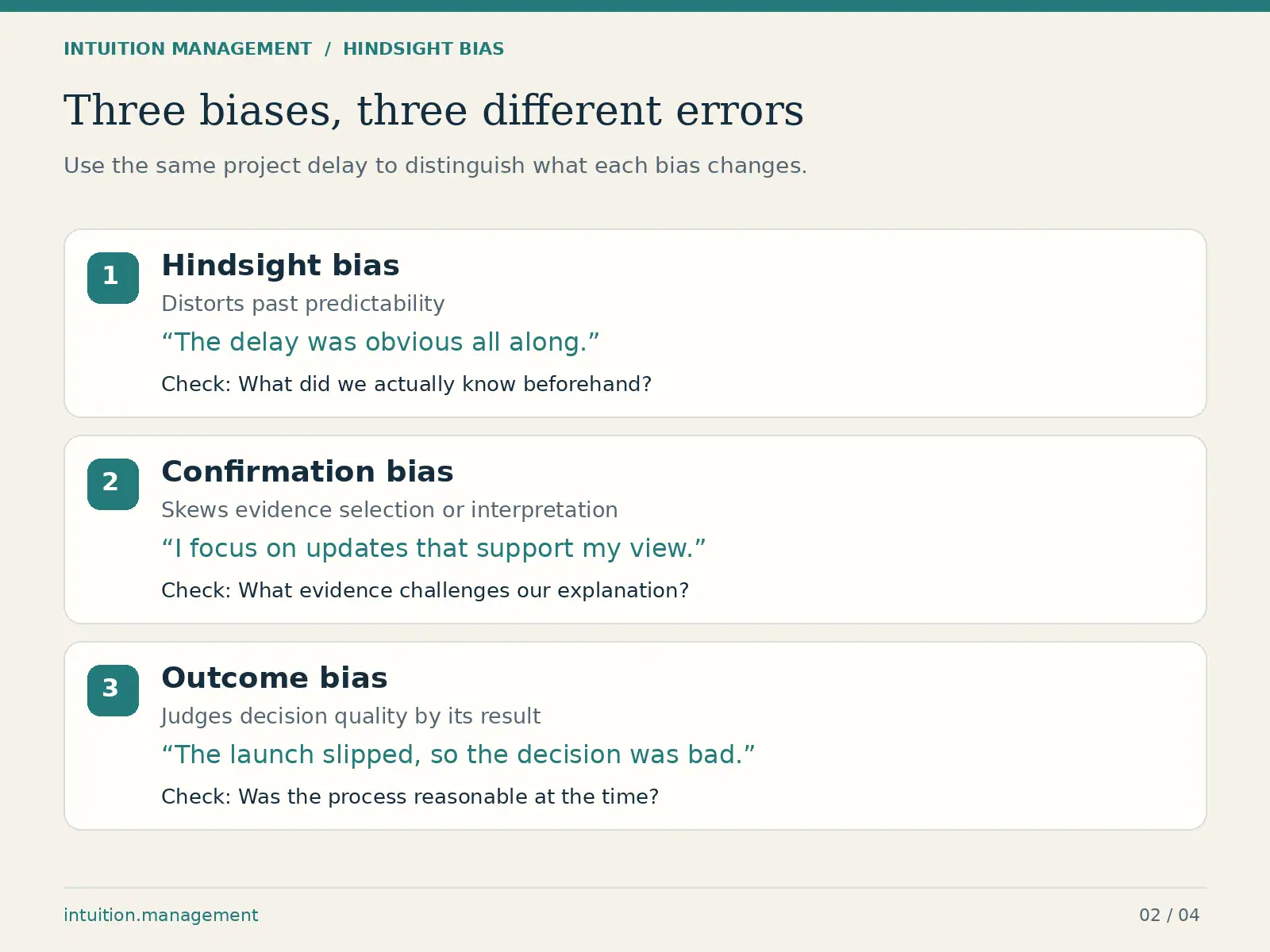
A 2023 replication and extension of an outcome-bias experiment found that outcome information influenced evaluations of decision quality. This supports treating the result and the quality of the earlier process as separate matters to investigate.
A missed deadline can reveal a poor planning process. It can also occur despite a reasonable plan. To distinguish those cases, examine the assumptions, checks, and responses rather than letting the final date answer every question.
Hindsight Bias and Intuition: Did You Actually Predict It?
Suppose you felt uneasy about a proposal and it later failed. That experience deserves examination. Start by recovering the content of the original impression: were you expecting a budget problem, a delay, a disagreement, or simply an unspecified difficulty?
A broad statement such as “something could go wrong” can fit many results. A narrower statement—“the unresolved vendor dependency may delay testing”—gives you something more specific to compare with events.
A dated prediction provides evidence of what you expected, but one successful prediction does not establish dependable intuition. You also need to examine misses, similar situations, and how specific the prediction was. The expert intuition guide explains why the task, learning opportunities, and feedback matter.
This preserves useful recognition without awarding yourself certainty you did not have. It also avoids the opposite mistake: dismissing a documented, specific warning simply because hindsight bias exists.
Worked Example: “I Knew the Launch Would Slip”
This is a fictional teaching example. The probability is illustrative, not a research finding.
Before the outcome
A delivery manager records: “I estimate a 60% chance of meeting the launch date. Vendor integration remains unresolved. A missed vendor milestone could delay testing. We need an owner, a checkpoint, and a fallback decision.”
What happens
The vendor misses its milestone and the launch slips. In the retrospective, the manager says, “I knew we would miss it.”
What the record supports
The manager identified a relevant risk. The note did not predict failure with certainty; it assigned a higher probability to meeting the date. A delay is compatible with that uncertain forecast. One outcome cannot tell us whether the 60% estimate was well calibrated.
What the team should review
Check whether the checkpoint happened, whether the fallback was feasible, and how the team responded when new information arrived. If an agreed action was ignored, identify that failure directly. If a safeguard was taken but proved insufficient, examine why and what should change.
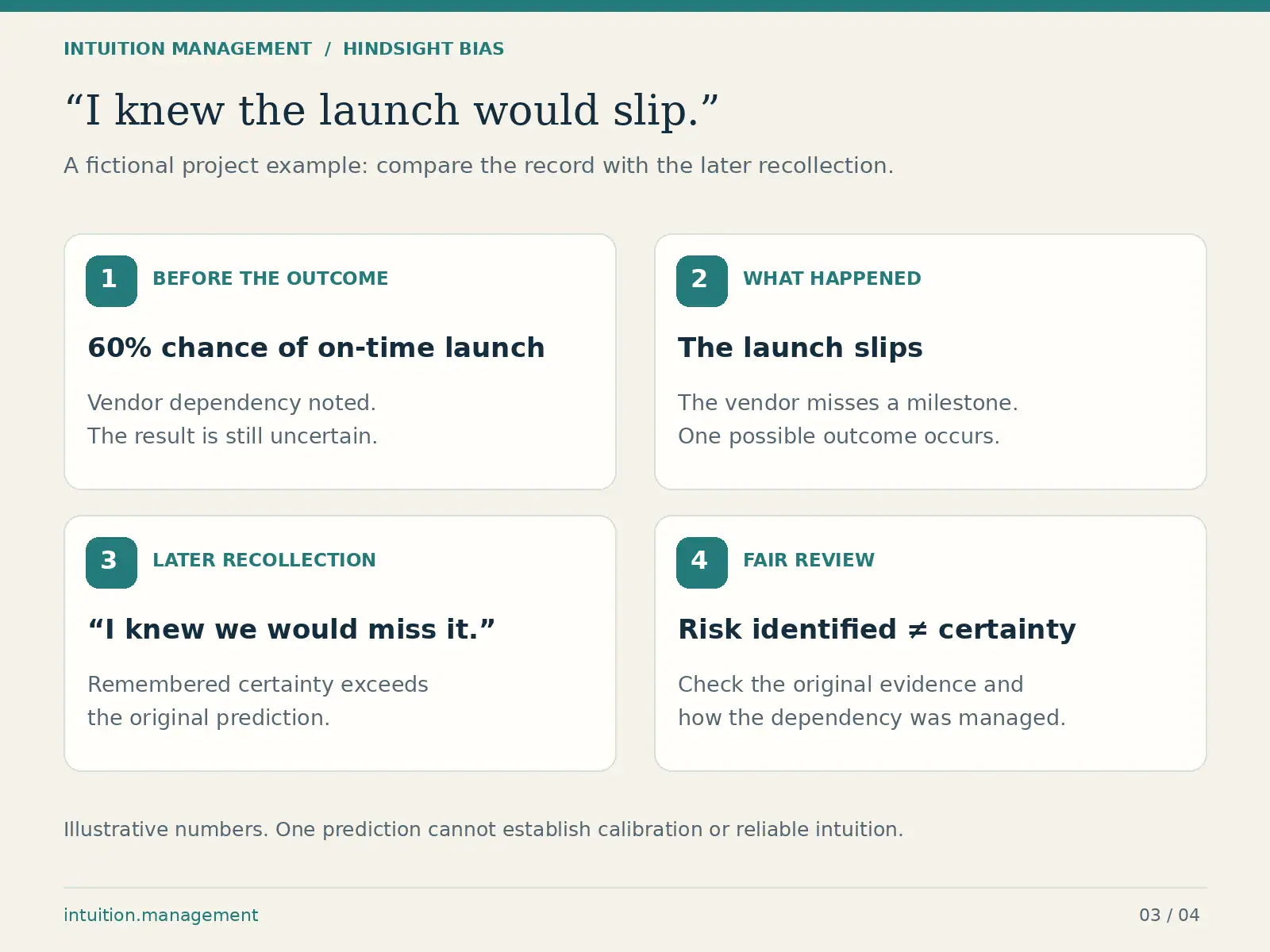
A fair conclusion might be: “We identified the dependency, but our checkpoint came too late to preserve the fallback. Next time we will schedule that check before the fallback becomes unavailable.” That produces a testable improvement rather than a contest over who remembers being right.
How to Reduce Hindsight Bias
The following routine is an original practical application of the distinctions above. It helps make reviews inspectable; it is not a proven method for eliminating bias.
1. Record the prediction before the result
Write what you expect, when you expect it, the cues supporting it, and what remains uncertain. Include an alternative. Preserve the original entry when you later update it. A decision journal with a simple template gives you a consistent place to keep that record.
2. Reconstruct the information available then
For a review, gather the relevant dated messages, assumptions, estimates, and unresolved questions. Label information that became available only later. Where practical, review the earlier record before reading the final outcome summary.
3. Consider plausible alternatives
Ask what other result the same earlier evidence could have supported. Roese and Vohs’s review reports that considering alternative causal explanations can reduce hindsight bias. The purpose is to examine reasonable alternatives, not invent remote possibilities to excuse every decision.
4. Separate the prediction from the response
“We noticed a risk” and “we managed it adequately” are different claims. A team can anticipate a problem and still fail to act. Another team can take reasonable precautions and encounter a bad result. Review the evidence for each claim separately.
5. Replace retrospective certainty with a concrete lesson
Instead of “the warning was obvious,” specify which cue should receive more attention next time and why. Define a check, owner, or decision point. Avoid a lesson so broad that nobody can tell whether it has been applied.
6. Review several comparable judgments
Keep both hits and misses. For comparable predictions labeled 60% likely, calibration concerns how outcomes match that probability over a sufficiently informative set—not whether one event happened. The intuition calibration guide offers a broader review routine.
Five Questions for a Fair Decision Review
- What did I record before the outcome? Use dated notes, estimates, or messages where available.
- How uncertain was I at the time? Keep the original probability, range, or uncertainty statement visible.
- What other outcomes were plausible? Assess alternatives using the evidence available then.
- What did I learn only afterward? Separate new information from prior knowledge.
- Was the decision process reasonable? Examine the evidence, actions, and constraints as well as the result.

For your next review, choose one completed decision. Compare its earliest available record with your current account. Write one sentence about what changed in your knowledge and one specific action for a similar future situation.
Frequently Asked Questions About Hindsight Bias
What is hindsight bias in simple terms?
It is seeing a result as more predictable once you already know it. An uncertain possibility can later feel like something you expected all along.
What is a simple example of hindsight bias?
Before a match, you say either team could win. After one team wins, you remember the result as obvious. A record of your original prediction helps establish whether your recollection changed.
How is hindsight bias different from confirmation bias?
Hindsight bias concerns how outcome knowledge changes your view of earlier predictability. Confirmation bias concerns favoring evidence that supports an existing belief. Both can occur in the same decision review.
How is hindsight bias different from outcome bias?
Hindsight bias can make a result seem foreseeable. Outcome bias can make the result dominate your evaluation of the decision. “We should have known” and “the result was bad, so the decision was bad” are different claims.
Does hindsight bias mean my intuition was wrong?
No. It means your later recollection needs checking. A dated, specific prediction may support your account. If no record exists, acknowledge the uncertainty; do not assume either reliable foresight or definite bias.
Can a decision journal prevent hindsight bias?
It preserves an earlier account that you can compare with later recollection. That is a useful safeguard, but it does not guarantee an unbiased interpretation. Keep original entries and examine alternative explanations.
Does avoiding hindsight bias remove accountability?
No. A fair review can still identify ignored evidence, missed commitments, or poor safeguards. The aim is to ground accountability in what people knew and did, rather than in certainty supplied by the outcome.
Build a clearer record of your judgment. Start with one decision-journal entry before an outcome is known. If you want a broader framework for examining impressions and uncertainty, explore The Personal Signal Decoder.
Sources and Scope
Written by Denys Kostin for Intuition Management. Research references support the named concepts and findings. The everyday scenarios, launch example, review routine, and checklist are original educational material, not reported study results or validated tests.
- Fischhoff, B. (1975; reprinted 2003). Hindsight not equal to foresight: the effect of outcome knowledge on judgment under uncertainty. Reprint in Quality and Safety in Health Care, 12(4), 304–311; discussion 311–312. DOI: 10.1136/qhc.12.4.304.
- Roese, N. J., & Vohs, K. D. (2012). Hindsight Bias. Perspectives on Psychological Science, 7(5), 411–426. DOI: 10.1177/1745691612454303.
- Aiyer, S., et al. (2023). Outcomes affect evaluations of decision quality: Replication and extensions of Baron and Hershey’s (1988) outcome bias experiment 1. International Review of Social Psychology, 36(1), Article 12. DOI: 10.5334/irsp.751.