Expert intuition is a rapid judgment based on patterns learned through experience in a specific task. Its reliability depends on learnable patterns and opportunities to learn them through relevant practice and useful feedback. A strong feeling of certainty is not evidence of accuracy. Kahneman and Klein, 2009.
A quality specialist may notice a familiar defect almost immediately. A manager may recognize that a plan rests on an assumption that has failed before. Either impression can be worth investigating. Neither becomes dependable simply because its owner sounds certain.
This guide shows how to examine the experience behind a gut feeling, recognize its limits, and choose an independent check. For the broader relationship between fast judgment and deliberate analysis, start with intuition in decision-making.

What Is Expert Intuition?
Expert intuition is sometimes called intuitive expertise or trained intuition. The emphasis is on a learned capability within a specific kind of task. Gary Klein’s review of naturalistic decision making describes how experience helps people categorize situations rapidly in real settings. Klein, 2008.
It helps to name the capability precisely. Recognizing a recurring print defect is one judgment; choosing a new production technology is another. A person may have substantial evidence behind the first and little behind the second, even when both fall within the same job title.
For this guide, treat an expert impression as a proposal with a history: what was noticed, what similar cases taught the person, and what still needs checking. That makes the impression available for discussion rather than leaving the team to accept or reject someone’s reputation.
Recognition-primed decision making explains how experienced recognition can suggest a response and how that response may be evaluated. Here, the focus is narrower: what justifies relying on the expertise behind it?
How Experience Becomes Expertise
Some patterns are learned before you can clearly explain them. This process, called implicit learning, can contribute to expert intuition. However, learning a pattern does not guarantee that it is accurate or applies to a new situation.
To inspect your own learning, choose one recurring judgment you actually make. Avoid a broad label such as “reading people” or “knowing what will work.” Try a statement that another person could examine: “I can distinguish this recurring defect from two similar-looking problems.”
The following learning loop is an original practical exercise. It makes the connection between a first impression and later evidence visible; it is not a formal model attributed to a researcher.
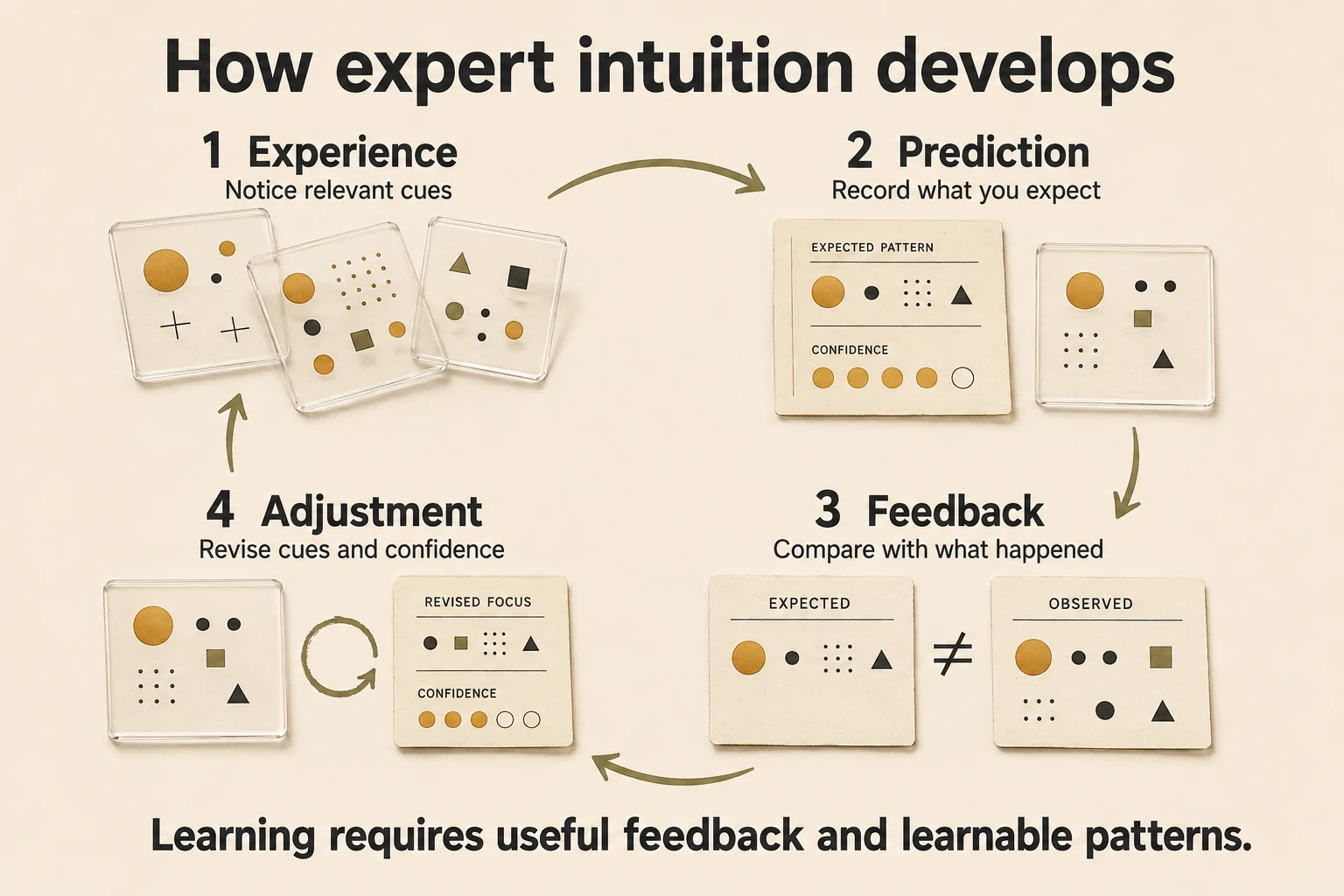
- Experience: identify the case and the specific details that caught your attention.
- Prediction: record what you expect before the result is known, including an observation that would challenge the explanation.
- Feedback: compare the record with what happened and with any evidence about why it happened.
- Adjustment: write one change to your interpretation, the cues you will examine, or the confidence you will place in the next judgment.
For example, replace “I knew something was wrong” with “I expected this pattern to have cause A; the investigation found cause B.” Then identify the clue that would have separated those possibilities. A useful review ends with a concrete revision, even if that revision is to withhold judgment until a missing fact is available.
When Is Expert Intuition Reliable?
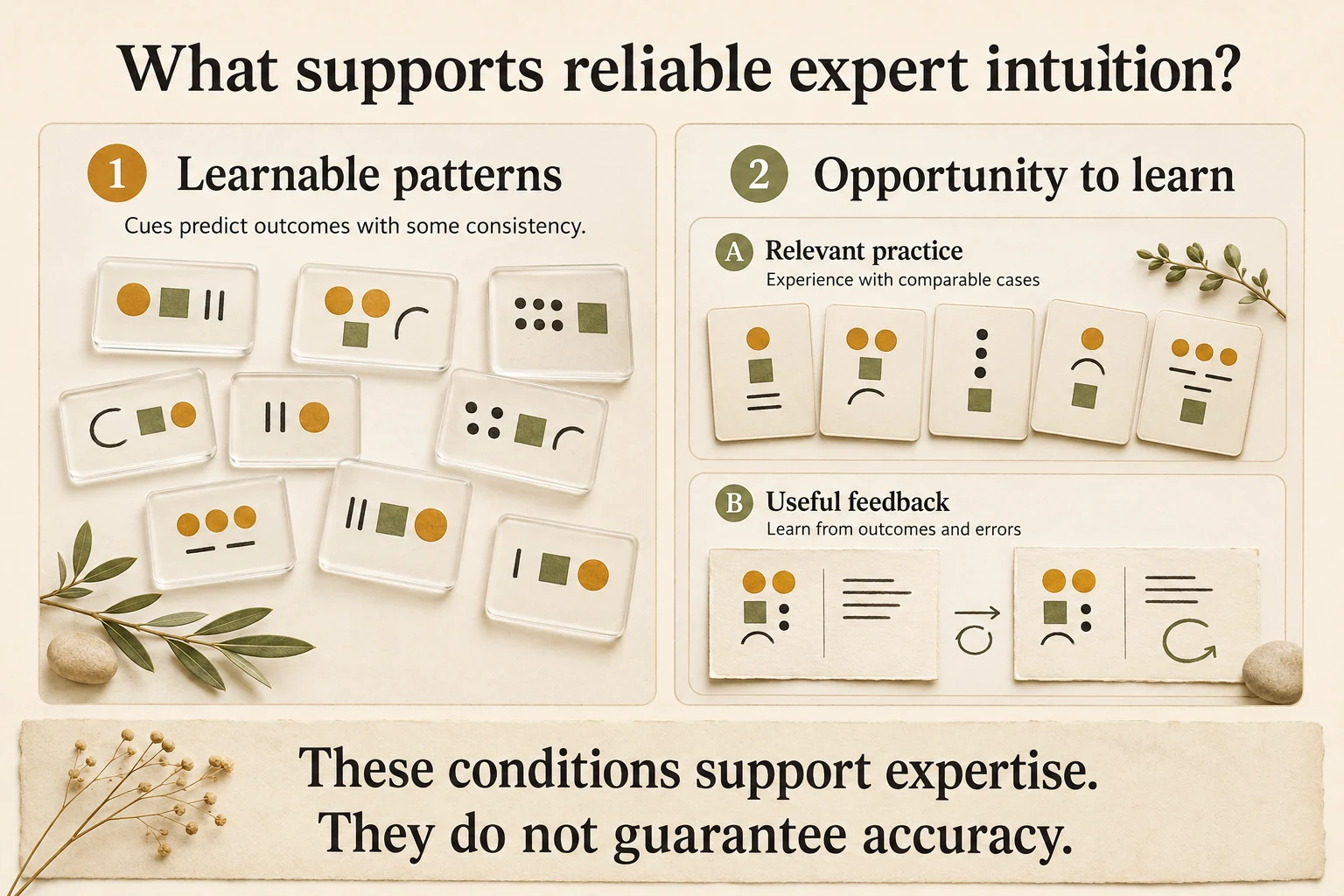
Daniel Kahneman and Gary Klein identify two broad conditions: an environment with learnable patterns and sufficient opportunities to learn them. Kahneman and Klein, 2009.
Relevant practice and useful feedback help explain the second condition. They are not two additional conditions or a separate three-part test.
Make the claimed pattern inspectable
Ask the person to point to comparable cases. What makes them comparable? Which observations favored this explanation over alternatives? Look for records or examples that another practitioner could examine, including cases where a similar appearance led to a different conclusion.
Ask what corrected the learning
Request an example of a judgment that was revised. What evidence prompted the change? Did the person learn the actual cause, or only hear that the issue was closed? These questions give you a more useful conversation than asking how many years someone has worked in the field.
Use the conditions to guide verification. If a mistake would have serious or difficult-to-reverse consequences, keep the relevant procedures, authorization, and specialist checks in place. Experience can inform those checks; it does not remove them.
Why Experienced People Still Get It Wrong
One problem is evaluating the reasoning through the ending of the story. In a 2023 replication study using hypothetical medical decisions, Aiyer and colleagues found that successful outcomes produced more favorable decision evaluations than unsuccessful outcomes. The experiment concerns outcome bias; it does not measure the competence of working experts. Aiyer and colleagues, 2023.
For a workplace review, separate two questions: did the result meet the goal, and did the evidence available beforehand support the judgment? Keep both answers. A successful result deserves attention, but you should still ask whether the proposed explanation was confirmed.
Consider a team that changes several things at once and sees a defect disappear. It would be premature to credit one person’s diagnosis unless the available evidence distinguishes that explanation from the other changes. Record what remains unresolved instead of turning an ambiguous outcome into a confident lesson.
You can also examine the record itself. Does it include incorrect predictions, unresolved cases, and reports from people who disagreed? If the review includes only memorable successes, ask for a broader set before treating it as evidence of dependable judgment.
For a closer look at misleading impressions, see intuition versus bias. In the review meeting, make disagreement concrete: which observation fits poorly, and what additional evidence would help?
Where Does Your Expertise Stop Applying?
Hogarth, Lejarraga, and Soyer distinguish the setting in which information is learned from the setting in which it is applied. Their account of kind and wicked learning environments examines matches and mismatches between those settings. The distinction is about information and inference, not whether a workplace feels pleasant or stressful. Hogarth and colleagues, 2015.
A practical implication is to ask what carried over into the present case. The appearance of the problem may be familiar while the rules, materials, incentives, or reporting process have changed. List those differences before accepting the old interpretation.
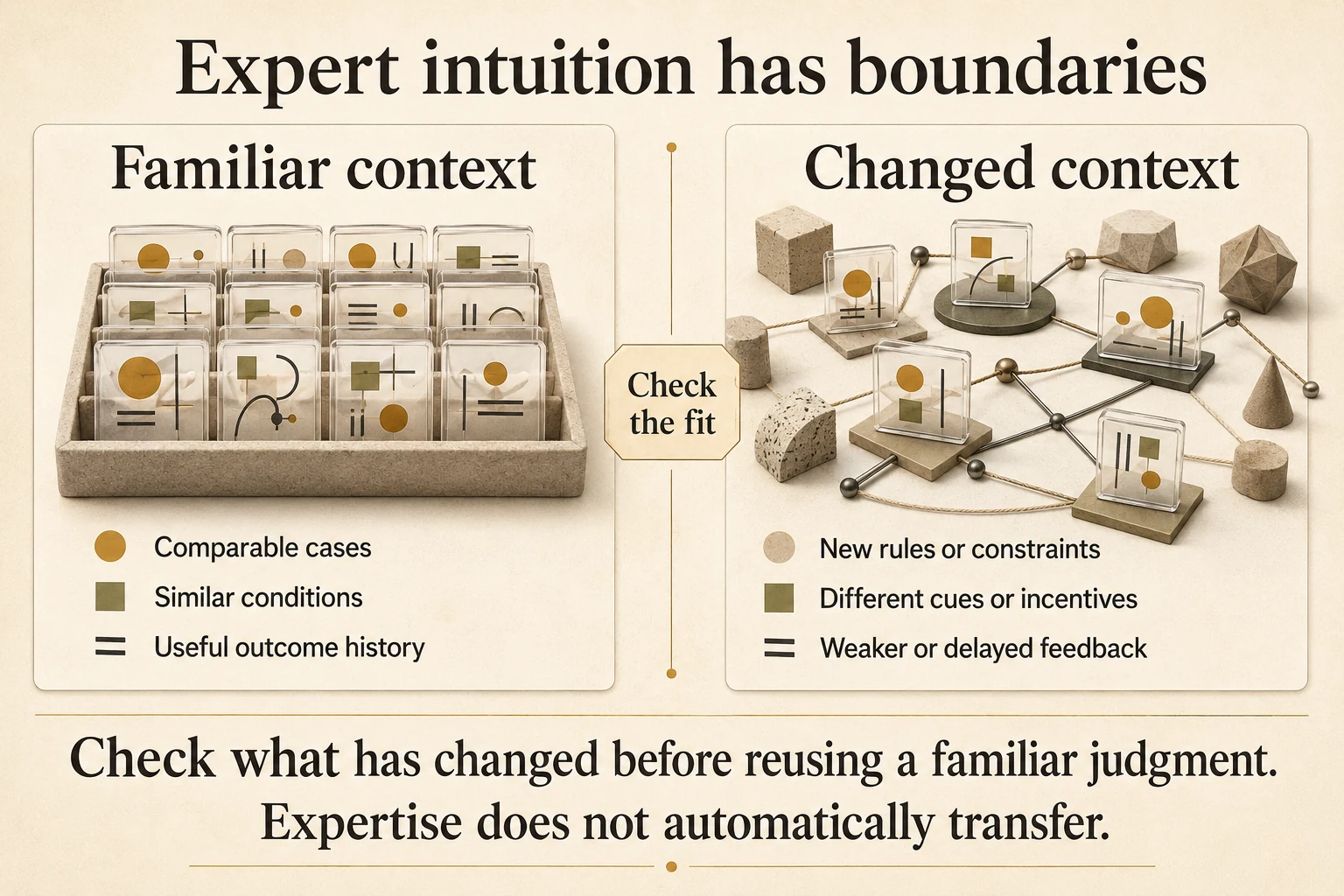
Keep the check proportionate and specific. If only a document’s formatting changed, that may have no bearing on the judgment. If the document now uses a different definition of a defect, it may matter substantially. The useful question is which difference could change the connection between the cue and the conclusion.
Expert Intuition in Two Workplace Examples
Both examples are fictional. They illustrate how to evaluate a judgment, not how to operate equipment or replace quality and safety procedures.
Example 1: A familiar defect in an established process
Maya, a quality specialist, notices faint bands on a printed carton. In the established process, she has investigated this appearance before. A recurring setup issue is one possible explanation, but she also remembers lookalike cases with another cause.
She records the suspected explanation, retrieves comparable investigation records, and requests the approved verification step. The investigation in this fictional case supports her initial suspicion. Her contribution was to identify a promising place to look quickly while keeping the explanation open to correction.
The evidence worth keeping includes the original cues, the alternative she considered, and what the check actually established. “Maya was right again” would preserve much less of the learning.
Example 2: A similar appearance after the process changes
Now imagine the same visible bands on a carton made with a different material under a revised process. The supplier’s quality reports arrive later and group several possible causes together. Maya recognizes the appearance, but the earlier case history does not yet establish that the explanation transfers.
She notes the changed conditions and asks a specialist familiar with the revised process to examine the evidence. Her earlier experience remains useful for framing questions. It does not settle which cause produced these bands.
The appropriate change is to reopen the explanation and choose a relevant check. It is neither to disregard Maya’s experience nor to treat her first impression as a diagnosis.
On smaller screens, scroll the comparison horizontally.
| Question | Established process | Revised process |
|---|---|---|
| Comparable experience | Prior investigations concern this process. | Visual similarity is established; process similarity is not. |
| Outcome evidence | Records distinguish the suspected cause from lookalikes. | Delayed, grouped reports leave the cause less clear. |
| Present conditions | The relevant setup is familiar. | Material and process have changed. |
| Next check | Verify the familiar explanation through the approved process. | Reassess with evidence and expertise relevant to the revised process. |
Five Questions Before Trusting an Expert Judgment
Use these prompts for a real discussion or a retrospective exercise. They are an original reflection guide for Intuition Management, not a validated test or scoring system. Do not count affirmative answers or turn completion into permission to act.
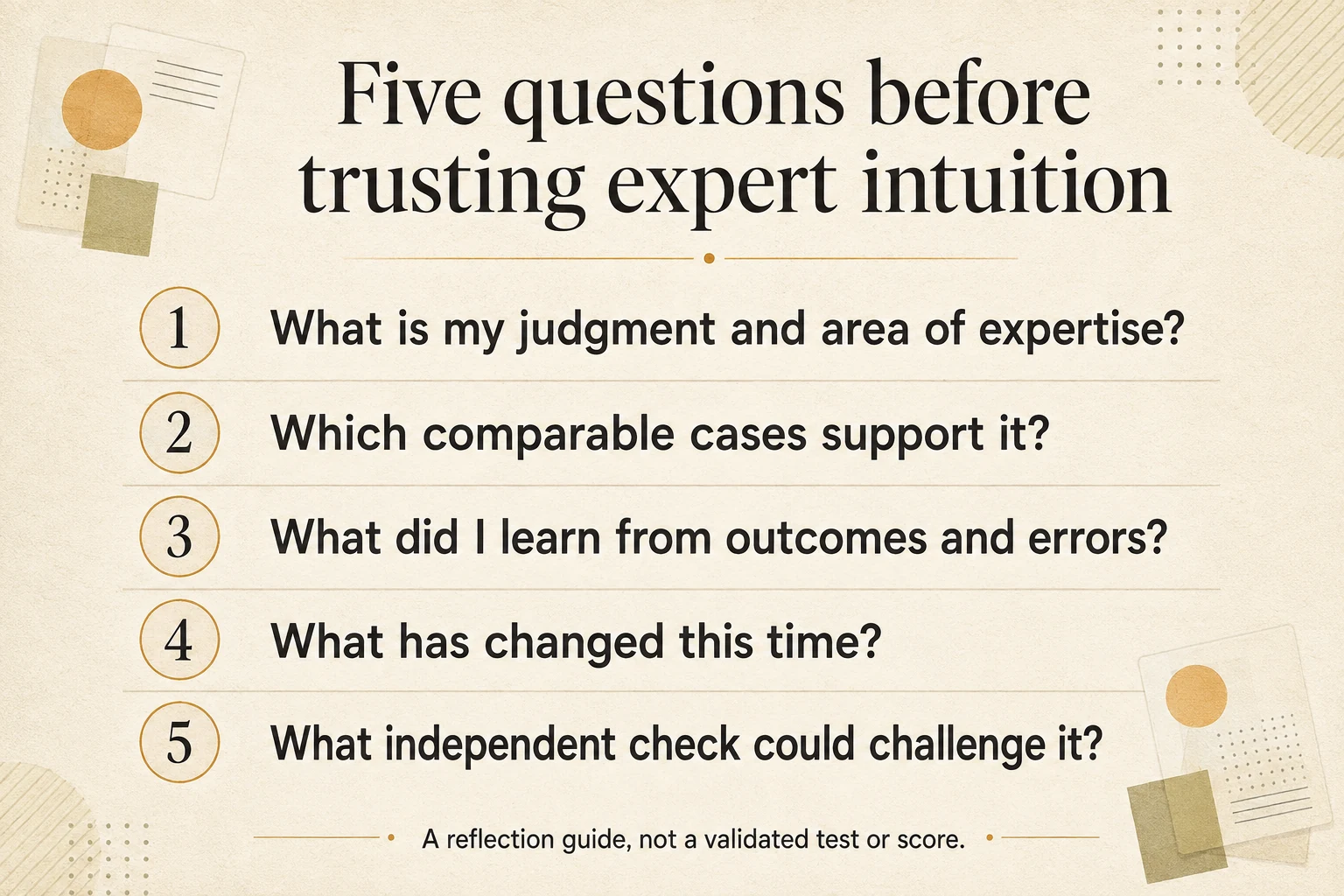
- What is my judgment and area of expertise?State the claim in one sentence. Specify the task and setting in which your experience is relevant. “I know this industry” is too broad to tell another person which part of the decision you can assess.
- Which comparable cases support it?Identify examples or records and explain what matches. Include cases with a similar appearance but a different explanation; those can help you examine the boundaries of the comparison.
- What did I learn from outcomes and errors?Describe what the evidence confirmed, what it contradicted, and what remained uncertain. Be explicit if earlier cases were closed without establishing the part of the explanation you now rely on.
- What has changed this time?Check the relevant conditions, including rules, materials, incentives, and feedback. Distinguish a cosmetic difference from one that could change the meaning of the cue.
- What independent check could challenge it?Choose evidence that might change your mind: an appropriate measurement, a documented standard, relevant records, or another practitioner’s assessment. Ask for examination of the claim, not reassurance about your confidence.
The result is a clearer account of the judgment’s limits and a specific next check. It is not a certificate that the intuition is reliable.
How to Strengthen Expert Intuition
Start with a narrow learning goal and cases whose outcomes can be examined. For a low-risk retrospective exercise, ask a colleague to select two completed cases that looked similar at first but had different explanations. Review only the information available before the outcome was known.
Write your initial interpretation, the cue carrying the most weight, an alternative, and the evidence you would request next. Then compare your account with the case record. Discuss which differences you noticed and which you missed. This is a suggested practice exercise, not a validated training protocol.
Keep the original note when you revise it. If the record cannot resolve the explanation, preserve that uncertainty. You can still learn that the available information was insufficient to justify the claim.
When reviewing past judgments, check for hindsight bias: knowing the outcome can make your earlier prediction seem more certain than it was. Compare your recollection with the original record before treating a successful judgment as evidence of reliable intuition.
For a longer review routine, use the intuition calibration guide. For broader practice ideas, see how to train your intuition. Keep practice connected to the kind of judgment you intend to improve.
Experts may recognize a familiar pattern before they can explain every cue behind their judgment. Learn how tacit knowledge supports decision-making and why relevant experience and useful feedback matter.
To check whether your experience is producing reliable judgments, use a decision journal to record the cues you noticed, your prediction, and your confidence before the outcome is known. Reviewing several entries can help you identify where your intuition is useful and where your expectations need adjusting.
Frequently Asked Questions About Expert Intuition
What is an example of expert intuition?
A quality specialist rapidly recognizing a possible explanation for a recurring defect is one example. In this article’s fictional case, the specialist then checks whether the current evidence supports that explanation.
What conditions support reliable expert intuition?
Kahneman and Klein emphasize environmental predictability and opportunities to learn its regularities. Practice and useful feedback help explain the learning opportunity. These considerations guide evaluation; they do not certify a particular answer.
Does expert intuition always produce the right decision?
No. Treat the impression as something to evaluate against evidence and current conditions. The consequences of error should also shape the checks you use. A familiar task does not remove required safeguards.
How many years of experience are enough?
This guide sets no years-of-service threshold. Ask instead what judgments the person has made, what comparable evidence they can show, and how earlier errors changed their understanding. Tenure alone does not answer those questions.
Can expertise transfer to a different field?
Some knowledge may transfer. Check whether the relationships learned in the original setting also hold in the new one.
Sources and Further Reading
The sources support the research discussion. The workplace cases, comparison table, learning exercise, diagrams, and five-question guide are original educational material, not reported study results.
- Klein, G. (2008). Naturalistic decision making. Human Factors, 50(3), 456–460. DOI: 10.1518/001872008X288385.
- Kahneman, D., & Klein, G. (2009). Conditions for intuitive expertise: A failure to disagree. American Psychologist, 64(6), 515–526. DOI: 10.1037/a0016755.
- Hogarth, R. M., Lejarraga, T., & Soyer, E. (2015). The two settings of kind and wicked learning environments. Current Directions in Psychological Science, 24(5), 379–385. DOI: 10.1177/0963721415591878.
- Aiyer, S., Kam, H. C., Ng, K. Y., Young, N. A., Shi, J., & Feldman, G. (2023). Outcomes affect evaluations of decision quality: Replication and extensions of Baron and Hershey’s (1988) outcome bias experiment 1. International Review of Social Psychology, 36(1), Article 12. DOI: 10.5334/irsp.751.