Intuition vs bias is one of the most misunderstood distinctions in decision-making.
Both feel fast. Both feel convincing. And both can push you toward action before analysis fully forms. But only one reflects reality accurately.
A gut feeling is not automatically intuition. Cognitive bias can wear the same face: speed, certainty, and a push to act before you can explain why. The skill is not trusting the feeling. The skill is recognizing the difference in decision-making while the pressure is still on.
You struggle with signals you can’t trust.
Because in real moments, intuition and bias feel almost identical. Both arrive fast. Both feel convincing. Both push you toward action before analysis fully forms.
Understanding intuition vs bias is not just theoretical — it directly affects how you make decisions under pressure.
And if you can’t tell the difference — you don’t actually have intuition.
You have noise that sometimes happens to be right.
This is one of the most important distinctions in decision-making.
If you want to go deeper into how intuition actually works as pattern recognition, start here: how your brain makes decisions before you think.
Why Intuition vs Bias Feel the Same
The confusion is not accidental.
Your brain is designed to generate fast judgments. It compresses information, predicts outcomes, and suggests direction before conscious reasoning catches up. That is why people mix up intuition, impulse, heuristics, and cognitive bias — all of them arrive before a full explanation.
- Both intuition and bias are fast
- Both appear before explanation
- Both can feel emotionally certain
But speed alone is not intelligence.
The difference is not how fast the signal appears. The difference is where it comes from — and what happens when you examine it.
What Intuition Actually Is
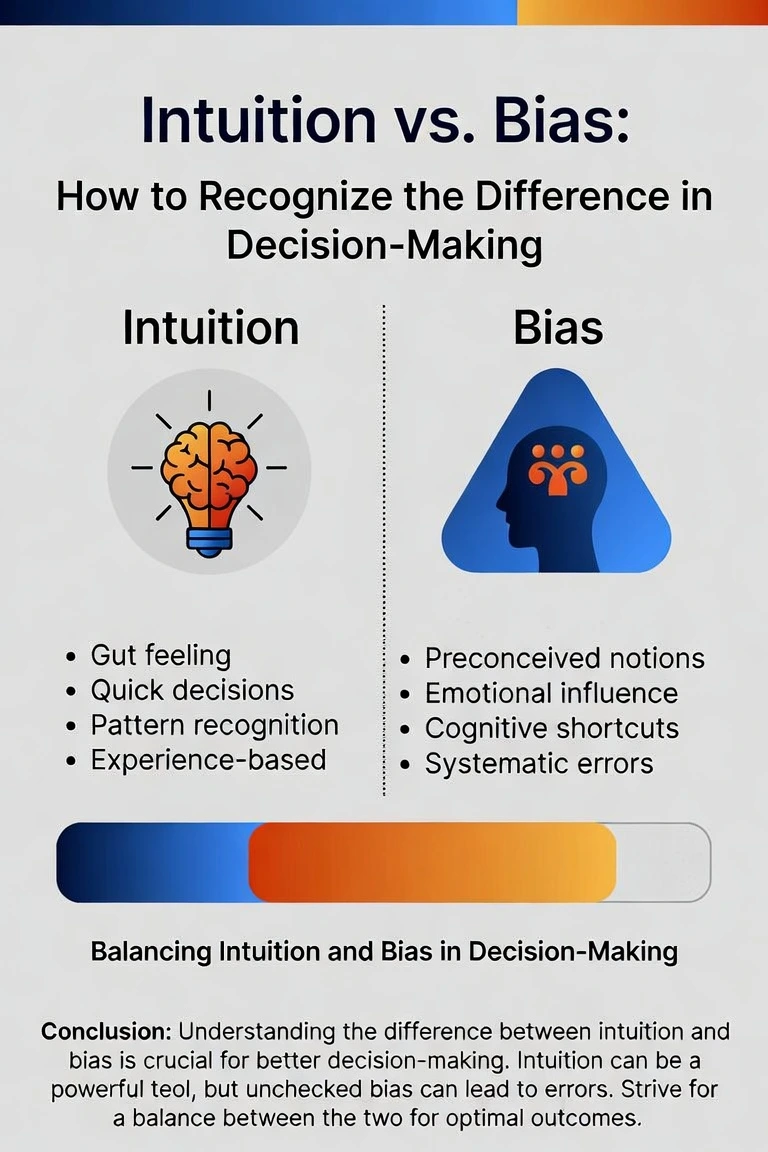
Intuition is pattern recognition under uncertainty.
It is built from:
- repeated experience
- emotional signal reading
- context awareness
- subconscious integration of past outcomes
It does not guess. It compresses.
This is why experienced leaders can sense tension in a room before it becomes visible. Or why something feels “off” before there is evidence. That “off” feeling is useful only when it comes from real exposure to similar patterns — not from fear, preference, or a story you already wanted to be true.
If you want to strengthen this ability, see: how to train intuition in real decisions.
What Bias Actually Is
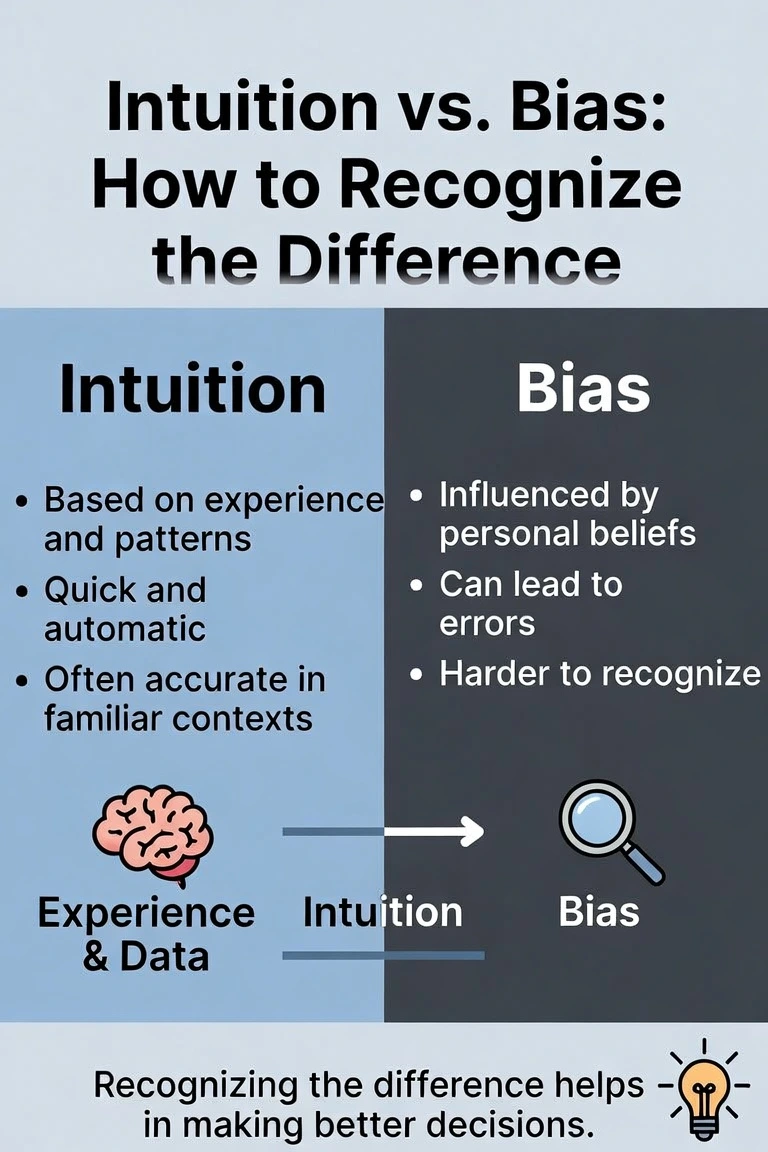
Bias is not intelligence. It is distortion disguised as certainty.
It comes from:
- assumptions
- fear
- ego protection
- habitual thinking patterns
Bias simplifies reality too early. It replaces perception with expectation. That is why “don’t trust your gut” is the wrong rule — and “always trust your gut” is worse. You are not choosing between feeling and logic. You are separating a usable inner signal from a fast, convincing error.
And the most dangerous part: bias feels right.
The Simplest Real-Time Test
If you remember only one thing from this article, use this:
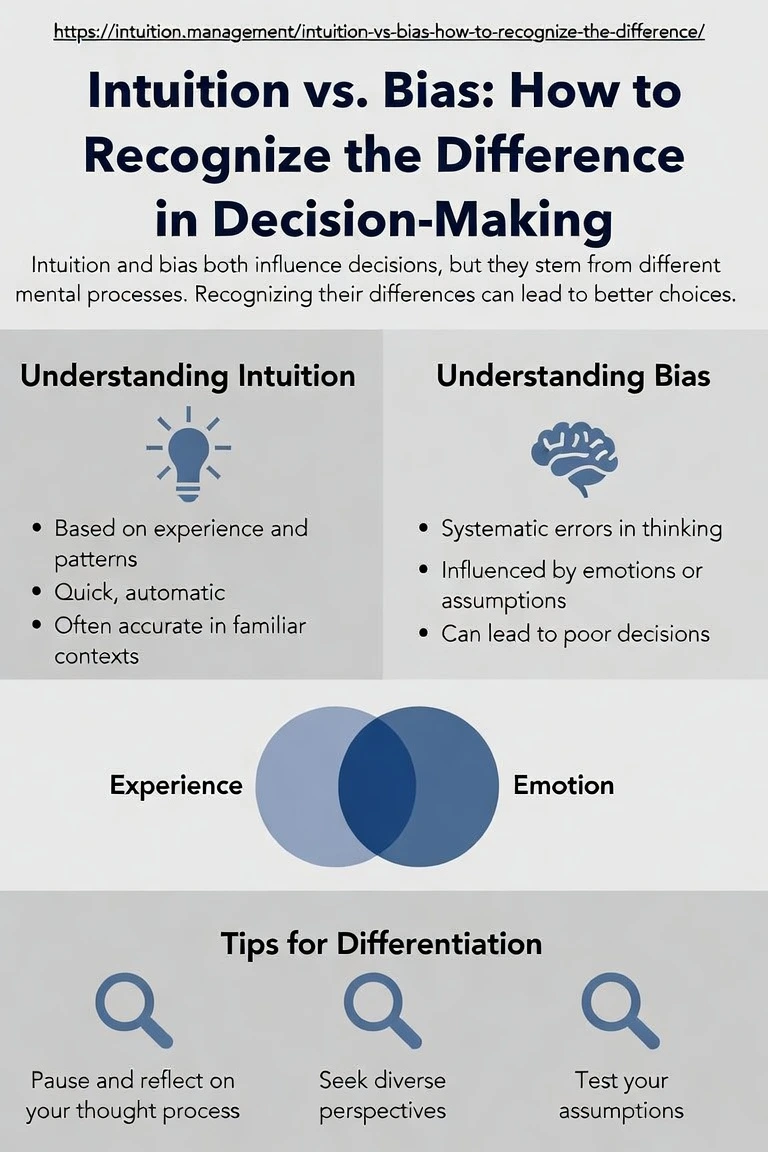
- Intuition becomes clearer when examined
- Bias becomes weaker when examined
When you pause and look deeper:
- intuition reveals patterns
- bias reveals assumptions
This is the fastest way to tell intuition from bias without turning every decision into a research project. Pause. Ask what would prove you wrong. Watch whether the feeling sharpens or collapses.
Common Biases That Imitate Intuition
- Confirmation bias — seeing only what supports your belief
- Anchoring bias — overvaluing first information
- Overconfidence bias — trusting judgment too early
- Emotional bias — reacting instead of perceiving
- Familiarity bias — preferring what resembles past success, even when the current situation is genuinely different
- Authority bias — trusting a familiar voice or status more than the actual signal in front of you
Bias is strongest when:
- you feel pressure
- you want a specific outcome
- you are emotionally activated
Signal vs Bias: How to Tell the Difference in the Moment
This is the real skill underneath everything above.
- Signal is quiet. Bias is often urgent.
- Signal is directional. Bias is reactive.
- Signal remains stable. Bias fluctuates with emotion.
- Signal opens perception. Bias narrows it.
- Signal can be tested. Bias usually resists being questioned.
Learning this distinction doesn’t mean removing intuition from decisions. It means refining it.
Why Bias Gets Stronger Under Pressure
Bias is not constant — it increases specifically when internal stability decreases.
Under pressure:
- perception narrows
- decisions accelerate
- emotional signals intensify
- old patterns become more tempting
- the fastest explanation starts to feel like the correct one
This is exactly why a signal that feels like decisive intuition in a high-pressure moment may actually be a compressed reaction rather than real pattern recognition — and why the check later in this article matters most in the exact moments you’re most tempted to skip it.
When Intuition Is Actually Reliable
Intuition is not always correct. It becomes reliable under specific conditions:
- you have real experience in the domain
- patterns repeat in the environment
- your state is stable (not reactive)
- you are not forcing an outcome
This is why intuition in leadership improves with exposure — not belief. A hiring call, a deal, or a strategy shift can produce a clean inner signal if you have seen the pattern before and you are not defending an identity. If the environment is new, noisy, or loaded with what you want to be true, treat the feeling as a hypothesis, not a verdict.
How to Work With Intuition Without Distortion
1. Stabilize Before You Decide
Clarity is state-dependent — if your system is unstable, your intuition will be distorted. Slow your breathing, release physical tension, reduce urgency slightly, and pause before defending your first interpretation. Even small stabilization restores perceptual accuracy.
2. Separate Signal From Story
Intuition appears first; explanation comes after. Bias often hides inside the story you attach to a feeling after the fact. Ask: what did I actually feel before I explained it?
3. Test Without Overloading
Good decision-makers don’t ignore intuition — they test it lightly. Check one relevant data point, ask one external perspective, observe the system’s response, look for one disconfirming signal. Too much validation destroys speed; too little increases bias.
4. Look for What Would Prove You Wrong
Bias protects itself. Signal can tolerate testing. Before committing to a decision, ask what evidence would make you reconsider — this one question can prevent more mistakes than another dashboard.
A Practical Intuition Bias Check
Next time a decision feels obvious, pause and ask:
- Is this signal, or is this familiarity?
- Is this clarity, or is this urgency?
- Is this current reality, or an old pattern?
- What am I not willing to question?
- What would prove this intuition wrong?
- What small test would reduce the risk?
Conclusion: Intuition vs Bias
Intuition and bias are both fast. Only one is useful.
Intuition is refined perception. Bias is distortion that imitates certainty.
The difference is not obvious in the moment. But once you learn to see it — decision-making changes completely. You don’t remove intuition. You learn to read it correctly.
Where to Go Next
If you want to strengthen this skill further, continue with these related guides:
- Gut Feeling or Anxiety: How to Tell the Difference
- How the Brain Processes Intuition
- How to Develop Intuition
FAQ: Intuition vs Bias
Is intuition always correct?
No. Intuition is only as good as the patterns behind it. It tends to be useful when you have real experience in the domain, the environment repeats enough to learn from, and your state is stable. In unfamiliar territory, or when you are pushing for one outcome, treat the feeling as a lead to test — not as proof.
Can bias feel like intuition?
Yes. That is why the mix-up is dangerous. Cognitive bias can arrive with the same speed and certainty as a real inner signal. The giveaway is usually urgency, a story that cannot be questioned, and a feeling that weakens when you pause and look for disconfirming evidence.
How do I improve intuitive accuracy?
Build real exposure, then review outcomes. After a decision, note what you felt, what you assumed, and what actually happened. Test signals lightly instead of defending them. Over time you calibrate: which body-level cues predicted reality, and which were familiarity, fear, or preference wearing intuition’s face.
What is the fastest way to check a signal?
Pause briefly and examine it. If the feeling becomes clearer and more specific, it is more likely intuition. If it weakens, needs a story, or demands immediate action, it is more likely bias. Then run one small test — one data point, one outside view, or one thing that could prove you wrong.
How does intuition bias affect leadership decisions specifically?
It can make leaders mistake urgency, confidence, familiarity, or emotional reaction for insight. The result is faster calls that feel clean in the room and look sloppy after the fact: a hire who “felt right,” a deal protected from questions, a strategy chosen because it resembled last year’s win. Speed stays. Accuracy drops.
How can leaders reduce intuition bias without losing decision speed?
Stabilize before deciding, separate the raw signal from the story you attach to it, and test lightly rather than exhaustively. Ask for one disconfirming perspective. Use after-action feedback to calibrate judgment. That sequence keeps most of the speed and removes the part of “gut feel” that was only pressure.
Leave a Reply
You must be logged in to post a comment.