You may assume the worst because your mind is trying to reduce uncertainty by predicting danger before it happens. Stress, previous experiences and threat-focused mental filters can make a negative possibility feel more probable than the available evidence supports.
Assuming the worst is often an attempt to feel prepared. An uncertain situation leaves several outcomes open; a frightening prediction collapses them into one story. That story may create a temporary sense of control, but feeling prepared is not the same as seeing the situation accurately.
Scope: This article explains a common pattern of worst-case prediction. It does not diagnose anxiety or any other mental health condition.
Perhaps a friend has not replied, your manager has asked to speak with you, or you notice an unfamiliar sensation. Before anything has actually been confirmed, your mind produces a conclusion: They are upset with me. I made a serious mistake. Something bad is about to happen.
This does not necessarily mean you are irrational, pessimistic or incapable of trusting yourself. It may mean your prediction system is giving too much weight to threat. Research on intolerance of uncertainty suggests that difficulty living with unknown outcomes can be relevant across several emotional difficulties, while research on anxiety increasingly emphasizes disrupted learning about uncertainty rather than fear alone.
The goal is not to force yourself to think positively. It is to notice when a possibility has quietly become a verdict—and to return to evidence, proportion and choice.
Why do I always assume the worst?
You may assume the worst because the mind is built to predict what could happen next, not simply to wait for certainty. When information is missing, it uses memories, expectations, bodily signals and current context to fill the gap. If threat has become the most accessible interpretation, the prediction can arrive before a more balanced assessment has time to form.
The National Institute of Mental Health describes potential threat as a situation in which possible harm is distant, ambiguous or uncertain in probability. That definition helps explain why an unanswered question can feel so activating: the danger is not confirmed, but it cannot yet be ruled out.
Several processes may contribute:
- Uncertainty feels difficult to tolerate. Not knowing becomes uncomfortable enough that any definite explanation feels preferable.
- Past outcomes shape current expectations. The mind uses previous experience as a template, even when the present situation is different.
- Stress changes what receives attention. Possible danger becomes easier to notice than neutral or reassuring information.
- Vivid thoughts feel probable. The easier an outcome is to picture, the more believable it can seem.
- The body reacts to the interpretation. Tension and urgency then make the prediction feel even more credible.
These are not separate problems. They can form one self-reinforcing system.
Assuming the worst is often an attempt to feel prepared
Uncertainty contains many possible futures. The mind cannot prepare equally for all of them, so it may select the most threatening outcome and begin rehearsing it. This can create the feeling that you are being responsible, vigilant or realistic.
But there is an important difference between preparation and prediction. Preparation says, “This is one plausible risk, and here is what I would do.” Worst-case prediction says, “This is probably what is happening, and I must react now.”
The mind may prefer a frightening answer to an unanswered question.
A definite threat can feel easier to organize around than an open future. You know what to fear, what to rehearse and what to avoid. The cost is that one possibility begins to crowd out every other explanation.
This is why telling yourself to “stop being negative” rarely works. The negative story is performing a function: it is trying to replace uncertainty with apparent certainty. A more useful response is to understand the function and then find a safer way to remain open.
The Threat Prediction Loop™
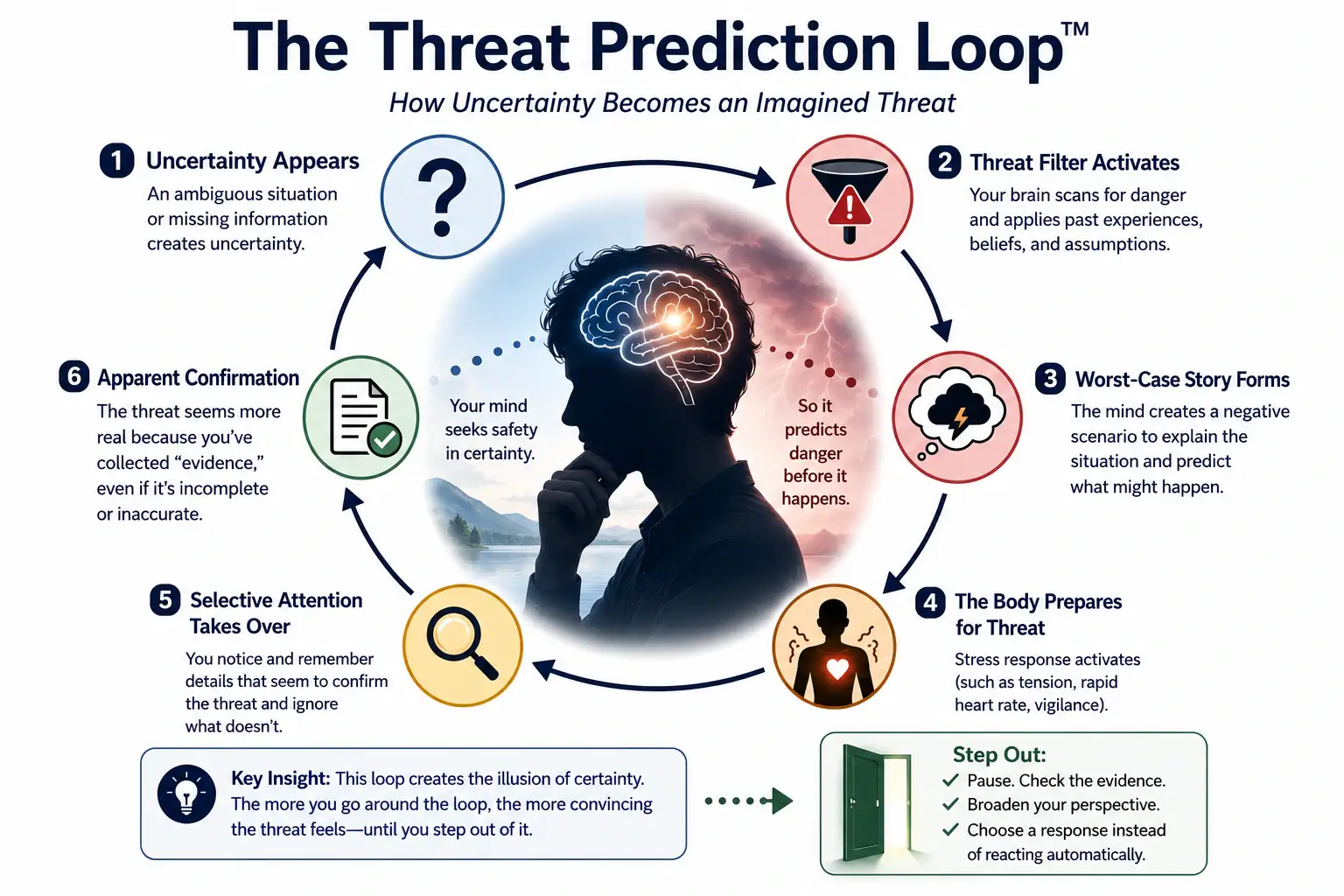
The Threat Prediction Loop™ describes how an ambiguous event can become a convincing inner reality:
- Uncertainty appears. Something is missing, unclear or unresolved.
- A threat filter activates. The mind scans the situation through past experiences, assumptions and current stress.
- A worst-case story forms. One negative explanation becomes the leading prediction.
- The body prepares for threat. Tension, vigilance or urgency make the situation feel more serious.
- Selective attention takes over. Details that fit the prediction stand out; details that challenge it receive less attention.
- Apparent confirmation develops. The collected details make the original prediction seem proven, even when the evidence remains incomplete.
A simple example
Your friend has not responded for several hours. The fact is limited: there is no reply yet. A rejection filter adds an explanation: They are avoiding me. Your body becomes tense. You reread the last conversation and notice one message that sounded less warm than usual. That detail now feels like proof.
Nothing in this sequence requires deliberate choice. Each stage makes the next one easier. By the end, you are no longer responding to an unanswered message. You are responding to a relationship crisis that your mind has predicted.
A prediction can be emotionally real without being factually confirmed.
Why worst-case thoughts can feel like facts
A thought does not become convincing only because of its words. It becomes convincing because imagery, emotion, repetition and attention give it weight.
Emotional intensity
When a thought produces a strong physical response, the response can be interpreted as evidence. “I feel afraid” quietly becomes “There must be danger.” Yet emotion tells you that something matters to your system; it does not, by itself, establish what is happening outside you.
Vivid mental imagery
A detailed mental scene can feel like a preview rather than a possibility. You picture the meeting going badly, the relationship ending or the problem becoming unmanageable. Because the scene is easy to access, it begins to feel likely.
Repetition and familiarity
A prediction that returns many times becomes familiar. Familiarity can then be mistaken for accuracy: I have thought this so often that it must mean something. Repetition may show that a concern is unresolved, but it does not automatically show that the prediction is true.
Confirmation filtering
Once a story is active, attention tends to organize around it. You notice the delayed reply, the serious facial expression or the one unusual symptom. You may overlook competing facts: the person is busy, the manager schedules routine check-ins, or the sensation has several ordinary explanations.

Catastrophizing is commonly described as magnifying a possible negative outcome while underestimating the ability to cope. A review in the medical literature describes three recurring elements: magnification, rumination and helplessness. The useful question is not “Am I allowed to consider a bad outcome?” It is “Have I begun treating that outcome as inevitable?”
The role of mental filters
A mental filter does not necessarily invent information. It changes which information becomes prominent and what meaning is assigned to it. As explained in What Are Mental Filters?, the mind cannot process every detail equally, so it selects, organizes and prioritizes.
Worst-case thinking often involves one or more of these filters:
Threat filter
Ambiguity is evaluated primarily for danger. The first question becomes, “What could go wrong?” rather than “What are the possible explanations?”
Rejection filter
Silence, brevity or a neutral expression is interpreted as disapproval. The mind fills missing social information with the expectation of exclusion.
Failure filter
Difficulty is treated as evidence of future defeat. One mistake becomes proof that the entire effort is going badly.
Scarcity filter
The mind expects time, money, energy, support or opportunity to run out. A manageable limit becomes a sign of approaching collapse.
These filters are influenced by the mental models you use to understand relationships, competence, safety and control. A filter selects the evidence; a mental model explains what the selected evidence means.
The filter may identify a real detail. The distortion happens when that detail is treated as the whole situation.
Why past experiences can become predictions about the present
The mind learns from repetition. If previous ambiguity was followed by criticism, rejection, instability or disappointment, a new ambiguous event may activate the old expectation before you have examined the current evidence.
This does not require a dramatic past. A pattern can develop through repeated smaller experiences: messages that often contained bad news, environments where mistakes were punished, relationships where silence signaled withdrawal, or periods when resources genuinely were scarce.
“This happened before” is evidence about the past. “It will happen again” is a prediction about the future.
The prediction may sometimes be right. Past experience contains information. The problem is not using it; the problem is letting it decide the present before the present has been observed.

A useful pause is: “What belongs to this situation, and what belongs to the pattern I brought into it?” The purpose is not to dismiss your history. It is to prevent old information from becoming the only information.
Is assuming the worst anxiety or intuition?
Worst-case thinking can feel intuitive because it arrives quickly and may be accompanied by a strong bodily signal. But speed and intensity do not establish that a thought is intuition.
Threat prediction and intuition can both begin before conscious reasoning is complete. The difference is better examined through what happens next.

Threat prediction often:
- Expands into several frightening scenarios.
- Creates pressure to act, check, avoid or secure certainty immediately.
- Searches for evidence that confirms the feared conclusion.
- Becomes harder to question as physical tension increases.
- Treats possibility as probability.
A potentially useful intuitive signal often:
- Begins as a concise impression or a sense that something deserves attention.
- Can remain present without producing an expanding narrative.
- Allows relevant facts to refine or correct the interpretation.
- Points toward observation or a proportionate action.
- Remains a signal to evaluate, not a verdict to obey.
Intuition is not automatically correct, and anxiety is not automatically meaningless. Anxiety may highlight a real need for safety, boundaries or preparation. Intuition may be shaped by incomplete experience or bias. The most reliable approach is calibration: notice the signal, examine the context, test it against evidence and observe the outcome.
For a deeper distinction, read Intuition or Anxiety? and Signal vs Noise.
Catastrophizing, practical planning and intuition are not the same
| Process | What it does | Relationship with uncertainty | Useful next question |
|---|---|---|---|
| Catastrophizing | Magnifies the worst outcome and may underestimate coping capacity. | Attempts to remove uncertainty by treating danger as likely or inevitable. | “What evidence supports this probability, not just this possibility?” |
| Practical planning | Defines a plausible risk and prepares a proportionate response. | Accepts that the outcome is unknown while reducing avoidable risk. | “What preparation is enough for now?” |
| Intuition | Highlights a potentially meaningful pattern before full explanation is available. | Offers a signal that still needs context, calibration and verification. | “What might I be noticing, and how can I check it?” |
Practical planning has an endpoint. Once a reasonable response exists, you can return to the present. Catastrophizing rarely feels complete because its real objective is impossible: total certainty.
Why reassurance often works only temporarily
When a prediction feels urgent, reassurance can reduce distress quickly. Someone says the relationship is fine, the meeting is routine or the situation is probably manageable. Relief appears—but it may disappear as soon as a new uncertainty emerges.
In some anxiety-related patterns, repeated reassurance-seeking can function as an attempt to lower perceived threat. Research involving obsessive-compulsive and health-anxiety presentations has found that reassurance may reduce anxiety in the moment while leaving the underlying need for certainty unresolved.
Fear → reassurance → temporary relief → renewed uncertainty → stronger need for reassurance
Reassurance answers one prediction. It does not necessarily change the process that generates predictions.
This does not mean you should never ask for clarification or support. Direct communication can be healthy and necessary. The question is whether you are gathering information that enables action—or repeatedly asking for certainty that no answer can permanently provide.
The Present Evidence Check™
The Present Evidence Check™ is a seven-step process for separating an event from the story built around it. It is influenced by cognitive restructuring principles: recognize an automatic interpretation, examine it carefully and consider a response that better fits the available information. The American Psychological Association describes this kind of reevaluation as a core feature of cognitive behavioral approaches.
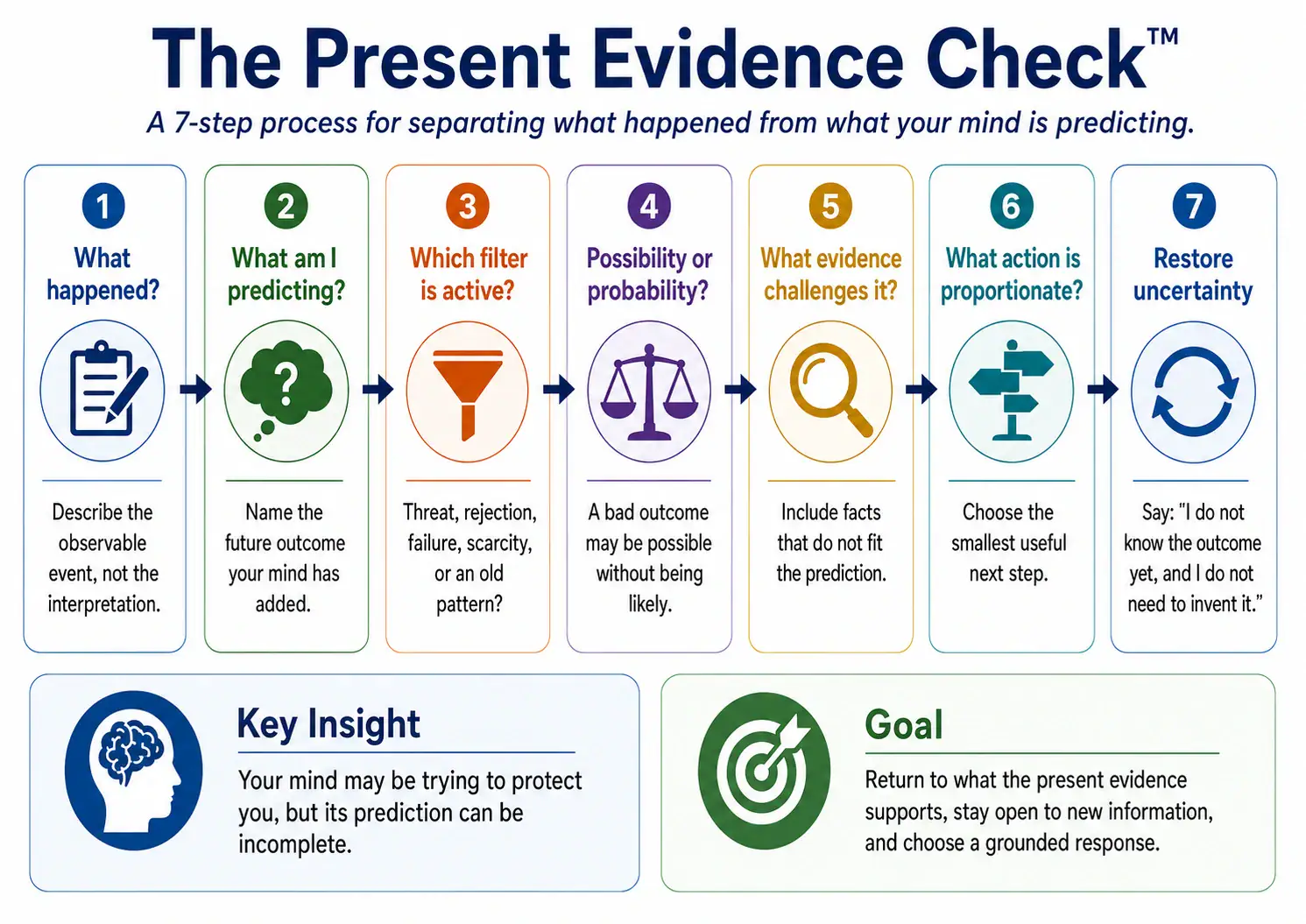
- What happened?Describe only the observable event. “My manager asked to speak later” is a fact. “My manager is angry” is an interpretation.
- What am I predicting?Name the future your mind has added: “I will be criticized,” “They will leave,” or “This problem will become unmanageable.”
- Which filter is active?Is the interpretation organized around threat, rejection, failure, scarcity, control or a past pattern?
- Is this a possibility or a probability?A bad outcome may be possible without being the most likely outcome. Ask what probability the evidence actually supports.
- What evidence challenges the prediction?Look for facts that do not fit the story. This is not forced optimism; it is an attempt to include omitted information.
- What action is proportionate?Choose the smallest useful response: clarify, prepare, wait, document, set a boundary or continue observing.
- Restore uncertainty.End with: “I do not know the outcome yet, and I do not need to invent it.”
Worked example
Event: A friend read your message but has not replied.
Prediction: “They are upset and no longer want to talk to me.”
Filter: Rejection.
Probability check: Rejection is possible, but so are distraction, fatigue, work, uncertainty about how to respond or a simple delay.
Challenging evidence: The relationship has been warm recently; delayed replies have happened before without conflict.
Proportionate action: Continue with the day and follow up later if a response is genuinely needed.
Restored uncertainty: “I do not know why they have not replied.”
How to stop automatically assuming the worst
You do not need to eliminate every negative prediction. The aim is to stop giving one prediction automatic authority.
1. Use language that preserves probability
Change “This will go badly” to “One possible outcome is that this goes badly.” The event has not changed, but your relationship with the prediction has.
2. Delay interpretation
Give facts time to accumulate. When possible, separate receiving information from deciding what it means. A pause is not avoidance when it prevents an incomplete story from becoming a decision.
3. Reduce scenario multiplication
Ask: “Am I solving one actual problem, or generating ten imaginary problems?” If there is one concrete issue, define it. If there are ten hypothetical branches, return to the first fact.
4. Keep a prediction record
Write down the prediction, your estimated probability and the eventual outcome. Over time, this helps you see whether your mind routinely overestimates certain risks—and where your intuition is genuinely well calibrated.
5. Build a coping plan instead of a certainty plan
Ask: “What would I do if the difficult outcome occurred?” A coping plan recognizes that uncertainty remains while reminding you that you are not helpless.
6. Lower urgency before acting
When the body is highly activated, you may feel compelled to send another message, cancel, check, confront or make a major decision. Unless there is an immediate safety issue, allow the physical urgency to settle before choosing.
7. Choose the smallest evidence-based action
A grounded next step is often modest: ask one clear question, review the facts, prepare one document, wait for a defined period, or set one boundary. Action becomes useful when it responds to reality rather than trying to erase all uncertainty.
When your thoughts continue to race, the related articles Why Do I Overthink Everything?, Why Do I Keep Replaying Conversations in My Head? and Why Does My Brain Feel Like It Is Always On? explore adjacent parts of the same system.
What if the worst outcome is genuinely possible?
Sometimes a difficult outcome is realistic. A balanced article should not treat every warning as distorted thinking. The question is whether your response is proportionate to the probability, impact and available evidence.
Use three tests:
- Specific evidence: Is there observable information supporting the concern?
- Proportion: Does the intensity of the response match the probability and potential impact?
- Usefulness: Does the response improve preparedness, or does it only increase checking, avoidance and distress?
| Estimated probability | Potential impact | Proportionate response |
|---|---|---|
| Low | Low | Observe, continue and avoid unnecessary intervention. |
| Low | High | Create a basic contingency without living as though the event is certain. |
| High | Low | Take a simple corrective action and review the result. |
| High | High | Act promptly, gather qualified guidance and use appropriate support. |
Risk awareness is useful when it produces proportionate preparation. It becomes costly when every uncertain event is experienced as an emergency.
When to consider professional support
Worst-case thinking is common and does not, by itself, establish a mental health condition. Consider speaking with a qualified mental health professional when it is persistent, difficult to interrupt or significantly interferes with daily life.
Support may be especially useful when the pattern:
- Disrupts sleep, school, work or relationships.
- Leads to repeated avoidance, checking or reassurance-seeking.
- Causes intense physical distress or frequent panic.
- Makes ordinary decisions feel unsafe or impossible.
- Continues even when you recognize that the prediction is unsupported.
Cognitive behavioral therapy is one evidence-supported approach that helps people identify automatic patterns of thinking, examine how those thoughts influence feelings and actions, and develop more useful responses. The National Institute of Mental Health provides an accessible overview.
The frameworks in this article are reflection tools, not diagnostic instruments or substitutes for individualized medical or psychological care.
Related: Why Do I Interpret Everything Negatively?
Frequently asked questions
Why does my brain immediately go to the worst-case scenario?
Because uncertainty can activate threat-focused prediction. The mind may use previous experiences, current stress and negative filters to select an alarming explanation before enough information is available.
Is always assuming the worst a sign of anxiety?
It can occur alongside anxiety, but the pattern alone does not establish a diagnosis. Its significance depends on frequency, intensity, context and how much it affects daily life.
Is expecting the worst a form of intuition?
Not necessarily. Both can arrive quickly, but worst-case thinking often expands into stories, demands certainty and resists contradictory evidence. An intuitive impression is still only a signal to evaluate.
How do I stop imagining bad things happening?
Start by separating the observable event from the predicted outcome. Identify the filter shaping the story, compare possibility with probability, look for evidence that challenges the prediction and choose one proportionate action.
Why do I assume people are upset with me?
Ambiguous social cues may be interpreted through a rejection filter, especially when previous experiences have made disapproval feel likely. A delayed reply or shorter message contains less information than the conclusion your mind may attach to it.
Can assuming the worst ever be useful?
Considering risks can be useful when it leads to proportionate planning. It becomes less useful when possibility is treated as certainty, coping ability is underestimated and no amount of checking feels sufficient.
When every thought feels important, decode the signal before obeying the story
The problem is not always a lack of insight. It may be difficulty separating a meaningful signal from a prediction, a mental filter or accumulated noise. The Personal Signal Decoder offers a structured way to examine what your internal response may be communicating.
Sources and further reading
- Boswell JF, et al. Intolerance of Uncertainty: A Common Factor in the Treatment of Emotional Disorders.
- Brown VM, et al. Anxiety as a Disorder of Uncertainty.
- National Institute of Mental Health. Potential Threat (“Anxiety”).
- Cox AR, et al. Managing Catastrophizing Before It Becomes a Problem.
- Halldorsson B, Salkovskis PM. Why People with OCD and Health Anxiety Seek Reassurance.
- American Psychological Association. What Is Cognitive Behavioral Therapy?
- National Institute of Mental Health. Generalized Anxiety Disorder: What You Need to Know.