Intuition vs Anxiety
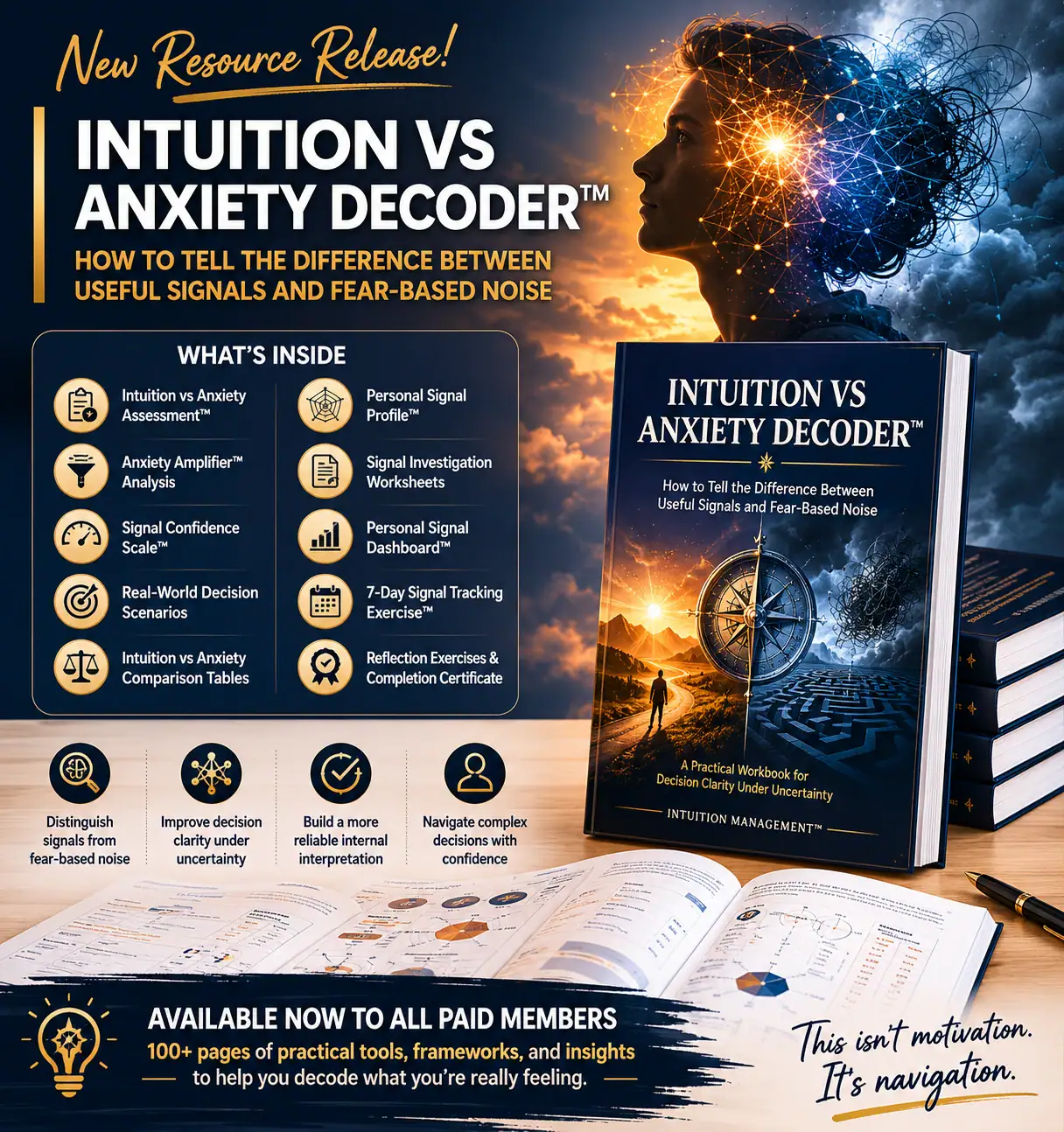
Intuition and anxiety can feel similar, but they come from very different processes. Intuition is a signal based on pattern recognition and internal alignment. Anxiety is a reaction driven by uncertainty, fear, and the need for control.
Learning to distinguish between the two is critical for making accurate decisions. Without this distinction, it is easy to mistake fear for insight or ignore useful signals.
How intuition works
Intuition appears as a quiet, consistent sense of direction. It does not need constant reinforcement. It often feels simple, even if the decision itself is difficult.
- Pattern recognition — how intuition detects meaning quickly
- Somatic signals — how intuition is felt in the body
How anxiety works
Anxiety is more urgent and repetitive. It pushes for immediate action or avoidance. It often creates multiple conflicting thoughts rather than a clear direction.
- Nervous system — how stress creates anxious signals
- Cognitive bias — how fear distorts perception
Key differences
- intuition is calm, anxiety is urgent
- intuition is simple, anxiety is repetitive
- intuition points, anxiety pushes
Why the confusion happens
- Decision fatigue — reduced clarity makes signals harder to read
- Signal vs noise — difficulty filtering internal input
- Clarity under pressure — stress amplifies anxiety
How to distinguish them
Instead of trying to think your way out, observe how the signal behaves. Intuition tends to remain stable over time. Anxiety changes, escalates, and seeks certainty.
Developing awareness of your internal state makes it easier to separate real signals from reactive noise.
- Mindfulness — observing without reacting
- Self-regulation — stabilizing your state
- Decision clarity — acting on reliable signals
Below are articles that help you recognize the difference between intuition and anxiety, reduce confusion, and make clearer decisions.