Signals vs noise is one of the most important distinctions in decision-making under uncertainty. Many people do not struggle because they lack feelings, instincts, or inner signals. They struggle because they do not know which feelings deserve attention and which ones are only creating noise.
A feeling appears. A hesitation. A pull toward something. A sense that a decision feels heavier than expected. A quiet signal says, “Pay attention.” But another part of you asks: is this useful information, anxiety, fatigue, social pressure, or overthinking?
This article explores how to distinguish signals vs noise, how to interpret your feelings without blindly obeying them, and how to make clearer decisions when certainty is unavailable.
Useful starting point: if you want to practice this directly, try the Signal vs Noise Simulator. You can also explore the broader framework through Your Intuition Journey, the central hub connecting Intuition Management resources.
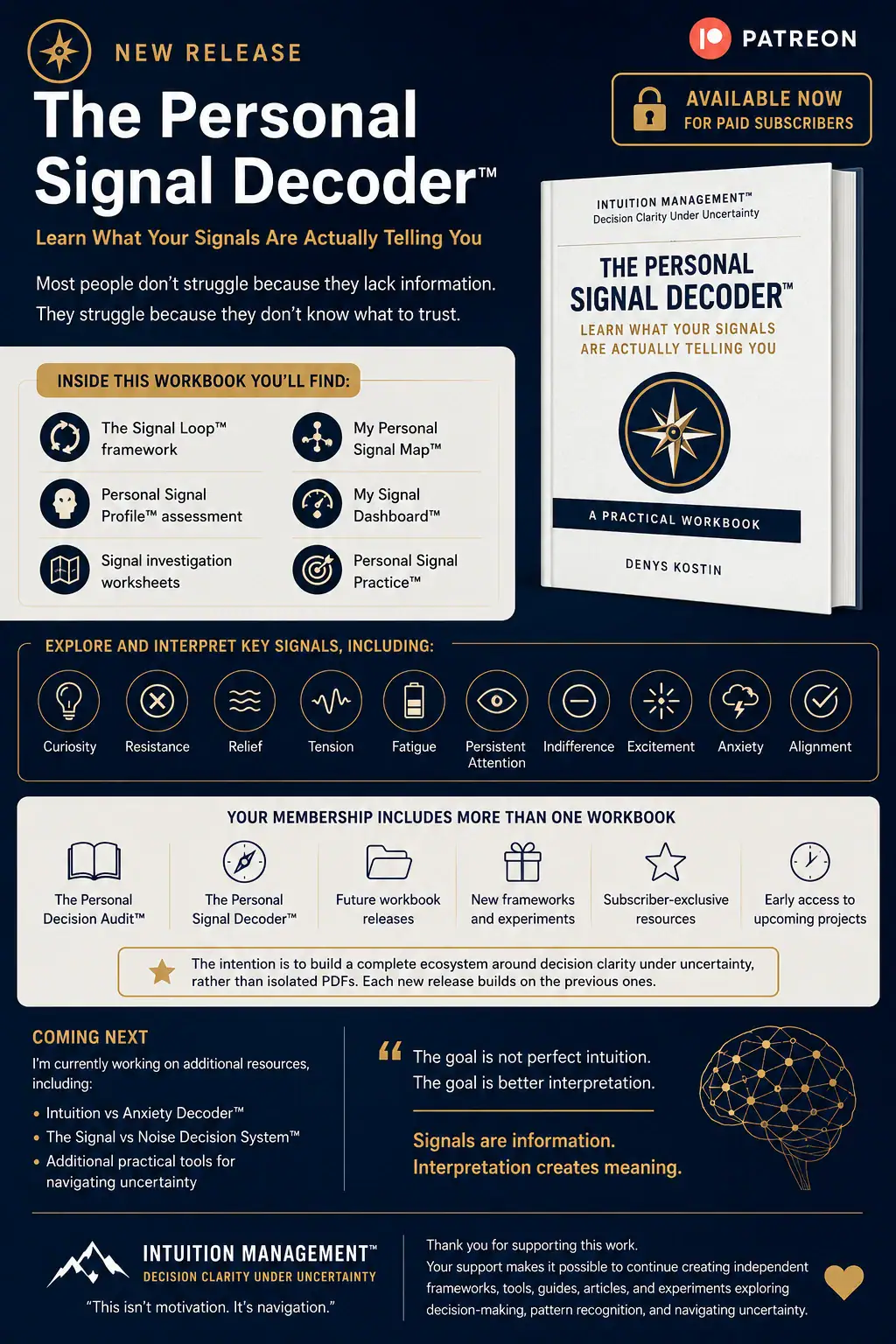
New workbook: The Personal Signal Decoder™ is now available to all paid subscribers on Patreon.
What signals vs noise means
At Intuition Management, the distinction is simple:
- Signal is information that deserves attention.
- Noise is information that interferes with attention.
The ability to distinguish signals from noise is one of the core skills of decision-making under uncertainty. It helps you stop treating every feeling as truth while also avoiding the opposite mistake: dismissing useful information just because it is not yet logical, complete, or easy to explain.
This does not mean every signal is automatically correct. It also does not mean every uncomfortable feeling is noise.
Signal is not certainty. Noise is not always false. The real skill is interpretation.
For example, anxiety may contain useful information about risk. But anxiety can also exaggerate danger, create imagined outcomes, and make uncertainty feel like proof. Curiosity may point toward meaningful opportunity. But curiosity can also be temporary novelty. Relief may indicate alignment. But relief can also come from avoidance.
This is why the question is not:
Should I trust this feeling?
The better question is:
What information might this feeling be trying to provide?
Why feelings can be useful but unreliable
Your brain and body are constantly processing information before your conscious mind can explain it. Tone, timing, inconsistency, fatigue, social cues, past experience, pressure, and subtle shifts in context may all influence what you feel.
That is why a feeling can be meaningful before it is clear.
But meaningful does not mean accurate.
A feeling may be based on pattern recognition. It may also be shaped by stress, exhaustion, fear of judgment, old experiences, or the need for certainty. The feeling itself is real. The interpretation remains open.
This is where many people make mistakes. They either dismiss everything internal as irrational, or they treat every internal reaction as truth.
Both extremes create confusion.
The goal is not blind trust. The goal is not endless skepticism. The goal is better interpretation.
Why your feelings are not instructions
One of the most common decision-making errors is treating feelings as commands.
If someone feels afraid, they stop. If they feel excited, they rush forward. If they feel relief, they assume the decision is correct. If they feel resistance, they assume the path is wrong.
But signals are not instructions.
Signals are data.
Data requires interpretation.
For example, anxiety may mean danger. But it may also mean uncertainty, lack of control, social pressure, lack of preparation, or unfamiliar growth.
Resistance may mean misalignment. But it may also mean fear of exposure, overload, or unclear next steps.
Relief may mean alignment. But it may also mean escape from responsibility.
The signal is real. The meaning is not automatic.
The Signal Loop: how feelings become decisions
Most people think decisions begin with feelings. More accurately, decisions move through a loop.
- Signal: something is noticed.
- Interpretation: you decide what it means.
- Meaning: the signal becomes a story.
- Decision: you act based on that story.
- Outcome: something happens.
- New information: the outcome teaches you something.
The crucial step is interpretation.
The same signal can lead to completely different choices depending on the meaning you assign to it.
Example:
- Signal: “I feel anxious.”
- Interpretation A: “Something is wrong.”
- Decision: avoid.
- Outcome: lost opportunity.
Or:
- Signal: “I feel anxious.”
- Interpretation B: “This is uncertain.”
- Decision: investigate.
- Outcome: more information.
The signal is identical. The interpretation changes the outcome.
Test Yourself: Signal or Noise?
Unsure whether you are dealing with signal or noise?
Try the Signal vs Noise Simulator to practice decision-making under uncertainty and see how your interpretation changes your next move.
Common signals and what they may mean
Curiosity
Curiosity often appears before clarity. It may mean something deserves exploration, not commitment. If the same topic keeps returning, the best question is: what information might be worth gathering?
Resistance
Resistance can mean fear, growth, overload, lack of clarity, or genuine misalignment. Do not assume resistance automatically means stop. Also do not assume it automatically means go. Investigate what you are actually resisting.
Relief
Relief often means internal conflict has decreased. But relief can also come from avoidance. The key question is: did the relief create more clarity, or did it simply reduce discomfort?
Tension
Tension is often mistaken for danger. Sometimes it is danger. Sometimes it is importance, exposure, uncertainty, or growth. Before reacting, ask: what exactly feels threatened?
Fatigue
Fatigue is one of the most misread signals. Many people call it laziness, lack of discipline, or lack of motivation. Often it is simply a capacity signal. Before judging yourself, ask what resources are depleted.
If low energy is shaping your decisions, you may also find Decision Fatigue at Work useful.
Persistent attention
When something keeps returning to your mind, it may not mean you must act immediately. It may mean there is unfinished information. The best response is not obsession. It is investigation.
Indifference
Indifference does not always mean nothing matters. Sometimes it means fatigue, overload, emotional protection, or temporary loss of capacity. Before making major decisions from indifference, check whether recovery changes the signal.
Excitement
Excitement creates energy, but energy is not the same as accuracy. Excitement may point toward opportunity, growth, novelty, or escape. A useful question is: would this still matter if the excitement faded?
Anxiety
Anxiety often predicts danger, but it does not always detect reality accurately. It frequently responds to uncertainty, lack of control, old patterns, or imagined outcomes. Anxiety should be respected, but not automatically obeyed.
Alignment
Alignment often feels like reduced internal conflict. It may not feel dramatic. It may feel quiet, coherent, and sustainable. A useful question is: does this direction create greater coherence over time?
How to distinguish signals vs noise in real life
When a feeling appears, use this process.
1. Name the signal
Is it anxiety, tension, resistance, fatigue, relief, curiosity, indifference, excitement, or something else?
Naming the signal reduces confusion because it separates the experience from the story you immediately attach to it.
2. List multiple interpretations
Do not accept your first explanation automatically.
If you feel resistance, it could be fear, misalignment, overload, or lack of clarity. If you feel anxiety, it could be risk, uncertainty, lack of preparation, or an old pattern.
The goal is not to invent excuses. The goal is to avoid premature certainty.
3. Check your condition
Before interpreting a signal, ask:
- Am I tired?
- Am I overloaded?
- Am I under social pressure?
- Am I seeking certainty too quickly?
- Am I reacting from fear?
- Am I trying to avoid discomfort?
Capacity affects interpretation. A tired nervous system may interpret an ordinary decision as impossible. An overloaded mind may interpret a useful opportunity as another burden.
If this describes your current state, the related article Why Your Brain Feels Tired may help you understand the capacity side of signal interpretation.
4. Look for evidence
Ask what you actually know.
Not what you fear. Not what you assume. Not what someone else expects. What do you actually know?
This question protects you from treating emotional intensity as evidence.
5. Run a small experiment
Often, clarity does not come from thinking harder. It comes from generating new information.
Send one message. Ask one question. Research one option. Try one small version. Take one step and observe what changes.
Small experiments reduce the pressure to know everything before moving.
Why signal interpretation matters for decision clarity
Most people wait for certainty before making decisions.
But certainty often arrives late.
In real life, decisions usually happen under uncertainty. You rarely have complete evidence, perfect timing, full confidence, or guaranteed outcomes.
That means the real skill is not eliminating uncertainty.
The real skill is navigating it better.
This is where signal interpretation becomes powerful.
When you understand your signals more clearly, you become less reactive. You stop treating every fear as truth. You stop treating every excitement as destiny. You stop treating every hesitation as failure.
You become more observant, more precise, and more capable of separating what deserves attention from what merely creates noise.
For a deeper foundation, read Signal vs Noise.
A practical next step: The Personal Signal Decoder™
If this article resonated with you, the next step is to work through the full framework inside The Personal Signal Decoder™.
This workbook helps you identify and interpret the signals that influence your decisions, including curiosity, resistance, relief, tension, fatigue, persistent attention, indifference, excitement, anxiety, and alignment.
Inside, you will find:
- The Signal Loop™ framework
- Personal Signal Profile™ assessment
- Signal investigation worksheets
- My Personal Signal Map™
- My Signal Dashboard™
- Personal Signal Practice™
- Reflection exercises
- Completion certificate
All paid subscribers receive access to the growing Intuition Management resource library, including current and future workbooks, frameworks, experiments, and decision clarity tools.
Continue your intuition journey
For a complete roadmap, visit Your Intuition Journey, the central hub connecting all Intuition Management resources.
You may also find these related resources useful:
- Signal vs Noise Simulator
- The Personal Signal Decoder™
- Why Decisions Feel Hard
- Decision Clarity Toolkit
- Personal Signal Atlas
Related reading
To continue exploring signal, noise, overload, and decision clarity, read these related articles:
- Why Decisions Feel Hard
- Simple Decisions Feel Exhausting
- Why Everything Feels Harder
- Why Everything Feels Harder Than It Should
- Why Simple Tasks Feel Impossible
- Why Your Brain Feels Full
- Why You Feel Overwhelmed for No Reason
- When Intuition Is Wrong
- Intuition vs Bias
- How to Align Your Intuition With Your Values
FAQ: signals vs noise
What is the difference between signal and noise?
Signal is information that deserves attention. Noise is information that interferes with attention. Signal may come through curiosity, relief, alignment, or persistent attention. Noise may come through overthinking, fear, fatigue, social pressure, or the urgent need for certainty.
How do I know if a feeling is signal or noise?
Start by naming the feeling, listing several possible interpretations, checking your current condition, and looking for evidence. Signal usually becomes clearer when investigated. Noise often creates more pressure, urgency, confusion, or imagined scenarios.
Is intuition a signal?
Intuition can be understood as pattern recognition under uncertainty. It may appear as a signal, but it still requires interpretation. A feeling may contain useful information, but that does not mean it should be followed blindly.
Can anxiety be a signal?
Yes, anxiety can contain useful information about risk, uncertainty, or preparation. But anxiety can also exaggerate danger and turn possibility into prediction. Anxiety should be respected, examined, and tested against evidence rather than automatically obeyed.
What should I do when I cannot tell signal from noise?
Do not force certainty. Reduce pressure, check your capacity, gather evidence, and take one small action that creates more information. The goal is not to know everything immediately. The goal is better interpretation.
Final thought
When a feeling appears, do not rush to obey it.
Do not rush to dismiss it either.
Pause. Name the signal. Consider multiple interpretations. Look for evidence. Run a small experiment.
Because signals are information.
Interpretation creates meaning.
And better interpretation creates better decisions.
This isn’t motivation. It’s navigation.