Decision clarity and self-awareness
If you keep asking, “Why don’t I know what I want anymore?”, you may not have lost your desires. Stress, constant adaptation, fear of consequences, and other people’s expectations can make the signals that form a preference difficult to notice, interpret, or trust.

Someone asks what you want, and your mind goes blank.
You can explain what would be practical. You can predict what other people would approve of. You can list the risks, compare the options, and describe what a responsible person is supposed to choose. Yet when you ask yourself what you prefer, nothing feels clear.
Sometimes every option feels equally flat. Sometimes you change your answer after speaking to someone else. Sometimes you know what you want until you begin thinking about the consequences. And sometimes the problem is not a major life decision at all. You may struggle to choose what to eat, how to spend a free evening, whether you want company, or what kind of work would feel meaningful.
This experience can feel like evidence that you have lost yourself. But that conclusion is often too absolute.
When this uncertainty is part of a broader loss of self-contact, begin with How to Feel Like Yourself Again When You Feel Disconnected.
A preference is not a permanent object hidden inside you. It is a developing response created through experience, attention, interpretation, choice, and feedback. When this system becomes overloaded or dominated by pressure, your preferences can become harder to access without disappearing.
You may not have lost what you want. You may have lost reliable access to the signals that help you recognise it.
Why don’t I know what I want anymore?
You may not know what you want because stress, cognitive overload, constant adaptation, fear of consequences, or other people’s expectations are making your preferences difficult to access. You have not necessarily lost your desires. You may need less pressure, more direct experience, and smaller choices that help you observe what creates interest, relief, energy, curiosity, or resistance.
The most common explanations are:
- Your attention is overloaded, so quieter internal signals receive less processing.
- You have adapted to other people’s needs for so long that environmental requirements feel more familiar than personal preferences.
- You are evaluating consequences before allowing yourself to notice attraction.
- You have internalised expectations as if they were your own goals.
- Too many options have turned curiosity into comparison and regret prevention.
- You do not yet have enough direct experience to know what fits.
- Exhaustion or emotional flattening is reducing your access to interest and reward.
These possibilities require different responses. If you genuinely have no preference, forcing one creates noise. If you have a hidden preference, more comparison may strengthen avoidance. If you lack information, reflection alone cannot replace experience. The first task is not to produce an answer. It is to identify what kind of uncertainty you are experiencing.
What “knowing what you want” actually means
The phrase what do I want? appears simple, but it can refer to several different kinds of internal information. Confusing them makes clarity harder.
| Concept | What it means | Typical timescale | Useful question |
|---|---|---|---|
| Preference | What feels more fitting, appealing, or acceptable among available options. | Moment to months | Which option do I lean toward before I evaluate the consequences? |
| Need | A condition that supports functioning, safety, connection, recovery, or wellbeing. | Immediate to ongoing | What condition is missing or overextended right now? |
| Value | A principle or quality that influences what feels meaningful and worth protecting. | Months to years | What matters even when no option is perfect? |
| Goal | A future outcome you intend to create or move toward. | Days to years | What result am I trying to produce? |
| Impulse | An immediate urge that may contain useful information but does not automatically deserve action. | Seconds to hours | What is this urge trying to change, escape, or obtain? |
A preference does not need to be profound. It may be as ordinary as wanting a quiet evening, a different task, a slower pace, more stimulation, less social contact, or a particular kind of environment. Small preferences matter because they provide frequent feedback about how your system responds.
A value is broader. You may value freedom while preferring the more structured option in one specific situation. A need can override a preference temporarily: you may prefer to keep working but need sleep. An impulse can point toward a real need, but it can also reflect urgency, habit, or avoidance.
Clarity improves when you ask the right question. “What should I do with my life?” mixes values, identity, goals, practical limitations, imagined futures, and social expectations into one impossible demand. “Which kind of work gives me more usable energy?” is narrower, observable, and testable.
The Preference Access System™
Preferences do not arrive as perfectly worded conclusions. They develop through a sequence:
Experience → Internal response → Attention → Interpretation → Preference → Choice → Feedback
You encounter something. Your mind and body respond. Attention notices—or misses—that response. Mental models and beliefs assign meaning to it. A conscious preference begins to form. You make a choice. Then the result updates your understanding.

This explains why “I don’t know what I want” can have many causes.
You may have a response but not notice it. You may notice it but interpret it through a filter such as that is selfish, that is unrealistic, or people like me do not do that. You may form a preference but never test it, leaving your understanding dependent on imagination rather than feedback.
Emotions can meaningfully influence decisions, sometimes helpfully and sometimes harmfully. They are part of the information available to you, not an unquestionable command.6 The goal is not to obey every feeling. It is to include emotional, cognitive, bodily, behavioural, and contextual information in a better-calibrated interpretation.
Framework note: The Preference Access System™, Preference Suppression Loop™, Five Forms of “I Don’t Know”™, Preference Recovery Framework™, and Preference–Pressure Matrix™ are original educational frameworks developed for Intuition Management. They organise established ideas about attention, motivation, stress, choice, and feedback. They are not clinical models or diagnostic instruments.
Signs your preferences have become difficult to access
Preference difficulty does not always feel like complete emptiness. It often appears as a pattern of hesitation, automatic accommodation, or excessive explanation.
- You ask what everyone else wants before checking your own response.
- You can explain what is sensible but not what feels personally fitting.
- You automatically choose the most responsible, productive, or defensible option.
- You cannot identify enjoyment without evaluating whether it is useful.
- You change your answer after hearing a confident opinion.
- You recognise what you dislike more easily than what you like.
- Free time feels empty because no external structure is telling you what to do.
- You need reassurance or permission before making ordinary choices.
- Your goals look correct from the outside but feel emotionally distant.
- You postpone decisions until circumstances choose for you.
- You mistake relief from pressure for genuine desire.
- You keep researching even though new information no longer changes the decision.
- You feel certain alone but doubtful after imagining other people’s reactions.
- You want a guaranteed outcome before admitting that you prefer one direction.
These signs can also overlap with broader self-disconnection. The difference is emphasis. Self-disconnection concerns reduced contact with your identity, emotions, continuity, or internal reference point. Preference difficulty concerns the specific process by which alternatives become personally distinguishable.
Seven reasons you may not know what you want anymore
1. Stress and overload reduce access to quieter information
When your mind is managing deadlines, threats, interruptions, unresolved problems, and competing demands, attention becomes expensive. The loudest and most urgent information receives priority. Subtle interest, hesitation, relief, or curiosity may remain present without receiving enough processing to become a conscious preference.
Research on acute stress indicates that stress can impair working memory and cognitive flexibility, although the effects vary with timing, intensity, and context.1 Reviews of chronic stress also describe effects across cognitive domains, including flexibility, learning, attention, and decision processes.2
This does not mean every stressful decision is wrong. It means the condition of the decision-maker changes which signals are available. When capacity is low, familiar, safe, or externally obvious options can dominate simply because they are easier to process.
If your mind has felt continuously crowded, begin with the broader distinction between signal and noise. Clarity often improves before the answer changes.
2. Constant adaptation trains you to detect requirements instead of preferences
Adaptation is useful. It helps you work with other people, manage responsibility, respond to changing circumstances, and protect relationships. The problem begins when adaptation becomes your default orientation.
You may become highly skilled at asking:
- What does this situation require?
- What will prevent conflict?
- What would make me easier to work with?
- What will disappoint the fewest people?
- What would a competent person choose?
These questions can solve external problems while leaving one question unpractised: What do I prefer?
Over time, environmental requirements can feel immediate and concrete while your own response feels vague. This is especially common when belonging, safety, approval, or stability has depended on accurately anticipating other people.
The solution is not to stop caring about others. It is to restore your own preference as one legitimate source of information among several.
3. “Should” has replaced “want”
Many desires are not freely chosen. They are inherited from family, culture, professional identity, social status, fear, or an earlier version of yourself.
You may think:
- I should want the impressive career.
- I should be grateful, so I should not want change.
- I should turn every interest into something productive.
- I should want stability more than exploration.
- I should already know my long-term plan.
Self-determination theory distinguishes more autonomous motivation—action experienced as chosen and personally endorsed—from controlled motivation driven by external demands or internal pressure.3 Real life contains both. You will not enjoy every necessary task. But when controlled motivation occupies nearly every domain, your own preferences can become difficult to distinguish from obligation.
A useful question is not only Do I want this? Ask: Would I still move toward this if nobody praised, criticised, compared, or watched me?
4. You know the preference but fear its consequences
Sometimes “I don’t know” protects you from what knowing would require.
The hidden sentence may be:
- I know, but the answer may disappoint someone.
- I know, but I cannot guarantee financial security.
- I know, but it conflicts with who I said I would become.
- I know, but choosing it would make the loss of the other option real.
- I know, but I am not ready to act.
Preference and decision are different.
Preference asks, “Which direction attracts me?” Decision asks, “Am I willing and able to accept what choosing it requires?”
You can acknowledge a preference without immediately obeying it. You may prefer one option and responsibly choose another because of timing, resources, obligations, or risk. Denying the preference does not remove the constraint; it only reduces the accuracy of your internal map.
5. Too many options turn curiosity into evaluation pressure
More choice is not always harmful. Sometimes it increases freedom and fit. Choice overload is conditional: it becomes more likely when options are difficult to compare, the decision is important, preferences are uncertain, or the cost of regret feels high.4
The problem is not simply the number of options. It is the demand to calculate the perfect option across too many dimensions.
You begin comparing salary, identity, future regret, status, relationships, location, growth, security, meaning, and every possible alternate future. The decision stops being an experiment and becomes a verdict on the rest of your life.
Reduce dimensions before reducing options. Ask which two or three criteria genuinely matter in this phase of life. A decision can be good enough for its current purpose without proving itself optimal across every imagined future.
6. You do not yet have enough experience to know
Some preferences cannot be discovered through introspection alone.
You may not know whether you prefer leadership until you try responsibility for a small team. You may not know whether remote work suits you until you experience its freedom and isolation. You may not know whether a creative practice is meaningful until novelty wears off and repetition begins.
Thinking can compare information you already possess. It cannot manufacture feedback from an experience you have never had.
This is why small, reversible tests are central to preference recovery. The objective is not to prove that your first instinct was correct. It is to generate better information about fit.
7. Emotional flattening has reduced interest and reward
Periods of exhaustion, grief, prolonged stress, and major transition can temporarily reduce interest. You may still function while everything feels less vivid or rewarding.
Persistent loss of interest or pleasure can also occur with depression, especially when accompanied by low mood, changes in sleep or appetite, fatigue, concentration problems, hopelessness, or impaired daily functioning.5 This article cannot determine the cause, and difficulty knowing what you want is not by itself a diagnosis.
When emotional flattening is persistent or worsening, the next step may not be another decision technique. It may be rest, medical assessment, psychological support, or treatment for the condition reducing your capacity to feel interest.

These filters are not enemies. They are shortcuts intended to help you maintain belonging, usefulness, safety, identity, and access to limited resources. Problems arise when a filter silently becomes the only criterion.
The approval filter asks what others will accept. The practicality filter asks what is reasonable. The productivity filter privileges output. The safety filter avoids risk. The identity filter protects an existing self-image. The scarcity filter focuses on limited time and missed opportunities.
Awareness does not eliminate these concerns. It allows you to see when they are replacing rather than informing your preference. For a deeper explanation of how attention is selectively organised, read What Are Mental Filters?
The Preference Suppression Loop™
Preference difficulty often reinforces itself.
A signal begins weak, conflicted, or unsafe. Pressure creates urgency. Urgency increases analysis. Analysis fails to produce certainty, so you seek reassurance. Another person’s confident interpretation becomes a borrowed answer. Because the answer did not emerge from your own experiment, the result provides limited self-knowledge. Self-trust weakens. The next signal feels even harder to hear.
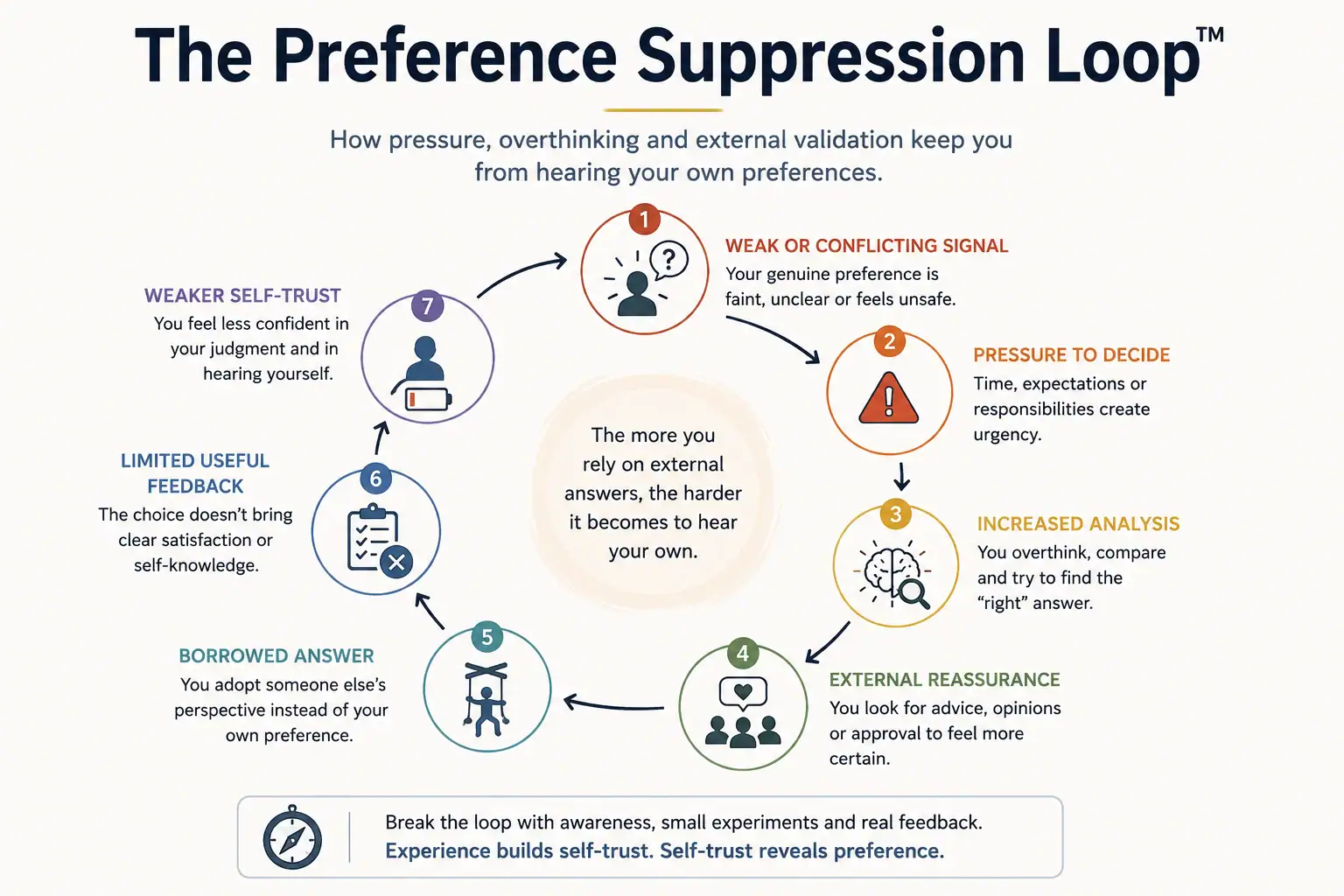
Advice is not the problem. Other people can reveal blind spots, provide facts, identify risks, and share experience you do not possess. The problem begins when advice replaces contact with reality.
Suppose someone tells you that you would thrive in a particular job. You accept the answer because it sounds confident. If the job later feels wrong, you may conclude that you are impossible to understand. But the failure was not evidence that you have no preferences. The process never generated your own prediction, criteria, or test.
Breaking the loop requires real feedback. Make a smaller choice. Record what you expected. Observe what happened. Notice what you want to repeat, change, or stop. This is how experience begins rebuilding self-trust.
Do you not know what you want—or is something else happening?
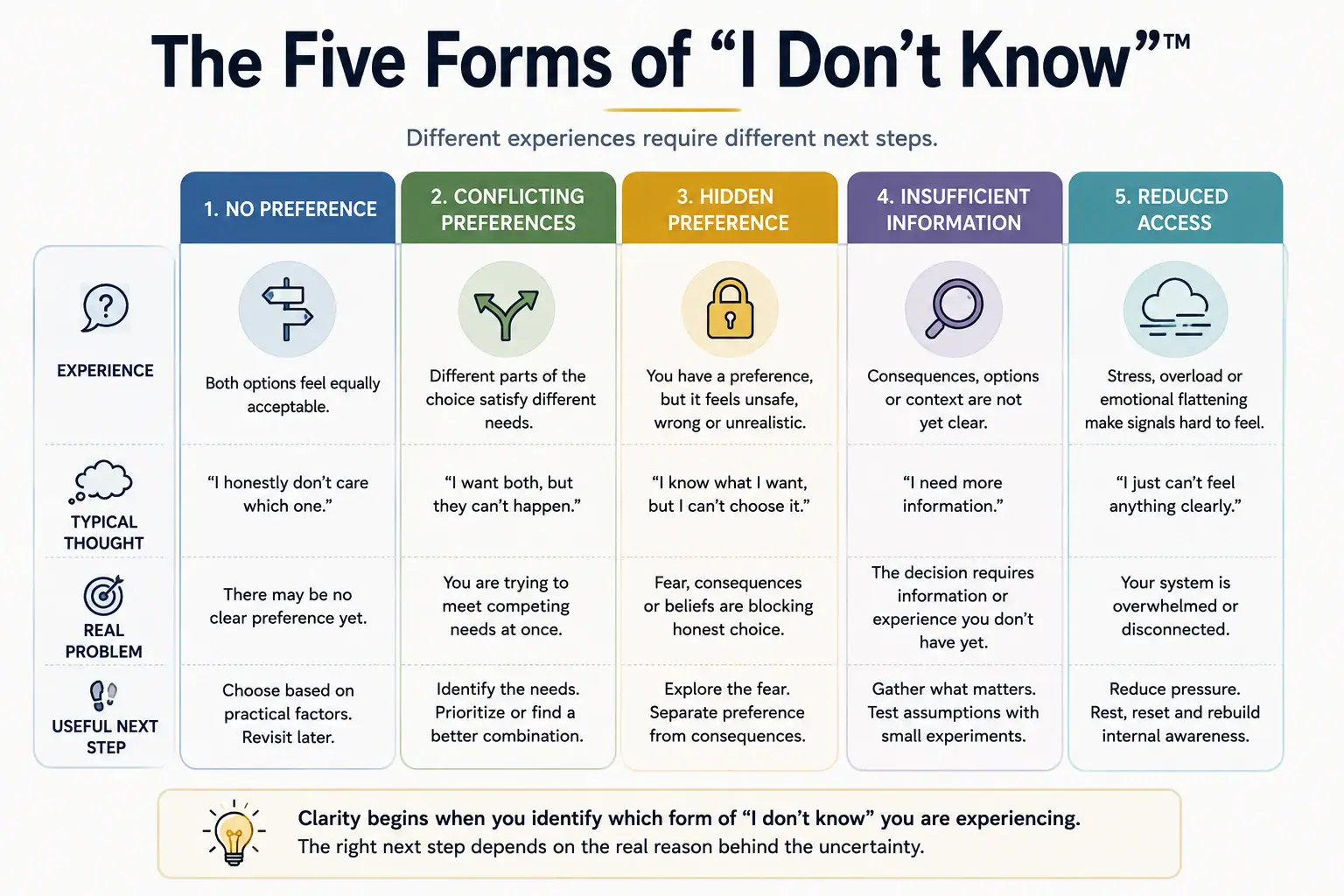
“I don’t know” can describe at least five different states. Identifying the state matters because each one requires a different next step.
1. No preference
Both options are genuinely acceptable. There is no hidden truth that must be uncovered. Choose using practical criteria, randomness, convenience, or another value, and revisit only if new information appears.
2. Conflicting preferences
Different options satisfy different needs. You may want freedom and security, novelty and belonging, rest and progress, or closeness and independence. The task is not to discover which side is fake. It is to clarify priorities, timing, trade-offs, and possible combinations.
3. Hidden preference
You have a preference, but it feels unsafe, selfish, unrealistic, embarrassing, or identity-threatening. Separate the preference from the decision. Naming what attracts you does not force you to act.
4. Insufficient information
The consequences, options, or context are unclear. Gather only the information likely to change the decision. When possible, replace abstract research with a limited real-world test.
5. Reduced access
Stress, exhaustion, overload, or emotional flattening makes your responses difficult to feel. Reduce pressure before demanding clarity. Rest, regulation, support, or professional care may be more useful than additional analysis.
Preference versus pressure
Pressure often feels more convincing than preference because pressure is louder. It produces urgency, justification, fear, and imagined consequences. Preference can be quiet, incomplete, and difficult to defend.
| Preference signal | Pressure signal |
|---|---|
| Often feels specific: “I would rather do this.” | Often feels urgent: “I must decide now.” |
| Can exist without complete certainty. | Demands certainty before movement. |
| May remain noticeable after emotion settles. | Often changes with reassurance, threat, or approval. |
| Points toward fit, interest, relief, or meaning. | Focuses on avoiding blame, loss, regret, or disapproval. |
| Can be tested through a small action. | Frames the choice as permanent and irreversible. |
| Does not always arrive with an elaborate explanation. | Produces repeated justification and argument. |
This distinction is not a truth detector. Calmness does not prove accuracy. Intensity does not prove importance. A quiet preference can reflect avoidance, and urgency can sometimes be appropriate. The purpose is to identify the type of information influencing the choice so that it can be evaluated rather than automatically obeyed.
Ask three separate questions:
- Preference: Which option attracts me before I calculate the consequences?
- Constraint: What practical, relational, ethical, or financial realities must be considered?
- Decision: Given both, what is the next responsible action?
Why thinking harder can make the answer less clear
Thinking is useful when it transforms information. It becomes noise when it repeatedly moves the same assumptions without producing new evidence.
You may revisit the same choice because you believe one more comparison will eliminate uncertainty. But many meaningful decisions contain uncertainty that cannot be removed in advance. More analysis then increases the number of imagined futures, objections, and regret scenarios without improving prediction quality.
Executive functions support planning, inhibition, flexible thinking, and working with information.7 These capacities are valuable, but they operate on available representations. If the missing information concerns lived fit—how you actually respond to a work environment, routine, relationship pattern, or creative practice—analysis has reached its boundary.
Thinking helps you compare known options. Experience helps you discover how you respond to them.
This is also why decisions can feel difficult even when the options are obvious. Cognitive noise, emotional interference, social pressure, fatigue, and weak feedback can create friction around an otherwise manageable choice. Read Why Decisions Feel Hard for a broader map of decision friction.
When you notice repeated analysis, ask:
- What new information am I trying to obtain?
- Could this information realistically become available before I act?
- What belief or prediction am I repeatedly rehearsing?
- What is the smallest action that would generate real feedback?
How to hear your own preferences again
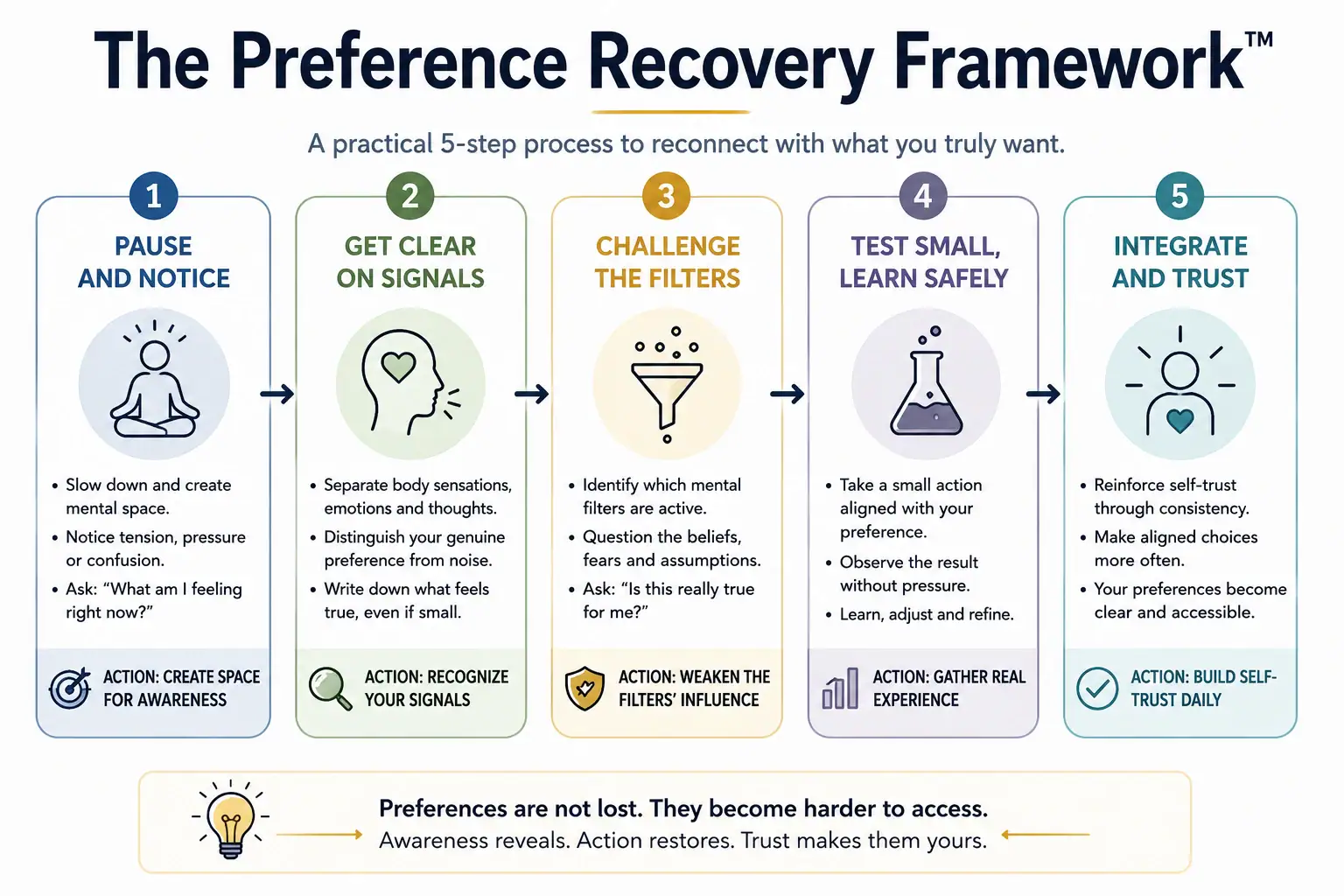
Preference recovery is not a single breakthrough. It is a repeated process of reducing interference, noticing responses, testing interpretations, and learning from results.
Step 1: Pause and notice
Create enough space to observe your current condition before solving the decision. Notice whether you feel rushed, tired, tense, emotionally flat, afraid, or socially exposed.
Ask: What am I experiencing right now, and how might that condition be shaping the options?
Step 2: Get clear on signals
Separate the channels of information instead of compressing them into one vague feeling.
- Thoughts: What interpretations and predictions are appearing?
- Emotions: What feels attractive, sad, threatening, relieving, or frustrating?
- Body responses: Where do you notice tension, settling, activation, heaviness, or energy?
- Behaviour: What do you repeatedly approach, avoid, delay, or return to?
- Context: What external demands, power dynamics, or practical limits are present?
No channel is automatically correct. The purpose is to stop treating “I don’t know” as a single undifferentiated state. The Personal Signal Decoder provides a deeper framework for separating these signal languages from urgency, learned reactions, and background noise.
Step 3: Challenge the filters
Name the filter rather than arguing with yourself in general.
- Am I prioritising approval over fit?
- Am I dismissing something because it is not immediately productive?
- Am I treating unfamiliarity as danger?
- Am I protecting a past identity?
- Am I acting from fear that this is my only opportunity?
Then ask: If this filter became 20 percent quieter, what preference might become visible?
Step 4: Test small and learn safely
A reversible choice is often more informative than a perfect theory.
Instead of deciding whether to change careers, interview someone in the role, take a short project, or test the work for several hours. Instead of deciding whether you want a new social life, attend one event and observe your response. Instead of defining your identity, schedule one activity and see whether you want to repeat it.
Before the experiment, record:
- What do I predict I will feel?
- What would count as useful evidence?
- What is reversible?
- What is the maximum acceptable cost?
Afterward, record what happened without forcing it into success or failure.
Step 5: Integrate and trust
Self-trust grows when your predictions, actions, and feedback become connected. It does not require always choosing correctly. It requires confidence that you can observe results and update.
Ask:
- What felt better or worse than expected?
- What did I want to continue after the novelty passed?
- Which discomfort represented growth, and which represented poor fit?
- What should I adjust in the next experiment?
A preference becomes clearer through repeated contact with reality. It becomes more trustworthy when it survives several contexts, emotional states, and feedback cycles.
The Preference–Pressure Matrix™
Your next step depends on two variables: how clear the preference is and how much pressure the decision environment contains.
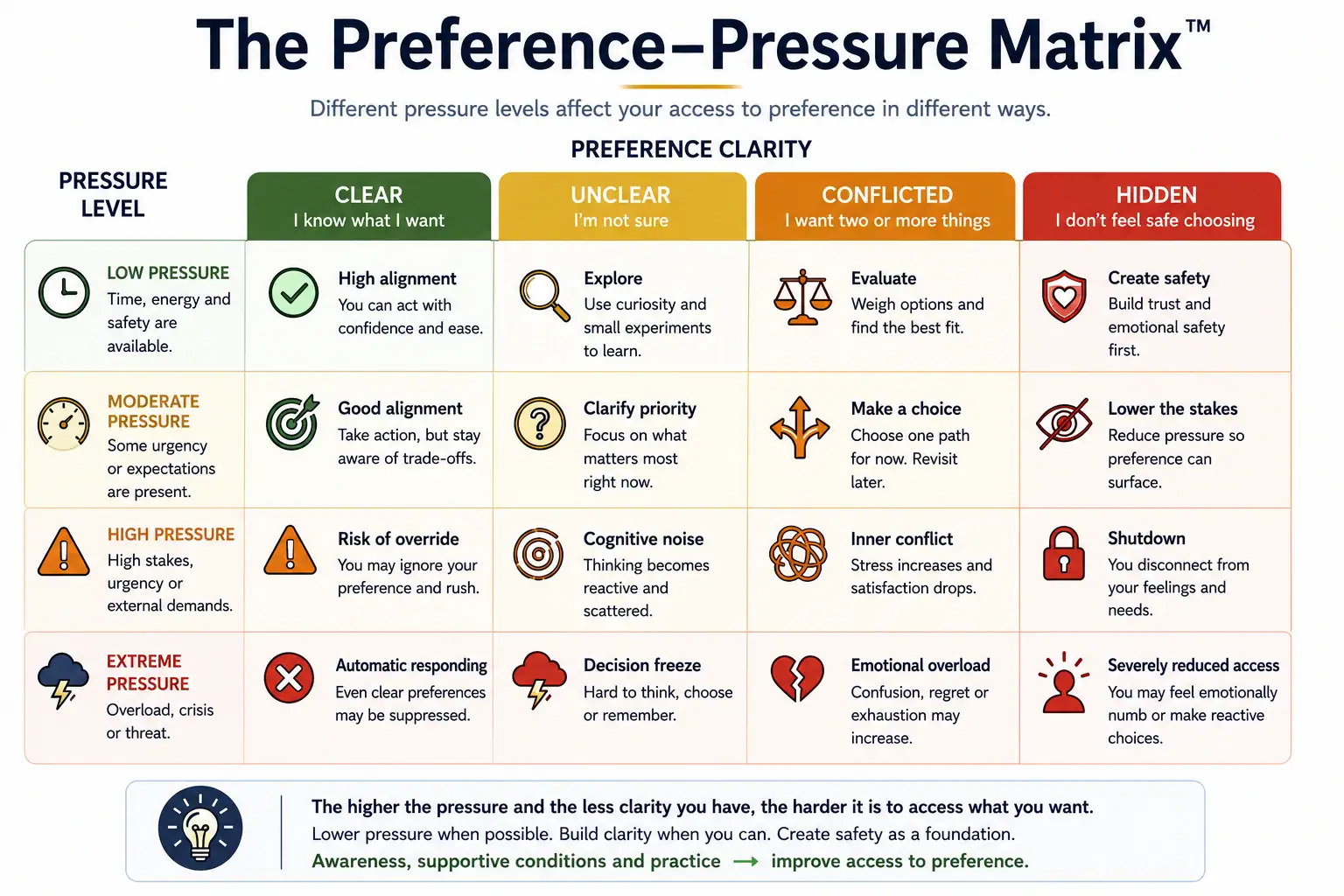
When pressure is low and preference is clear, action may be straightforward. When pressure is low and preference is unclear, curiosity and small experiments are appropriate. When pressure is moderate and preferences conflict, you may need to choose one priority for now rather than resolve your entire life.
High pressure changes the task. Even a clear preference can be overridden. Unclear preferences become cognitive noise. Conflict becomes more emotionally charged. Hidden preferences become harder to access because choosing does not feel safe.
Under extreme pressure, the priority may be stabilisation rather than preference discovery. Reduce urgency where possible. Obtain support. Protect sleep and basic functioning. Separate immediate safety decisions from longer-term identity questions.
The matrix is not a diagnosis. It is a reminder that clarity depends partly on conditions. You do not need to judge yourself for failing to hear a quiet signal in a loud environment.
The seven-day small preference experiment
This exercise is designed to restore contact with low-stakes preferences. It does not ask you to discover your purpose. It asks you to generate seven days of observable feedback.
Day 1: Notice automatic deferral
Each time you ask someone else what they want, pause and record what you would have chosen first. You do not need to insist on it. The aim is to notice the preference before accommodation begins.
Day 2: Make one sensory choice
Choose food, music, lighting, clothing, or environment without polling anyone. Observe whether the experience produces enjoyment, neutrality, or regret.
Day 3: Track energy, not only pleasure
Identify one activity that leaves you with more usable energy and one that leaves you depleted. This does not prove what you should do, but it adds data about fit and capacity.
Day 4: Delay an immediate answer
Use the sentence: I need a little time to decide. Notice what emerges when social pressure is temporarily removed.
Day 5: Test one curiosity
Spend 20–60 minutes on something mildly interesting without demanding productivity, mastery, or commitment. Curiosity often appears before certainty.
Day 6: Compare chosen and performed behaviour
Review the week. Which actions felt self-endorsed? Which felt like performances of responsibility, competence, identity, or approval?
Day 7: Identify one stable signal
Choose one preference that appeared more than once. Design a second small experiment for the following week.
Important: A result of “I still do not know” is not failure. It may indicate genuine indifference, conflicting needs, insufficient information, or reduced access. Use the Five Forms of “I Don’t Know”™ to choose the next response.
What not to do when you feel lost
Do not demand a complete life plan
Large questions combine too many unknowns. Replace a permanent identity decision with the next useful experiment.
Do not treat every preference as a commitment
You can prefer an option without choosing it. You can choose it without promising to prefer it forever.
Do not ask unlimited people for reassurance
Different people optimise for different values. More advice can create more perspectives without creating more self-knowledge.
Do not make a drastic change only to escape uncertainty
Urgent action can produce temporary relief because the decision process stops. Relief does not automatically mean the choice fits.
Do not assume a weak signal means no preference exists
Signals vary in intensity. Some become clearer only after pressure decreases or experience increases.
Do not turn body sensations into unquestionable instructions
Your body contributes information, but tension can reflect risk, excitement, fatigue, memory, pain, caffeine, conflict, or many other causes. Interpret the response in context and test it against evidence.
Should you make a major decision when you do not know what you want?
Uncertainty does not automatically mean you should delay. Waiting has costs, and perfect clarity may never arrive. The decision is whether the current level of uncertainty is manageable or whether your condition is significantly distorting access to information.
Consider delaying an irreversible choice when:
- the main motive is immediate escape from distress;
- you are severely sleep-deprived, overwhelmed, or unable to concentrate;
- you have not tested reasonable alternatives;
- you are relying on one highly emotional moment as the complete picture;
- the consequences are poorly understood and more relevant information is available;
- you feel unable to say what you prefer because another person’s reaction feels unsafe.
Consider moving forward despite uncertainty when:
- the decision is reversible or adjustable;
- delay is already creating meaningful harm;
- you understand the main risks and trade-offs;
- the choice can be framed as a test rather than a final identity statement;
- you have enough support to review and adjust after acting.
A mature decision is not always the option you most prefer. It is the action that integrates preference, values, constraints, consequences, and current capacity without pretending any one source of information is the whole truth.
When professional support may help
Periods of uncertainty are common during burnout, grief, relationship change, career transition, prolonged stress, and identity development. However, professional support may be useful when difficulty knowing what you want is persistent, worsening, or interfering with ordinary life.
Consider speaking with a qualified healthcare or mental-health professional when the experience is accompanied by:
- persistent loss of interest or pleasure;
- sustained low mood, hopelessness, or severe anxiety;
- significant changes in sleep, appetite, energy, or concentration;
- trauma-related symptoms, emotional numbness, or dissociation;
- inability to manage work, relationships, self-care, or ordinary decisions;
- thoughts of self-harm, suicide, or being unable to stay safe.
If you may be in immediate danger or unable to keep yourself safe, contact local emergency services or seek urgent in-person help now.
A therapist can help separate preference difficulty from anxiety, depression, trauma responses, relationship dynamics, or learned patterns of accommodation. A medical professional can assess physical conditions, medication effects, sleep problems, or other factors that may affect mood and cognition.
This article is educational and is not a diagnosis or a replacement for professional care.
Frequently asked questions
Why don’t I know what I want anymore?
You may be experiencing cognitive overload, constant adaptation, fear of consequences, conflicting needs, external pressure, or reduced access to interest. The problem is not always the absence of desire. It may be an interruption between internal response, attention, interpretation, and feedback. Reduce the pressure, identify which form of uncertainty is present, and use a small real-world choice to gather better information.
Is it normal not to know what you want?
Yes. Preferences are not always immediate or stable, especially when a situation is unfamiliar, the options are similar, several needs conflict, or circumstances are changing. Not knowing can be an accurate response to insufficient information. It becomes more concerning when the uncertainty is persistent across most areas of life, causes significant distress, or appears alongside symptoms such as severe exhaustion, emotional numbness, or loss of interest.
Can stress make it difficult to know what you want?
Yes. Stress can reduce working-memory capacity and cognitive flexibility, increase attention to threat or urgency, and make familiar responses easier to access than subtle preferences. This does not mean stress erases desire. It can change which information becomes available during a decision. Reducing unnecessary urgency, protecting rest, and making the question smaller may improve access to your response.
Can burnout make you lose interest in everything?
Burnout can be associated with exhaustion, detachment, reduced motivation, and a sense that activities no longer feel rewarding. Persistent loss of interest can also occur with depression or other health conditions, so it should not automatically be attributed to burnout. If reduced interest is prolonged, worsening, or interfering with daily functioning, seek assessment from a qualified professional.
Why do I know what other people want but not what I want?
You may have practised detecting other people’s expectations more often than detecting your own preferences. This can develop through responsibility, people-pleasing, conflict avoidance, caregiving, or environments where belonging depended on adaptation. Begin by noticing your first response before asking anyone else. You do not need to act on it immediately; the first goal is to restore it as valid information.
Do I not know what I want, or am I afraid to admit it?
Ask whether a particular option becomes clearer when you temporarily remove consequences and other people’s reactions. If you can identify what attracts you but immediately argue that it is unsafe, selfish, unrealistic, or impossible, you may have a hidden preference rather than no preference. Name the preference separately from deciding whether or when to act on it.
How can I tell whether a desire is genuinely mine?
No single feeling proves that a desire is authentic. Look for patterns across time, contexts, and feedback. Does the preference remain after urgency or approval fades? Do you want to repeat the experience after novelty passes? Does acting on it produce useful energy, meaning, or fit? Treat authenticity as a calibration process rather than a moment of perfect certainty.
Why does every possible option feel wrong?
Every option may feel wrong because important needs conflict, the available options are poor, pressure is making trade-offs feel intolerable, or you are expecting one choice to solve too many problems. Identify what each option provides and costs. Then ask whether a new option, sequence, temporary choice, or smaller experiment could satisfy more of the underlying needs.
Can people-pleasing make you lose your preferences?
People-pleasing can make preferences harder to access because attention is repeatedly directed toward approval, harmony, and anticipated reactions. Your preferences may not disappear, but they can be noticed later or dismissed earlier. Practise making low-stakes choices without consultation, delaying immediate answers, and distinguishing kindness from automatic self-erasure.
Should I make a major decision while feeling disconnected?
Avoid making an irreversible decision solely to escape distress when you are severely overwhelmed, sleep-deprived, or unable to evaluate consequences. However, uncertainty alone does not require indefinite delay. Improve the decision conditions, gather the information likely to matter, obtain support, and identify whether a reversible first step can generate feedback before a larger commitment.
Can depression make it difficult to know what you want?
Yes. Depression can involve loss of interest or pleasure, fatigue, concentration problems, and difficulty making decisions. These symptoms can make preferences feel flat or inaccessible. Difficulty knowing what you want does not prove depression, but persistent changes in interest, mood, sleep, appetite, energy, or functioning deserve professional assessment.
How do I begin finding out what I want?
Begin with a small, reversible question rather than a permanent life decision. Reduce external input briefly, notice thoughts, emotions, body responses, and behaviour, then choose one low-risk action that creates real feedback. Record what you expected and what actually happened. Preference clarity develops through repeated observation, action, and updating.
You do not need one final answer
You do not need to discover one permanent truth about who you are or what your entire life should become.
Begin with one preference you can test. Notice the response before you explain it away. Separate attraction from consequence. Make a choice small enough to revise. Then allow experience to provide information that pressure and endless analysis cannot.
Your preferences may change as you change. That is not evidence that you cannot trust yourself. Reliable self-trust does not mean predicting every future version of you. It means trusting your ability to notice, interpret, test, learn, and update.
Clarity is not the absence of uncertainty. It is enough contact with reality—and with yourself—to make the next useful move.
About the author
Denys Kostin is the creator of Intuition Management and develops practical frameworks for decision clarity, signal detection, self-trust, and navigating uncertainty. His work connects systems thinking, psychological self-help, pattern recognition, and reflective practice without treating intuition as magic or replacing evidence-based care.
References
- Shields GS, Sazma MA, Yonelinas AP. The effects of acute stress on core executive functions: A meta-analysis and comparison with cortisol. Neuroscience & Biobehavioral Reviews. 2016. PubMed record.
- Girotti M, Adler SM, Bulin SE, Fucich EA, Paredes D, Morilak DA. Effects of chronic stress on cognitive function. 2024. PubMed record.
- Ryan RM, Deci EL. Self-determination theory and the facilitation of intrinsic motivation, social development, and well-being. American Psychologist. 2000. Read the paper.
- Iyengar SS, Lepper MR. When choice is demotivating: Can one desire too much of a good thing? Journal of Personality and Social Psychology. 2000; and related later work examining the conditions under which choice overload occurs. PubMed record; motivational account.
- National Institute of Mental Health. Depression. Symptoms can include loss of interest or pleasure, fatigue, and difficulty concentrating or making decisions. NIMH guidance.
- Lerner JS, Li Y, Valdesolo P, Kassam KS. Emotion and decision making. Annual Review of Psychology. 2015. PubMed record.
- Diamond A. Executive functions. Annual Review of Psychology. 2013. PubMed record.
Editorial note: This article presents an educational framework for understanding preference access, stress, attention, motivation, and decision feedback. It is not intended to diagnose a medical or mental-health condition or replace individual professional advice.
Written by Denys Kostin, founder of Intuition Management—a practical framework for decision clarity under uncertainty.