Self-Reconnection Guide
You may not have lost yourself. Stress, overload and constant adaptation can make the signals that normally help you recognize yourself harder to access. Reconnection begins by noticing one signal, making one small choice and creating one moment that feels genuinely yours.
Not feeling like yourself can be unsettling because it makes the problem seem larger than tiredness or stress. Familiar activities may feel strangely distant. Your reactions may seem automatic. You may continue working, responding and getting through the day while feeling as though the person doing it is only partially you.
That experience does not necessarily mean your identity has disappeared. Often, the sense of self becomes less available when attention is repeatedly pulled toward demands, distractions, other people’s expectations or the need to keep functioning. Your preferences, emotions, bodily cues and values may still be present, but quieter than the external noise surrounding them.
If you are first trying to understand why you feel disconnected from yourself, the companion guide explores the experience in more detail. This article focuses on the next practical step: restoring contact with your internal signals, testing small self-directed choices and learning from the response without demanding that you instantly recover an earlier version of yourself.
In this guide
- How to feel like yourself again
- What feeling like yourself means
- Signs of self-disconnection
- Why you may not feel like yourself
- The Self-Disconnection Loop™
- Access, not identity
- The Self-Reconnection Loop™
- A 10-minute exercise
- A seven-day plan
- What makes it worse
- Signs reconnection is working
- When support may help
- Frequently asked questions
How do you feel like yourself again?
To feel like yourself again, reduce unnecessary input, return attention to your body, identify one genuine preference, make one small self-directed choice and observe how it affects you. Reconnection usually returns through repeated moments of internal recognition—not by forcing yourself to recover your previous personality immediately.
- Reduce noise long enough to notice what is happening inside you.
- Return to your body and observe sensations without immediately interpreting them.
- Identify one real preference, even if it concerns something small.
- Make one self-directed choice based on that preference.
- Observe the response and notice what feels more or less like you.
The aim is not perfect certainty. It is to increase the number of moments in which your actions, attention and internal experience feel connected.
What does “feeling like yourself” actually mean?
Feeling like yourself is not a permanent mood. It is a pattern of recognition. Your sensations feel connected to your body. Your emotions make sense as your responses. You can detect at least some of your preferences. Your present life feels connected to your memories, values and direction. Some of your actions feel chosen rather than merely performed.
Research on interoception describes how the nervous system senses, interprets and integrates signals from within the body. Those signals contribute to moment-by-moment awareness of the body and have been linked in research to several dimensions of self-experience.[1][2] This does not mean every sensation is a reliable instruction. It means bodily information is one part of how you know what is happening within you.
The Six Signals of Self™
- Body recognition: physical sensations feel connected to you and become usable information.
- Emotional recognition: you can identify feelings as your responses, even when they are mixed or incomplete.
- Preference recognition: you can tell what you like, dislike, want, need or would rather avoid.
- Continuity: today feels connected to your memories, values and developing identity.
- Agency: at least some actions feel chosen rather than entirely automatic or imposed.
- Meaning: your actions connect with something that matters to you.

When several of these signals become difficult to access at once, the result may feel like identity loss. Yet what has changed may be access, clarity or attention—not the existence of the self underneath.
Signs that you may feel disconnected from yourself
Self-disconnection can be difficult to describe because daily life may still look normal from the outside. You may complete tasks, speak with people and make decisions while sensing that something essential is missing.
- You operate on autopilot and rarely notice how an experience affects you.
- You struggle to identify what you want, even in low-stakes situations.
- Activities you usually enjoy feel remote, muted or mechanical.
- You constantly adjust to other people and notice yourself only afterward.
- Your emotions feel inaccessible, delayed or difficult to name.
- Your decisions are guided mainly by urgency, obligation or anticipated reactions.
- You keep analysing yourself but feel no closer to an answer.
- Your past self feels familiar yet strangely unreachable.
- You feel as though you are watching your life instead of living it.
- You need external expectations to tell you what to do next.
Experiencing one or two of these signs occasionally does not automatically indicate a serious problem. People can feel temporarily unlike themselves during demanding periods, transitions, conflict, sleep disruption or prolonged uncertainty. The important questions are how persistent the experience is, how distressing it feels and how much it interferes with everyday life.
Why you may not feel like yourself anymore
There is no single explanation that applies to everyone. The following mechanisms can overlap, and an article cannot determine which one is operating in your life. They are useful as possibilities to examine rather than diagnoses to adopt.
Too much external input
Messages, notifications, meetings, news, entertainment and other people’s needs can keep attention continually directed outward. Working memory and attention are closely connected, and both have limited capacity.[3] A meta-analysis found that acute stress can impair working memory and cognitive flexibility, while a broader review describes stress-related effects on attention and other prefrontal executive processes.[6][7] When the system is occupied with holding, sorting and responding to incoming information, less attention may remain for subtle internal experience.
This can help explain why your preferences become clearer only after a conversation ends, why an emotion appears when the room becomes quiet or why you suddenly know what you wanted after you have already agreed to something else.
Constant adaptation
Adaptation is useful. It helps you cooperate, work, maintain relationships and respond to changing circumstances. But when adaptation becomes nearly continuous, you may become highly skilled at detecting what the situation requires while becoming less practised at detecting what you require.
The issue is not kindness or flexibility. It is the absence of moments in which your own response is allowed to become visible.
Emotional suppression
Postponing an emotion can be necessary in the middle of a crisis or important task. Repeatedly overriding emotions, however, may make them harder to identify later. Sometimes the first available answer is not a precise label but “flat,” “unclear,” “irritated,” “heavy” or “numb.” Naming an emotion does not solve everything, but experimental research suggests that putting feelings into words can reduce distress in some contexts.[4]
For a deeper explanation of reduced emotional access, read Why Do I Feel Emotionally Numb?
Cognitive and emotional overload
When everything feels like too much, the immediate goal often becomes keeping up. Reflection, curiosity and nuanced preference can seem less urgent than finishing the next task or preventing the next problem.
Research on stress and recovery also describes emotion regulation as a changing process across different phases of a stressful experience rather than a fixed personal trait.[8] That does not mean your deeper signals have disappeared. It may mean the system is prioritising immediate functioning over detailed self-awareness.
Living through roles
You may spend much of the day being an employee, parent, partner, manager, caregiver, problem-solver or dependable friend. Roles organise behaviour and make social life possible. Yet a role becomes constricting when it leaves no room for experiences that are not useful to someone else.
A useful question is not “Which role is false?” but “Where am I allowed to exist without immediately performing a function?”
Loss of self-directed action
Preferences become easier to recognise when they shape behaviour. If nearly every action is driven by deadlines, pressure, habit or anticipated judgement, you receive fewer examples of what your own choices feel like.
Self-determination research treats autonomy—the experience of acting with volition and self-direction—as a core psychological need associated with motivation and well-being.[5] This does not mean complete independence is possible or desirable. It means some room for genuine choice matters.
The Self-Disconnection Loop™
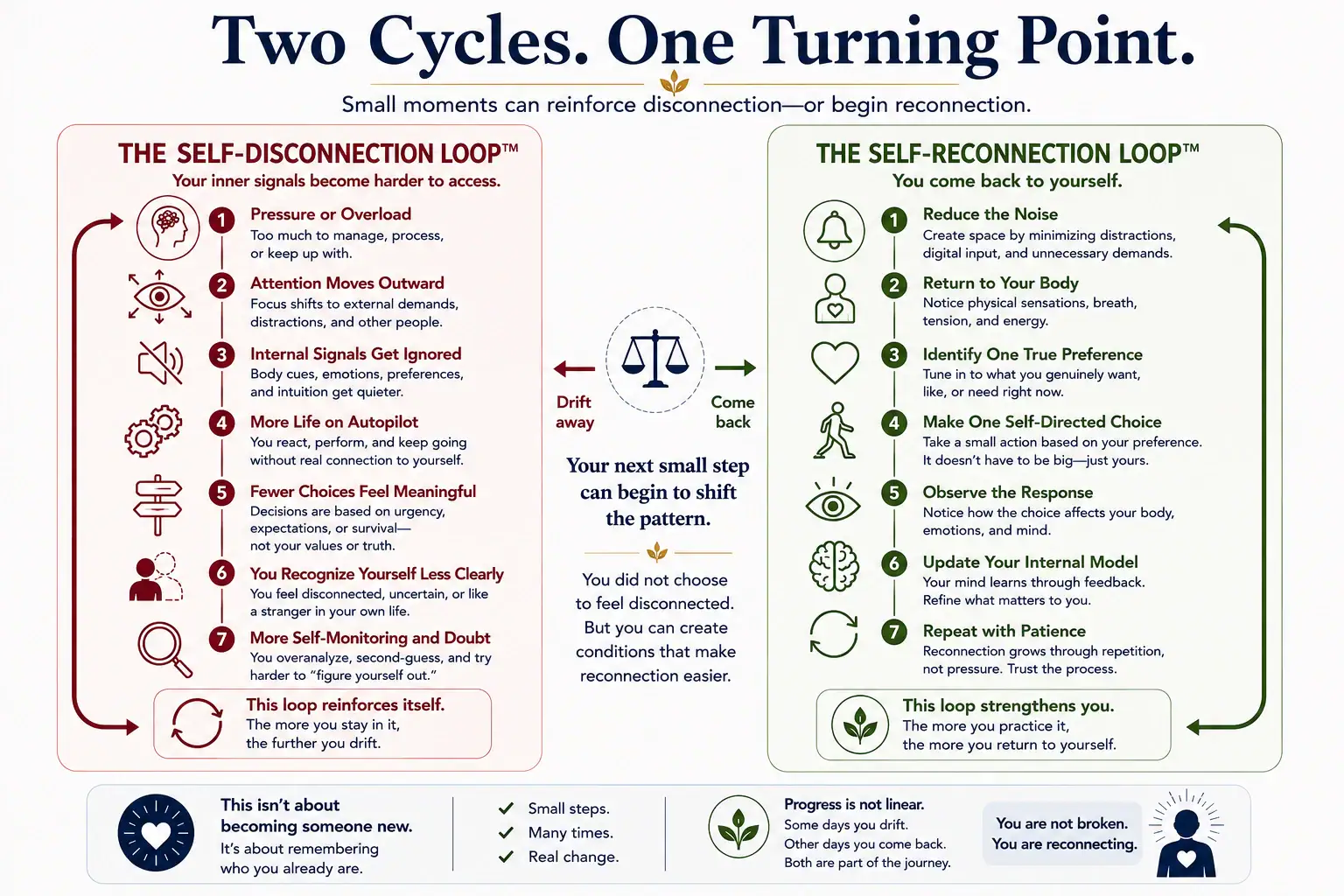
Self-disconnection can reinforce itself. The more distant you feel, the harder you may try to monitor, analyse and correct yourself. That additional effort can create more noise, making weak internal signals even harder to detect.
- Pressure or overload: too much must be managed, processed or kept under control.
- Attention moves outward: focus shifts toward external demands, distractions and other people’s needs.
- Internal signals get ignored: bodily cues, emotions and preferences become quieter or easier to miss.
- More life happens on autopilot: you react, perform and keep going with little sense of contact.
- Fewer choices feel personally meaningful: decisions follow urgency or expectation rather than values.
- You recognise yourself less clearly: your own life begins to feel distant or unfamiliar.
- Self-monitoring and doubt increase: you analyse and second-guess yourself more intensely.

The loop is self-reinforcing, but it is not permanent. You do not have to solve your identity all at once. You need a turning point small enough to interrupt the pattern.
You may have lost access to yourself—not your identity
When internal signals become difficult to access, the mind may interpret the absence of clarity as evidence that there is no stable self left. That conclusion can feel convincing because you cannot immediately produce a preference, emotion or direction on demand.
But inability to access a signal in one moment is not proof that the signal does not exist. The distinction between identity and access creates a more useful set of questions.
| It may feel like | What may actually be happening |
|---|---|
| “I have no personality anymore.” | Your preferences and emotional responses may be harder to notice under current conditions. |
| “I have completely changed.” | You may be functioning under pressures that produce a narrower range of behaviour. |
| “I do not know who I am.” | External demands may be receiving more attention than internal signals. |
| “I need to get my old self back.” | You may need new moments of recognition rather than a perfect return to the past. |
| “Nothing matters to me.” | Overload or emotional shutdown may be reducing access to motivation and relevance. |
Your mind maintains an evolving internal model of reality, including expectations about who you are, what situations mean and how you are likely to respond. A period of disconnection can make that model feel outdated or unreliable. Reconnection supplies new feedback so the model can become more accurate again.
You do not need to prove who you are before taking the next step. Sometimes the next honest step is what helps you recognise yourself.
The Self-Reconnection Loop™
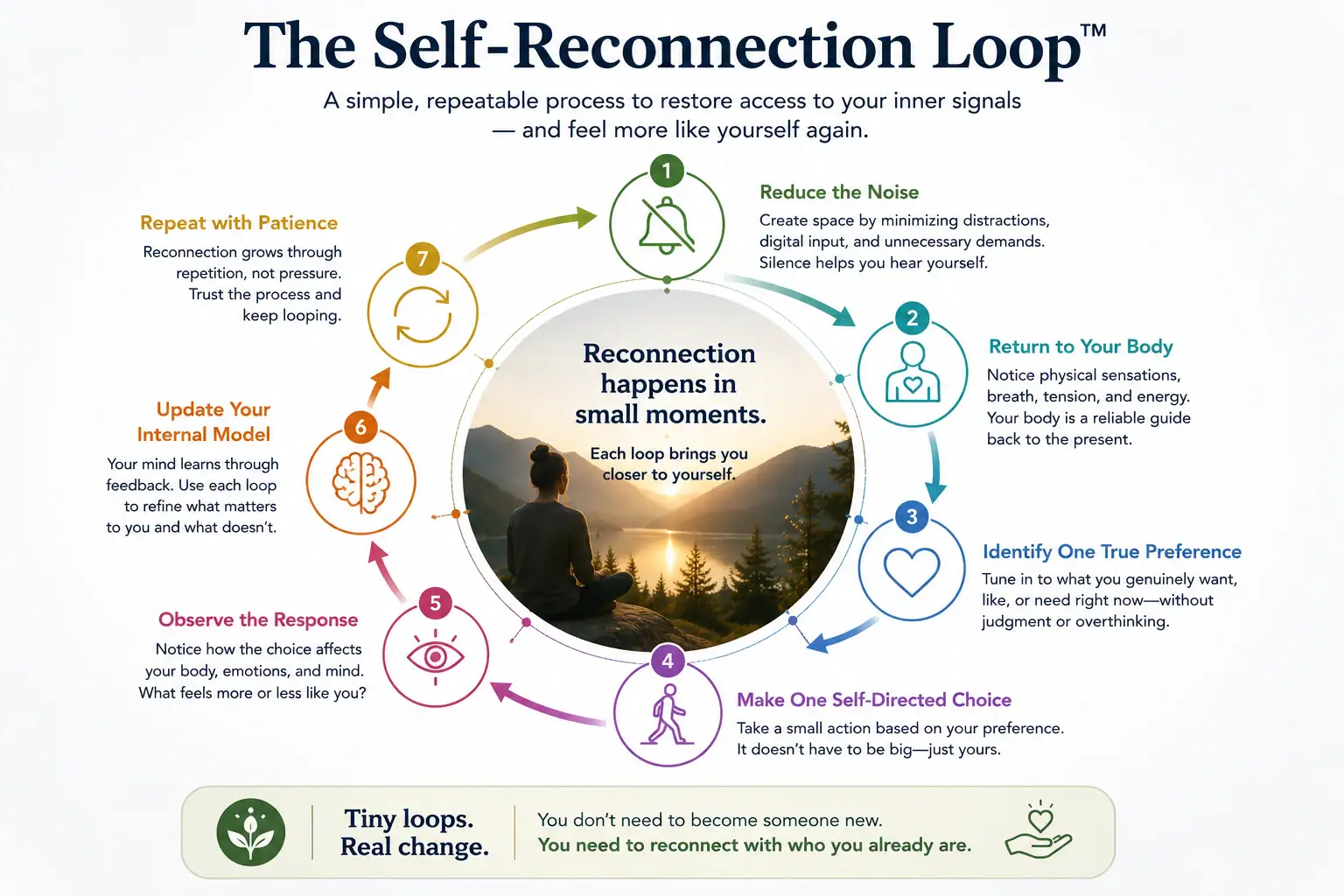
The Self-Reconnection Loop™ is a repeatable process for restoring access to internal signals. It begins with conditions, not conclusions. Instead of asking “Who am I?” under pressure, you create enough space to notice one signal and test one small response.
1. Reduce the noise
The goal is not perfect silence. It is a temporary reduction in competing input. Put the phone in another room for ten minutes. Finish one source of information before opening another. Delay a non-urgent response. Sit without audio or video. Step away from other people’s opinions before making a personal decision.
Noise can be external, such as notifications, or internal, such as rehearsing every possible interpretation. You do not have to eliminate it. Create a small gap in which another signal can become detectable.
2. Return attention to the body
Observe before interpreting. Where do you notice tension, heaviness, warmth, restlessness, hunger, fatigue or ease? Is your breathing shallow or settled? Does the situation make your body contract, mobilise or soften?
A sensation is information, not a command. Tension may reflect fear, excitement, habit, physical discomfort or several things at once. The purpose is to include the body in your awareness, not to treat every feeling as infallible intuition.
3. Identify one genuine preference
Begin with something small enough that the answer does not require a life plan. Do you want light or dimness? Company or ten minutes alone? Music or quiet? Which task feels most important? What would make the next hour slightly more workable?
A preference does not need to be rationally impressive. It only needs to be honest enough to test.
4. Make one self-directed choice
Turn the preference into a visible action. Close one tab. Move to a quieter room. Choose the meal you actually want. Decline one optional request. Work on the task that matters before the task that merely creates urgency.
The choice should be small enough to complete without waiting for confidence. Action gives the mind evidence that your signals can influence what happens next.
5. Observe the response
After the action, notice what changes. Do you feel more settled, more present or slightly relieved? Does the choice create resistance but also a sense of rightness? Do you feel more drained? Did it feel like yours?
Do not demand a dramatic transformation. A two-percent shift is still information.
6. Update your internal model
Your first preference will not always be the best guide. The value of the process is feedback. Perhaps quiet helped. Perhaps isolation made the disconnection stronger. Perhaps the task you expected to enjoy felt empty, while an overlooked activity restored curiosity.
Use the response to refine what you understand about your needs, limits and values.
7. Repeat without demanding certainty
Reconnection grows through repetition. The aim is not a final answer to who you are. It is a stronger relationship with the signals that allow you to recognise yourself while you continue changing.
Decode the signals you are already receiving
When your internal signals feel unclear, the solution is not always to think harder. The Personal Signal Decoder helps you distinguish bodily cues, emotions, learned reactions, preferences and background noise.
A 10-minute exercise to feel more like yourself
This exercise is not designed to produce a breakthrough. It is designed to create one complete loop of noticing, choosing and learning.
- Minutes 1–2: stop new input. Close messages, audio, video and unnecessary tabs. Let the environment become slightly less demanding.
- Minutes 3–4: notice three body signals. Name sensations without explaining them: “tight jaw,” “warm hands,” “heavy eyes.”
- Minute 5: name the strongest available emotion. “Unclear,” “flat,” “numb” and “mixed” are valid answers.
- Minute 6: identify one preference. Choose between two simple options rather than searching for the perfect answer.
- Minutes 7–8: act on the preference. Change position, get water, step outside, close a task or begin the action you chose.
- Minute 9: observe the effect. Look for a small change in tension, clarity, presence or resistance.
- Minute 10: record one sentence. Complete: “I felt slightly more like myself when…”
Do not judge the exercise by whether you felt wonderful. Judge it by whether you gathered one piece of honest information.
A seven-day plan to reconnect with yourself
This plan gives each signal a small place in daily life. Five minutes is enough. The seven days are not a promise that persistent disconnection will disappear within a week. They are a structured experiment that can show you which conditions make self-recognition easier.
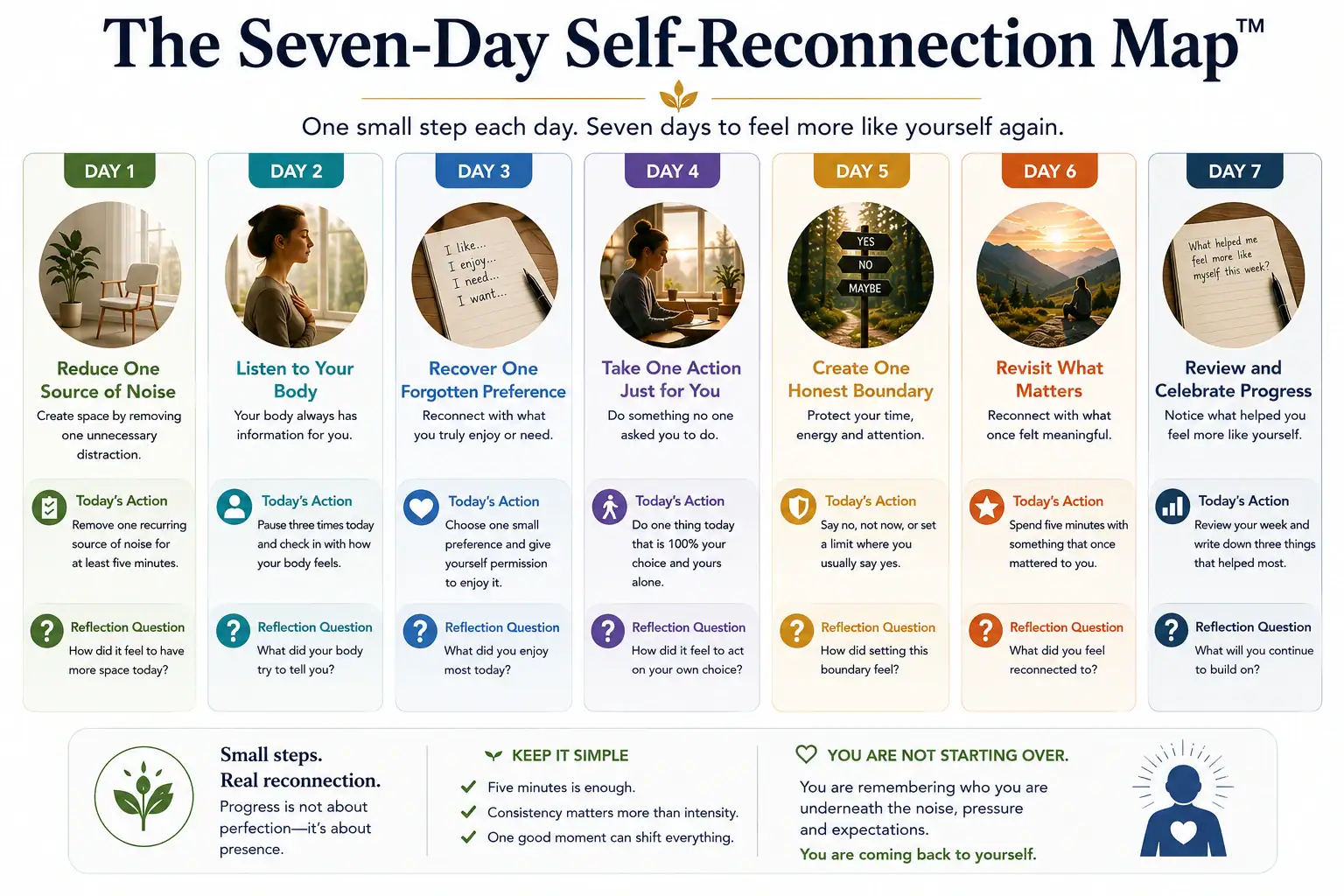
Day 1: reduce one recurring source of noise
Remove or pause one unnecessary input for at least five minutes. This might be a notification stream, background video, repeated checking or a conversation you do not need to continue immediately.
Reflection: What became noticeable when there was slightly more space?
Day 2: listen to your body
Pause three times and identify one sensation each time. Do not turn it into a story. Simply notice the data.
Reflection: What was your body trying to tell you about energy, tension or need?
Day 3: recover one forgotten preference
Choose one thing you enjoy, need or prefer and allow it to influence a small decision.
Reflection: What did you enjoy most today, even briefly?
Day 4: take one action just for you
Do one thing that nobody requested and that does not need to be productive, impressive or shared.
Reflection: How did it feel to act on your own choice?
Day 5: create one honest boundary
Say “not now,” decline an optional request or limit the time and attention given to something that usually expands automatically.
Reflection: What did the boundary protect?
Day 6: revisit what matters
Spend five minutes with something that once felt meaningful: a book, place, skill, question, piece of music or unfinished idea.
Reflection: Did anything still feel alive, interesting or personally relevant?
Day 7: review and celebrate progress
Review the week and write down three moments that helped you feel more present, honest or self-directed.
Reflection: What is worth continuing, and what can remain an experiment?
Continue your intuition journey
Reconnection is not only about reducing distress. It is also about learning how your signals, values and choices work together over time.
What usually makes disconnection worse
Trying to force a strong emotion
Demanding that you feel excited, grateful, motivated or “normal” can create another performance. Start with the emotion or sensation that is actually available, including uncertainty.
Comparing every moment with your past self
Your earlier self existed under different conditions and had different information. The goal is not to reproduce a previous identity perfectly. It is to develop honest contact with your present experience.
Analysing yourself continuously
Reflection can help, but constant self-monitoring may become another form of noise. Alternate reflection with a small action that can produce new feedback.
Waiting for complete certainty
Clarity often develops after a low-risk choice, not before it. Treat small actions as experiments rather than irreversible declarations of identity.
Making a dramatic change too quickly
Feeling unlike yourself does not automatically mean you should leave a job, end a relationship, relocate or abandon major commitments. Large decisions may be appropriate in some circumstances, but they deserve more evidence than a temporary state of disconnection can provide.
Consuming more advice instead of testing one action
Reading about reconnection is not the same as experiencing it. Stop after one useful idea and test it before collecting ten more.
How to know whether reconnection is working
Progress often appears quietly. You may not wake up with a dramatic feeling of being restored. Instead, you notice that internal information reaches you sooner and influences behaviour more often.
- You detect preferences before automatically agreeing.
- Decisions feel slightly less mechanical.
- You recover moments of curiosity or spontaneous interest.
- You notice tension before overriding it.
- You require less external validation for simple choices.
- Your emotions become more understandable, even when they remain uncomfortable.
- You experience short moments of presence rather than waiting for permanent certainty.
- Saying “no,” “not now” or “I need time” becomes easier.
- Your days contain more actions that feel chosen.
Some days you may drift outward again. That does not erase progress. Reconnection is the ability to return, not the ability to remain perfectly centred forever.
When additional support may help
Feeling disconnected can have many causes, and this article cannot identify yours. Consider speaking with a qualified mental-health or medical professional when the experience is persistent, becoming more intense, feels frightening or significantly affects work, relationships, memory, safety or daily functioning.
Professional support is especially important when disconnection follows a traumatic or destabilising experience, includes severe confusion or major memory gaps, or is accompanied by thoughts of self-harm. Practical exercises can support awareness, but they are not a substitute for assessment or treatment.
This article is educational and does not diagnose depersonalisation, derealisation, depression, burnout, trauma or any other condition.
Frequently asked questions
Why do I not feel like myself anymore?
You may not feel like yourself when stress, overload, emotional suppression, major change or constant adaptation makes your usual internal signals harder to access. The experience can involve reduced awareness of emotions, preferences, bodily cues, agency or continuity. Because many causes are possible, persistent or severe disconnection deserves professional attention.
How can I start feeling like myself again?
Begin by reducing one source of unnecessary input. Notice one bodily or emotional signal, identify one genuine preference, make one small choice based on it and observe the effect. Repeat the process without demanding immediate certainty.
Can stress make you feel disconnected from yourself?
Stress can narrow attention toward immediate demands and reduce the capacity available for reflection and nuanced self-awareness. That can make preferences, feelings and bodily signals harder to notice. Stress is not the only possible explanation, however.
Is feeling disconnected the same as emotional numbness?
They can overlap but are not identical. Emotional numbness primarily concerns reduced access to emotion. Self-disconnection may also involve preferences, bodily awareness, agency, continuity, meaning and the feeling that actions belong to you.
Should I try to become my old self again?
Not necessarily. Your earlier self belonged to an earlier context. A healthier goal is to restore honest contact with your present signals and values while allowing your identity to continue developing.
How long does it take to reconnect with yourself?
There is no universal timeframe. A small moment of recognition can occur quickly, while a stable sense of reconnection may require repeated practice, changes in circumstances and, for some people, professional support. Avoid treating the seven-day plan as a deadline.
You can begin with one signal
You do not need to recover your entire identity today. Begin with one signal that is available now: a sensation, an emotion, a preference, a value or a small action that feels honestly yours.
Reduce the noise around that signal. Let it influence one low-risk choice. Observe what happens. Use the response to update what you know. Then repeat.
You may not have lost yourself. You may be learning how to hear yourself again.
Take the next step
Use the Personal Signal Decoder to separate meaningful inner information from stress, habit, expectation and background noise.
Research references
- Khalsa SS, et al. “Interoception and Mental Health: A Roadmap.” Biological Psychiatry: Cognitive Neuroscience and Neuroimaging. Read the full article.
- Monti A, et al. “The inside of me: interoceptive constraints on the concept of self in neuroscience and clinical psychology.” Read the full article.
- Oberauer K. “Working Memory and Attention—A Conceptual Analysis and Review.” Read the full article.
- Lieberman MD, et al. “Subjective Responses to Emotional Stimuli During Labeling, Reappraisal, and Distraction.” Read the full article.
- Martela F, et al. “In selecting measures for a comprehensive assessment of well-being, it is essential to include indicators of psychological need satisfaction.” Read the full article.
- Shields GS, et al. “The Effects of Acute Stress on Core Executive Functions: A Meta-Analysis and Comparison with Cortisol.” Read the full article.
- Girotti M, et al. “Prefrontal Cortex Executive Processes Affected by Stress in Health and Disease.” Read the full article.
- Flores-Kanter PE, et al. “A Narrative Review of Emotion Regulation Process in Stress and Recovery Phases.” Read the full article.