The Adaptive Reality Model™: a framework for understanding intuition, self-trust, attention, and decision-making in the internal model of reality.
Estimated reading time: 20–22 minutes
Why do intelligent people sometimes make poor decisions?
Why can two people experience the same event yet remember it completely differently?
Why does intuition sometimes seem remarkably accurate—and other times completely misleading?
Why does self-trust disappear during periods of stress, cognitive overload, or prolonged uncertainty?
At first glance, these appear to be separate psychological questions.
This article proposes that they may all arise from the same underlying process.
Your mind never experiences the external world directly.
Instead, it continuously receives incomplete streams of information through the senses.
That information is filtered by attention.
Compared with previous experience.
Interpreted through memory.
Used to generate predictions.
Then continuously updated whenever reality provides new feedback.
What you consciously experience is therefore not reality itself.
It is your mind’s best continuously evolving internal model of reality.
One useful way to understand cognition is to see the mind as a system that continuously constructs, tests, and refines an internal model of reality.
This article introduces the Adaptive Reality Model™, an integrative framework that draws on established ideas from cognitive science—including perception, attention, prediction, learning, and feedback—to explain how intuition, confidence, self-trust, decision-making, and wisdom may emerge from the same adaptive process.
It is not intended to replace existing scientific theories. Instead, it offers a conceptual model that connects them into a single practical framework for understanding how the mind learns to navigate an uncertain world.
Whether you arrived here because you struggle with overthinking, decision fatigue, cognitive overload, second-guessing yourself, or simply want to understand how intuition works, each of those questions eventually leads to one deeper question.
How does the mind gradually learn to build an increasingly accurate understanding of reality?
Why This Question Changes Everything
Most advice about improving the mind focuses on individual outcomes.
- Become more confident.
- Trust your intuition.
- Stop overthinking.
- Think more positively.
- Make better decisions.
Each recommendation treats these as separate abilities.
But what if they are not separate at all?
What if confidence, intuition, judgment, learning, and self-trust are all different expressions of the same adaptive system?
A pilot does not become safer by trying to feel confident.
A physician does not recognize subtle symptoms because they simply believe in themselves.
An experienced leader rarely navigates uncertainty because they have eliminated doubt.
Each improves because years of observation, action, feedback, and learning have gradually produced a better internal model of reality.
Confidence can exist without accuracy.
But accurate understanding naturally produces a form of confidence that cannot be manufactured through motivation alone.
This changes the questions we ask ourselves.
Instead of asking:
- How do I become more confident?
- How do I trust myself?
- How do I stop overthinking?
We begin asking something more fundamental.
How does the mind become better calibrated to reality?
Viewed through that lens, many familiar psychological experiences begin to make sense.
Intuition becomes rapid pattern recognition.
Self-trust becomes confidence in a continuously improving internal model.
Decision-making becomes an ongoing experiment.
Wisdom becomes the long-term result of repeatedly allowing reality to improve your understanding.
Perhaps the most valuable ability we develop is not intelligence itself.
It is the willingness to let reality continually refine the model through which we experience it.
The Adaptive Reality Model™
If the mind continuously builds an internal model of reality, an obvious question follows.
How does that process actually work?
No single scientific theory completely answers that question.
Research from neuroscience, psychology, cognitive science, learning theory, and perception each explains part of the picture.
The Adaptive Reality Model™ brings many of those ideas together into one practical framework.
It is not intended to replace established scientific models.
Instead, it offers an integrative way of understanding how the mind transforms information into perception, understanding, intuition, judgment, and eventually wisdom.
The mind is not primarily a storage system.
It is not primarily a reasoning system.
It is an adaptive modeling system that continuously updates its understanding of reality.
Within this framework, nearly every familiar cognitive experience emerges from the same continuous cycle.
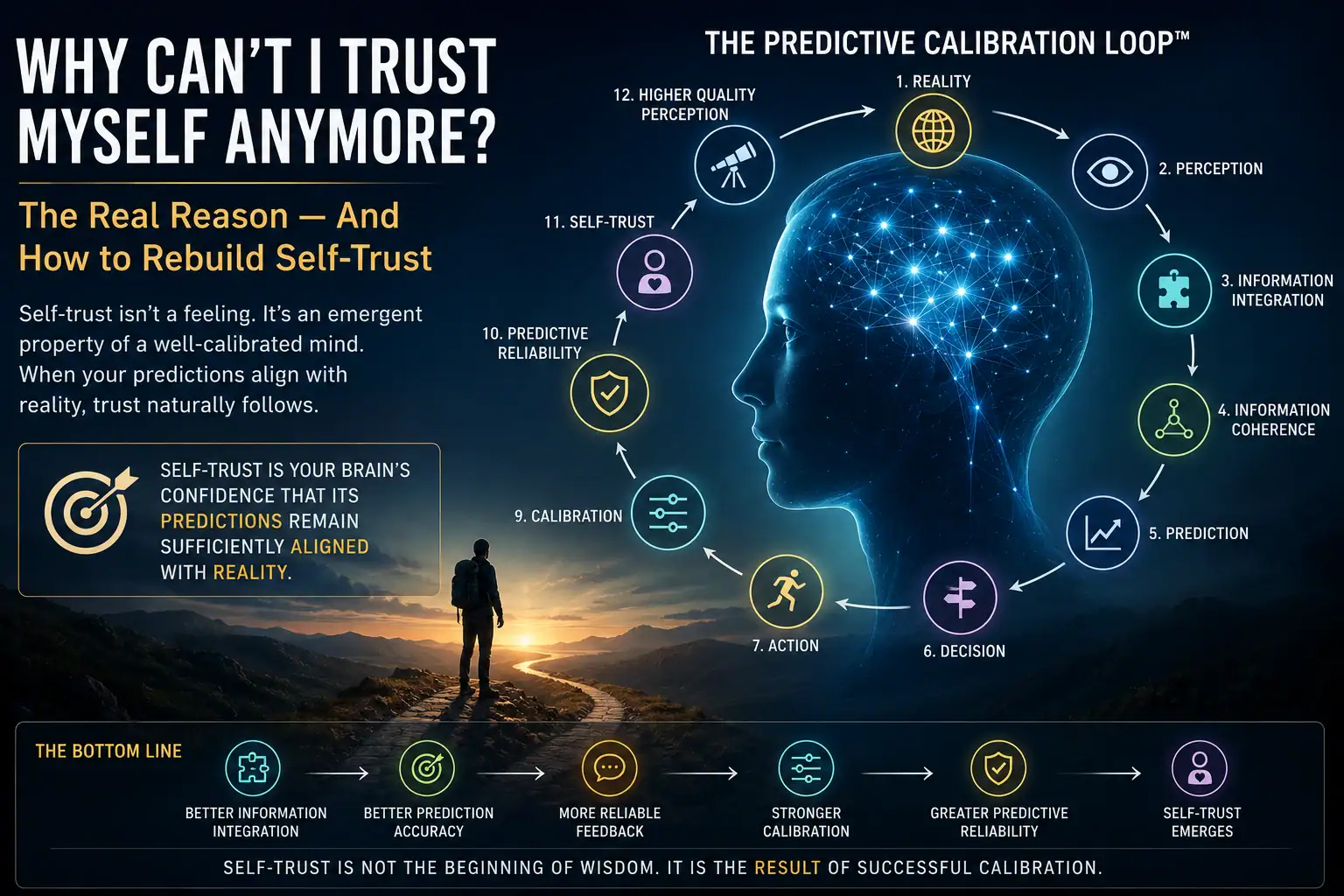
The model begins with reality itself.
Reality continuously generates vastly more information than any human mind could consciously process.
Attention selects only a tiny fraction of that information.
Those selected signals are compared with previous experience, integrated into an internal model, used to generate predictions, tested through action, and continuously refined through feedback.
As this cycle repeats over thousands of experiences, entirely new psychological abilities begin to emerge.
- Understanding becomes more coherent.
- Predictions become more accurate.
- Attention becomes more selective.
- Decision-making becomes more efficient.
- Intuition becomes increasingly reliable.
- Self-trust gradually strengthens.
- Wisdom slowly accumulates.
None of these abilities exist independently.
They are different expressions of the same continuously adapting cognitive system.
Intuition is not a separate faculty.
Confidence is not a separate faculty.
Self-trust is not a separate faculty.
They emerge as the internal model becomes increasingly calibrated to reality.
This perspective also explains why cognitive overload can affect so many seemingly unrelated experiences at once.
When attention becomes fragmented, learning slows.
When learning slows, calibration weakens.
When calibration weakens, confidence, intuition, and decision-making often become less reliable—not necessarily because your intelligence has changed, but because the quality of the underlying model has begun to deteriorate.
The Adaptive Reality Model™ proposes that improving the mind is less about increasing intelligence and more about continuously improving the quality of the internal model through attention, feedback, and calibration.
Stage 1: Reality Produces More Information Than the Mind Can Process
Every moment, the world generates an astonishing amount of information.
Light reaches your eyes.
Sound reaches your ears.
Your body reports temperature, pressure, movement, balance, pain, heartbeat, hunger, and countless other internal signals.
At the same time, memories become active, emotions influence interpretation, expectations shape perception, and previous experience quietly predicts what is likely to happen next.
No nervous system can consciously process every available signal.
The limitation is not intelligence.
It is bandwidth.
The first challenge of cognition is not understanding reality.
The first challenge is deciding which tiny fraction of reality deserves attention.
This simple limitation explains why attention sits at the very foundation of every higher cognitive process explored throughout this article.
Stage 2: Attention Selects What Becomes Your Reality
If the human mind cannot consciously process everything, something must constantly decide what deserves further attention.
That mechanism is attention.
Attention is often described as the ability to concentrate.
Its role is far more fundamental than that.
Attention is the filter that determines which tiny fraction of available information is allowed to participate in constructing your internal model of reality.
Everything outside your attention still exists.
But until it enters awareness, it has almost no influence on your conscious experience.
Attention does not simply determine what you think about.
It determines which parts of reality your mind is even able to learn from.
This helps explain one of the oldest puzzles in human psychology.
How can two intelligent people witness exactly the same event yet leave with completely different conclusions?
The answer is not simply that they interpreted the event differently.
Long before interpretation began, they were already paying attention to different information.
One noticed facial expressions.
Another noticed the words.
One remembered previous conversations.
Another focused only on what happened today.
Each mind began constructing a different internal model from the very first moment.
Before people disagree about conclusions, they often disagree about which information became part of their reality.
This idea also changes how we think about cognitive overload.
Many people imagine overload as simply having too much information.
That is only part of the problem.
The deeper problem is that too many competing signals begin competing for the same limited attention.
Eventually, the mind struggles to distinguish information that genuinely improves understanding from information that merely consumes mental resources.
This is where one of the central ideas of Intuition Management naturally emerges.
Signal vs Noise™ Begins With Attention
Signal vs Noise™ is often described as a decision-making framework.
Within the Adaptive Reality Model™, it becomes something even more fundamental.
It explains how attention protects the quality of the internal model itself.
A signal is not simply useful information.
A signal is information that meaningfully improves your understanding of reality.
Noise is not merely false information.
Noise is any information that consumes attention without improving that understanding.
- Some noise is inaccurate.
- Some is emotionally compelling but irrelevant.
- Some is true but poorly timed.
- Some is interesting without being useful.
- Some simply distracts the mind from integrating what matters most.
The distinction matters because attention is one of the few truly limited resources the mind possesses.
Every unnecessary demand on attention reduces the capacity available for learning, calibration, and sound decision-making.
The quality of your attention determines the quality of the internal model your mind is able to build.
This is why protecting attention is not merely a productivity skill.
It is one of the primary ways we protect our ability to understand reality itself.
Stage 3: The Mind Builds an Internal Model
Attention alone is not enough.
Selecting information is only the beginning.
The mind must then transform countless disconnected fragments into something coherent enough to guide future behavior.
That coherent structure is what this framework calls an internal model of reality.
It is not a literal picture stored somewhere in the brain.
It is a continuously evolving network of expectations, memories, relationships, concepts, and predictions that helps you answer one essential question:
“Given everything I have learned so far, what kind of world am I living in?”
Every meaningful experience slightly changes that answer.
Every conversation.
Every mistake.
Every success.
Every unexpected outcome.
Little by little, the model becomes richer, more coherent, and—when calibration remains healthy—more closely aligned with reality.
Learning is not the accumulation of information.
Learning is the continuous improvement of the internal model that gives information meaning.
Stage 4: Prediction Is the Mind’s Primary Job
An internal model would have little value if it only described the past.
Its real purpose is helping you anticipate what is likely to happen next.
Long before you consciously decide how to respond, your mind is already making countless predictions.
Will this person smile?
Is this sound dangerous?
Can this situation be trusted?
What happens if I say yes?
Should I pay attention to this?
Most of these predictions never reach conscious awareness.
Yet they quietly influence what you notice, what you ignore, how you feel, and ultimately how you behave.
Your mind is not waiting for reality to explain itself.
It is continuously predicting reality and comparing those predictions with what actually happens.
This explains why expectations are so powerful.
What you expect influences what you notice.
What you notice influences what you learn.
What you learn reshapes what you expect next.
The cycle never truly stops.
Stage 5: Feedback Calibrates the Model
Predictions alone are not enough.
A model only improves when its predictions meet reality.
Every conversation.
Every decision.
Every success.
Every mistake.
Each creates feedback.
Sometimes reality confirms your expectations.
Sometimes it contradicts them.
Both outcomes are equally valuable.
Confirmation strengthens confidence in parts of the model that continue matching reality.
Contradiction identifies parts of the model that require revision.
Reality is constantly answering the predictions your mind makes.
Learning depends on whether those answers are allowed to change the model.
This ongoing process is what I call Cognitive Calibration™. A practical method for testing and improving intuitive accuracy is explored in How to Calibrate and Improve Your Intuition.
Calibration is not the accumulation of knowledge.
It is the continuous adjustment of your internal model so that it remains aligned with reality as both you and the world continue changing.
Importantly, calibration is not something that happens only during formal learning.
It happens every day.
While talking to colleagues.
While raising children.
While solving problems.
While making mistakes.
While changing your mind.
The mind is always learning.
The only question is whether it is learning accurately.
Wisdom does not emerge because reality always confirms your expectations.
Wisdom emerges because reality continually improves them.
When Calibration Stops
The greatest threat to good judgment is rarely a lack of intelligence.
It is a model that gradually stops updating.
Sometimes this happens because certainty feels emotionally safer than uncertainty.
Sometimes because stress narrows attention toward immediate survival.
Sometimes because cognitive overload leaves too little capacity for careful reflection.
Sometimes because identity becomes attached to particular beliefs.
Whatever the reason, the result is similar.
The model slowly drifts away from reality.
Predictions become less reliable.
Unexpected outcomes become more frequent.
Confidence and accuracy begin separating.
Some people become increasingly uncertain despite remaining highly capable.
Others become increasingly certain despite becoming progressively less accurate.
The opposite of calibration is not ignorance.
It is allowing the internal model to become increasingly disconnected from reality.
This explains why genuine learning requires more than intelligence.
It requires intellectual humility.
The willingness to let reality revise your understanding—even when doing so is uncomfortable.
The purpose of thinking is not to defend your current model of reality.
The purpose of thinking is to improve it.
Why Intelligent People Can Experience Different Realities
If every human being lives in the same physical world, why do we so often experience it differently?
Why can two intelligent people witness the same conversation, read the same evidence, and reach completely opposite conclusions?
The Adaptive Reality Model™ suggests that the answer lies less in intelligence than in the internal models each person has developed over time.
Every experience passes through layers of interpretation before it reaches conscious awareness.
- Previous experience
- Attention
- Memory
- Emotional state
- Current goals
- Expectations
- Existing beliefs
These filters do not create reality.
They shape the internal model through which reality becomes meaningful.
Reality is shared.
Internal models are personal.
This explains why disagreement is often far more complex than one person being rational and another being irrational.
Different people attend to different signals.
They organize those signals differently.
They generate different predictions.
Over time, those differences accumulate into remarkably different understandings of the same world.
Before people disagree about conclusions, they usually disagree about which information became part of their internal model.
Why Intelligence Alone Does Not Produce Good Judgment
We often assume that more intelligence naturally produces better decisions.
Reality suggests otherwise.
History is filled with brilliant people who confidently defended inaccurate beliefs.
Likewise, many people of ordinary intellectual ability consistently demonstrate remarkably sound judgment.
The difference often lies not in processing power, but in calibration.
Intelligence helps you manipulate information.
Calibration helps ensure the information reflects reality.
Intelligence determines how efficiently you think.
Calibration determines how accurately you understand.
A highly intelligent person working from a poorly calibrated internal model may confidently reach incorrect conclusions.
A person of average intelligence with a well-calibrated model may consistently make sound decisions because their understanding remains closely aligned with reality.
This distinction also explains why expertise feels different from intelligence.
Experts are not simply people who know more facts.
They have repeatedly tested their understanding against reality and allowed feedback to improve it.
Expertise is accumulated calibration.
Why Cognitive Overload Changes Everything
The modern world exposes us to more information than any previous generation.
News.
Notifications.
Emails.
Meetings.
Social media.
Messages.
Opinions.
Every source competes for the same limited pool of attention.
The problem is not simply distraction.
The problem is that excessive competing information makes it increasingly difficult to identify which signals genuinely deserve to reshape the internal model.
Noise gradually consumes the attention required for calibration.
Cognitive overload is not merely having too much information.
It is losing the ability to determine what deserves to become part of your understanding.
This helps explain why mentally overloaded people often report remarkably similar experiences. The practical process of restoring attention and reducing competing demands is explored further in Cognitive Overload Recovery.
- Everything feels equally important.
- Simple decisions become exhausting.
- Nothing feels completely certain.
- Concentration becomes difficult.
- Confidence slowly fades.
- Even ordinary tasks require unusual mental effort.
These experiences do not necessarily indicate reduced intelligence.
They often indicate a cognitive system struggling to maintain a coherent internal model while processing more competing information than it can effectively integrate.
When attention becomes overwhelmed, calibration slows.
When calibration slows, understanding gradually becomes less reliable.
Why Intuition Emerges
Once the mind has spent years building, testing, and refining an internal model of reality, something remarkable begins to happen.
It starts recognizing patterns before conscious reasoning finishes explaining them.
Most people call that intuition.
Within the Adaptive Reality Model™, intuition is not a mysterious force or a supernatural ability.
It is an emergent property of a well-calibrated internal model.
Every conversation.
Every observation.
Every success.
Every mistake.
Each one leaves small traces inside the model.
Eventually those accumulated experiences become rich enough for the mind to recognize meaningful relationships almost instantly.
You notice that something feels wrong before you can explain why.
You sense that a conversation is about to change direction.
You recognize an opportunity that others overlook.
None of these experiences require mystical explanations.
They reflect a cognitive system whose internal model has quietly integrated thousands of previous experiences.
Intuition is not thinking without evidence.
It is evidence that has become too deeply integrated to require conscious explanation before influencing perception.
This also explains why intuition sometimes fails.
If the internal model has been built from distorted information, poor feedback, chronic stress, or persistent cognitive overload, intuition will faithfully generate predictions from that imperfect model.
The problem is rarely intuition itself.
The problem is the quality of the model from which intuition emerges.
The goal is not to trust every feeling.
The goal is to cultivate the kind of internal model from which increasingly reliable intuition naturally emerges.
Why Self-Trust Emerges
Self-trust is often misunderstood as confidence in yourself. When that trust weakens, the experience often appears as repeated doubt and second-guessing, a pattern explored in Why Do I Second-Guess Myself?
Within this framework, it is something more precise.
Self-trust is confidence in the ongoing ability of your internal model to keep improving through interaction with reality.
People with healthy self-trust are not convinced they are always right.
They simply know they can continue learning when they are wrong.
This distinction changes the meaning of confidence.
Confidence no longer depends on certainty.
It depends on adaptation.
You observe reality.
You make a decision.
You receive feedback.
You improve the model.
After thousands of successful cycles, uncertainty no longer feels like a threat.
It becomes another opportunity to learn.
Self-trust is not confidence that you will always be correct.
It is confidence that reality will continue teaching you if you remain willing to learn.
Decision-Making Becomes Continuous Learning
This framework also changes how we think about decisions.
Many people believe the purpose of thinking is to make the perfect choice.
Reality suggests something different.
Excellent decisions sometimes produce disappointing outcomes.
Poor decisions occasionally succeed through luck alone.
If outcomes become the only measure of success, the internal model gradually becomes distorted.
Luck begins looking like wisdom.
Thoughtful reasoning begins looking like failure whenever circumstances happen to turn against it.
A healthier perspective evaluates both the quality of the reasoning and the information gained from the outcome.
The purpose of decision-making is not to eliminate uncertainty.
The purpose of decision-making is to continuously improve your understanding of reality.
Every meaningful decision becomes an experiment.
Every experiment generates feedback.
Every piece of feedback helps refine the model.
Success teaches.
Failure teaches.
Only ignored feedback loses its value.
Reality is not judging you.
Reality is continually teaching you.
The Quiet Emergence of Wisdom
Wisdom is often treated as something mysterious.
Something that simply appears with age.
Age certainly creates opportunities for learning.
It does not guarantee learning.
Two people can live through the same decades and develop profoundly different understandings of reality.
The difference is rarely the passage of time.
It is whether they repeatedly allowed reality to refine their internal model.
Wisdom is accumulated calibration.
It is the long-term result of allowing reality to improve your understanding, one experience at a time.
Viewed through this lens, intuition, expertise, judgment, confidence, and self-trust no longer appear to be unrelated psychological traits.
They become different expressions of the same lifelong adaptive process.
The quality of your life depends less on how much information you possess than on how accurately your internal model continues to evolve.
Frequently Asked Questions
Does the brain experience reality directly?
No. The brain does not experience the external world without sensory processing and interpretation. It receives incomplete information through the senses and uses perception, memory, attention, prediction, and feedback to build a continuously updated internal model that helps interpret and navigate the world.
What is an internal model of reality?
An internal model is the mind’s continuously evolving understanding of how the world works. It integrates perception, memory, attention, prediction, and experience into a framework that guides interpretation, decision-making, and future learning.
What is Cognitive Calibration™?
Cognitive Calibration™ is the ongoing process of comparing expectations with reality and adjusting your internal model accordingly. Rather than defending existing beliefs, calibration allows new information and feedback to improve your understanding over time.
How does intuition fit into this model?
Within the Adaptive Reality Model™, intuition emerges when a well-calibrated internal model recognizes meaningful patterns before conscious reasoning has fully explained them. Reliable intuition develops through repeated interaction with reality, not through blind faith in feelings.
Why do intelligent people disagree?
People often disagree because they have developed different internal models based on different experiences, expectations, goals, and attention patterns. Intelligence influences how information is processed, while calibration determines how closely those models remain aligned with reality.
How does cognitive overload affect decision-making?
Cognitive overload consumes the limited attention required to distinguish meaningful signals from mental noise. As overload increases, calibration becomes more difficult, uncertainty grows, and even simple decisions may begin to feel mentally exhausting.
Why do I stop trusting myself?
Self-trust often weakens when chronic stress, information overload, repeated uncertainty, or distorted feedback reduce confidence in the reliability of your internal model. Rebuilding self-trust involves restoring the cycle of observation, action, feedback, learning, and adaptation.
Can the internal model ever become perfect?
No. Reality continually changes, making perfect understanding impossible. A healthy cognitive system remains open to revision and continuously updates its internal model as new information becomes available.
Final Thought
Much of modern life encourages us to search for certainty.
To become more confident.
To eliminate doubt.
To make perfect decisions.
The Adaptive Reality Model™ suggests a different goal.
Your mind is not capable of possessing perfect knowledge.
Its strength lies in continuously improving its understanding through interaction with reality.
Every observation.
Every conversation.
Every prediction.
Every mistake.
Every success.
Every unexpected outcome.
Each becomes another opportunity to refine the internal model through which you experience the world.
Over time, that ongoing calibration produces something that often appears mysterious from the outside.
Clearer judgment.
Better decisions.
More reliable intuition.
Greater self-trust.
And, perhaps, wisdom itself.
The mind does not simply experience reality.
It continuously builds, tests, and refines an understanding of reality.
The quality of your life depends not on possessing a perfect model, but on remaining willing to let reality improve it.
Continue Exploring
- Signal vs Noise™
- How to Calibrate and Improve Your Intuition
- The Personal Signal Decoder™
- Why Do I Second-Guess Myself?
- Cognitive Overload Recovery
- Decision Fatigue Symptoms
- Intuition and Consciousness
- Your Intuition Journey