
Mind and emotions
You may be too drained to think clearly, yet still unable to settle. The contradiction makes sense once you separate available energy from the activation that keeps you monitoring, anticipating and preparing to respond.
Editorial scope: This educational article explains a common experience using sleep-health guidance from NIH, CDC and MedlinePlus together with the editorial Activation–Recovery Mismatch model. It does not diagnose the cause of fatigue or replace individual medical advice.
Feeling tired but wired means your available energy is low while your level of alertness remains high. Your body may be exhausted, but part of your system is still tracking unfinished tasks, anticipating what comes next, responding to stimulation or preparing for another demand. This pattern can appear after prolonged stress, disrupted sleep, cognitive overload, irregular routines or stimulant use. It is a recognizable experience, not a diagnosis.
You finally stop working. The messages are answered—or at least postponed. The room becomes quiet. Your body feels heavy enough to collapse, but your mind begins reviewing the day, forecasting tomorrow and searching for something you may have missed.
You are tired, but not settled. You want rest, but the moment you stop moving, your internal activity becomes louder. You may reach for your phone even though you want less stimulation. You may lie down, then start calculating how much time remains before morning. You may feel too exhausted to do anything useful and too alert to enjoy doing nothing.
This experience is often reduced to a vague instruction: “Just relax.” But relaxation is difficult to command when the systems responsible for readiness have not yet registered that the demand is over.
Low energy does not automatically produce low activation.
What does “tired but wired” actually mean?
“Tired but wired” is an informal description of two experiences occurring at the same time: depleted capacity and continuing activation. It is not a clinical label, and it does not identify a single cause.
Tired describes reduced capacity
Tiredness can show up as physical heaviness, slower thinking, weak concentration, reduced patience, lower emotional bandwidth or difficulty beginning even simple tasks. Fatigue is not exactly the same as sleepiness. Sleepiness is the tendency to fall asleep; fatigue is a broader lack of usable energy that may remain even when you do not feel ready to sleep.
When capacity falls, ordinary demands can feel disproportionately expensive. A decision that would usually take thirty seconds may feel like another burden. A message may remain unanswered not because you do not care, but because composing a response requires attention you no longer have.
Wired describes continuing readiness
Feeling wired is not necessarily a feeling of energy. It can be a state of mental scanning: checking, anticipating, rehearsing, remembering and preparing. You may feel tense or restless. Your thoughts may move quickly, or they may circle around the same unresolved point. Your attention may remain sensitive to notifications, noises or signs that someone needs you.
The crucial distinction is that readiness consumes energy without creating restoration. A tired mind can continue monitoring long after it has lost the capacity for useful action.
Tired but wired is the coexistence of low capacity and high activation. The body is asking for recovery while the mind remains organized around response.
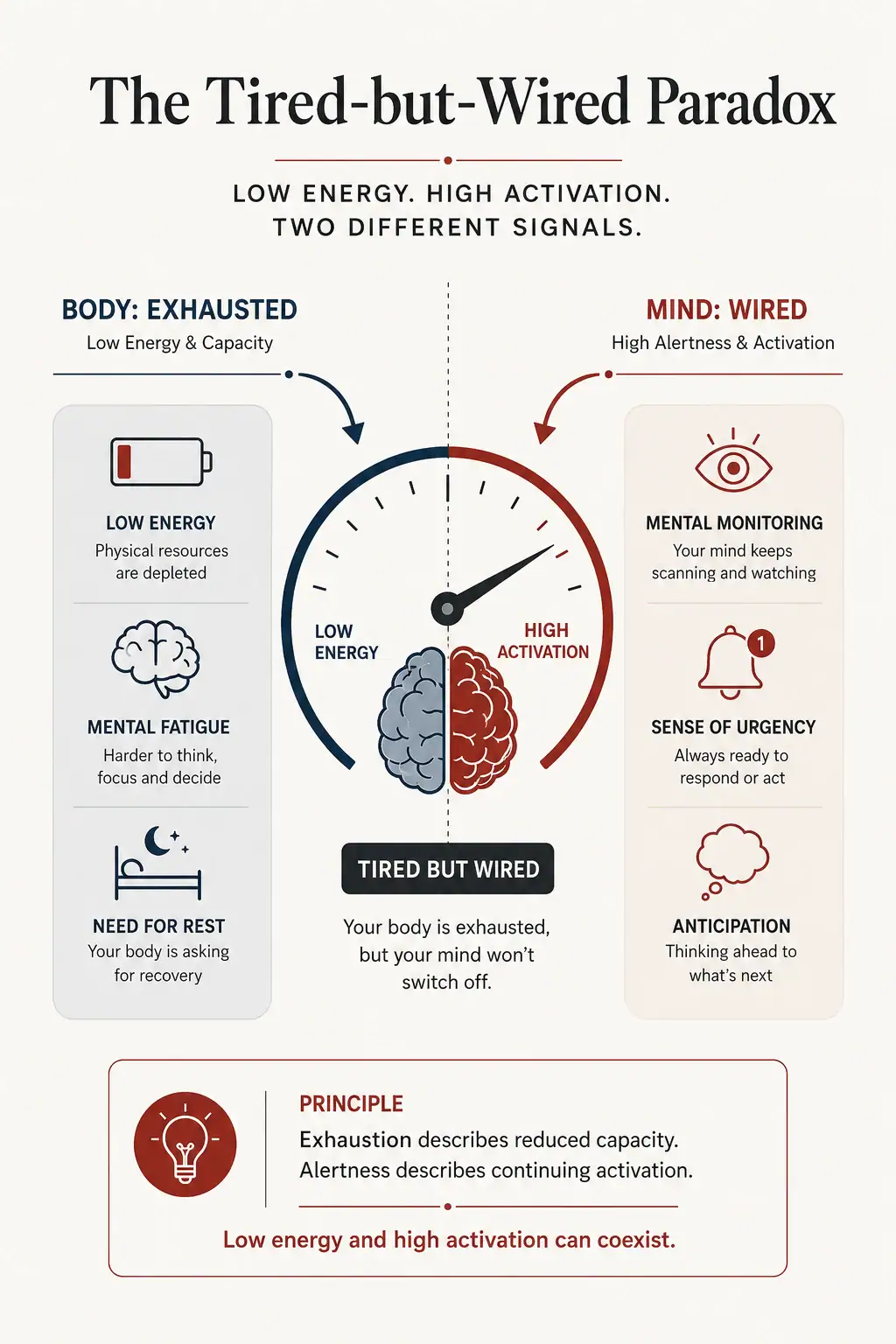
Why can your body be tired while your mind stays alert?
Energy and activation influence one another, but they are not the same signal. Energy describes the resources available for thinking, feeling and acting. Activation describes how ready you remain to notice, predict or respond.
Consider a demanding day. Every meeting, decision, interruption and emotional adjustment uses capacity. By evening, your energy may be low. Yet if important tasks remain unresolved, tomorrow feels uncertain or messages can still arrive, your readiness may remain high. The result is not productive focus. It is depleted monitoring.
Sleep also matters. CDC sleep guidance explains that good sleep supports health and emotional well-being, while ongoing sleep problems deserve professional attention. Insufficient or disrupted sleep can contribute to fatigue, slower thinking, difficulty remembering and reduced concentration. Stress, medications, the sleep environment, irregular timing and what you consume can influence the sleep–wake cycle. That is why “tired but wired” should be treated as a description to investigate, not as proof of one psychological explanation.
A late stimulant can complicate the pattern. Caffeine can preserve wakefulness without restoring energy already spent during the day. The National Heart, Lung, and Blood Institute notes that caffeine is a stimulant, can interfere with sleep and may continue affecting the body for up to eight hours.
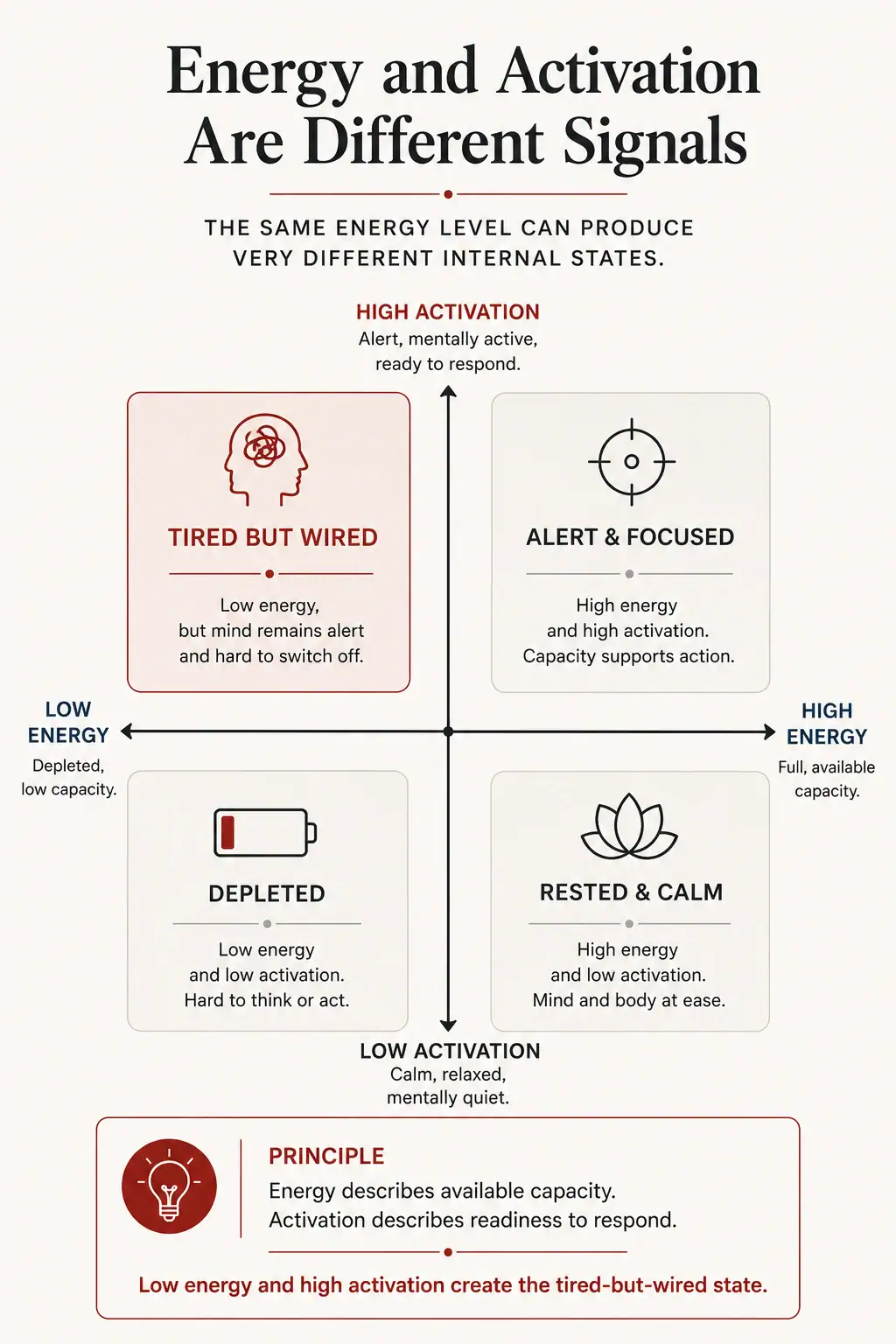
The same low energy can therefore produce two very different experiences. When activation also falls, rest may feel accessible. When activation stays high, you may be exhausted and still unable to switch off.
The Activation–Recovery Mismatch
The tired-but-wired state often becomes easier to understand as a mismatch between what has happened to your energy and what has happened to your readiness.
1. Demand builds
Tasks, decisions, uncertainty, messages, emotional labor and context switching accumulate. Even when each demand is manageable alone, the total load can exceed the amount of attention available.
2. Capacity falls
Your energy, patience and cognitive flexibility decline. You may continue functioning, but each new demand takes more effort. The system begins borrowing from capacity that would otherwise support recovery.
3. Activity stops, but monitoring continues
You close the laptop, leave the conversation or lie down. Externally, the activity has ended. Internally, the mind keeps checking what remains unfinished, what might go wrong and what must happen next.
4. Recovery remains shallow
Inactivity begins without a full downshift. You may scroll, replay conversations or plan tomorrow. You are resting in the sense that you are not working, but attention is still being recruited by incoming and imagined demands.
5. The next demand arrives before restoration is complete
Morning begins with part of yesterday’s load still active. The new day consumes capacity that was never fully restored, and the mismatch becomes easier to trigger again.

Stopping activity is not always the same as entering recovery.
This loop overlaps with the experience described in why your brain can feel as if it is always on. The difference is emphasis: an always-on mind describes continuing mental activity, while tired but wired describes continuing activity after usable energy has already fallen.
What keeps the system switched on?
Persistent activation does not have one universal cause. It can be maintained by several ordinary conditions that repeatedly signal, “More may be required.”
Unfinished tasks
An unfinished task is not only work left undone. It may also be a decision with no next step, a conversation with no resolution or an obligation you are afraid of forgetting. When the next action is unclear, the mind may continue bringing the task back into awareness.
Time pressure
Deadlines make the future feel present. Even after today’s activity ends, the mind may continue calculating how little time remains, what must happen first and what could be delayed. That calculation can preserve urgency when no useful action is currently possible.
Messages and alerts
Notifications create repeated opportunities for attention to reopen. The content does not need to be dramatic. The possibility that a new request may arrive can be enough to keep part of the mind oriented toward response. This is especially relevant when you feel that you always have to be available or feel compelled to respond immediately.
Uncertainty
When important information is missing, the mind may keep scanning for clues. Uncertainty is not always resolved by more thinking, yet the absence of a clear answer can keep attention active. This is one reason prolonged ambiguity can feel more exhausting than a difficult but definite task.
Anticipation
Tomorrow’s meetings, possible conflict, unanswered questions and imagined obligations can remain mentally present before they occur. Anticipation can be useful when it supports preparation. It becomes costly when it continues after preparation has stopped producing anything new.

Stimulants, light and irregular timing
Mental load is only part of the picture. Caffeine, bright light, irregular sleep timing and an environment that remains stimulating late into the evening can also support wakefulness. Reducing these influences may help some people, but it should not be framed as a cure for every case of persistent fatigue or sleep difficulty.
Similarly, rest may not feel restorative when the form of rest keeps providing new information. Replacing work with endless scrolling changes the content of attention without necessarily reducing the demand placed on it.
What the tired-but-wired state can feel like
The experience differs from person to person. You may recognize some of the following patterns without recognizing all of them:
- You feel exhausted throughout the day but become more mentally active when the room becomes quiet.
- You need rest, yet stopping feels uncomfortable or strangely difficult.
- Your body feels heavy while your thoughts remain fast, repetitive or watchful.
- You are too tired to work effectively but too activated to enjoy your free time.
- You repeatedly check messages, the time or tomorrow’s schedule without finding anything new.
- Small decisions feel difficult because capacity is low, while urgency makes every choice feel important.
- You feel irritable or emotionally thin because even minor demands use resources you do not have.
- You fall asleep but wake feeling as though part of your mind remained on duty.
- You want quiet but automatically reach for stimulation when quiet arrives.
- You feel that something has been forgotten even when you cannot identify what it is.
None of these experiences proves a particular diagnosis. They can overlap with stress, sleep disruption, cognitive overload and many other conditions. Persistent or severe symptoms need individual assessment rather than a generic internet explanation.
A useful question is not only “How tired am I?” but also “How much readiness is still active?” Those two answers may point toward different needs.
Tired but wired versus other energy and activation states
Not every form of tiredness is the same, and not every form of activation is harmful. Useful activation helps you direct energy toward something that matters. The tired-but-wired state becomes costly because activation remains high after capacity has fallen.
| State | Available energy | Activation | Typical experience |
|---|---|---|---|
| Rested and calm | High | Low | Clear, recovered and not preparing for immediate action. |
| Alert and capable | High | Useful | Energy supports focus, response and flexible action. |
| Activated | Beginning to fall | High | Readiness remains useful for a time, but recovery will soon be needed. |
| Tired but wired | Low | High | Exhausted, mentally active and unable to settle easily. |
| Depleted | Low | Low | Little energy remains for thinking, feeling or acting. |

This spectrum is not a diagnostic scale. Real states are fluid and can overlap. Its purpose is to help you notice that restoration requires more than stopping work: both energy and activation matter.
For a deeper comparison, see recovering from cognitive overload, burnout versus nervous-system overload and why your brain may still feel tired after rest.
Why forcing yourself to relax can keep you activated
When rest feels inaccessible, it is natural to try harder. You may tell yourself that you must calm down immediately, stop thinking, fall asleep now or make the remaining free time count. But those instructions turn recovery into another performance task.
You begin monitoring whether relaxation is working:
- Am I calmer yet?
- Why am I still thinking?
- How many hours can I still sleep?
- What is wrong with me?
- What technique should I try next?
Each evaluation asks attention to remain active. The mind becomes responsible not only for tomorrow’s demands, but also for producing the correct internal state on command.
Recovery is more likely to emerge from reduced demand than from increased control.
This does not mean thoughts must disappear before you can rest. It means you can stop assigning yourself the task of eliminating them. A downshift may begin as a small reduction in checking, urgency or mental switching—not as instant calm.
This is also why trying harder to relax can sometimes backfire. The effort preserves the very monitoring that recovery requires you to reduce.
How to help your system move from readiness into recovery
The goal is not to force your system off. It is to create conditions in which continuing activation is less necessary. Think of recovery as a transition rather than a command.
- Reduce incoming signalsPause nonessential notifications, messages and information. Close unnecessary tabs. Move from several competing streams of attention to one low-demand environment. The purpose is not perfect digital discipline; it is to stop reopening readiness every few seconds.
- Externalize unfinished mental loopsWrite down what remains unresolved. Use plain language: what is unfinished, what the next action is and what does not need attention tonight. Externalizing a task does not complete it, but it may reduce the need to keep rehearsing it in working memory.
- Signal completionDecide what will happen next and when. A task with a clear next step is easier to set down than a vague obligation. “Review this tomorrow at 10:00” gives the mind more closure than “Do not forget this.”
- Lower decision demandUse simple defaults for the end of the day. Choose a predictable sequence rather than repeatedly asking an exhausted mind what would be optimal. A glass of water, lower light, prepared clothes and one quiet activity may be more accessible than designing the perfect recovery plan every evening.
- Allow the downshiftStop measuring whether relaxation is working. Look for smaller changes: less urge to check, slower switching between thoughts, a reduced sense of urgency or a greater ability to stay with one quiet activity. Let activation decline gradually.
- Restore capacityGive recovery enough time to have an effect. Sleep, quiet, nourishment, movement and lower cognitive demand may all support restoration, but the right balance depends on the person and the cause of the fatigue. Recovery is not a reward earned after complete exhaustion; it is part of maintaining capacity.
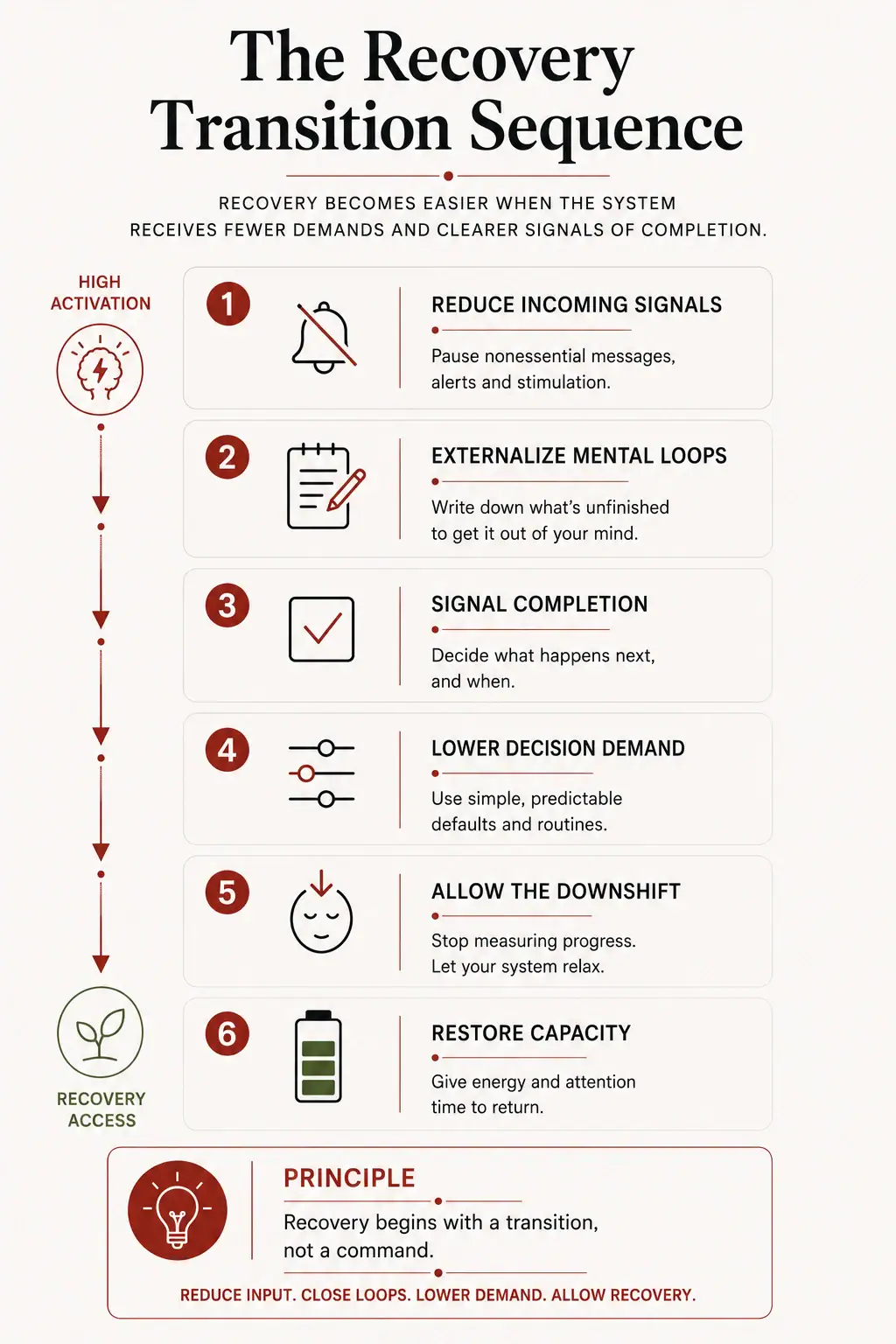
The 10-minute recovery transition
- Write down the three thoughts or tasks most likely to return tonight.
- Give each one a next action, a time or an explicit decision to leave it alone.
- Silence nonessential notifications for a defined period.
- Change one feature of the environment: lighting, room, clothing or sound.
- Choose one low-demand activity and do not optimize it.
- Stop checking whether you have relaxed yet.
This is not a treatment protocol. It is a practical way to make the boundary between demand and recovery more visible.
Support the biological side of the transition
When tired-but-wired feelings cluster around bedtime, basic sleep conditions matter. The NHLBI healthy-sleep guidance recommends a consistent schedule, quiet time before bed, a sleep-supportive environment and avoiding late stimulants. They are foundations, not guarantees.
Notice timing rather than blaming yourself. If caffeine, irregular work hours, long naps or late stimulation are part of the pattern, changing their timing may be more useful than demanding stronger willpower at night.
Protect recovery before capacity reaches zero
Waiting until you are completely depleted makes every part of recovery harder. A tired mind has less capacity to set boundaries, choose what matters and tolerate unfinished work. Small transitions during the day can prevent activation from accumulating into one large evening problem.
These transitions might include closing one task before opening another, taking a brief period without new input, identifying the next action before leaving work or creating a clear end to availability. The aim is not constant calm. It is preventing readiness from becoming the only state your system practices.
When tired-but-wired feelings deserve professional attention
Feeling tired for a short period can be a normal response to insufficient sleep, emotional stress, demanding activity or a disrupted routine. MedlinePlus also emphasizes that fatigue has many possible contributors and that continuing fatigue should be evaluated rather than explained through one assumption. Persistent or unexplained fatigue can have physical, psychological, sleep-related, environmental or medication-related contributors.
Consider speaking with a qualified healthcare professional when:
- fatigue has continued for weeks or is repeatedly getting worse;
- sleep problems significantly affect school, work or daily functioning;
- you regularly wake unrefreshed despite enough opportunity to sleep;
- the pattern began after a medication or health change;
- you experience unexplained physical symptoms alongside the fatigue;
- daytime sleepiness makes driving or other safety-sensitive activities unsafe;
- your attempts to improve sleep or recovery are not helping.
This article can help you recognize a pattern, but it cannot determine its cause.
MedlinePlus advises contacting a healthcare provider when tiredness continues for weeks. A professional can review sleep, medications, health history, daily demands and other factors that an online article cannot evaluate.
Frequently asked questions
Why do I feel tired but wired at night?
Your energy may be depleted while alertness remains supported by unfinished tasks, stress, stimulation, irregular timing, light or caffeine. Quiet can also make thoughts that were masked during the day more noticeable. The phrase describes the experience, but it does not reveal the cause. A repeating nighttime pattern is worth examining in the context of your sleep schedule, daytime load and health.
Can stress make you feel exhausted and restless at the same time?
Yes. Demands can consume energy while the need to monitor or prepare keeps activation high. This can produce exhaustion, restlessness and difficulty settling at the same time. However, stress is not the only possible contributor; sleep disruption, stimulants, medications and health conditions may also matter.
Why am I tired all day but awake when I go to bed?
Several patterns can contribute, including irregular sleep timing, late light or stimulation, caffeine, daytime napping, anticipatory thinking and an environment that becomes quiet only at bedtime. Because persistent daytime fatigue can have multiple causes, talk with a healthcare professional when it continues or interferes with daily life.
Can caffeine cause a tired-but-wired feeling?
Caffeine may maintain alertness even when your underlying capacity is low. It does not replace sleep or restore energy already spent. Its effects can continue for hours, so timing and individual sensitivity matter. Reducing or moving caffeine earlier may help some people, but it will not address every cause of fatigue.
Is tired but wired the same as anxiety?
No. The experiences can overlap, but feeling tired and alert does not by itself establish anxiety. The phrase can describe a temporary response to workload, disrupted sleep, stimulation or uncertainty. A qualified professional is needed to assess persistent symptoms in context.
Why does rest not feel restorative?
Rest may remain shallow when attention continues scanning, receiving new input or carrying unresolved obligations. Inactivity is not always the same as a reduction in activation. Sleep quality, health and the type of rest also matter, which is why persistent unrefreshing rest deserves proper evaluation.
How long does the tired-but-wired state last?
There is no universal duration because “tired but wired” is a description rather than a diagnosis. A temporary episode may ease after demand and sleep stabilize. A pattern that continues for weeks, repeatedly returns or significantly limits daily functioning should be discussed with a healthcare professional.
What is the first thing I should do when I feel tired but wired?
Reduce new input, write down unresolved tasks and give them a clear next step or time. Then choose one predictable low-demand transition instead of trying to force immediate calm. Seek professional advice when the fatigue is persistent, severe or accompanied by concerning symptoms.
You may not need more effort—you may need a completed transition
You are not necessarily failing to rest. Your system may still be waiting for evidence that it no longer needs to prepare, remember, monitor or respond.
Exhaustion tells you that capacity has fallen. Recovery becomes accessible when activation is allowed to fall with it. That does not always happen instantly. It may begin with something smaller: one closed loop, one paused signal, one clear boundary or one period in which nothing new is required.
Recovery begins with a transition, not a command.
The tired-but-wired state is not solved by judging yourself for being unable to switch off. It becomes more understandable when you identify what is still asking your attention to remain ready—and create conditions in which that readiness can finally soften.
Decode what your internal signal is asking for
Continue through Intuition Management to distinguish overload, uncertainty, unresolved demand and genuine signals that require action.
How this article was developed
This article was written to answer the specific search intent behind “why do I feel tired but wired?” without treating the phrase as a diagnosis. The explanation separates available energy from continuing activation, then uses the Activation–Recovery Mismatch as an editorial model for organizing the experience.
Health-related statements were checked against current public guidance from the National Institutes of Health, the Centers for Disease Control and Prevention and MedlinePlus. The diagrams are explanatory models created for Intuition Management; they are not clinical assessment tools.
Sources and further reading
- National Heart, Lung, and Blood Institute: Healthy Sleep Habits
- National Heart, Lung, and Blood Institute: Your Sleep/Wake Cycle
- Centers for Disease Control and Prevention: About Sleep
- MedlinePlus: Fatigue
- MedlinePlus Medical Encyclopedia: Fatigue
Editorial note: “Activation–Recovery Mismatch” is an explanatory model used in this article to organize the reader’s experience. It is not a medical diagnosis.