Expert judgment is an assessment based on specialized knowledge and relevant experience. It can combine intuitive recognition, deliberate reasoning, and data analysis. Organizations use it to estimate outcomes, assess risks, and interpret incomplete evidence. Its usefulness depends on who contributes, what supports the assessment, and how uncertainty is handled.
Imagine asking two experienced specialists when an integration will be ready. One expects a short delivery window; the other anticipates a delay. The useful next question is what each person knows and assumes. Their disagreement may reveal a dependency that the plan has missed.
This guide explains how to obtain and use expert assessments, with a fictional project example and a copyable record. The workflow, template, and review questions are original practical aids, not validated tests.

What is expert judgment?
Expert judgment turns relevant knowledge into an assessment about a particular question. The output might be an estimated duration, a possible explanation, a risk assessment, or advice about a technical option. “Expert judgement” is the British spelling of the same term.
For example, a specialist may examine a proposed data migration and identify a validation step missing from the schedule. Their contribution combines familiarity with similar migrations and an examination of this project’s requirements.
Keep three things separate: the expert’s assessment, the evidence supporting it, and the decision made using it. A specialist can estimate a technical constraint without owning the business decision about whether to accept the resulting delay.
Expert judgment often operates under time pressure, with incomplete information and competing goals. Naturalistic decision making examines how experienced people make decisions in these real-world conditions.
Expert elicitation is the process of obtaining those assessments systematically. More formal approaches can ask experts for probability distributions and use a specified method to compare or combine their judgments. Morgan’s review emphasizes that elicitation should build on available research and analysis rather than substitute for it. Read Morgan’s review of expert elicitation.
Expert judgment vs expert intuition vs data analysis
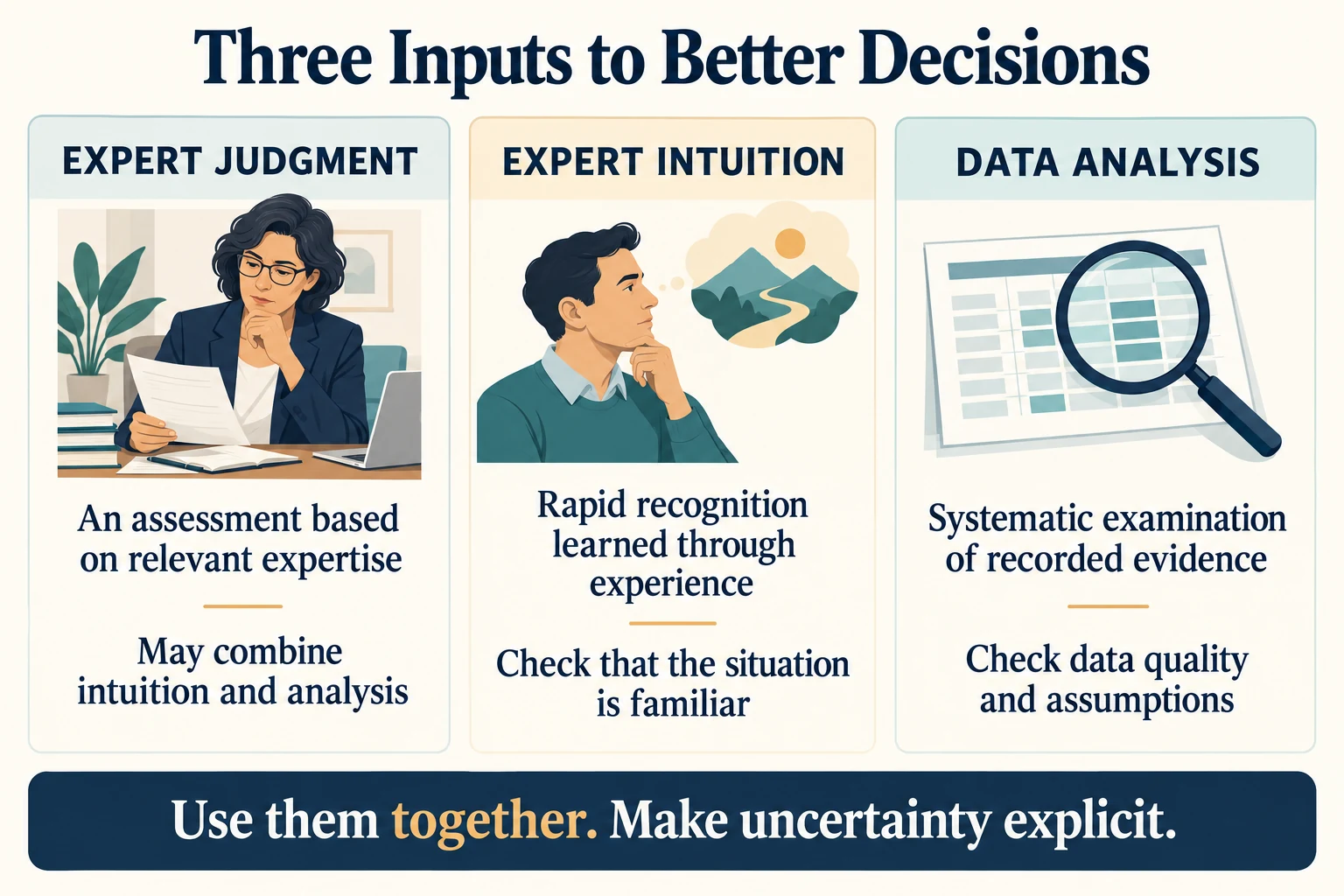
| Approach | What it contributes | What to examine |
|---|---|---|
| Expert judgment | An assessment based on relevant expertise; may include intuition and analysis. | Expertise, evidence, assumptions, and uncertainty. |
| Expert intuition | Rapid recognition learned through experience. | Whether learned patterns apply to this task and setting. |
| Data analysis | Systematic examination of recorded evidence. | Data quality, definitions, methods, and assumptions. |
Your expert intuition may suggest where to investigate. Analysis may test that suggestion. The eventual expert judgment can incorporate both. A spreadsheet and an experienced specialist are therefore not necessarily competing sources of advice.
Kahneman and Klein identify environmental predictability and opportunities to learn its regularities as central considerations in evaluating intuitive expertise. Feeling certain does not establish accuracy. See their research on intuitive expertise.
Some relevant knowledge is difficult to explain immediately. Ask for comparable cases and observations to make more of that knowledge discussable. The guide to tacit knowledge in decision-making explores that challenge.
When should you use expert judgment?
Use it when a specific decision would benefit from relevant experience and the available evidence does not settle the question. First identify the gap: missing measurements, ambiguous interpretation, uncertain future conditions, or a choice between feasible approaches.
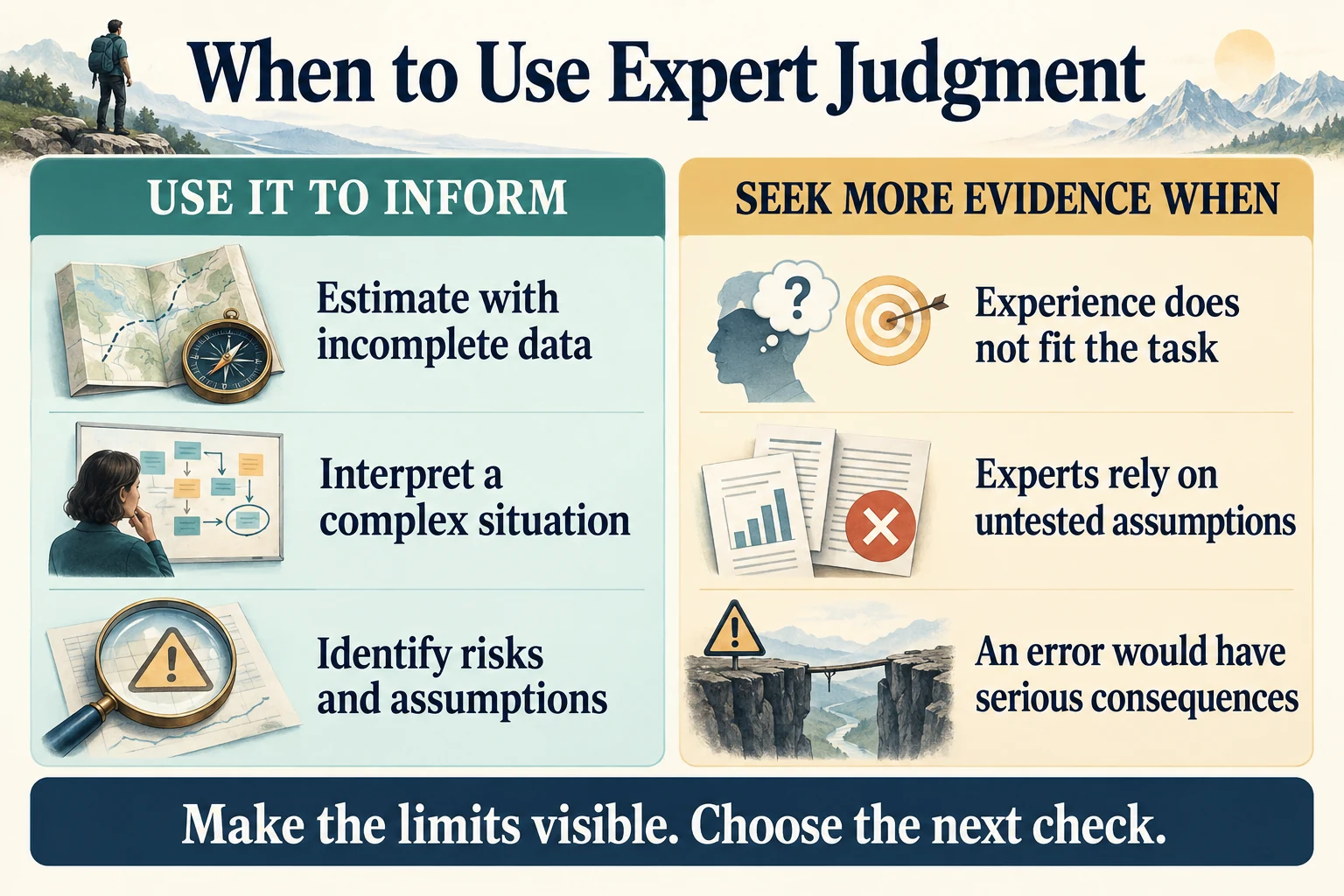
- Estimation: assess likely work, constraints, or duration using comparable tasks and current conditions.
- Interpretation: examine which explanation fits an unfamiliar combination of observations.
- Risk assessment: identify plausible failure conditions and evidence that would make them more concerning.
- Option review: explain practical differences that a feature list or headline metric does not capture.
Seek additional evidence when the relevant expertise is missing, an assumption is testable but unchecked, or the consequences demand stronger verification. If a short measurement can answer the question directly, include that measurement in the work.
A useful initial prompt is: “What can this person assess from experience, and what still needs to be observed?” This keeps the request narrow enough to answer.
Expert judgment examples in project management and daily work
| Situation | Expert contribution | Useful follow-up |
|---|---|---|
| Project delivery | Identify integration work missing from an initial estimate. | Check interfaces, acceptance criteria, and external dependencies. |
| Technical diagnosis | Suggest a plausible cause of a recurring fault. | Test the explanation against current observations and alternatives. |
| Resource planning | Identify skills required for an unfamiliar work package. | Compare the proposed roles with actual tasks and availability. |
These are illustrative situations, not reported case studies. In each one, the expert contributes a claim that someone can examine. “We need a specialist” becomes more useful when the assessment names the task, expected contribution, and evidence.
For decisions made under operational constraints, naturalistic decision making provides broader context. Recognition-primed decision making examines how experienced recognition can suggest an action for further evaluation.
How to select the right experts
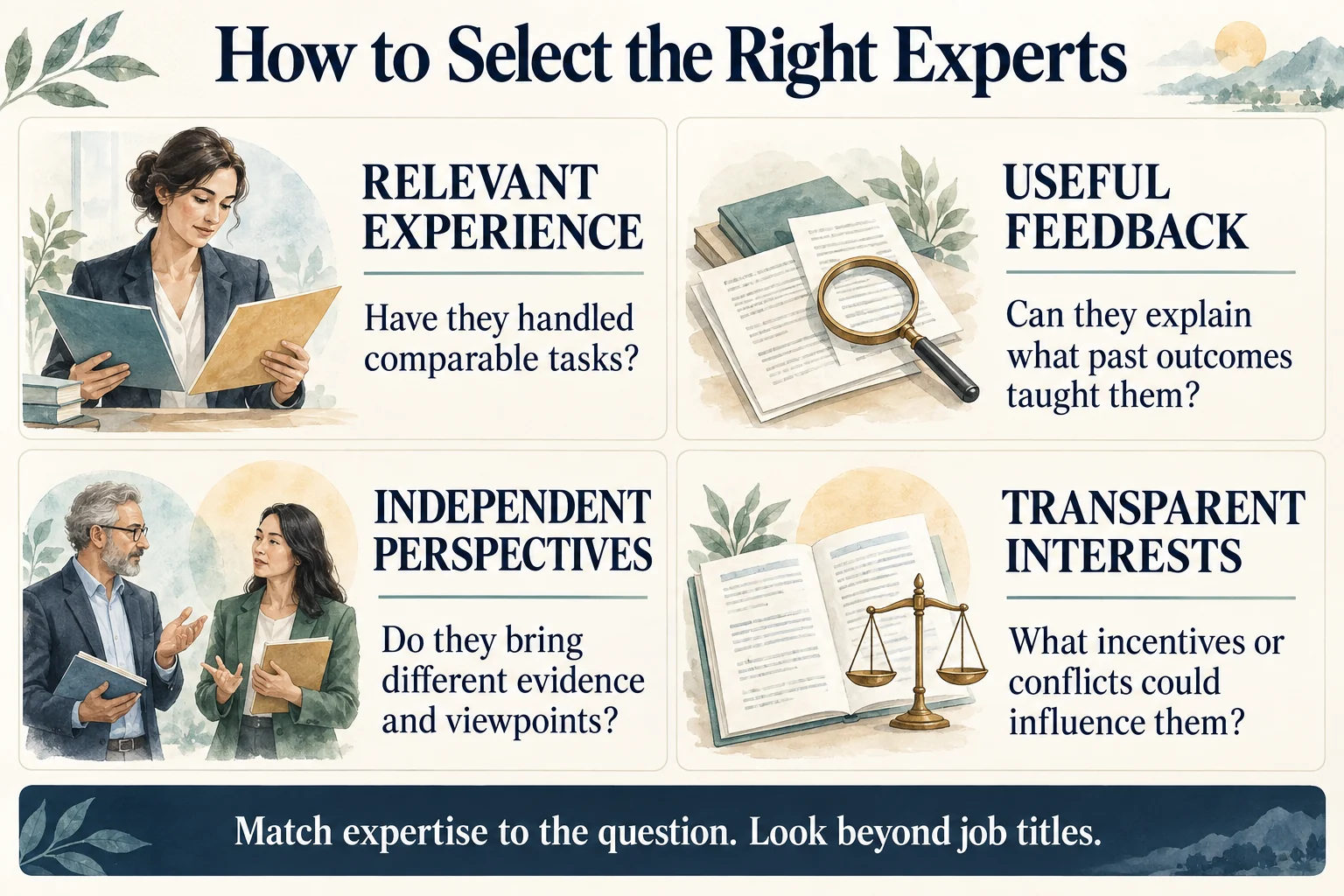
Start with the question, then identify whose experience fits it. A senior title is useful context but does not explain whether someone has handled this particular integration, market, operating condition, or failure mode.
- Relevant experience: ask for comparable tasks and the differences that matter now.
- Useful feedback: ask what past outcomes confirmed, contradicted, or left unresolved.
- Independent perspectives: seek distinct evidence and viewpoints where the question crosses specialties.
- Transparent interests: record incentives or conflicts that could affect the assessment.
For a delivery estimate, an implementation specialist may understand the internal work while a supplier coordinator knows the approval constraints. Write down the part of the question each person can address. Do not ask either to invent expertise about the other’s domain.
How to use expert judgment: six practical steps
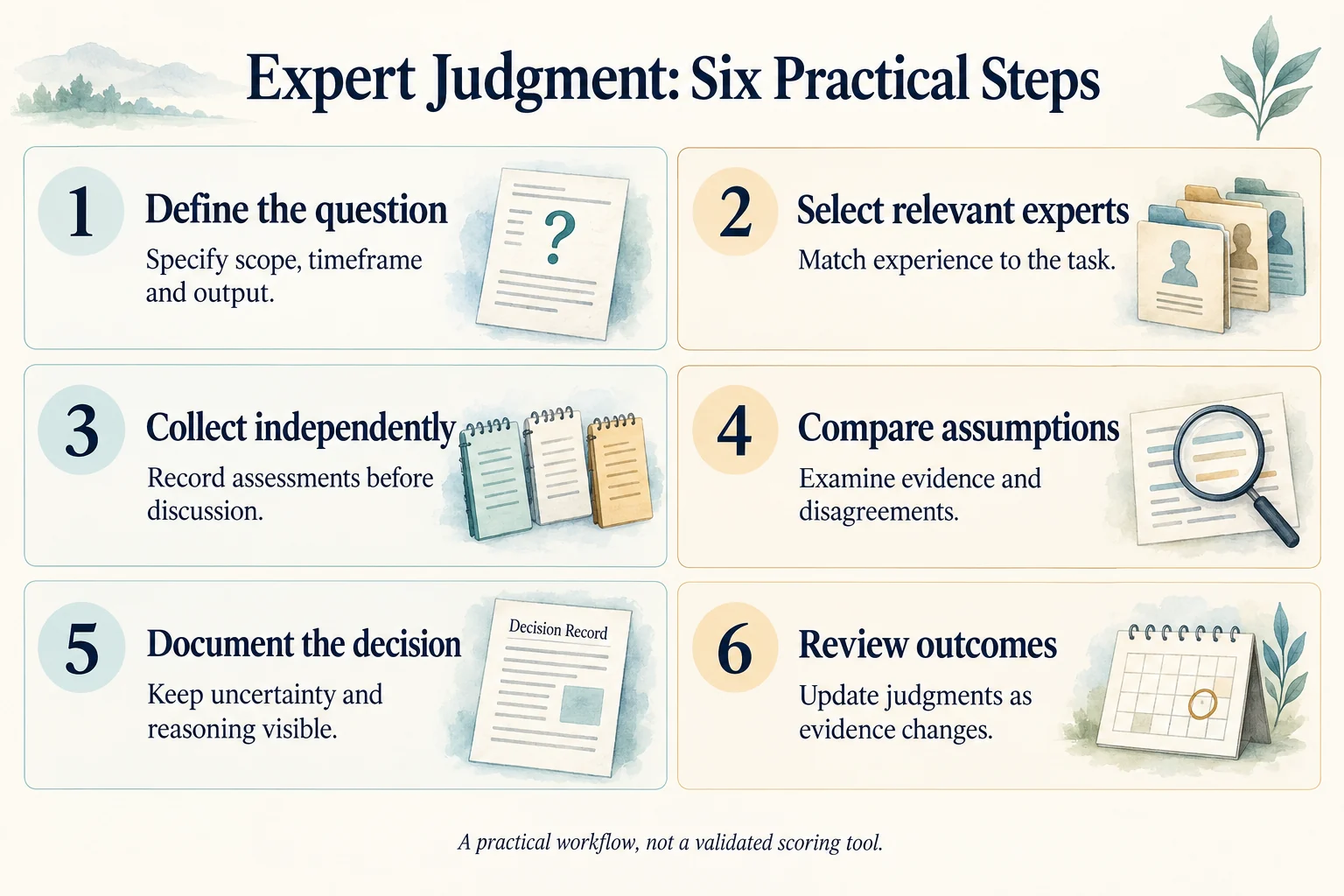
1. Define the question
Specify the scope, timeframe, and output. “Can we finish soon?” leaves too much undefined. Try: “What work remains before the integration meets these acceptance criteria, and what could delay completion?” Give everyone the same baseline information.
2. Select relevant experts
Record why each participant is relevant. Identify gaps explicitly. If nobody understands the external approval process, assign someone to obtain that information before treating the schedule as complete.
3. Collect independent assessments
As a practical meeting rule, request written initial assessments before discussion. Ask each person for their conclusion, supporting observations, assumptions, and unresolved questions. Retain those first versions so later changes remain visible.
4. Compare evidence and assumptions
Discuss the reason for differences. Are people estimating the same scope? Are they using different definitions of “finished”? Does one know about a dependency the other has not considered? List the questions that additional evidence could resolve.
5. Document the decision and uncertainty
Record what the decision owner chooses and how the assessment informs that choice. Separate a forecast from a target or commitment. Define any range: is it a scenario range, a judgmental probability interval, or another type of estimate? Do not label it a statistical confidence interval without an appropriate method.
The CDC’s published elicitation approach offers a concrete example of explicitly asking experts about uncertainty. Its context is public-health assessment; the workplace record here is an adaptation for discussion, not that agency’s protocol. See the CDC’s elicitation methods.
6. Review against outcomes
Assign a review owner and trigger. Return to the original assessment when evidence arrives or the relevant milestone passes. Record what changed, which assumption failed, and what remains unknown. Preserve the earlier reasoning instead of rewriting it to match the result.
Worked example: two experts disagree on a delivery estimate
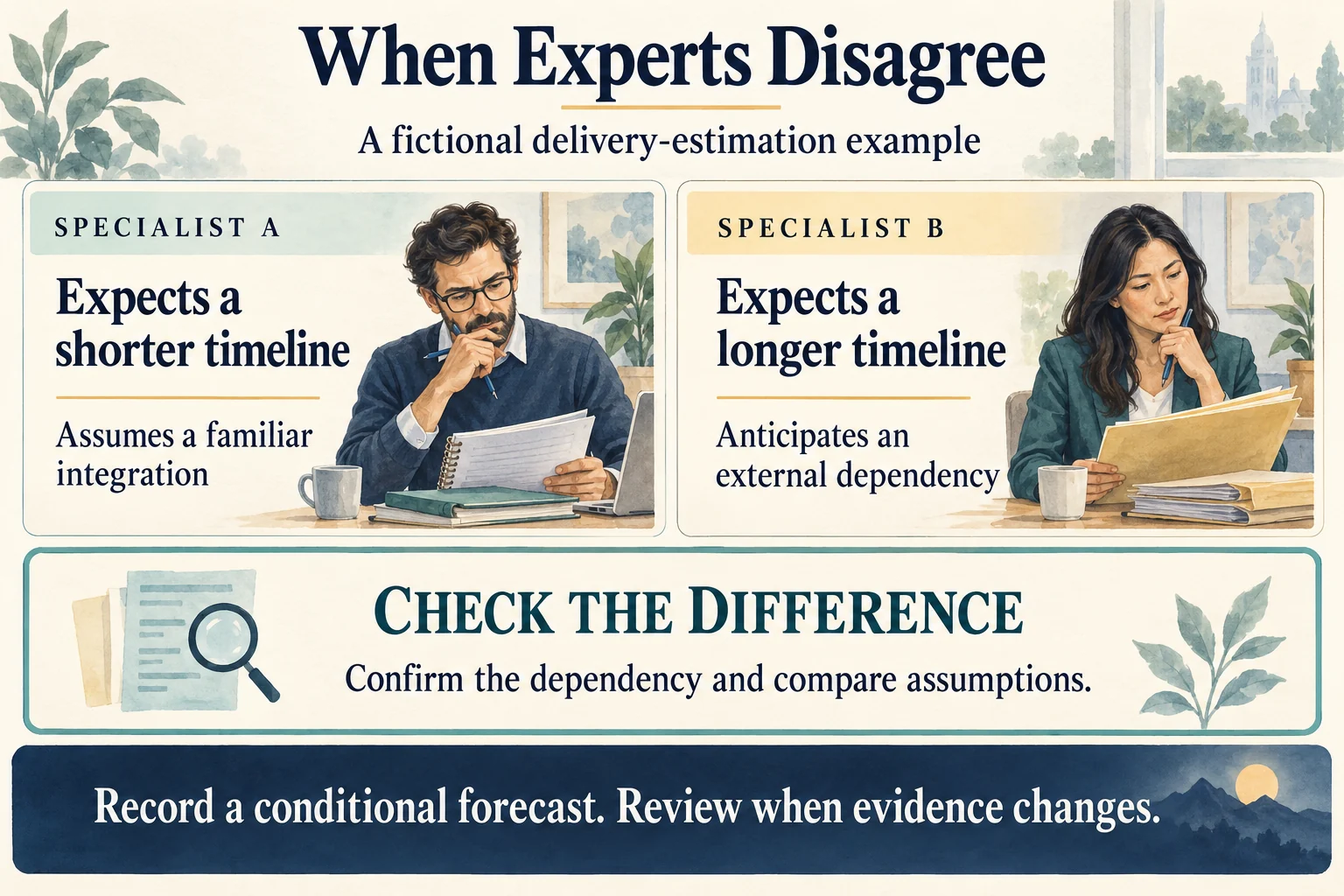
A team is planning a software integration. Its internal development work is understood, but the external test environment has not been confirmed. The decision owner wants to know whether there is enough evidence to communicate a delivery date.
| Stage | Specialist A | Specialist B |
|---|---|---|
| Initial assessment | Expects a shorter timeline based on a similar completed integration. | Expects a longer timeline because supplier access may be delayed. |
| Underlying assumption | The test environment will be ready when development finishes. | Access requires an approval that has not yet been obtained. |
| Evidence requested | Confirm whether earlier integration conditions still apply. | Obtain the supplier’s access requirements and status. |
Make the estimates and their conditions explicit
For illustration, both specialists estimate elapsed working days from the agreed project start to acceptance, including testing. Specialist A proposes 10–12 working days, assuming access is ready on working day 8. Specialist B proposes 15–20 working days, assuming access is delayed by 5–8 working days and some testing must be rescheduled. These are fictional planning ranges, not confidence intervals, measured performance, or delivery promises. Do not derive B’s range simply by adding endpoints; it includes a different sequencing assumption.
The supplier then confirms that an approval is required and that its completion date is not yet known. This fictional new evidence challenges A’s readiness assumption, but it does not establish an exact delay.
The team keeps two conditional scenarios: 10–12 working days if access is available on day 8, and 15–20 working days under B’s delay and rescheduling assumptions. Neither scenario bounds every possible outcome: a longer access delay could push completion beyond 20 working days. The team does not assign probabilities without a basis.
The team separates the internal-work estimate from the unresolved access dependency. It records a conditional forecast: the completion expectation depends on access being available for testing. The decision owner communicates that dependency rather than presenting an unsupported date as certain.
The supplier coordinator owns the next review. The forecast will be revisited when approval timing is confirmed, or at the day-5 planning review if confirmation is still missing. A’s original assessment remains in the record alongside the reason for revision.
The practical result is a clearer decision and an assigned next check. Neither specialist is declared universally more accurate from this single example.
Limitations and common mistakes
The following table is a practical meeting-review aid. Use it to identify what needs checking in your process.
| Mistake | What to notice | Practical response |
|---|---|---|
| Authority bias | A conclusion is accepted mainly because of the speaker’s position. | Request task-relevant evidence and comparable cases. |
| Anchoring | Discussion starts from a prominent estimate without examining its basis. | Keep initial assessments separate and compare their assumptions. |
| Shared blind spots | Several participants rely on the same incomplete source. | Identify missing information and seek a relevant independent perspective. |
| False precision | A precise date or percentage lacks an explained basis. | State assumptions and the meaning of uncertainty estimates. |
| Forced consensus | Important disagreement disappears from the final record. | Preserve unresolved differences and assign checks. |
| Outcome-only review | A good result is treated as proof that all reasoning was sound. | Review what the evidence supported at the time. |
More elaborate methods are available when a simple discussion record is insufficient. For example, the classical model of structured expert judgment evaluates assessments using calibration questions with known outcomes and can combine judgments using performance-based weights. This requires a designed elicitation and validation process; it is not achieved by adding a confidence score to a meeting template. Read about validation with the classical model.
Expert judgment template: a copyable assessment record
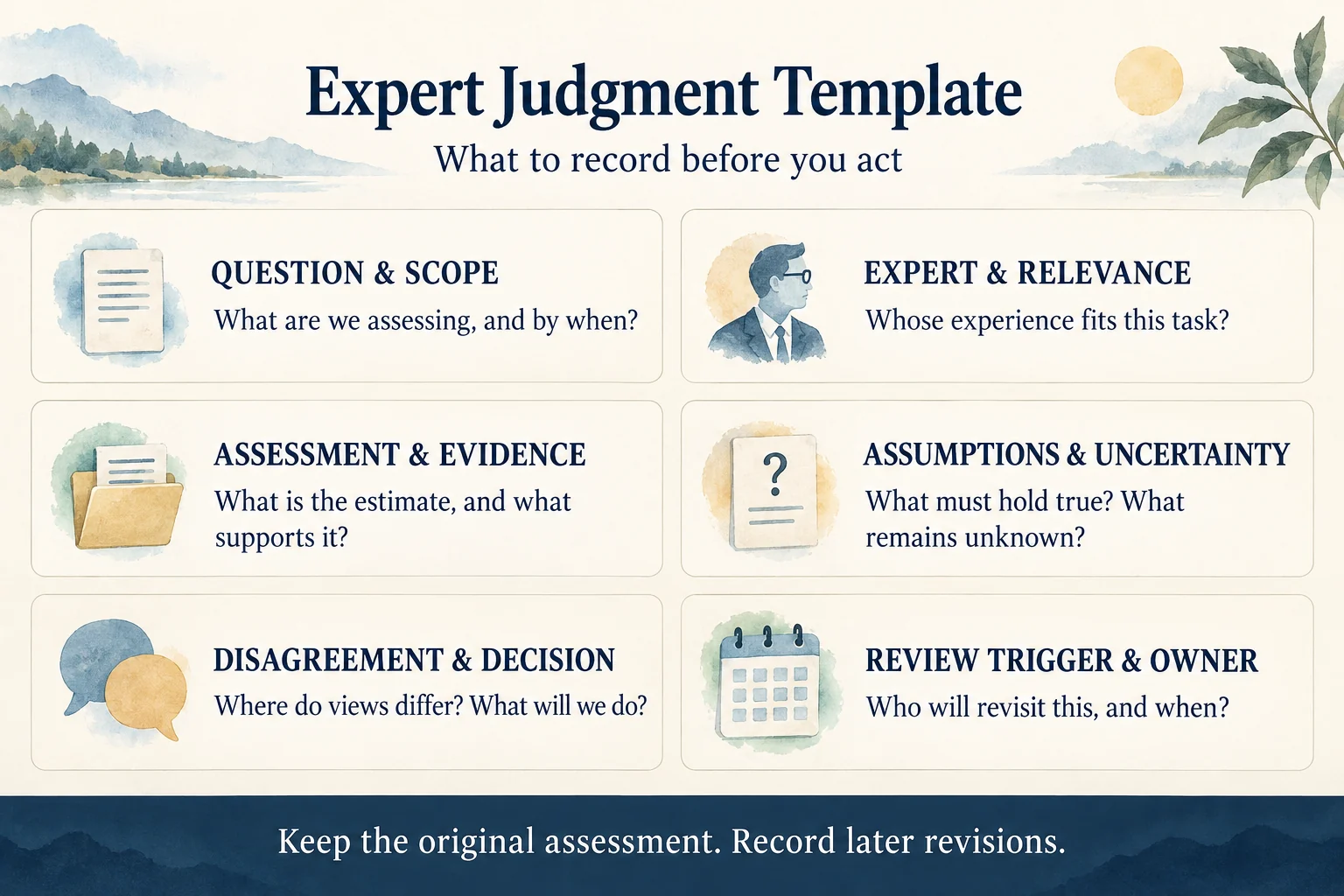
Complete one initial record per expert before discussion, then add the decision and review details. Keep dates and versions so the original assessment can be distinguished from later revisions.
Question and scope:
Decision to inform:
Included and excluded work:
Time horizon and definition of completion:
Expert and relevance:
Name, role, and assessment date:
Comparable experience:
Relevant interests or conflicts:
Assessment and evidence:
Conclusion or estimate:
Supporting observations and sources:
Meaning of any range or probability:
Assumptions and uncertainty:
Conditions assumed:
Unknowns and alternative explanations:
Evidence that would change the assessment:
Disagreement and decision:
Differences between assessments:
How those differences were handled:
Decision, owner, and reasoning:
Review trigger and owner:
Next check and responsible person:
Review date or triggering event:
Later evidence and revision history:
Leave unresolved fields explicitly marked “unknown.” A complete-looking form should not hide missing evidence. This record organizes a conversation; it does not calculate reliability.
Five questions before using an expert assessment
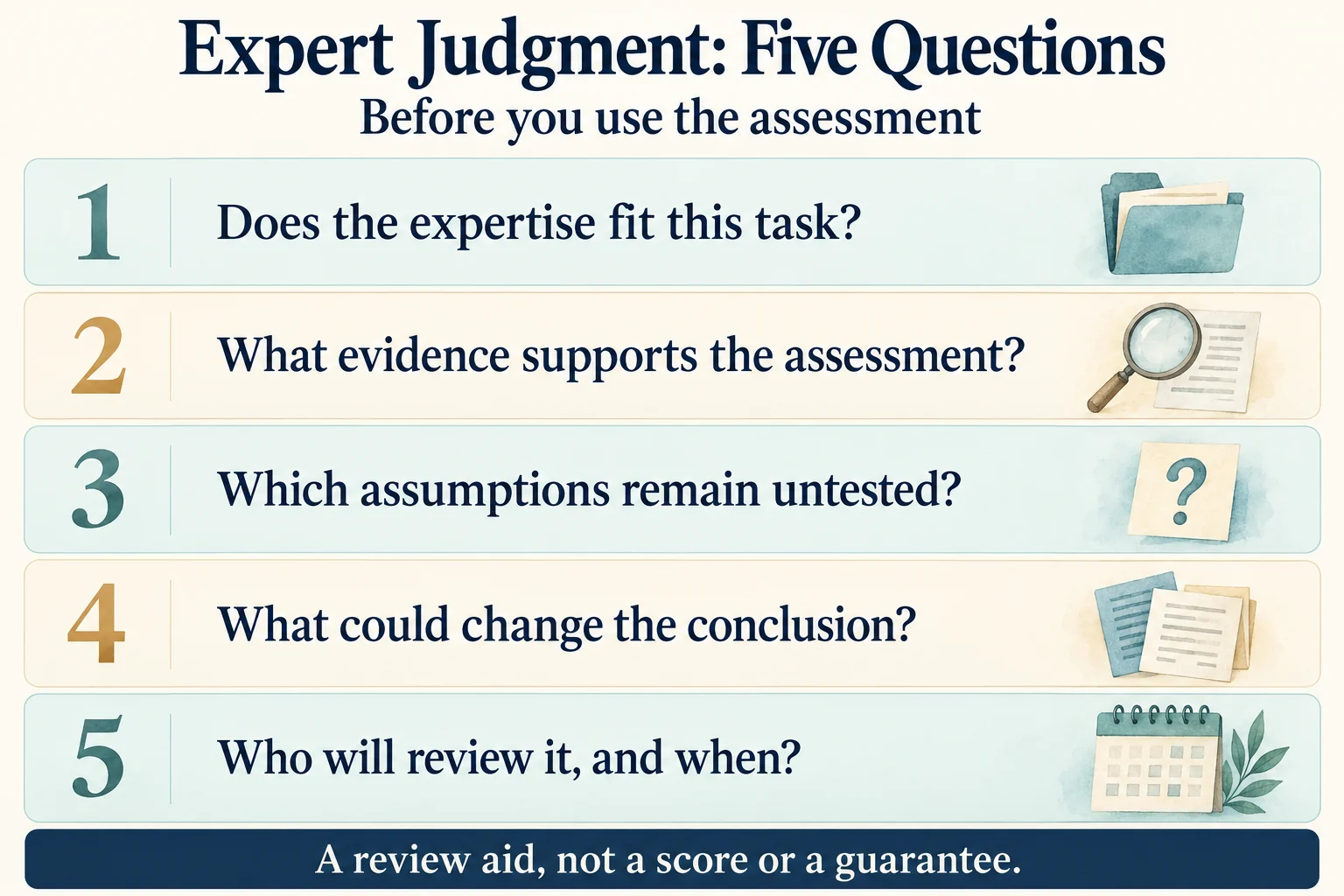
- Does the expertise fit this task? Name the relevant experience and its boundaries.
- What evidence supports the assessment? Identify observations and sources someone else can examine.
- Which assumptions remain untested? Make the conditions behind the conclusion explicit.
- What could change the conclusion? Specify evidence that would justify a revision.
- Who will review it, and when? Assign responsibility for the next check.
Try the record on one current, reversible workplace decision. Ask a relevant colleague for an independent assessment, compare assumptions, and choose one useful check. For the broader relationship between evidence and fast judgment, continue with intuition in decision-making.
Frequently asked questions
What is expert judgment in project management?
It is the use of relevant specialist knowledge to assess a project question, such as remaining work, technical feasibility, required skills, or risk. Document the basis of the assessment and how it informs the project decision.
Is expert judgment the same as intuition?
No. Expert judgment can include rapid intuitive recognition, explicit reasoning, data analysis, and consultation. Expert intuition describes the rapid recognition component rather than the entire assessment process.
What is the difference between expert judgment and expert elicitation?
The judgment is the assessment. Elicitation is the process used to obtain it. A structured process defines the question, collects reasoning and uncertainty, and specifies how assessments will be used.
How many experts do you need?
This guide sets no universal number. Match participation to the question’s scope and the expertise required. Adding people with the same information does not necessarily address a missing specialty.
Should you average conflicting expert estimates?
First check that they concern the same scope and assumptions. An average can conceal different scenarios. If estimates are combined, explain the chosen method and preserve material uncertainty and disagreement.
Can expert judgment replace data?
It can help interpret evidence and address unresolved questions, but obtain relevant data when feasible. Record where the assessment depends on experience rather than a direct observation.
Sources and further reading
These sources support the research and methods discussion. The workplace examples, six-step workflow, template, and checklist are original educational material.
- Morgan, M. G. (2014). Use (and abuse) of expert elicitation in support of decision making for public policy. PNAS, 111(20), 7176–7184. DOI: 10.1073/pnas.1319946111.
- Kahneman, D., & Klein, G. (2009). Conditions for intuitive expertise: A failure to disagree. American Psychologist, 64(6), 515–526. DOI: 10.1037/a0016755.
- CDC Center for Forecasting and Outbreak Analytics. How CFA uses the expert elicitation process to inform our work.
- Resources for the Future. Expert elicitation: Using the classical model to validate experts’ judgments.