Expert judgment · Models and practical examples
A service starts failing minutes after a software update. An experienced colleague notices a familiar combination of alerts and immediately suggests a response. How did they get there so quickly—and what would make that response worth trusting?
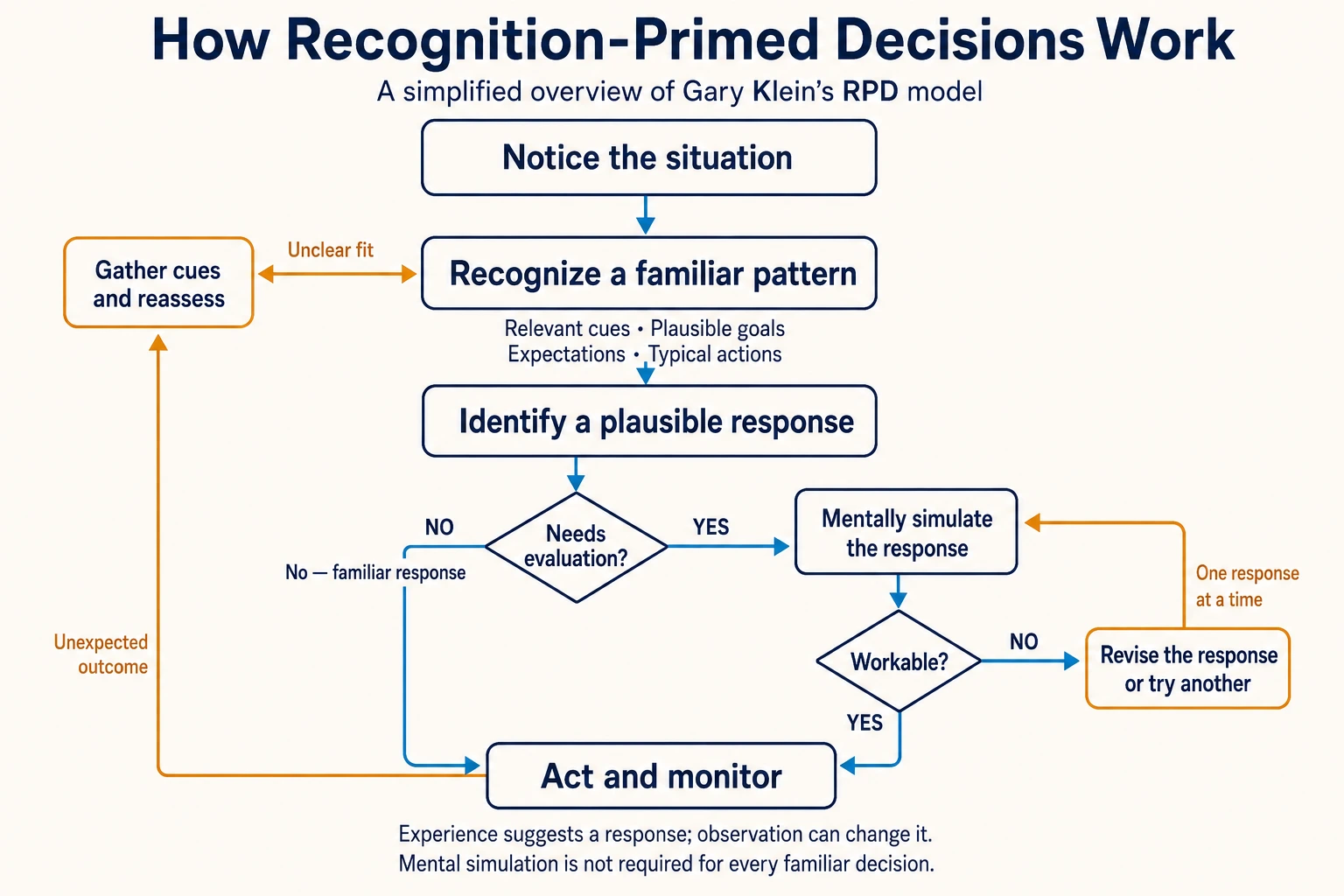
Recognition-primed decision making (RPD) is a model of how experienced people recognize a situation and identify a plausible response without first comparing a full list of alternatives. They may mentally rehearse that response, adjust it, and reassess the situation as new information arrives.
Gary Klein’s model helps explain this form of intuition in decision-making. This guide covers its main variations, an original worked example, the limits of expert judgment, and a practical way to review your own decisions. The aim is to make the reasoning behind a quick response easier to examine.

What Is Recognition-Primed Decision Making?
RPD describes how experience can supply a promising starting point. Someone who has handled similar situations may recognize what matters and what response could fit before they can explain every detail. The model emerged from Gary Klein’s work with Roberta Calderwood and Anne Clinton-Cirocco on experienced fireground commanders in the 1980s. Klein’s overview identifies 1985 as the model’s origin.
It belongs to naturalistic decision making: research on judgment in real settings, where information can be incomplete, goals can compete, and events keep changing. Klein’s 2008 review of naturalistic decision making explains why experience became central to this research approach.
RPD is a descriptive model, not an instruction to accept the first idea. A useful question when applying it is: What makes this situation familiar, and what would show that my interpretation is wrong? That keeps attention on evidence you can discuss with a colleague.
The broader topic of intuitive reasoning includes other ways judgments arise quickly. RPD gives us a more specific account of recognizing a situation, finding a candidate action, and evaluating its fit.
How the Recognition-Primed Decision Model Works
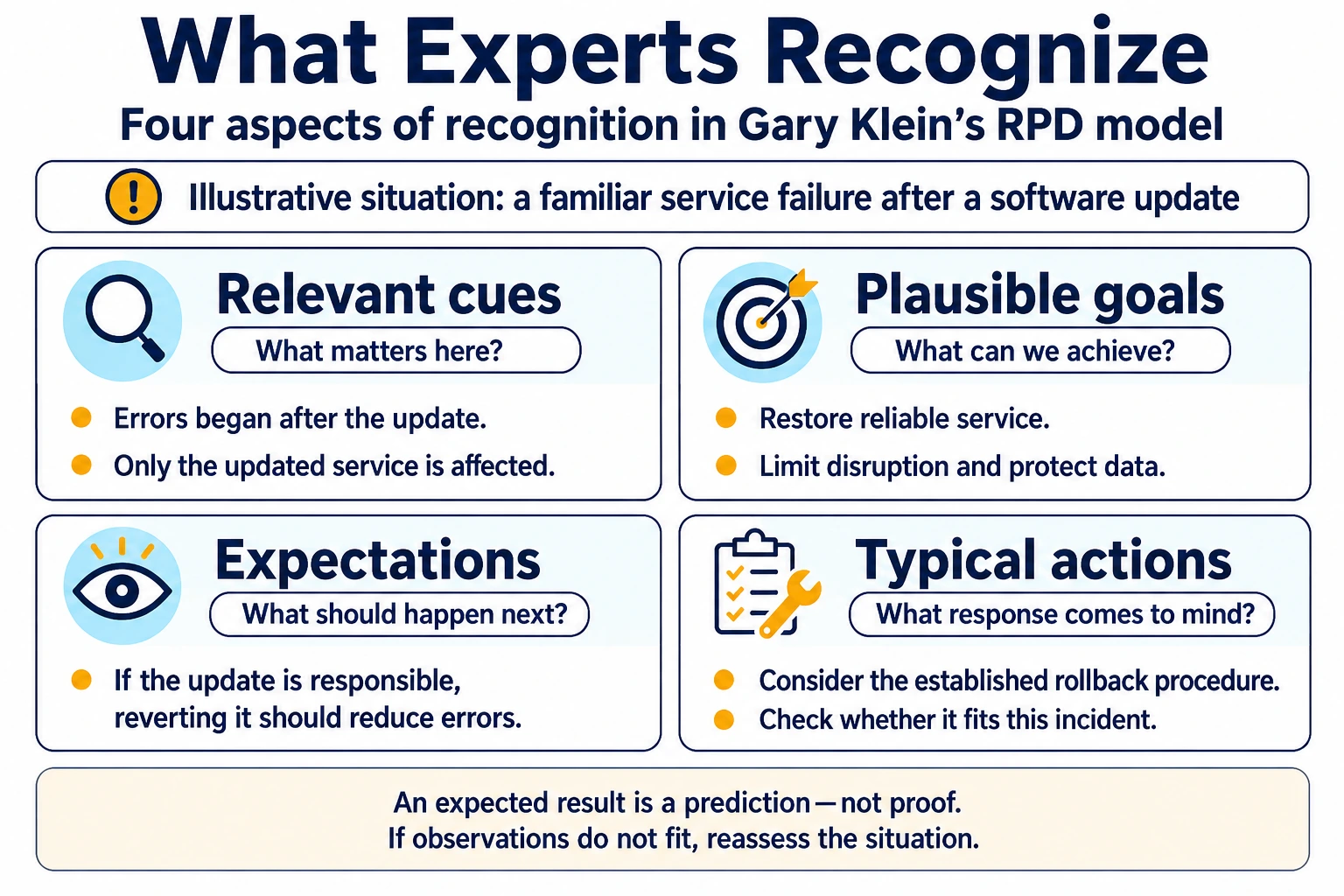
The model connects situation assessment with action. In his 1993 RPD chapter, Klein describes recognition in terms of relevant cues, plausible goals, expectations, and typical actions. These aspects help explain why a familiar situation can suggest a response.
What does the expert recognize?
Consider the fictional software incident introduced above. The following questions make the four aspects concrete:
- Relevant cues: Which observations matter? Errors began after an update, and the updated service appears to be the only one affected.
- Plausible goals: What can the team achieve now? Restore reliable service while limiting disruption and protecting data.
- Expectations: What should happen if the interpretation is right? If the update caused the fault, a suitable recovery action should reduce the errors.
- Typical actions: What response comes to mind? Consider the established rollback procedure, then check whether its assumptions hold here.
The timing is evidence to investigate, not proof that the update caused the problem. A separate failure could have started at the same time. In a team discussion, keep the observation—errors followed the update—separate from the explanation you are testing.
How mental simulation tests a response
Mental simulation means imagining how a candidate action would unfold. Klein explains that this can be deliberate evaluation, even when the initial recognition is fast and difficult to verbalize. RPD therefore includes more than a gut feeling. Klein, 2021.
For the incident team, useful rehearsal questions include: Will the previous version accept the current data? Who must authorize the change? What should we observe afterward? A concern about compatibility could rule out a simple rollback before anyone attempts it.
This is where mental models in decision-making become practical: the team needs an account of how the service, its data, and its dependencies interact. If that account is incomplete, imagining a smooth recovery cannot establish that the recovery will work.
For more background on recognizing a familiar pattern, see pattern recognition under uncertainty.
The Three Variations of Recognition-Primed Decision Making
Klein’s model distinguishes three variations. They describe different demands on the decision-maker; they are not three compulsory steps. The following short examples are original illustrations of those variations. See Klein’s model chapter.
1. Simple match
The situation and a suitable response are readily recognized, without extensive mental rehearsal. Imagine a coordinator seeing the same routine approval omission encountered many times before. They contact the designated approver through the established process and monitor completion.
2. Diagnosing the situation
The situation is unclear or the observations do not fit expectations, so assessment takes more work. In our software example, errors appearing in an unchanged service would challenge the update explanation. The team needs to investigate that mismatch before assuming the familiar recovery fits.
3. Evaluating a course of action
A response comes to mind, but its feasibility needs examination. The decision-maker mentally simulates it and may modify or reject it. Here, the team considers rollback, notices a compatibility constraint, and tests a revised proposal against that constraint.
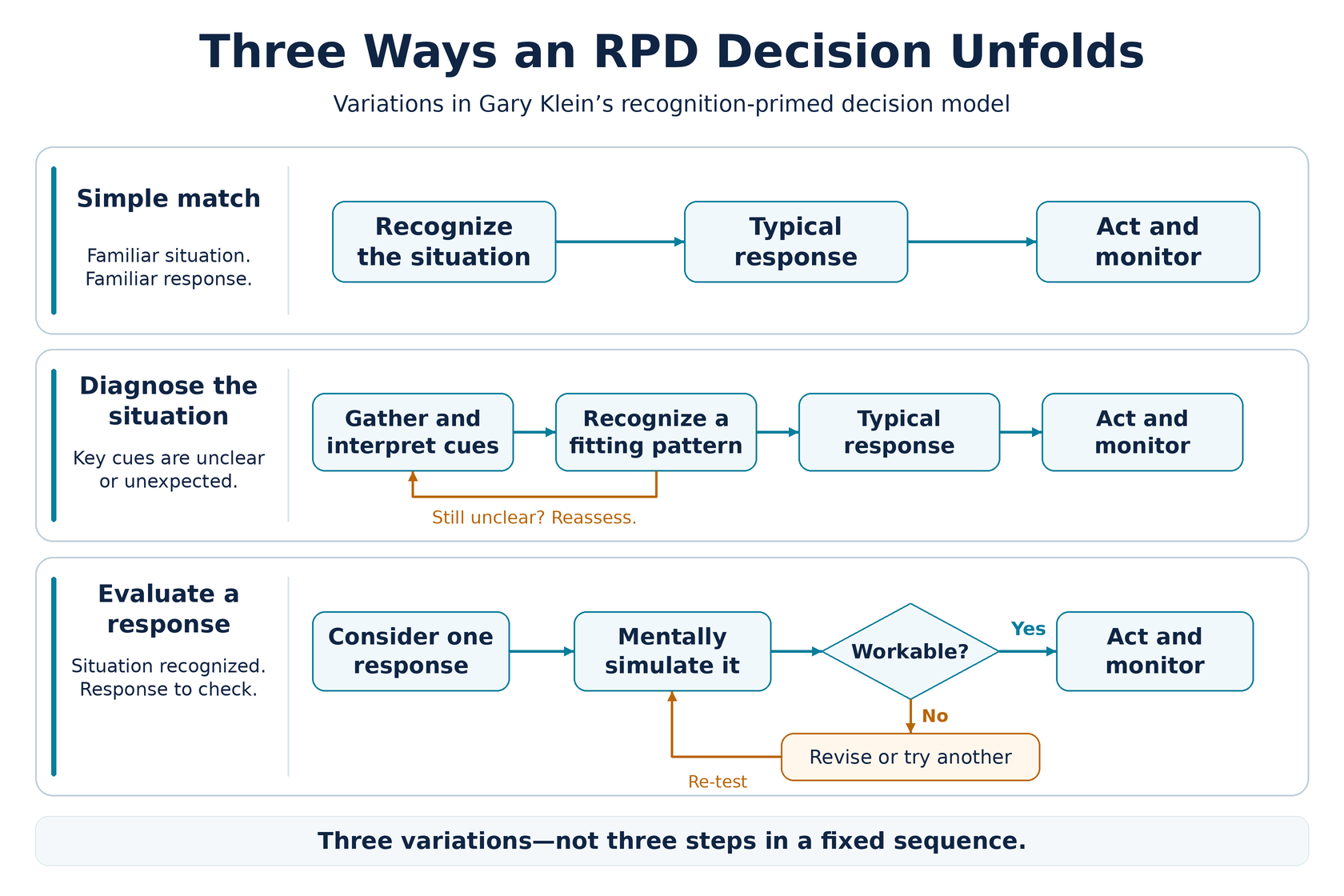
When discussing a decision afterward, identify the uncertainty that required attention. Was the situation unclear? Was the response unfamiliar? Did an expected result fail to appear? These questions make a review more informative than asking only whether someone “used their intuition.”
Recognition-Primed Decision-Making Examples
A software incident: testing one response at a time
Fictional worked example: a customer-facing service begins returning errors after an update. Monitoring initially suggests that other services remain healthy. An experienced incident lead recognizes a possible deployment problem. This scenario illustrates reasoning, not an operational recovery procedure.
- State the provisional interpretation. “The update may be responsible.” The lead records the timing and affected service, while keeping the cause open to investigation.
- Name the immediate goal. Restore reliable service without creating a data problem. The goal makes compatibility relevant to the response.
- Consider the familiar action. The established rollback procedure comes to mind because it has worked in similar incidents.
- Rehearse the consequence. The lead asks whether the earlier version can read the data now being written. In this fictional case, the answer is no.
- Revise the proposal. A compatible recovery procedure is considered and checked against the same goals, authorization requirements, and technical constraints.
- Act within the procedure and monitor. After the authorized response, the team checks service behavior and data integrity. If observations contradict the explanation, it revisits the assessment.
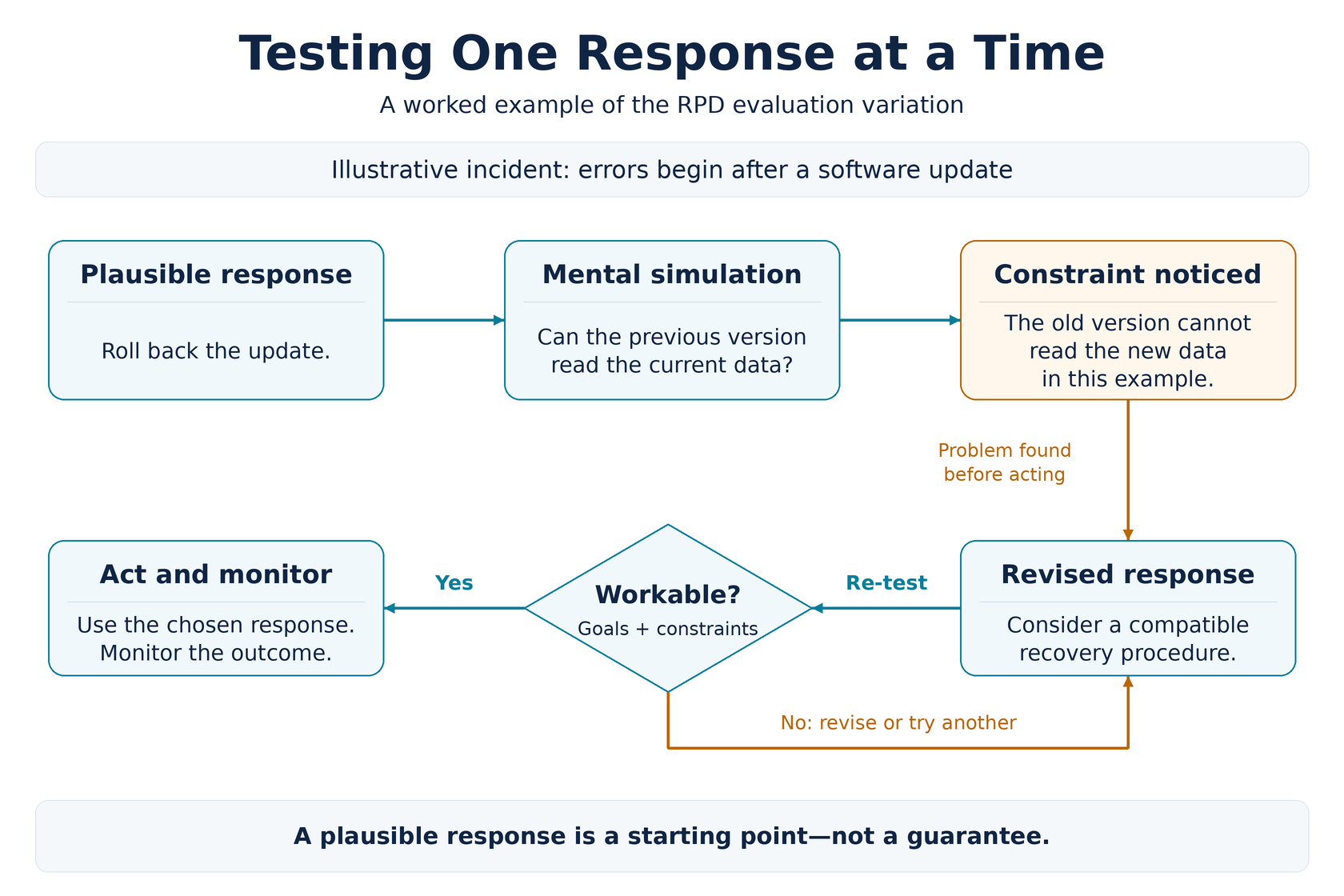
The key moment is the compatibility question. It reveals why “this worked last time” is insufficient for this case. The experienced lead has contributed both a candidate response and a reason to reconsider it.
Suppose the errors later disappear. That is useful outcome evidence, but the review should still ask what changed and whether the diagnosis was supported. Another event might have contributed to recovery. Keep a record of what was known at the decision point so the outcome does not erase the original uncertainty.
The fireground research: where the model began
Klein, Calderwood, and Clinton-Cirocco’s 1986 fireground study examined how proficient commanders made consequential decisions under time pressure. Using critical-incident interviews, the researchers investigated the judgments behind resource allocation and responses to developing situations.
This is the empirical research context, unlike the fictional workplace examples here. The study should not be read as proof that every quick judgment is expert judgment. Nor does a general article about its model provide firefighting instructions or replace professional training.
A delivery-management example: recognizing an approval bottleneck
Fictional example: a delivery manager sees completed work piling up while approvals remain unchanged. A familiar explanation is an unavailable approver. The first response they consider is escalating the approval queue.
Before doing that, the manager checks one completed item. Its acceptance criteria were changed yesterday, so the item is not ready for approval under the current agreement. The manager revises the interpretation and brings the changed criteria to the responsible owners.
For a practice discussion, change one fact: suppose the criteria were unchanged and the approver was absent. Would the same response still be reasonable? Comparing these two versions makes the boundary of the familiar pattern easier to see.
Recognition-Primed vs Analytical Decision Making
RPD emphasizes recognizing a situation and assessing a candidate response. An analytical comparison makes alternatives and decision criteria explicit. In practice, a team can use both. Klein’s review of naturalistic decision making describes the role of experience in generating and evaluating options.
The table shows typical emphases, not mutually exclusive modes. On a narrow screen, scroll the table horizontally.
| Question | RPD emphasis | Analytical comparison emphasis |
|---|---|---|
| Where do we start? | Recognize the situation and a plausible response. | Define alternatives and criteria for comparing them. |
| What do we examine? | The fit and feasibility of a candidate, often one at a time. | Differences, trade-offs, and evidence across alternatives. |
| What helps? | Relevant experience and an informed understanding of the situation. | Usable evidence, explicit criteria, and time proportionate to the decision. |
| Example in this article | Check whether a familiar recovery response fits the incident. | Compare longer-term reliability investments after service is restored. |
| Useful challenge | Which observation would make us reconsider this response? | Which assumption or omitted alternative could change the comparison? |
For example, a team might use experienced recognition to identify a plausible containment action, then compare several redesign options during the later review. It does not need to commit to one decision style for the entire problem.
If you can pause, ask what additional work would improve this particular choice. Checking an unfamiliar constraint, obtaining another specialist’s assessment, or comparing an overlooked option may each be useful. Select the check according to what remains uncertain and what a mistake would cost.
A heuristic is a simplifying strategy or rule; RPD describes a broader pattern of assessment and response. For that distinction, see intuition versus heuristics.
When RPD Works—and When It Can Fail
The advantage of experience depends on what it has allowed someone to learn. Kahneman and Klein emphasize two conditions for intuitive expertise: an environment with learnable regularities and sufficient opportunity to learn them. Subjective certainty, by itself, is not a reliable measure of accuracy. Kahneman and Klein, 2009.
Some of the patterns behind experienced recognition may develop through implicit learning, without the person being able to explain every regularity they have acquired. However, a familiar pattern can still mislead when conditions change or earlier feedback was incomplete.
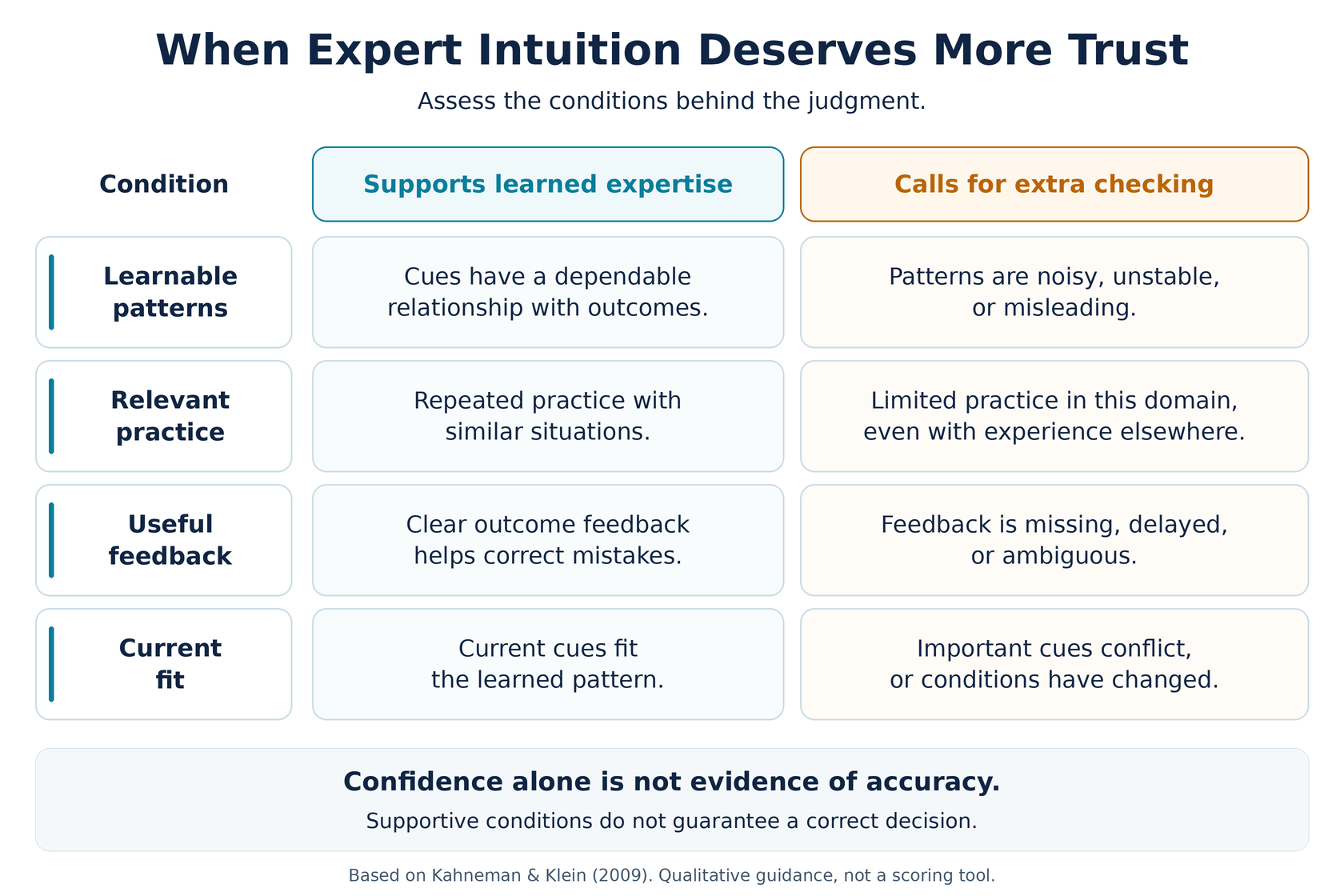
Check the experience behind the judgment
Use these prompts to examine a real decision. They are an original discussion aid, not a validated assessment:
- Learnable patterns: Which repeated relationship supports this interpretation? In the incident example, timing alone leaves several explanations open.
- Relevant practice: What similar cases has the person handled? Ask about this service and failure type, not only years of general seniority.
- Useful feedback: How did they learn whether earlier judgments were sound? A completed incident ticket may not explain why the service recovered.
- Current fit: What has changed? A new data format, dependency, agreement, or operating constraint could matter even when the visible symptoms look familiar.
Notice when the familiar response stops fitting
In the worked example, several warning signs deserve attention: errors spread beyond the updated service; the old recovery assumptions no longer hold; or the response produces something different from what the lead predicted. Any of those observations should reopen the discussion.
A team can make this easier by inviting a concrete challenge: “Which part of our explanation does this observation fail to support?” That question lets a less experienced colleague raise useful evidence without having to claim a better diagnosis immediately.
Pressure does not establish expertise. Treat a quick response as a proposal whose basis can be examined. Follow required procedures and escalation rules, especially where safety, authorization, or irreversible consequences are involved.
For further discussion of misleading familiarity, read intuition versus bias.
How to Develop Recognition-Primed Decision-Making Skills
Use the following original practice exercise to make your interpretation, prediction, and review visible. It is informed by RPD, but it is not an official sequence from Klein or a tested training program. Choose a low-risk retrospective case or an appropriate supervised simulation.
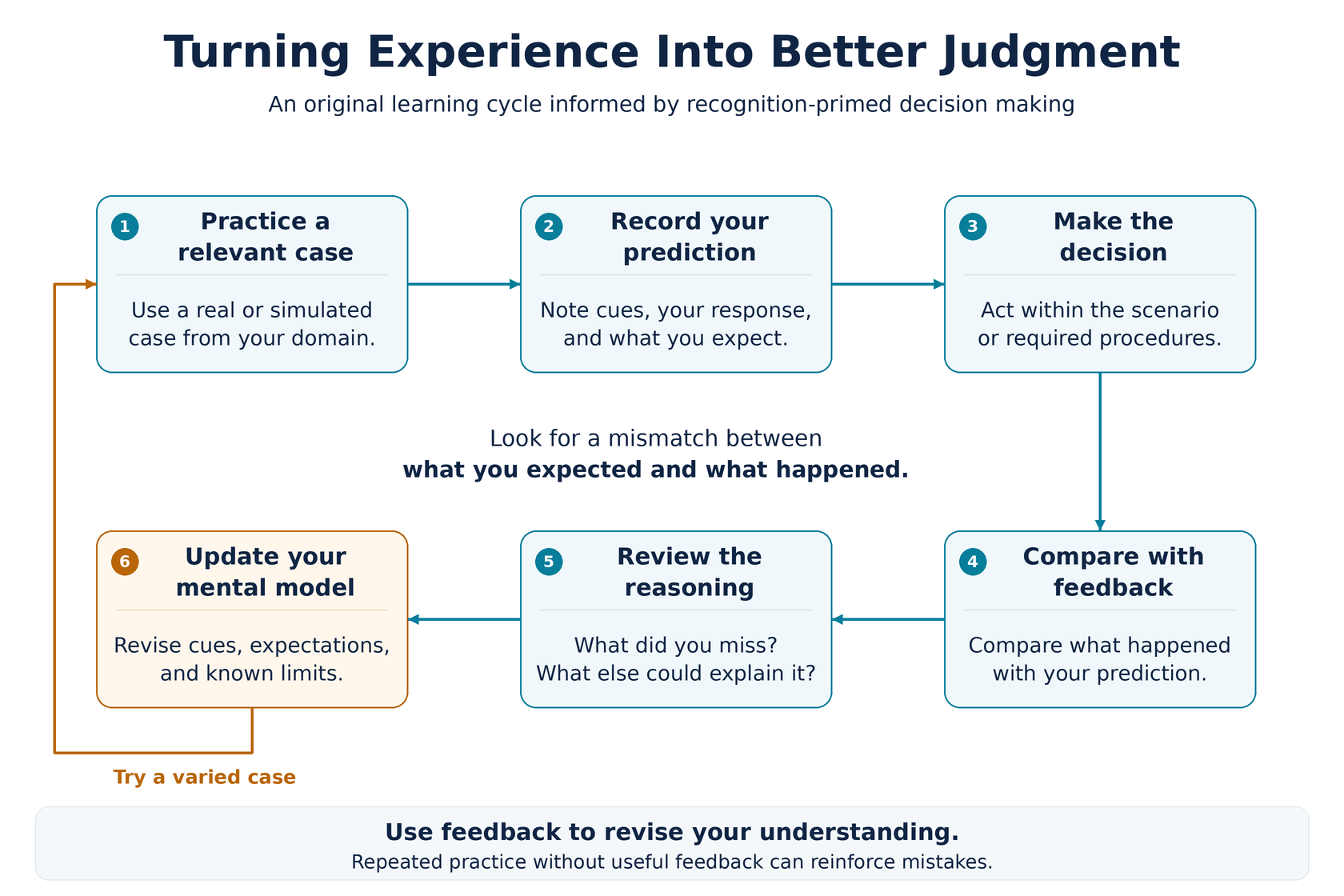
- Choose a relevant case. Use a problem from the domain in which you want to improve. Stop the case description at a meaningful decision point, before revealing what happened.
- Record your prediction. Write the cues you noticed, your provisional explanation, the response you would consider, and what you expect to observe next. Identify one observation that would challenge your explanation.
- Make the practice decision. State the action you would take within the scenario’s rules and your role. Include any consultation or authorization needed; “ask the responsible specialist” can be an appropriate decision.
- Compare with feedback. Reveal the outcome and available evidence. Mark what your prediction got right, what it missed, and what the case does not allow you to determine.
- Review the reasoning. Compare your account with a knowledgeable practitioner’s explanation when available. Ask which cue changed their assessment, which constraint mattered, and what they would have checked next.
- Revise and vary. Write one specific change to your understanding, then try a case with a different underlying cause or constraint. See whether your revised reasoning notices the difference.
For the delivery example, a useful revision would be: “Before attributing the queue to an absent approver, check whether the item meets the current acceptance criteria.” “Be more careful next time” gives you less to test.
Keep unknowns visible in your notes. If the case provides no evidence about why an action succeeded, record that limit instead of inventing a lesson. The exercise is complete when you can state what you learned, what remains uncertain, and what you would examine in the next case.
For broader exercises, continue with how to train your intuition. Keep practice tied to the decisions you actually want to improve.
A Practical RPD Decision-Review Card
Copy this card into a notebook or an existing review document. Complete the first five prompts before revealing the outcome in a practice case; complete the last one afterward. For real work, use it only where it fits the required decision process.
Situation, response, and learning
Original learning aid informed by recognition-primed decision making. Not a validated assessment or a substitute for professional procedures.
- 1. What makes the situation familiar?
- Record the relevant cues, the provisional interpretation, and any observation that does not fit.
- 2. What matters, and what do I expect?
- State the immediate goal and an observable prediction. Separate what you know from what you are assuming.
- 3. What response seems plausible?
- Name the action within your role, including required consultation, authorization, or escalation.
- 4. Where might that response fail?
- When rehearsal is useful, trace the likely sequence. Note a constraint, dependency, or missing fact that could change it.
- 5. What would make me reconsider?
- Specify the observation that would trigger reassessment or a request for help.
- 6. What happened, and what should change?
- Compare the outcome with the recorded prediction. Revise a specific assumption and retain any unresolved uncertainty.
Try the card on the software example. If “the older version cannot read the current data” appears only after the outcome is revealed, note that you missed a constraint. If you noticed it beforehand, explain which information prompted the check. Either result gives the next practice session a concrete focus.
Continue the reflection. Explore the Decision Clarity Toolkit for a broader collection of decision exercises. Use the card above as a starting point for examining one specific judgment.
Frequently Asked Questions
Is recognition-primed decision making the same as intuition?
It explains a particular use of experienced recognition. It also includes diagnosing unclear situations and deliberately evaluating responses when needed. Calling the whole model intuition can obscure those parts of the reasoning.
Does RPD always choose the best option?
No. RPD seeks a response that meets the situation’s needs without proving it is the best possible one—a strategy called satisficing. A workable response must still fit the evidence and constraints, and the assessment can be mistaken.
Can beginners use the RPD model effectively?
Beginners can use the model to understand questions worth asking and to structure supervised practice. Reading the model does not supply the experience needed for expert recognition. Work within your role and seek appropriate guidance.
Does RPD apply only to emergencies?
No. Although time-pressured work was central to its origins, Klein notes that people also use recognition-primed tactics in slower situations. A familiar planning problem can still suggest a candidate response. Klein’s clarification.
Does recognition-primed decision making replace checklists or procedures?
No. Understanding how a judgment arises does not remove procedural requirements. Use relevant checklists, authorization rules, and specialist support. In the examples here, the candidate response must remain compatible with those requirements.
Sources and Further Reading
The references below support the model’s origins, mechanisms, and limits. The workplace scenarios, comparison table, practice cycle, and review card are original teaching material; they are not reported research findings.
- Klein, G. Recognition-Primed Decision Model. Author’s overview of the model and its origins.
- Klein, G. A., Calderwood, R., & Clinton-Cirocco, A. (1986). Rapid Decision Making on the Fire Ground. Proceedings of the Human Factors Society Annual Meeting, 30(6), 576–580. DOI: 10.1177/154193128603000616.
- Klein, G. A. (1993). A Recognition-Primed Decision (RPD) Model of Rapid Decision Making. In Decision Making in Action: Models and Methods, pp. 138–147. Ablex. Author-uploaded chapter.
- Klein, G. (2008). Naturalistic Decision Making. Human Factors, 50(3), 456–460. DOI: 10.1518/001872008X288385.
- Kahneman, D., & Klein, G. (2009). Conditions for Intuitive Expertise: A Failure to Disagree. American Psychologist, 64(6), 515–526. DOI: 10.1037/a0016755.
- Klein, G. (2021, February 9). The RPD Model: Criticisms and Confusions. Psychology Today. Author’s clarification of the model’s scope.