Anchoring bias is the tendency for an initial number or reference value to pull a later judgment toward it, even when that starting point is weak or irrelevant. The first price, deadline, or estimate you hear can influence what feels reasonable next.
A stakeholder says a project should take four weeks. Soon everyone is debating whether it needs four weeks or five. Nobody has yet examined comparable projects, dependencies, or the work involved. The initial number has become the centre of the discussion.
This guide explains anchoring bias through everyday examples, a worked project scenario, and a practical checklist. The aim is to build estimates you can explain with evidence, while recognizing that uncertainty remains.

What Is Anchoring Bias?
Anchoring concerns the influence of a starting value on a subsequent estimate. In their foundational account of judgment under uncertainty, Amos Tversky and Daniel Kahneman described how people can begin with an initial value and adjust away from it insufficiently. Their work helped establish anchoring and adjustment as a major topic in research on judgment.[1]
For example, a chair marked down from $300 to $180 may feel inexpensive because $300 becomes your reference point. But if comparable chairs sell for $150, the discount does not establish good value. These prices are illustrative; the useful question is what relevant comparisons show.
Using a reference point is not automatically a bias. An initial figure may contain valuable information. The problem is giving it more influence than its evidence warrants. You cannot diagnose anchoring merely because someone accepts an opening offer or retains an early estimate.
Anchoring Bias Examples in Everyday Life and Work
| Situation | Possible anchor | Useful check |
|---|---|---|
| Shopping | The advertised original price makes a discount look attractive. | Compare the current price with equivalent products. |
| Salary discussion | The first offer sets the range both sides keep discussing. | Review responsibilities and relevant market comparisons. |
| Supplier selection | The first quote becomes the benchmark for later quotes. | Compare equivalent specifications, service and total costs. |
| Project planning | An early deadline shapes estimates before scope is examined. | Review completed work, dependencies and available capacity. |
| Budget planning | Last year’s allocation becomes the default, despite changed needs. | Reassess demand, constraints and costs before adjusting the old figure. |
These situations illustrate where anchoring might occur. They do not prove that a particular decision is biased. Last year’s budget, for instance, can be an appropriate starting point when the underlying conditions remain relevant.

Why Anchoring Happens
Anchoring is not explained by one process in every setting. Two useful explanations are:
- Insufficient adjustment: you start from a value and move away from it, but not far enough. The adjustment can feel substantial while the original number still dominates.
- Selective accessibility: considering a proposed value can make information consistent with it easier to bring to mind. You may find reasons why that value fits before exploring reasons it does not.[2]
Knowing about a bias does not establish that you have corrected for it. A more useful response is to change how the estimate is produced: gather independent information, make assumptions visible, and examine reasons the anchor may be inappropriate.
For the broader context, see how heuristic thinking can make judgments efficient while also creating predictable errors.
Anchoring Bias and Intuitive Judgment
An estimate can feel immediately plausible without its basis being clear. That feeling may reflect relevant experience, influence from a suggested number, or a mixture of both. Confidence by itself cannot tell you which explanation is correct.
Suppose an experienced manager hears “four weeks” and thinks it sounds right. The next question is not simply whether to trust the feeling. Ask which previous projects support it, how those projects compare, and which current constraints might change the estimate.
Expert judgment becomes easier to examine when people explain the evidence, conditions and limits behind their estimates. Asking for an independent estimate before sharing a stakeholder’s figure is one practical way to keep the initial suggestion from defining the whole discussion.
Anchoring vs Confirmation vs Availability Bias
| Bias | Main influence | Project example |
|---|---|---|
| Anchoring | A starting value pulls the estimate toward it. | “The initial suggestion was four weeks, so five should be enough.” |
| Confirmation | Evidence supporting an existing belief receives preferential treatment. | “These easy tasks prove our plan; the difficult dependencies are exceptions.” |
| Availability | Easily recalled examples receive disproportionate influence. | “The last project finished quickly, so this one probably will too.” |
The influences can overlap. An initial estimate may encourage a team to focus on supporting evidence, while one memorable success makes the estimate feel realistic. Read the guides to confirmation bias and the availability heuristic for more detailed distinctions.
Worked Example: The Four-Week Project Estimate
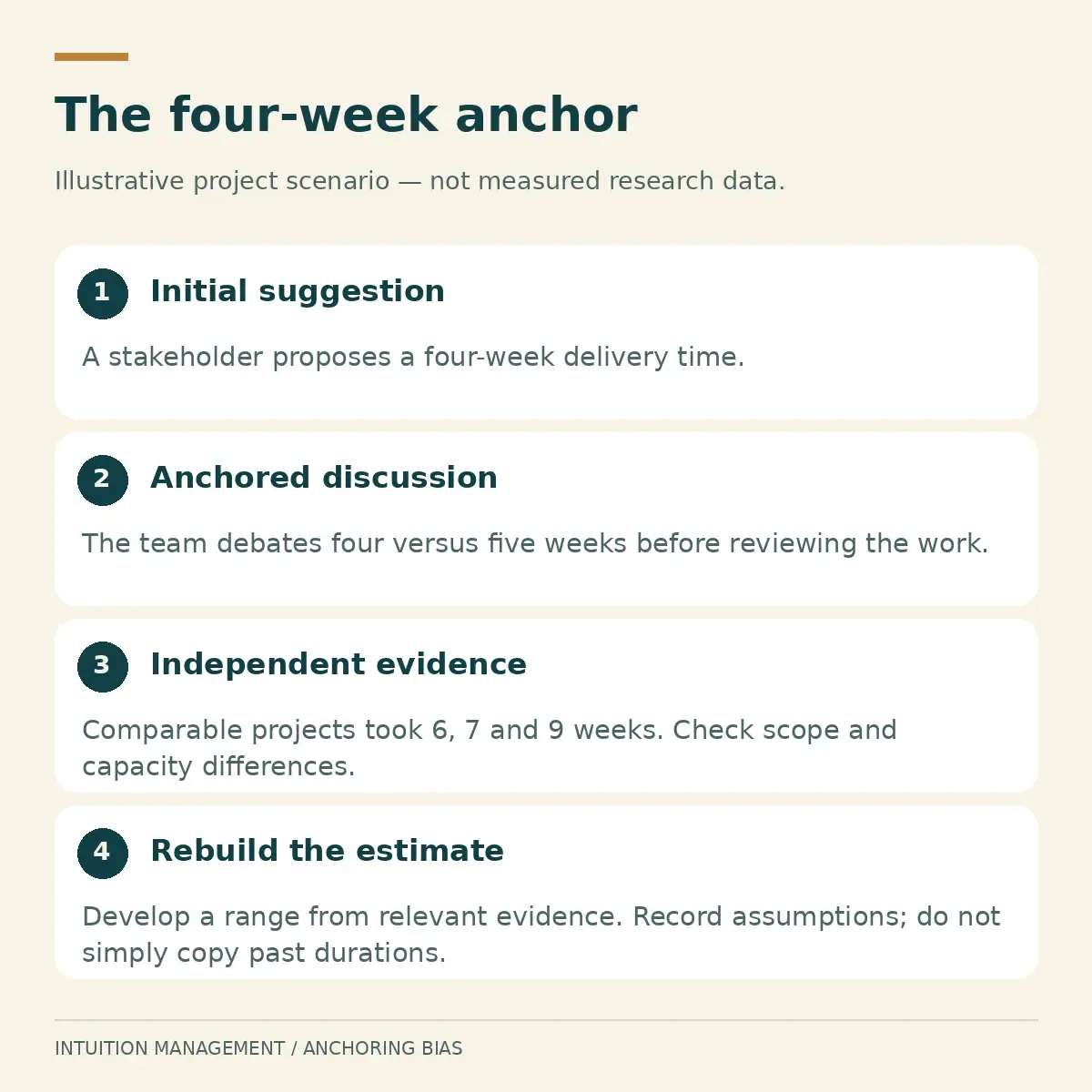
Illustrative scenario: the figures below are invented to demonstrate a review process. They are not study results or a report of a real project.
1. The starting number takes over
A stakeholder suggests four weeks for a delivery. The team discusses whether to add a week, without first reviewing the actual scope. Four weeks becomes the baseline because it was proposed early, not because it has been validated.
2. The team investigates independent evidence
Three broadly comparable completed projects took six, seven and nine weeks. The team examines what drove those durations: integration work, review cycles, staffing and dependencies. It also checks whether the current project is smaller, better understood or differently constrained.
3. The estimate is rebuilt
The team develops a range using the current work breakdown and the relevant comparison cases. It records assumptions about capacity and approvals, then identifies what information could change the range. The three historical durations do not automatically establish the right answer.
4. Target and forecast are separated
A four-week business target can remain a genuine constraint. If the evidence-supported forecast differs, the team discusses scope, resources, sequencing or risk explicitly. Calling a date a target does not make it an unbiased estimate of what will happen.
How to Reduce Anchoring Bias
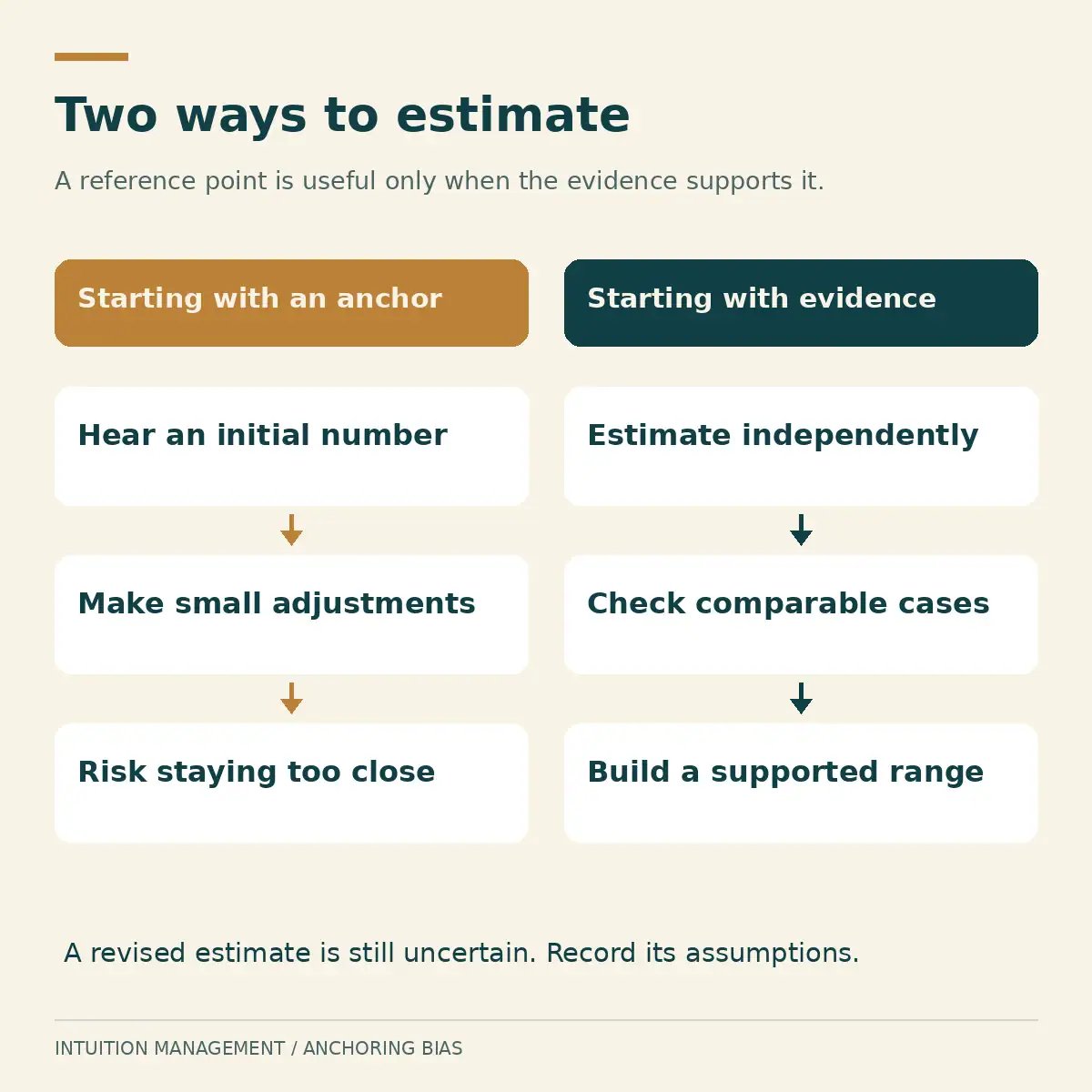
1. Estimate before seeing the suggested number
Where practical, ask people to write their estimates and assumptions before showing an opening proposal or the group’s figures. This creates an independent starting record. It does not remove every possible influence: people may already have their own anchors.
2. Check relevant comparison cases
Use more than the single example you remember best. Compare scope, conditions, definitions and constraints. A collection of poorly matched cases can mislead just as an unsupported starting figure can.
3. Consider reasons the anchor could be wrong
Ask what would support a substantially higher or lower estimate. In two studies, Mussweiler, Strack and Pfeiffer found that considering reasons against an anchor reduced anchoring effects in the tested settings.[3] That is a useful research basis for a checking habit, not a guarantee that it works equally well in every decision.
4. Build a range from explicit assumptions
A range is useful when its boundaries have reasons. Adding an arbitrary percentage around the original figure may preserve the same anchor. Explain what conditions would produce the lower and upper estimates, and which uncertainties matter most.
5. Record your reasoning and update it
Write down the initial value, its source, the comparison evidence and the reasons for your final estimate. Use a decision journal to preserve what you knew before the outcome. Later, examine both the result and the quality of the estimating process.
A Five-Question Anchoring Checklist
Before accepting a price, deadline or forecast, pause for these five questions:
- 1. Source: Where did this number come from?
- 2. Support: What independent evidence supports it?
- 3. Alternatives: What evidence points substantially higher or lower?
- 4. Relevance: Are the comparison cases truly comparable?
- 5. Revision: What would make me revise this estimate?
You do not need a lengthy analysis for every small choice. Match the checking effort to the importance, uncertainty and reversibility of the decision.

Frequently Asked Questions
What is a simple example of anchoring bias?
A sale price can seem attractive because it is compared with a high advertised original price rather than with equivalent products. The original price acts as a reference point, even if it says little about current value.
Are anchoring bias and anchoring and adjustment the same?
They are related terms. Anchoring bias describes the influence of an initial reference value on judgment. Anchoring and adjustment describes a process in which someone starts from a value and adjusts away from it; insufficient adjustment is one explanation for anchoring effects.
Can experts be affected by anchoring?
Yes. Research on considering the opposite included expert participants and found anchoring could be reduced in that setting.[3] Expertise does not make every estimate immune, although relevant knowledge can provide a stronger basis for checking a proposed value.
Is the first number always misleading?
No. A starting number may be accurate and useful. Assess its source and relevance. Deliberately moving away from a well-supported value simply to avoid an anchor can also make judgment worse.
Can you completely eliminate anchoring bias?
No checklist guarantees that. Independent estimates, relevant comparisons and reasons against an anchor can support better judgment, but their usefulness depends on the situation and the quality of the evidence.
How can a team reduce anchoring during planning?
Collect estimates before sharing a preferred deadline, discuss assumptions and comparison cases, and distinguish the desired delivery date from the forecast. Record why the estimate changes when new evidence arrives.
Try this on your next estimate: record the first number you hear, identify its source, and write down the independent evidence before you accept or revise it. Your goal is to explain why the estimate deserves weight.
Research References and Scope
This article is an educational synthesis. The project scenario and checklist are practical illustrations, not a validated diagnostic test or a guaranteed debiasing intervention.
- Tversky, A., & Kahneman, D. (1974). Judgment under Uncertainty: Heuristics and Biases. Science, 185(4157), 1124–1131.
- Mussweiler, T., & Strack, F. (2000). Numeric Judgments under Uncertainty: The Role of Knowledge in Anchoring. Journal of Experimental Social Psychology, 36(5), 495–518.
- Mussweiler, T., Strack, F., & Pfeiffer, T. (2000). Overcoming the Inevitable Anchoring Effect: Considering the Opposite Compensates for Selective Accessibility. Personality and Social Psychology Bulletin, 26(9), 1142–1150.