Heuristic thinking means simplifying a judgment or decision by using selected cues, rules, or shortcuts instead of examining every available detail. It can be deliberate or automatic. A useful heuristic reduces effort while preserving what matters for the task; a poorly matched one can overlook decisive information.
Imagine choosing a meeting venue. You could compare every venue in the city, or choose the first one that meets your accessibility, capacity, date, and budget requirements. The second approach uses a heuristic called satisficing. You find an acceptable option without proving that it is the best possible one.
This guide explains seven heuristic thinking examples, how to recognize their limits, and how to check a shortcut before relying on it. The everyday scenarios are illustrations, not reports of research findings.

What is heuristic thinking?
A heuristic reduces the work needed to reach a judgment. It may focus on a memorable event, a recognized name, a feeling, a predictive cue, or a minimum requirement. These strategies differ in how they operate, so “mental shortcut” is a useful introduction rather than a complete explanation.
Heuristics can be consciously chosen. Writing “stop searching once a venue meets these requirements” is an explicit rule. Other judgments arise with little awareness of the cue involved. Speed alone therefore does not identify a particular heuristic.
The research literature considers both predictable errors and successful uses of simplification. Gigerenzer and Gaissmaier’s review of heuristic decision making explains why performance must be assessed in relation to the environment and task. A simple strategy can sometimes outperform a more complex one, but that is an empirical possibility, not a universal promise.
Heuristic thinking overlaps with intuition without being identical to it. Intuition describes a rapid impression or judgment; a heuristic describes a simplifying strategy that may contribute to that judgment. For the fuller comparison, see intuition vs heuristics. The related guide to intuitive reasoning explores judgments that emerge without an explicit chain of reasoning.
How heuristic thinking simplifies a decision
For many explicit heuristics, three questions make the strategy visible: what information will you search for, when will you stop, and how will you decide? They provide a way to describe a rule, not a claim that every automatic judgment follows three conscious stages.
- Define the rule. Specify the information or requirements that matter. For a venue, these might include accessibility, capacity, availability, and total cost.
- Search selectively. Check options against that rule. You do not have to compare every decorative feature before discovering that a room is too small.
- Apply a stopping condition. With satisficing, stop at the first option that meets the requirements. If nothing qualifies, continue searching or deliberately reconsider the requirements.
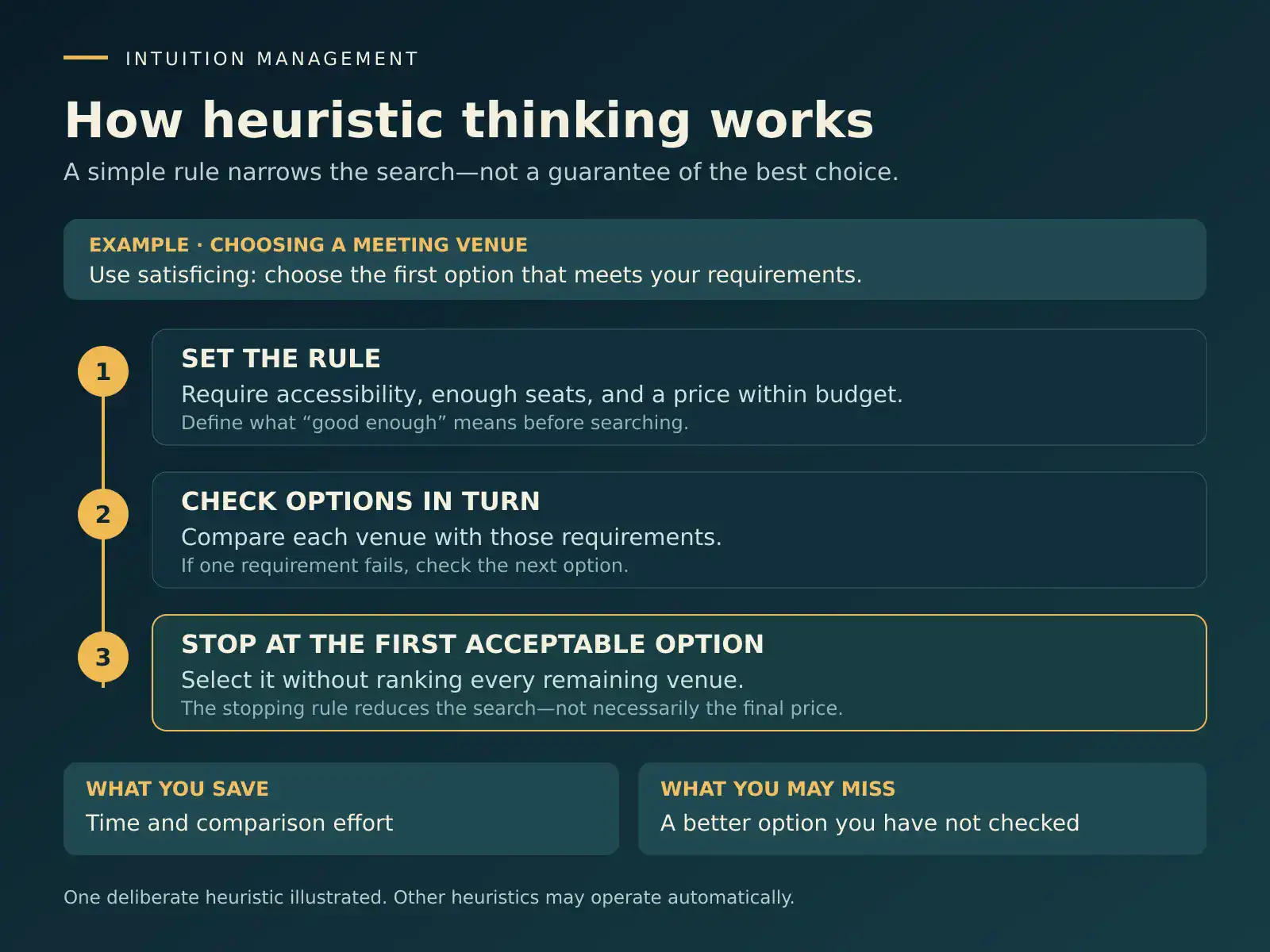
A stopping rule also determines what remains unknown. The worked example below shows that trade-off in a complete decision.
Seven heuristic thinking examples
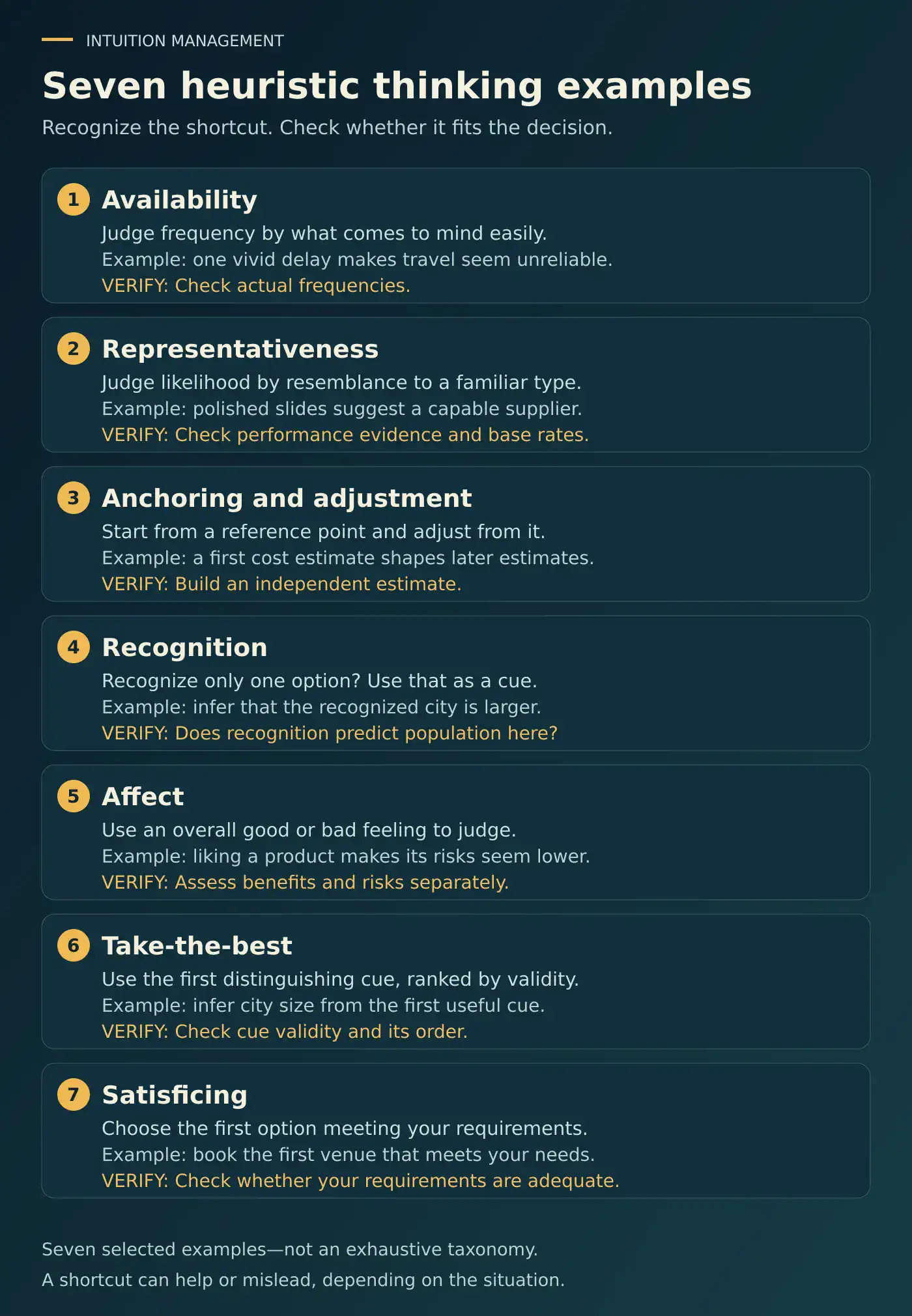
The following examples include probability judgments, numerical estimation, and choices between options. They are seven selected strategies, not a complete taxonomy. The table provides a quick reference; the explanations below show what each shortcut can miss.
| Heuristic | Shortcut | Information it may miss | Useful check |
|---|---|---|---|
| Availability | Use ease of recall | Actual event frequencies | Review relevant records |
| Representativeness | Use resemblance to a type | Base rates and individual evidence | Check both |
| Anchoring and adjustment | Adjust from a starting value | Independent estimates | Build a separate baseline |
| Recognition | Use recognizing one of two options | Why the name is recognizable | Check recognition’s relevance |
| Affect | Use an overall positive or negative feeling | Separate risk and benefit evidence | Evaluate each separately |
| Take-the-best | Use the first distinguishing cue in validity order | Lower-ranked cues | Check the cue ordering |
| Satisficing | Choose the first acceptable option | Unexamined alternatives | Check the requirements |
1. Availability: what comes to mind easily?
Availability uses the ease of recalling examples or imagining scenarios to inform judgments of frequency or plausibility. A vivid recent delay may make travel seem less reliable than the overall record suggests. Availability is one of the heuristics examined in Tversky and Kahneman’s foundational paper.
Try this check: before changing a team’s travel policy after one memorable incident, compare delay records for the relevant route and period. Ask whether you are reacting to a representative pattern or to an unusually striking example.
2. Representativeness: what does this resemble?
Representativeness uses similarity to a familiar category or prototype to judge likelihood. It can underweight base rates: how common something is in the relevant population. For example, the share of suppliers that deliver comparable projects on time is a base rate; a polished presentation is not.
Illustration: a supplier’s polished presentation resembles your image of a capable organization. Before treating that impression as evidence of delivery quality, examine relevant project results and references. Decide in advance what evidence would count against your first impression.
3. Anchoring and adjustment: what number came first?
Anchoring and adjustment describes numerical judgment that starts from a reference value and adjusts from it. Adjustments may be insufficient. The initial estimate can therefore continue to influence the result.
Illustration: someone suggests that a project will take six weeks. Instead of only debating whether six should become seven, build an estimate from the work required and comparable completed projects. Reconcile the two estimates after producing the independent baseline.
4. Recognition: which option do I recognize?
In its classic two-option form, the recognition heuristic applies when one option is recognized and the other is not. A person infers that the recognized option ranks higher on the criterion being judged. Goldstein and Gigerenzer’s research examined how recognition can support such inferences.
If both options are recognized, or neither is recognized, this basic rule cannot distinguish them; another strategy or additional information is needed.
City population is a useful illustration: you recognize one city’s name and infer that it has more inhabitants. This only makes sense when recognition is informative about population in that setting. A small place could be famous for an unrelated reason.
Try this check: ask why the name is familiar and whether that reason predicts the attribute you need. The recognition heuristic is also distinct from recognition-primed decision making, which concerns experienced people recognizing situations and evaluating workable actions.
5. Affect: how does the option feel?
The affect heuristic uses an overall positive or negative feeling to guide judgments. Liking an option may influence both how beneficial and how risky it seems. Slovic and colleagues explore this relationship in The Affect Heuristic.
Illustration: you enjoy a new software product’s interface and become less attentive to its limitations. Write down the benefit you expect, then separately check export options, access controls, and contractual constraints. Enjoyment is relevant to usability, but it does not answer every other question about the purchase.
6. Take-the-best: which predictive cue distinguishes the options?
Take-the-best orders cues by predictive validity—how often each cue points to the correct answer when it distinguishes the alternatives— checks them in that order, and stops at the first cue that distinguishes two alternatives. It makes an inference using that cue instead of combining every cue. It does not mean choosing whichever feature you personally like most. The model was developed in Gigerenzer and Goldstein’s work on fast and frugal reasoning.
Fictional cue example: suppose prior evidence has ranked three cues for inferring which of two cities has the larger population. The ranking below is assumed for illustration; it is not a recommendation to use these cues without testing them.
| Cue order | City A | City B | Action |
|---|---|---|---|
| 1. Has an international airport | Yes | Yes | Tie: check the next cue |
| 2. Has a university | Yes | No | Distinguishes: infer A is larger; stop |
| 3. Has a major sports team | Not checked | Not checked | Omitted after stopping |
The inference assumes that a positive value on the second cue predicts a larger population in the relevant setting. It may still be wrong. The method stops at that cue rather than combining all three.
Try this check: establish whether the cue ordering remains valid for the population and circumstances you are judging.
7. Satisficing: is this option good enough?
Satisficing searches for an option that meets an aspiration level or set of requirements rather than proving that an option is optimal. It belongs to the tradition of bounded rationality associated with Herbert Simon’s work on rational choice.
Illustration: select the first meeting venue that has enough seats, meets accessibility needs, is available on the date, and fits the budget. The result depends on both your requirements and the order in which you search.
Try this check: define mandatory needs before looking. If requirements change, reopen the check rather than assuming that an earlier acceptable choice still qualifies.
When does heuristic thinking work well?
A productive shortcut leaves out information that the decision can afford to leave out. Check the rule against the actual goal and revisit it when the goal changes.
- The selected information is relevant. A venue’s seating capacity is directly relevant to accommodating the group. Its popularity on social media may not be.
- The stopping condition matches the goal. Finding an acceptable room and finding the cheapest possible room are different tasks.
- The cost of further search matters. Spending hours comparing interchangeable options consumes time that could serve another purpose.
- Exceptions can be detected. New accessibility or remote-participation needs should trigger another check.
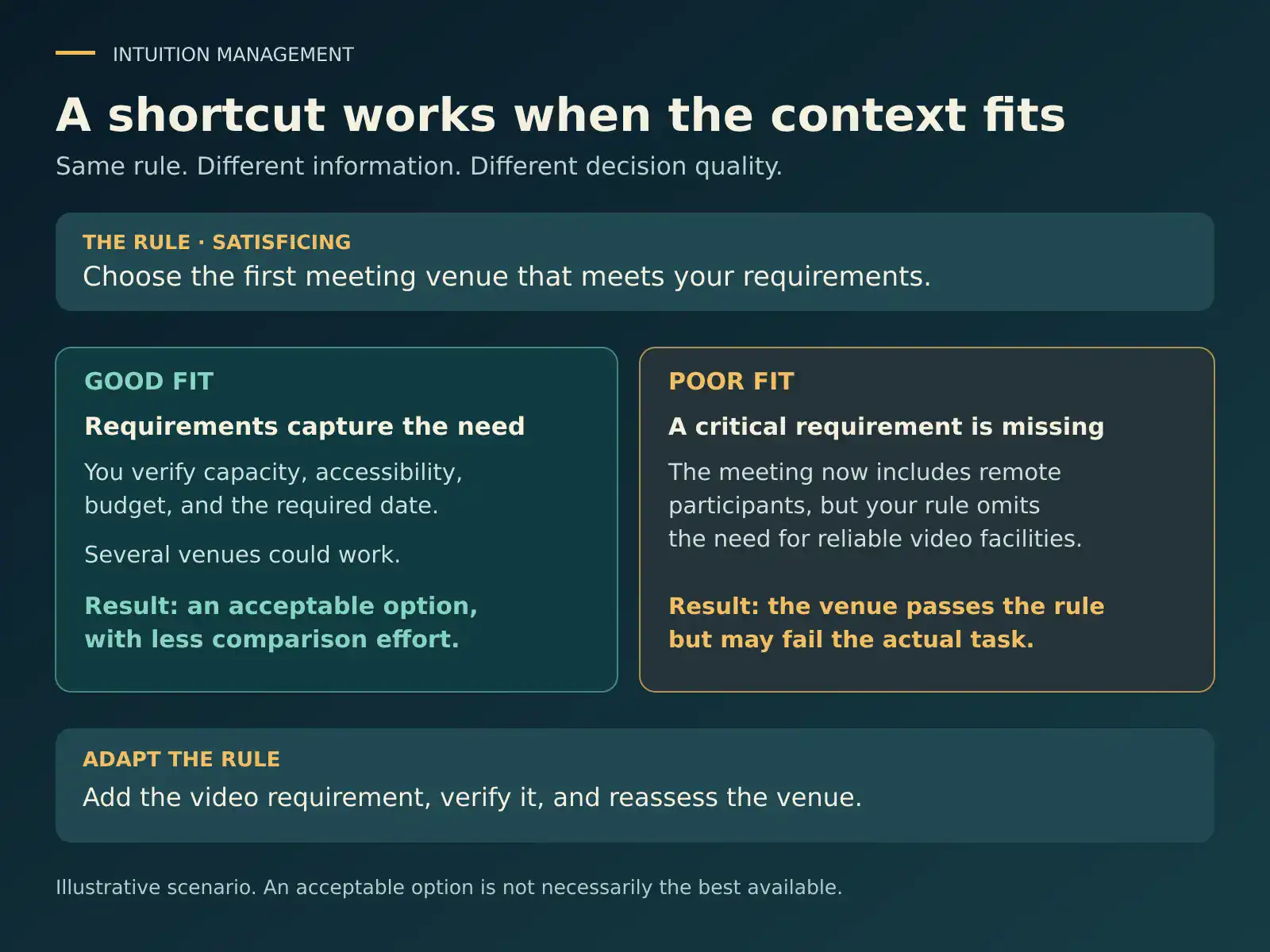
These are practical considerations, not a formula guaranteeing success. A rule justified in one setting may be unsuitable elsewhere. Likewise, substantial experience does not automatically transfer across domains; the guide to expert intuition explains why relevant learning and feedback matter.
When does a shortcut produce a biased judgment?
A heuristic is a strategy; cognitive bias refers to a systematic pattern of error in judgment. A shortcut can contribute to bias, but the two terms are not interchangeable. One incorrect estimate alone does not establish a recurring bias.
Consider the travel example. Recalling a dramatic delay could prompt a useful question about reliability. The problem arises if you treat the ease of recall as sufficient evidence of a high delay rate, even when relevant records tell a different story.
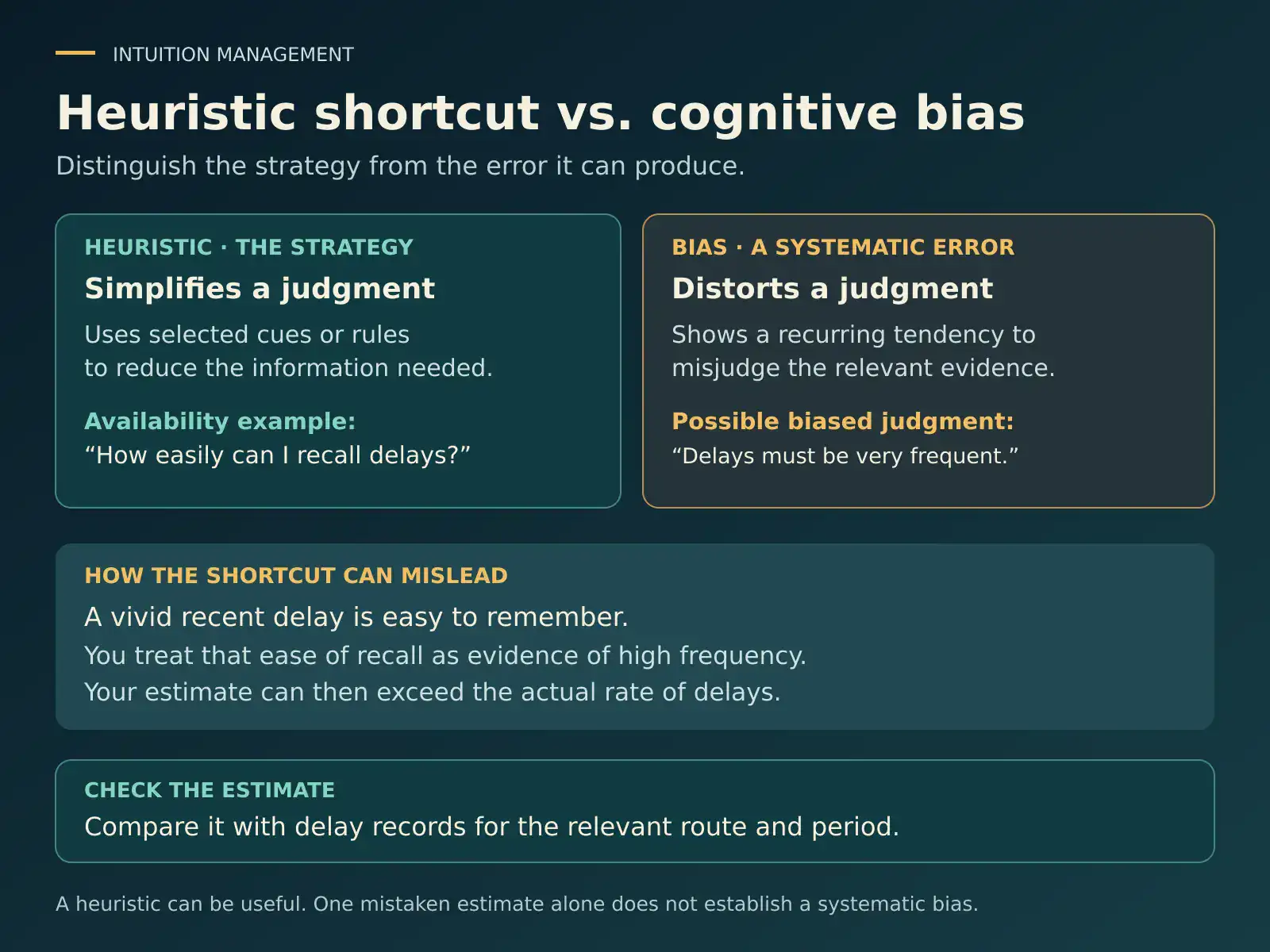
To check your judgment, separate the impression from the evidence. Write down the actual claim—such as “this route is frequently delayed”—then identify the records that could support or challenge it. This turns a vague feeling into something you can investigate.
An initial number can also shape what feels reasonable. Explore these anchoring bias examples to see how prices, deadlines, and estimates influence judgment—and how to check them against independent evidence.
For another distinction that helps keep the concepts clear, see mental models vs cognitive biases. Recognizing a label is only the beginning; the practical task is to identify what would change your decision.
Worked example: choosing a meeting venue
This is a fictional illustration. You need a venue for 20 people. Before searching, you require enough seats, appropriate accessibility, availability on the meeting date, and a total venue cost no higher than €500.
| Search order | Seats | Accessible | Date available | Cost | Action |
|---|---|---|---|---|---|
| Venue A | 16 | Yes | Yes | €400 | Reject: insufficient capacity |
| Venue B | 24 | Yes | Yes | €480 | Select; stop searching |
| Venue C | Not checked | No conclusion about suitability | |||
Venue B qualifies under the initial rule. You have saved the effort of examining Venue C and any later options. You have not established that B is cheapest, most attractive, or best overall.
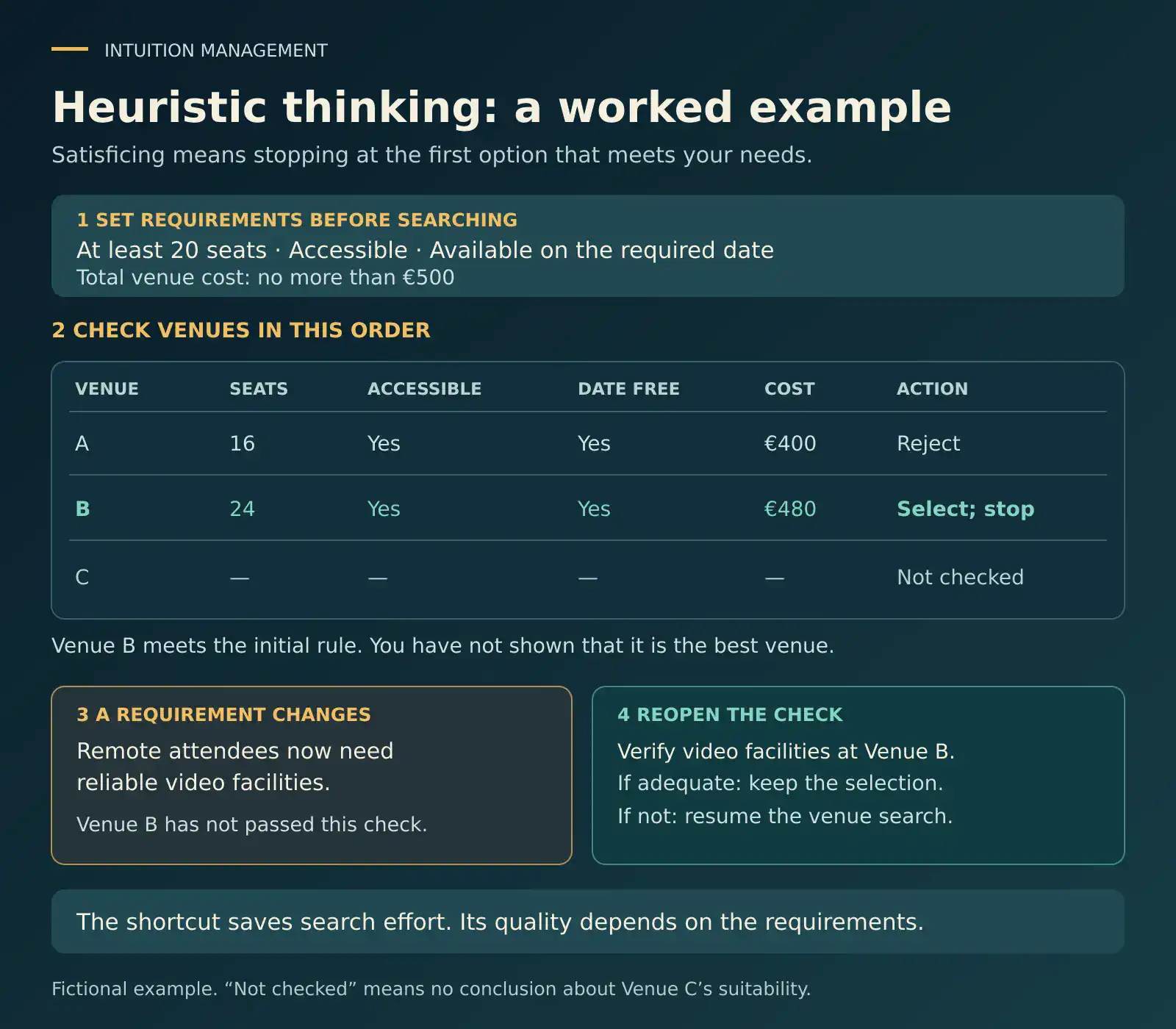
Now remote attendees join the meeting. Reliable video facilities become necessary. The earlier selection did not verify this requirement, so it needs another check. If B meets the new need within the budget, retain it. If it does not, resume searching using the updated requirements.
The useful lesson is to record why a choice qualified. “We liked B” gives little guidance when circumstances change. “B met capacity, accessibility, date, and budget requirements” makes the missing video check visible.
Five questions before relying on a shortcut
Use this editorial checklist to examine a real decision. It is a reflection aid, not a validated psychological assessment or a score predicting accuracy.
- What cue or rule is driving this judgment? Name the relevant signal or stopping condition. If you cannot identify it, treat your explanation as tentative.
- Why should it work here? Look for relevant evidence, rather than relying solely on familiarity or confidence.
- What important information am I ignoring? Check requirements, base rates, and exceptions that could change the answer.
- What would happen if it were wrong? Consider consequences and reversibility when deciding how much verification is appropriate.
- What evidence would make me revise it? Specify a reason to reopen the decision and how you will notice it.
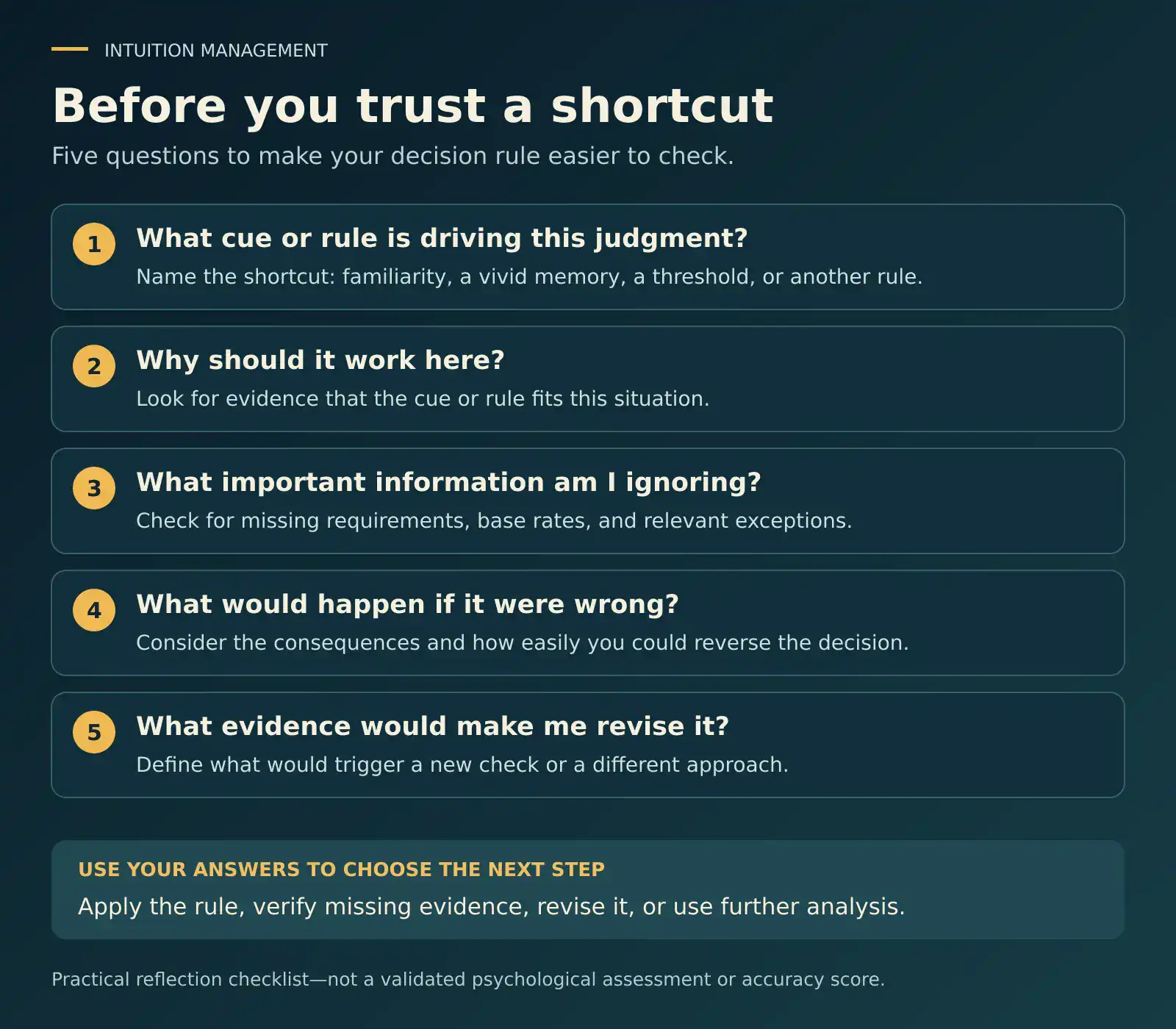
Use the answers to choose a next step: apply the rule, obtain missing evidence, revise the rule, or use further analysis. A useful decision note can be short: “I chose this option because it meets these conditions; I will reconsider if this changes.”
Turn the answers into a next step
| What you find | Next step | Venue example |
|---|---|---|
| The rule fits and requirements are verified | Apply the rule | Select the qualifying venue |
| A relevant fact is unknown | Verify the missing evidence | Test the video facilities |
| A requirement or context has changed | Revise the rule | Add remote-participation needs |
| Important trade-offs or costly uncertainty remain | Analyze further | Compare alternatives against the unresolved needs |
These actions can be combined. Revising a rule may reveal a new fact to verify, and further analysis may produce a better stopping condition.
Related: Cognitive Reflection Test: Questions, Answers, and Limits
Frequently asked questions
Is heuristic thinking the same as intuition?
No. A heuristic is a simplifying strategy. Intuition is a rapid impression or judgment that can arise without explicit reasoning. A heuristic may contribute to an intuitive judgment, and some heuristics are used deliberately.
Are heuristics always biased?
No. They can support useful decisions or contribute to error. Their value depends on the task, the information used, and the information omitted. Calling a strategy a shortcut does not establish that it is inaccurate.
Can you use a heuristic consciously?
Yes. Setting minimum requirements and choosing the first qualifying option is a deliberate use of satisficing. Other heuristics may influence judgment without conscious selection.
What is the difference between a heuristic and an algorithm?
An algorithm is a specified procedure. A heuristic emphasizes simplification or a practical search strategy without a general guarantee of an optimal result. These categories can overlap: a heuristic such as take-the-best can be implemented as an algorithm.
When should you check a shortcut with further analysis?
Check when its relevance is uncertain, important information is missing, circumstances have changed, or the consequences of error warrant more verification. Further analysis should address the uncertainty that matters rather than merely increase the amount of information collected.
Make the shortcut visible
Heuristic thinking becomes easier to evaluate when you can explain the rule and its limits. Before your next decision, name the shortcut, identify one important omission, and write down what would make you reconsider.
For a deeper look at how these strategies relate to rapid impressions, continue with intuition vs heuristics.
Research references
- Tversky, A., & Kahneman, D. (1974). Judgment under Uncertainty: Heuristics and Biases. Science, 185, 1124–1131.
- Gigerenzer, G., & Gaissmaier, W. (2011). Heuristic decision making. Annual Review of Psychology, 62, 451–482.
- Goldstein, D. G., & Gigerenzer, G. (2002). Models of ecological rationality: the recognition heuristic. Psychological Review, 109, 75–90.
- Slovic, P., Finucane, M. L., Peters, E., & MacGregor, D. G. (2007). The affect heuristic. European Journal of Operational Research, 177, 1333–1352.
- Gigerenzer, G., & Goldstein, D. G. (1996). Reasoning the fast and frugal way: models of bounded rationality. Psychological Review, 103, 650–669.
- Simon, H. A. (1955). A Behavioral Model of Rational Choice. The Quarterly Journal of Economics, 69, 99–118.