
Sometimes an answer appears before the explanation. You notice a familiar pattern, sense that a project is drifting, choose a promising direction, or recognize that something does not fit—then only later find the words for why. That is the territory of intuitive reasoning: rapid inference built from patterns, experience, context, and learned regularities.
Intuitive reasoning is the rapid formation of an inference, judgment, prediction, or conclusion without consciously working through every intermediate step. It often draws on learned patterns and implicit knowledge, so the result may enter awareness before the reasoning behind it can be fully explained.
Example: an experienced manager may sense that a project is drifting before consciously identifying the individual warning signs that produced the judgment.
Intuitive reasoning is not automatically wise, irrational, mystical, or biased. Sometimes it is expert pattern recognition operating efficiently. Sometimes it is a shortcut built on weak assumptions. The practical skill is not simply “trust your gut.” It is learning when an intuitive conclusion is likely to contain useful information, when it needs verification, and how feedback can improve it over time.
What is intuitive reasoning?
Intuitive reasoning is a way of reaching a conclusion without consciously rehearsing the full chain of logic that produced it. The mind detects cues, relates them to prior patterns, and generates an interpretation or prediction quickly. You may experience the result as recognition, confidence, unease, a sense of direction, or simply an answer that seems to arrive “all at once.”
This is closely related to intuitive thinking, but the terms are not identical. Intuitive thinking is the broader cognitive mode: fast, associative, largely automatic processing. Intuitive reasoning is narrower. It describes what happens when that processing produces an inference—for example, “this option is more promising,” “this pattern will probably continue,” or “something about this situation does not fit.”
Psychologists Erik Dane and Michael Pratt (2007) described intuition as judgments arising through rapid, nonconscious, holistic associations. Dual-process research likewise distinguishes fast, autonomous processing from slower, controlled reasoning, while cautioning against treating the two as completely separate systems or assuming that fast thinking is always wrong (Evans & Stanovich, 2013).
A useful distinction: intuitive reasoning does not mean reasoning without information. It means that much of the information processing occurs outside conscious step-by-step awareness.
How intuitive reasoning works
A simplified model of intuitive reasoning looks like this:
Cues → pattern recognition → prediction → intuitive judgment → conscious explanation.
First, the brain registers details in the environment: tone of voice, timing, deviations from a familiar process, visual structure, repeated behavior, contextual signals, or subtle combinations of information. Many of these cues never become the focus of conscious attention.
Next, current cues are compared with patterns built from previous experience. When a match is strong enough, the mind can generate an expectation about what is happening or what is likely to happen next. The resulting judgment may reach awareness before you can articulate which cues mattered.
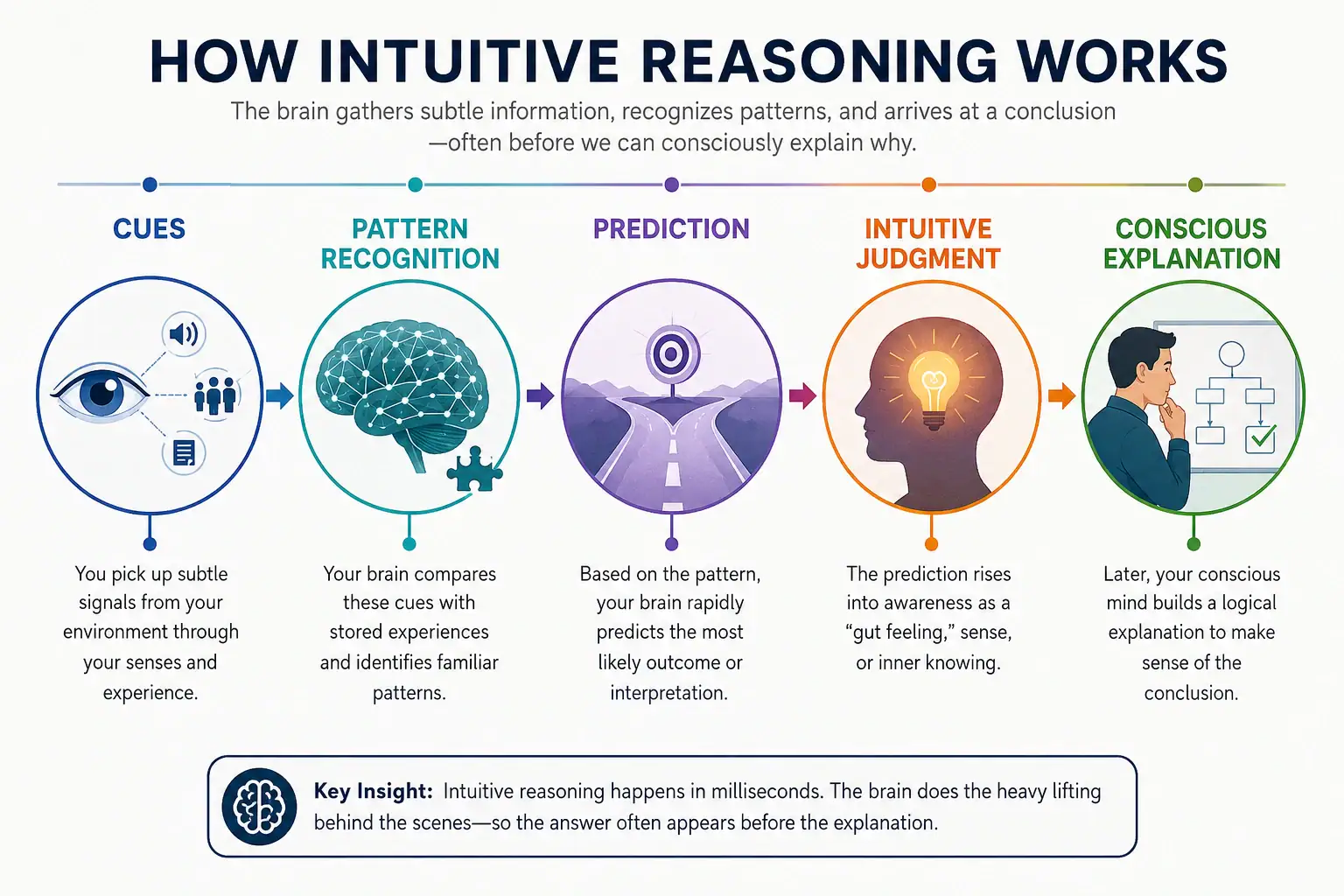
This pattern-matching idea is central to naturalistic decision-making research. Gary Klein’s recognition-primed decision model (Klein, 1998), developed from observations of experienced decision-makers such as fireground commanders, explains how experts can recognize a familiar situation and generate a workable action without comparing a long list of alternatives. The expert may still mentally simulate whether the first option will work, but pattern recognition narrows the search dramatically.
That is also why experience matters. Experience does not merely give you more facts to remember. Under the right conditions, it changes what you notice and how quickly meaningful configurations become recognizable.
Intuitive reasoning examples
The easiest way to understand intuitive reasoning is to see what it looks like in practice. These examples are not proof that the intuition is correct; they show the form the reasoning can take.
1. Project risk
A manager notices that status reports look normal but several small coordination signals resemble earlier projects that later slipped. The judgment “this delivery is at risk” appears before a complete causal explanation.
2. Chess
An experienced player looks at a position and quickly senses that one side is strategically weak. Years of pattern exposure compress many relationships into rapid recognition.
3. Conversation
You hear a familiar shift in pacing, wording, and tone and infer that the other person is uncomfortable, even though no single cue would be decisive by itself.
4. Editing
An experienced editor reads a paragraph and immediately feels that the argument is not flowing. Only after rereading can they identify the exact transition or assumption that caused the problem.
5. Driving
You notice a vehicle moving in a way that resembles previous unsafe lane changes and create extra distance before the driver actually moves across.
6. Hiring interview
A candidate’s answer seems inconsistent with the rest of the conversation. Instead of treating the feeling as a verdict, the interviewer uses it as a signal to ask a more specific follow-up question.
7. Creative work
Several ideas suddenly combine into a promising concept. The creator cannot initially explain every connection, but the new configuration feels worth exploring.
8. Prioritization
A team lead quickly recognizes which issue is likely to become the bottleneck because the situation resembles a pattern seen repeatedly across previous releases.
For more concrete cases across work and everyday life, see intuitive thinking examples. The important point is that intuitive reasoning usually compresses multiple cues into a single interpretation rather than consciously evaluating each cue one at a time.
Intuitive reasoning vs analytical reasoning
Intuitive and analytical reasoning are best understood as complementary modes, not enemies. Intuition can generate a rapid candidate answer; analysis can examine assumptions, quantify trade-offs, compare alternatives, and test whether the candidate survives scrutiny.
| Dimension | Intuitive reasoning | Analytical reasoning |
|---|---|---|
| Speed | Often rapid | Usually slower |
| Awareness | Much processing may occur outside awareness | Steps are more consciously accessible |
| Information use | Integrates patterns and contextual cues holistically | Separates variables and examines evidence deliberately |
| Mental effort | Often relatively effortless | Uses attention and working memory |
| Explainability | Reason may be difficult to verbalize immediately | Reasoning chain is usually easier to articulate |
| Best conditions | Familiar, learnable domains with meaningful experience | Novel, complex, high-stakes, or explicitly quantitative problems |
| Main risk | Bias, false pattern recognition, overconfidence | Overanalysis, delay, false precision, excessive complexity |
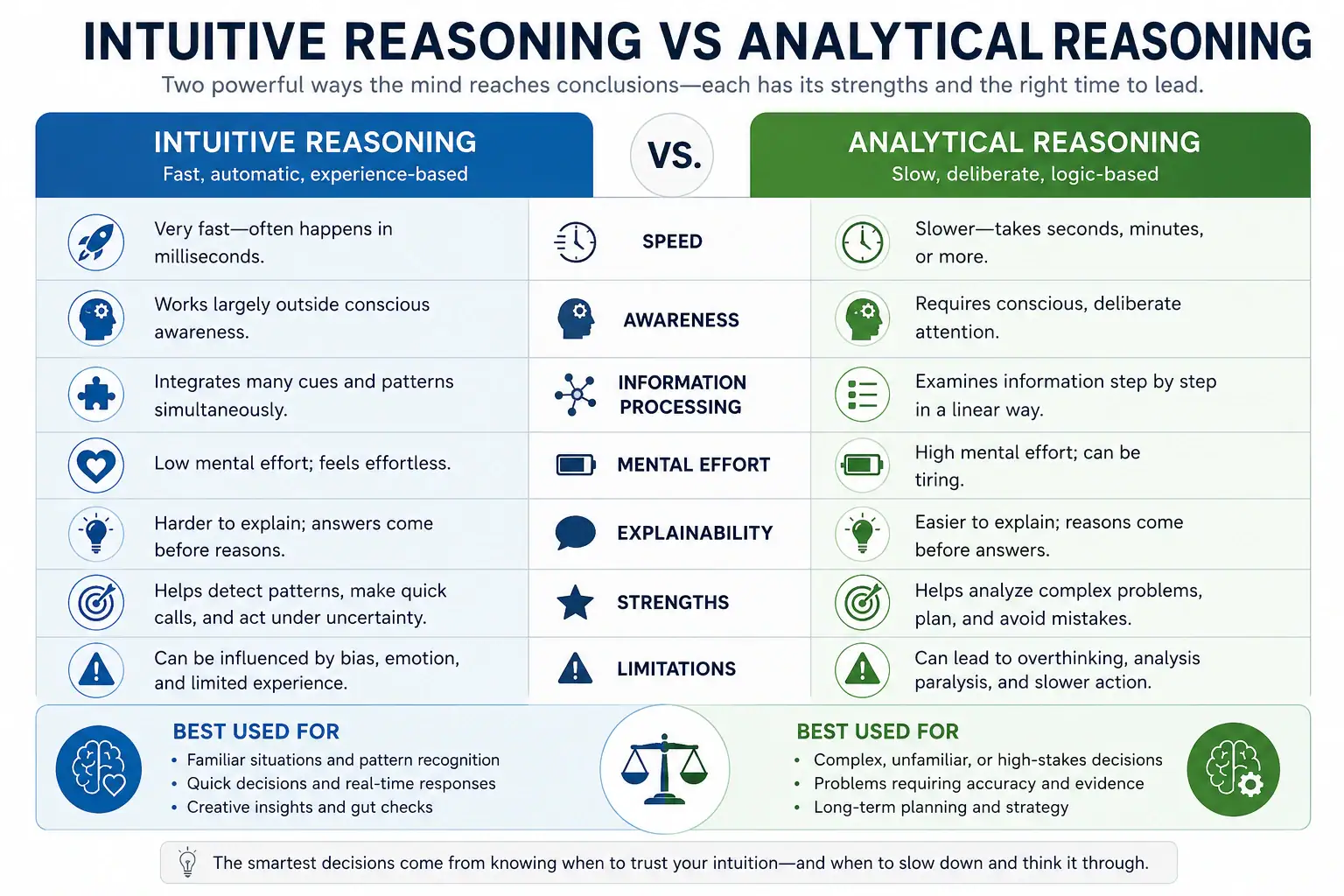
The common mistake is assuming that one mode is inherently superior. In some tasks, deliberate calculation is indispensable. In others, experienced pattern recognition can be remarkably efficient. Research on expert decision-making repeatedly suggests that the quality of the environment and the quality of learning matter more than a simple “intuition versus logic” slogan.
Intuitive reasoning vs intuitive thinking
Intuitive thinking is the broader process of rapidly perceiving meaning, relationships, or possibilities. Intuitive reasoning is what happens when those impressions support a conclusion, prediction, or judgment.
You might intuitively think that a room feels tense. That is a broad perception. You use intuitive reasoning when you infer, “the meeting is unlikely to produce agreement unless someone changes the framing.” The second statement moves from perception toward a conclusion about what the pattern means.
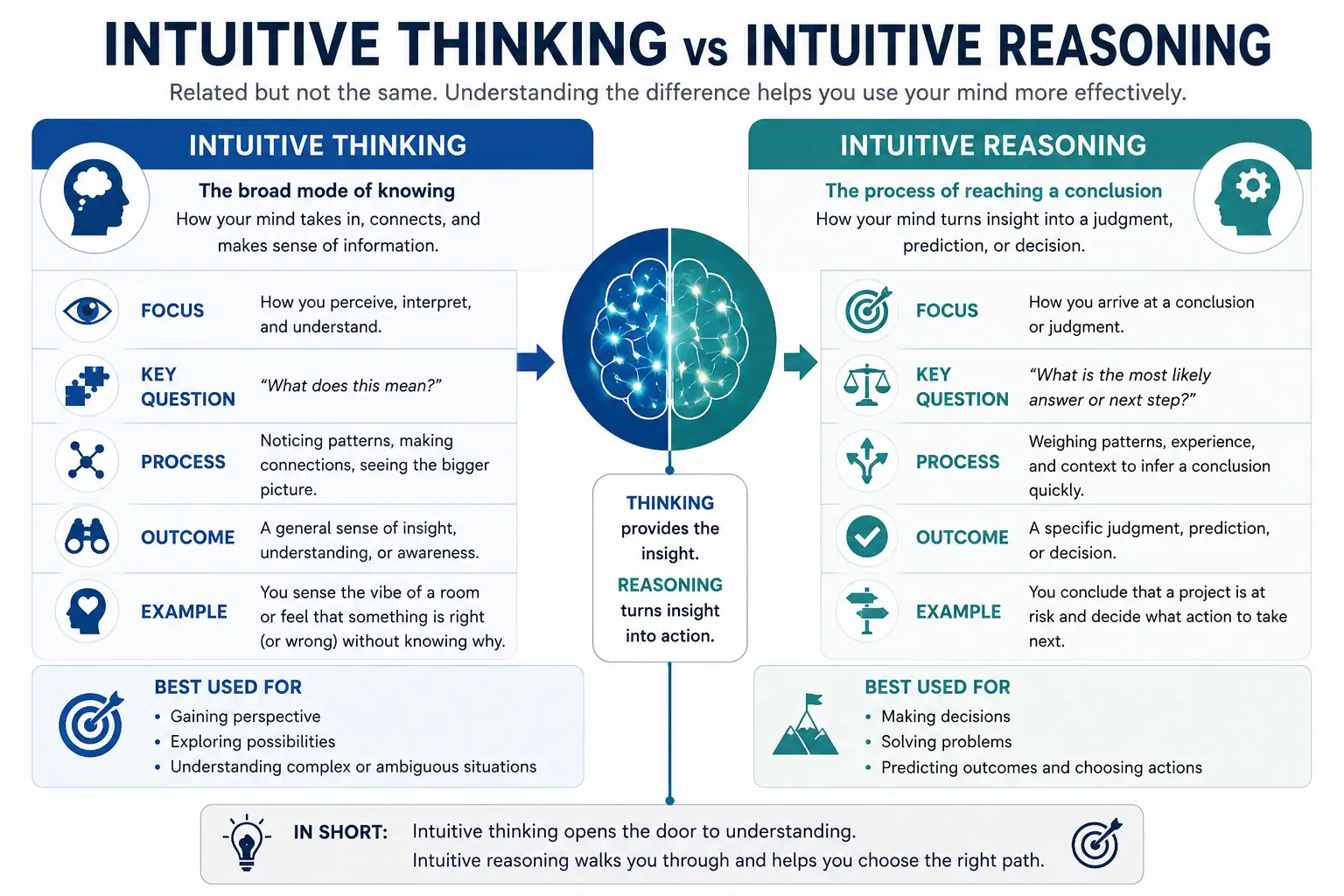
This distinction keeps the concepts useful. If every fast impression is called “reasoning,” the term becomes too broad. If reasoning is defined only as consciously verbalized logic, we miss how trained pattern recognition can contribute to real decisions before explanation becomes explicit.
Intuition vs heuristics vs instinct vs impulse
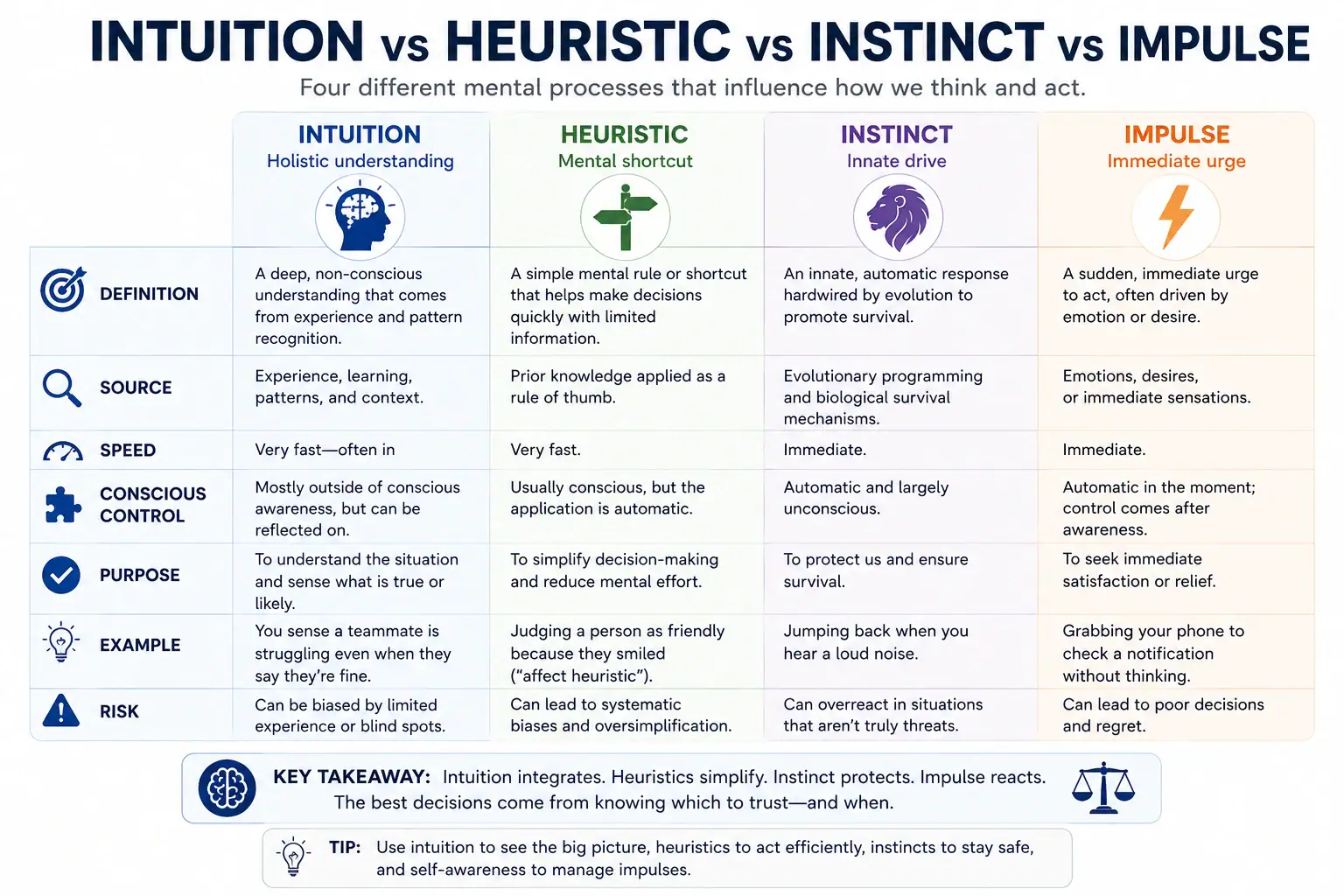
These concepts overlap in everyday language, but they are not interchangeable.
- Intuition often integrates learned patterns, context, and experience into a rapid impression or judgment.
- A heuristic is a simplifying rule or strategy that reduces cognitive effort. Some heuristics operate automatically; others can be consciously applied.
- Instinct refers more strongly to biologically prepared tendencies and automatic responses, although real behavior usually reflects learning as well as biology.
- Impulse is an urge to act, often driven by immediate reward, emotion, or salience. It does not require a meaningful inference about the situation.
For a deeper comparison, see intuition vs heuristics, intuition vs instinct, and intuition vs impulse.
Is intuitive reasoning logical?
It can be. The fact that you cannot immediately describe a reasoning chain does not prove that no valid processing occurred. A person can learn relationships so thoroughly that the correct response becomes available rapidly and with little conscious effort.
In a series of reasoning experiments, Boissin et al. (2021) found that training could improve performance at the initial intuitive stage, not only during later deliberation. Participants sometimes learned to produce the correct response from the outset rather than first generating a biased answer and then correcting it. That matters because it challenges the simplistic equation intuition = error, deliberation = correction.
But the opposite simplification is equally dangerous. Feeling certain does not prove that an intuition is logical. Daniel Kahneman and Gary Klein (2009), approaching intuition from different research traditions, agreed on a crucial boundary condition: skilled intuition is more likely when the environment contains learnable regularities and the person has had enough opportunity to learn those regularities through meaningful feedback.
Confidence is not calibration. A judgment can feel immediate and compelling even when the environment is noisy or the person has received poor feedback. Subjective certainty alone is not evidence of accuracy.
When is intuitive reasoning reliable?
Intuitive reasoning becomes more credible when several conditions are present at the same time:
- Relevant experience: you have repeatedly encountered comparable patterns.
- A learnable environment: the domain contains enough regularity for patterns to predict outcomes.
- Reliable feedback: you discover whether previous judgments were right or wrong.
- Repeated domain-specific practice: experience has been active enough to refine discrimination, not merely accumulate years.
- Meaningful cues: the signals you are using actually relate to the outcome.
- Reasonable emotional regulation: intense fear, excitement, anger, or social pressure is not dominating interpretation.
This is why intuition can be excellent in one domain and poor in another. Someone may have finely calibrated intuition about software delivery risks after years of feedback-rich work yet have no special intuitive advantage when forecasting an unfamiliar market, evaluating a medical symptom, or predicting a random event.
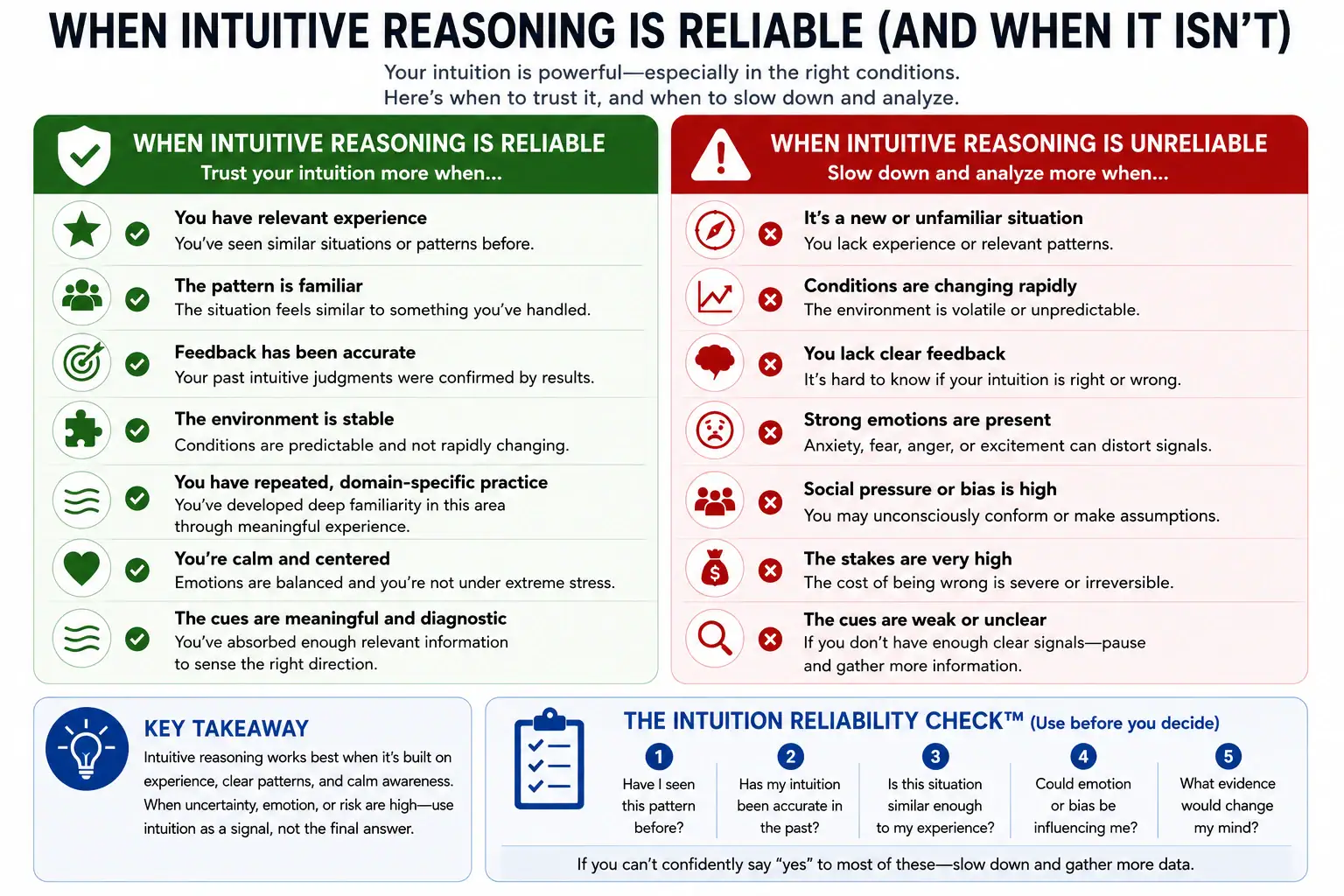
The broader lesson is consistent with pattern recognition under uncertainty: intuition is most useful when the pattern library in your head has been built in an environment that actually rewards learning.
When intuitive reasoning fails
Intuitive reasoning can fail for several different reasons, and those reasons should not be collapsed into one vague idea of “bias.”
1. The pattern is familiar—but misleading
The current situation resembles a past one in superficial ways, so an old response is triggered even though an important variable has changed. Familiarity can create false confidence.
2. The environment is too noisy to learn
If outcomes depend heavily on chance, hidden variables, or constantly changing conditions, experience may not produce reliable intuitive expertise. Repetition alone is not enough.
3. Feedback is delayed, incomplete, or distorted
You can only calibrate a prediction if you eventually discover what happened and connect the result to the original judgment. Without that loop, confidence can grow while accuracy stays flat.
4. Emotion changes what you notice
Strong emotion can alter attention and interpretation. Fear may amplify threat cues; excitement may suppress warning signs; a desire for a particular outcome may make supporting evidence feel more persuasive than it deserves.
5. Cognitive bias is mistaken for expertise
Anchoring, confirmation bias, availability, stereotyping, and motivated reasoning can all produce fast conclusions. The speed of a judgment does not tell you which mechanism produced it. This is why it helps to understand mental models vs cognitive biases: learned models can guide fast judgment, while bias can distort which cues are noticed, weighted, or remembered.
Intuitive reasoning vs overthinking
Overthinking is not simply “using analysis.” Good analysis adds information, tests assumptions, narrows uncertainty, or improves the decision. Overthinking repeatedly processes the same uncertainty without a proportional increase in useful evidence.
A practical distinction is convergence versus repetition. Intuitive reasoning tends to produce a candidate interpretation quickly. Productive analysis can then confirm, modify, or reject it. Overthinking keeps reopening the question without a clear stopping rule.
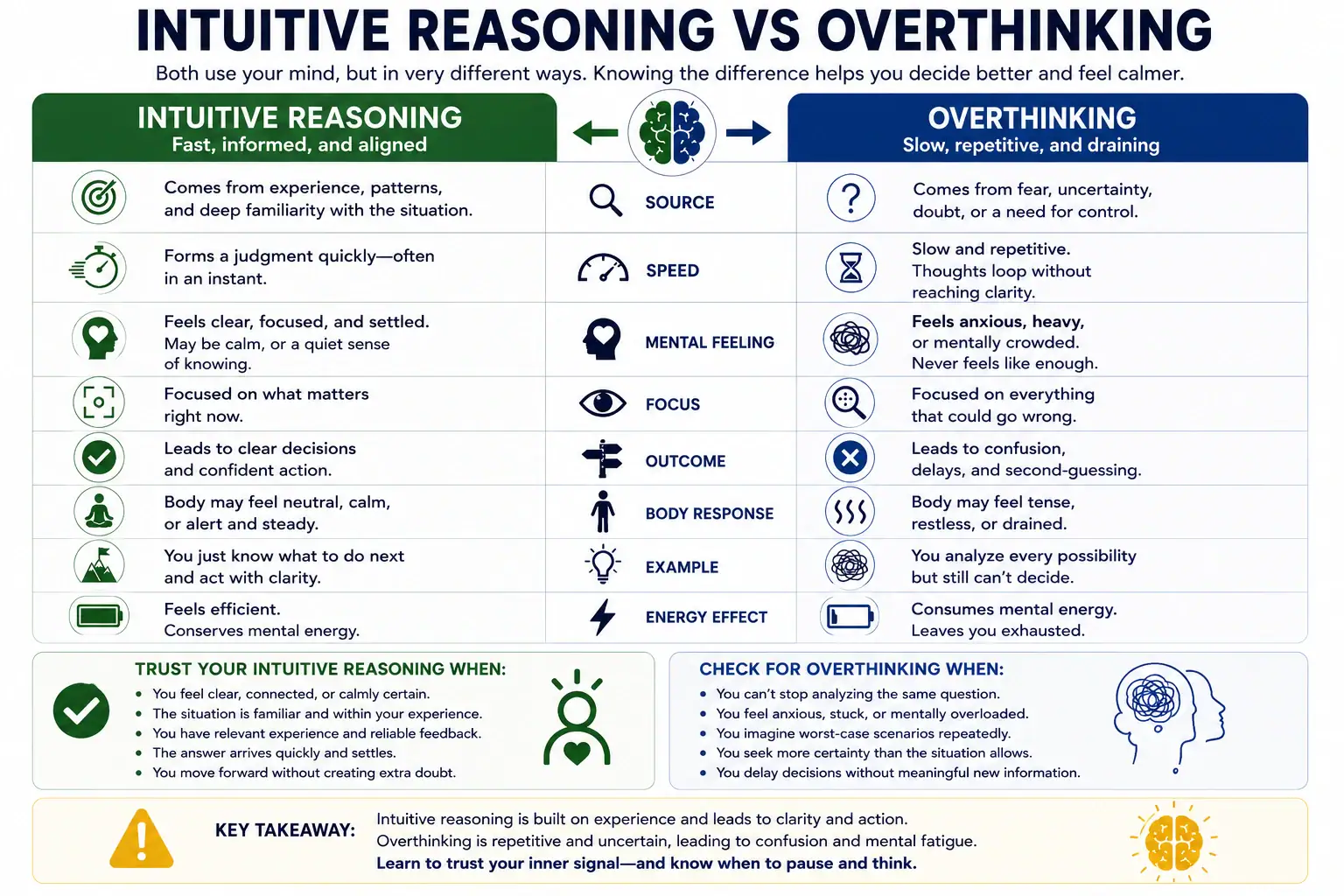
If thinking longer is making you less certain rather than more informed, why you feel less certain the more you think explores that mechanism in more depth.
The Intuition Reliability Check
Instead of asking only, “Do I trust my intuition?”, ask whether the conditions that produced the intuition deserve trust. Use these five questions before acting on an important intuitive judgment:
- Have I seen this pattern before?
Look for relevant, domain-specific experience rather than vague familiarity. - Has my intuition been accurate in this kind of situation?
Remember outcomes, not just moments when your hunch felt impressive. - Is this situation similar enough to my previous experience?
Identify what is different, especially variables that could break the pattern. - Could emotion, incentive, social pressure, or bias be influencing me?
Ask what you want to be true and whether that desire changes what you notice. - What evidence would change my mind?
If the answer is “nothing,” you are no longer testing a judgment; you are defending one.
You do not need a perfect “yes” to all five questions. The purpose is to decide how much verification the judgment needs. A familiar, reversible decision with good feedback may justify acting quickly. A novel, irreversible decision should demand more evidence.
How to improve intuitive reasoning
The most useful way to train intuition is not to become more sensitive to every feeling. It is to improve the quality of the learning loop behind your judgments.
1. Make predictions explicit
Before the outcome is known, write down what you think will happen and why. Even a short note prevents hindsight from rewriting the original judgment.
2. Record confidence
Add a rough confidence estimate: 60%, 75%, 90%. Over time, compare confidence with actual accuracy. Calibration matters more than certainty.
3. Seek fast, accurate feedback
Where possible, shorten the distance between decision and outcome. Expert intuition develops more readily when people can see whether their predictions worked and adjust accordingly.
4. Study misses, not only successes
A correct intuition can occur for the wrong reason. An incorrect one may reveal a cue you overweighted, a change you missed, or a mental model that no longer fits.
5. Separate domains
Do not generalize expertise too freely. Being excellent at reading project risk does not automatically make you excellent at reading people, markets, relationships, or future events.
6. Build the pattern library deliberately
Compare cases, look for discriminating cues, study near misses, and ask experienced practitioners what signals they notice. For a broader training approach, see how to train your intuition.
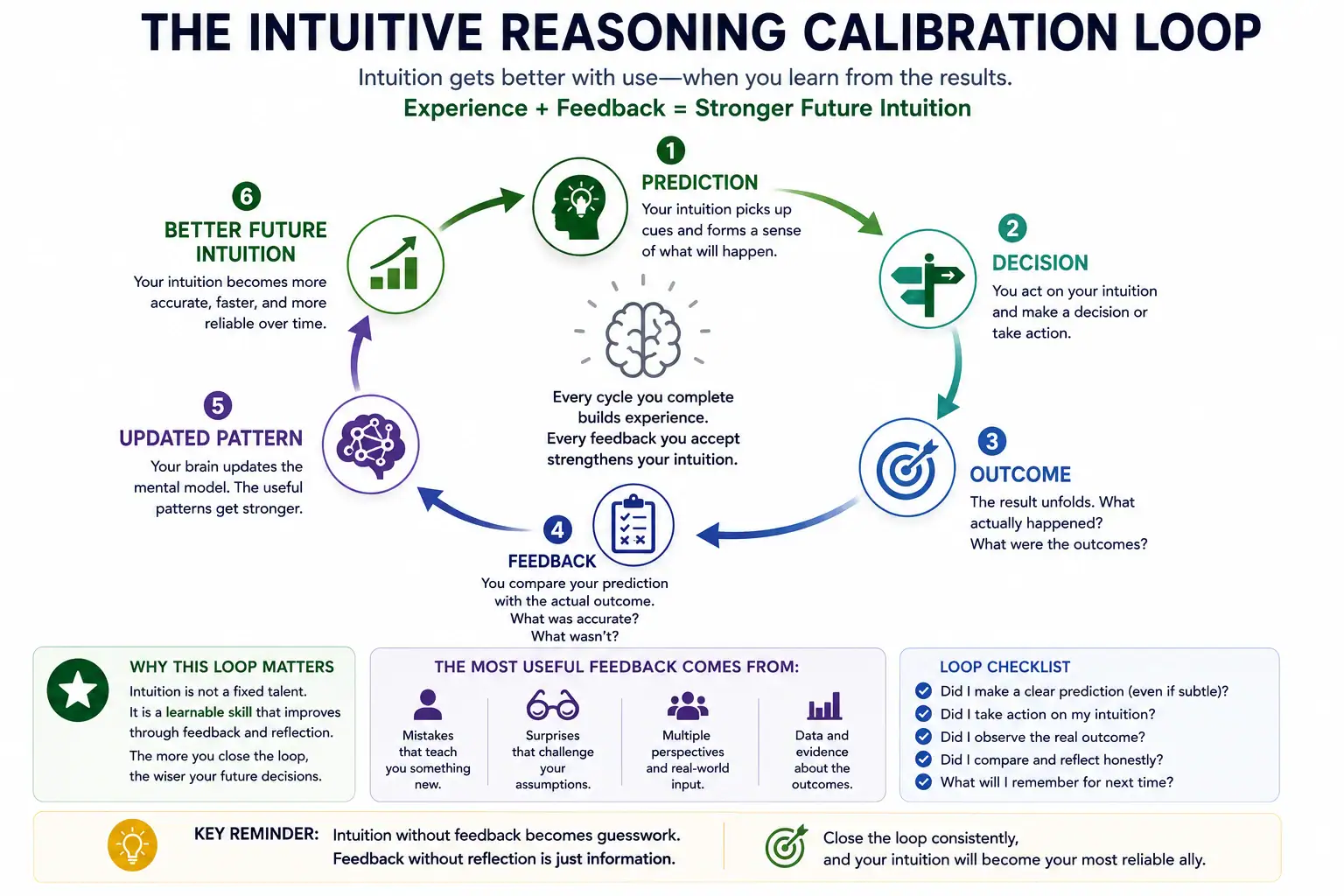
The calibration loop is simple:
Prediction → Decision → Outcome → Feedback → Updated Pattern → Better Future Intuition.
The quality of the loop matters more than the number of repetitions. Ten years of ambiguous experience can teach less than one year of deliberate practice with clear feedback.
When should you switch from intuition to analysis?
Use intuition as an input rather than the final answer when one or more of these conditions are present:
- the situation is novel or structurally different from your experience;
- the decision is difficult or costly to reverse;
- the stakes are high for other people;
- the environment changes rapidly;
- the judgment depends on precise quantities or probabilities;
- you have strong incentives to prefer one conclusion;
- independent evidence conflicts with your first impression;
- you cannot identify any mechanism by which your experience could have taught you the relevant pattern.
A good hybrid sequence is:
- Notice the intuitive judgment. What answer arrived first?
- Interrogate its basis. What pattern might you be recognizing?
- Test the fragile assumptions. What would make the intuition wrong?
- Match analysis to reversibility. The harder the decision is to undo, the more evidence you should require.
- Act, then close the feedback loop. Learn from what actually happens.
This approach avoids two bad extremes: obeying every gut feeling and distrusting every fast judgment. The goal is calibrated intuition—knowing where your rapid reasoning has earned confidence and where uncertainty should trigger deliberate analysis.
Related: What Is Intuitive Thinking? · Intuitive Thinking Examples · Intuitive Processing · Types of Intuition
Frequently asked questions about intuitive reasoning
What is intuitive reasoning?
Intuitive reasoning is the rapid formation of a conclusion, prediction, or judgment without consciously working through every intermediate step. It commonly draws on patterns learned from experience and context.
What is an example of intuitive reasoning?
An experienced project manager may notice several subtle coordination signals and quickly infer that a delivery is at risk before being able to explain every cue. The intuition should then be checked against evidence rather than treated as proof.
What is the difference between intuitive and analytical reasoning?
Intuitive reasoning is typically faster, more associative, and less consciously step-by-step. Analytical reasoning is slower and uses deliberate attention to inspect assumptions, evidence, alternatives, and logical relationships.
Is intuitive reasoning logical?
It can be. A conclusion may be logically or factually correct even if the person cannot immediately verbalize how it was reached. But subjective certainty does not guarantee accuracy, so important intuitions still need calibration and verification.
Is intuitive reasoning the same as intuition?
Not exactly. Intuition is the broader category of rapid, nonconscious impressions or judgments. Intuitive reasoning specifically describes the use of that rapid processing to form an inference, prediction, or conclusion.
Is intuitive reasoning the same as a heuristic?
No. A heuristic is a simplifying rule or strategy. Intuitive reasoning may involve heuristics, but it can also integrate complex patterns built from domain experience without relying on one identifiable shortcut.
Why does an answer sometimes appear before I know why?
Pattern recognition can integrate cues outside conscious awareness and make a conclusion available before the underlying cues have been translated into words. Later reflection may reconstruct part of the reasoning, but not always all of it.
Can intuitive reasoning be learned?
Yes, especially in domains with learnable regularities and reliable feedback. Practice, explicit prediction, outcome review, and correction can make useful patterns easier to recognize rapidly.
When should I trust intuitive reasoning?
Trust it more when you have relevant experience, the environment is reasonably stable, cues are meaningful, and you have received reliable feedback on similar judgments. Trust it less in unfamiliar, volatile, emotionally loaded, or high-stakes situations.
Can intuitive reasoning be wrong?
Yes. Familiarity, bias, emotion, misleading feedback, and random environments can all produce compelling but inaccurate judgments. Intuition is a source of information, not an automatic guarantee of truth.
The goal is not more intuition. It is better-calibrated intuition.
Intuitive reasoning is one of the ways the mind converts experience into speed. It allows learned patterns to shape judgments before every step is consciously available. That can make decision-making efficient, creative, and responsive—but only when the patterns behind the judgment deserve trust.
The strongest intuitive reasoners are not people who obey every inner signal. They learn where their experience is deep, where feedback is reliable, where bias is likely, and when a decision deserves a slower second pass.
If you want to map the broader landscape, continue with types of intuition or explore how mental models shape decisions. The practical objective is the same: make your internal patterns more visible, testable, and useful.
Research foundation
This article uses a practical synthesis of research on intuition, dual-process cognition, expertise, naturalistic decision-making, and reasoning. Key references include:
- Dane, E., & Pratt, M. G. (2007). Exploring Intuition and Its Role in Managerial Decision Making. Academy of Management Review, 32(1), 33–54. DOI: 10.5465/AMR.2007.23463682.
- Klein, G. (1998). Sources of Power: How People Make Decisions. MIT Press.
- Kahneman, D., & Klein, G. (2009). Conditions for Intuitive Expertise: A Failure to Disagree. American Psychologist, 64(6), 515–526. DOI: 10.1037/a0016755.
- Evans, J. St. B. T., & Stanovich, K. E. (2013). Dual-Process Theories of Higher Cognition: Advancing the Debate. Perspectives on Psychological Science, 8(3), 223–241. DOI: 10.1177/1745691612460685.
- Boissin, E., Caparos, S., Raoelison, M., & De Neys, W. (2021). From Bias to Sound Intuiting: Boosting Correct Intuitive Reasoning. Cognition, 211, 104645. DOI: 10.1016/j.cognition.2021.104645.
- Harteis, C., & Billett, S. (2013). Intuitive Expertise: Theories and Empirical Evidence. Educational Research Review, 9, 145–157. DOI: 10.1016/j.edurev.2013.02.001.