Intuitive thinking is fast understanding that appears before you consciously work through every step. It can draw on learned patterns, experience, context, emotional information, and subtle cues, allowing the mind to form a judgment without a visible chain of reasoning.
That does not make intuition mystical, irrational, or automatically correct. A gut feeling can reflect genuine expertise, but it can also reflect anxiety, assumptions, stereotypes, wishful thinking, or a pattern that does not actually apply. The useful question is therefore not simply “Should I trust my intuition?” It is “What produced this intuitive judgment, and how well calibrated is it for this situation?”

In this guide, we will separate intuitive thinking from instinct, emotion, and bias; examine real-world examples; compare intuition with analytical thinking; and build a practical method for deciding when an intuitive signal deserves more—or less—weight.
What Is Intuitive Thinking?
Intuitive thinking is a rapid form of judgment in which an answer, impression, or sense of direction emerges without deliberate step-by-step analysis. The judgment may feel immediate, but it can still be informed by prior learning. What is missing is not necessarily processing; what is missing is conscious access to all of that processing.
This helps explain why experienced people sometimes notice something important before they can explain exactly what they noticed. A physician may sense that a familiar presentation contains one unusual detail. A manager may recognize that a project is entering a failure pattern seen several times before. A driver may slow down before consciously identifying the behavior of another vehicle that triggered concern.
Researchers have long connected skilled intuition with pattern recognition and experience. Kahneman and Klein’s influential analysis of intuitive expertise concluded that reliable intuitive skill depends on environments with enough regularity to learn and on opportunities to learn those regularities through experience and feedback. Their 2009 paper in American Psychologist is particularly important because it also explains why subjective confidence alone is a poor test of intuitive accuracy.
If you want the broader foundation first, see what intuition really is as pattern recognition under uncertainty and the overview of the different types of intuition.
How Intuitive Thinking Works
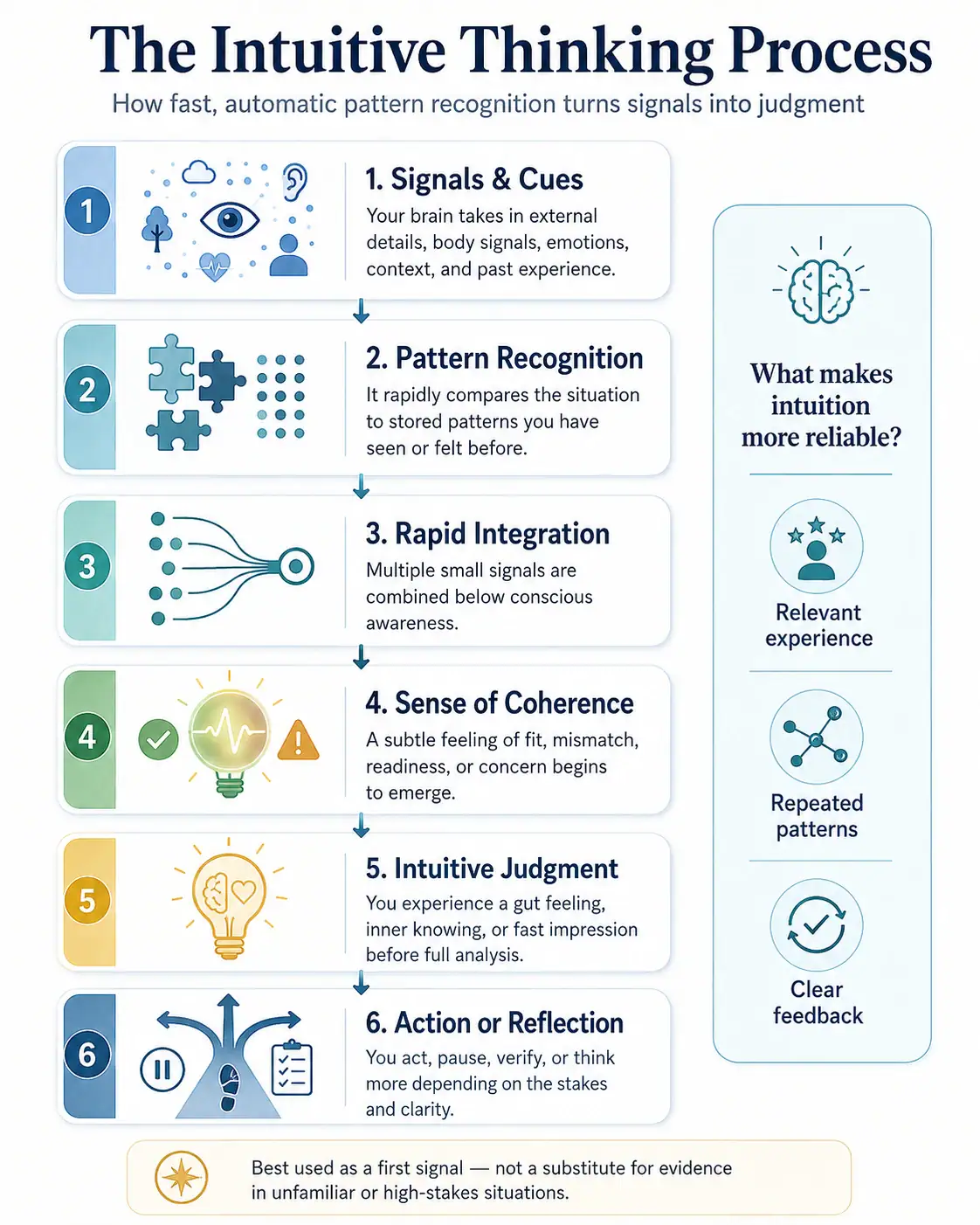
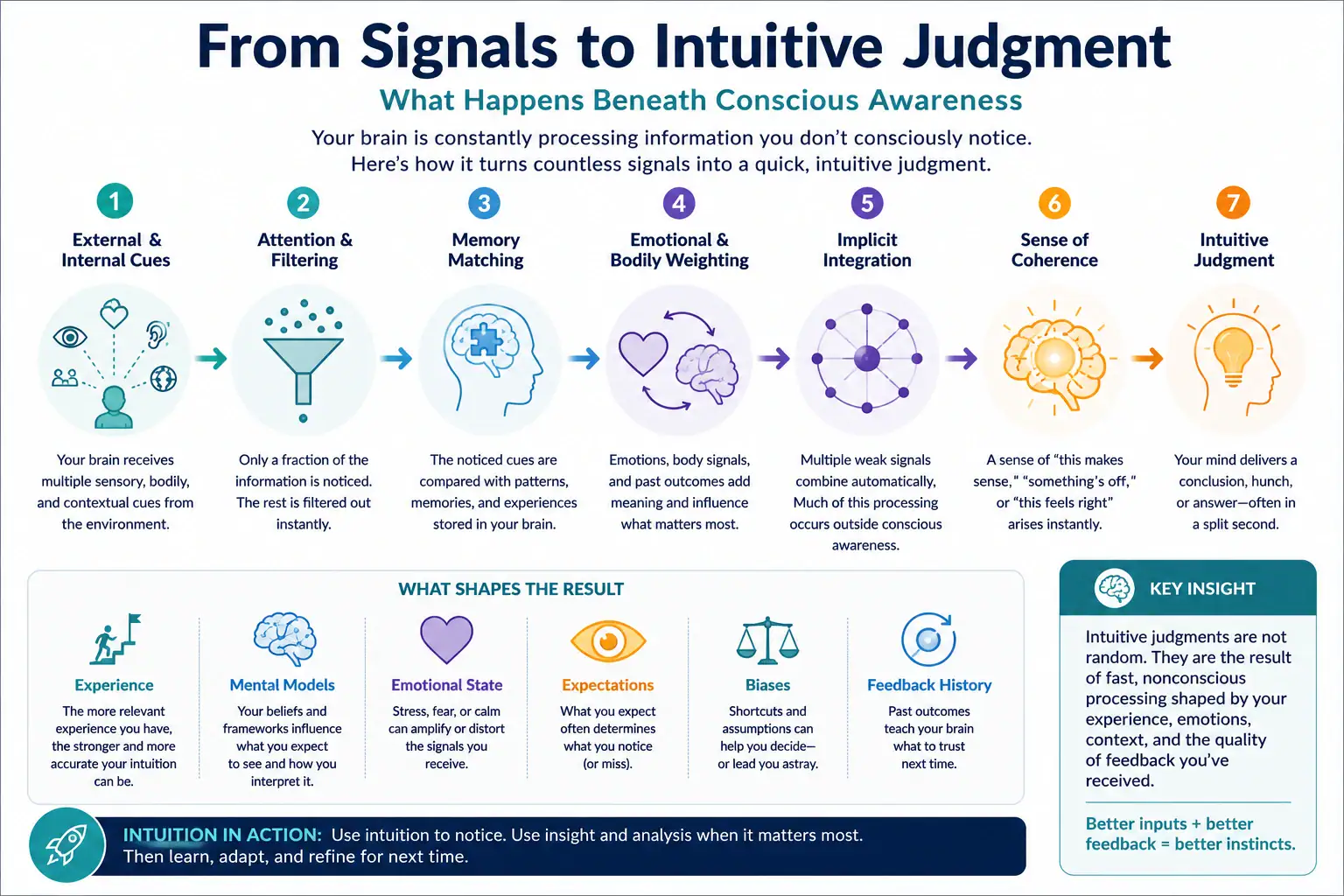
Intuition often feels like an answer arriving from nowhere. A more useful model is that the answer becomes conscious after information has already been filtered, compared, weighted, and integrated outside the narrow spotlight of deliberate reasoning.
1. You encounter external and internal cues
The raw material can include what you see and hear, timing, context, previous outcomes, another person’s behavior, your own emotional response, and bodily sensations. Attention immediately filters this stream. You do not consciously inspect every cue.
2. Current cues activate stored patterns
Past experience creates expectations about what commonly goes together. When a new situation resembles a learned pattern, recognition can happen quickly. Experimental work has shown that intuitive decision making defined as real-world pattern recognition can be developed through implicit statistical learning under appropriate training conditions. Patterson and colleagues tested this process in a simulated naturalistic decision environment.
3. Multiple weak signals can combine into coherence
One cue may mean little by itself. Several mutually consistent cues can produce a stronger sense that “this fits” or “something is off.” Research on intuitive coherence has linked the subjective feeling of intuition to fluency and affect when information forms a coherent pattern. Topolinski and Strack’s work on the architecture of intuition is one example of this approach.
4. Emotional and bodily information may influence the judgment
Intuitive judgments can also have a bodily component: tension, ease, unease, activation, or a subtle shift in feeling. Research inspired by the somatic-marker hypothesis argues that emotional and bodily states can contribute to decision processes. However, this area should not be simplified into “the body always knows first.” Classic findings have also been challenged by evidence that people may possess more consciously accessible knowledge than early interpretations suggested. Compare Bechara and colleagues’ account of emotion and decision making with Maia and McClelland’s reexamination of the evidence.
This is why somatic intuition is useful as one source of information, not as automatic proof that a conclusion is true.
7 Real-Life Examples of Intuitive Thinking
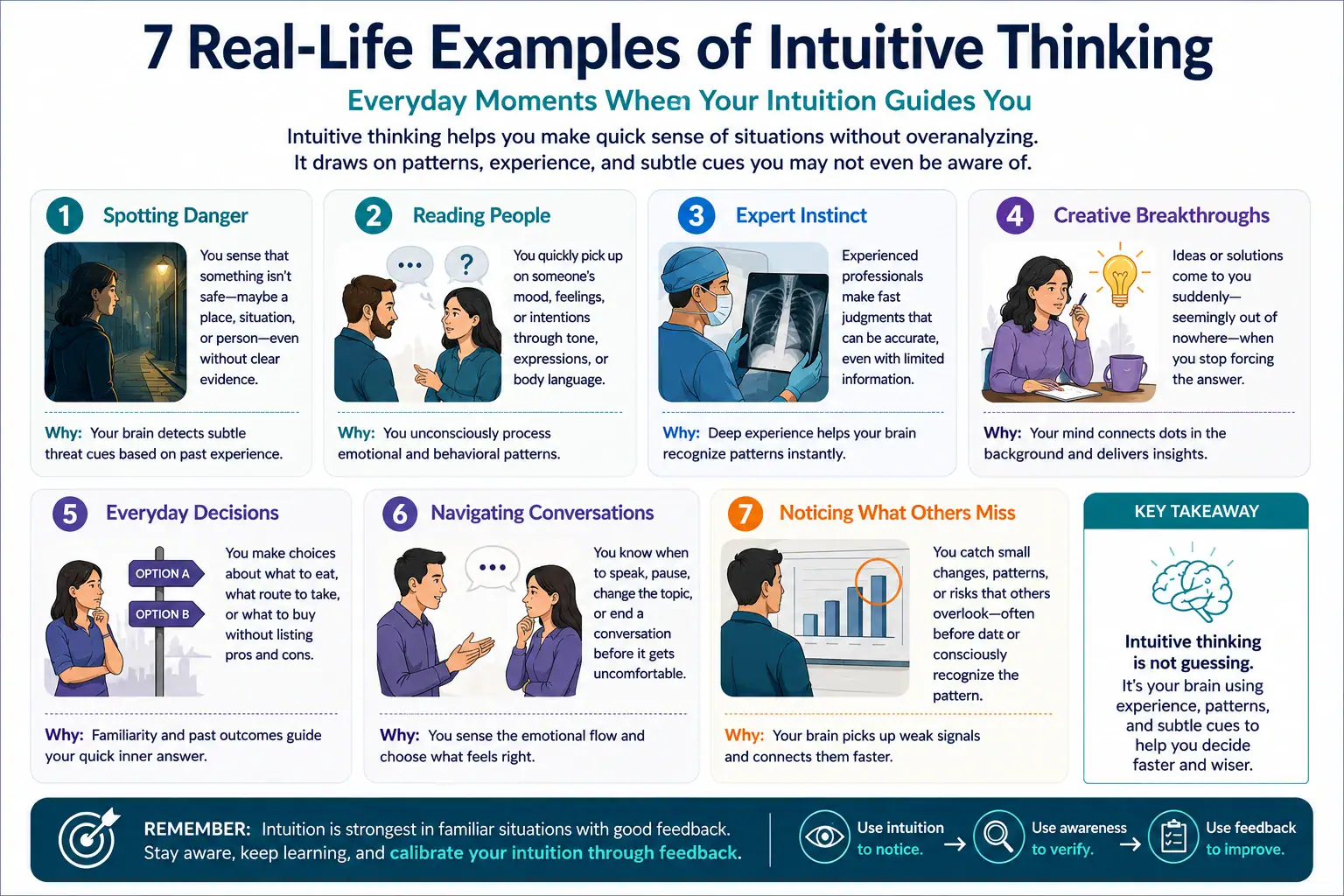
Examples make intuitive thinking easier to recognize because the same mechanism can feel very different depending on the situation.
1. Spotting danger
You sense that a situation deserves caution before you can name the exact cue. In a familiar environment, your brain may be recognizing subtle deviations from what normally happens.
2. Reading a conversation
You notice that someone’s words and tone do not quite match, or you sense that it is time to pause. The judgment may integrate timing, expression, previous interactions, and emotional context.
3. Expert judgment
An experienced professional recognizes a familiar configuration quickly. Experts do not need to consciously reconstruct every past case before a pattern becomes meaningful.
4. Creative breakthrough
An idea arrives after you have stopped forcing a solution. Prior knowledge can continue to interact outside deliberate attention until a useful connection becomes conscious.
5. Everyday choices
You choose a familiar route, meal, tool, or workflow without formally comparing every alternative. Repeated feedback has made many low-stakes decisions efficient.
6. Social timing
You know when to speak, wait, change direction, or end a conversation. The signal can reflect learned interpersonal patterns—but it can also be distorted by anxiety or assumptions.
7. Noticing an anomaly
An experienced analyst, engineer, clinician, or manager spots something that looks ordinary to a beginner. The important information is often the deviation from a deeply learned baseline.
The important theme is not “mysterious knowing.” It is that relevant cues can acquire meaning through experience. When experience is weak or the environment is misleading, the same subjective feeling can be much less dependable.
Intuitive Thinking vs Analytical Thinking
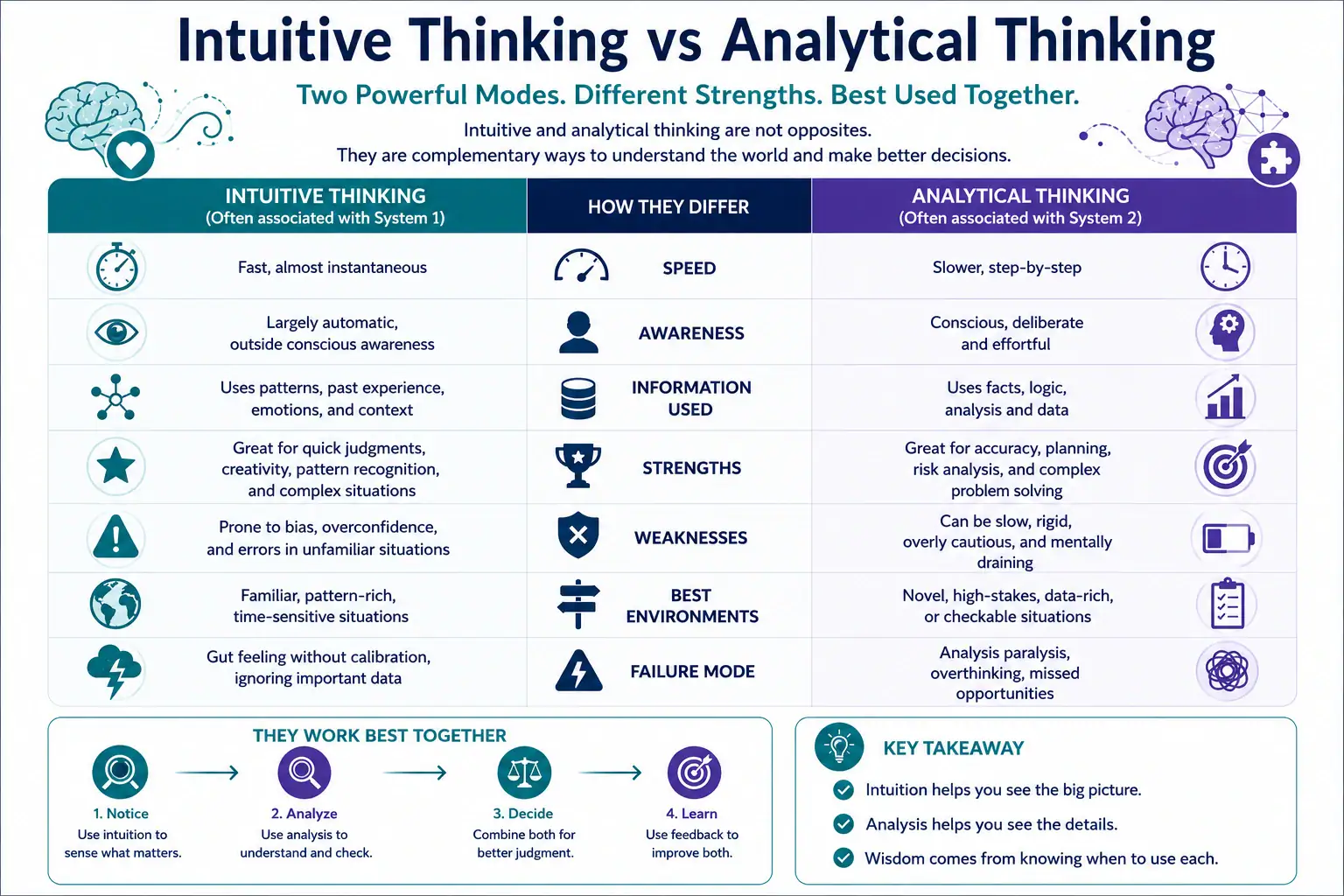
Intuitive and analytical thinking are often described as two different modes of cognition. Dual-process accounts commonly associate intuitive processing with faster, more automatic operations and analytical processing with more deliberate, effortful reasoning. But it is safer to treat these as useful tendencies rather than two completely separate machines inside the brain. In this article, intuitive reasoning means this fast, pattern-based route to a judgment, not a separate faculty from intuition.
In practical terms, intuitive thinking is usually better at generating a fast first impression from familiar patterns. Analytical thinking is better at making assumptions explicit, comparing alternatives, checking evidence, calculating consequences, and slowing a decision down when the first answer may be misleading.
Intuitive thinking
Often: fast, associative, automatic, context-sensitive.
Strongest when: the situation is familiar, pattern-rich, and time-sensitive, and you have meaningful experience.
Failure risk: bias, overconfidence, emotional contamination, false pattern recognition.
Analytical thinking
Often: deliberate, explicit, sequential, checkable.
Strongest when: the situation is novel, high-stakes, data-rich, or can be evaluated systematically.
Failure risk: analysis paralysis, overcomplication, false precision, delayed action.
The most useful approach is not to choose a permanent side. Use intuition to notice and generate a candidate judgment; use analysis to test it when the cost of being wrong justifies the effort. For a deeper comparison, see intuition vs logic and intuition in decision-making.
Intuition vs Instinct vs Emotion vs Bias
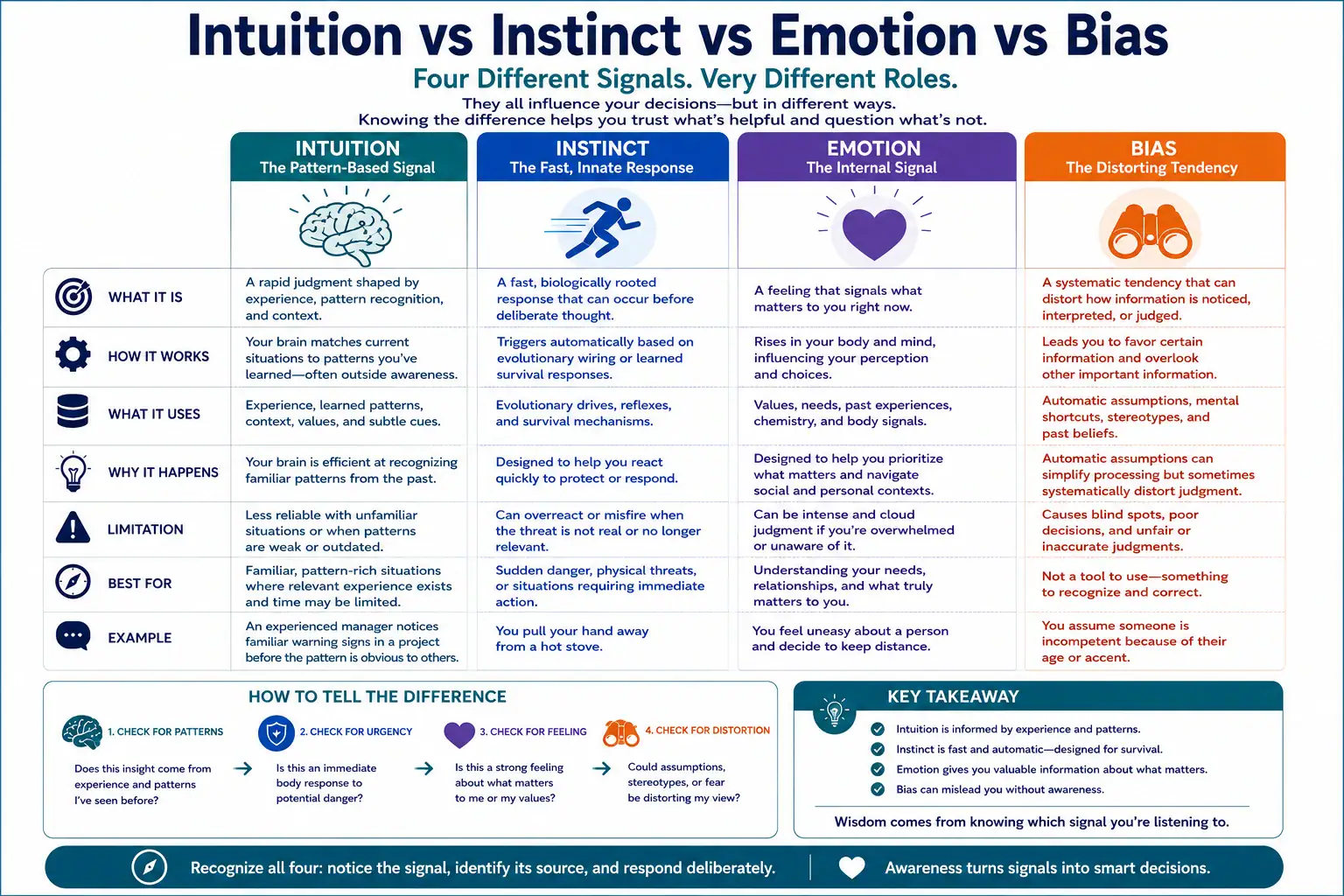
One reason people struggle to evaluate intuition is that several different experiences get called a “gut feeling.” They are related, but they are not interchangeable.
Intuition
A rapid judgment shaped by experience, learned patterns, context, and implicit integration. It can be useful when the current situation resembles patterns you have learned well.
Instinct
A biologically rooted tendency or rapid response that does not require the same kind of domain learning. Pulling away from sudden physical danger is closer to instinct than expert intuition.
Emotion
A feeling state that tells you something about significance, needs, goals, threat, reward, attachment, or meaning. Emotions carry information, but they do not automatically identify the correct action.
Bias
A systematic tendency that can distort what you notice, remember, interpret, or judge. Bias can feel intuitive because it also operates quickly and can produce a confident answer.
This distinction matters because “it felt right” is not evidence that the feeling came from expertise. Fear can imitate warning. Desire can imitate certainty. Familiar stereotypes can imitate pattern recognition. If you want a deeper bias check, read intuition vs bias and mental models vs cognitive biases. If stress is the main source of confusion, intuition or anxiety is the better next step.
When Is Intuitive Thinking Reliable?
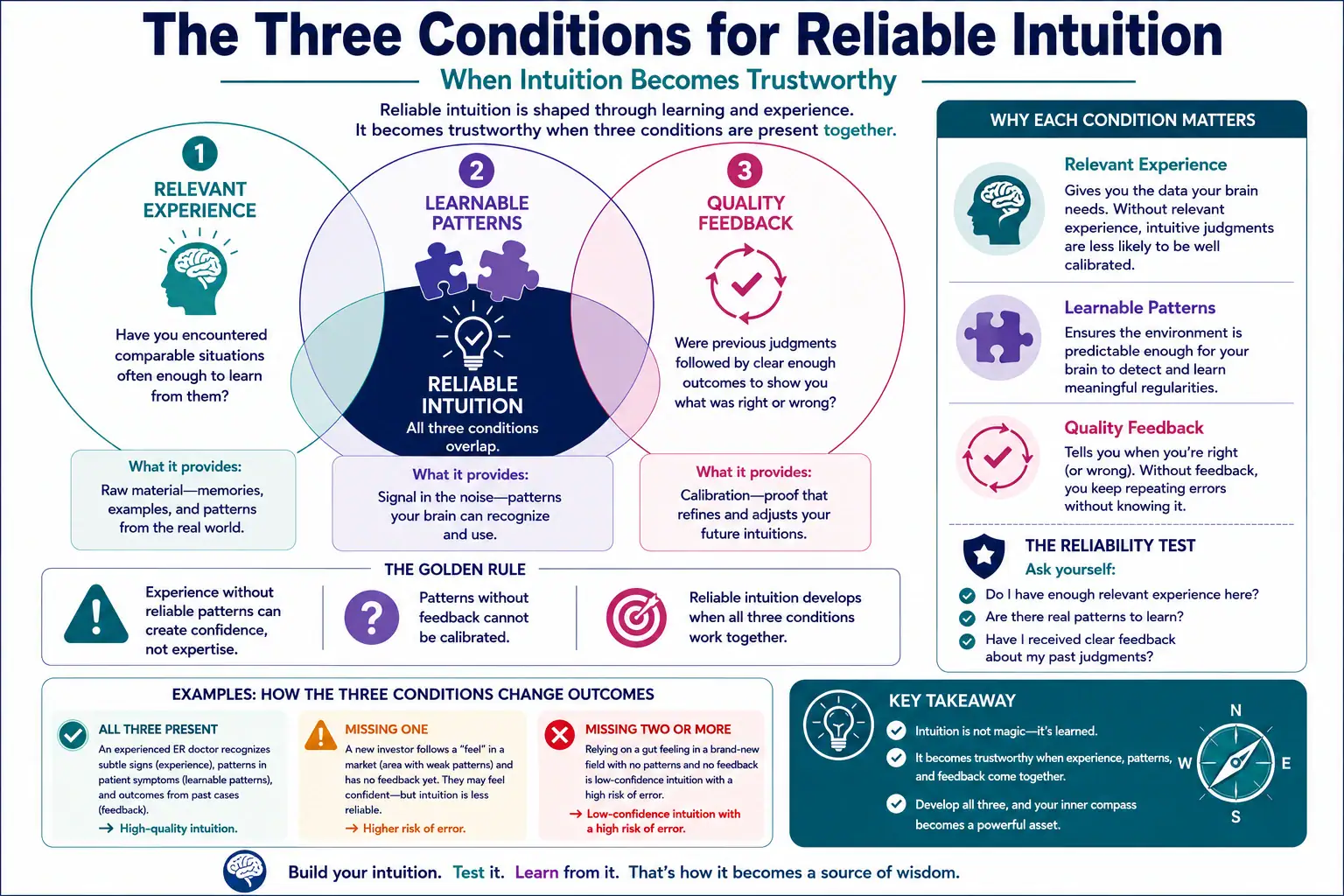
The most useful research-based answer is that intuition becomes more credible when the environment can actually teach you something. Kahneman and Klein emphasized two core requirements for skilled intuition: an environment containing valid, learnable regularities and enough opportunity to learn those regularities. In practice, feedback is what makes that learning calibratable.
1. Relevant experience
You need experience with the kind of pattern you are trying to recognize. Ten years of experience in one domain does not automatically create reliable intuition in another. Even within the same profession, expertise may be narrow.
2. Learnable patterns
The environment must contain enough regularity for yesterday’s experience to teach you something about today. Some environments are highly noisy, random, adversarial, or constantly changing. Repetition in those environments can create familiarity without genuine predictive skill.
3. Quality feedback
You need to find out what happened after your judgment. Clear and reasonably timely feedback helps separate patterns that work from patterns that merely feel compelling. Without feedback, confidence can grow while accuracy remains unknown.
The Intuitive Thinking Reliability Matrix™
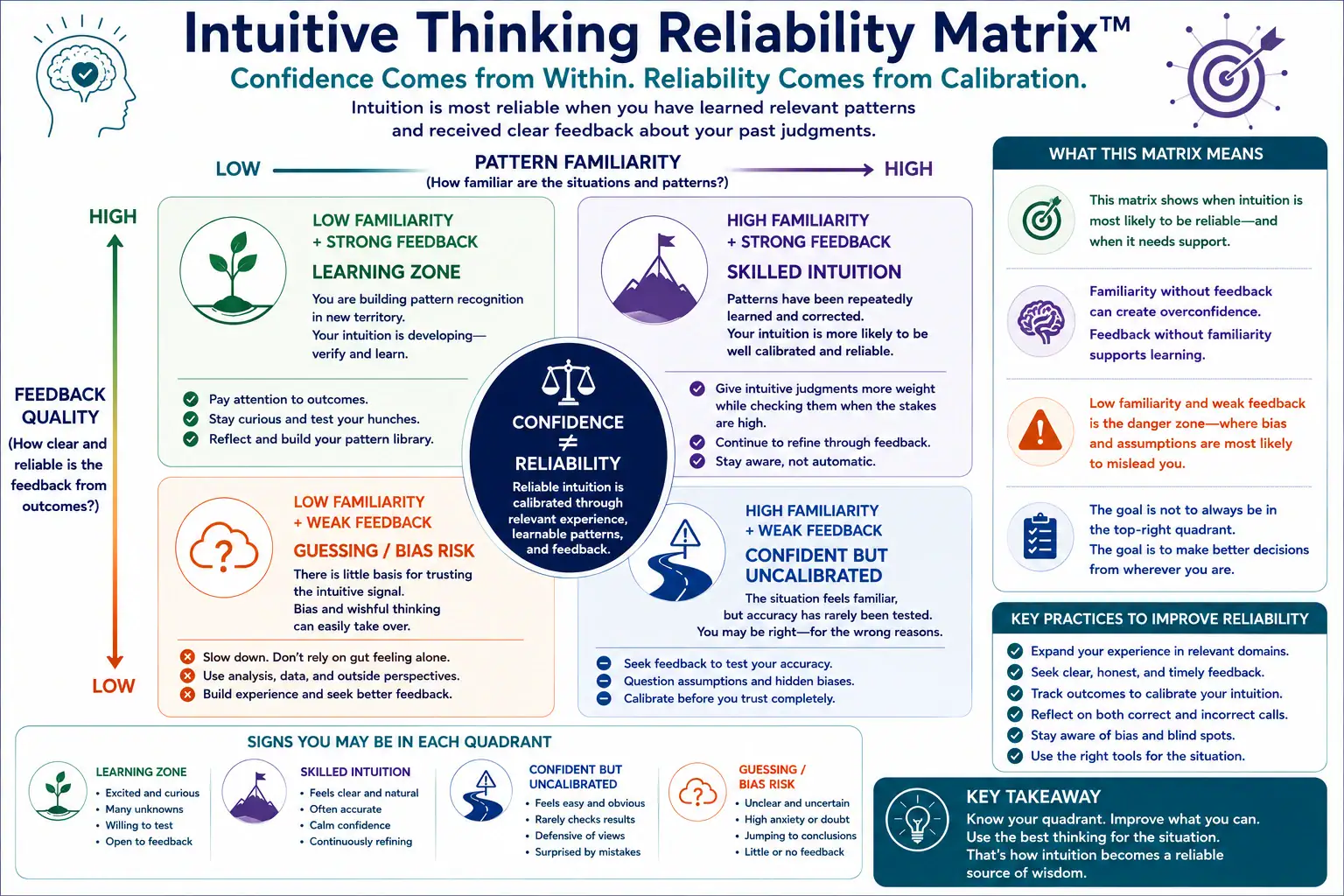
The Intuitive Thinking Reliability Matrix™ is a practical framework for asking where an intuitive judgment sits before you act on it. It is not a validated psychometric test. It translates research on experience, environmental regularity, and feedback into two questions:
- Pattern familiarity: How familiar are the relevant situations and patterns?
- Feedback quality: How clear and reliable has the feedback from past outcomes been?
High familiarity + strong feedback
Skilled intuition. Patterns have been learned repeatedly and corrected through outcomes. Give the intuitive judgment more weight, while still checking when the stakes are high.
High familiarity + weak feedback
Confident but uncalibrated. The situation feels familiar, but you may rarely learn whether your judgments were actually correct.
Low familiarity + strong feedback
Learning zone. You are building a pattern library. Use the signal as a hypothesis, verify it, and keep learning from outcomes.
Low familiarity + weak feedback
Guessing / bias risk. There is little basis for giving the intuitive feeling much evidential weight. Slow down and seek data or outside perspectives.
The central point is simple: confidence is not reliability. A feeling can be vivid, calm, immediate, and completely sincere while still being poorly calibrated. The matrix asks about the learning conditions behind the feeling rather than the intensity of the feeling itself.
When Should You Stop and Think Analytically?
Even experienced intuition should not receive the same weight in every decision. Deliberate analysis becomes especially valuable when one or more of the following conditions are present:
- The situation is genuinely new. You do not have a relevant pattern library yet.
- The decision is high-stakes or difficult to reverse. A quick verification has high expected value.
- Your emotional activation is unusually strong. Fear, anger, attraction, urgency, or exhaustion may be shaping the signal.
- You have poor feedback history. You cannot tell whether similar past intuitions were accurate.
- The environment has changed. Old expertise can become outdated when incentives, technology, rules, or people change.
- There is important contradictory evidence. Do not use intuition as permission to ignore data you dislike.
- The conclusion would conveniently confirm what you already want. Motivated reasoning deserves an extra check.
- The judgment concerns a person or social group. Fast social impressions are particularly vulnerable to stereotype and bias.
For decisions where the consequences are real, the goal is not to silence intuition. Use it as an early signal, then choose an appropriate level of verification. See intuition in high-stakes decisions and when intuition is wrong.
How to Improve Intuitive Thinking Without Training Your Biases
You do not improve intuition simply by trusting it more. You improve your ability to use intuition by improving the learning loop behind it. A useful intuitive mindset is curious rather than certain: treat the signal as information, compare it with outcomes, and update your confidence.
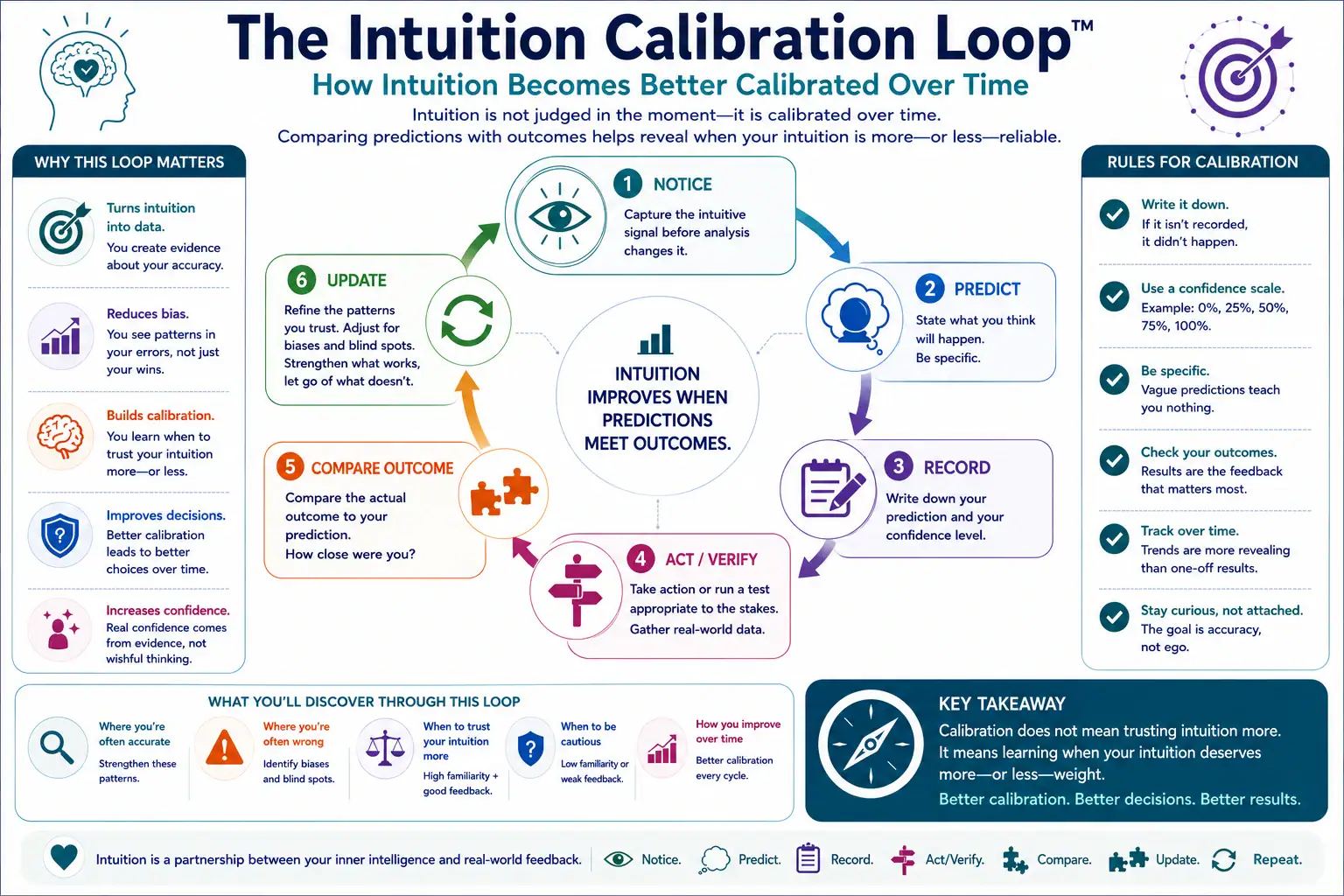
The Intuition Calibration Loop™
The following six-step loop turns an intuitive impression into something you can evaluate over time:
- Notice. Capture the intuitive signal before hindsight or analysis rewrites it.
- Predict. State what you think the signal means or what you expect to happen.
- Record. Write down the prediction, context, and your confidence level.
- Act or verify. Take an action or run a test appropriate to the stakes.
- Compare the outcome. Ask what actually happened and how close the prediction was.
- Update. Refine the patterns you trust, identify recurring errors, and change your confidence accordingly.
This is calibration, not affirmation. The purpose is not to prove that your intuition is good. It is to discover where it is good, where it is weak, and what conditions change its reliability.
If you want to train this systematically, continue with how to train your intuition or use the structured 30-day intuition calibration program.
What Intuitive Thinking Is Really Good For
Intuitive thinking is especially valuable as a fast orientation system. It can tell you what deserves attention before you have finished analyzing it. That makes it useful for generating hypotheses, spotting anomalies, navigating time pressure, accessing expert pattern recognition, sensing relational dynamics, and producing creative possibilities.
Its weakness is that the same subjective experience can be produced by very different underlying causes. Expertise, anxiety, bias, desire, memory, and genuine anomaly detection can all feel compelling. That is why the mature use of intuition is not blind trust and not blanket skepticism.
Go deeper: Intuitive Thinking Examples · Intuitive Thinking Skills · Intuitive Reasoning · Intuitive Processing · Types of Intuition · Why Modern Systems Ignore Intuition
Frequently Asked Questions About Intuitive Thinking
What is intuitive thinking in simple terms?
Intuitive thinking is reaching a judgment or understanding quickly without consciously working through every reasoning step. The result may still be informed by experience, learned patterns, context, and emotional information.
What is an example of intuitive thinking?
An experienced project manager may notice that a project is drifting toward failure before the dashboard clearly shows it. Their judgment can come from recognizing a familiar combination of subtle warning signs learned from previous projects.
Is intuitive thinking the same as a gut feeling?
Not exactly. A gut feeling is one way an intuitive judgment can be experienced, especially when bodily or emotional signals are involved. But intuitive thinking can also appear as a rapid idea, recognition, sense of mismatch, or immediate answer without a strong bodily sensation.
Is intuitive thinking System 1 thinking?
Intuitive thinking is often associated with fast, automatic Type 1 or “System 1” processing in dual-process models. The terms should not be treated as perfect synonyms, however. Dual-process language is a useful model for contrasting automatic and deliberate features of cognition, not a claim that every intuitive judgment comes from one isolated brain system.
Is intuitive thinking always accurate?
No. Intuition can reflect genuine expertise, but it can also reflect bias, outdated experience, anxiety, stereotypes, wishful thinking, or random variation. Reliability depends on the quality of the learning conditions behind the judgment.
What conditions make intuition more trustworthy?
Intuition is more defensible when you have relevant experience, the environment contains learnable patterns, and previous judgments have received meaningful feedback. Confidence by itself is not enough.
Can intuitive thinking be learned?
Some forms of intuitive skill can improve through repeated exposure to valid patterns and useful feedback. Research on simulated naturalistic decision making provides evidence that pattern-recognition-based intuitive decisions can be trained under suitable conditions. What improves is not a mystical faculty but the quality of learned recognition and calibration.
What is the difference between intuitive and analytical thinking?
Intuitive thinking tends to produce a fast impression or judgment without explicit step-by-step reasoning. Analytical thinking deliberately examines information, compares alternatives, checks assumptions, and constructs an explicit reasoning path. Strong decision making often uses both.
When should I not trust intuitive thinking?
Give intuition less weight when the situation is unfamiliar, feedback has been weak, the environment is highly random or has changed, emotions are unusually intense, important evidence conflicts with the feeling, or the consequences of error are high enough to justify careful verification.
Final Takeaway
Intuitive thinking is not the opposite of intelligence. It is one way intelligence operates when learned information can be integrated faster than conscious explanation. Sometimes that produces remarkable expertise. Sometimes it produces a convincing mistake.
The difference is rarely visible from the feeling alone. Ask what experience produced the judgment, whether the environment contains learnable patterns, and what feedback has calibrated similar judgments in the past. Then decide how much analytical checking the stakes require.
Use intuition to notice. Use analysis to verify. Use feedback to learn. If you want to continue building that skill, start with Your Intuition Journey.
Research Sources and Further Reading
Kahneman, D., & Klein, G. (2009). Conditions for intuitive expertise: A failure to disagree. American Psychologist, 64(6), 515–526.
Patterson, R. E., et al. (2013). Training intuitive decision making in a simulated real-world environment. Research on implicit statistical learning and pattern-recognition-based decisions.
Topolinski, S., & Strack, F. (2009). The architecture of intuition: Fluency and affect determine intuitive judgments of semantic and visual coherence.
Bechara, A., Damasio, H., & Damasio, A. R. (2000). Emotion, decision making and the orbitofrontal cortex.
Maia, T. V., & McClelland, J. L. (2004). A reexamination of the evidence for the somatic marker hypothesis. PNAS, 101(45), 16075–16080.