Sometimes your body reacts before you can explain why: your chest tightens in a meeting, your stomach drops during a conversation, or an option that looks perfect on paper somehow feels wrong. Those sensations can be meaningful—but they are not automatic proof that your first interpretation is correct.
Somatic intuition is the experience of intuitive information becoming noticeable through bodily sensations before or alongside a conscious explanation. It can reflect interoception, emotion, learned associations and rapid pattern recognition. The sensation itself is real, but what you think it means still needs context, evidence and calibration.

Somatic intuition is a practical way to describe intuitive judgment that is experienced through bodily sensations. It may involve rapid pattern recognition, emotion, physiological change and interoception—the processing and perception of signals from inside the body. The important distinction is simple: the sensation is real, but the meaning you assign to it may or may not be accurate.
What Is Somatic Intuition?
Somatic intuition is an intuitive impression that becomes noticeable through bodily experience before, during or alongside conscious reasoning. You may notice tension, warmth, a change in breathing, a sinking sensation, stillness, a pull toward something or an urge to move away before you can put your reasoning into words.
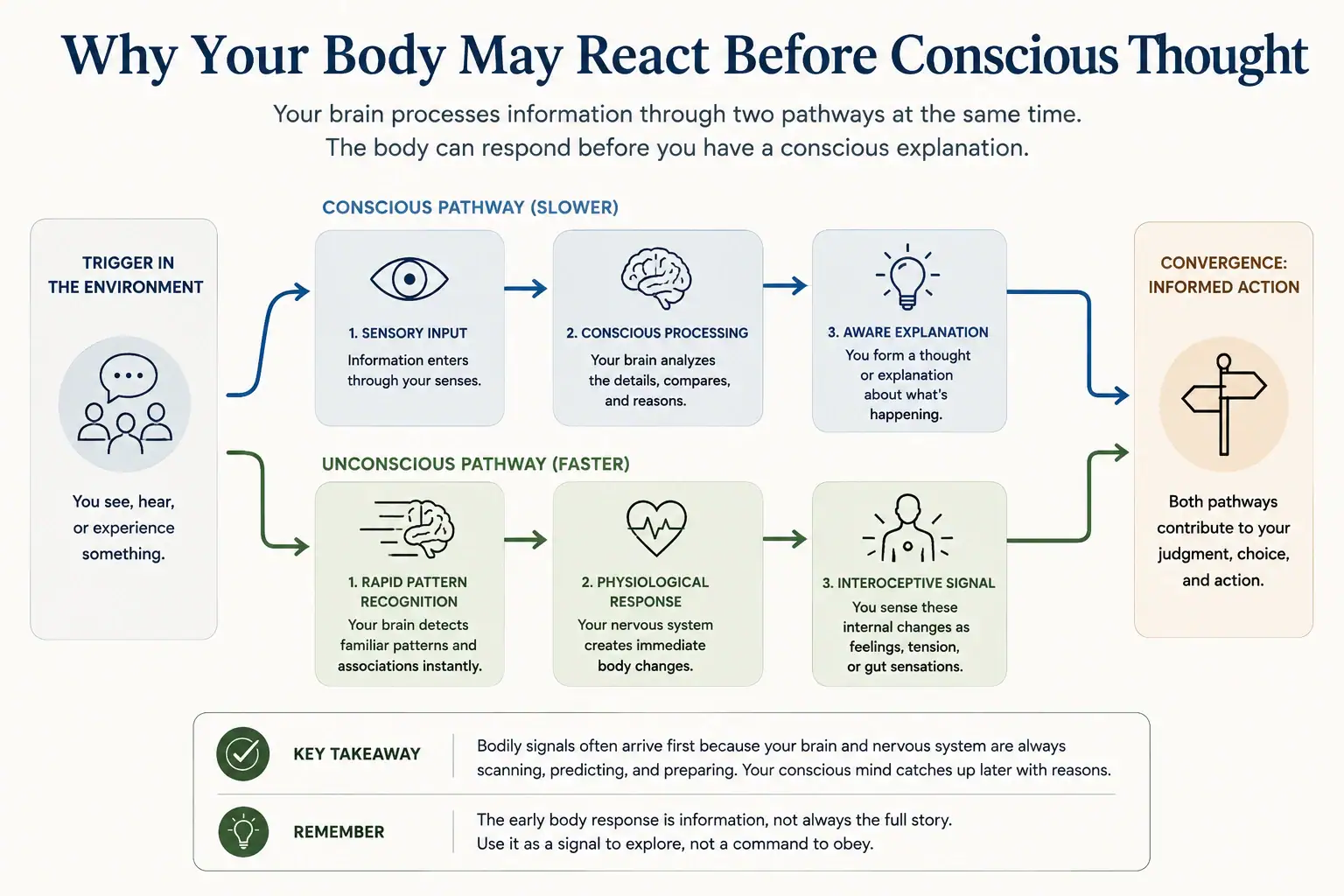
The word somatic refers to the body. In this context, the useful scientific bridge is interoception: the nervous system’s processing of internal bodily signals. Research describes interoception as more than simply “feeling your heartbeat”; it involves how body-relevant signals are detected, represented, integrated and interpreted. Those processes contribute to emotion, self-regulation and decision-making.
That does not make bodily intuition supernatural. A more grounded model is that the brain is continuously combining current sensory information with memory, learned associations, physiological state and expectations. Some of that processing can influence feeling and action before you can consciously explain what produced the impression.

This connects closely with the broader idea of intuition as pattern recognition under uncertainty. When experience has taught you meaningful regularities, your system may register that “something fits” or “something is off” before the cues responsible for that impression reach conscious explanation.
Why Your Body Can React Before You Know Why
Conscious reasoning is not the only way information influences judgment. The model in this article is an integrative explanatory framework, not a claim that science has identified one single “somatic intuition circuit.” Research on intuitive decision-making supports the idea that experience-based impressions can emerge before the underlying coherence becomes verbally explainable.
Pattern recognition can happen outside conscious awareness
When you have repeated experience in a domain, your brain can become sensitive to familiar configurations. An experienced manager may sense that a delivery discussion does not fit the usual pattern; a clinician may notice a subtle constellation of cues; a musician may know that a phrase is wrong before explaining the technical reason. The value is not that experts possess a mysterious faculty. It is that experience can compress large numbers of learned relationships into rapid recognition.
Your internal state becomes part of the information
Interoceptive signals include changes related to heartbeat, respiration, visceral state, muscle tension, temperature and other aspects of the body’s physiological condition. These signals do not arrive with ready-made labels. The brain must integrate them with context.
Experimental work has found associations between interoceptive accuracy and aspects of decision performance, but the relationship is not universal. Context, task, individual differences and the way interoception is measured all matter. That is why “better body awareness always means better decisions” would be an overstatement.
Emotion and body state can influence decisions
The somatic marker hypothesis, associated with Antonio Damasio and colleagues, proposes that body-related signals can help shape choices, including under uncertainty. It is influential, but it should be presented as a hypothesis with a substantial research history—not as settled proof that every gut feeling contains hidden truth. Critical evaluations have challenged parts of its evidence and interpretation, especially claims based on the Iowa Gambling Task.
What Are the Signs of Somatic Intuition?
Possible signs include a sudden change in breathing, chest or stomach sensations, muscle tension or release, warmth or coldness, stillness, increased heartbeat, or an urge to approach or withdraw. None of these sensations proves that an intuition is correct. Their usefulness depends on context, experience and what later evidence shows.
What Does Somatic Intuition Feel Like?
There is no universal physical signature of intuition. People may experience changes such as a tight or open feeling in the chest, a sinking or settled stomach, altered breathing, warmth or coldness, tension or relaxation, a sense of heaviness or lightness, increased heart rate, stillness, or an urge to approach or withdraw.
The mistake is turning those examples into a dictionary. A tight chest does not automatically mean “no.” A warm feeling does not automatically mean “yes.” The same sensation can emerge from excitement, fear, fatigue, caffeine, memory, social pressure, uncertainty or other causes.
This is why what intuition feels like matters less than how well you learn to interpret your own signals in context.
A Body Signal Is Data, Not a Verdict
One of the most useful distinctions in somatic intuition is separating three things that often get collapsed into one:
Signal → Interpretation → Decision.
Imagine your heart rate rises before a difficult meeting. The signal is the physiological change. Your interpretation might be “this person is unsafe,” “I am afraid of conflict,” “this matters to me,” “I noticed an inconsistency,” or simply “I am overstimulated.” Only after that interpretation do you decide whether to proceed, ask questions, slow down, set a boundary or gather more evidence.
Your body can provide information before your conscious mind explains it. Your first explanation is still a hypothesis.
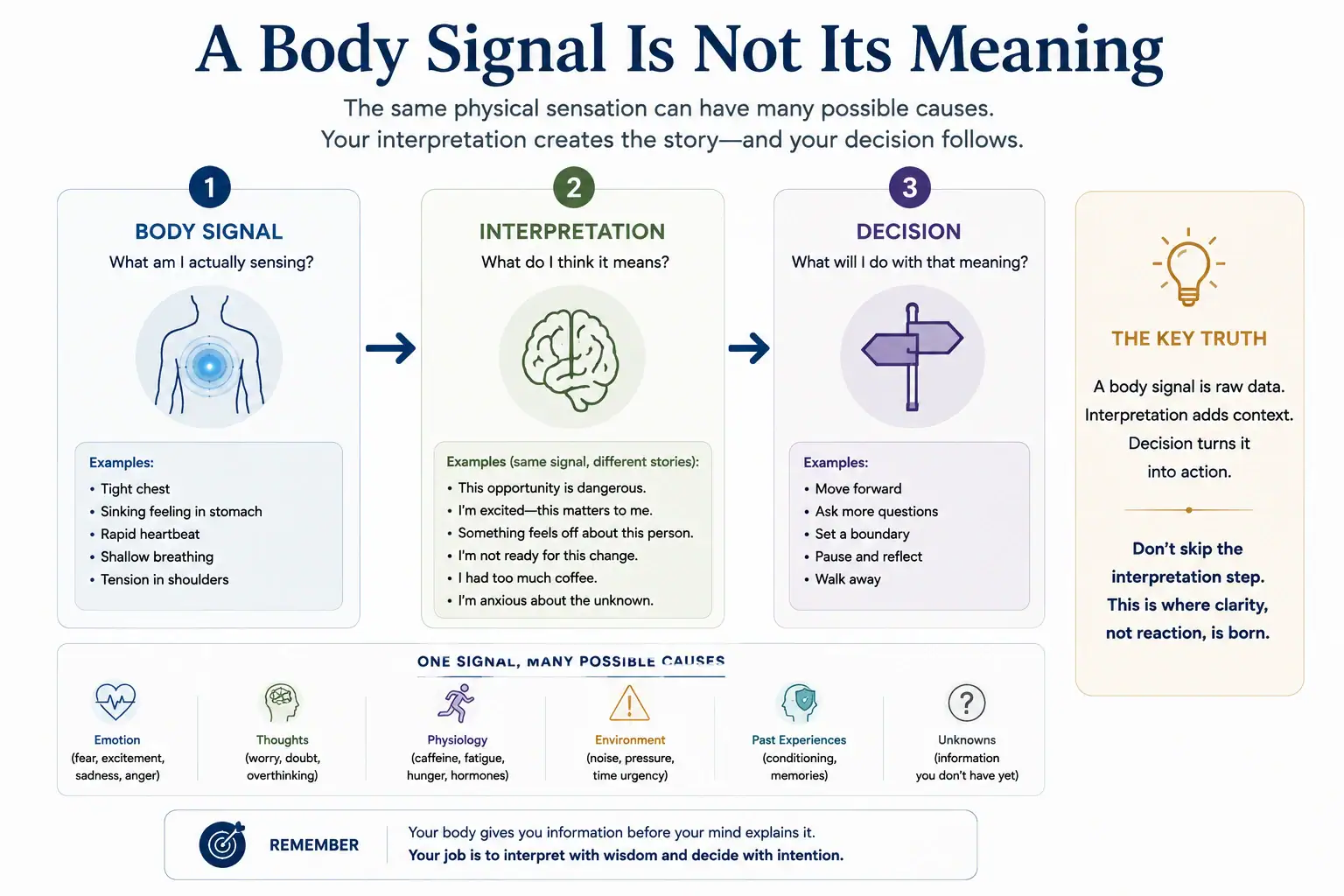
This principle complements the Personal Signal Decoder and the broader signal vs noise approach: notice first, interpret second, then test the interpretation against reality.
Somatic Intuition vs Anxiety: How Can You Tell the Difference?
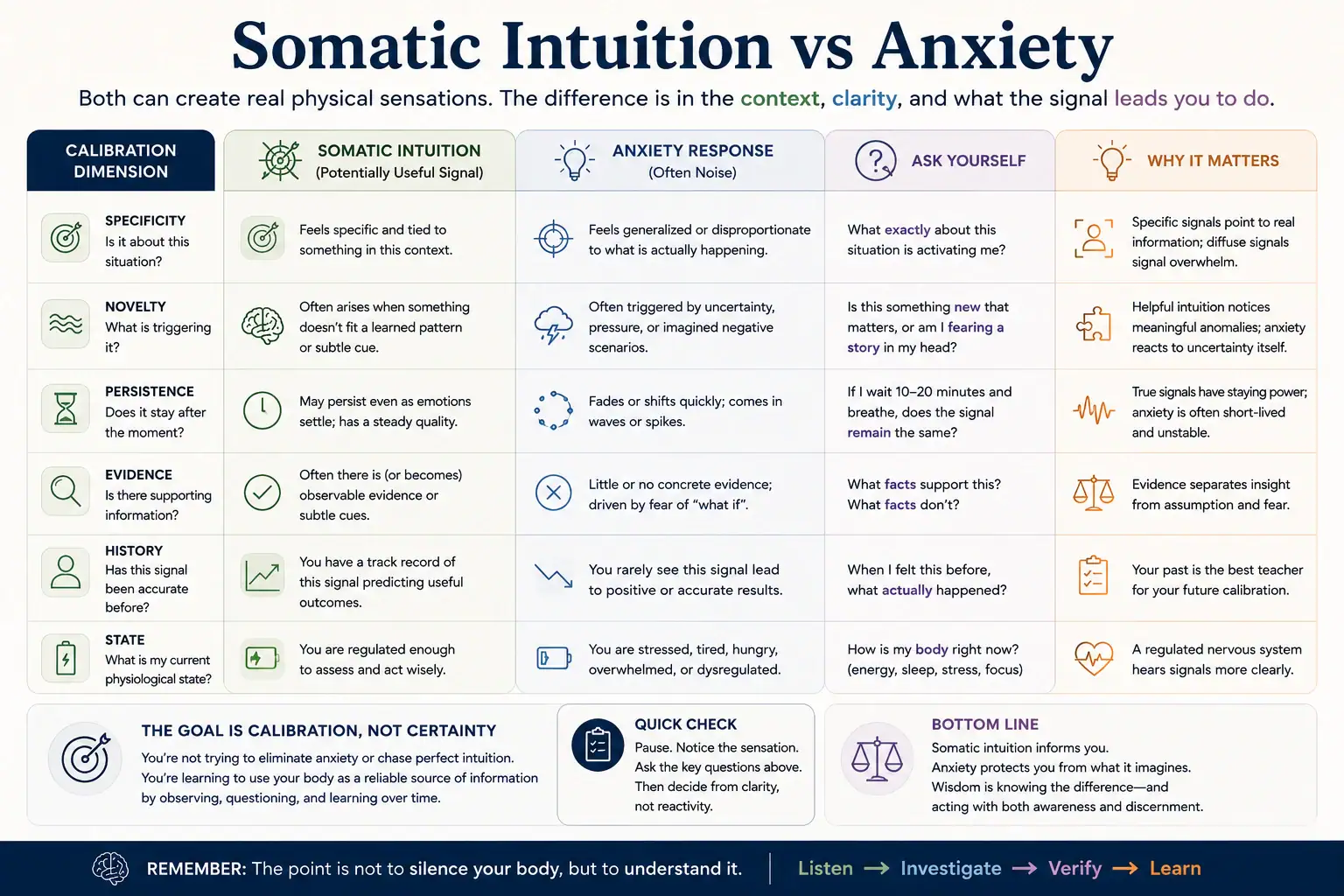
Somatic intuition and anxiety can both produce real bodily sensations. There is no scientifically reliable rule that intuition is always quiet and anxiety is always loud. Anxiety can be subtle; useful intuition can sometimes be intense. A better approach is calibration.
Ask six questions:
Specificity: Is this sensation tied closely to something in this situation, or does it appear across many unrelated situations?
Novelty: Did something meaningfully violate an expected pattern, or is uncertainty itself triggering the reaction?
Persistence: What happens after you slow down and physiological arousal changes? Does the concern remain, disappear or transform?
Evidence: What observable facts support your interpretation? What facts challenge it?
History: When you have felt this particular signal before, what actually happened?
State: Are you sleep-deprived, hungry, overstimulated, exhausted, stressed or otherwise in a condition likely to alter perception and judgment?
If this distinction is your main question, see the deeper guides on intuition or anxiety and gut feeling or anxiety.
Somatic Intuition vs Fear, Conditioning and Past Experience
Past experience changes what the nervous system expects. A cue that once predicted difficulty can later produce a fast bodily response even when the present situation is different. That does not make the sensation fake. It means the sensation may be reflecting learned history rather than current danger.
The practical question is therefore not “Did my body react?” It is “What information is this reaction using?” Sometimes the answer will be a meaningful cue in the present. Sometimes it will be expectation, memory, bias or a physiological state. Often it will be a mixture.
This is one reason somatic intuition should not be treated as an oracle. A body signal deserves attention, not automatic obedience.
When Is Somatic Intuition More Likely to Be Useful?
Intuitive judgment tends to become more defensible when several conditions are present:
You have relevant experience. Pattern recognition requires patterns to have been learned in the first place.
The environment contains repeatable structure. If outcomes are essentially random, confidence can grow without accuracy.
You receive meaningful feedback. You eventually discover whether your impressions were useful, which allows learning.
The signal is context-specific. A reaction tied to a concrete anomaly may be more informative than generalized unease.
You can compare the feeling with external evidence. Intuition is strongest when it complements—not replaces—reality testing.
When should you be more skeptical?
Be more cautious when you are operating in an unfamiliar domain, when feedback is weak or delayed, when stereotypes and preferences can drive interpretation, when you are highly aroused or depleted, when the decision requires statistical reasoning, or when the feeling simply confirms what you already want to believe.
For a broader framework, see intuition vs bias.
The Somatic Signal Calibration Method
Instead of asking yourself to “trust your body,” use a repeatable process that trains both awareness and skepticism:
1. Sense
Notice what changed physically. Be specific: “My breathing became shallow and my stomach tightened” is more useful than “Something is wrong.”
2. Name
Describe the sensation without turning it into a story. Use plain physical language: tight, warm, heavy, restless, open, numb, sinking, energized.
3. Contextualize
Ask what happened immediately before the signal. What did you see, hear, remember or notice? What pattern might have been activated?
4. Check
Compare your interpretation with observable evidence and alternative explanations. Include your current state: sleep, stress, hunger, stimulation, fatigue and emotional load can all matter.
5. Learn
After the decision, review the outcome. Was the signal useful? Was your interpretation useful? Those are different questions. Update your expectations accordingly.

A 60-Second Somatic Intuition Check
- 0–10 seconds: Pause. Do not force a decision.
- 10–20 seconds: Scan breathing, chest, stomach, throat, face and major muscle groups.
- 20–30 seconds: Identify the strongest physical change.
- 30–40 seconds: Separate sensation from story. What are you feeling physically, and what are you merely assuming it means?
- 40–50 seconds: Ask what changed in the situation immediately before the sensation appeared.
- 50–60 seconds: Ask what evidence would support or contradict your interpretation.
The purpose is not to manufacture a quick answer. It is to improve the quality of the information you bring into the decision.
Examples of Somatic Intuition in Everyday Decisions
Choosing between two opportunities
One option looks superior on paper, yet you repeatedly tense when discussing a particular condition. Instead of treating the tension as a veto, identify what exactly triggers it. Perhaps the role is misaligned with your values, perhaps the interviewer is inconsistent, or perhaps the uncertainty simply activates fear. The signal starts the investigation.
A difficult conversation
Your body tightens before you consciously notice a change in another person’s tone, pacing or wording. That can be useful pattern recognition—but it still does not tell you their intention. Ask, observe and verify.
Leadership and work
An experienced leader may sense that a project update “doesn’t add up” before identifying the discrepancy. Domain experience can make subtle deviations from familiar patterns easier to register quickly. The best next move is not to accuse; it is to inspect the data.
Relationships
A bodily reaction may alert you to mismatch between words and behavior, but it can also reflect your own expectations and history. Treat the reaction as a prompt for attention rather than proof about another person.
Creative work
Writers, designers and musicians often recognize “fit” before they can articulate the rule that was satisfied or violated. In domains with extensive practice and feedback, intuitive coherence can become an efficient guide to where further attention is needed.
Can You Train Somatic Intuition?
You can train awareness and calibration. That is different from guaranteeing that every gut feeling becomes more accurate.
A useful practice is to keep a small decision log:
Signal: What did you physically notice?
Context: What was happening?
Prediction: What did you think the signal meant?
Action: What did you do?
Outcome: What happened?
Update: What should you learn about that signal?
Over time, this gives you something intuition alone cannot provide: feedback about your own accuracy. For a broader practice system, see how to train your intuition.
Does Better Interoception Mean Better Intuition?
Not automatically. Interoception itself is multidimensional. Detecting bodily changes, paying attention to them and accurately interpreting what they mean are not the same skill. A person can notice every change in heartbeat and still misread why it occurred.
Research linking interoceptive accuracy with decision-making is promising but mixed across tasks and populations. Some studies report associations between more accurate perception of internal signals and better performance in particular decision tasks. Other work emphasizes how bodily arousal can bias choices. The responsible conclusion is that body-state information can participate in judgment—not that stronger body awareness creates a universal “sixth sense.”
A Better Way to Think About “Trusting Your Body”
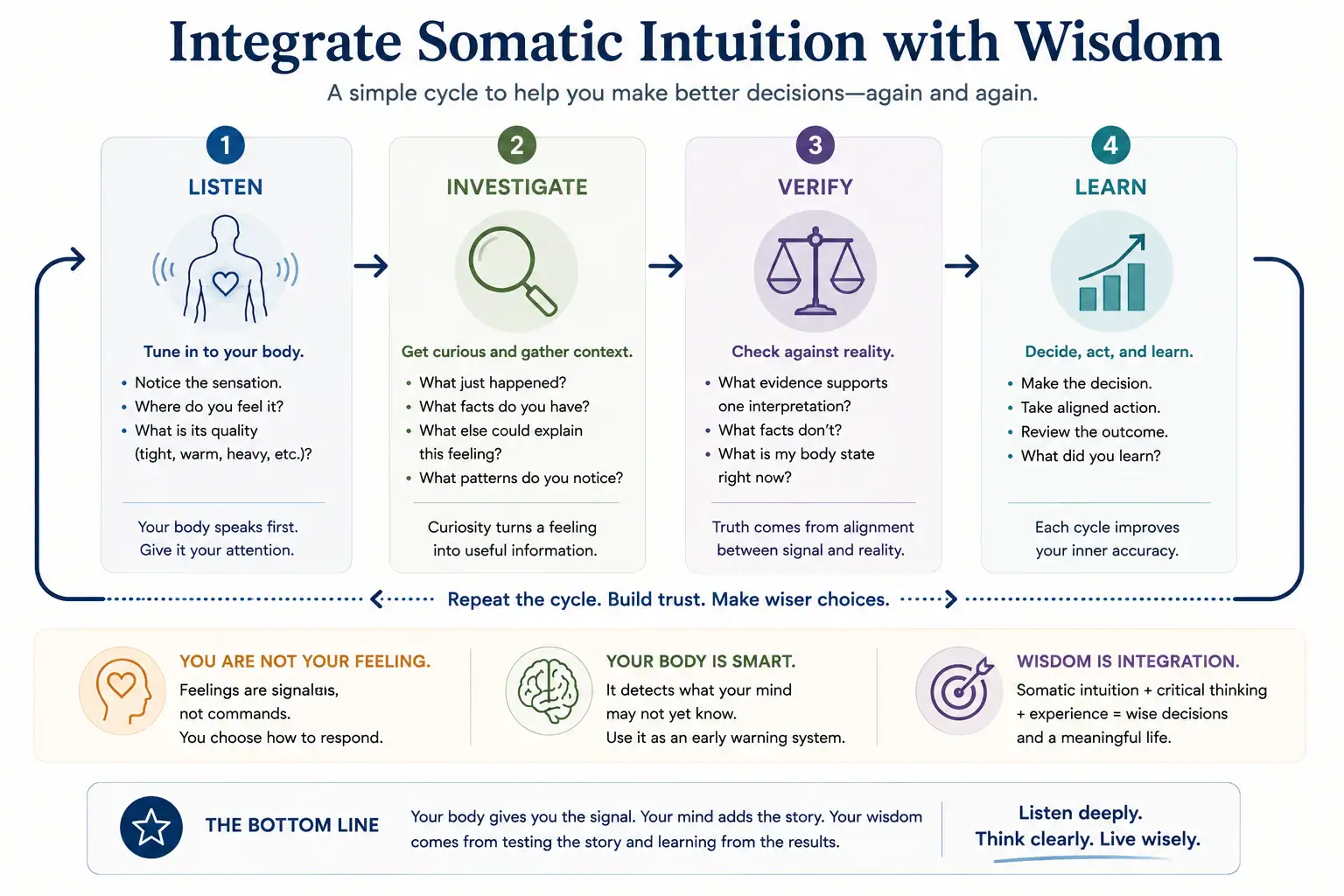
“Trust your body” is memorable advice, but it is incomplete. A better rule is:
Listen to your body. Investigate the signal. Verify the interpretation. Learn from the outcome.
This approach does not require choosing between intuition and logic. It treats intuitive information as one part of a larger decision system—alongside evidence, reasoning, experience and feedback.
If you want to go further, use the Personal Signal Decoder to examine your own patterns, then continue with How to Train Your Intuition to build a broader practice.
Frequently Asked Questions
What is somatic intuition?
Somatic intuition is a practical term for intuitive judgment experienced partly through bodily sensations. It can involve rapid pattern recognition, physiological changes, interoception, emotion and learned associations before a person can fully explain the reasoning behind an impression.
What does somatic intuition feel like?
It can feel like tension, warmth, a shift in breathing, a sinking or settled stomach, increased heartbeat, heaviness, lightness, stillness or an urge to approach or withdraw. No single sensation reliably identifies intuition, so context and calibration matter.
Is somatic intuition scientifically proven?
“Somatic intuition” is not a single established scientific mechanism. However, relevant research supports roles for interoception, physiological state, emotion and nonconscious pattern processing in decision-making. The somatic marker hypothesis is influential but also has important criticisms and should not be treated as final proof.
Is a gut feeling the same as somatic intuition?
They overlap. “Gut feeling” is a common-language term for an intuitive impression that may include bodily sensations. Somatic intuition emphasizes the bodily component and the need to interpret it in context.
How can I tell somatic intuition from anxiety?
Do not rely on a single rule such as “intuition is calm.” Instead check specificity, context, evidence, your physiological state, how the signal changes over time and whether similar signals have predicted useful outcomes before.
Can somatic intuition be wrong?
Yes. Bodily signals can reflect useful pattern recognition, but they can also reflect fear, bias, fatigue, conditioning, stress, excitement or unrelated physiological changes. The sensation can be genuine while the interpretation is inaccurate.
Can you train somatic intuition?
You can train body awareness and improve calibration by recording signals, interpretations, decisions and outcomes. This helps you learn which patterns are useful in which contexts instead of treating every sensation as equally trustworthy.
What is the relationship between interoception and intuition?
Interoception concerns how internal bodily signals are processed and perceived. Those signals can contribute to emotion and decision-making, so interoception provides one plausible scientific pathway through which bodily states can participate in intuitive judgment.
Research and Further Reading
- Sun W. et al. — Neural underpinnings of interoception and decision-making.
- Pollatos O. et al. — Interoceptive accuracy and decision-making.
- Damasio A.R. — The somatic marker hypothesis and possible functions of the prefrontal cortex.
- Dunn B.D. et al. — The somatic marker hypothesis: a critical evaluation.
- Werner N.S. et al. — Interoceptive awareness and neural activity during decision-making.
- Zander T. et al. — Intuitive decision making as a gradual process.
Takeaway: Somatic intuition is most useful when it becomes a question, not a command. Notice the body signal, separate it from the story, compare your interpretation with reality, and let feedback teach you what your signals actually predict.