A mental model becomes useful when it does more than explain the world: it makes expectations visible, meets evidence, and changes when reality disagrees.
To build a mental model, define the situation you are trying to understand, identify the variables that matter, map the relationships and assumptions connecting them, make a prediction, test that prediction against evidence, and update the model when the evidence does not fit. The goal is not to create a perfect explanation on the first attempt. The goal is to create an explanation that can improve.

You already use mental models. When you predict how a colleague will react, estimate whether a project will slip, decide whether a job is worth taking, or explain why a relationship feels different, you are using an internal representation of how parts of a situation fit together. The representation may be explicit or barely conscious, accurate or distorted, simple or sophisticated.
The important question is therefore not whether you have mental models. It is whether you know what is inside them, where their assumptions came from, and what would make you revise them.
What Does It Mean to Build a Mental Model?
A mental model is a simplified internal representation of a situation, system, relationship, or possibility. It is not reality itself. It is your working explanation of reality.
That distinction matters. A useful model leaves room for the possibility that the model is incomplete. If you want the deeper cognitive-science background, start with what mental models are and how they shape thinking. This guide focuses on the next question: how do you deliberately construct one that can be tested?
Philip Johnson-Laird’s foundational work on mental models proposed that reasoning involves constructing representations of possibilities and using those representations to draw conclusions. The theory is broader and more technical than the everyday decision framework in this article, but it gives us an important principle: reasoning often depends on what possibilities we represent—and which possibilities we fail to represent. Johnson-Laird’s 1980 paper is one of the classic sources behind this tradition.
A model therefore needs at least three things: structure (what variables are connected), expectation (what you think will happen), and revision (what you will change when your expectation fails).
Why Your Brain Builds Models Automatically
Raw information is too complex to treat as a pile of unrelated facts. We organize it. We infer causes. We compress repeated experiences into patterns. We project likely consequences. A model is the structure that lets one observation become meaningful in relation to another.
This is useful because decisions require more than description. If you are choosing between two jobs, it is not enough to know that one role pays more and the other offers a better manager. You need some model of how pay, manager quality, growth, stability, autonomy, and your own priorities interact over time.
But compression creates risk. A model can become so familiar that we stop seeing it as a model. We start treating an assumption as a fact, or an old pattern as a law. That is why deliberate model-building begins by making the hidden structure visible.
Research note: The five-step Define → Identify → Map → Test → Update process below is an applied Intuition Management synthesis. It is not presented as a standardized academic or clinical protocol. It translates principles from research on mental representation, reasoning, prediction, feedback, and information search into a practical decision tool.
The 5-Step Mental Model Building Process
The simplest way to make a mental model useful is to force it through a loop. A statement such as “this company is a good place to work” is only a belief. A model asks what variables produce that judgment, how those variables interact, what the model predicts, and what evidence would make you change it.
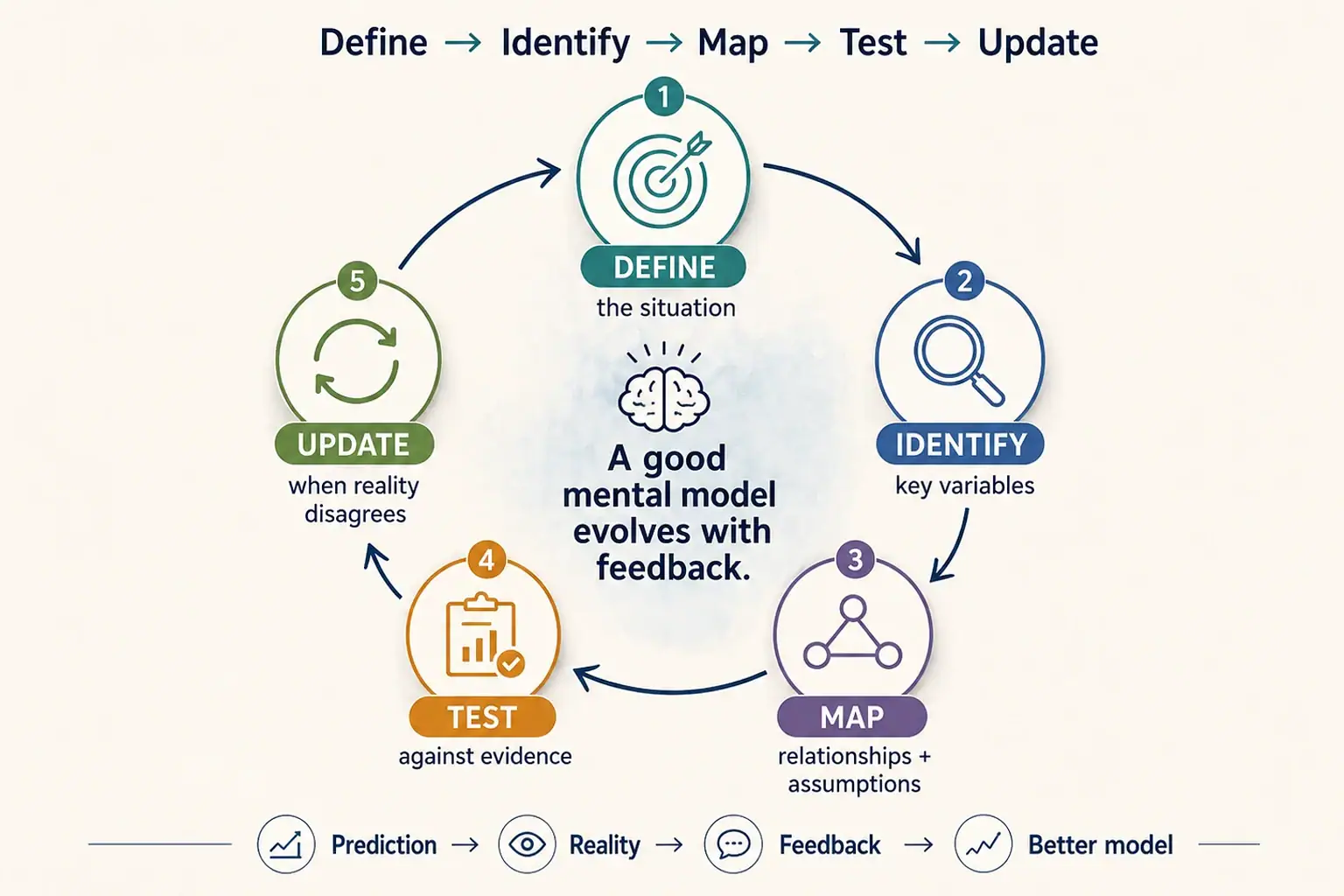
Step 1: Define the Situation or Decision
Start with a question narrow enough to model. “What should I do with my career?” is too broad. “Should I accept this job offer?” is modelable. “Why is my team struggling?” is still vague; “Which factors are most likely reducing this team’s delivery reliability?” is more useful.
A clear model begins with a clear boundary. Ask: What am I trying to explain, predict, or decide?
Step 2: Identify the Variables That Actually Matter
List the factors that could materially influence the outcome. In a job decision, they might include compensation, manager quality, learning, autonomy, role clarity, workload, stability, location, future options, and personal priorities.
Do not confuse “everything that exists” with “everything that matters.” A useful model is selective. The challenge is selecting without hiding important variables.
Step 3: Map Relationships and Assumptions
Variables alone are not yet a model. The model appears when you state how you think the variables relate.
You might believe that a strong manager increases learning, that higher learning expands future options, that remote work improves flexibility, or that rapid organizational growth increases both opportunity and instability. Those links are hypotheses. Some may be well supported; others may be assumptions inherited from past experience.
Write the connection explicitly: A affects B because… This exposes the reasoning that would otherwise remain hidden.
Step 4: Test the Model Against Evidence
A model that cannot be contradicted cannot teach you much. Ask what you would expect to observe if the model were correct—and what you would expect if it were wrong.
If your model says “this manager will support my growth,” evidence might include how the manager describes feedback, examples from current team members, internal promotion patterns, or the specificity of the development plan. “They seemed nice in the interview” is evidence of something, but probably not enough evidence of long-term coaching quality.
The point is not to eliminate uncertainty. It is to make the uncertainty inspectable.
Step 5: Update the Model When Reality Disagrees
This is the step that turns a belief into a learning system. If new information does not fit, do not immediately invent a reason to protect the old explanation. Ask which assumption, relationship, or missing variable would make the mismatch understandable.
Updating does not mean abandoning your whole model every time something surprises you. It means changing the smallest part that the evidence genuinely challenges—and then testing again.
A Mental Model Template You Can Reuse
For most everyday decisions, you do not need a complex diagram. You need a repeatable sequence that separates what you know from what you infer.
Situation → Variables → Assumptions → Relationships → Prediction → Evidence → Update
Situation: What am I trying to understand or decide?
Variables: Which factors are likely to affect the outcome?
Assumptions: What do I currently believe that may not be verified?
Relationships: How do I think the variables influence one another?
Prediction: What should happen if my model is roughly correct?
Evidence: What information could support or challenge that prediction?
Update: What changes when the evidence does not fit?

The value of the template is not the boxes. It is the separation between categories. Facts belong in one place. Assumptions belong in another. Predictions become explicit. Evidence has somewhere to land. Revision becomes part of the process instead of an admission of defeat.
If you want to see different types of models before building your own, browse these mental model examples.
Worked Example: Should I Accept a New Job Offer?
Suppose you receive an offer with a 20% salary increase, a more senior title, remote flexibility, and a manager who appears supportive. Your first reaction may be “obviously yes.” That reaction is not necessarily wrong, but it hides the model.
First separate facts from assumptions. The salary, title, written remote policy, and start date are facts. “The manager will support me,” “the culture will fit,” “I will grow faster,” and “the company will remain stable” are assumptions until you have stronger evidence.
Next map the relationships. Perhaps you believe manager quality influences learning; learning influences future opportunity; flexibility affects energy; and stability changes how much risk you are willing to tolerate. Now the decision is not “higher salary versus current job.” It is a network of expected effects.
Then make predictions. If the model is right, you should see evidence of strong team retention, specific examples of coaching, clear role expectations, healthy work boundaries, and a believable growth path. If interviews reveal recent layoffs, ambiguous ownership, or inconsistent answers about progression, the model needs to change.

Notice what happened: the model did not make the decision for you. It improved the quality of the question. Instead of asking “Do I like this offer?” you can ask “Which assumptions carry most of my confidence, and what evidence would reduce the uncertainty around them?”
How to Know When Your Mental Model Is Wrong
No model is complete. The more useful question is whether it is failing in ways you refuse to notice.
Watch for these signals:
- Repeated prediction failure: the outcome keeps surprising you in the same direction.
- Exception inflation: you need more and more special explanations for why the model “still works.”
- Evidence asymmetry: confirming evidence feels important while contradictory evidence is dismissed as irrelevant.
- Outdated assumptions: the environment changed but your model still reflects an older reality.
- Identity attachment: changing the model feels like changing who you are rather than changing an explanation.
- Missing variables: results vary because something important is absent from your map.
The phrase “I was right except for…” is sometimes legitimate. But if the exceptions are doing most of the explanatory work, your model may no longer be doing useful work.
Mental Models vs Mental Filters
Mental models and mental filters are related, but they are not the same thing.
A mental filter changes what information gets your attention or weight. A mental model changes how you organize that information into an explanation.
Imagine two managers receiving the same project update. One notices every risk signal because previous failures made risk highly salient. Another notices the signs of progress because they are strongly invested in the initiative succeeding. Those are filtering differences. Once the information is selected, each manager may then use a different model of what causes delivery problems, what motivates the team, or which intervention will work.
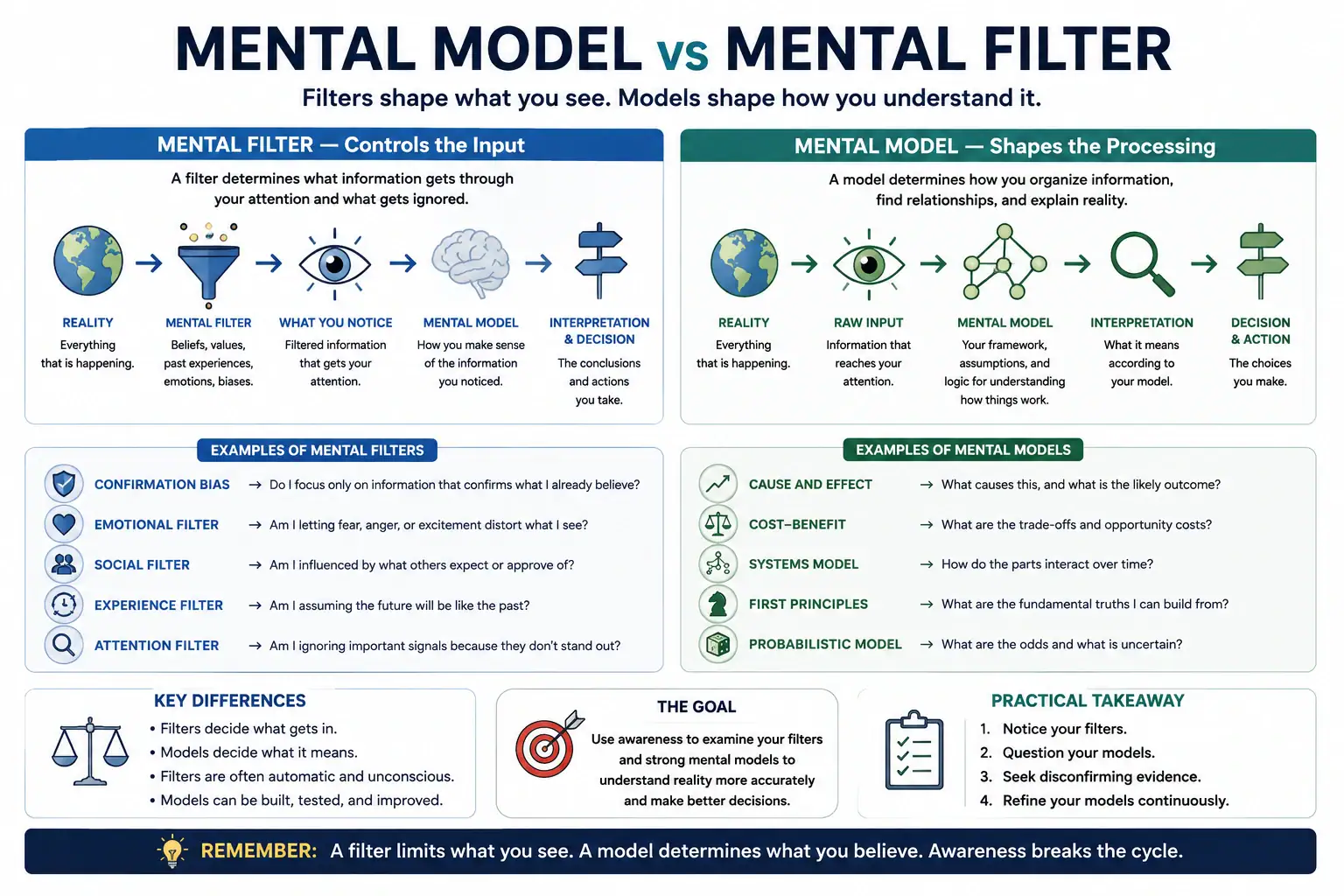
For a deeper treatment of the first half of that process, see what mental filters are. The distinction matters because improving your model is not enough if your attention keeps excluding the evidence the model needs.
Why Smart People Can Build Bad Mental Models
Intelligence does not automatically protect a model from distortion. In some situations, greater reasoning ability can simply make us better at defending the explanation we already prefer.
One mechanism is selective information search. In a series of experiments, Eva Jonas and colleagues found that after preliminary decisions, participants tended to prefer information that supported the decision over information that conflicted with it. The 2001 study is a useful reminder that the information we choose to inspect can itself become part of the bias.
A bad model can therefore survive in a loop: an assumption guides attention, attention finds supportive evidence, supportive evidence increases confidence, contradictory evidence is rationalized, and the original assumption becomes even harder to question.

The escape path is deliberately uncomfortable: look for disconfirming evidence, separate facts from assumptions, treat surprise as data, and revise the model rather than merely repairing the story.
If you recognize the feeling of being locked into one interpretation, this connects directly with why we get stuck in one way of thinking.
Use Multiple Mental Models Instead of One
Complex decisions often resist a single explanation. A business problem can look different through a financial model, a systems model, a behavioral model, an incentives model, or a probabilistic model. None has to be “the truth” to be useful.
The advantage of using more than one model is triangulation. If several independent models point toward the same risk, your confidence can increase. If they disagree, the disagreement identifies where your assumptions deserve closer inspection.
For example, a cost-benefit model may favor a new initiative because the expected value is positive. A systems model may reveal downstream capacity constraints. A behavioral model may expose incentives that make adoption unlikely. A probabilistic model may show that the outcome is attractive only if several uncertain events all go right.
This is where mental models become especially useful in real decisions. See how mental models work in decision making for a deeper application-focused discussion.
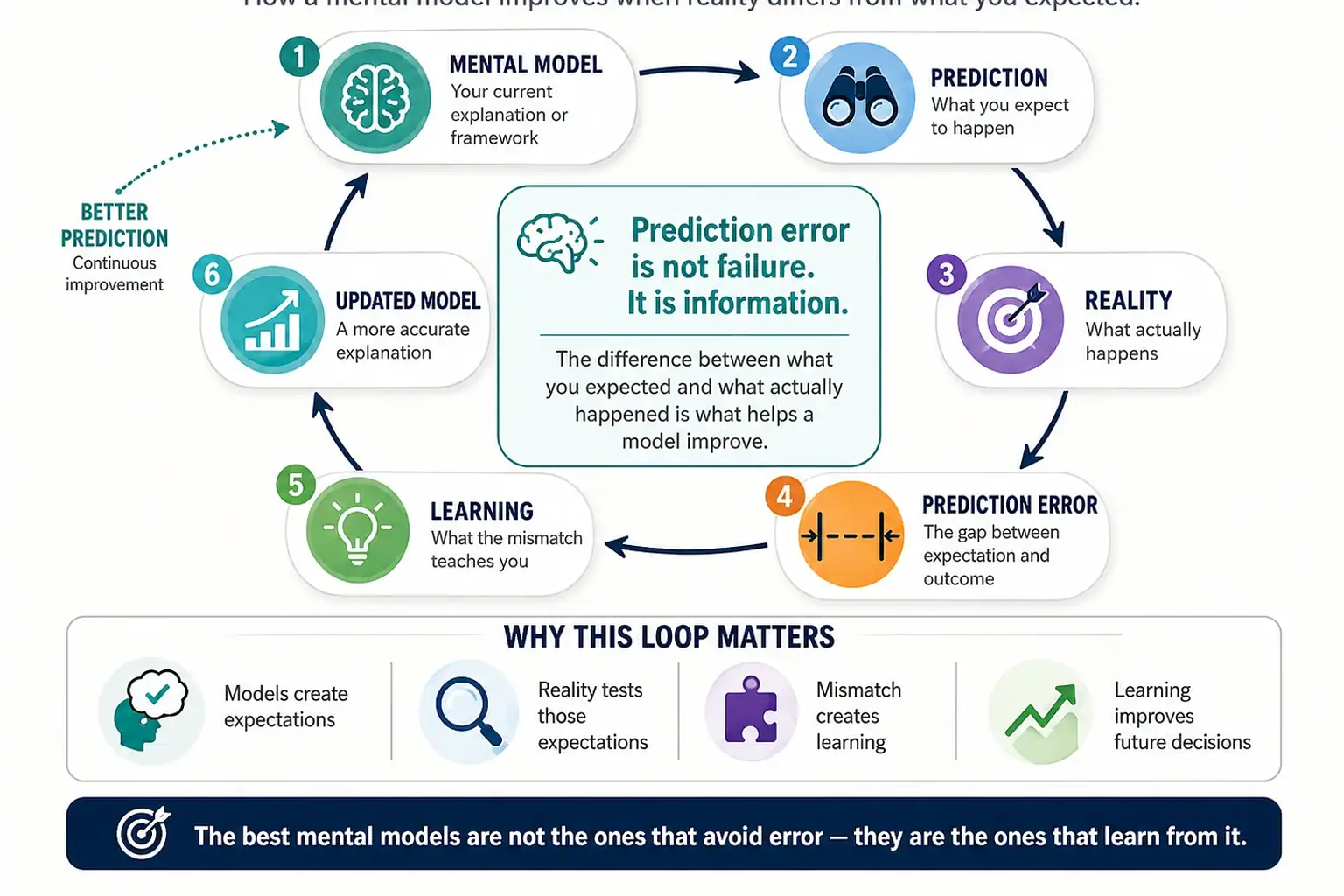
The Prediction-Error Learning Loop
One of the most productive things a model can do is be wrong in a way that teaches you something.
In the strict sense used in predictive-processing and reinforcement-learning research, a prediction error is a discrepancy between an expected outcome and an observed outcome. That does not mean every bad decision is a “prediction error,” and it does not mean one neuroscience theory explains all reasoning. But the broader learning principle is powerful: mismatches between expectation and reality contain information.
Rao and Ballard’s influential 1999 computational model of visual processing proposed a hierarchy in which higher-level activity carries predictions and lower-level pathways carry residual errors between prediction and input. Their Nature Neuroscience paper concerns visual processing, not everyday strategic decision making, so the analogy should be used carefully. Still, it illustrates the formal importance of the gap between prediction and observation.
Reward-learning research offers another specific example. Schultz, Dayan, and Montague reported patterns in primate dopamine-neuron activity consistent with changes or errors in reward prediction. Their 1997 Science paper helped connect neural reward signals with prediction-based learning. Again, that is not evidence that a career decision works like dopamine reward learning; it is evidence that error signals can play a central role in biological learning systems.
There is also evidence that mental-model practice itself can be trained in at least some reasoning contexts. A 2023 study of a mental-model training app reported improvements in adults’ verbal deductive reasoning performance during and after training. Read the study by Cortes, Weinberger, and Green. The result is encouraging, but it should not be stretched into a claim that a short mental-model exercise will automatically improve every kind of real-world decision.
A 60-Second Mental Model Check
Before a difficult decision, ask:
1. What do I currently believe is happening?
2. Which parts are facts, and which parts are assumptions?
3. Which variable could I be underweighting or missing?
4. What would I expect to happen if my model were correct?
5. What evidence would genuinely make me change my mind?
6. What has changed since I first formed this view?
The fifth question is usually the hardest. If you cannot name any evidence that would change your mind, you may not be testing a model. You may be protecting a conclusion.
This is also where mental models connect with signal versus noise. A model helps you decide which signals matter, but the model itself can become a source of noise if it makes you notice only what you expect.
Want to test your judgment under uncertainty? Try the Signal vs Noise Simulator, then compare your choices with the assumptions you thought you were using.
How Mental Models Improve Decision Making
A strong mental model does not remove uncertainty. It makes uncertainty easier to reason about.
It helps because it forces you to externalize your logic. Instead of saying “I have a bad feeling,” you can ask which variable your intuition may be reacting to. Instead of saying “the data proves this,” you can ask which causal relationship you are assuming. Instead of saying “I know how this ends,” you can write down the prediction and check whether reality agrees.
This is also why mental models and intuition are not opposites. Intuition can surface a pattern before you can explain it. A mental model can then help you inspect that pattern: What might the signal represent? What assumptions are being made? What else could explain it? What evidence would distinguish the alternatives?
If the decision itself is the problem, use the process alongside this guide on how to make the right decision under uncertainty.
The Most Important Rule: Keep the Model Editable
The purpose of a mental model is not to give you certainty. It is to give uncertainty a structure you can inspect.
A useful model says, “Given what I know, this is my best current explanation.” A dangerous model quietly changes that sentence into, “This is how reality is.”
The difference is editability.
Build the model. Make the assumptions visible. Let it generate a prediction. Look for evidence that could prove it incomplete. When reality disagrees, learn before you defend.
That is how mental models become more than ideas. They become a practical system for improving judgment over time.
Frequently Asked Questions
How do you build a mental model?
Define the situation, identify the variables that matter, state your assumptions, map the relationships between variables, make a prediction, compare the prediction with evidence, and update the model when reality differs from what you expected.
What is an example of a mental model?
A simple job-choice mental model might connect manager quality to learning, learning to future opportunities, remote flexibility to energy, and company stability to risk. The model becomes testable when you state what evidence you expect to see if those relationships are true.
What makes a good mental model?
A good mental model is simple enough to use, detailed enough to explain the important relationships, explicit about its assumptions, capable of generating expectations, and easy to revise when new evidence arrives.
What is a mental model diagram?
A mental model diagram is a visual representation of variables, assumptions, and relationships in a system or decision. Its purpose is to make the structure of your reasoning visible so that it can be questioned and tested.
Can mental models be changed?
Yes. In fact, the ability to change a mental model is one of its most important features. New evidence, changed conditions, failed predictions, and better explanations should all be able to modify the model.
How do you test a mental model?
Ask what the model predicts, identify evidence that could support or contradict that prediction, then compare the expected outcome with what actually happens. Pay particular attention to evidence that would force you to revise an assumption rather than evidence that merely confirms what you already believe.
What is the difference between a mental model and a mental filter?
A mental filter shapes what information gets noticed or weighted. A mental model shapes how that information is organized into an explanation. Filters affect input; models affect interpretation.
How do mental models affect decision making?
Mental models influence which variables you consider important, which causal relationships you expect, what outcomes you predict, and how you interpret new evidence. Making those models explicit can improve decision quality because assumptions become easier to inspect and revise.
Sources and Research Basis
The practical framework in this article is an editorial synthesis. The sources below support specific claims about mental representations, reasoning, selective information search, predictive coding, reward prediction error, and mental-model training. They do not collectively establish the exact five-step framework as a validated universal decision protocol.
- Johnson-Laird, P. N. (1980). Mental Models in Cognitive Science. Cognitive Science, 4(1), 71–115.
- Jonas, E., Schulz-Hardt, S., Frey, D., & Thelen, N. (2001). Confirmation bias in sequential information search after preliminary decisions. Journal of Personality and Social Psychology, 80(4), 557–571.
- Rao, R. P. N., & Ballard, D. H. (1999). Predictive coding in the visual cortex: a functional interpretation of some extra-classical receptive-field effects. Nature Neuroscience, 2, 79–87.
- Schultz, W., Dayan, P., & Montague, P. R. (1997). A neural substrate of prediction and reward. Science, 275(5306), 1593–1599.
- Cortes, R. A., Weinberger, A. B., & Green, A. E. (2023). The Mental Models Training App: Enhancing verbal reasoning through a cognitive training mobile application. Frontiers in Psychology, 14, 1150210.
Editorial transparency: This article was written and editorially reviewed by Denys Kostin for Intuition Management. Published research is cited for the claims it supports; the five-step framework is identified as an applied editorial synthesis rather than a validated universal protocol. For more on the project, see About Intuition Management.
Mental Models vs Mental Filters
A mental filter changes what information reaches your attention. A mental model changes how you organize that information into an explanation. Two people can filter for different signals and then apply different models to whatever gets through.
For the full comparison, see What Are Mental Filters?
Leave a Reply
You must be logged in to post a comment.