Why do I assume the worst in relationships?
Your partner takes longer than usual to reply.
You do not know why.
But your mind does not leave the space empty. Maybe they are angry. Maybe they are losing interest. Maybe you said something wrong. Maybe something has changed.
Within minutes, an unanswered question has become an explanation—and the explanation can feel almost as real as something you actually observed.
If you keep assuming the worst in relationships, your mind may be treating uncertainty as information. Past experiences, expectations, current stress, and habitual interpretations can make threatening explanations feel more believable than neutral ones. The goal is not to dismiss warning signs. It is to separate what actually happened from what your mind predicts it means.

Why Do I Always Assume the Worst in Relationships?
Assuming the worst usually begins with something genuinely uncertain: a delayed reply, a different tone, a canceled plan, less warmth than usual, or a partner who seems distracted. The event is real. The meaning is not yet known.
Your mind then has to answer a question: What does this mean?
That answer is influenced by more than the present moment. It can draw on previous experiences, expectations about relationships, current stress, memories of rejection, beliefs about yourself, and the patterns your attention has learned to notice. This is why two people can receive the same short text message and experience it very differently.
Relationship researchers have studied these explanations—often called attributions—for decades. A foundational review by Thomas Bradbury and Frank Fincham found that dissatisfied spouses were more likely than satisfied spouses to explain partner behavior in ways that cast the partner negatively, and longitudinal research has continued to connect negative partner attributions with relationship satisfaction. Bradbury & Fincham, 1990; Fincham et al., 2000.
This does not mean that every concern is a distortion. It means that interpretation becomes part of the relationship itself.
If you notice the same pattern outside romantic relationships too, see why you may always assume the worst. This relationship-specific guide focuses on what changes when those interpretations involve a partner, attachment, communication, and feedback between two people.
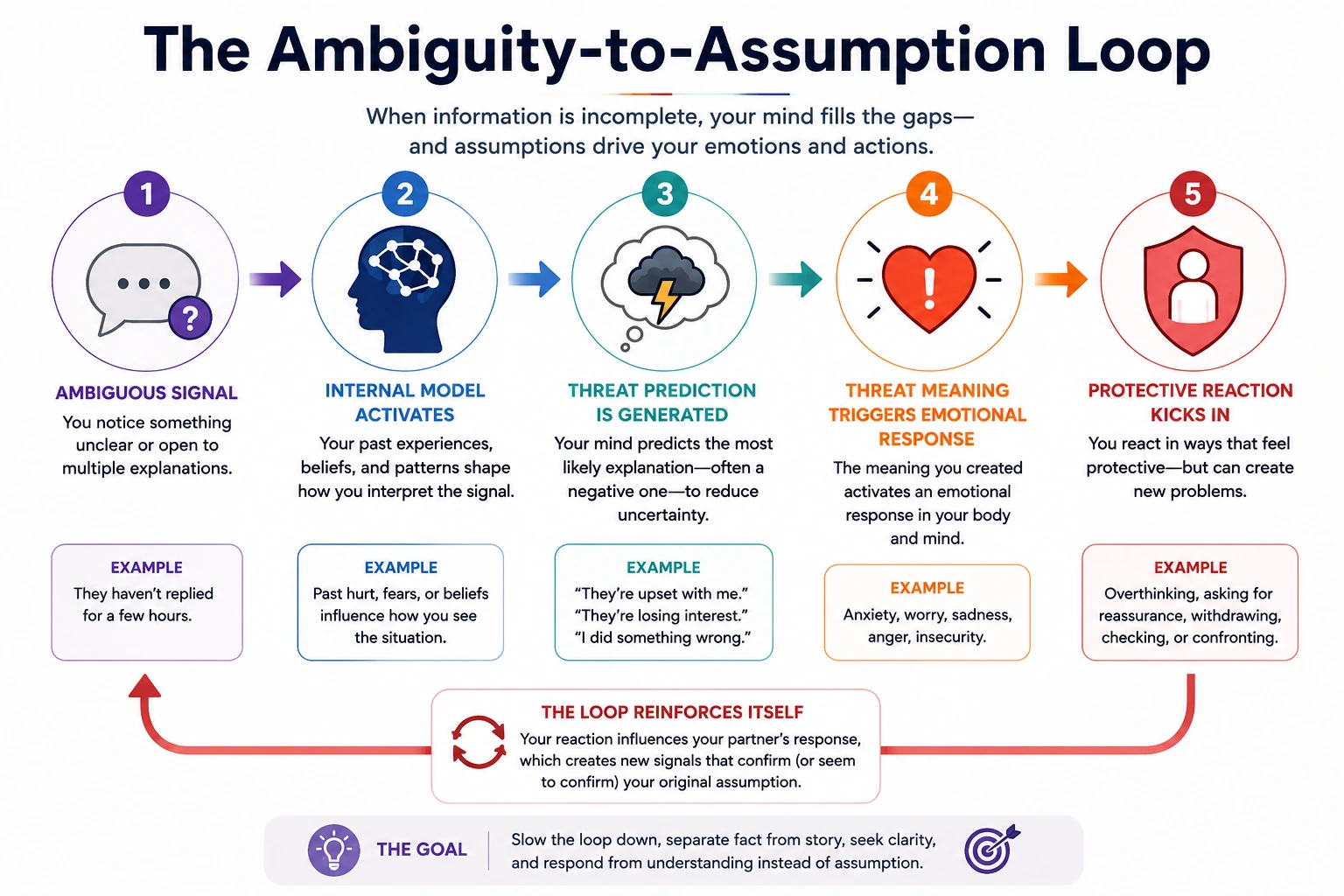
Your Brain Hates an Information Vacuum
People rarely experience raw events without interpretation. The mind continuously uses context and prior knowledge to decide what is probably happening. That ability is useful: it lets you act without rebuilding reality from zero every second.
But prediction becomes risky when missing information is mistaken for negative evidence.
Consider:
- Signal: Your partner has not replied for three hours.
- Missing information: You do not know what they are doing, why they are unavailable, or whether they have even seen the message.
- Prediction: “They are deliberately ignoring me.”
- Meaning: “They do not care.”
- Reaction: You check repeatedly, withdraw, send an accusing message, or seek reassurance.
The prediction may eventually prove correct, partially correct, or completely wrong. The problem is not that your mind formed a hypothesis. Minds have to form hypotheses. The problem begins when a hypothesis quietly becomes a verdict.
This is closely related to the idea of an internal model of reality: the mental structure you use to interpret what you cannot directly know. If you want to understand why some information stands out while other information disappears, see what mental filters are.
The Difference Between What Happened and What You Think It Means
One of the fastest ways to reduce worst-case thinking is to separate an observation from the story attached to it.
An observation can usually be described without claiming to know another person’s motives:
- “They canceled our plans.”
- “Their message was shorter than usual.”
- “They said they needed time alone.”
- “They seemed distracted during our call.”
A story adds intention, prediction, or hidden meaning:
- “They canceled because they do not want to see me.”
- “Their short message means they are angry.”
- “They need time alone because the relationship is failing.”
- “They were distracted because I am no longer important.”
The story is not automatically false. It is simply not the same category of information as the fact.
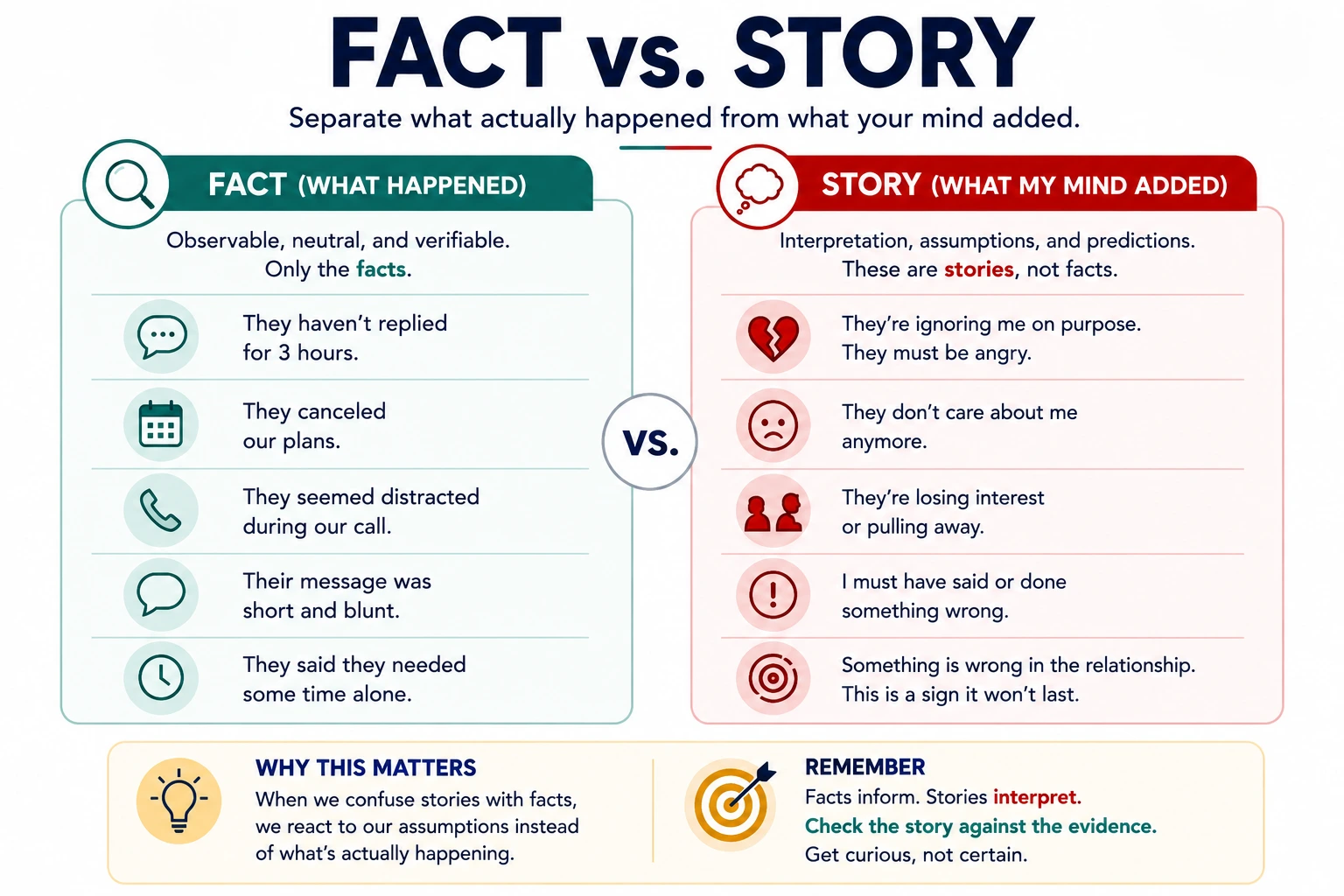
A useful rule: facts inform; stories interpret.
You do not need to suppress the story. Make it visible enough to test it.
Negative Attribution: When Ambiguity Becomes Bad Intent
Sometimes the mind does more than predict a negative outcome. It assigns negative intent.
“They forgot” becomes “They did not care enough to remember.”
“They were quiet” becomes “They are punishing me.”
“They needed space” becomes “They are trying to make me anxious.”
Psychologists use terms such as negative partner attributions and, in some contexts, hostile attribution bias to describe patterns in how people explain another person’s behavior. Researchers have even developed and validated a relationship-specific measure called the Hostile Attributions in Romantic Relationships Test. See the validation research.
A 2026 cross-cultural study in the United Kingdom, China, and New Zealand found that romantic hostile attribution bias was positively related to attachment anxiety and avoidance and helped explain part of their association with relationship satisfaction. The finding does not mean that attachment insecurity causes every negative interpretation, but it strengthens the case for examining how learned expectations shape ambiguous relationship signals. Li et al., 2026.
A 2021 study of married couples also found that negative attributions about undesirable partner behavior changed how physiological reactivity during conflict related to relationship satisfaction. The important point is not that emotion is bad; it is that the meaning assigned to a partner’s behavior can shape the relational consequences of that emotion. Adamo et al., 2021.
This is why the question “Why did they do that?” can matter as much as “What did they do?”
Why Past Experiences Change the Meaning of Present Signals
Your present relationship is happening now, but your interpretation system was built over time.
If uncertainty repeatedly preceded rejection, betrayal, criticism, withdrawal, or unpredictable conflict in previous relationships, ambiguity may begin to feel informative by itself. Your mind can learn, “When I do not know what is happening, prepare for something bad.”
That does not require a clinical diagnosis, and it does not mean every reader has trauma. It is a basic learning problem: repeated outcomes shape expectations.
Current state matters too. Stress, lack of sleep, emotional exhaustion, insecurity, and cognitive overload can make it harder to hold several explanations in mind at once. Under pressure, the most threatening story may feel unusually compelling simply because it arrives fast and demands action.
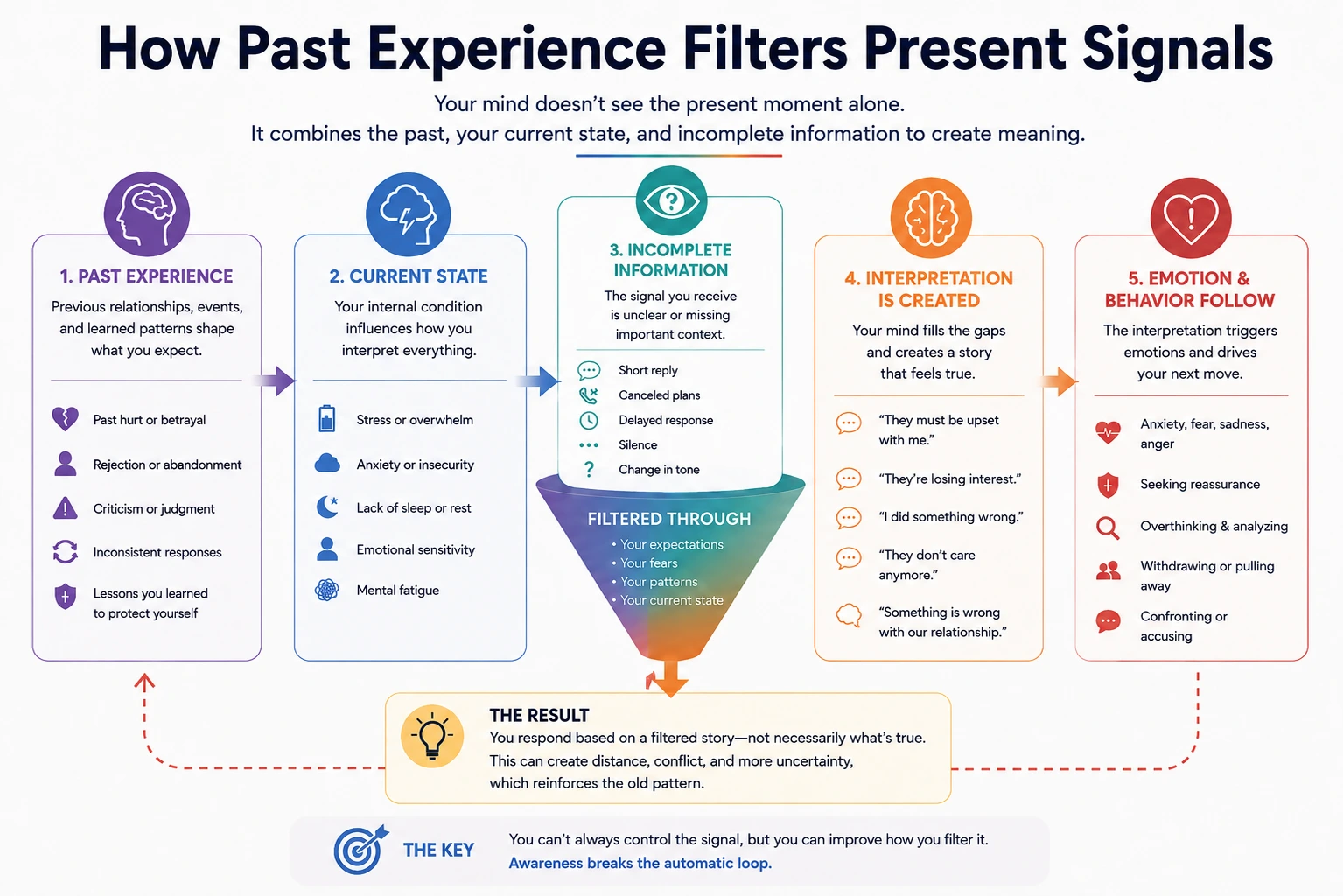
If you notice that the same moments keep replaying after conversations, the process may continue long after the interaction ends. The article on why you keep replaying conversations in your head explains how memory, interpretation, and rumination can reinforce one another.
The Relationship Assumption Cycle
Worst-case thinking becomes especially powerful when it starts changing the very relationship you are trying to understand.
A simplified cycle looks like this:
- Something ambiguous happens.
- You assume a negative meaning.
- The assumption triggers anxiety, hurt, anger, or insecurity.
- You withdraw, confront, check, test, or seek reassurance.
- Your partner reacts to your reaction.
- Their reaction becomes a new signal that seems to confirm the original assumption.
For example, you interpret a delayed reply as rejection. You send an accusing message. Your partner becomes defensive. Their defensiveness now feels like proof that something was wrong all along.
But the defensiveness may partly be a response to the accusation. The relationship has become a feedback system.
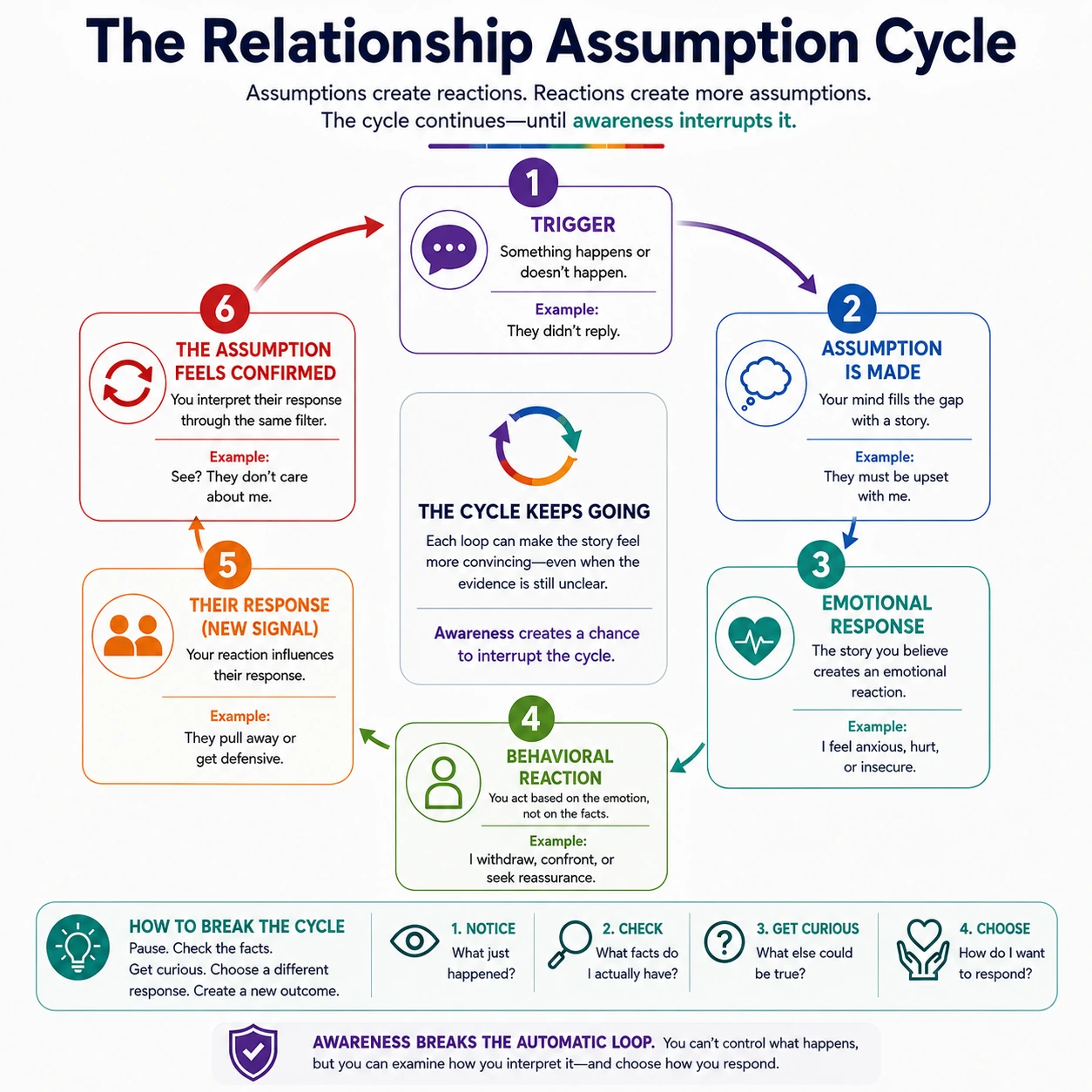
The aim is not to become emotionless. It is to create enough awareness that the cycle is no longer completely automatic.
Why Reassurance Helps—But Sometimes Only Briefly
Reassurance can be healthy. People in close relationships naturally ask each other for clarification, comfort, and confirmation.
The difficulty comes when reassurance is asked to do an impossible job: eliminate all uncertainty.
You ask, “Are we okay?” Your partner says yes. You feel better for ten minutes. Then another detail appears: their tone, a pause, a message without an emoji, a plan they did not mention. The mind produces a new question, and reassurance is needed again.
In that pattern, reassurance is not providing information once. It is repeatedly trying to make uncertainty disappear.
If this feels familiar, see why you may need reassurance for every decision. The same mechanism can operate in relationships: repeated checking reduces distress briefly without necessarily improving your ability to evaluate the underlying signal.
Is It Intuition, Threat Prediction, or Evidence-Based Concern?
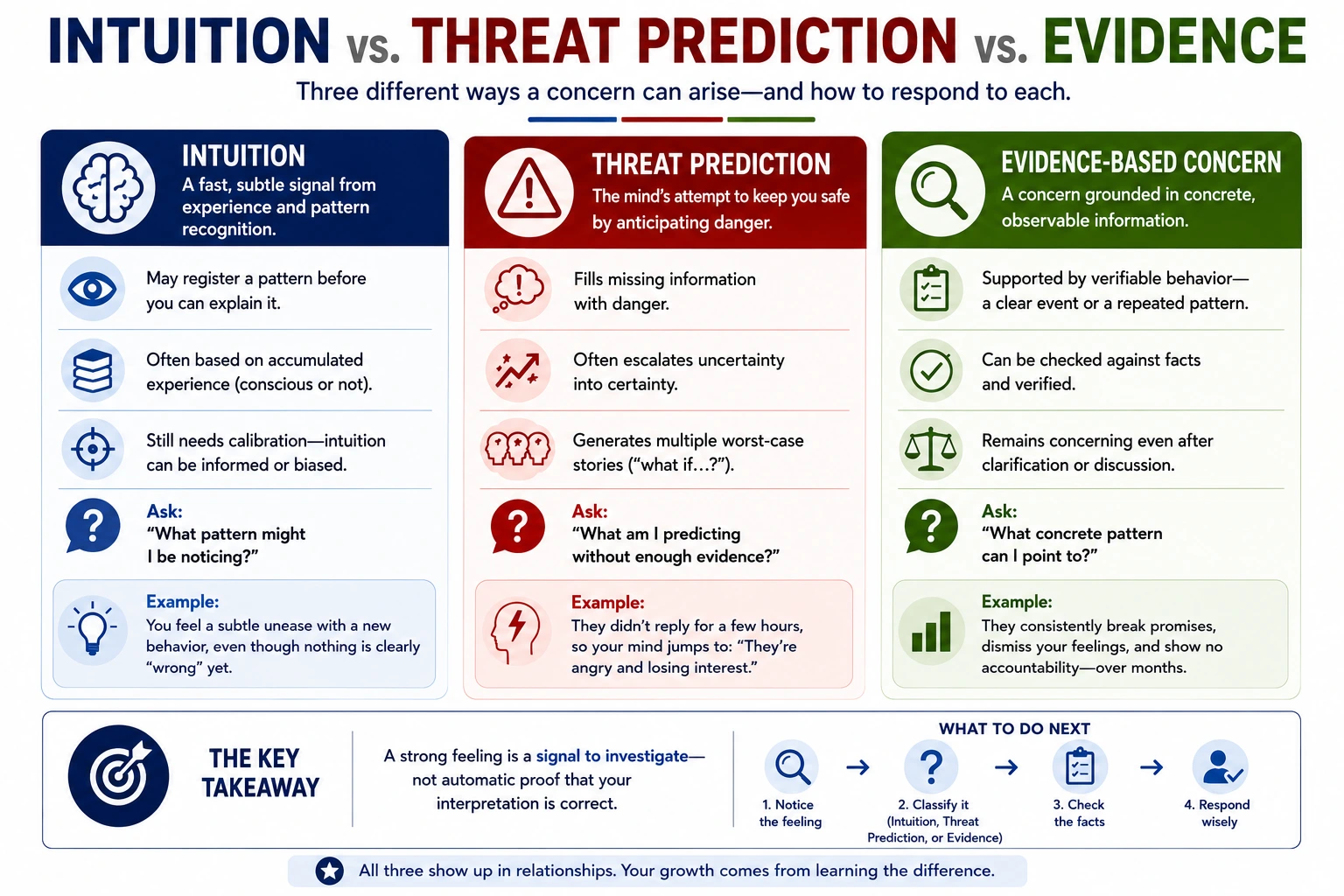
This distinction matters because “I have a bad feeling” can describe several very different processes.
Intuition
Intuition can be understood as a fast signal influenced by experience and pattern recognition. You may notice that something is different before you can consciously explain which cues produced the impression. But intuition still needs calibration: experience can be informative, and it can also contain bias.
Ask: What pattern might I be noticing?
Threat prediction
Threat prediction fills uncertainty with danger. It often converts “I do not know” into “I know something bad is happening.” It may generate multiple worst-case scenarios and create a strong urge to act before more information is available.
Ask: What am I predicting without enough evidence?
Evidence-based concern
Evidence-based concern is grounded in concrete, observable information. That can be a clear single event—such as an explicit lie, threat, or boundary violation—or a repeated behavioral pattern. The concern remains connected to facts you can identify rather than only to the intensity of the feeling.
Ask: What concrete event or pattern can I point to?
This is also why the simple idea that “intuition is calm and anxiety is loud” is not reliable enough. Genuine concerns can feel intense, and intuitive pattern recognition can occur under stress. The better question is how the signal behaves when you compare it with evidence and alternative explanations.
For a deeper distinction, see intuition or anxiety and how to stop mistaking stress signals for inner wisdom. If you want the broader science-based framing, intuition as pattern recognition under uncertainty develops that model further.
Sometimes the Worst-Case Interpretation Is Not “Just Overthinking”
Reality-checking should never become a method for talking yourself out of concrete evidence.
Do not use “maybe I am overthinking” to explain away repeated dishonesty, coercion, threats, contempt, manipulation, explicit boundary violations, controlling behavior, or other conduct that gives you a concrete reason for concern.
Relationship perception research is more nuanced than “trust your feelings” versus “ignore your feelings.” A major review found evidence for both accuracy and bias in romantic-partner judgments, and other longitudinal research has warned that overly benevolent interpretations can be harmful in already troubled relationships if they reduce motivation to address real problems. Fletcher & Kerr, 2010; McNulty et al., 2008.
Reality-checking is not self-gaslighting. The purpose is to distinguish uncertainty from evidence—not to reinterpret clear harmful behavior until it feels acceptable.
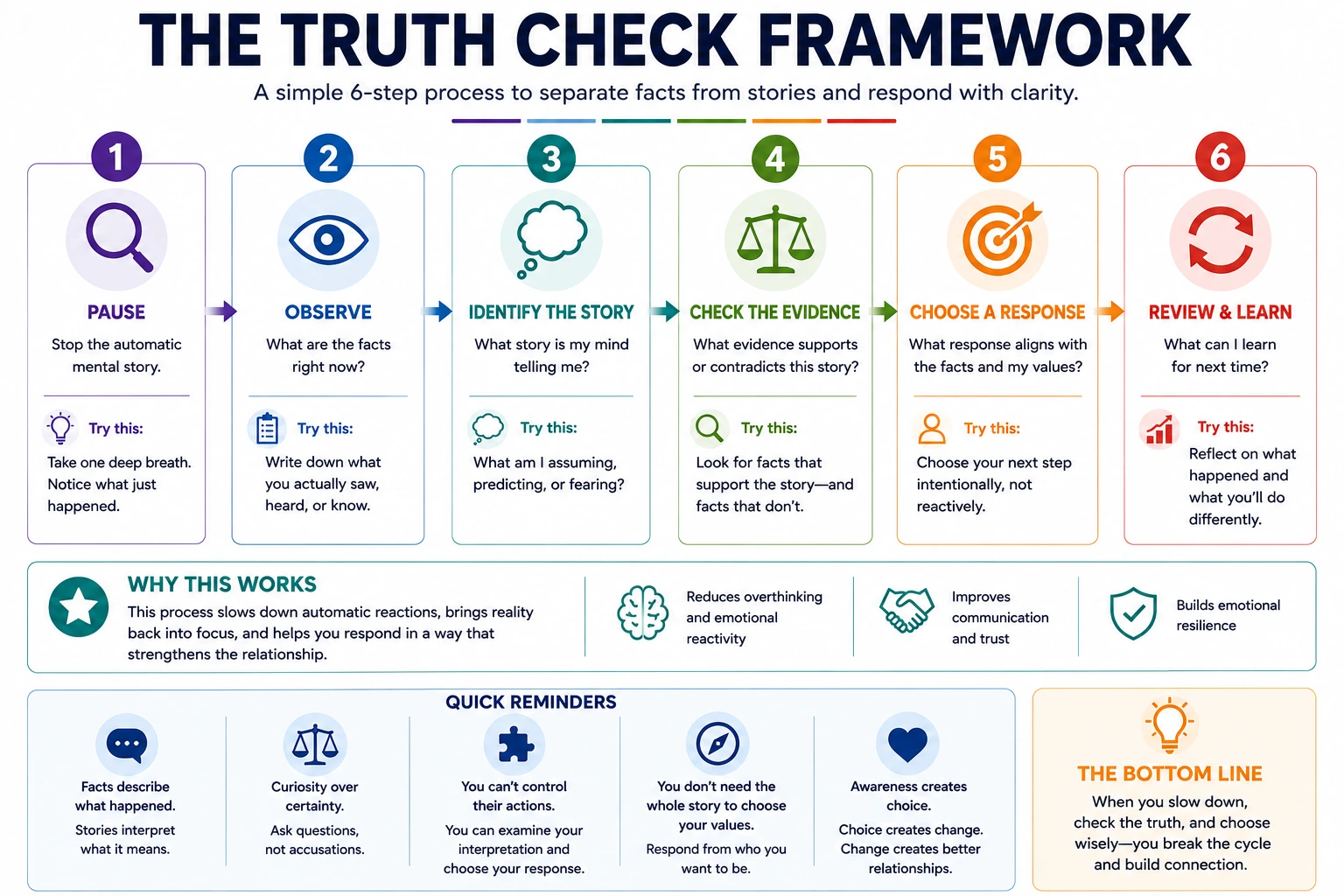
The Truth Check Framework: What to Do Before You Believe the Worst-Case Story
Intuition Management uses the Truth Check Framework as a practical way to slow the move from ambiguous signal to confident story. It is not a diagnostic tool; it is an evidence-checking sequence for turning uncertainty into a clearer next action.
When your mind has already moved from a small signal to a large conclusion, trying to “just stop overthinking” is usually too vague. Use a concrete process instead.
1. Pause
Interrupt the automatic story for a moment. One slow breath is enough to create a small gap between the signal and your next action.
2. Observe
Write or say what you actually know. Use language a camera or recording could verify where possible.
Example: “They have not replied since 1 p.m.”
3. Identify the story
Name what your mind added.
Example: “I am assuming they are angry and losing interest.”
4. Check the evidence
Look for evidence that supports the interpretation and evidence that does not. The goal is not to force a positive answer. It is to prevent one explanation from becoming certain simply because it arrived first.
5. Consider alternative explanations
Generate at least two other plausible possibilities: busy, tired, distracted, dealing with something private, needing space, phone unavailable, or simply communicating differently today.
6. Choose a response
Ask what action fits the facts, your values, and the relationship you want to build. Sometimes that means waiting. Sometimes it means asking directly. Sometimes it means setting a boundary.
7. Review and learn
When you eventually learn what happened, compare the outcome with your original prediction. This is how interpretation becomes calibrated instead of merely repeated.
How to Talk About It Without Accusing Your Partner
Once you have separated the observation from the interpretation, communication becomes easier.
Compare these two openings:
Accusation: “Why are you ignoring me?”
Observation + reaction + question: “I noticed we have barely spoken today, and I caught myself assuming something was wrong. Is everything okay between us?”
The second version does not pretend you have no feelings. It simply avoids presenting an unverified motive as a fact.
A useful pattern is:
Observation → internal reaction → request for information.
This keeps communication open while still taking your concern seriously.
How to Stop Automatically Assuming the Worst in a Relationship
You do not need to become a permanently positive thinker. In fact, replacing every negative story with a positive story can be another form of guessing.
Instead, practice these shifts:
- Slow interpretation. Give facts a chance to arrive before certainty does.
- Separate behavior from intention. “They did X” and “They did X because…” are different claims.
- Generate competing explanations. A mind with only one explanation will mistake plausibility for proof.
- Look for patterns, not isolated moments. Repeated evidence deserves more weight than one ambiguous cue.
- Ask directly when information is available. Curiosity often provides better data than monitoring.
- Notice repetitive reassurance seeking. Ask whether you are obtaining new information or only briefly reducing uncertainty.
- Review your predictions. Calibration requires feedback.
If worst-case thinking has also weakened your confidence in your own judgment, why you do not trust yourself and why you second-guess yourself are useful next steps.
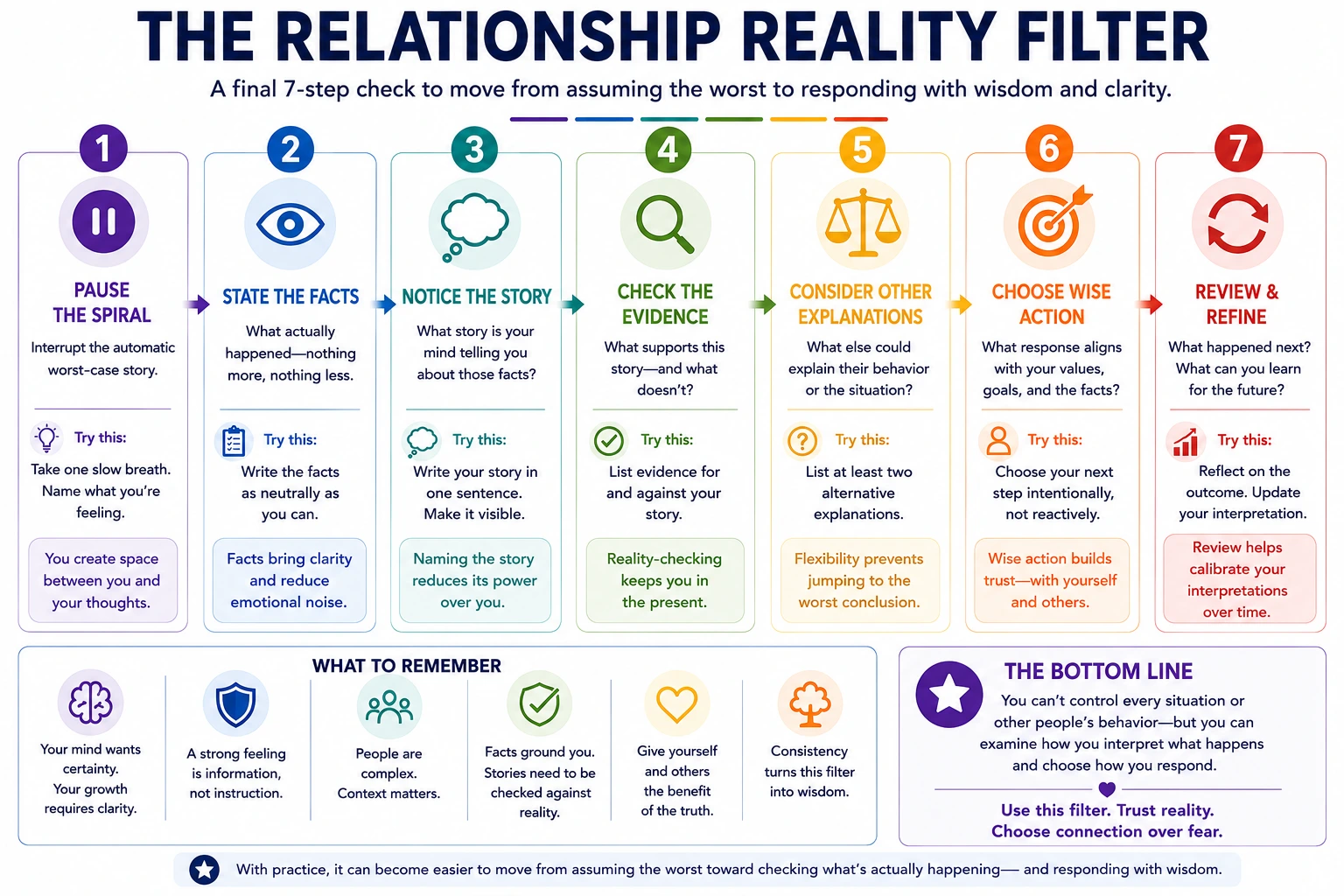
The Relationship Reality Filter is Intuition Management’s compact review tool for the same process: pause, separate facts from story, test the evidence, consider alternatives, choose a response, and learn from what actually happened.
The Goal Is Not to Think Positively
Trying to replace “They are losing interest” with “Everything is definitely fine” misses the point. Both statements can outrun the evidence.
The better movement is:
from certainty without evidence to curiosity with evidence.
That means you can take a feeling seriously without automatically obeying its first explanation. You can notice an intuitive signal without declaring it infallible. You can acknowledge fear without treating fear as proof. And you can recognize concrete evidence without explaining it away.
This is one of the foundations of better self-trust: not always being right, but becoming better at knowing what kind of information you actually have.
If relationship intuition itself is the question, see intuition in relationships: genuine connection vs. projection.
Related: Why Do I Interpret Everything Negatively?
Frequently Asked Questions
Why do I always assume the worst about my partner?
You may be interpreting ambiguous behavior through expectations shaped by past experiences, current stress, relationship beliefs, or repeated fears. A delayed response or different tone is real, but the meaning your mind assigns to it is still an interpretation. Separating the fact from the story makes the interpretation easier to evaluate.
Why do I assume bad intentions when nothing has happened?
When information is incomplete, the mind still tries to explain what is happening. If threatening explanations are highly available, uncertainty can quickly become an assumption about motive: “They did this because they do not care.” Try naming the observable event first, then ask what evidence actually supports the intention you assigned.
Is assuming the worst a sign of anxiety?
Anxiety can make threat-focused interpretations more compelling, but assuming the worst is not specific enough to diagnose anything. It can also reflect learned expectations, current stress, relationship conflict, or a real pattern you are beginning to notice. The useful question is whether the conclusion is grounded in evidence or mainly filling a gap in information.
Can past relationships make you expect the worst?
Yes, previous outcomes can shape present expectations. If ambiguity repeatedly preceded rejection, dishonesty, criticism, or conflict, similar uncertainty may later trigger faster negative predictions. Past learning can influence your first interpretation without determining whether that interpretation is correct now.
How do I stop assuming my partner is upset with me?
Start by stating what you actually observed, such as “their message was shorter than usual.” Then name the story: “I am assuming they are upset.” Check evidence for and against it, consider other explanations, and ask directly when appropriate. The aim is not to force yourself to believe everything is fine; it is to obtain better information.
How can I tell intuition from relationship anxiety?
Do not rely only on how calm or intense the feeling is. Ask what pattern you might be noticing, what you are predicting without evidence, and what concrete facts exist. Intuition can contain useful pattern recognition, while threat prediction tends to fill uncertainty with danger. Both should be calibrated against evidence.
What is hostile attribution bias in relationships?
Hostile attribution bias describes a tendency to interpret another person’s ambiguous behavior as having hostile or harmful intent. In romantic relationships, researchers have studied and measured hostile partner attributions specifically. It does not mean every negative interpretation is wrong; it describes a pattern in how ambiguous motives are assigned.
When should I trust that something really is wrong?
Give greater weight to concrete and verifiable information: a clear event, repeated inconsistency, explicit dishonesty, boundary violations, threats, coercion, or other observable behavior. A strong feeling can alert you to investigate, but evidence helps determine what response is justified. Do not use “maybe I am overthinking” to dismiss clear harmful behavior.
Research Behind This Article
This article is educational and does not diagnose anxiety, attachment style, trauma, or any mental-health condition. Its relationship-attribution framework is informed by research on partner attributions, relationship perception, and couple conflict.
- Bradbury TN, Fincham FD. Attributions in marriage: review and critique. Psychological Bulletin. 1990.
- Fincham FD, Harold GT, Gano-Phillips S. The longitudinal association between attributions and marital satisfaction. 2000.
- Adamo C, et al. Negative Partner Attributions Moderate the Association between Heart Rate Reactivity During Relationship Conflict and Relationship Satisfaction. Family Process. 2021.
- The Hostile Attributions in Romantic Relationships Test: development and validation research.
- Fletcher GJO, Kerr PSG. Through the eyes of love: reality and illusion in intimate relationships. Psychological Bulletin. 2010.
- McNulty JK, et al. Benevolent cognitions as a strategy of relationship maintenance: “Don’t sweat the small stuff”… but it is not all small stuff. 2008.
- Li D, Carnelley KB, Crawford MT, Lin X, Rowe AC. How hostile attribution bias affects attachment anxiety/avoidance and relationship satisfaction: a cross-cultural perspective during the COVID pandemic. The Journal of Social Psychology. 2026. doi:10.1080/00224545.2026.2626036.
Editorial note: Intuition Management uses a signal-vs-noise approach: feelings and fast judgments can contain information, but their interpretation should be calibrated against context, evidence, and feedback. This article is intended for education and self-reflection, not as a substitute for individualized professional care.