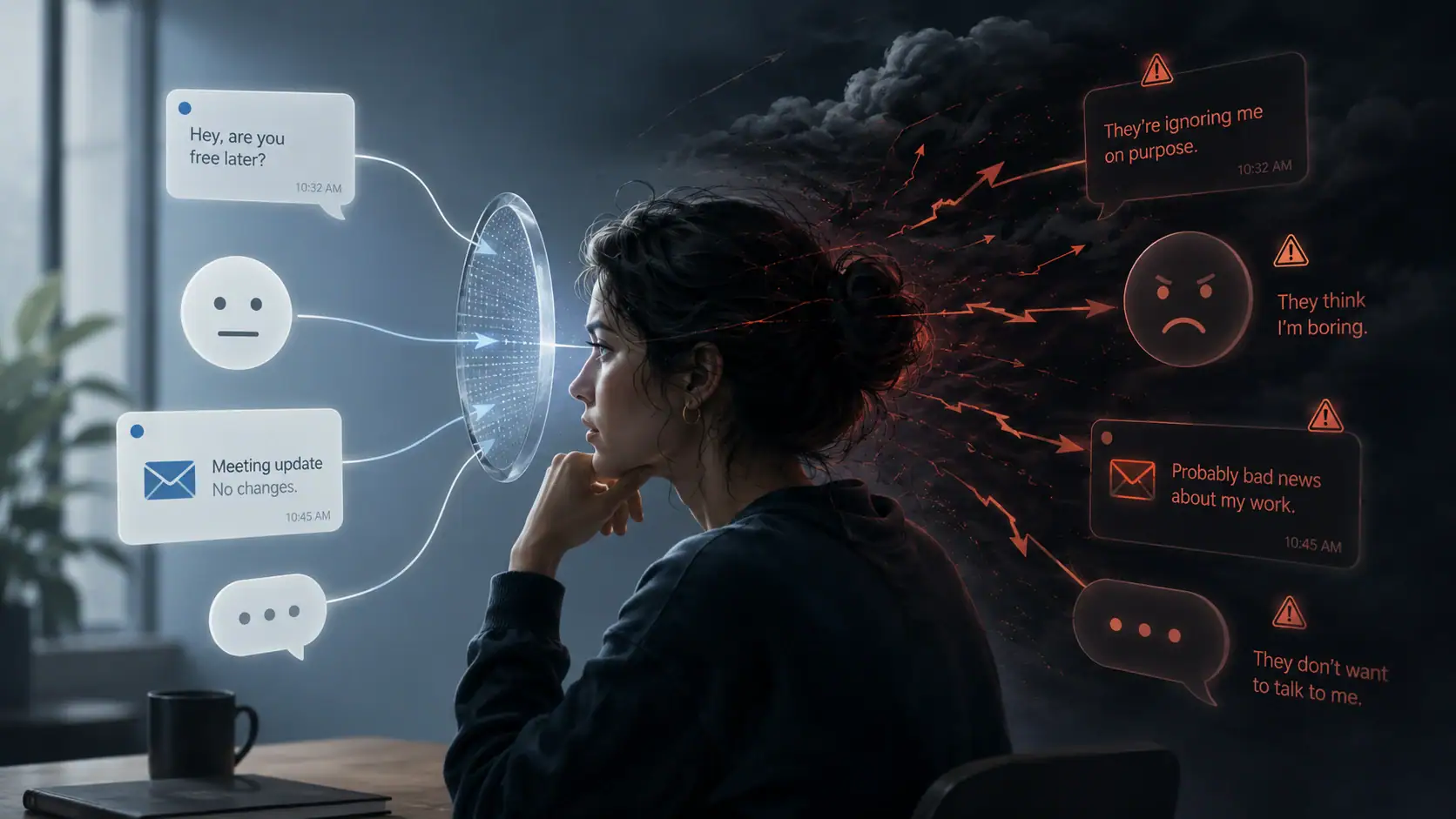
Why do I interpret everything negatively? Often, the problem is not that every situation is negative. It is that your mind has to interpret incomplete information, and the first explanation it generates can feel as if it were the event itself.
By Denys Kostin, founder and editor of Intuition Management. Published August 16, 2026 · Last updated August 16, 2026 · Sources reviewed and updated August 16, 2026.
Evidence-informed educational content. This article is not a diagnosis or a substitute for individualized medical or mental-health care.
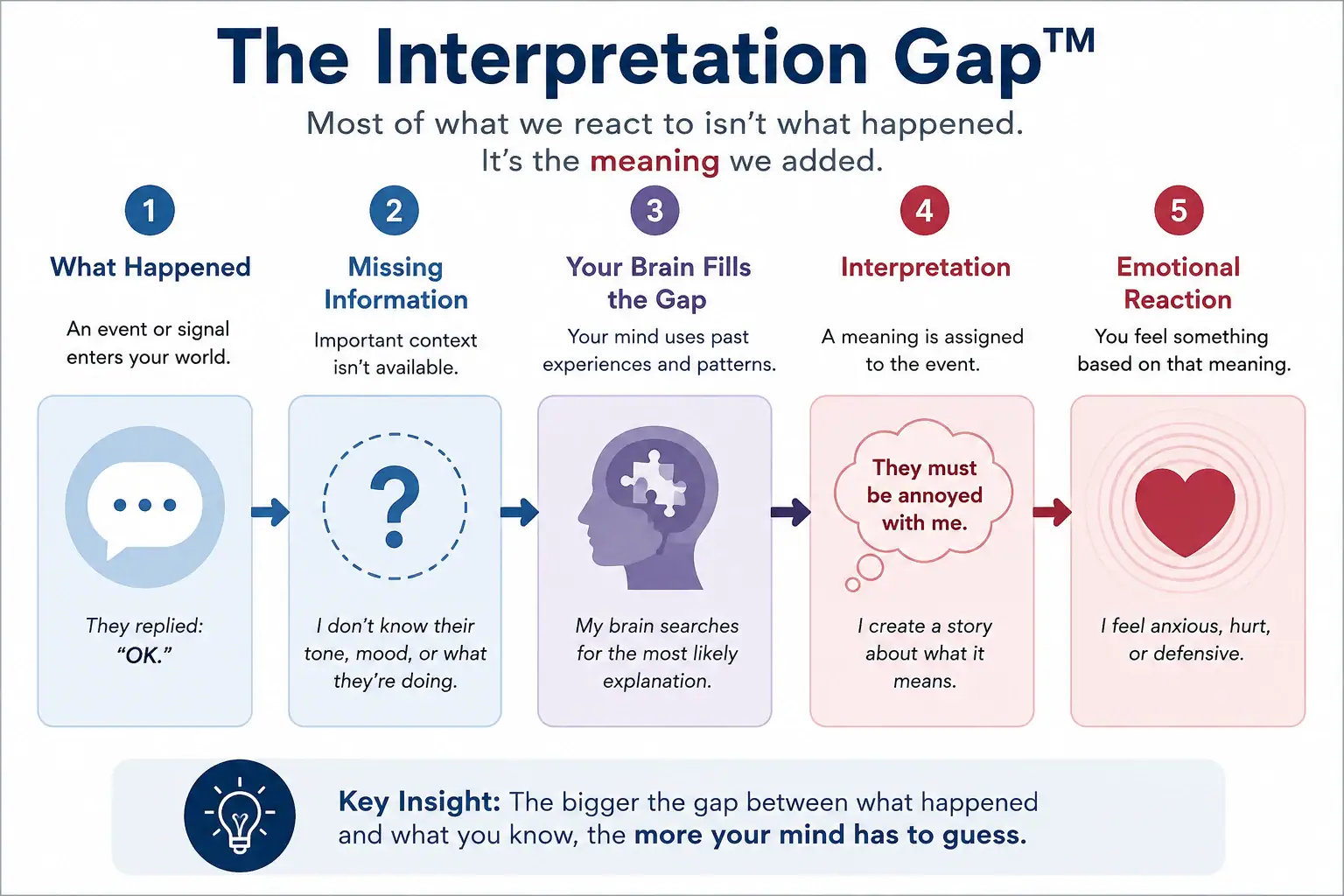
Someone replies, “OK.” A manager says, “Can we talk later?” A friend becomes quiet. A message goes unanswered. Each event contains some information—but usually not enough to tell you exactly what another person thinks, why something happened, or what will happen next.
Your brain fills that gap. Sometimes it fills it with: They are annoyed with me. I did something wrong. They are losing interest. This is going to end badly.
Psychologists study this tendency under the broader concept of interpretation bias: how people resolve ambiguous information when more than one meaning is possible. In anxiety research, a negative interpretation bias commonly refers to a tendency to choose more threatening or negative meanings for ambiguous situations.1 That does not mean every negative interpretation is false, and it does not mean having one is a diagnosis. It means the mind has moved from observation to explanation.
What is negative interpretation bias?
Negative interpretation bias is the tendency to give ambiguous situations a disproportionately negative, threatening, rejecting, or unfavorable meaning when several interpretations are possible.
The key word is ambiguous. If someone directly tells you, “I am angry,” recognizing anger is not interpretation bias. But if someone sends a shorter-than-usual message and you conclude, “They are angry with me,” your mind has supplied information that was not contained in the message itself.
Research on social anxiety provides a clear example because social information is often ambiguous: a facial expression, a pause, a yawn, a delayed response, or a short comment can have several plausible explanations. Studies have found associations between social anxiety and more negative interpretations of ambiguous social situations, and negative interpretations can be related to stronger anxiety responses during social-evaluative situations.12
A 2020 systematic review of interpretation bias in social anxiety found a consistent pattern across the literature: socially anxious participants tend to interpret ambiguous social information more negatively, while also highlighting important variation across tasks and study designs.7
The important lesson is broader than anxiety: meaning is not always delivered with the event. Often, the mind constructs it.
Why do I interpret everything negatively?
If negative interpretations happen often, there is rarely one single cause. Several cognitive processes can work together.
Your brain has to make predictions from incomplete information
Daily life does not arrive with perfect explanations attached. You rarely know another person’s exact motives, the complete context behind a decision, or every variable that shaped an outcome. Your brain still has to decide what matters and what to do next, so it uses prior knowledge to make a working prediction.
This is efficient. Without it, every uncertain moment would require starting from zero. But efficiency has a cost: a prediction can arrive so quickly that it feels like perception rather than inference.
Past experiences make some explanations easier to generate
If criticism, rejection, conflict, or unpredictability has been common in a certain context, your mind may become faster at generating explanations that fit those patterns. That does not prove the current situation is the same. It means one interpretation has become cognitively available.
This is closely related to the way mental models help you anticipate how situations work. Mental models can be useful precisely because they compress experience into expectations. The risk appears when a useful model becomes the only model you consider.
Attention is selective before interpretation even begins
You cannot process everything around you with equal depth. Selective perception means some information receives attention while other information is missed or given less weight. Then mental filters influence what feels relevant. Interpretation happens on top of that already-reduced picture.
This matters because two people can encounter the same event, notice different details, and therefore generate different meanings without either person consciously deciding to distort reality.
Uncertainty can make a definite negative answer feel safer than no answer
“I don’t know” leaves a situation open. A negative conclusion may be painful, but it can create a temporary sense of certainty: At least I know what this means. The mind may prefer a familiar explanation to unresolved ambiguity.
That is why the target is not endless doubt. The target is calibrated certainty: confidence that rises with evidence rather than with emotional intensity.
Repeated interpretations can become expectations
If you repeatedly interpret silence as rejection, correction as failure, disagreement as disrespect, or uncertainty as danger, those interpretations can gradually become default expectations. Then the expectation influences what you notice next.

The difference between what happened and what you think happened
One of the fastest ways to reduce negative interpretation bias is to separate an observable fact from an added meaning.
The interpretation may eventually turn out to be correct. The point is that it is not yet the same thing as the observation.

How negative interpretation becomes a self-reinforcing loop
A negative interpretation can influence what happens after the event. Imagine that someone does not reply to you. You interpret the silence as rejection. You become hurt and distant. When the person eventually responds, your own guarded tone changes the interaction. You then notice the awkwardness and treat it as confirmation that something was wrong all along.
This does not mean your thoughts magically create reality. It means interpretations can influence emotion, attention, behavior, information seeking, and what evidence you notice afterward.
Research on cognitive biases has long examined interpretation and attention as related but distinguishable information-processing processes.3 A practical way to understand the interaction is the Negative Interpretation Loop™:
Ambiguous event → negative meaning → emotional reaction → protective behavior → selective attention → confirming evidence → stronger expectation.
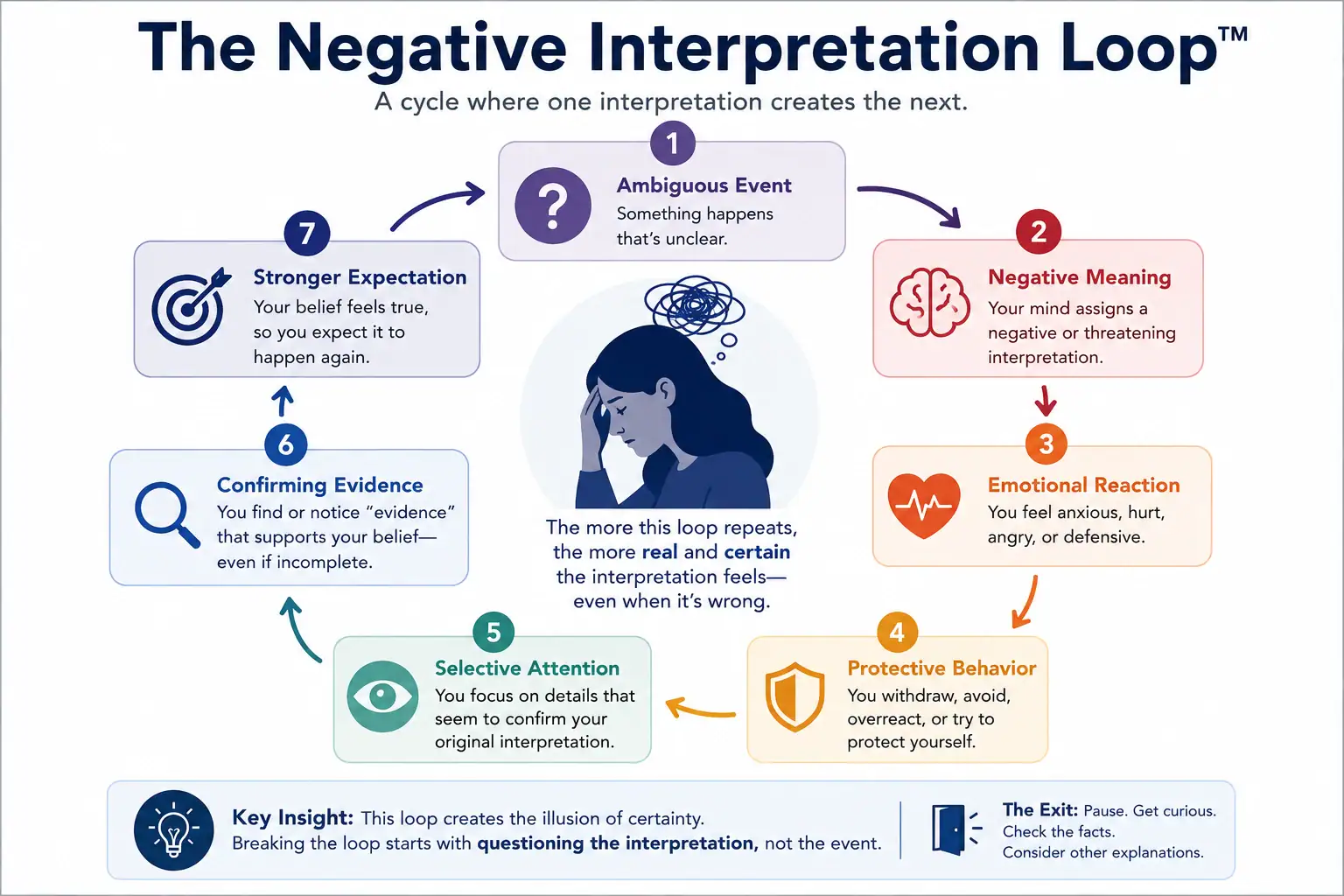
This loop is especially useful for understanding why “I just know” can become stronger even without new independent evidence. Repetition can increase familiarity. Familiarity can feel like certainty. But certainty and accuracy are not the same thing.
Interpretation bias vs negativity bias, confirmation bias, and mental filters
These concepts overlap, but they are not interchangeable. Keeping them separate helps you identify where the distortion—or simply the uncertainty—actually enters the process.
If you want the broader distinction between mental shortcuts and internal models, see Mental Models vs Cognitive Biases. The practical point here is that a negative interpretation may emerge after selective attention and then be strengthened by confirmation bias.

This also connects to your broader internal model of reality: you do not react to a complete copy of the world. You react to a usable internal representation built from limited information, attention, memory, expectations, and current context.
How negative interpretation bias appears in everyday life
In relationships
Your partner is quieter than usual. The signal is real: their behavior changed. The interpretation—They are pulling away from me—is one possible explanation. Other explanations may include fatigue, distraction, stress, pain, work pressure, or a problem unrelated to you.
If this pattern is familiar, read Why Do I Assume the Worst in Relationships?, which focuses specifically on relationship threat interpretations.
In texting and online communication
Text strips away tone, facial expression, timing context, and much of the information available in face-to-face interaction. “Sure.” can be warm, distracted, neutral, irritated, rushed, or simply brief. The less context you have, the larger the interpretation gap becomes.
At work
A manager schedules a meeting. A colleague edits your work. Someone does not respond immediately. If your default interpretation is I failed or They are unhappy with me, you may experience the emotional response before you have enough information to evaluate the situation.
In social situations
Ambiguous social cues are a major setting in interpretation-bias research. A neutral expression, awkward pause, or unclear reaction can be interpreted as negative evaluation even though several explanations remain possible.1
In decision-making
Uncertainty itself can become evidence: I feel unsure, therefore this must be the wrong choice. But uncertainty often means only that the decision contains incomplete information or meaningful trade-offs. Feeling uncertain is data about your internal state; it is not automatically proof about the external choice.
Why a negative interpretation can feel like intuition
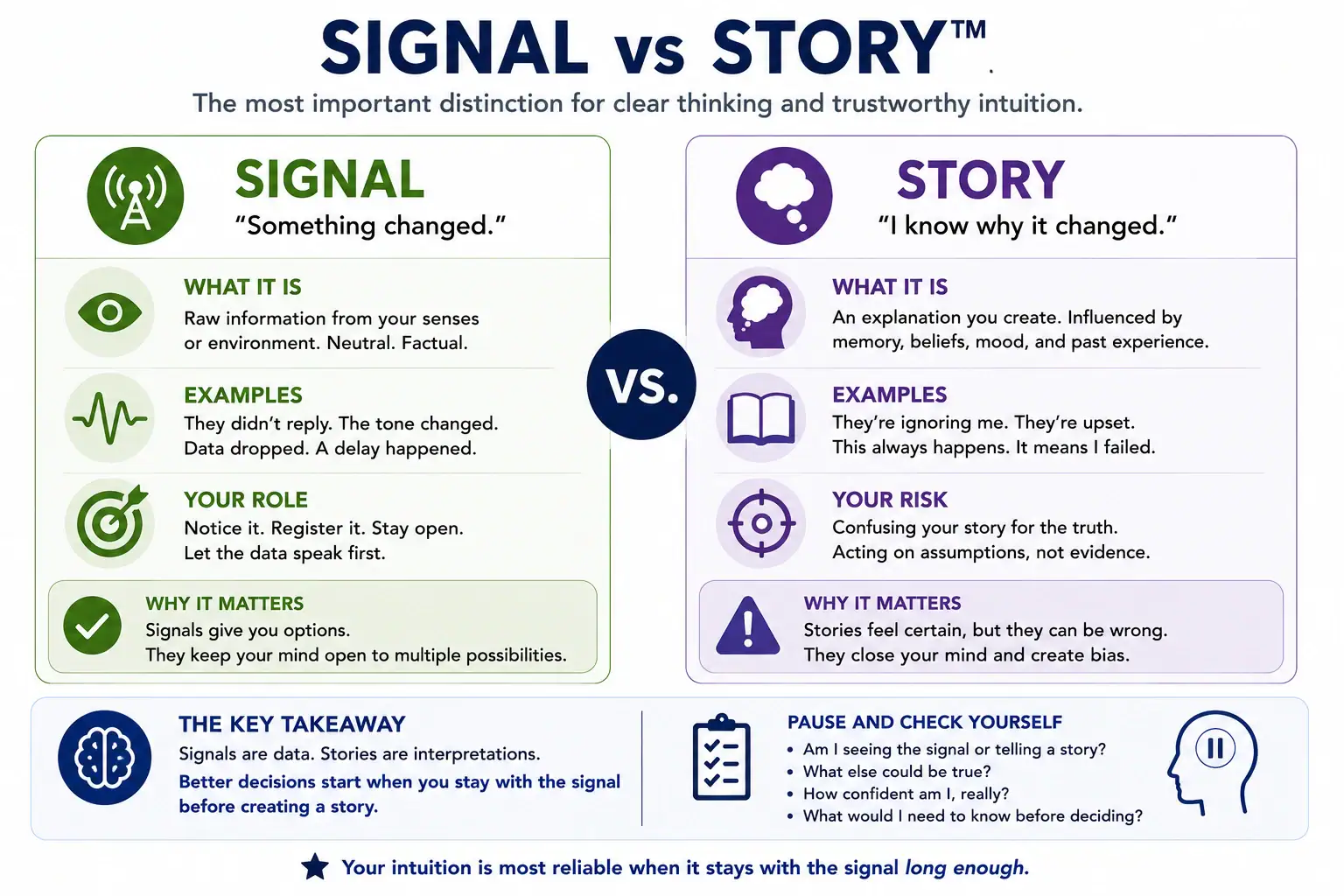
Interpretations and intuition share an important feature: both can arrive quickly, before deliberate reasoning has fully unfolded. That speed can make a negative story feel like a direct perception.
A useful distinction is:
The first may be a real observation. The second contains a causal explanation.
This does not mean intuition is merely raw sensory data. Skilled intuition can involve rapid pattern recognition built through experience. But when you want to decide whether a feeling is trustworthy, it helps to separate the detected pattern from the explanation attached to it.
That distinction is central to Signal vs Noise and Intuition or Anxiety?. A fast feeling deserves attention; it does not automatically deserve certainty.
The Interpretation Audit™: a practical way to check your first explanation
You do not need to distrust every thought. You need a method for checking how much confidence a thought deserves.
The Interpretation Audit™ is a practical seven-step framework for doing that. It is an educational reflection tool, not a clinical diagnostic instrument.
1. Notice
Catch the moment when observation becomes explanation. Ask: What happened immediately before I made this assumption?
2. Describe
Describe the event in language a camera, recording, or neutral observer could verify. Remove motive words such as “ignored,” “rejected,” “disrespected,” or “judged” unless the motive was explicitly communicated.
3. Identify filters
Ask which prior experiences, beliefs, fears, expectations, or current emotions may be shaping what feels most plausible.
4. Examine the meaning
Name your interpretation directly: I am interpreting this as rejection. Then ask why that meaning seemed plausible to you.
5. Consider alternatives
Generate at least two other explanations that fit the known facts. They do not have to be positive. They only have to be possible.
6. Check the impact
Notice what the interpretation is making you want to do: withdraw, accuse, check repeatedly, seek reassurance, over-explain, avoid, or react immediately.
7. Choose consciously
Choose the interpretation and response best supported by the available evidence. If the evidence is weak, your conclusion should remain provisional.

A shorter version works when you are under pressure:
What am I assuming?
What else could explain this?
What evidence would help me tell the difference?
This is not about arguing with yourself until every concern disappears. It is about turning a single interpretation into a testable hypothesis.
You do not need a positive interpretation—you need a calibrated one
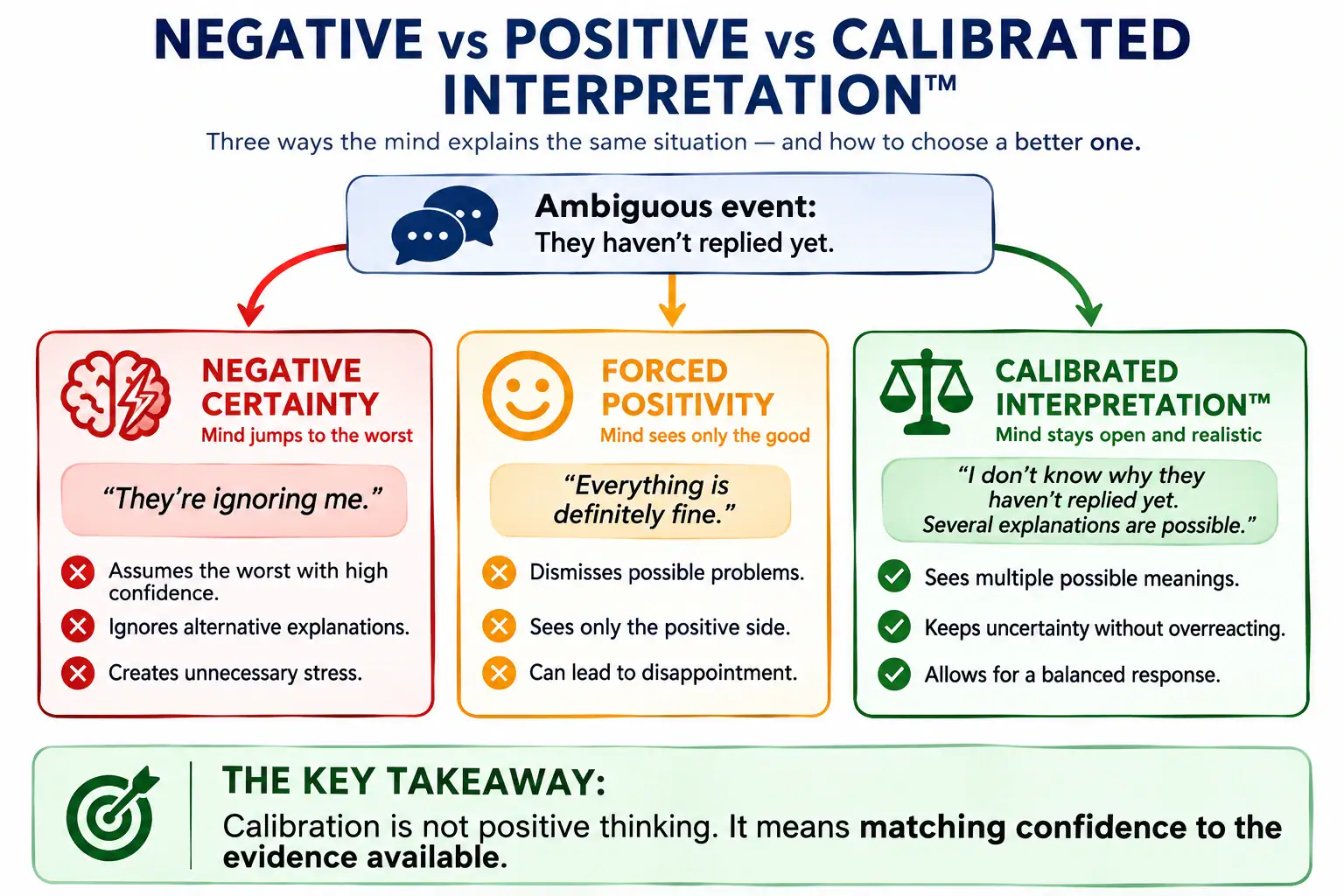
A common mistake is to replace one certainty with another.
Negative certainty: “They are ignoring me.”
Forced positivity: “Everything is definitely fine.”
Calibrated interpretation: “They have not replied yet. I do not know why. Several explanations are still possible.”
Forced positivity can be just as uncalibrated as catastrophizing because both claim more certainty than the evidence supports. The goal is not to find the nicest explanation. It is to match your confidence to the quality of the evidence.
Can interpretation bias change?
Interpretation habits are not necessarily fixed. Experimental research using cognitive bias modification for interpretation (CBM-I) has shown that interpretation patterns can be shifted under controlled conditions, although findings about broader emotional or clinical outcomes are mixed across studies and populations.45
That nuance matters. A single exercise is not a cure, and a diagram is not therapy. But the research supports a useful principle: the way ambiguous information is interpreted is a process that can be examined and, in some contexts, modified.
A 2025 living systematic review of cognitive bias modification for social anxiety also found that the intervention literature is heterogeneous: some approaches can change targeted cognitive biases, but effects on symptoms and broader outcomes are not uniformly strong. That supports a cautious conclusion—interpretation patterns are modifiable, but changing a bias is not the same as guaranteeing a clinical benefit.8
For everyday self-calibration, the practical target is repeated practice: noticing interpretations, testing them against evidence, collecting outcomes, and updating your expectations. That is closer to learning than to “thinking positive.”
When should you trust your interpretation?
Not every interpretation deserves the same confidence. Treat confidence as something that should rise as independent evidence accumulates.
Low evidence: hold it loosely
A feeling, first impression, single cue, delayed reply, unusual tone, or one uncomfortable moment may be worth noticing. It is not enough, by itself, to establish motive or cause.
Middle evidence: test alternatives
Repeated patterns matter more than isolated events. Context matters more than a decontextualized cue. Independent information that points in the same direction should increase your confidence—but you should still ask whether another explanation fits the evidence.
Stronger evidence: trust it more
Direct clarification, consistent patterns across contexts, independent corroboration, and interpretations that repeatedly predict what later becomes clear deserve more weight.
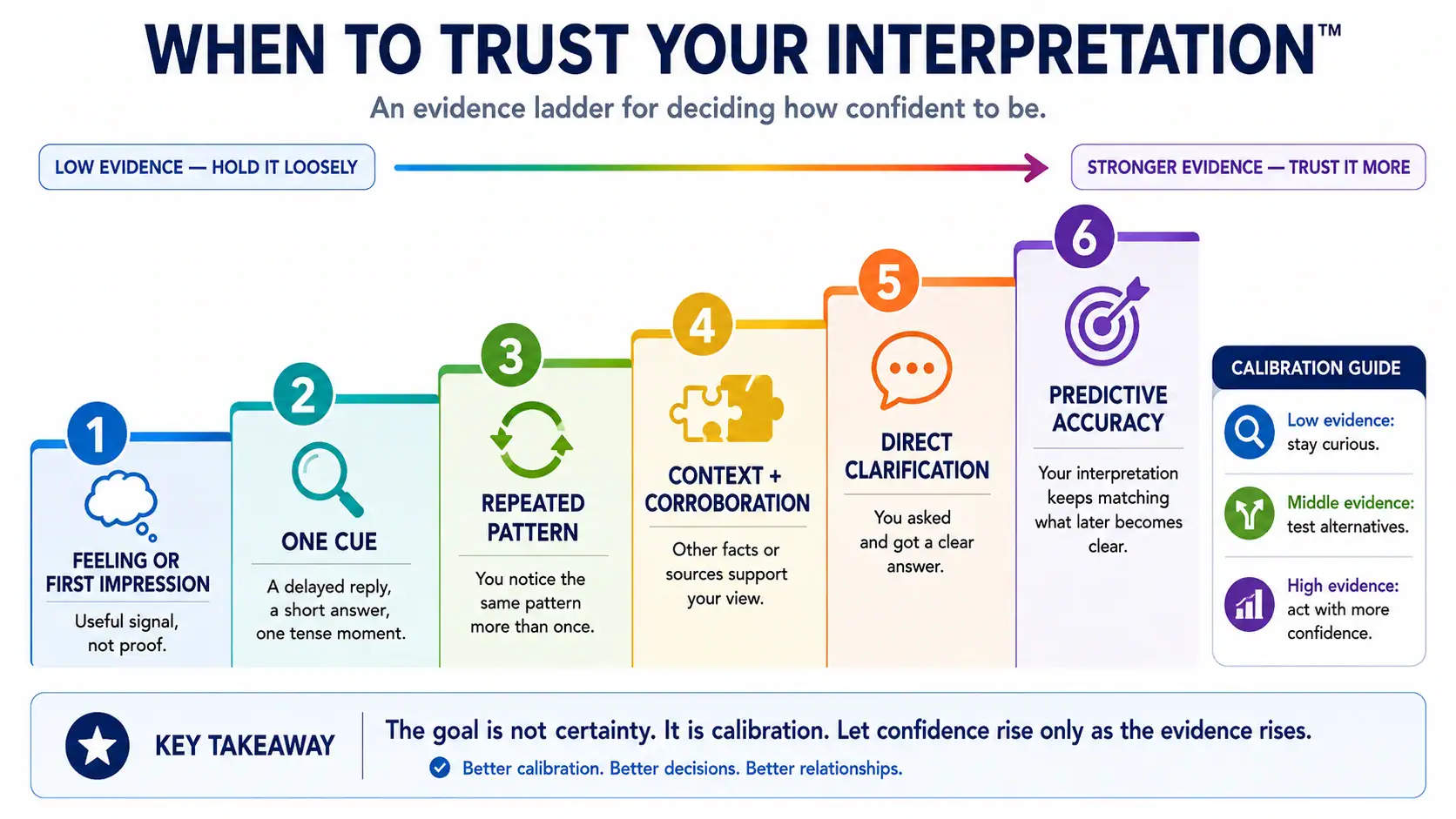
One reason this step matters is that interpretation-bias research itself is methodologically nuanced: different tasks do not always measure the construct equally well, and findings can vary across samples and measures.6 That is a useful reminder for everyday life too. Confidence should reflect the strength of the evidence, not merely the strength of the feeling.
How to stop interpreting everything negatively
If you want a compact practice to use in real situations, use this sequence:
- Separate the event from your explanation. Write down only what you can verify.
- Label the first interpretation as a hypothesis. “My current explanation is…”
- Name the filter. Ask whether fear, previous experience, self-image, or an existing belief is making one meaning especially available.
- Generate alternatives. Find at least two explanations that fit the same facts.
- Look for discriminating evidence. Ask what information would make one explanation more likely than the others.
- Delay irreversible reactions when evidence is incomplete. You can notice a feeling without immediately acting from its explanation.
- Track predictions. If you repeatedly predict rejection, criticism, or failure, record what actually happens. Calibration requires feedback.
If your pattern is specifically about catastrophic assumptions, Why Do I Always Assume the Worst? explores that question directly. If you constantly doubt your own conclusions after making a decision, The Personal Signal Decoder can help you separate recurring internal signals from noise.
When negative interpretation is affecting your life
Negative interpretations are common and do not automatically indicate a mental-health condition. Consider seeking qualified professional support if interpretations repeatedly create substantial distress, drive avoidance or compulsive checking, damage relationships, interfere with work or daily functioning, or feel impossible to examine even when contradictory evidence is available.
A clinician can help distinguish a normal cognitive habit from patterns related to anxiety, depression, trauma, or other concerns. This article is educational and should not be used to diagnose yourself or someone else.
Frequently asked questions
Why do I automatically interpret things negatively?
Your first interpretation can be shaped by prior experiences, expectations, selective attention, current emotional state, threat sensitivity, and existing mental models. Because the process can happen quickly, the interpretation may feel like a direct reading of reality rather than one possible explanation.
What is negative interpretation bias?
Negative interpretation bias is a tendency to resolve ambiguous information in a more negative or threatening direction when multiple interpretations are possible. It has been studied extensively in relation to anxiety and ambiguous social information.1
Why do I assume people have bad intentions?
When another person’s motive is unclear, your mind may use previous experiences and expectations to fill in the missing information. If threat-based explanations are highly available, bad intentions may become the first explanation you generate. The first explanation is still a hypothesis until evidence supports it.
Is interpretation bias the same as negativity bias?
No. Interpretation bias concerns the meaning assigned to ambiguous information. Negativity bias is a broader tendency for negative information or outcomes to receive greater attention or psychological weight. They can interact, but they describe different processes.
Why do I assume the worst when someone does not reply?
A missing reply contains very little causal information. Your brain therefore has a large interpretation gap to fill. If rejection, conflict, or uncertainty is especially salient to you, those explanations can become easier to generate than neutral alternatives.
Can anxiety make you interpret things negatively?
Research has repeatedly linked anxiety—especially social anxiety—with more negative interpretations of ambiguous situations, although the strength of the relationship varies by population and measurement method.26
How do I know if it is intuition or I am assuming the worst?
Separate the signal from the story. “Something changed” may be a useful observation. “I know exactly why it changed” is an interpretation. Then ask what evidence supports the explanation, what alternatives remain possible, and whether your interpretation has shown reliable predictive accuracy over time. For a deeper comparison, see When Intuition Is Wrong.
How do I stop taking neutral things negatively?
Practice describing the event factually, naming the interpretation separately, generating plausible alternatives, and matching confidence to evidence. The goal is not to convince yourself that everything is positive. The goal is to stop treating an untested interpretation as a fact.
The deeper shift: from certainty to calibration
The most useful question is not, “How do I make myself stop thinking negatively?”
It is:
That shift changes the task. You no longer have to win an argument against every negative thought. You only have to place the thought in the right category: observation, interpretation, prediction, or evidence.
Some negative interpretations will be correct. Some positive interpretations will be wrong. A calibrated mind does not demand optimism. It keeps enough uncertainty open to learn.
The goal is not certainty. It is calibration. Notice the signal. Separate it from the story. Let evidence change your confidence—and let new information change your mind.
Research references
- Beard C, Amir N. Interpretation in Social Anxiety: When Meaning Precedes Ambiguity. Research on interpretation of ambiguous social information and social anxiety. PubMed Central.
- Beard C, et al. Negative Interpretation Bias Mediates the Effect of Social Anxiety on State Anxiety. Study of negative interpretations and anxiety response to social-evaluative threat. PubMed Central.
- Beard C. Cognitive Bias Modification for Anxiety: Current Evidence and Future Directions. Review discussing attention and interpretation biases as related cognitive processes. PubMed Central.
- Joormann J, et al. Cognitive Bias Modification for Interpretation in Major Depression. Experimental evidence that interpretation bias can be modified, with corresponding changes in other responses. PubMed Central.
- de Voogd EL, et al. A randomized controlled trial of two types of interpretation bias modification for adolescents. Findings illustrate that CBM-I results can be mixed across outcomes. PubMed Central.
- Duken SB, et al. Reliability and validity of four cognitive interpretation bias measures. Research highlighting variability in interpretation-bias measurement and findings. PubMed Central.
- Chen J, Short M, Kemps E. Interpretation bias in social anxiety: A systematic review and meta-analysis. Systematic synthesis of research on negative interpretation of ambiguous social information. PubMed.
- Kennett J, et al. Cognitive bias modification for social anxiety. Living systematic review evaluating cognitive-bias modification approaches and outcomes. PubMed.
Editorial note: The Interpretation Gap™, Negative Interpretation Loop™, From Perception to Belief™, Six Mental Filters That Shape Interpretation™, Interpretation Audit™, Signal vs Story™, and When to Trust Your Interpretation™ are explanatory frameworks used in this article to organize established psychological concepts. They are not diagnostic instruments or validated clinical scales.
Leave a Reply
You must be logged in to post a comment.