By Denys Kostin · August 15, 2026
Your brain does not simply record reality. It uses prior experience, expectations, attention, and learned patterns to interpret what is happening. Those internal models can make perception faster and more useful—but they can also make an outdated interpretation feel obvious.

Imagine receiving a short message from someone important to you: “Can we talk tomorrow?”
The words are the same for everyone who reads them. Yet one person may immediately notice danger: Something is wrong. I must have done something. Another may interpret the message as routine coordination. A third may simply think, I do not have enough information yet.
The difference is not necessarily in the message. It is often in the mental model used to interpret it.
That is the central answer to the question of how mental models shape perception: we do not approach every situation as a blank slate. The brain uses prior knowledge and expectations to decide what deserves attention, what a signal probably means, and what action is likely to make sense. Research on top-down processing and predictive perception supports the broader idea that expectations and prior knowledge can influence attention and sensory interpretation (Gilbert & Li, 2013; Shurygina et al., 2019), although scientists continue to debate the scope and mechanisms of predictive-processing theories.
What Is a Mental Model?
A mental model is a simplified internal representation of how something works. It may represent a person, a relationship, a workplace, a risk, a market, a social rule, or an entire category of situations. Instead of rebuilding an explanation from zero each time, the mind uses accumulated experience to generate a workable prediction.
If you want the full foundation, start with What Are Mental Models?. The important point here is that mental models are not only abstract beliefs. They influence what you expect to happen next—and expectations can influence what you notice.
A useful model compresses complexity. When you enter a familiar restaurant, for example, you do not consciously calculate what every object means. You already have a model of menus, tables, ordering, payment, and social behavior. That model saves cognitive effort and lets you focus on what is unusual or relevant.
The same process applies to less concrete situations. If your working model is “feedback helps me improve,” a critical comment may attract information about what to change. If your model is “criticism means rejection,” the same comment may make tone, facial expression, and status threat feel more important than the useful information inside it.
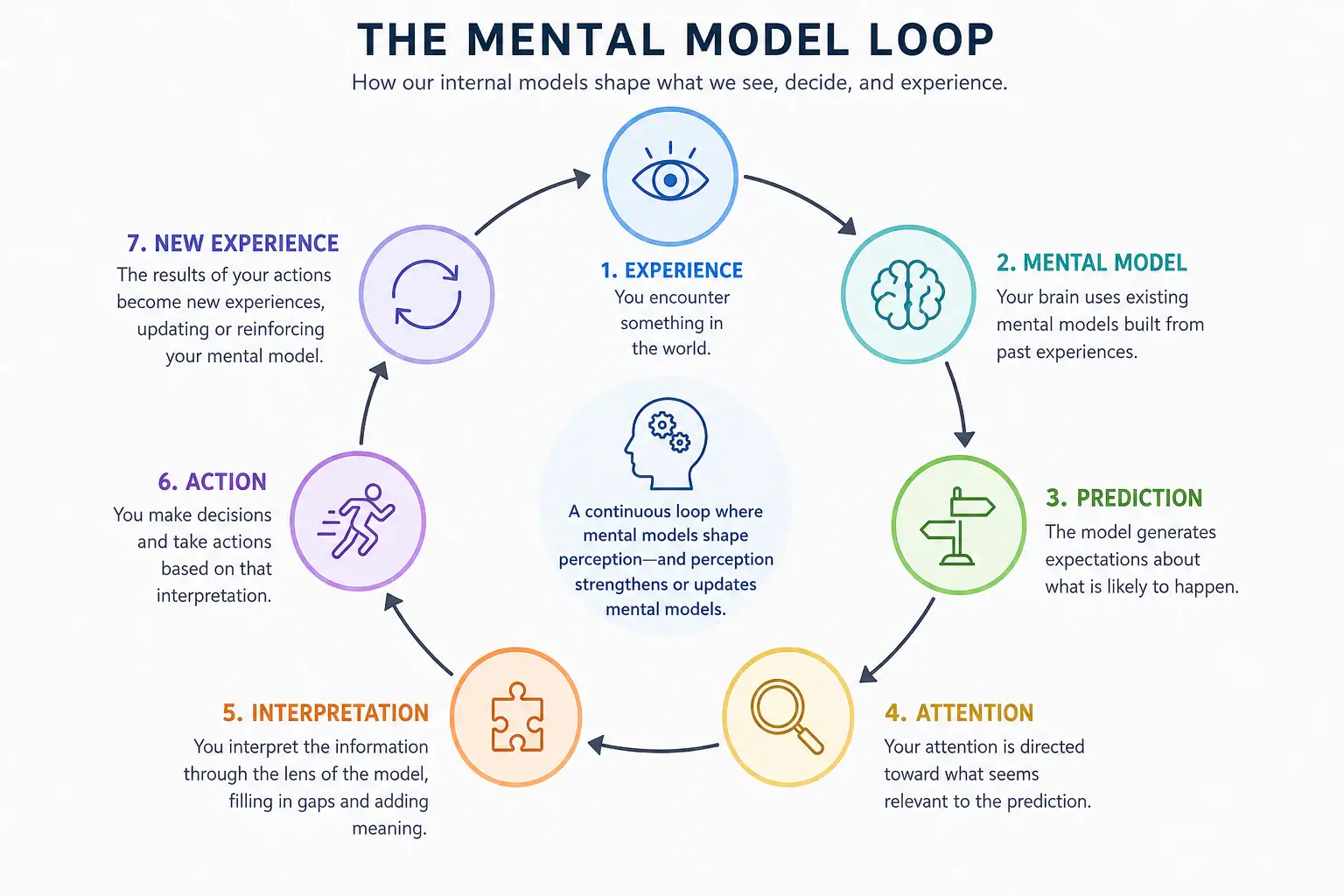
The loop matters because it explains why models can become self-reinforcing. A model helps create a prediction; the prediction guides attention; attention changes which information is most available; that information is interpreted through the model; and the resulting action produces a new experience. Sometimes the experience corrects the model. Sometimes it appears to confirm it.
How Mental Models Shape Perception
Perception is not simply a camera-like recording of everything in front of us. Sensory information is processed selectively, and the brain combines incoming signals with context, goals, memory, and prior knowledge. Research on visual processing has documented top-down influences on perception (Gilbert & Li, 2013), while experiments have shown that expectations can affect visual search (Shurygina et al., 2019) and modulate early sensory processing (Aitken et al., 2020).
One influential account is predictive processing: the brain continually generates predictions about likely causes of sensory input and adjusts those predictions when incoming evidence does not fit. Predictive-processing theories are not the only way to explain perception, and they should not be treated as a settled explanation for every cognitive phenomenon. But they provide a useful lens for understanding why expectations can matter before conscious interpretation feels complete.
Mental models generate expectations
Every model contains implicit predictions. If you believe a meeting with your manager is likely to be evaluative, you enter the room expecting signs of judgment. If you believe the meeting is collaborative, you expect clarification, exchange, and problem-solving. Before the conversation unfolds, your model has already changed the probability you assign to different meanings.
Expectations guide attention
Attention is limited. We cannot consciously process every signal with equal depth. Goals, prior knowledge, salience, and expectations help allocate attention. In laboratory research, top-down expectations have been shown to influence how quickly people orient toward predicted visual targets (Shurygina et al., 2019). This does not mean expectation controls everything we see; strong bottom-up signals can capture attention too. It means perception emerges from an interaction between what is present and what the system is prepared to detect.
Attention changes the evidence available to awareness
Once attention is concentrated on certain cues, those cues become easier to use in interpretation. If you are scanning for rejection, a delayed reply, a shorter sentence, or an ambiguous expression may become highly salient. Meanwhile, contradictory context—a busy day, a neutral previous interaction, an ordinary explanation—may receive less weight.
Interpretation fills gaps
Real-world information is often incomplete. We rarely know another person’s motives, every cause behind an outcome, or every variable affecting a decision. Mental models help fill those gaps. That is useful when the model is well calibrated. It becomes risky when the mind quietly converts “one plausible explanation” into “the only possible explanation.”
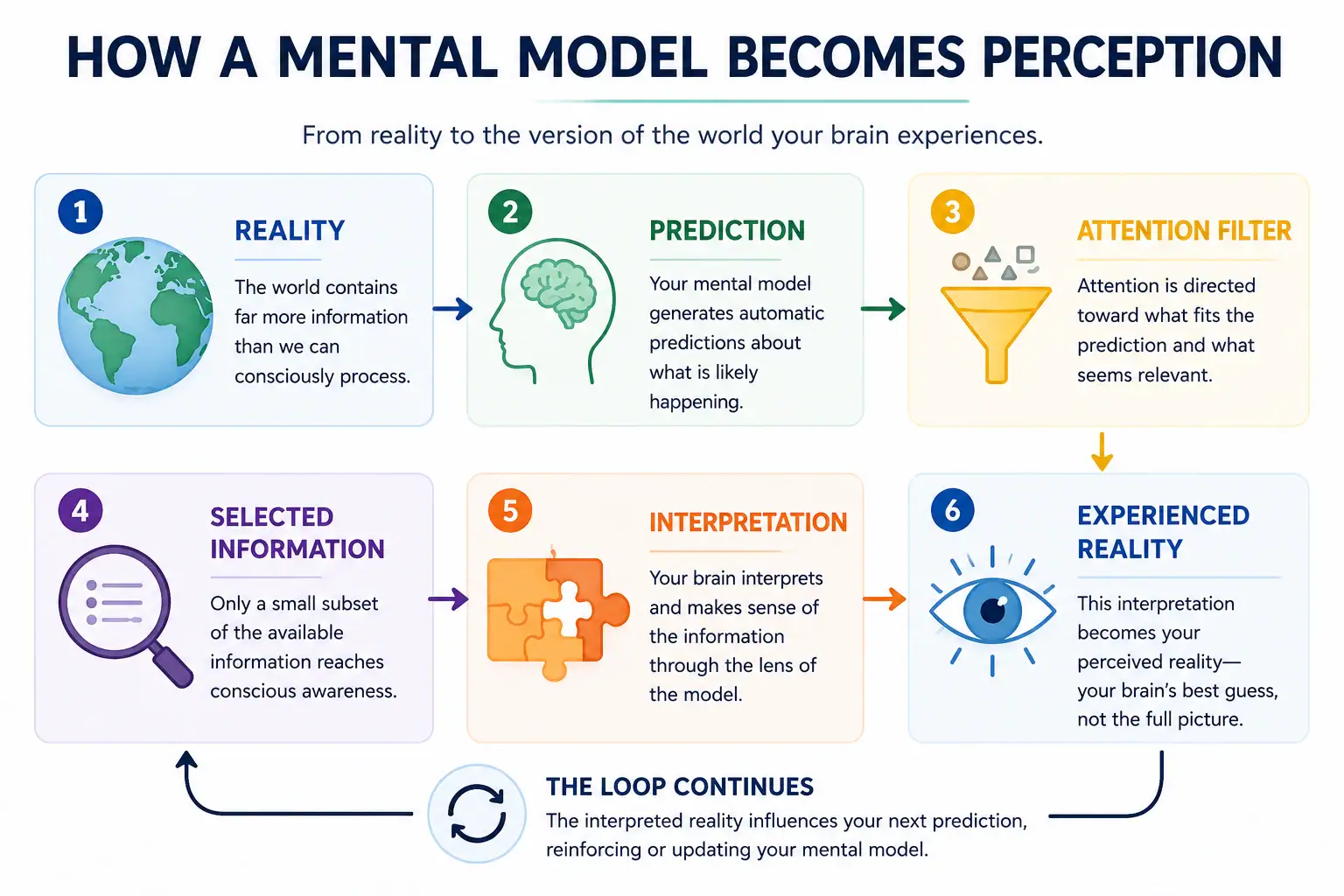
The result is not that “reality is whatever you believe.” Reality constrains interpretation. The better conclusion is more modest: the evidence you experience consciously is not always identical to all the evidence that exists, and the model you bring to a situation can influence which evidence becomes meaningful.
Why Two People Can See the Same Event Differently
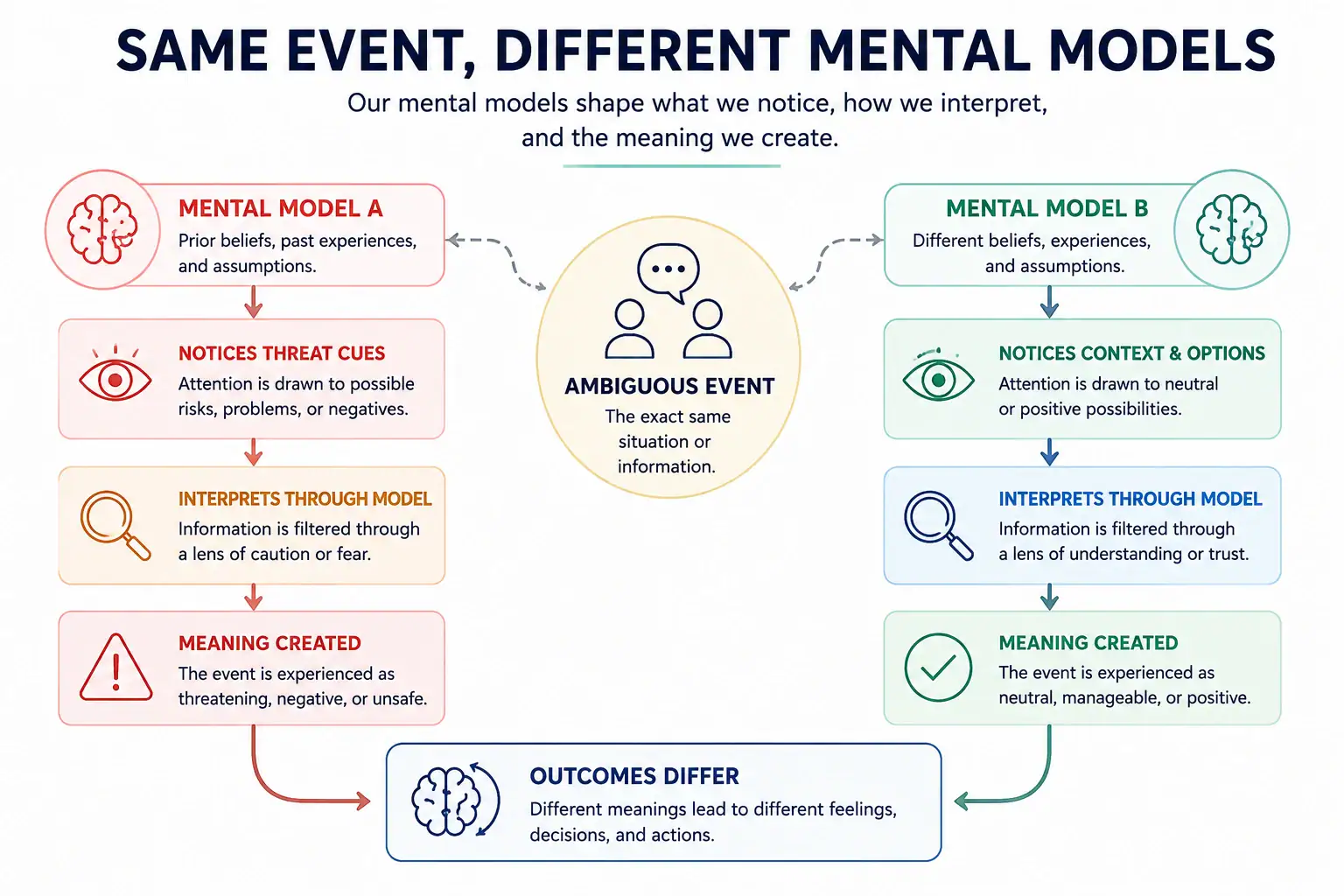
Consider a manager saying, “I would like to review your presentation before the client meeting.” The observable event is simple. The psychological experience can be very different.
Person A may carry a model in which review means distrust. Attention moves toward possible threat: the manager’s wording, the possibility of criticism, the fear of being exposed as unprepared. The review request becomes evidence that something is wrong.
Person B may carry a model in which review means shared responsibility. Attention moves toward the opportunity to improve the work, catch errors, and align before a high-stakes meeting. The same request becomes evidence of collaboration.
Neither interpretation should automatically be declared correct. The point is to notice that the event alone does not contain the entire meaning attributed to it.
This pattern appears in relationships too. A delayed reply can be interpreted as rejection, busyness, uncertainty, conflict avoidance, distraction, or nothing significant at all. In uncertain environments, the mind often prefers a coherent story to an unresolved question. Mental models supply that coherence.
The practical skill is therefore not “stop interpreting.” Interpretation is unavoidable. The skill is learning to distinguish what happened from what your current model says it means.
Mental Models vs. Mental Filters
Mental models and mental filters are related, but they are not identical.
A mental model is a broader representation of how something works: “feedback helps performance,” “people withdraw when they are angry,” “markets overreact to uncertainty,” or “good decisions require perfect confidence.” A mental filter influences which parts of incoming information receive attention or meaning.
A useful shorthand is:
For a deeper explanation of filtering, see What Are Mental Filters?. The distinction matters because changing a single attentional habit may not be enough if the broader model behind it remains untouched.
Mental Models and Selective Perception
Selective perception describes the tendency to notice, prioritize, or interpret some information while other information receives less attention. Mental models can contribute to that process by making certain signals more expected and therefore more relevant.
The mechanism can be summarized as a funnel:
available information → expectations → attention → mental filters → interpretation → experienced reality
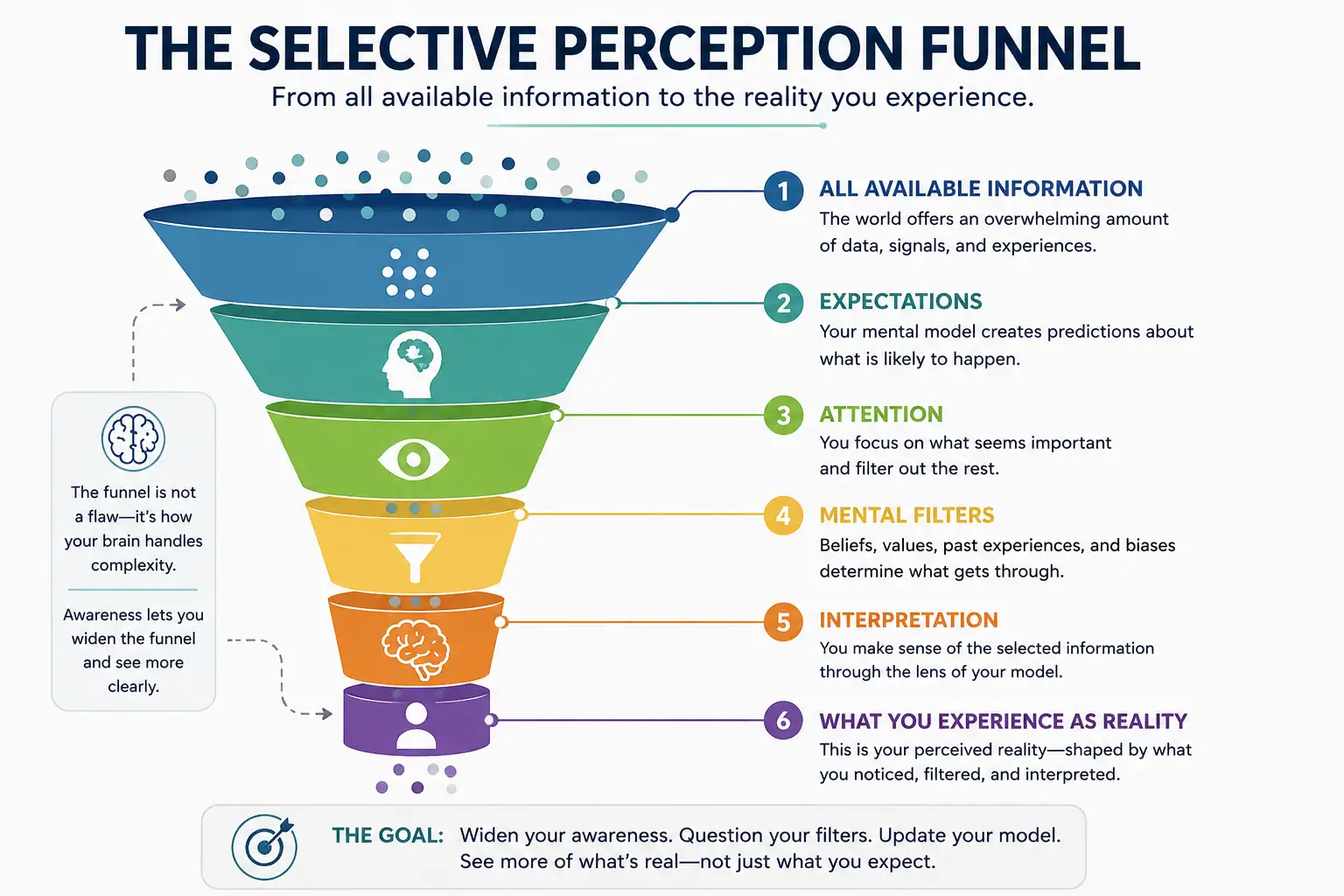
The important word is selective, not false. Selection is unavoidable. You need to ignore most background information in order to read this sentence, drive a car, follow a conversation, or solve a problem. The question is whether your selection process continues to track what matters.
A well-calibrated model can make attention more efficient. An outdated model can make attention systematically efficient at noticing the wrong things.
Mental Models Are Not the Same as Cognitive Biases
A mental model can be accurate, inaccurate, incomplete, or useful only in a specific context. A cognitive bias refers to a systematic tendency that can skew judgment or information processing. That means mental models are not inherently biases.
An accurate mental model can improve judgment. A poorly calibrated model can make biased interpretation more likely. For example, if a model strongly predicts that a colleague is unreliable, confirmation bias may make evidence supporting that judgment easier to notice while contradictory evidence receives less weight.
The difference is important enough that it deserves its own treatment. See Mental Models vs. Cognitive Biases for the full comparison.
When a Useful Mental Model Becomes Outdated
A model can be useful when it is learned and still become harmful later. This is one reason rigid thinking is difficult to recognize: the model may have once been an intelligent adaptation.
Someone who learned that conflict reliably led to punishment may develop a strong model that “conflict is dangerous.” In a safer adult environment, disagreement may instead be a normal mechanism for clarification. The original model is understandable, but its predictions may no longer fit the current context.
Other examples include:
- “If I do not respond immediately, something will go wrong.”
- “If I am uncertain, I must be making the wrong decision.”
- “More information always produces a better choice.”
- “If someone is quiet, they are upset with me.”
- “If I struggle, I am not capable.”
- “A good relationship should not contain disagreement.”
These statements may feel like observations. Often they are models: compressed rules that predict meaning. Once the distinction becomes visible, the model can be tested rather than automatically obeyed.
The Mental Model–Reality Gap
A useful way to think about misperception is as a gap between your current model of reality and what the available evidence currently supports.
Your model contains beliefs, assumptions, past experiences, expectations, and learned filters. Available evidence includes observable facts, new information, context, change, other perspectives, and unknowns you have not yet resolved.
The overlap is where your model fits the evidence well enough to guide action. Outside the overlap are two different problems:
- In your model but unsupported by evidence: outdated beliefs, wrong assumptions, rigid predictions, or overgeneralizations.
- In the evidence but outside your model: missed signals, new possibilities, emerging changes, or information your existing framework cannot yet explain.

This framework avoids two extremes. The first is assuming your interpretation is reality. The second is assuming you can never trust your interpretation at all. Calibration sits between them: use the model, but keep testing its fit.
What keeps the gap wide?
The gap tends to persist when a model becomes emotionally protected from revision. Attachment to being right, selective attention, narrow perspective, resistance to new information, and habitual filtering can all reduce the amount of corrective evidence that reaches the model.
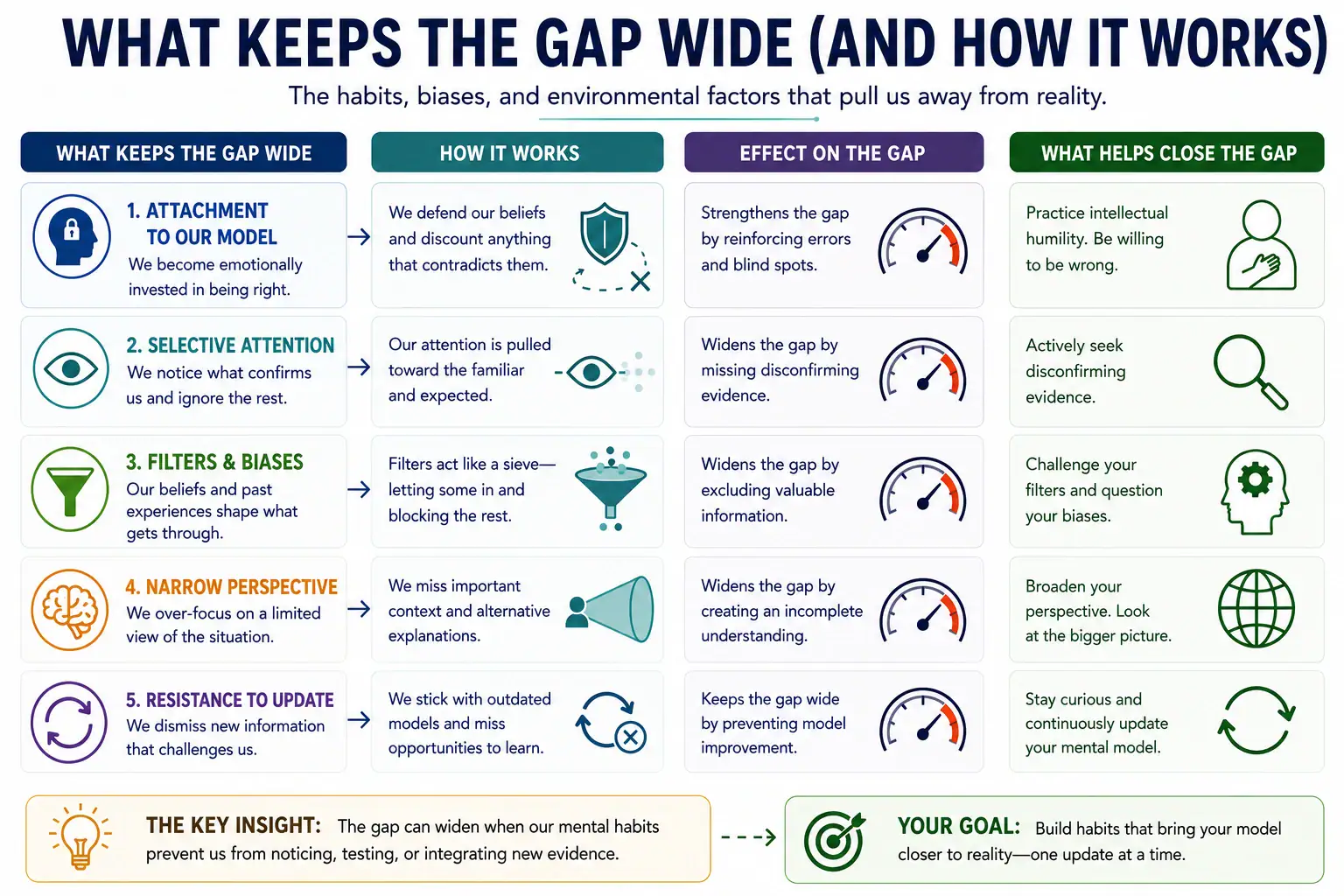
The goal is not endless self-doubt. Constantly questioning every perception can be as unhelpful as never questioning any perception. The aim is proportionate calibration: investigate when the stakes are high, evidence is ambiguous, predictions repeatedly fail, or your certainty is stronger than the data supporting it.
How to Tell When Your Mental Model Is Shaping What You See
You cannot observe a mental model as directly as you observe an object. You infer it from repeated patterns in attention, interpretation, and prediction. Several signs are worth investigating:
- You reach a confident explanation before enough information is available.
- You repeatedly interpret different situations through the same theme.
- Contradictory evidence feels easy to dismiss while confirming evidence feels immediately compelling.
- You assume another person’s motive without checking it.
- Your emotional response arrives with a story that feels like a fact.
- Reasonable people consistently see evidence you did not notice.
- Your predictions fail, but the underlying model remains unchanged.
None of these proves your perception is wrong. They are prompts for testing. Sometimes your first interpretation will survive scrutiny. Calibration is valuable precisely because it can strengthen confidence in a model that continues to fit reality.
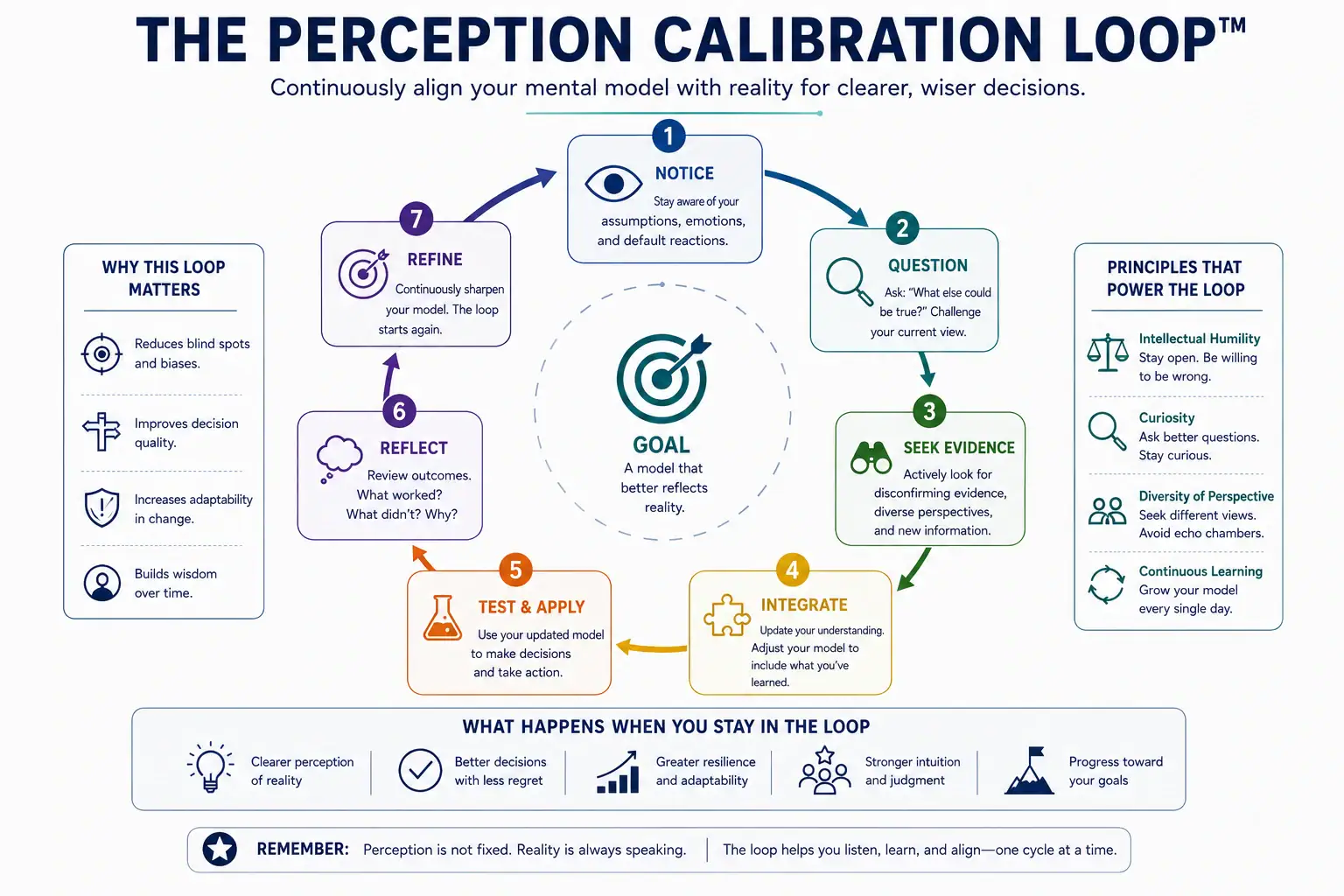
The Perception Calibration Loop™
A practical response to model-driven perception is not to eliminate mental models. It is to build a repeatable way to update them.
The Perception Calibration Loop™ uses seven stages:
- Notice. Become aware of your assumptions, emotions, and automatic reaction.
- Question. Ask, “What else could be true?”
- Seek evidence. Look deliberately for disconfirming information, alternative explanations, and perspectives you would otherwise miss.
- Integrate. Update your understanding to include what you have learned.
- Test and apply. Use the revised model in a real decision or action.
- Reflect. Compare the outcome with the prediction. What worked? What did not?
- Refine. Adjust the model again rather than treating the latest version as final.
A simpler five-question version
When you need a faster check, ask:
- What happened that a camera could have recorded?
- What meaning did I add?
- What did I expect before I interpreted it?
- What evidence would make my current explanation less likely?
- What is the smallest useful update to my model?
That last question matters. You do not need to replace one certainty with its opposite. If your model is “silence means rejection,” the calibrated alternative is not “silence never means rejection.” A better update is: “Silence has multiple possible causes; I need more evidence before assigning meaning.”
How Better Mental Models Improve Decision-Making
Decision quality depends partly on what information enters the decision in the first place. If attention is guided by a poor model, analysis can be technically sophisticated and still solve the wrong problem.
Better mental models can improve decisions by helping you:
- recognize which signals are actually relevant;
- separate evidence from interpretation;
- generate alternative explanations before committing;
- notice when a familiar pattern does not fit the current context;
- update faster when outcomes contradict predictions; and
- act under uncertainty without demanding impossible certainty.
For applications to judgment and choice, see Mental Models in Decision-Making. If you want to deliberately construct better frameworks, continue with How to Build Mental Models and Mental Model Examples.
How Mental Models and Intuition Interact
Intuition often feels immediate, but immediacy does not mean the judgment came from nowhere. Fast judgments can draw on learned patterns, prior experience, and internal representations that operate without a long conscious chain of reasoning.
That is why mental models matter to intuition. A well-calibrated model can help experience produce useful pattern recognition. A poor model can make an old expectation feel like a fresh signal.
This is also why “trust your gut” is incomplete advice. A better question is:
For the site’s broader framework, see What Intuition Really Is: Pattern Recognition Under Uncertainty. You can also explore the deeper concept of an Internal Model of Reality.
This does not reduce intuition to a single mechanism. Human intuition can involve multiple interacting processes, and researchers do not have one universally accepted model that explains every intuitive experience. The practical point is narrower: fast perception becomes more trustworthy when the models generating predictions are repeatedly tested against outcomes.
Your Brain Needs Mental Models—The Goal Is Calibration, Not Elimination
There is no model-free life. Without internal representations, every familiar situation would have to be interpreted from the beginning. Mental models make expertise, planning, social understanding, and efficient action possible.
The shift is therefore not from “having a model” to “seeing pure reality.” It is from rigid certainty to calibrated thinking.
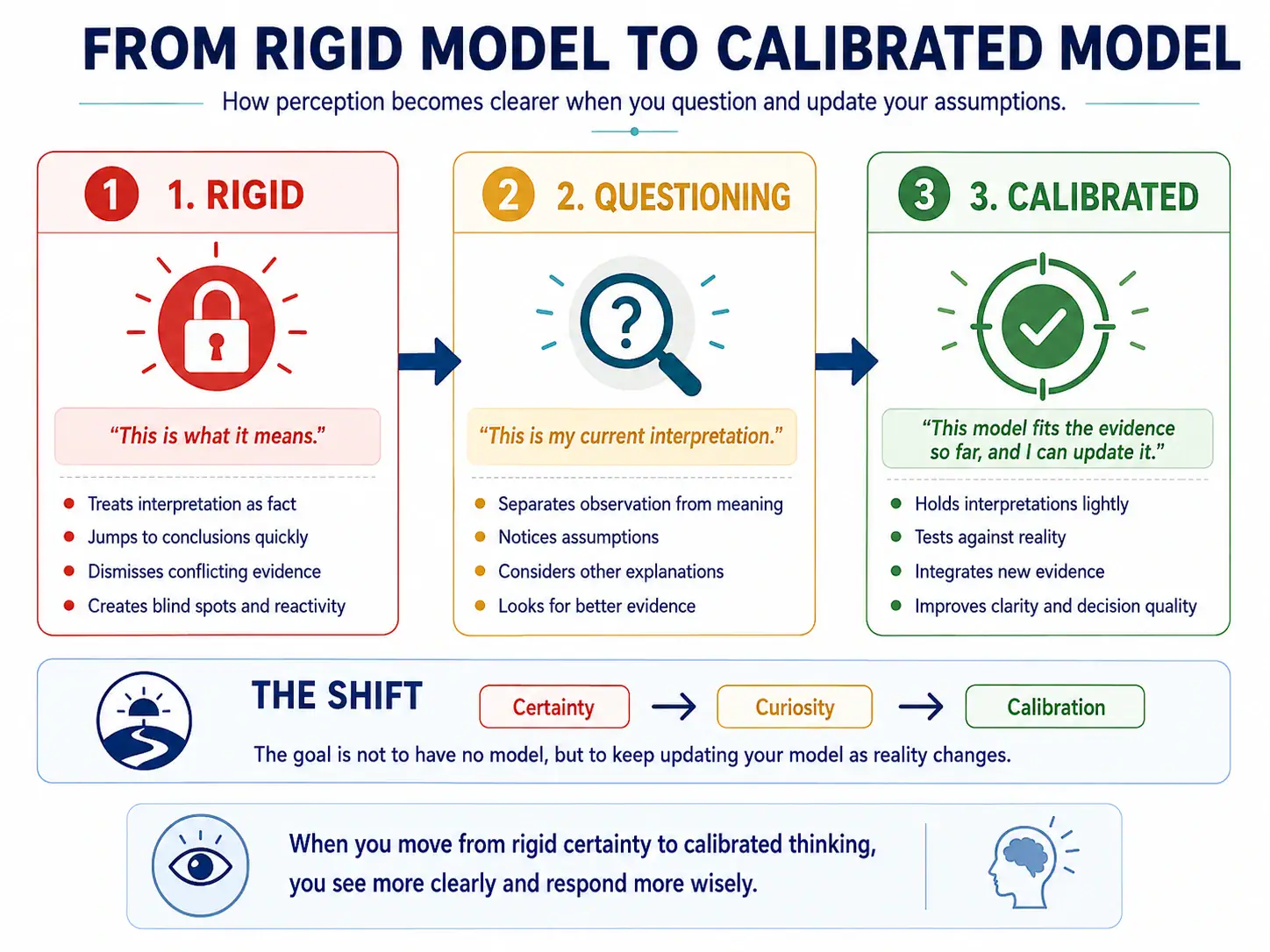
A rigid model says, “This is what it means.”
A questioning model says, “This is my current interpretation.”
A calibrated model says, “This interpretation fits the evidence so far, and I can update it.”
That final sentence captures the skill. You do not need to distrust perception. You need to understand that perception is shaped by a system that predicts, selects, interprets, and learns.
The useful question is not simply, “Is what I am seeing real?” A better question is:
Frequently Asked Questions
Do mental models affect perception?
Yes. Mental models can influence expectations, attention, and interpretation, which in turn can affect what information becomes salient and what meaning is assigned to ambiguous events. They do not completely determine perception: incoming sensory information, context, goals, and bottom-up salience also matter.
What is an example of a mental model affecting perception?
Imagine a manager asking to review your work. If your model is “review means I am not trusted,” you may notice threat cues and interpret the request as criticism. If your model is “review improves important work,” you may notice useful feedback and interpret the same request as collaboration. The event is identical; the model changes what seems important about it.
Are mental models the same as cognitive biases?
No. Mental models are internal representations used to understand and predict situations. Cognitive biases are systematic tendencies that can skew judgment or information processing. Mental models can be accurate and useful, although poorly calibrated models can interact with biases.
Can mental models be wrong?
Yes. A model can be inaccurate, incomplete, too general, or simply outdated. It can also be useful in one environment and misleading in another. The goal is not to create a perfect permanent model but to update models when evidence changes.
How do expectations affect what we perceive?
Expectations can guide attention and influence how ambiguous sensory information is interpreted. Research on top-down visual processing and predictive perception shows that prior knowledge and predictions can interact with incoming sensory signals. The effect is not unlimited: strong or surprising evidence can challenge expectations and force an update.
Can you change your mental models?
Yes. Mental models can be revised through new experience, deliberate reflection, exposure to other perspectives, testing predictions, and paying attention to disconfirming evidence. Change is usually more reliable when the updated model is tested in real situations rather than adopted only as a new idea.
Evidence and Further Reading
Evidence note: “Mental model” is used here as a practical cognitive framework. Predictive processing is an influential family of theories, not a universally settled account of all perception. The sources below support the article’s narrower claims about top-down influences, expectations, attention, and sensory processing.
- Rao, R. P. N., & Ballard, D. H. (1999). Predictive coding in the visual cortex: a functional interpretation of some extra-classical receptive-field effects. Nature Neuroscience, 2, 79–87.
- Gilbert, C. D., & Li, W. (2013). Top-down influences on visual processing. Nature Reviews Neuroscience, 14, 350–363.
- Shurygina, O., Pooresmaeili, A., & Rotermund, D. (2019). Expectations and perceptual priming in a visual search task.
- Gordon, N. et al. (2019). Expectation and attention increase the integration of top-down and bottom-up signals in perception.
- Aitken, F. et al. (2020). Prior expectations of motion direction modulate early sensory processing.
Related reading on Intuition Management: What Are Mental Models? · Selective Perception · What Are Mental Filters? · Mental Models vs. Cognitive Biases · How to Build Mental Models
Leave a Reply
You must be logged in to post a comment.