By Denys Kostin
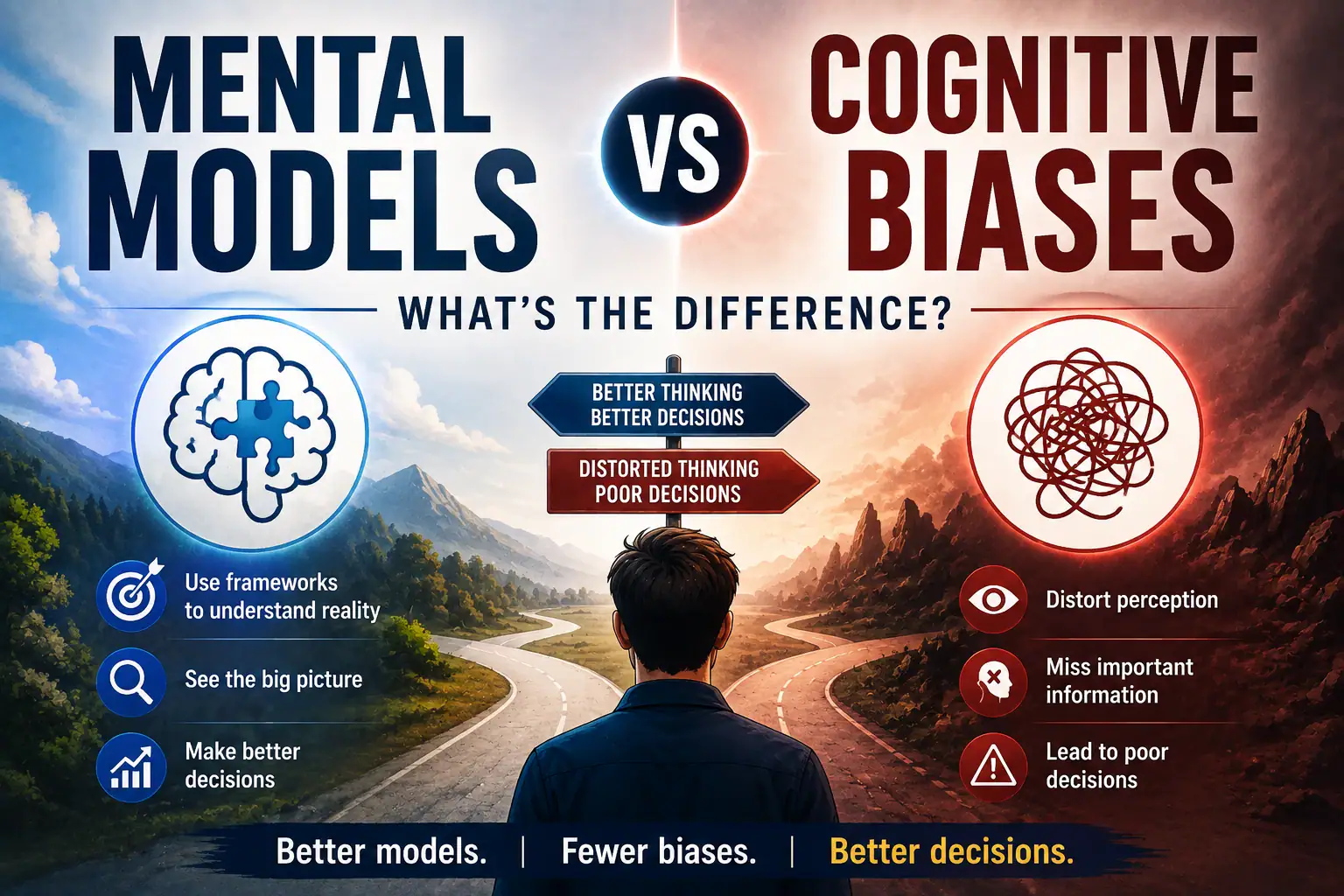
Mental models vs cognitive biases is not a choice between “good thinking” and “bad thinking.” A mental model is a representation we use to understand how something works, make predictions, and decide what to do. A cognitive bias is a systematic tendency that can skew attention, interpretation, judgment, or memory. Mental models are necessary for thinking; biases can influence how those models are built and used.
The practical difference matters because the same framework that once helped you understand reality can become a blind spot when you stop testing it. Better decisions come not from eliminating mental models, but from making them more accurate, holding them lightly, and noticing when bias is shaping what you see.
In this guide
- Mental models vs cognitive biases at a glance
- What is a mental model?
- What is a cognitive bias?
- Mental filters, models, heuristics, and biases
- How mental models shape what you see
- When a useful mental model becomes a blind spot
- Five decision examples
- The Model–Bias Check
- Where intuition fits
- Fast and slow thinking
- Frequently asked questions
Mental Models vs Cognitive Biases at a Glance
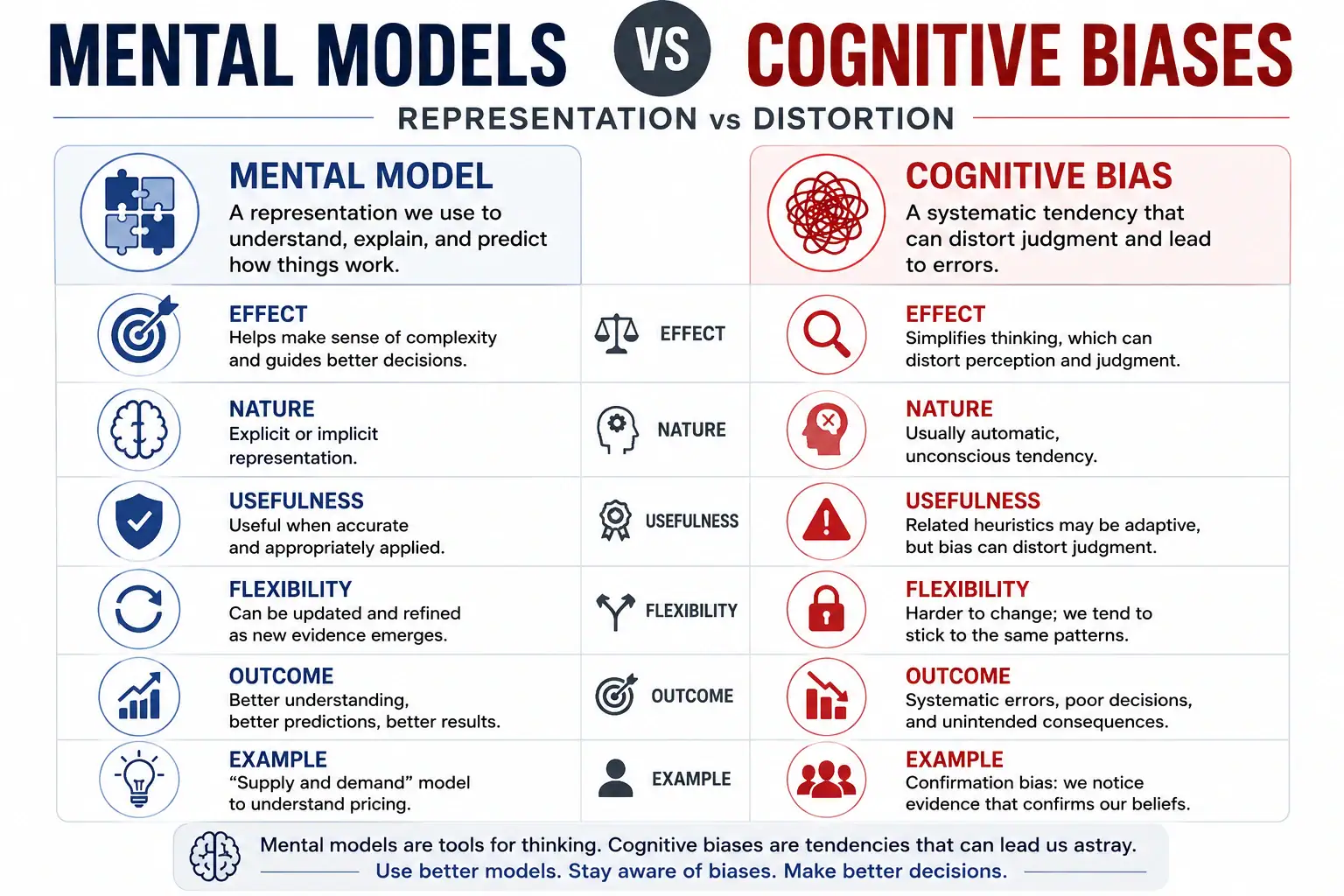
The simplest distinction is this: a mental model represents; a cognitive bias distorts. That sentence is useful, but it needs one qualification. Mental models are not automatically accurate. They are simplified representations, and a poor or outdated model can misrepresent reality. Cognitive biases are also not the same thing as heuristics: a heuristic is a shortcut or rule of thumb, while a bias is a systematic pattern of error or skew that can arise in judgment.
| Question | Mental model | Cognitive bias |
|---|---|---|
| What is it? | A representation or framework for understanding how something works. | A systematic tendency that can skew judgment or interpretation. |
| What does it do? | Organizes information, supports explanation, and enables prediction. | Can make some information, interpretations, or choices disproportionately influential. |
| Is it conscious? | It can be explicit or implicit. | Often operates without deliberate awareness. |
| Can it help? | Yes, especially when it fits the situation and is regularly updated. | The related shortcut may sometimes be useful, but bias can still produce systematic error. |
| Example | Supply and demand, opportunity cost, incentives, or second-order effects. | Confirmation bias, anchoring, availability bias, or the sunk-cost effect. |
What Is a Mental Model?
A mental model is an internal representation of how a situation, system, relationship, or process works. It allows you to move beyond isolated facts and reason about relationships: if this changes, what is likely to happen next? If I choose option A instead of B, what are the likely consequences?
Psychologist Philip Johnson-Laird’s work on mental models and human reasoning describes reasoning as involving representations of possibilities rather than only the application of formal rules. In everyday language, a mental model is your working map of a piece of reality.
That map is useful precisely because it is simpler than reality. A model strips away detail so that you can identify causes, constraints, incentives, feedback loops, or trade-offs. But simplification creates a built-in limitation: the model is never the whole system.
Imagine a manager who uses the model “incentives shape behavior.” That model can reveal why a team optimizes a metric at the expense of customer value. Yet if the manager treats incentives as the only explanation, the model may hide other causes such as unclear strategy, social norms, workload, trust, or missing information.
If you want the broader foundation, see What Are Mental Models?. For practical applications, the site also covers mental model examples, mental models in decision making, and how to build mental models.
What Is a Cognitive Bias?
A cognitive bias is a systematic tendency in judgment or information processing that can move our conclusions away from what the available evidence, probability, or decision context would support. Bias can influence what we notice, what we remember, how we interpret ambiguous evidence, how much weight we give to an initial number, or how willing we are to revise a belief.
In their landmark 1974 paper Judgment under Uncertainty: Heuristics and Biases, Amos Tversky and Daniel Kahneman described several shortcuts people use when making judgments under uncertainty and showed how those shortcuts can produce predictable errors.
Three familiar examples make the distinction concrete. Confirmation bias can make supporting evidence easier to notice or accept than contradictory evidence. Anchoring can make an initial value influence later estimates even when that starting point is weak. Availability-based judgment can make vivid or easily recalled examples feel more representative than they really are.
The important point is not that the human mind is defective. We have limited time, attention, memory, and information. Shortcuts are unavoidable. Some heuristics can work well in the environments for which they are suited. The SEO-friendly but inaccurate version of this topic is “mental models are rational; biases are irrational.” The more useful version is: we need simplified representations and shortcuts, but we also need ways to detect when they are no longer tracking reality well.
Mental Filters, Mental Models, Heuristics, and Cognitive Biases Are Not the Same Thing
These concepts are often blended together, which makes it harder to understand where a decision went wrong. A useful working distinction is:
- Mental filters describe which information becomes salient or receives attention.
- Mental models organize and interpret what that information means.
- Heuristics are shortcuts or rules of thumb that simplify judgment.
- Cognitive biases are systematic skews that can influence one or more stages of the process.
“Mental filter” here is a practical explanatory term rather than a claim that the brain contains a single filtering module. Attention, expectations, emotion, prior experience, and context all influence what becomes salient. For a deeper treatment, see What Are Mental Filters?.

How Mental Models Shape What You See
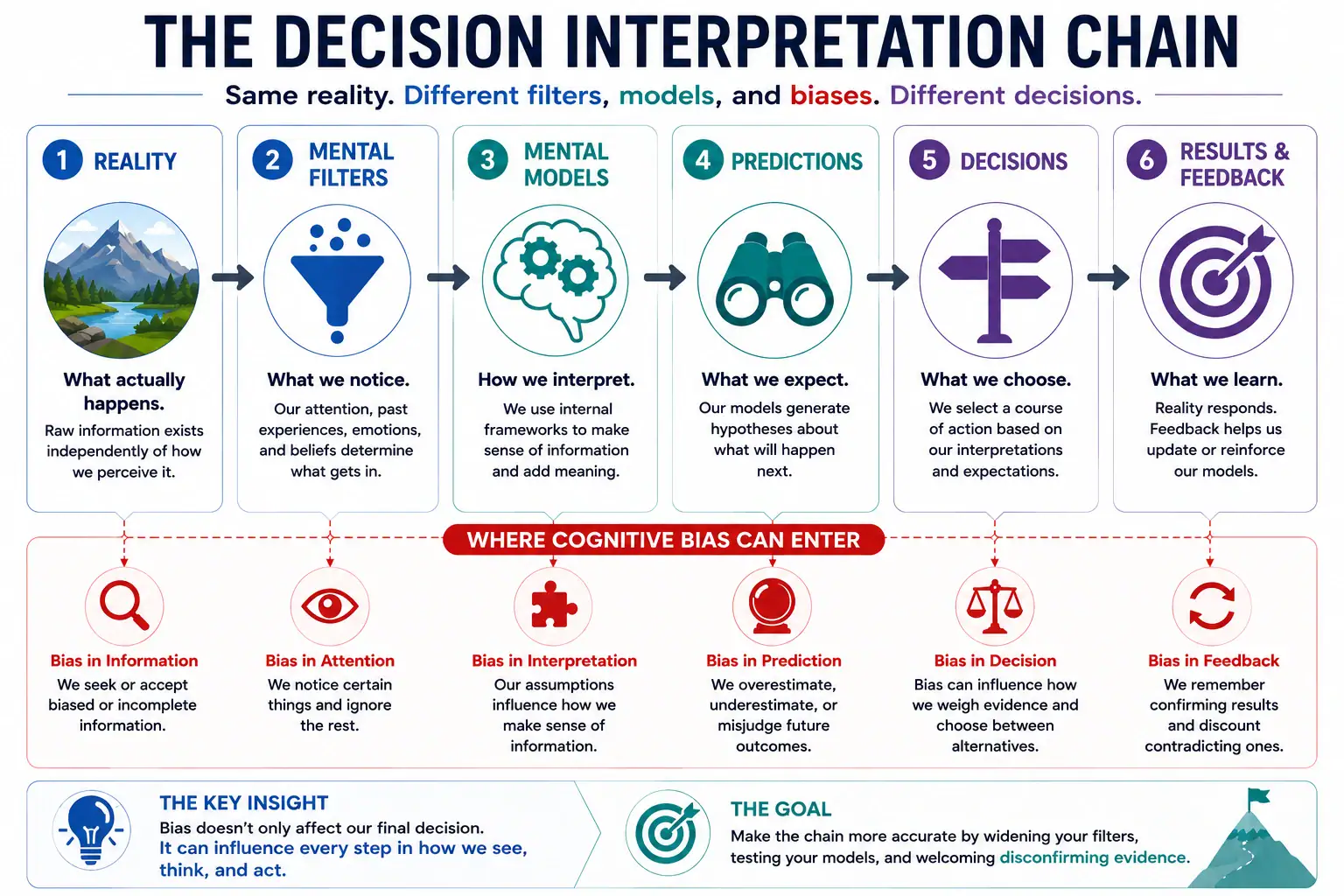
You never make a decision from raw reality alone. Information reaches you through attention and context. You interpret it through prior knowledge and internal models. Those models generate expectations. Expectations influence choices. Results then provide feedback that may strengthen, weaken, or revise the model.
A compact way to describe the process is:
Reality → Mental Filters → Mental Models → Predictions → Decisions → Results & Feedback
Bias can influence any part of this chain. You may seek incomplete information, notice only a subset of it, interpret ambiguous data in a preferred direction, become overconfident in a forecast, choose an option that protects an existing belief, or remember confirming outcomes more strongly than disconfirming ones.
Consider a simple example. It starts raining and traffic slows. One driver notices the delay, interprets it as evidence of poor planning, predicts that congestion will worsen, and changes route. Another driver notices that several roads are affected, predicts that alternative routes may be equally congested, and stays on course. The external event is the same; the internal model changes the forecast and therefore the action.

Can a Mental Model Become a Cognitive Bias?
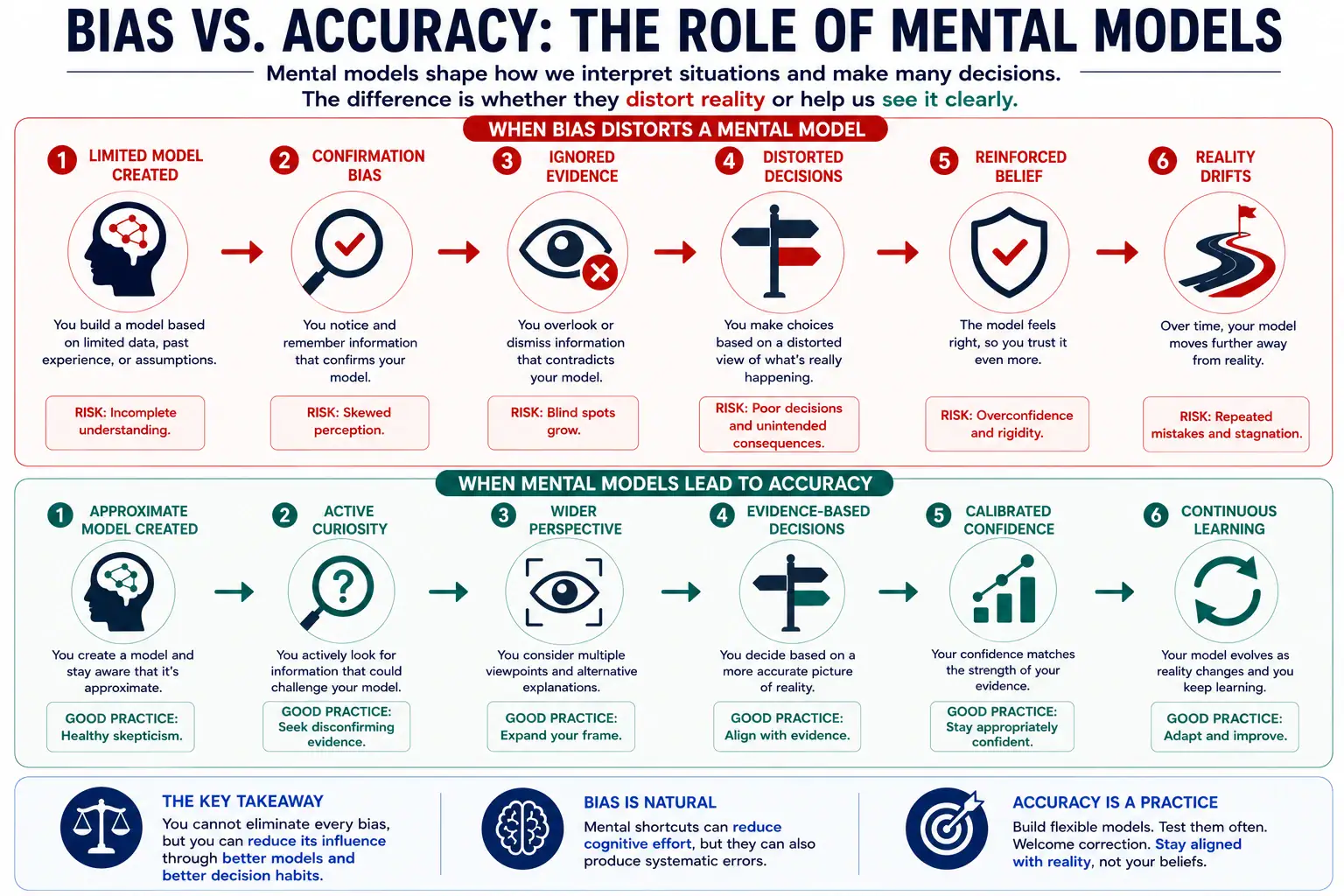
Not literally. A mental model and a cognitive bias are different concepts. But a rigid, incomplete, or outdated mental model can interact with bias in a way that creates a self-reinforcing blind spot.
Suppose a leader forms the belief that “the strongest employees are the people who speak most confidently in meetings.” That belief becomes part of a mental model for evaluating talent. The leader then pays more attention to confident speakers, remembers their successful contributions, and discounts strong work produced by quieter employees. Confirmation bias strengthens the original model. Eventually, a rough rule becomes something that feels like reality itself.
The dangerous moment is not when the model is created. Models have to come from somewhere. The danger is when contradictory evidence stops changing the model.
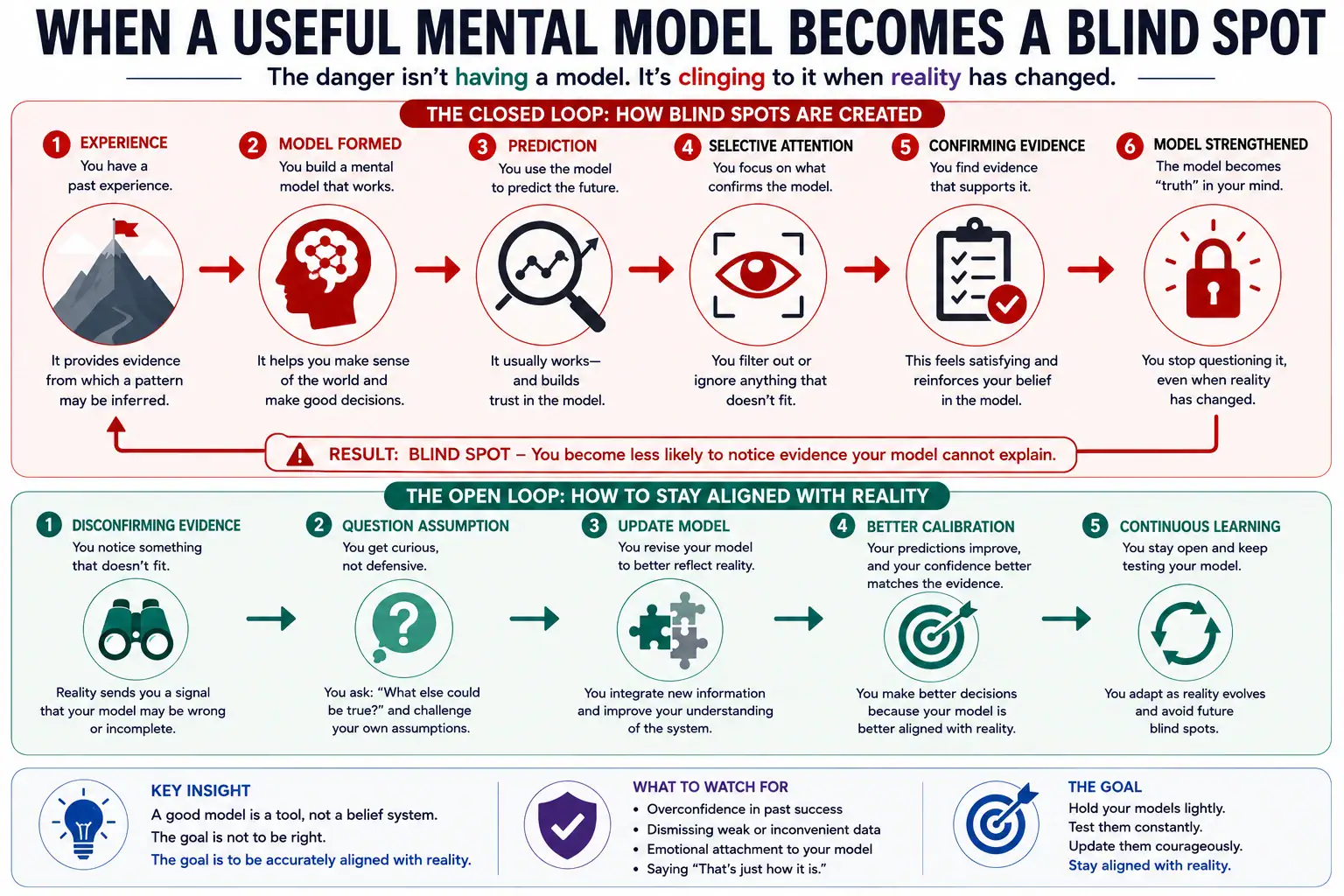
The corrective loop begins with disconfirming evidence: something does not fit. Instead of defending the model automatically, you ask what else could be true, revise the model, compare new predictions with outcomes, and calibrate confidence to the quality of the evidence. This does not guarantee perfect judgment. It creates a process in which reality is allowed to correct the map.
Five Examples of Mental Models and Cognitive Biases in the Same Decision
1. Hiring: base rates vs halo effect
A useful mental model asks what usually predicts performance in this type of role and how reliable the available signals are. A bias risk appears when one salient trait—prestige, charisma, similarity, confidence, or an impressive first answer—colors the evaluation of everything else. The model says, “Use multiple predictive signals.” The bias says, “This person feels exceptional, so the rest of the evidence probably fits.” Structured criteria help keep the model in contact with evidence.
2. Investment: opportunity cost vs sunk-cost thinking
Opportunity cost asks what you give up by continuing with the current option. Sunk-cost thinking pulls attention toward resources already spent. If a project has consumed six months and a large budget, the key decision is still whether the next unit of time or money is better spent here than on the best available alternative. The past cost explains how you arrived at the decision point; it should not automatically determine what comes next.
3. Forecasting: second-order effects vs availability bias
Second-order thinking asks what happens after the immediate effect. Availability can make a vivid recent example dominate the forecast. After one memorable failure, a team may overestimate how likely the same failure is to recur. A better model asks about base rates, conditions, feedback loops, and what would have to be true for the feared outcome to happen again.
4. Negotiation: incentives vs anchoring
An incentives model asks what each side values, what constraints they face, and what alternatives are available. Anchoring can make the first number disproportionately influential. The countermeasure is not to ignore the opening offer by force of will. It is to establish an independent reference range before the anchor arrives and explain the decision using evidence rather than proximity to the first number.
5. Leadership: systems thinking vs confirmation bias
A systems model looks for interactions, delays, incentives, bottlenecks, and feedback loops. Confirmation bias can turn that model into a story that explains everything after the fact. The discipline is to state predictions before outcomes are known and actively look for observations that would challenge the explanation. A model that cannot be wrong is difficult to learn from.
Why Smart People Still Fall for Cognitive Biases
Intelligence and expertise give you more knowledge to reason with, but they do not make your mind transparent to itself. In fact, expertise can create a new risk: a sophisticated model can generate sophisticated explanations for why contradictory evidence should be ignored.
The goal therefore is not simply to “know your biases.” Awareness can help, but knowledge of a bias does not automatically neutralize it in the moment. More structured approaches can improve judgment. Research by Carey Morewedge and colleagues found that a training intervention designed to reduce several decision biases improved performance, and later field research found promising transfer of debiasing training to professional decision tasks. See Morewedge et al. (2015) and Sellier et al. (2019).
The practical lesson is straightforward: build decision processes that make correction easier. Separate observations from interpretations. Record predictions before outcomes. Ask for disconfirming evidence. Use independent estimates before group discussion when anchoring is likely. Review outcomes rather than only intentions. These habits create friction in the places where bias can otherwise move unnoticed.
The Model–Bias Check: Six Questions Before an Important Decision
You do not need to identify every named bias before making a decision. A more practical approach is to test the model you are currently using.
- What am I assuming? Write the key causal claim or expectation in one sentence.
- What should I observe if my model is roughly correct? Turn the model into a prediction rather than a story.
- What evidence would make me revise it? If the answer is “nothing,” you are protecting a belief rather than testing a model.
- Am I overweighting information that supports what I already expect? Look specifically for inconvenient or disconfirming evidence.
- What alternative model could explain the same facts? Generate at least one plausible competing explanation.
- How did similar predictions perform before? Use feedback to calibrate confidence rather than relying on how compelling the explanation feels.
This method does not eliminate uncertainty. It makes uncertainty visible. That matters because confidence should rise when predictions repeatedly match reality and fall when the model misses important outcomes.
How to Improve Mental Models Without Becoming Paralyzed by Bias
Once people learn about cognitive bias, they sometimes respond by doubting every thought. That is not the goal. Endless self-monitoring can become another form of indecision. The objective is calibration: knowing when a model is reliable enough to act and when the situation deserves more testing.
A useful loop is:
Model → Prediction → Action → Reality → Feedback → Updated Model
- Predict before you know the outcome. This reduces hindsight storytelling.
- Use small tests when uncertainty is high. Reversible decisions create information.
- Track misses, not just wins. A model improves when errors are examined rather than explained away.
- Borrow models from multiple disciplines. One framework rarely captures every important variable.
- Match confidence to evidence. “I think this is likely” is often more accurate than “I know.”
- Update without shame. Changing your mind after receiving better evidence is successful learning, not failure.
This is closely related to the idea of an internal model of reality: your decisions depend on the model you are using, but the model becomes more useful when it remains open to correction.
Where Does Intuition Fit?
Intuition is often experienced as an answer arriving before conscious reasoning has finished explaining it. That does not mean intuition comes from nowhere. In familiar environments, experienced people can internalize patterns, relationships, and cues that later produce rapid judgments. But an intuitive feeling can also reflect anxiety, habit, expectation, emotional salience, or bias.
This is why the useful question is not simply “Should I trust my intuition?” A better question is: what kind of learning environment produced this intuition, and how well has it been calibrated by feedback?
When you have repeated experience, meaningful feedback, recognizable patterns, and a reasonably stable environment, intuition may carry valuable information. When the situation is novel, the feedback history is poor, the stakes are high, or strong emotions are narrowing attention, deliberate checking becomes more important.
For the specific relationship between gut feeling and distortion, see Intuition vs Bias: How to Recognize the Difference. You can also explore Signal vs Noise and Intuition in Decision Making.
Fast and Slow Thinking: A Useful Framework, Not Two Literal Brain Systems
The popular labels System 1 and System 2 are useful shorthand for contrasting fast, relatively automatic processing with slower, more deliberate processing. They should not be read as two anatomical systems living in separate halves of the brain. Dual-process theories are a family of models, and researchers disagree about some details of how best to characterize them. Evans and Stanovich summarize important distinctions and debates in Dual-Process Theories of Higher Cognition.
The practical value of the distinction is that different situations call for different levels of cognitive effort. Fast processing is efficient and can be highly effective in familiar environments where patterns have been learned through feedback. Deliberate reasoning is especially valuable when the problem is novel, assumptions need checking, trade-offs are complex, or consequences are difficult to reverse.
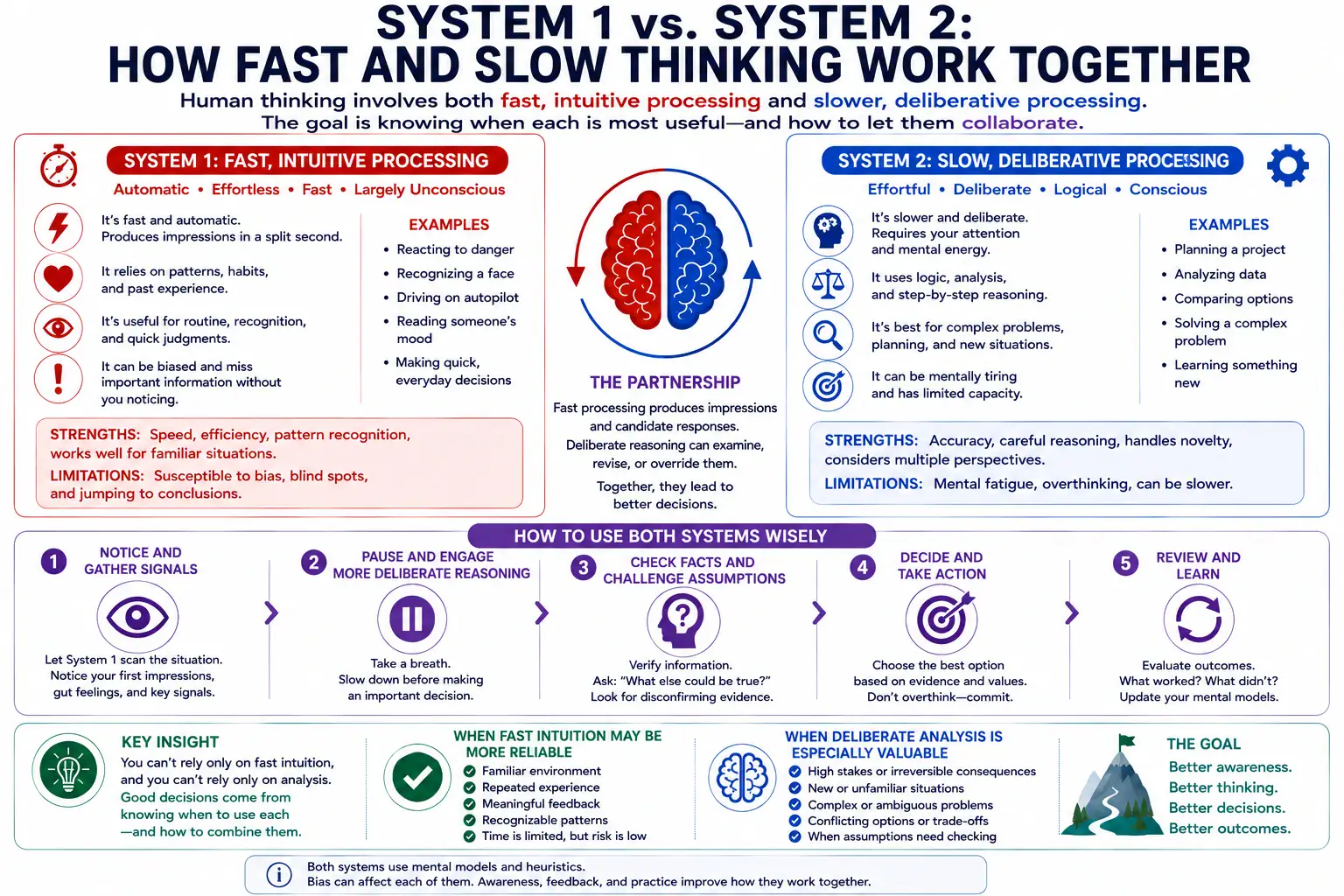
Neither mode has a monopoly on accuracy. Fast intuition can be excellent when expertise is genuine; slow analysis can rationalize a preferred conclusion. The better habit is to ask what kind of processing the situation needs and whether your current mental model has earned the confidence you are giving it.

Mental Models Should Be Maps, Not Reality
A mental model is valuable because it compresses complexity. That is also why it can never be identical to the world it represents. Problems begin when the map becomes so familiar that we stop noticing where reality no longer matches it.
The most useful models share three qualities. They make testable predictions. They improve decisions often enough to justify using them. And they remain revisable when evidence changes. Cognitive bias threatens all three by making preferred interpretations easier to protect than to test.
So the aim is not to become bias-free or to think slowly about everything. It is to create a better relationship between model and evidence:
Use a model. Make a prediction. Act when the evidence is sufficient. Observe what happens. Update the model. Repeat.
That cycle turns mental models from beliefs you defend into tools you improve. And that is the real difference between using a mental model and being trapped by one.
Frequently Asked Questions
What is the difference between a mental model and a cognitive bias?
A mental model is a representation used to understand, explain, or predict how something works. A cognitive bias is a systematic tendency that can skew judgment, attention, interpretation, or memory. A mental model can be useful or inaccurate; bias can influence how the model is formed, applied, or defended.
Are cognitive biases mental models?
No. They are related but distinct concepts. A mental model is an internal representation. A cognitive bias is a systematic pattern of skew or error in judgment or information processing. Bias can shape a mental model, and a rigid model can create conditions in which a bias becomes self-reinforcing.
Can mental models be wrong?
Yes. All mental models simplify reality, and some models are incomplete, outdated, or applied outside the conditions where they work well. A useful model should be judged by how well it explains relevant evidence, supports prediction, and improves decisions—and it should remain open to revision.
Are heuristics the same as cognitive biases?
No. A heuristic is a shortcut or rule of thumb that reduces cognitive effort. A cognitive bias is a systematic skew that can appear in judgment. Heuristics can sometimes be efficient and effective, but under some conditions they can contribute to biased conclusions.
How do mental models affect decision-making?
Mental models influence how you interpret information, what causes you consider important, what you predict will happen, and which actions appear sensible. Different models can therefore produce different decisions from the same external facts.
How can you reduce cognitive bias in decisions?
You cannot guarantee bias-free thinking, but you can reduce its influence by making assumptions explicit, seeking disconfirming evidence, considering alternative explanations, using independent estimates, recording predictions, reviewing outcomes, and updating models when reality contradicts them.
Research References
- Johnson-Laird, P. N. (2010). Mental models and human reasoning. Proceedings of the National Academy of Sciences.
- Tversky, A., & Kahneman, D. (1974). Judgment under Uncertainty: Heuristics and Biases. Science.
- Evans, J. St. B. T., & Stanovich, K. E. (2013). Dual-Process Theories of Higher Cognition: Advancing the Debate. Perspectives on Psychological Science.
- Morewedge, C. K., et al. (2015). Debiasing Decisions: Improved Decision Making With a Single Training Intervention. Policy Insights from the Behavioral and Brain Sciences.
- Sellier, A.-L., Scopelliti, I., & Morewedge, C. K. (2019). Debiasing Training Improves Decision Making in the Field. Psychological Science.
Final takeaway: Mental models are indispensable thinking tools. Cognitive biases are systematic influences that can pull those tools away from the evidence. The goal is not perfect objectivity. It is a repeatable practice of testing assumptions, calibrating confidence, learning from feedback, and letting reality update the model.