Selective perception helps explain a strange but ordinary fact of human life: two people can encounter the same situation, notice different details, and walk away with genuinely different impressions of what happened.
Noticing a cue and deciding what it means are different steps. Explore intuition vs perception to understand how observation and intuitive judgment interact.
Your brain does not record every available detail like a camera. It has limited attention, prior expectations, goals, memories, emotional associations, and learned models of how the world works. Those influences help determine what becomes noticeable, what fades into the background, and how ambiguous information is interpreted.
That filtering is not automatically a mistake. It is part of how a finite brain handles an information-rich world. The problem begins when an expectation repeatedly determines what you notice, what you discount, and what meaning you assign to uncertain evidence. Then perception can start reinforcing the very belief that shaped it.
This article explains what selective perception means, how it differs from selective attention and confirmation bias, why expectations can affect perception, how it can be confused with intuition, and how to become better calibrated without pretending you can ever see reality without a point of view.

What you notice can also influence which beliefs you reinforce. See how confirmation bias can shape the evidence you seek, interpret, and accept—and how to test your first impression.
What Is Selective Perception?
Selective perception is the tendency for expectations, beliefs, goals, prior experience, and context to influence which parts of available information become salient and how that information is interpreted.
The phrase is useful, but it should not be treated as if the brain contains one isolated “selective perception mechanism.” What we call selective perception emerges from several interacting processes: attention, prior expectations, learned associations, memory, interpretation, and decision-making.
That distinction matters. A person does not simply choose to ignore reality. Often the filtering happens before conscious reflection. Your mind is continuously allocating limited processing capacity, comparing incoming information with prior knowledge, and deciding—mostly outside awareness—what deserves further attention.
This is closely related to the internal model of reality your brain uses to predict what is likely to happen next. Mental models are useful because they reduce complexity. But every useful simplification also creates the possibility that relevant information will be missed.
Why Your Brain Cannot Notice Everything
At any moment, your sensory systems receive far more information than you can consciously examine. Attention therefore has to be selective. You notice the face speaking to you rather than every object behind it. You follow one conversation in a noisy room. You scan an email for the information that seems relevant to the decision in front of you.
This efficiency is necessary. Without selection, everyday life would become cognitively unmanageable.
But selection is not neutral. What counts as relevant depends partly on your task, goals, expectations, emotional state, and past experience. If you are waiting for an important message, the vibration of your phone becomes unusually salient. If you expect a meeting to become hostile, a brief pause or neutral expression may attract more attention than it otherwise would.
Research on visual perception supports a broader principle: prior expectations can influence sensory processing and help the brain interpret noisy or ambiguous inputs. Experimental work by Kok and colleagues found that expectations can sharpen neural representations of expected visual information. Later research has continued to show that perception is shaped by an interaction between incoming sensory evidence and prior information rather than by either one alone.
The practical implication is not that “you create your own reality.” External reality still constrains perception. The more defensible conclusion is that what you experience is influenced by both what is present and what your brain is prepared to notice and infer.
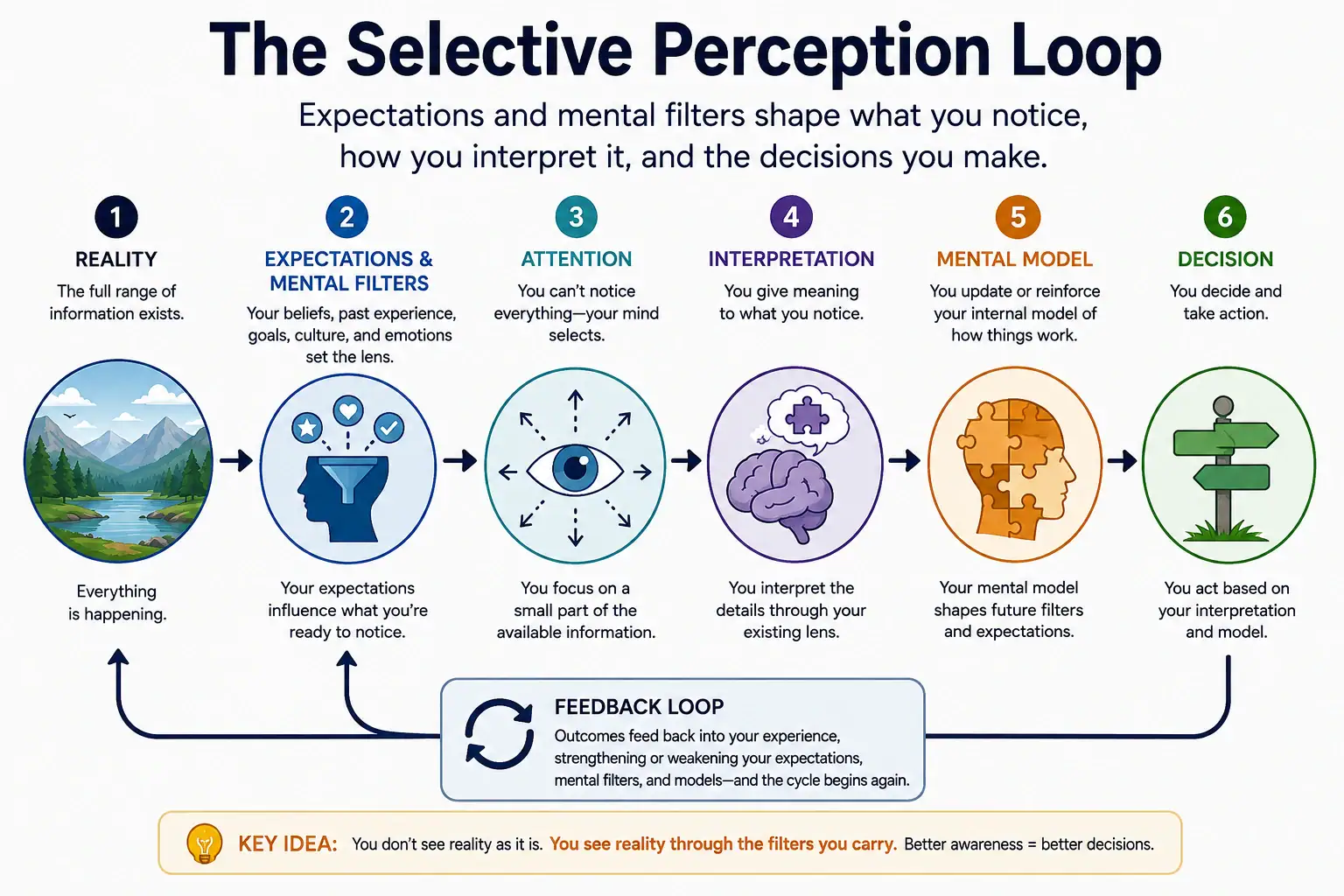
The Selective Perception Loop
A useful way to understand selective perception is as a loop rather than a single event:
Reality → expectations and mental filters → attention → interpretation → mental model → decision → feedback.
First, something happens. Then your existing expectations help determine which parts of the situation feel important. Attention gives those details greater processing priority. You interpret them using your current knowledge and assumptions. That interpretation can update—or reinforce—your mental model. Your model then influences what you do next, and the outcome becomes new experience that can shape future expectations.
This is why mental filters and mental models are so closely connected to selective perception. A mental filter affects what receives weight. A mental model gives the selected information a place in your explanation of how things work.
The loop can be adaptive. A paramedic who has seen hundreds of emergencies may notice subtle cues that a novice misses. An experienced designer may detect a usability problem almost immediately. Their expectations are not random; they are informed by repeated exposure and feedback.
But the same architecture can also preserve an inaccurate assumption. If you expect rejection, notice ambiguous signs of distance, interpret them as evidence of rejection, and then withdraw, your own behavior may reduce the chance of receiving disconfirming social information. The original expectation now feels even more plausible.
Selective Perception vs Selective Attention
Selective attention and selective perception overlap, but they are not identical.
Selective attention is about allocating processing resources: what receives focus when many possible stimuli compete for attention.
Selective perception is broader. It describes how what becomes salient—and how it is subsequently interpreted—can be influenced by expectations, beliefs, context, and prior experience.
Imagine driving in heavy traffic. Your attention may narrow to the car directly ahead because it is immediately relevant. That is selective attention. Now imagine you already believe the driver is reckless. The same lane change might be interpreted as aggressive rather than cautious or accidental. That added layer of expectation and interpretation is closer to selective perception.

The difference is important because “pay more attention” does not automatically solve a perception problem. You can pay intense attention to a narrow subset of evidence and still misunderstand the situation. Better calibration requires asking both what am I noticing? and how am I interpreting what I notice?
Selective Perception vs Confirmation Bias
Selective perception is also related to confirmation bias, but the concepts should not be collapsed into one another.
Confirmation bias describes tendencies to seek, interpret, remember, or give greater weight to information that supports an existing belief. Selective perception can contribute to this pattern when expectations influence which cues stand out in the first place.
For example, suppose you believe a colleague does not respect you. In a meeting, you may notice their brief reply but fail to register several neutral or friendly behaviors. Later, you may remember the short reply as especially diagnostic. If you then search your memory for similar examples, the belief gains more apparent support.
Recent experimental research has even distinguished perceptual confirmation effects from biases that occur later in decision-making. That is useful because it reminds us that bias can enter at multiple stages: what seems perceptually salient, how evidence is interpreted, what is remembered, and how the final judgment is made.

If you want a deeper distinction between useful simplification and systematic judgment errors, see mental models vs cognitive biases. Mental models are not automatically biases. They become risky when a useful model stops updating in response to evidence.
How Expectations Change What You Notice
Expectations are predictions about what is likely. They can come from direct experience, social learning, cultural assumptions, emotional memory, repeated narratives, or simple statistical regularities.
When an expectation is accurate, it can make perception faster and more efficient. If you know the structure of a familiar environment, you do not need to analyze every detail from scratch. Prior knowledge helps you resolve ambiguity.
But expectations can also become self-reinforcing when ambiguous evidence is repeatedly interpreted in the expected direction.
Consider a person who expects others to be unreliable. Cancellations and delays become highly memorable. Quiet examples of reliability may seem ordinary and receive less attention. Ambiguous behavior is interpreted pessimistically. Over time, the person accumulates a vivid archive of confirming examples—not necessarily because the belief is entirely false, but because the evidence was sampled unevenly.

This feedback loop is especially important when evidence is ambiguous. Clear counterevidence is harder to explain away. But when a situation could reasonably mean several things, prior expectations have more room to shape interpretation.
That is one reason a useful reality check is to separate observation from interpretation. “They replied with three words” is an observation. “They are angry with me” is an interpretation. The interpretation may be correct—but recognizing the difference creates room to test it.
7 Selective Perception Examples in Everyday Life
1. Relationships
If you fear rejection, delayed replies, changes in tone, or brief moments of distraction may stand out more than ordinary signs of warmth. The result can resemble the pattern described in why we assume the worst: an ambiguous cue quickly becomes evidence for a threatening explanation.
2. Workplace feedback
An employee who expects criticism may hear nine positive comments and one corrective comment, yet leave the conversation remembering mainly the correction. Another employee expecting praise may minimize the same corrective feedback. The meeting was identical; the salient evidence was not.
3. Leadership
A leader who strongly believes a strategy is succeeding may notice examples that fit the story while treating contradictory operational signals as exceptions. This does not require dishonesty. It can happen through normal attention and interpretation processes.
4. Self-image
If your internal model says “I am bad at social situations,” moments of awkwardness become diagnostic while ordinary conversations seem irrelevant. The model receives a steady stream of apparent confirmation.
5. News and social media
People are more likely to notice stories that connect with existing concerns and interests. Recommendation systems can amplify the effect by repeatedly exposing users to similar material, but selective perception can operate even without an algorithm: what feels personally meaningful is easier to notice and remember.
6. Consumer expectations
A strong brand expectation can influence which features of a product receive attention. Someone expecting premium quality may interpret a design choice as sophisticated; someone expecting poor value may interpret the same choice as unnecessary.
7. Uncertain decisions
When evidence is incomplete, an existing preference can quietly influence what feels most persuasive. This is where selective perception intersects with mental models in decision-making: the model that organizes the evidence can also determine which evidence seems important.
When Selective Perception Feels Like Intuition
This is where the distinction becomes especially important for Intuition Management.
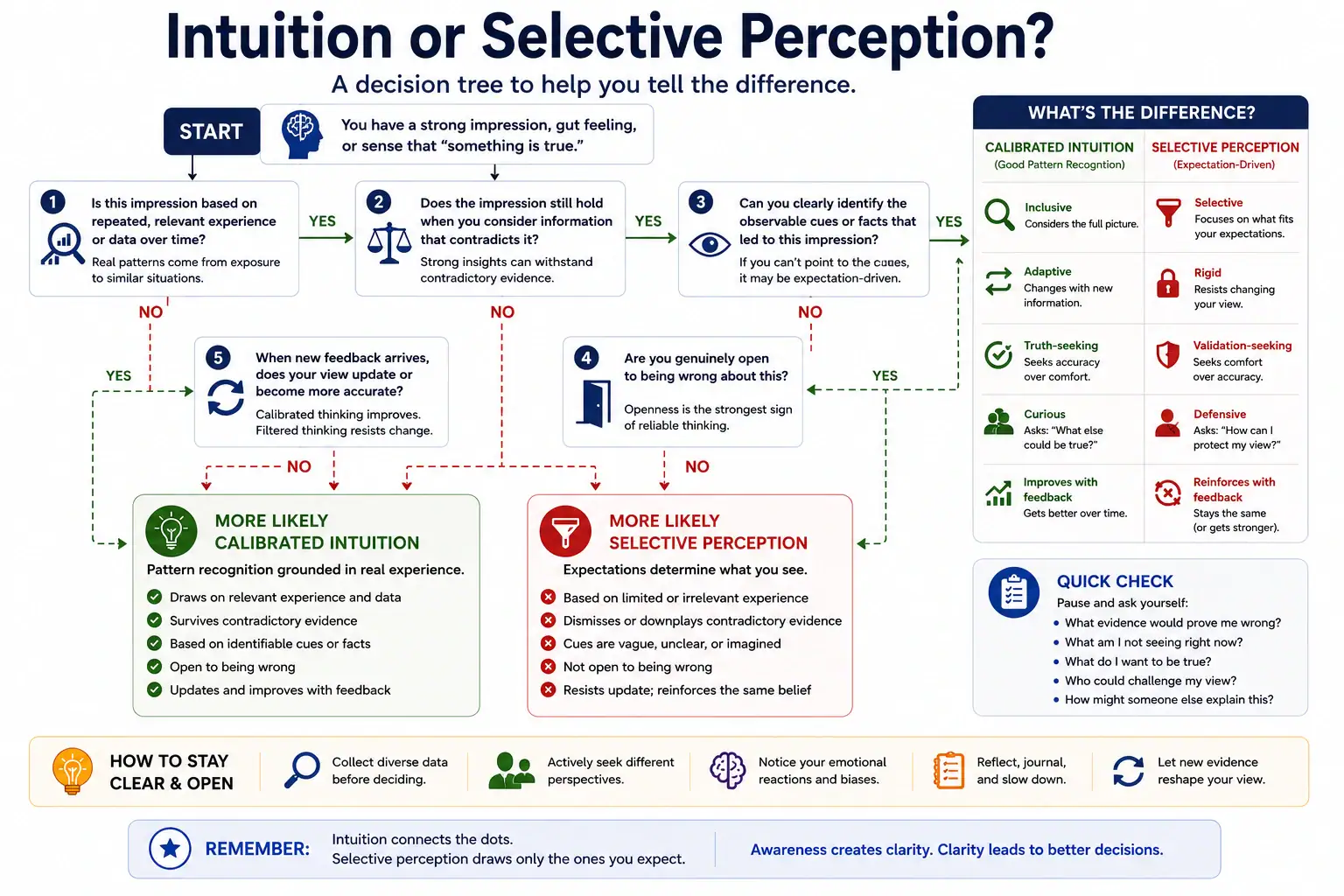
A fast impression can come from real pattern recognition. Experts sometimes recognize meaningful configurations before they can verbally explain every cue involved. But a strong feeling can also reflect an expectation that has filtered ambiguous evidence in a familiar direction.
The subjective experience alone cannot reliably tell you which process is operating. A belief can feel calm and certain and still be wrong. A good intuition can feel urgent. Emotional tone is therefore a poor diagnostic test by itself.
A better question is: How well calibrated is this impression?
Useful intuition is more credible when it grows from repeated relevant experience, is tied to observable cues, survives exposure to contradictory evidence, remains open to revision, and improves through feedback. That is consistent with viewing intuition as pattern recognition under uncertainty.
Selective perception becomes more likely when the evidence base is narrow, opposing cues are routinely discounted, the same conclusion appears regardless of changing evidence, or the person cannot specify what would cause the belief to update.
When a gut feeling is accompanied by strong physiological arousal or threat, another useful comparison is intuition or anxiety. The point is not to distrust every internal signal. It is to avoid granting a signal authority merely because it feels immediate.
The Hidden Costs of Selective Perception
Selective perception is normal, but an unexamined filter can become costly when important information is systematically missed.
Decisions may be based on an incomplete picture. Opportunities that do not fit the current model may be overlooked. Relationships can suffer when ambiguous behavior is repeatedly interpreted in a negative direction. Conflicting evidence can create mental friction because reality does not behave as the model predicts. Persistent blind spots make adaptation harder.
The key word is can. None of these outcomes is inevitable, and selective perception does not automatically cause anxiety, low self-trust, or relationship problems. The risk increases when a perception loop becomes rigid and resistant to correction.

The 5-Step Perception Reality Check
You cannot remove all filters from perception, but you can become better at detecting when an interpretation has outrun the evidence. Use these five questions when a conclusion feels especially obvious:
1. What did I actually observe?
Describe the event without explaining it. Replace “She dismissed my idea” with “She asked two questions and moved to the next agenda item.” This creates a clean boundary between data and meaning.
2. What interpretation did I add?
Name the story your mind supplied. Was the behavior disrespectful, distracted, efficient, uncertain, tired, or something else? You do not need to reject your first interpretation. You need to recognize it as an interpretation.
3. What else could explain the same evidence?
Generate at least two plausible alternatives. This does not mean every explanation is equally likely. The goal is to prevent the first available story from becoming the only story.
4. What evidence would change my mind?
If the answer is “nothing,” you are no longer testing a belief. A well-calibrated model needs conditions under which it can be revised.
5. Has this interpretation predicted outcomes accurately before?
Calibration depends on feedback. If a recurring gut feeling repeatedly predicts what happens next, that matters. If the feeling is vivid but its predictions fail, the model needs updating.
This is the same basic challenge behind separating signal from noise: do not ask only whether a signal feels strong. Ask whether it reliably carries information.
How to Reduce the Effects of Selective Perception
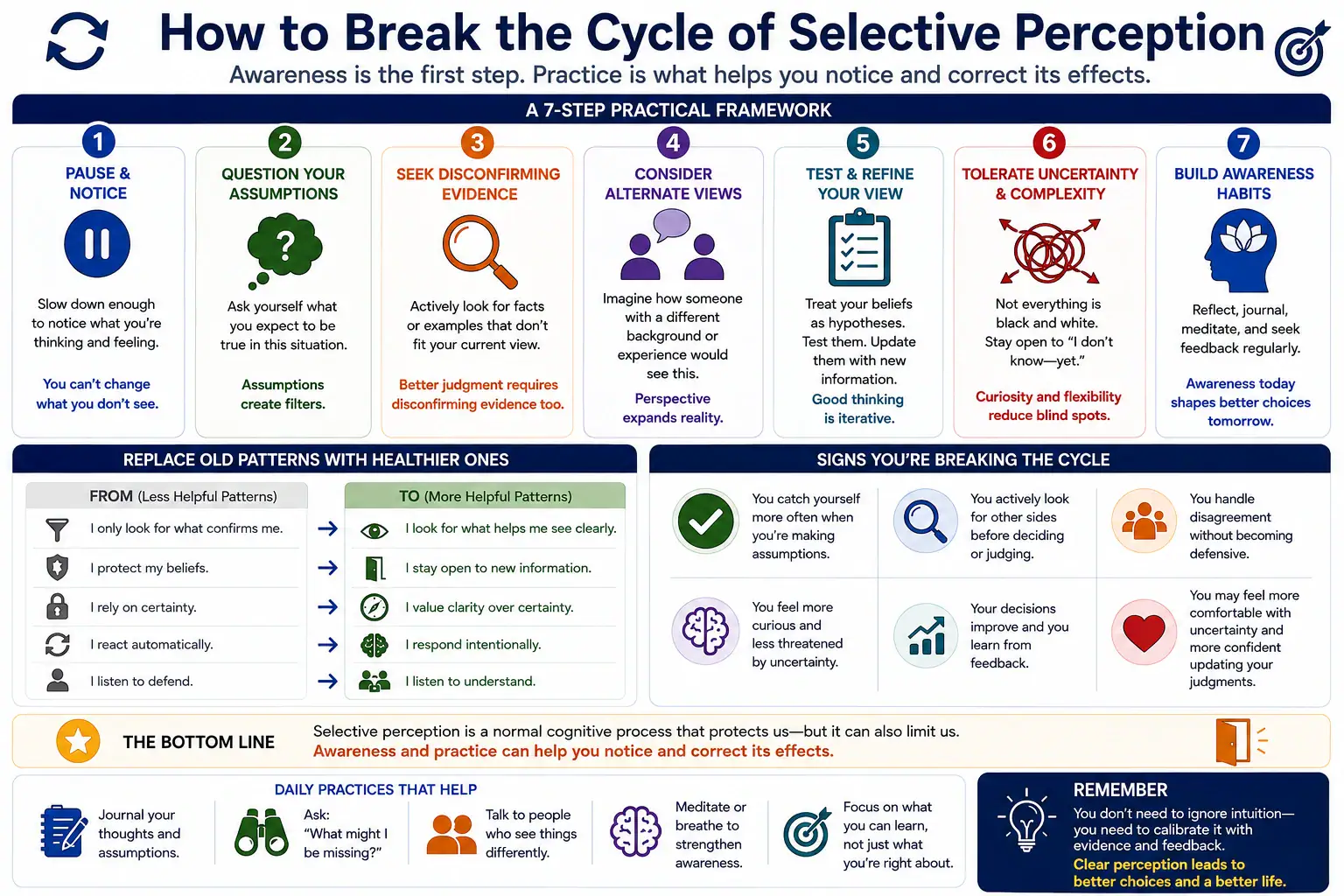
The goal is not perfectly objective perception. Human cognition does not work from nowhere. The more realistic goal is better calibration: filters that remain useful while becoming easier to inspect and update.
Pause before turning a cue into a conclusion
A short pause can create enough distance to distinguish what happened from what you think it means.
Question the assumption behind the interpretation
Ask, “What would I have to believe for this interpretation to feel obvious?” Often the hidden assumption is more revealing than the conclusion.
Actively seek disconfirming evidence
Do not merely wait for counterexamples to appear. Search for them. If you believe a project is failing, look specifically for evidence of progress. If you believe someone is unreliable, look for instances when they did follow through.
Consider another observer’s model
Someone with different experience may notice a different part of the same situation. Their view is not automatically more accurate, but the disagreement exposes assumptions that were previously invisible.
Treat beliefs as hypotheses
A useful mental model is provisional. It earns confidence by predicting reality and loses confidence when prediction repeatedly fails. Learning how to build mental models is therefore partly about building mechanisms for updating them.
Tolerate uncertainty
Some situations do not provide enough evidence for a confident conclusion. “I do not know yet” is not cognitive failure. It is sometimes the most accurate model available.
Build feedback into important decisions
Whenever possible, record what you expected, what you noticed, what you predicted, and what actually happened. Over time, this turns vague self-confidence into measurable calibration.
The Goal Is Not Perfect Objectivity. It Is Better Calibration.
Selective perception exists because the brain has to simplify. You cannot consciously process every signal, hold every explanation at once, or approach every situation without expectations.
So the objective is not to eliminate mental filters. It is to know when they are helping you detect meaningful patterns and when they are preventing important evidence from reaching your judgment.
A strong mental model should make reality easier to predict without becoming immune to reality. A useful intuition should improve with experience and feedback rather than becoming more certain regardless of what happens. A good decision process should make room for both prior knowledge and surprise.
That is the deeper connection between selective perception and intuition: both depend on patterns, but trustworthy judgment requires those patterns to remain corrigible.
You do not need to distrust what you notice. You need to stay curious about what you may not be noticing.
Frequently Asked Questions
What is selective perception in psychology?
Selective perception refers to the way expectations, beliefs, goals, prior experience, and context can influence what information becomes salient and how that information is interpreted. It is not one single brain mechanism; it reflects the interaction of attention, prediction, memory, and interpretation.
What is a simple example of selective perception?
If you expect a coworker to dislike you, you may notice their short replies more readily than their helpful actions and interpret ambiguous behavior negatively. The expectation influences what stands out and what meaning is assigned to it.
Is selective perception a cognitive bias?
Selective perception can contribute to biased judgment, but selection itself is not automatically an error. The brain must prioritize information. It becomes problematic when the selection or interpretation systematically excludes relevant evidence and prevents beliefs from updating.
What is the difference between selective perception and selective attention?
Selective attention concerns which information receives processing priority. Selective perception is broader and includes the way expectations and context influence what becomes salient and how selected information is interpreted.
Is selective perception the same as confirmation bias?
No. Confirmation bias involves seeking, interpreting, remembering, or weighting evidence in ways that support an existing belief. Selective perception may contribute to confirmation bias when expectations influence which cues are noticed or how ambiguous information is experienced.
Can selective perception affect relationships?
Yes. Expectations about another person’s motives can influence which behaviors stand out and how ambiguous actions are interpreted. This can contribute to misunderstandings, especially when assumptions are not checked against direct evidence.
Can selective perception be mistaken for intuition?
Yes. Both can produce fast impressions. A more reliable distinction comes from calibration: relevant experience, identifiable cues, openness to contradictory evidence, and improvement through feedback make an intuitive judgment more credible.
How can I reduce selective perception?
Separate observation from interpretation, identify your expectation, deliberately seek evidence that could disconfirm it, consider alternative explanations, and track whether your predictions are actually accurate. The aim is not to eliminate filters but to make them easier to update.
Research Note
This article uses “selective perception” as a practical umbrella term for interactions among attention, expectation, perceptual inference, interpretation, and judgment. Scientific findings do not support the simplistic claim that expectations freely create reality. Rather, perception reflects an interaction between sensory evidence and prior information.
Selected References
Kok, P., Jehee, J. F. M., & de Lange, F. P. (2012). Less Is More: Expectation Sharpens Representations in the Primary Visual Cortex. Neuron, 75(2), 265–270. DOI: 10.1016/j.neuron.2012.04.034.
Harrison, W. J., Bays, P. M., & Rideaux, R. (2023). Neural tuning instantiates prior expectations in the human visual system. Nature Communications, 14, 5320. DOI: 10.1038/s41467-023-41027-w.
del Río, M., de Lange, F. P., Fritsche, M., & Ward, J. (2024). Perceptual confirmation bias and decision bias underlie adaptation to sequential regularities. Journal of Vision, 24(2), 5. DOI: 10.1167/jov.24.2.5.
Next step: If you want to practice separating useful internal signals from expectation-driven noise, continue with Your Intuition Journey.