Perception organizes and interprets sensory information; intuition is a judgment or sense of knowing that arises without consciously working through the reasoning. Perception helps you experience a situation. Intuition can suggest what it means or what to do. Both can be fast, shaped by context, and mistaken.
You hear a colleague pause before answering. That is something you noticed. You immediately feel that they have reservations. That is a possible judgment about its meaning. Asking what they think can help you discover whether the impression fits.
Understanding intuition vs perception helps you keep a cue, an explanation, and a decision distinct enough to examine. The goal is to use an impression productively while leaving room for correction.

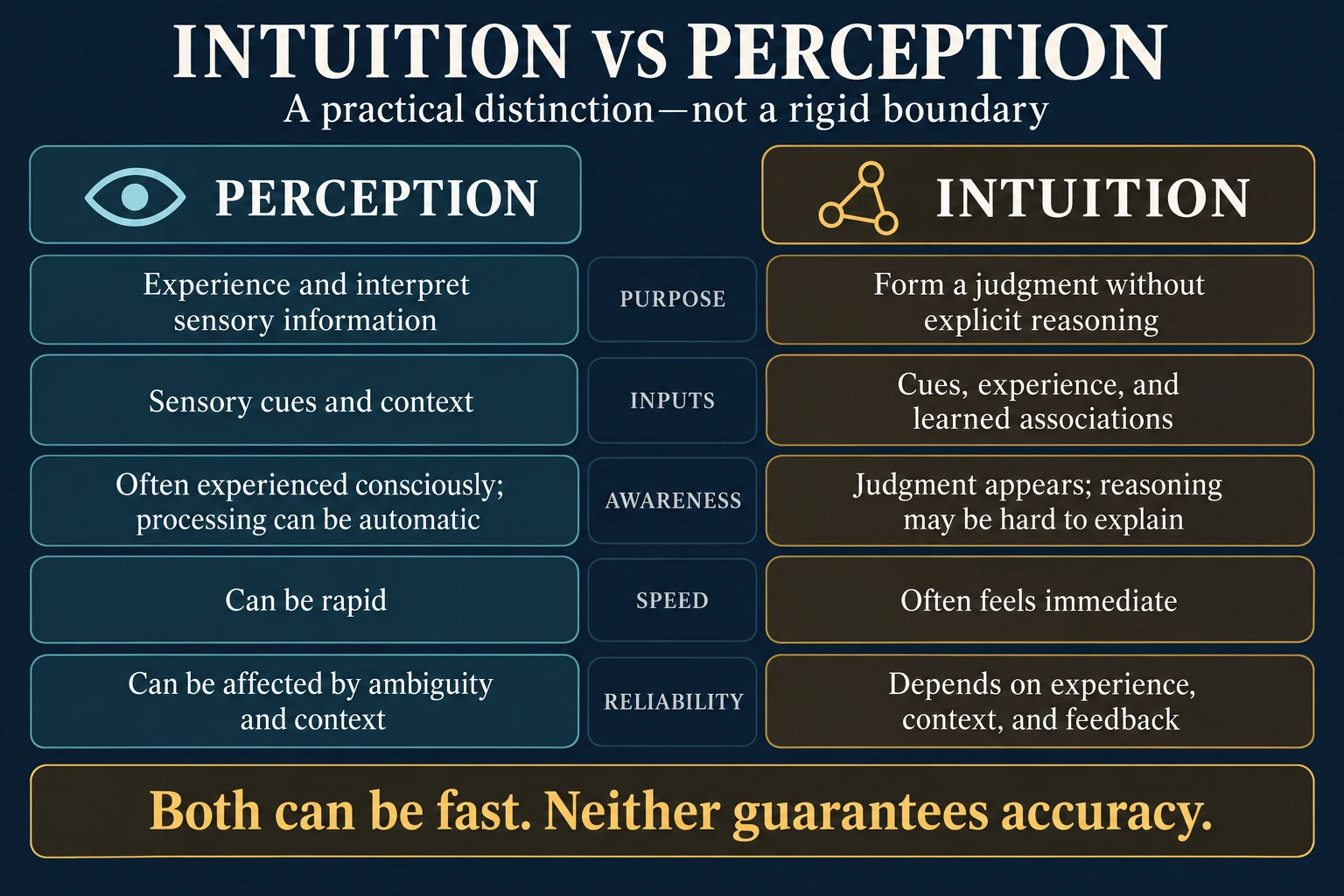
Intuition vs perception at a glance
The useful distinction is between experiencing a situation and forming an immediate judgment about it. These activities interact; neither is automatically accurate.
| Aspect | Perception | Intuition |
|---|---|---|
| Main function | Organizes sensory information into an experience of objects, events, and relationships. | Produces a judgment or impression without consciously tracing the reasoning. |
| Typical question | What am I noticing or experiencing? | What does this seem to mean, or what might I do? |
| Information | Sensory cues interpreted in context. | Current cues, remembered experience, and associations. |
| Awareness | The experience may be conscious even when its processing is automatic. | The judgment may be conscious while its basis is difficult to explain. |
| Speed | Can be rapid. | Often feels immediate. |
| Possible errors | Ambiguity, missed cues, and mistaken interpretation. | Irrelevant experience, misleading associations, and poorly checked confidence. |
| Useful check | Inspect the cue again or obtain a clearer observation. | Look for relevant evidence and alternative explanations. |
What is perception?
Perception is how sensory information becomes an experience of the world. You recognize a voice, distinguish a shape, hear a change in rhythm, or feel a surface. The American Psychological Association describes perception in terms of recognizing, interpreting, and organizing sensory information. Source: APA, Perception and attention.
It helps to separate three ideas. Sensation concerns receiving sensory stimulation. Attention concerns which information receives priority. Perception concerns how sensory information is organized and experienced. These are related concepts, not three boxes that must always operate in a neat sequence.
Hearing someone speak quietly is different from concluding that they dislike your proposal. The quietness is closer to a description of the cue. Dislike is an explanation you have added. Even descriptions can involve interpretation, but a specific description is usually easier for another person to check than a broad conclusion.
Why “my perception” can mean something broader
In everyday language, “my perception of the team” may mean your overall opinion. That opinion could include memories, explicit reasoning, and intuitive impressions. Here, perception primarily refers to sensory experience and the noticing of cues. When a statement goes beyond those cues, we will call it an interpretation or judgment.
This distinction helps in conversation. “You looked away while I was speaking” invites clarification about an observable event. “You were dismissive” combines the event with a claim about its meaning. The second statement may be justified, but it needs more support.
What is intuition?
Intuition is an immediate judgment or sense of knowing whose reasoning is not consciously available step by step. An experienced technician may suspect a familiar fault before listing the clues. A reader may feel that an explanation does not fit before identifying the inconsistency.
The term has several uses. The APA Dictionary entry for intuition includes immediate insight or perception in its definition. That overlap matters: there is no universally clean linguistic boundary between intuition and perception.
For this article, the focus is intuitive judgment in everyday decisions. Calling something intuition describes how the judgment arrives; it does not certify that the judgment is correct. A useful recognition and a mistaken association can both feel immediate.
Intuition also differs from a conclusion reached through an explicit argument. If you calculate remaining work against available capacity and identify a shortfall, you can explain that reasoning. If you first feel that the schedule will fail and later discover the shortfall, the initial impression was intuitive. The eventual evidence deserves its own assessment.
For a deeper explanation of how such impressions develop, see intuitive processing. For the boundaries between neighboring terms, see intuition, instinct, and insight.
How perception and intuition work together
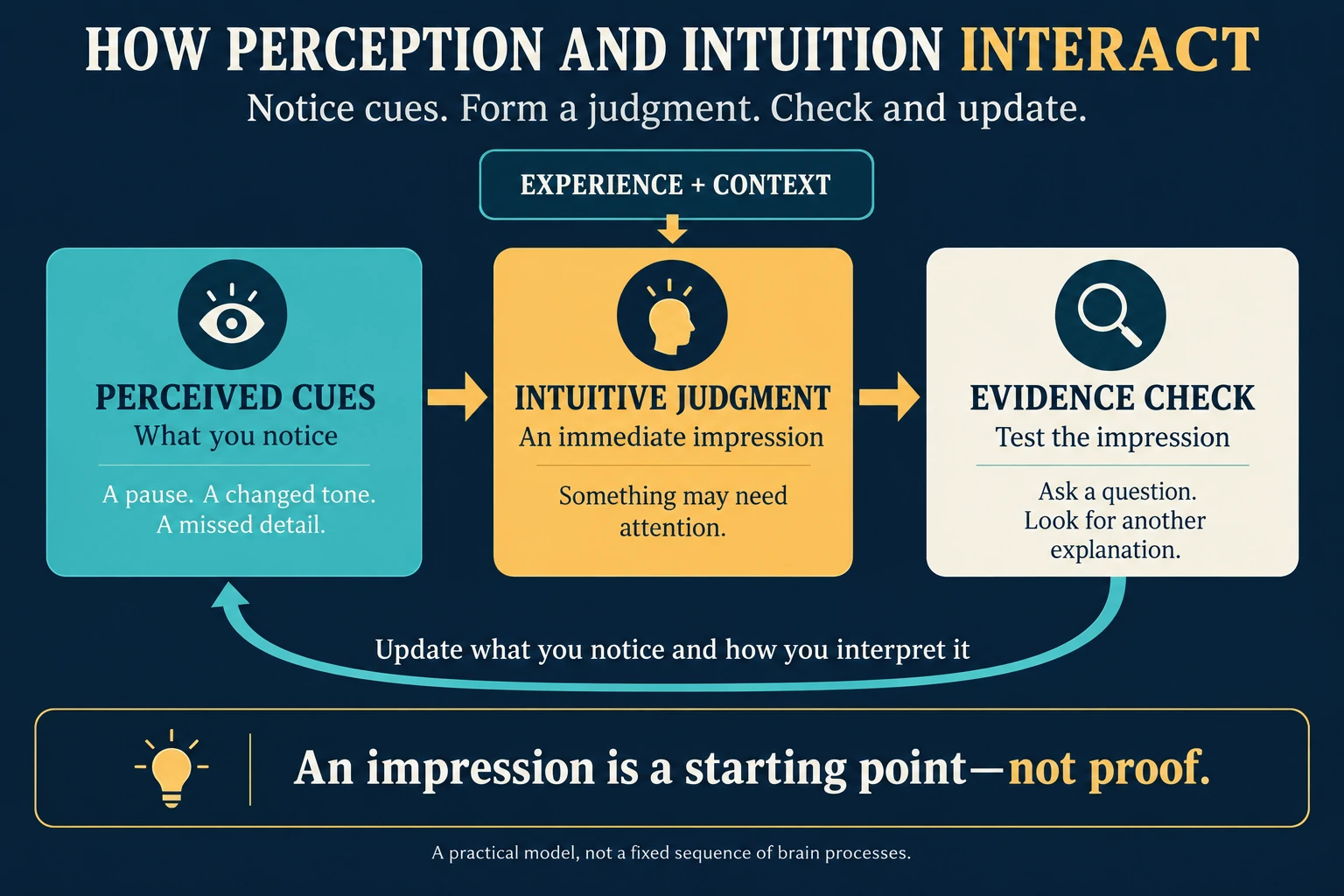
Consider a conversation in which you notice an unusual pause. You have an immediate impression that a topic needs more attention. That impression makes you listen more carefully and ask a question. The answer may support your concern, explain the pause, or change what you notice next.
A practical way to organize this is notice cues, form a judgment, check, and update. It is a reflection framework, not a fixed sequence of brain processes. You may notice a cue and experience its significance almost together. You may also begin with a remembered problem rather than a new sensory event.
Experience and context contribute to the judgment, while a judgment can redirect attention toward further cues. This is why checking should include information that could weaken your impression. Looking only for confirmation can make the original story feel stronger without making it better supported.
Researchers also debate where perception ends and judgment begins, especially across different senses. Andreas Keller’s commentary on perception and judgment illustrates that disagreement. The practical separation used here should not be mistaken for a settled anatomical division.
Five everyday examples of intuition vs perception
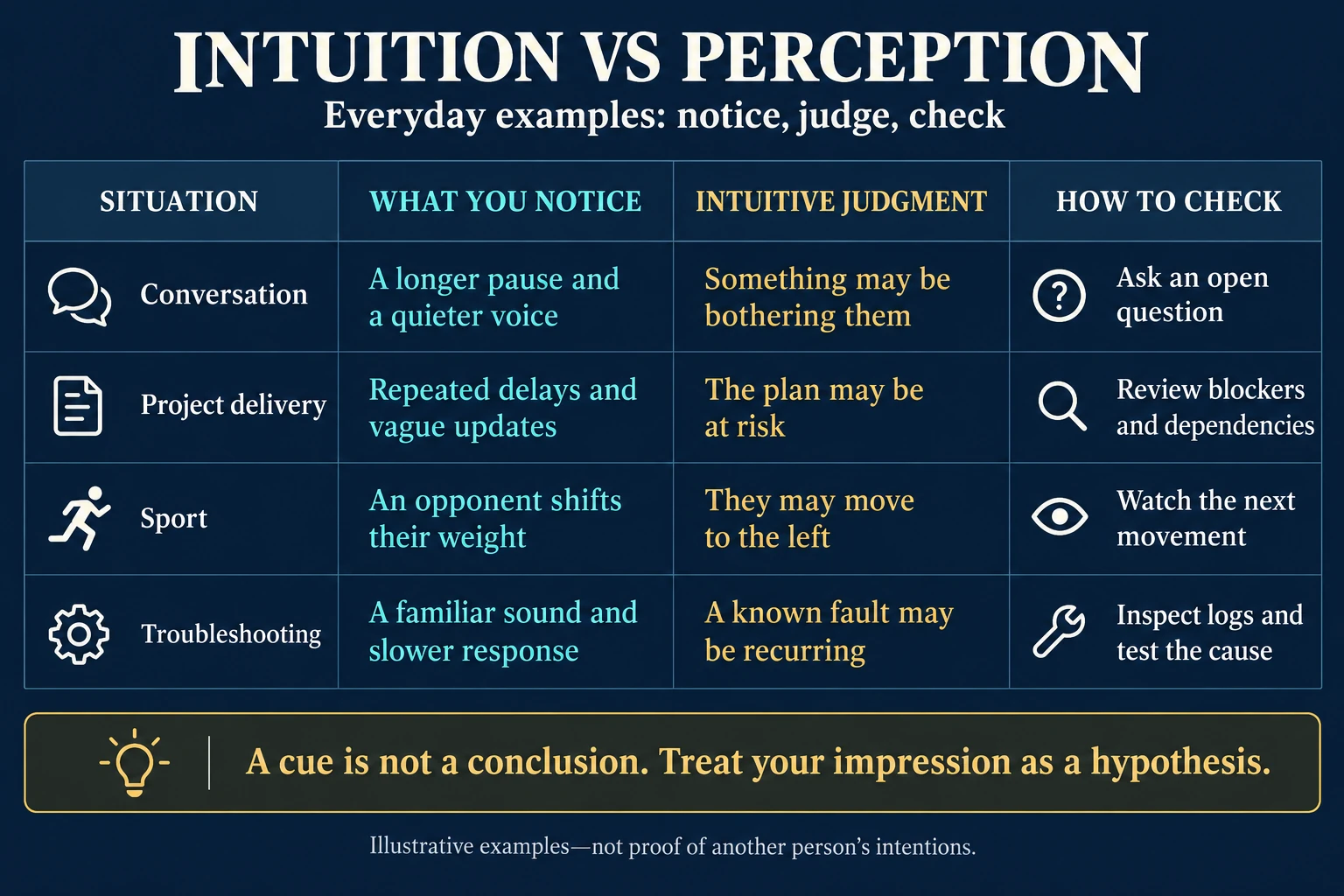
The following examples are illustrative. They show possible judgments, not dependable ways to infer hidden intentions or predict outcomes. A person might also reach the same conclusion through deliberate reasoning.
1. A conversation becomes quieter
What you notice: a longer pause and a quieter voice. Intuitive judgment: something may be bothering the other person. Check: ask an open question, such as “How does that suggestion land with you?”
The other person might be concerned, tired, distracted, or thinking carefully. Avoid turning a change in tone into certainty about their feelings. An invitation to explain is more informative than an accusation.
2. A delivery plan starts to feel fragile
What you notice: milestones slipping and updates becoming less specific. Intuitive judgment: the plan may be at risk. Check: review dependencies, remaining work, and estimates with the people responsible.
A vague update alone does not establish a delivery problem. The concern becomes actionable when the check identifies something concrete, such as unavailable input on a critical dependency.
3. An opponent changes position
What you notice: an opponent shifts their weight. Intuitive judgment: they may move left. Check: watch the next movement and compare your anticipation with what happens.
In fast sport, checking often occurs through immediate feedback after the response rather than a pause beforehand. The lesson is to learn from misses as well as successful anticipations; one correct prediction does not establish a general ability.
4. Equipment sounds familiar
What you notice: a familiar sound and slower response. Intuitive judgment: a known fault may be recurring. Check: inspect logs and test the suspected cause using the appropriate procedure.
The resemblance can help prioritize an investigation. It should not cause you to ignore a different fault that produces similar symptoms. Record which observation would make you abandon the first explanation.
5. A purchase feels wrong
What you notice: specifications are unclear and answers to questions keep changing. Intuitive judgment: this product may not meet your needs. Check: compare the written specifications with your requirements and request a clear answer to the missing detail.
You do not need to prove dishonesty to decide that the available information is insufficient. Keep the claim proportional: “I cannot verify the feature I need” is more defensible than “This seller is untrustworthy.”
How expectations can influence what you notice
Suppose you expect a meeting to be hostile. You might pay particular attention to interruptions and remember them afterward, while overlooking agreement. Another participant may leave with a different account because different moments stood out.
That does not automatically mean your expectation changed the sound reaching your ears or the basic visual experience. Selection, memory, interpretation, and reporting can all contribute to a disagreement. Avoid explaining every difference in judgment as a literal change in sensory perception.
For practical use, write down the event before attaching an explanation. “There were two interruptions during my update” is a better starting point than “Everyone resisted the idea.” Then look at the surrounding context: were others interrupted too, and what happened after the interruptions?
Your interpretation may survive this check. The point is to make its basis visible. The related article on selective perception explores selective noticing in more detail.
Why perception and intuition can both mislead you
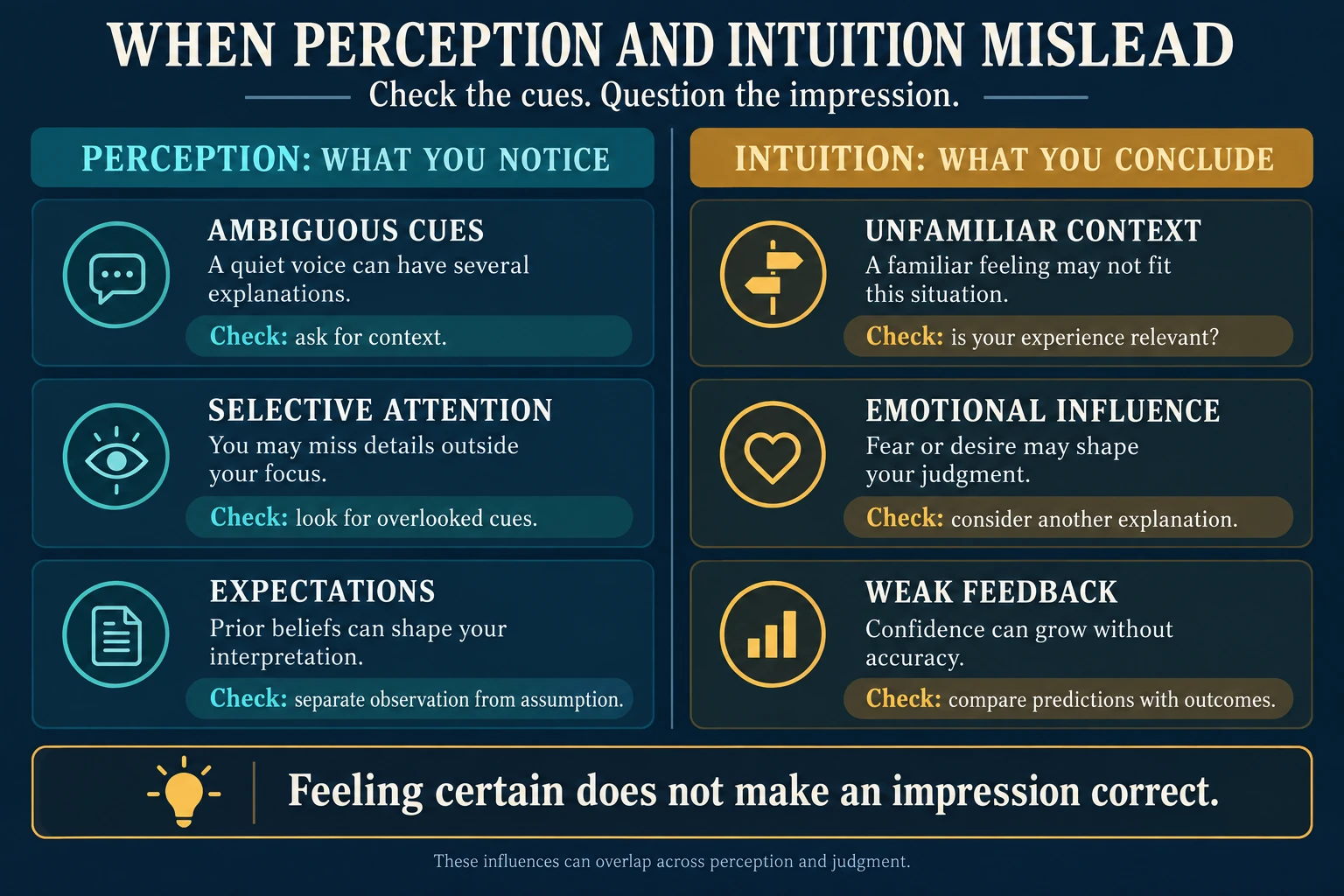
There is no reliable rule that says a calm impression is intuition and an urgent impression is error. The feeling’s intensity or tone cannot replace evidence. The following questions help identify reasons to check more carefully.
Are the cues ambiguous?
A quiet voice, a pause, or a delayed message can fit several explanations. Ask for context before settling on one. When possible, obtain a clearer observation rather than repeatedly interpreting the same uncertain cue.
Have you overlooked relevant information?
Review what fell outside your focus. If your concern centers on one missed deadline, look at the work’s dependencies and the agreed priorities too. A narrow view can make an incomplete explanation seem sufficient.
Is your experience relevant here?
A situation may resemble a familiar one while operating under different conditions. Expertise in one team, product, or environment does not automatically transfer. Ask what is similar and what has changed.
Could fear or desire be shaping the conclusion?
Try describing the same cues without the outcome you fear or want. This is a way to examine your interpretation, not a method for diagnosing an emotion or determining whether a feeling is “real intuition.”
Have you received useful feedback?
In their analysis of intuitive expertise, Kahneman and Klein emphasize a sufficiently predictable environment and opportunities to learn its regularities. Subjective confidence alone does not establish expertise. Source: Conditions for Intuitive Expertise (2009).
Keep track of predictions and outcomes rather than remembering only striking successes. For more on when experience supports judgment, read expert intuition.
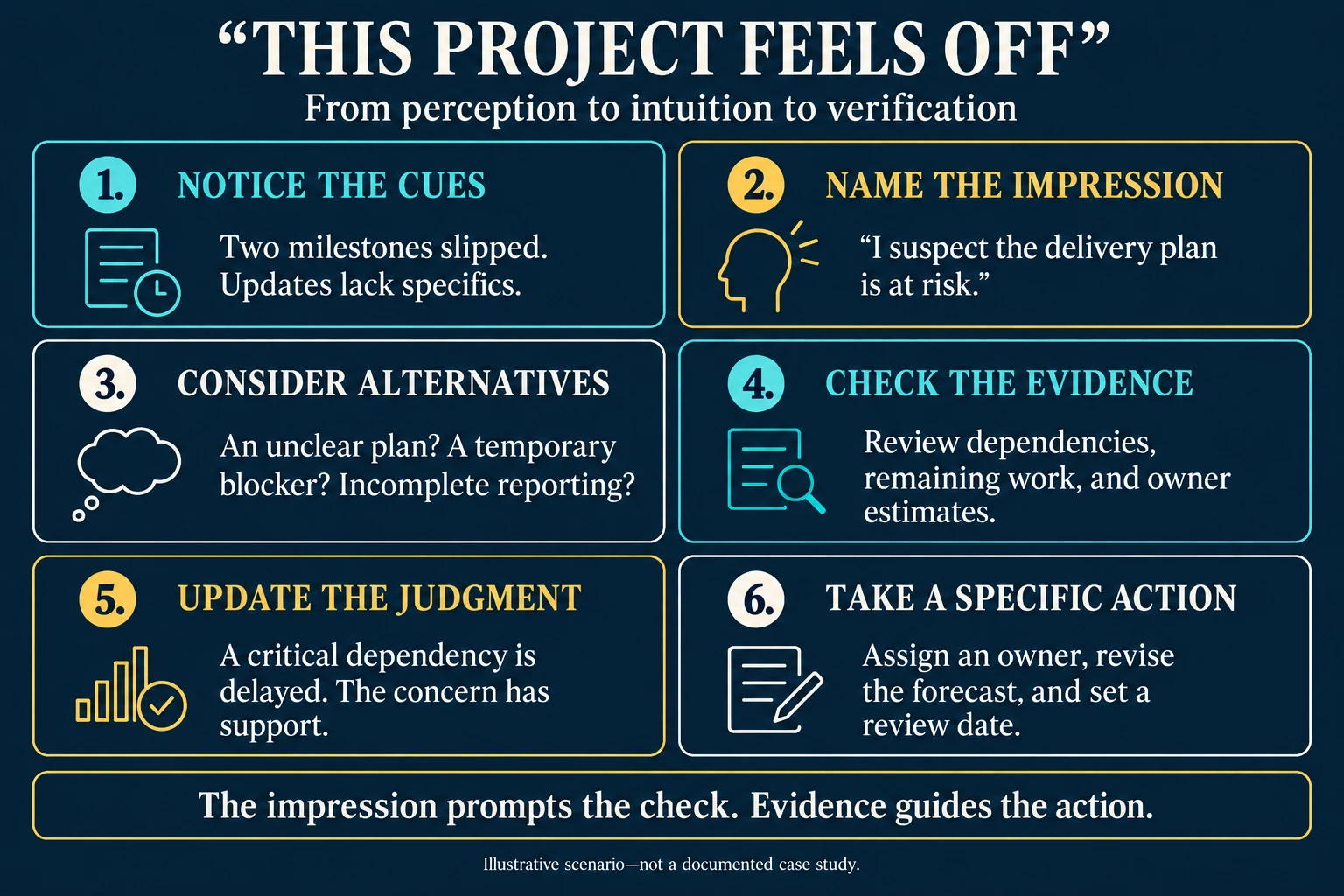
Worked example: “This project feels off”
This is an illustrative scenario, not a documented case study. A delivery manager leaves a review with an uneasy impression. The useful next step is to turn that concern into a question that can be checked.
- Notice the cues. Two milestones slipped, and recent updates do not explain the remaining work. Record those specifics without attributing motives.
- Name the impression. “I suspect the delivery plan is at risk.” Keep it provisional rather than announcing that failure is inevitable.
- Consider alternatives. The problem could be an unclear plan, a temporary blocker, or incomplete reporting. Each explanation implies a different intervention.
- Check the evidence. Review dependencies, remaining work, and owner estimates. Ask which assumption must hold for the forecast to remain credible.
- Update the judgment. In this scenario, the check finds a delayed critical dependency. The concern now has specific support, although the original impression did not identify the cause.
- Take a specific action. Assign an owner for resolving the dependency, revise the forecast as needed, and set a review date.
If the review instead found that reporting was incomplete but the plan remained feasible, the manager should revise the impression and improve reporting. A good check must allow that outcome. Otherwise, it is just a search for reasons to defend the initial feeling.
The action follows the finding. A delayed dependency calls for dependency management; missing reporting calls for better information. Neither finding justifies a broad claim that the team cannot be trusted.
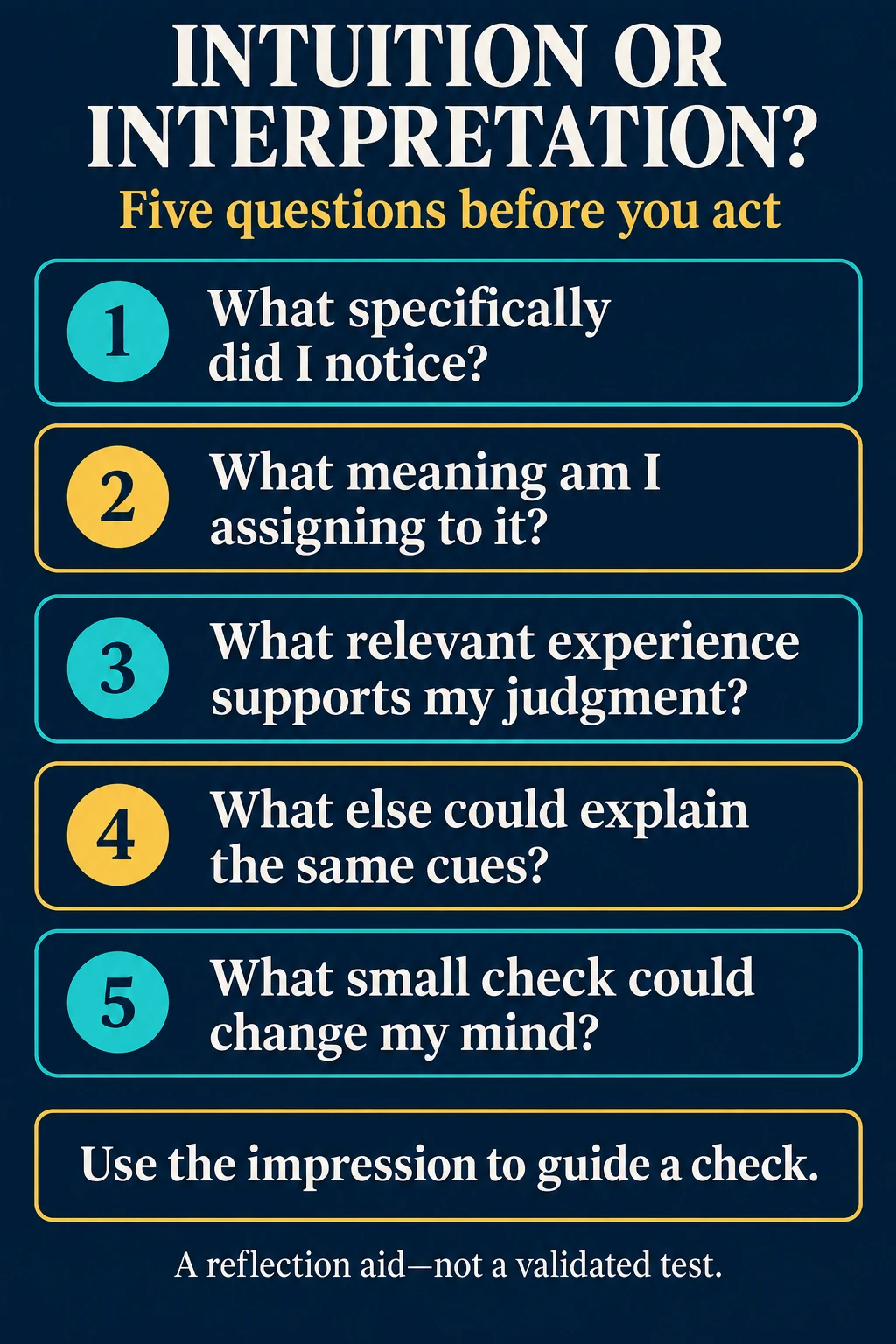
Five questions before you act
Use this short reflection aid when you have time to examine an impression. It is not a validated test and does not score your intuitive ability.
1. What specifically did I notice?
Name an event, sound, change, or inconsistency. If you cannot identify a cue, say so. Do not invent a reason afterward simply to make the feeling sound convincing.
2. What meaning am I assigning to it?
Write the explanation separately. “They answered briefly” and “They are angry with me” are different statements. The second may need clarification.
3. What relevant experience supports my judgment?
Identify a genuinely comparable situation and what you learned from its outcome. Familiarity with a person or setting does not guarantee that this particular judgment is informed.
4. What else could explain the same cues?
Choose at least one plausible alternative. You do not need an endless list; one serious alternative can reveal which information would distinguish the explanations.
5. What small check could change my mind?
Ask a question, inspect a record, repeat an observation, or run an appropriate test. Decide in advance what finding would weaken the impression. Match the effort to the decision’s consequences and the time available.
A useful one-sentence record is: “I noticed ___, my impression is ___, another explanation is ___, and I will check ___.” Add the outcome later when there is something meaningful to learn.
For a related framework, explore the Personal Signal Decoder. If you need to decide which information deserves attention, see Signal vs Noise.
Frequently asked questions
Are intuition and perception the same?
The terms overlap, but they are useful for different questions. Perception concerns sensory experience; intuitive judgment concerns an impression formed without consciously tracing the reasoning. Everyday uses of “perception” can also mean an opinion, which makes the boundary less precise.
Is perception always conscious?
Many perceptual operations occur without deliberate effort. You can consciously recognize a voice without being aware of the processing that made recognition possible. This distinction between the experience and its underlying processing matters more than labeling perception entirely conscious or unconscious.
Can intuition arise from perceptual cues?
Yes. A noticed pattern can contribute to an immediate judgment. However, intuition can also involve remembered information or associations, and you may not be able to identify which cues contributed. Inability to explain a judgment does not establish its accuracy.
Which is more reliable: intuition or perception?
Neither wins in every situation. A clear observation may settle a straightforward question; an experienced intuitive judgment may suggest where to investigate a complex problem. Reliability depends on the task, the quality of the information, and the opportunity to check.
How is insight different?
Insight commonly refers to a sudden understanding or realization. You might intuit that an explanation is wrong before having the insight that reveals why. This is a practical distinction; scientific and everyday uses of these terms are not perfectly uniform.
Does “intuition vs perception” mean the same thing in personality discussions?
Not necessarily. Personality frameworks may give these words specialized meanings. This article compares everyday sensory perception with intuitive judgment; it does not classify people into personality types or treat the comparison as a personality assessment.
Sources and scope
This article combines definitions, research context, and original illustrative examples. The checklist and project scenario are practical editorial aids, not research-validated interventions. The illustrations are conceptual, not anatomical models.
- American Psychological Association: Perception and attention. Background for the definition of perception.
- APA Dictionary of Psychology: Intuition. Terminology and overlap with immediate knowing.
- Kahneman, D., & Klein, G. (2009). Conditions for intuitive expertise: A failure to disagree. American Psychologist, 64(6), 515–526.
- Keller, A. (2016). The distinction between perception and judgment, if there is one, is not clear and intuitive. Behavioral and Brain Sciences, 39, e249.