Intuition Management · Psychology of Intuition
What Are Mental Filters?
How your brain decides what you notice, what you miss, and which version of reality feels true.

You do not experience every sound in the room, every sensation in your body, every possible meaning in a conversation, or every risk and opportunity in a decision. You experience a selection. Your attention highlights a small portion of what is available. Your expectations help interpret it. Your emotional state changes what feels important. Your memory supplies context. Your brain then uses the result to predict what is likely to happen next.
That selection process is what this article calls mental filtering. A mental filter is not a literal structure in the brain and not a clinical category. It is a practical umbrella term for the interacting processes that select, suppress, prioritize and interpret information. These processes include selective attention, learned expectations, memory, emotion, goals, habits, social identity and prediction.
The essential idea is simple: reality is larger than experience. What you experience is not false merely because it is filtered. It is incomplete. The task is not to remove filters, which would be impossible, but to notice when a filter fits the present situation and when it has become too narrow, too open or too rigid.
What are mental filters?
Mental filters are the invisible selection rules by which the mind reduces complexity. They influence what stands out, what fades into the background, what feels relevant, what becomes memorable and what never reaches conscious awareness. They are one reason two people can witness the same event and walk away with different memories, emotions and conclusions.
Imagine entering a crowded café while waiting for an important message. You may barely notice the music, furniture or conversations, but the vibration of your phone immediately captures attention. The environment did not contain only one signal. Your current goal made one signal more relevant than the others.
Now imagine entering the same café after a frightening experience. You may scan the exits, notice unusual movements and interpret ambiguous sounds as possible danger. The physical environment may be similar, but the selection rule has changed. What receives priority is different, and therefore the experienced reality is different.
This does not mean reality is arbitrary. It means human access to reality is selective. The mind must choose because attention and working memory are limited. Research on selective attention describes the preferential processing of some information while competing inputs are reduced or suppressed.1 Attention is therefore not a spotlight that can illuminate everything at once. It is a system of prioritization.
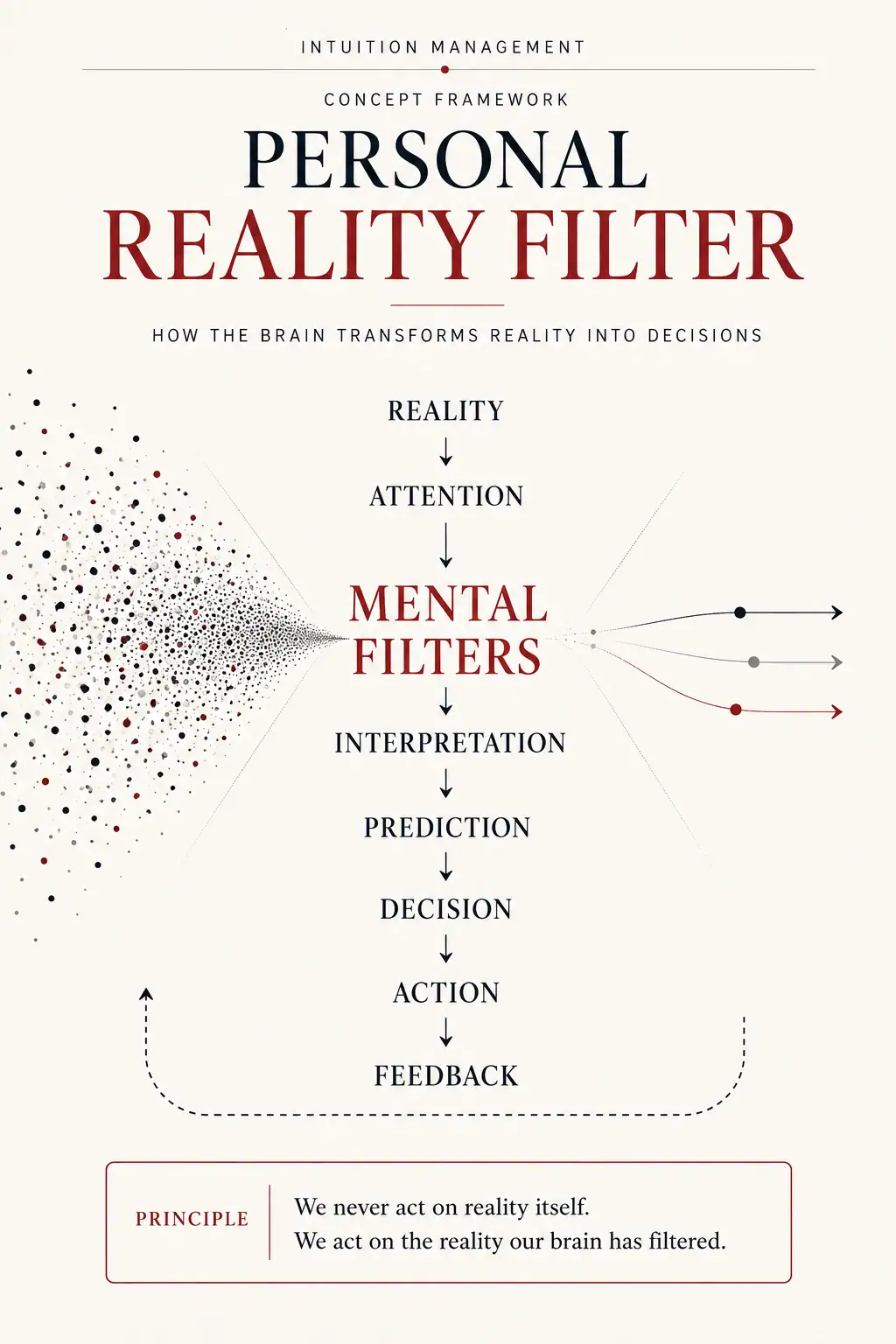
Mental filters are not automatically distortions
The word “filter” can sound negative, as though filtering always hides truth. In practice, filtering is necessary. Without it, every sound, sensation, memory, possibility and warning would compete at the same level. A useful filter converts complexity into relevance.
A driver filters for movement, signals and hazards. A physician filters for diagnostic clues. A musician filters for pitch, rhythm and timing. A parent may detect a child’s voice in a noisy room. A project leader filters for dependencies, risk and changing constraints. In each case, filtering supports skilled action.
The problem begins when a filter stops matching reality. A threat filter may remain active after danger passes. A goal filter may exclude relationships and recovery. A habit filter may repeat a successful response in a changed environment. A curiosity filter may keep opening possibilities after a decision is required.
Reality, experience and interpretation
It helps to separate three layers:
- Reality: events, conditions and signals that exist whether or not you notice them.
- Experience: the subset of those signals that reaches awareness, together with bodily and emotional responses.
- Interpretation: the meaning assigned to the selected experience.
Confusion arises when interpretation is mistaken for direct reality. “I noticed distance in their voice” is an observation. “They have stopped caring” is an interpretation. The interpretation may be correct, partly correct or wrong. Mental-filter awareness creates room between the two.
This is the central distinction behind signal versus noise: a signal can be meaningful without containing the complete explanation.
Why the brain filters reality
Limited capacity
The sensory world contains more information than can be consciously processed. Attention solves this problem by prioritizing. Working memory is also closely tied to attention and has strict functional limits.2 Filtering allows the mind to maintain a task, follow a conversation and prepare an action without being overwhelmed by every competing input.
Relevance
Goals alter perception. When you search for a particular word on a page, that word becomes easier to detect. When you are waiting for someone, faces that resemble them capture attention. When a deadline matters, time cues become more salient. Relevance is not contained only in the signal; it emerges from the interaction between the signal and the current goal.
Learning and reward
Attention can be shaped by what has previously produced reward or consequence. Research on value-driven attentional capture shows that stimuli associated with reward can continue to attract attention even when they are no longer relevant to the current task.3 This helps explain why habits of attention can persist after the original reason for them disappears.
Prediction
The brain prepares for likely events rather than waiting passively for complete information. Predictive-processing accounts describe perception as an interaction between incoming evidence and prior expectations.4 Prediction speeds recognition, but it can also cause ambiguous evidence to be interpreted through an old model.
Protection
Threat-related signals often receive priority because the cost of missing danger can be high. This asymmetry can be adaptive. Yet protection becomes costly when the system treats ordinary ambiguity as continuing threat. The person may notice genuine signs of tension while missing safety, support and alternative explanations.
Coherence
The mind also filters to maintain a stable sense of self and world. Coherence reduces uncertainty. It helps you know what to expect and how to act. But coherence can become defensiveness when disconfirming evidence threatens identity, belonging or a familiar story.
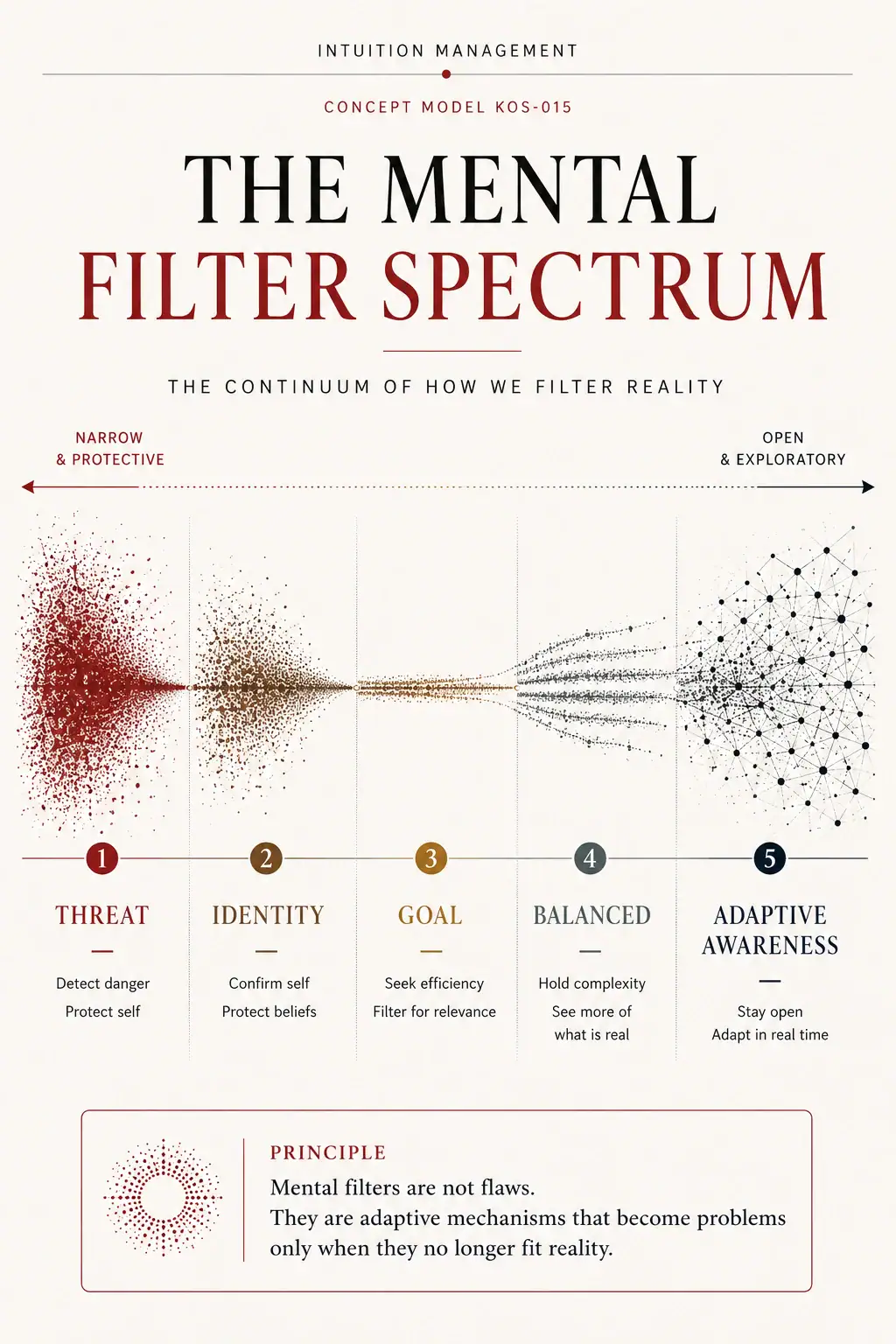
The Mental Filter Spectrum is not a ladder of moral or psychological worth. Narrow protective attention can be appropriate in danger. Goal focus can be appropriate under time pressure. Open exploration can be appropriate during learning. Adaptive awareness means being able to shift modes instead of being trapped in one.
Attention: the first gate
Attention is the practical gateway between the environment and conscious experience. It changes which signals receive enhanced processing and which remain weak. Research on visual attention shows that attention can influence early perceptual processing, not merely later reasoning.5
This means attention does more than choose what you think about. It helps determine what becomes available to think about.
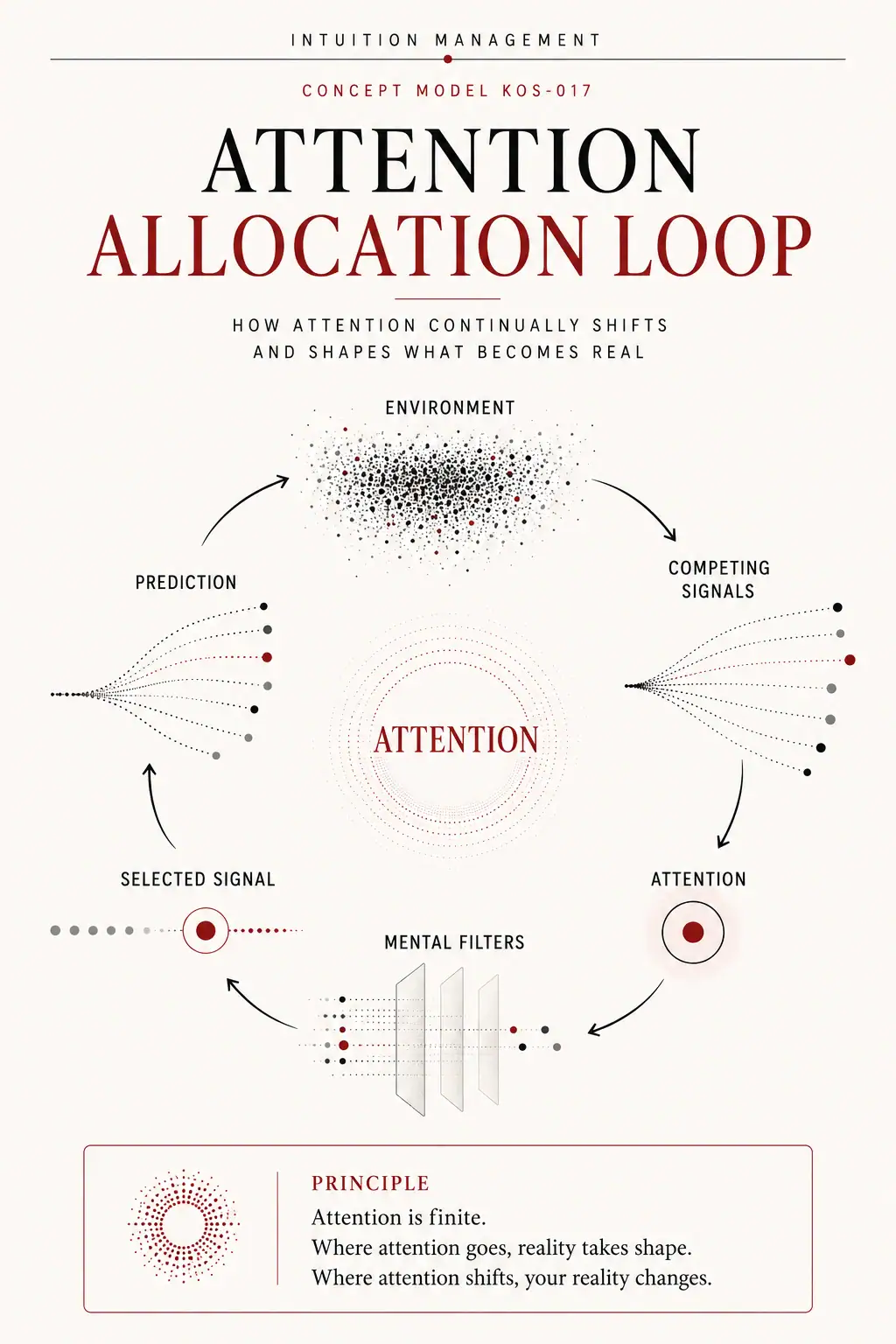
Bottom-up attention
Bottom-up attention is captured by salient events: a crash, sudden movement, flashing notification, emotionally charged phrase or unexpected change. It is fast and often useful. It also makes the system vulnerable to environments designed to seize attention repeatedly.
Top-down attention
Top-down attention is guided by intention: reading a report, listening for a specific answer, searching for a pattern or completing a task. It allows goals to organize perception.
Why anxiety changes attention
Attentional control theory proposes that anxiety can weaken goal-directed attentional control and increase the influence of stimulus-driven attention, especially for threatening information.6 This does not mean an anxious person invents danger. It means the system may allocate more resources to possible threat and fewer to neutral context.
Why more attention is not always better
Attention involves trade-offs. Stronger focus on one stream can improve processing of that stream while increasing errors elsewhere. In selective-attention research, emphasizing attended information can reduce performance on unattended information.7 Every focus has an opportunity cost.
Attention audit: What is receiving most of your attention now? Which goal, fear, reward or expectation makes it salient? What important evidence may be underweighted because attention is already committed elsewhere?
When focus becomes difficult, the problem may not be a lack of effort. It may be that too many signals are competing for the same limited gate.
Perception, interpretation and memory are different filters
Mental filtering does not happen once. It can occur at several points between an event and a later decision.
Perceptual filtering
Perceptual filtering determines which details become prominent. In a meeting, one person notices hesitation, another notices enthusiasm, and a third notices missing data. All may be observing real features, but each feature occupies a different position in attention.
Interpretive filtering
Interpretation gives selected information meaning. A delayed reply may mean rejection, overload, distraction, caution or nothing important. The chosen interpretation depends on expectations, current state, history and context.
Memory filtering
Memory is not a perfect recording retrieved unchanged. Remembering is reconstructive. Present goals, beliefs and emotion can influence what is accessible and how the event is organized. Mood-congruent memory research shows that people can more readily retrieve material that matches current or prior mood states.8
This can create a powerful loop. When you feel discouraged, failures may become easier to retrieve. Those memories then make the present situation feel more hopeless. The remembered evidence is real, but the sample is mood-shaped.
Meaning filtering
Events become part of larger stories: “I am unreliable,” “People cannot be trusted,” “I always recover,” “Challenges help me grow.” These stories organize experience efficiently. They also determine which details feel like proof and which appear irrelevant.
Why two people remember the same event differently
Different memories do not automatically imply dishonesty. People may have attended to different moments, encoded different meanings, experienced different emotions and reconstructed the event through different schemas. Memory disagreement should therefore be investigated with humility rather than treated as immediate evidence of bad faith.
Prediction and the internal model of reality
Perception is faster when the brain can anticipate what is likely. Prediction prepares the body and attention before events fully unfold. In broad terms, predictive processing includes mechanisms that use information about past and present states to represent likely future states.9
The practical implication is that you rarely meet a situation without expectations. You enter with a model:
- what usually happens here;
- what kind of person this is;
- what your body state means;
- which outcomes are likely;
- which signals deserve attention.
That model can make perception efficient. A skilled chess player recognizes configurations faster than a novice. An experienced clinician can notice a pattern that a beginner misses. A manager who has seen projects fail may detect early coordination problems before metrics visibly deteriorate.
But prediction can become self-sealing. When a model determines what is noticed, and what is noticed is then treated as proof of the model, the system may stop learning.
This is why the internal model of reality should be treated as a working model rather than a final verdict. Models are valuable because they compress complexity. They remain accurate only when they are exposed to correction.
Prediction error
Prediction error is the difference between what was expected and what occurred. It is one of the most valuable signals in learning. Yet a rigid filter may explain away prediction error rather than update. If you expect rejection and receive kindness, you might call it manipulation. If you expect failure and succeed, you might call it luck. The model survives, but learning stops.
Uncertainty and control
Uncertainty increases the need for cognitive control because several interpretations or actions remain possible.10 When control capacity is depleted, the mind may reduce uncertainty by choosing the fastest familiar explanation. This can create confidence without accuracy.
That helps explain why everything can feel uncertain while the mind simultaneously becomes more rigid. Rigidity is often an attempt to escape uncertainty, not evidence that uncertainty has been resolved.
Five common mental filters
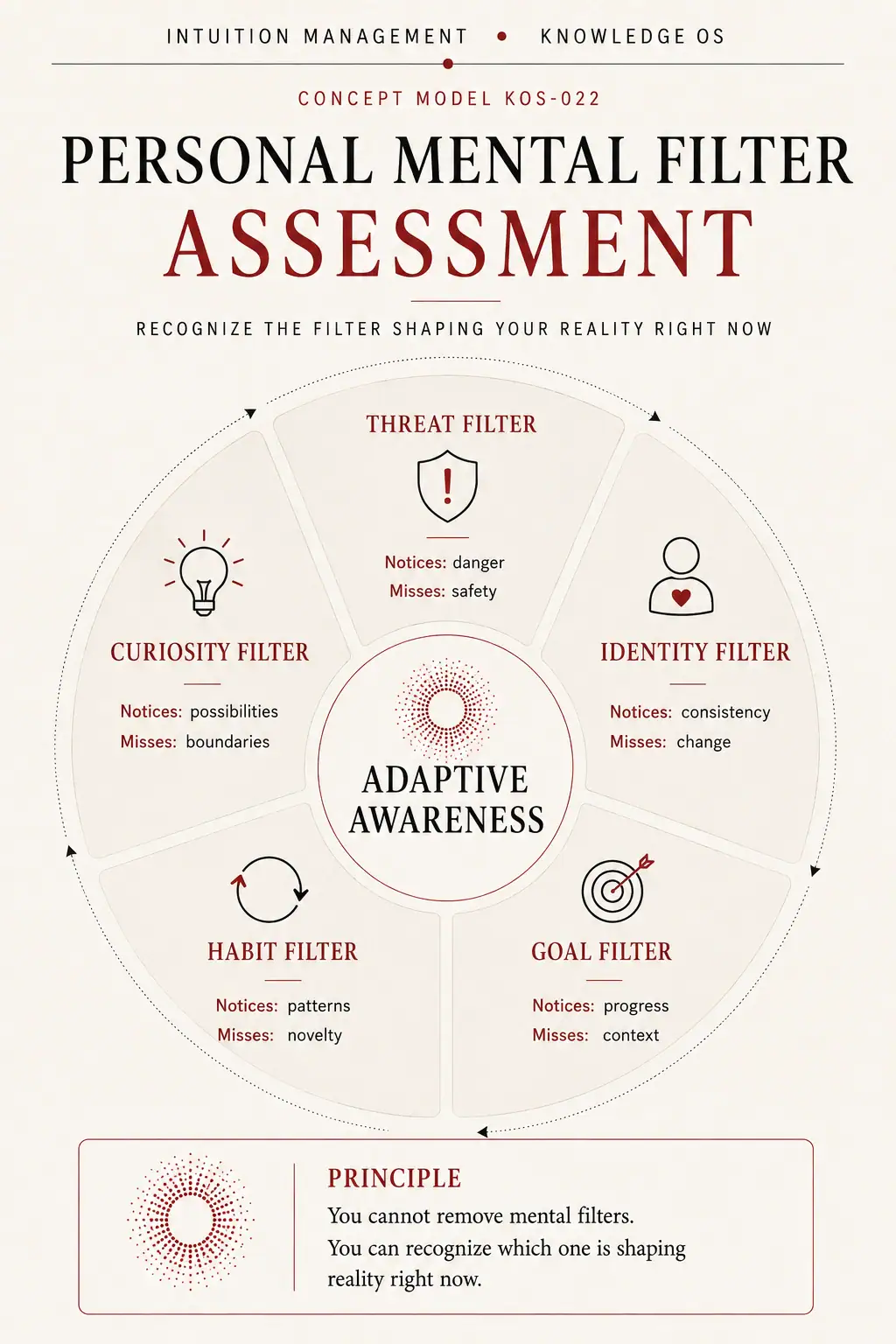
People do not have one permanent filter type. The same person can move between filters across situations and within a single conversation. These five modes are practical categories, not diagnoses.
Threat filter
The threat filter prioritizes danger, inconsistency, uncertainty and signs that something may go wrong. Its adaptive strength is protection. It supports fast detection when risk is real.
Its blind spot is safety. Neutral cues can receive threatening meaning, while reassuring information is treated as weak or temporary. The person may continue scanning even after enough evidence exists to stand down.
Calibration question: What evidence would indicate that this situation is safer than my system currently predicts?
Identity filter
The identity filter prioritizes information that fits self-image, group belonging and values. Its adaptive strength is coherence. It helps maintain commitments and stable relationships.
Its blind spot is change. Evidence may be evaluated according to whether it protects identity rather than whether it is accurate. Criticism can feel like rejection of the whole self.
Calibration question: Can this new information be true without making my entire identity false?
Goal filter
The goal filter prioritizes progress, leverage, obstacles and task relevance. Its adaptive strength is execution. It helps people resist distraction and convert plans into action.
Its blind spot is context. Relationships, long-term consequences, bodily limits and weak signals may be excluded because they do not contribute to the immediate objective.
Calibration question: What matters here that is not measured by progress toward the current goal?
Habit filter
The habit filter prioritizes familiar patterns, routines and previously successful responses. Its adaptive strength is efficiency. It reduces cognitive effort and supports reliable performance.
Its blind spot is novelty. New conditions can be forced into old categories. A response that was once intelligent becomes automatic.
Calibration question: What has changed since this response last worked?
Curiosity filter
The curiosity filter prioritizes novelty, possibility, anomalies and connections. Its adaptive strength is discovery. It supports creativity and learning.
Its blind spot is boundary. Exploration can continue without commitment. Possibility can receive more weight than feasibility.
Calibration question: What decision, limit or priority would make this exploration useful?
| Filter | Often notices | May miss | Adaptive value |
|---|---|---|---|
| Threat | Risk, danger, inconsistency | Safety, support, opportunity | Protection |
| Identity | Belonging, coherence, values | Change, contradiction, nuance | Continuity |
| Goal | Progress, obstacles, relevance | Context, relationships, recovery | Execution |
| Habit | Patterns, routines, familiar cues | Novelty, weak signals, changed conditions | Efficiency |
| Curiosity | Possibility, novelty, connection | Limits, deadlines, practical constraints | Learning |
Expertise, intuition and pattern recognition
Intuition is often experienced as knowing without conscious step-by-step reasoning. One important source of this experience is rapid pattern recognition. Through repeated exposure, the system learns which cues predict meaningful outcomes.
A firefighter may sense that a building is unsafe before being able to state every cue. A clinician may notice that a patient’s presentation does not fit the obvious diagnosis. A leader may detect tension in a team before a formal issue is reported. A skilled reader of a domain has filters that prioritize diagnostic signals.
Expert intuition becomes more reliable when three conditions are present:
- the environment contains recurring patterns;
- the person receives reasonably timely and accurate feedback;
- experience is broad enough to include exceptions and failed predictions.
Intuition becomes less reliable in noisy environments where outcomes are delayed, feedback is ambiguous or chance dominates. Confidence can grow even when calibration does not.
Good intuition is trained filtering
Good intuition is not the absence of filters. It is filtering shaped by relevant experience, corrected by feedback and kept flexible enough to notice exceptions. This matches the article’s account of intuition as pattern recognition under uncertainty.
Intuition and anxiety
A strong feeling is not proof of either intuition or anxiety. Anxiety can create urgency, repetition and threat-focused attention. Intuition may appear as a specific pattern match or directional sense. Yet these are tendencies, not diagnostic rules.
A safer process is to name the signal, identify the filter, examine evidence and choose a proportionate test. The guide to intuition versus anxiety explores this distinction in more detail.
Self-trust without unquestioning belief
Self-trust does not mean obeying every internal signal. It means trusting yourself to listen, investigate and update. That is why rebuilding self-trust requires calibration rather than certainty.
Trust the signal enough to examine it. Trust reality enough to correct it.
Mental filters vs cognitive biases
The terms overlap, but they are not identical.
| Mental filters | Cognitive biases |
|---|---|
| A broad practical concept for how information is selected, suppressed and prioritized. | Systematic patterns in judgment, estimation, memory or choice. |
| Can be adaptive, neutral or distorted depending on fit. | Often discussed as predictable deviations from normative reasoning. |
| Operate before and during interpretation. | Often become visible in interpretation and decision. |
| Examples: threat, identity, goal, habit and curiosity filters. | Examples: confirmation bias, anchoring and availability bias. |
Confirmation bias
Confirmation bias is the tendency to gather or interpret evidence in ways that support an existing belief. Experimental work shows that confirmation can occur at both perceptual and decision stages.11 A filter makes some evidence easier to notice; that evidence then appears to validate the filter.
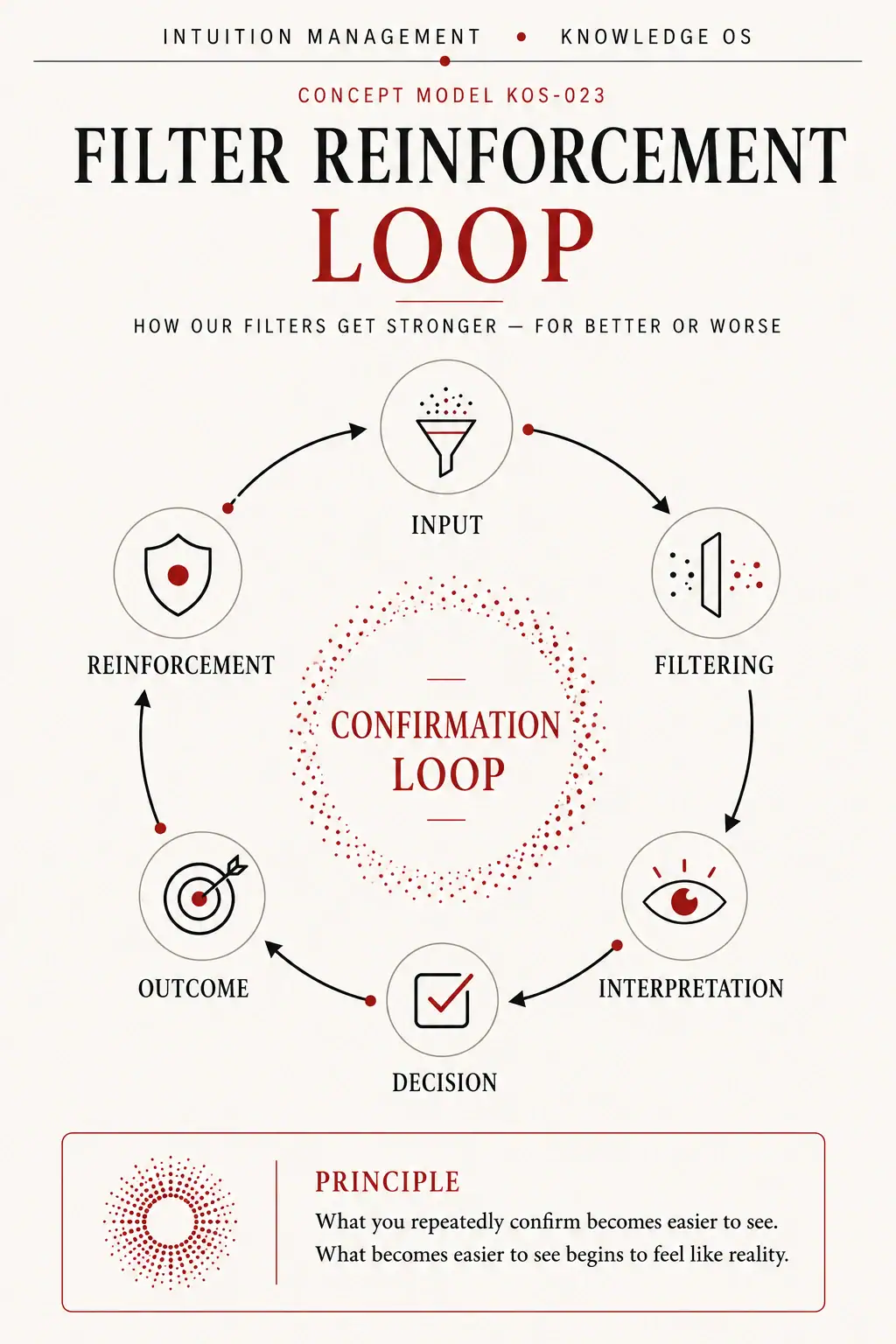
A self-confirming relationship loop
Suppose you expect people to dismiss your ideas. You become sensitive to interruptions, delayed replies and neutral expressions. You speak less confidently, explain less clearly or withdraw early. The other person responds with less engagement. The outcome seems to confirm the expectation.
Real events occurred, but the loop was partly shaped by the expectation. Breaking the loop requires a test that can reveal alternatives: asking directly, changing behavior, seeking independent evidence or comparing several interactions rather than one.
Availability bias
Information that is vivid or easy to recall can feel more common or probable. News exposure, recent experience and emotional intensity can therefore change perceived risk even when underlying probability is unchanged.
Anchoring
Early information can set a reference point that shapes later judgment. A first diagnosis, first impression or first estimate may continue influencing interpretation after better evidence appears.
Bias is not stupidity
Bias often emerges from efficient processes. Fast selection and pattern completion are necessary. The aim is not to eliminate heuristics but to know when the cost of error justifies slower evaluation.
The dedicated guide to intuition versus bias provides another way to test whether a signal reflects useful pattern recognition or a protected assumption.
How stress, anxiety, sleep and overload change filters
Stress is not merely an unpleasant feeling added to an otherwise unchanged mind. It can alter attention, working memory and cognitive flexibility. A meta-analysis found that acute stress can impair core executive functions, although effects vary by task, timing and individual response.12
Narrower sampling
Under pressure, attention often narrows toward immediate demands. This can improve performance when the demand is clear and the signal is reliable. It reduces performance when success requires broad context, flexible switching or integration of weak cues.
Threat weighting
Anxiety increases the priority of threat-related information and can shift control toward stimulus-driven capture.6 A system designed to detect danger may continue finding danger-like cues because that is what it has been instructed to prioritize.
Working-memory load
When many unresolved tasks, worries and decisions remain active, fewer resources are available for comparison and inhibition. The first plausible interpretation may therefore win by default.
Reduced flexibility
Cognitive flexibility is the capacity to shift perspectives, rules or strategies. Stress can make familiar responses more dominant. The person may know that alternatives exist but struggle to access them in the moment.
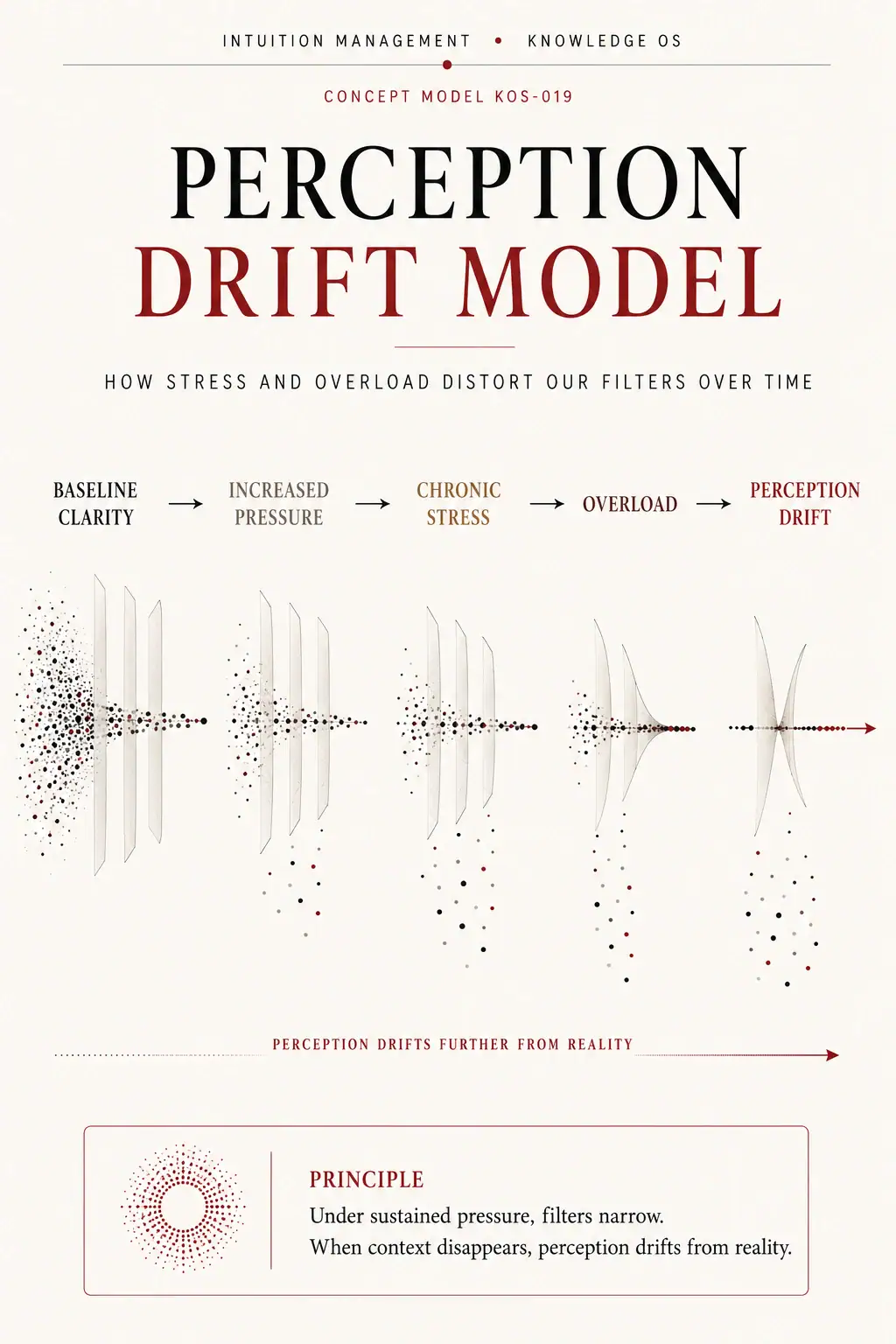
Perception drift
Perception drift does not mean hallucination or total loss of contact with reality. In this framework, it means that the sample of reality becomes narrower and increasingly shaped by pressure. Real details are noticed, but fewer competing details are available to correct interpretation.
This is why cognitive overload recovery can restore judgment. Rest is not simply a reward after good decisions. It can be a condition for making them.
Sleep
Sleep supports attention, memory and executive functioning. Insufficient sleep can reduce sustained attention and increase lapses. In practical terms, fatigue makes it harder to maintain goal-directed filtering and easier for emotionally salient or habitual cues to dominate.
Emotion and memory
Affective information can receive prioritized processing in attention and working memory.13 Current emotion can therefore change which evidence remains accessible during a decision.
Decision fatigue
Repeated decisions consume time and control. As fatigue rises, people may default to habit, avoidance or the most salient option. The signs of decision fatigue often look like poor motivation, but the underlying issue may be reduced capacity to compare and update.
Digital environments condition attention
Digital platforms do not merely contain information. They organize salience. Notifications, badges, autoplay, infinite feeds and rapid novelty compete for bottom-up attention.
Novelty becomes a selection rule
When attention is repeatedly rewarded for shifting, novelty itself becomes salient. Quiet tasks can then feel under-stimulating even when they matter. The problem is not that the person has lost all capacity for focus; the attention system has learned that frequent switching predicts reward.
Urgency without importance
Digital cues often compress different priorities into the same visual form. A critical message and a trivial update may both arrive as a red badge. Over time, the system can learn to treat arrival as importance.
Fragmented context
Each switch carries context costs. Returning to a task requires reconstructing the goal, current state and next step. The subjective result is the sense that the mind is full even when little has been completed. See why your brain feels full.
Social comparison
Feeds selectively display achievements, crises and emotionally engaging moments. This sample can become an implicit model of ordinary life. When exceptional events are repeatedly visible, average progress can feel like failure.
Designing the filter environment
- Remove nonessential notifications rather than relying only on willpower.
- Separate communication windows from focused work.
- Use full-screen or single-task modes when possible.
- Define what information is relevant before opening a feed or search.
- Create quiet periods in which novelty is not continuously rewarded.
Attention management is partly environmental design. A system that constantly captures attention cannot be corrected only by telling the individual to concentrate harder.
How to calibrate mental filters
Calibration means improving the fit between your internal model and current reality. It does not require perfect objectivity. It requires a repeatable process for noticing assumptions, testing them and updating when feedback changes.
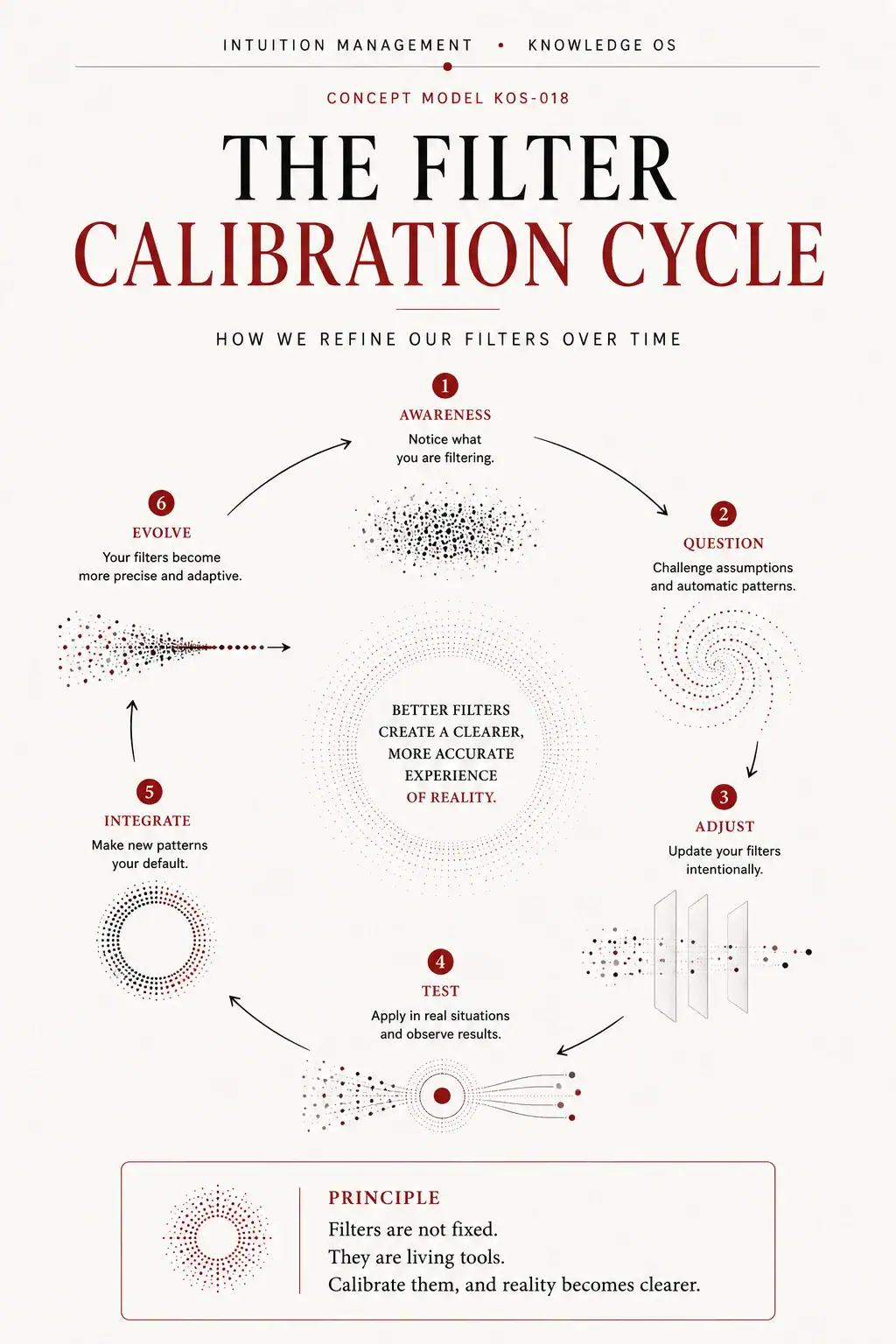
Awareness: name the filter
Start by identifying the current selection rule. Are you scanning for danger, approval, progress, familiarity or possibility? Naming the filter reduces fusion with it.
Question: identify the prediction
Every filter carries a prediction. Threat predicts harm. Identity predicts what fits the self. Goal focus predicts that relevance equals progress. Habit predicts that the past pattern will continue. Curiosity predicts that more exploration will create value.
Ask: “What is this filter expecting to happen?”
Adjust: widen or narrow
A rigid filter needs additional evidence and alternative hypotheses. An overly open filter needs relevance criteria and boundaries. Calibration is not always about opening. Sometimes clarity requires exclusion.
Test: create feedback
Choose a small action that can produce information. Ask the direct question. Run the prototype. Pause before replying. Compare the prediction with the result. A good test can prove the filter wrong.
Integrate: update proportionately
Do not turn one event into a universal rule. Integrate repeated, relevant feedback. Ask whether the filter is accurate in this kind of context, with this kind of signal, under these conditions.
Evolve: refine conditional knowledge
Mature calibration produces conditional knowledge: “This signal is often useful when…” rather than “This feeling is always right” or “My intuition cannot be trusted.”
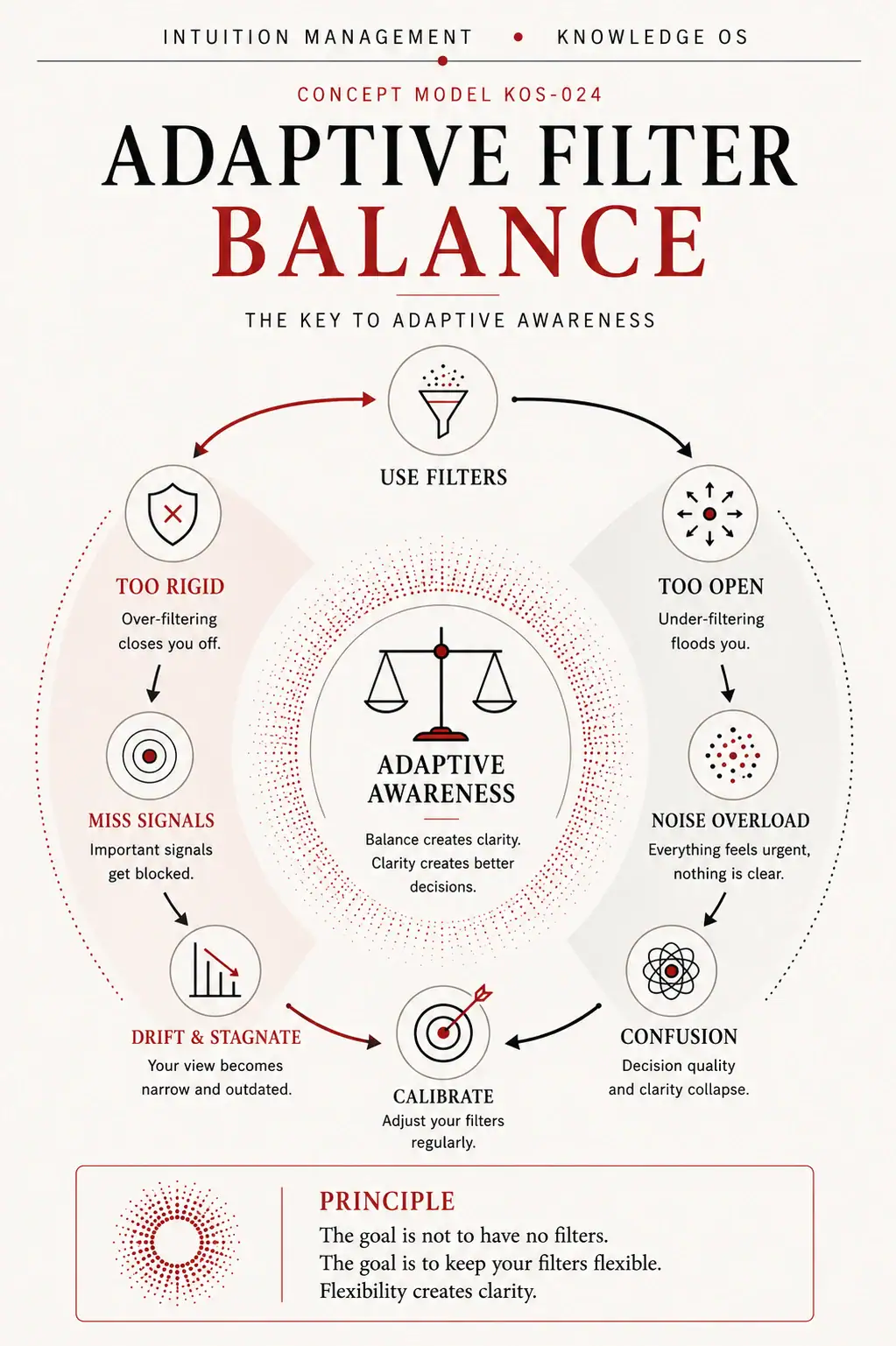
The final aim is adaptive filter balance. Filters that are too rigid block important information. Filters that are too open allow every signal to compete, producing noise overload. Adaptive awareness moves between focus and openness according to the demands of the situation.
Mindfulness and metacognitive space
Mindfulness does not remove filters, but it can help a person notice attention and interpretation as events rather than immediate facts. Research on mindfulness and cognition suggests potential effects on attention and memory, though results depend on method and population.14 The practical value is the pause: a moment in which the active filter can be observed before action.
Personal mental filter assessment
Use this as a reflective check, not a personality test. Answer according to the current situation.
- What feels most important right now: danger, consistency, progress, familiarity or possibility?
- Which evidence is easiest to notice?
- Which evidence feels irritating, irrelevant or hard to accept?
- What does the active filter help you do?
- What might it make you miss?
- What alternative filter would reveal a different part of the situation?
- What small test could produce corrective feedback?
The Signal Acceptance Matrix
Not every noticed signal deserves equal influence. The Signal Acceptance Matrix separates signal intensity from fit with evidence and context.
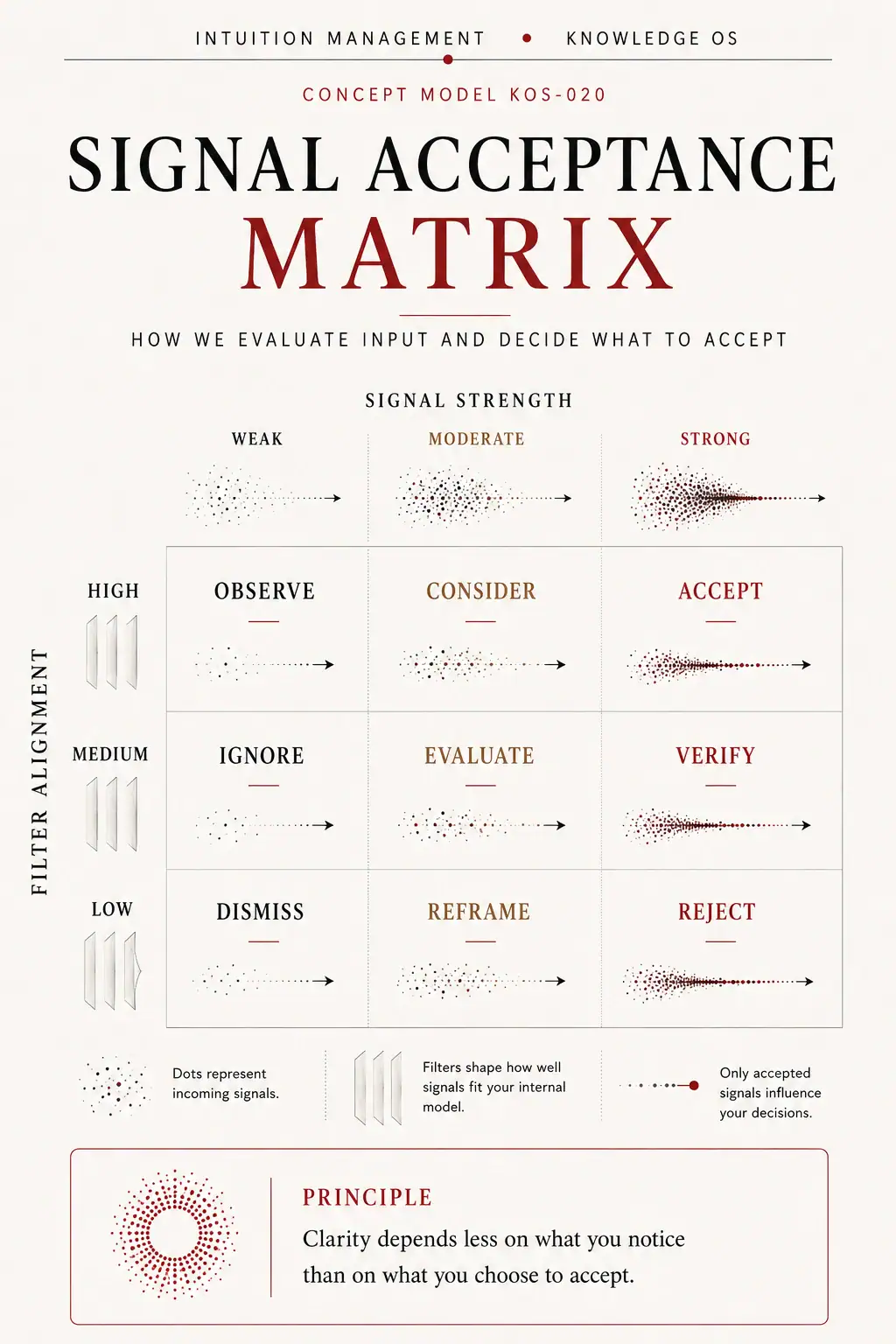
A strong signal with high alignment may justify action. A strong signal with low alignment should not be accepted merely because it is intense. A weak signal with high alignment may deserve observation because many useful intuitions begin as subtle pattern recognition.
Three checks before accepting a signal
- Specificity: Is the signal specific, or only urgent?
- Alignment: Does it fit observable evidence, relevant experience and values?
- Testability: What small action could confirm or challenge it?
When a decision remains difficult, use how to make the right decision or the more focused guide to choosing between two options.
Practical exercises for flexible filtering
1. The three-column attention audit
| What I noticed | What made it salient | What I may have missed |
|---|---|---|
| A delayed reply | Fear of rejection | Workload, neutral explanations, previous reliability |
The goal is not to dismiss the first signal. It is to restore context.
2. The prediction log
Before an important event, write a measurable prediction. Afterward, record the outcome. Over time, compare categories: social predictions, workload predictions, risk predictions and intuitive judgments. Calibration requires data from your own life.
3. The disconfirming-evidence question
Ask: “What evidence would change my mind?” If the answer is “nothing,” the belief is currently protected from learning.
4. The relevance boundary
When everything feels important, define a temporary rule: “For the next 25 minutes, only information that changes this task is relevant.” This narrows an overly open filter.
5. The context expansion
When attention is rigid, add three alternative explanations, two missing facts and one different perspective. Alternatives do not need equal probability. Their purpose is to reopen the evidence set.
6. The smallest reversible action
When filters disagree, choose an action that creates information without irreversible commitment. This is the logic behind the Adaptive Action System: act, observe and update.
7. The body-state check
Before treating a signal as a conclusion, check sleep, hunger, tension, pain, stimulation and recent stress. Body state can change salience and interpretation.
8. The role reversal
Explain the same event from the perspective of someone with a different goal or responsibility. This reveals which facts your current role prioritizes.
9. The filter rotation
Review one decision through all five filters:
- What danger is present?
- What identity or value is involved?
- What goal matters?
- What pattern is familiar?
- What possibility has not been considered?
10. The stopping rule
Curiosity and anxiety can both keep information gathering open indefinitely. Define in advance what evidence will be sufficient to decide.
Mental filters compared with related concepts
The phrase mental filters overlaps with several established concepts, but it should not be treated as a synonym for all of them. Clear distinctions improve both scientific accuracy and practical usefulness.
| Concept | What it describes | How it differs from mental filters | Example |
|---|---|---|---|
| Attention | The prioritization of some information over competing information. | Attention is one component of filtering. Mental filters also include expectation, emotion, memory, identity and meaning. | Noticing your name in a crowded room. |
| Mental model | An internal representation of how something works. | A mental model organizes interpretation. A mental filter influences which evidence reaches and updates that model. | Believing that conflict usually leads to rejection. |
| Schema | A structured knowledge pattern used to organize experience. | Schemas provide categories and expectations. Filters determine which cues activate or reinforce them. | A “competent professional” schema shaping how feedback is interpreted. |
| Belief | A proposition treated as true or likely true. | A belief is content. A filter is the selection process that makes some belief-relevant evidence easier to notice. | “People usually cannot be trusted.” |
| Heuristic | A fast rule of thumb used for judgment or action. | A heuristic simplifies a decision. A filter shapes the information on which the heuristic operates. | Choosing the familiar option when time is limited. |
| Cognitive bias | A systematic tendency in judgment, memory or decision-making. | A bias is a recurring pattern of error or deviation. Filtering is broader and can be adaptive. | Seeking confirming evidence while ignoring contradictions. |
| Mindset | A broad orientation toward ability, change, risk or effort. | A mindset influences interpretation across situations. A filter is the moment-to-moment selection rule through which that mindset is expressed. | Viewing difficulty as evidence of growth or failure. |
| Intuition | A rapid judgment or felt sense without fully conscious reasoning. | Intuition is an output. Mental filtering helps determine which patterns become available to produce that output. | Sensing that a plan contains an overlooked risk. |
Mental filters vs mental models
A mental model answers, “How do I think this situation works?” A mental filter answers, “Which parts of this situation become available to my model?” The distinction matters because a model can be sophisticated while still receiving a narrow evidence sample.
Imagine two managers using the same project-management framework. One notices delays, dependencies and risk. The other notices motivation, informal coordination and team confidence. Their formal model is similar, but their filters feed it different information. They may therefore recommend different actions while believing they are applying the same method.
Mental filters vs schemas
Schemas are organized knowledge structures. They make recognition fast because new experiences can be matched with existing categories. A “safe relationship” schema, for example, may include reliability, direct communication and repair after disagreement.
Filtering influences which cues activate a schema. A person with a threat-oriented filter may detect hesitation and activate an “unsafe relationship” schema before noticing signs of care. The schema supplies meaning; the filter determines which doorway is opened first.
Mental filters vs beliefs
Beliefs are statements about reality. Filters are the processes that make belief-consistent evidence salient. This is why changing a belief through argument alone can be difficult. If the filter continues selecting the same evidence, the old belief keeps receiving reinforcement.
Effective change often requires new experience, changed attention and feedback—not only a better sentence.
Mental filters vs intuition
Intuition is not a filter, but it depends on filtering. A rapid judgment emerges from what the system has learned to notice and how those cues have been connected with outcomes. When filtering is well trained and the environment contains recurring patterns, intuition can be useful. When filtering is distorted by stress, identity protection or unreliable feedback, intuition can become confidently wrong.
Mental filters in relationships and organizations
Filtering is often discussed as an individual process, but it also shapes conversations, teams and institutions. A relationship can develop shared filters. An organization can repeatedly notice some signals while making others difficult to express.
Relationship filters
Every relationship develops expectations. Partners learn which tone signals conflict, which silence means recovery, which requests are safe and which subjects produce defensiveness. These expectations improve coordination when they remain flexible.
Problems arise when an old pattern becomes the only available interpretation. A partner who once withdrew during conflict may later learn to pause and return, but the other person may continue filtering every pause as abandonment. The present interaction is interpreted through the strongest historical prediction.
A useful relational question is:
What am I responding to now, and what am I responding to from before?
This question does not deny history. It separates historical relevance from automatic repetition.
Projection and selective attention
Projection is not simply “seeing something that is not there.” Often, a real cue is present, but it is interpreted through the observer’s concerns. A neutral expression may be filtered through fear of judgment. A request for space may be interpreted as rejection. The cue exists; the assigned meaning exceeds the evidence.
The practical response is to move from silent certainty to testable communication: “I noticed your expression changed. I am interpreting it as frustration. Is that accurate?”
Team filters
Teams also learn what receives attention. A team rewarded only for speed may filter out maintainability. A team punished for raising concerns may stop surfacing weak signals. A team that celebrates experimentation but never closes decisions may underweight execution.
Shared filters become visible in recurring questions:
- Which metrics are reviewed first?
- Which problems receive immediate escalation?
- Which evidence is considered legitimate?
- Who is allowed to define what matters?
- What information repeatedly arrives too late?
Organizational blind spots
An organization may possess the necessary information but fail to integrate it. Frontline employees see customer friction. Technical teams see structural risk. Finance sees cost patterns. Leadership sees strategic constraints. If each group filters through its own local goals, no one constructs the full picture.
This is not merely a communication failure. It is a relevance failure. Each part of the system has learned that different signals matter.
Leadership filters
Leaders influence collective attention through the questions they ask, the stories they repeat and the outcomes they reward. A leader who repeatedly asks “Who is responsible?” creates a different filter environment from one who asks “What conditions made this outcome likely?”
Neither question is always wrong. Accountability matters. Systems matter. The filter becomes dangerous when one question excludes the other.
Decision meetings
Meetings often fail because participants argue conclusions without exposing filters. One person is optimizing for risk reduction, another for speed, another for customer trust and another for cost. The disagreement appears factual even when much of it concerns weighting.
A better meeting makes the filters explicit:
- Which signal are you prioritizing?
- Which failure are you trying to prevent?
- Which value are you protecting?
- What evidence would change your recommendation?
- What relevant signal may be missing from this room?
Collective calibration
Collective calibration requires more than encouraging people to “speak up.” The system must protect the signals it claims to value. If bad news creates punishment, bad news will be filtered before it reaches leadership. If uncertainty is interpreted as incompetence, forecasts will become artificially confident.
A healthy organization develops multiple sensing channels and compares them. Metrics, stories, customer feedback, operational anomalies and dissenting views should be allowed to correct one another.
Common myths about mental filters
Myth 1: The goal is to perceive reality without filters
Unfiltered perception is not a realistic human goal. Attention is limited, memory is selective and meaning depends on context. The useful goal is flexible filtering that remains open to correction.
Myth 2: Mental filters are always negative
Filters enable expertise, focus, speed and protection. A filter becomes costly when it no longer fits the environment or becomes too rigid to update.
Myth 3: Strong feelings reveal the strongest truth
Intensity reveals activation, not necessarily accuracy. A strong signal may reflect genuine danger, old learning, exhaustion, social pressure or a combination of factors.
Myth 4: Rational people do not use filters
Reasoning requires selected premises and evidence. A person can reason logically from an incomplete sample. Rationality improves when selection itself becomes examinable.
Myth 5: More information always improves decisions
More information can improve judgment only when it is relevant and integrable. Excess input can obscure priorities and increase reliance on simple cues. Better filtering may matter more than greater volume.
Myth 6: Expertise removes bias
Expertise improves pattern recognition in familiar, feedback-rich environments. It can also create overconfidence, anchoring and tool-based blind spots. Expertise needs calibration, not worship.
Myth 7: Open-mindedness means accepting every possibility
Open-mindedness means allowing evidence to update the model. It does not require treating every claim as equally plausible. Good filtering remains selective.
Myth 8: If a filter was learned through hardship, it must be eliminated
A protective filter may contain valuable sensitivity. The task is often to refine its threshold and context, not erase the capacity it created.
Myth 9: Self-awareness automatically changes filters
Insight is important, but repeated behavior and feedback usually shape attention more deeply than one realization. Awareness begins calibration; it does not complete it.
Myth 10: A framework can tell you exactly which filter is active
The five-filter framework is a reflective aid. Real situations involve overlapping motives, body states and histories. Use the model to generate questions, not final labels.
How mental filters develop across life
Mental filters are shaped gradually. Some priorities are biologically prepared, such as sensitivity to sudden movement, facial expression and potential threat. Others are learned through repetition, reward, correction and social meaning.
Early learning
Children learn not only facts but also relevance. They learn which emotions receive attention, which questions are welcomed, what counts as danger, when mistakes are safe and what earns approval. These lessons become attention policies.
A child raised in a predictable environment may learn that ambiguity can be explored. A child exposed to frequent conflict may learn that small changes in tone require immediate attention. Both filters are understandable adaptations to experienced conditions.
The difficulty appears when an adaptation travels into a different environment. A filter optimized for instability may over-detect danger in a stable relationship. A filter optimized for compliance may suppress disagreement in a workplace that requires initiative.
School and performance
Education can strengthen goal filters: correct answers, deadlines, rankings and measurable performance become salient. This can support discipline. It can also teach a student to filter out curiosity when curiosity appears inefficient.
Other environments reward creativity but underdevelop stopping rules. The student becomes excellent at generating possibilities and less skilled at selecting one. Neither pattern is a fixed trait. Each reflects a history of rewarded attention.
Adolescence and identity
As identity and belonging become more important, social feedback can receive intense weight. Signals of inclusion, exclusion, status and approval become easier to notice. This is not evidence of weakness. It reflects the developmental importance of social learning and identity construction.
Identity filters become healthier when belonging does not require the rejection of all contradictory evidence. A flexible identity can update while preserving continuity.
Adult expertise
Adulthood adds professional and relational filters. Repeated roles teach what matters: a caregiver notices needs, an analyst notices anomalies, a leader notices coordination and a craftsperson notices quality. Expertise is partly the ability to ignore what does not matter.
But every expertise creates an exclusion pattern. The person becomes efficient at seeing through one lens. Cross-functional conversation, reflective practice and exposure to unfamiliar contexts protect against lens lock.
Filters can be relearned
Learning remains possible because filters are not isolated traits. They are patterns of attention and interpretation maintained by use. Repeated corrective experiences can change what feels salient. The process is usually gradual because a filter that once protected or rewarded the person will not disappear simply because it has been intellectually criticized.
How mental filters operate in real life
Example 1: The parent and the teenager
A teenager comes home quiet. The parent’s threat filter notices withdrawal and predicts a serious problem. The identity filter adds, “A good parent should know what is happening.” The parent begins asking rapid questions.
The teenager’s autonomy filter interprets the questions as intrusion and gives shorter answers. The parent sees the shorter answers as confirmation that something is wrong. A reinforcement loop forms.
Calibration would not require ignoring the signal. It would change the action: “You seem quieter than usual. I am available if something is going on.” This response tests the concern without turning it into pressure.
Example 2: The project leader
A project is behind schedule. The leader’s goal filter prioritizes delivery dates and blockers. Team fatigue, weak coordination and uncertainty receive less attention because they are harder to quantify.
The leader increases tracking and reporting. The team spends more time demonstrating progress and less time resolving causes. Metrics look more active while delivery becomes slower.
A broader filter asks: What information is missing because the current management system rewards visible activity? The answer may reveal dependency problems, unclear decisions or overloaded specialists. Goal focus remains valuable, but it is supplemented by a systems view.
Example 3: The anxious message
A friend has not replied. The threat filter notices delay. Mood-congruent memory retrieves previous experiences of rejection. The internal model predicts abandonment.
The person checks the phone repeatedly. Each check finds no reply and feels like new evidence. Yet the checks are not independent events; they are repeated observations of the same unresolved condition.
A calibrated response distinguishes signal from conclusion: “There is a delay. I feel threatened by it. I do not yet know the reason.” This preserves the emotional truth while preventing an incomplete sample from becoming certainty.
Example 4: The experienced clinician
A clinician senses that a case does not fit the obvious diagnosis. Years of experience have tuned attention to subtle inconsistencies. This intuition may be valuable because it reflects learned pattern recognition.
But expertise can also anchor interpretation. The safest use of intuition is neither blind trust nor dismissal. It is to convert the feeling into testable questions: Which detail does not fit? What alternative explanation accounts for it? What evidence would discriminate between possibilities?
Example 5: The creative professional
A creator sees many connections and possible directions. The curiosity filter is highly productive during exploration. As the deadline approaches, the same filter becomes a problem because every new idea competes with completion.
The answer is not to become less curious in general. It is to shift filters by phase: curiosity during discovery, goal focus during selection, habit during execution and adaptive awareness during review.
Example 6: The conflict between two intelligent people
Two colleagues disagree. One filters for risk and sees the proposal as dangerously incomplete. The other filters for opportunity and sees delay as the greater danger.
Each may possess valid evidence. The conflict becomes destructive when each assumes the other is ignoring reality rather than prioritizing a different risk.
A better conversation makes filters explicit: “Which failure are you trying to prevent?” and “Which opportunity are you trying to protect?” This often reveals that the disagreement is partly about weighting, not facts.
Example 7: The athlete under pressure
During practice, an athlete relies on trained patterns. Under high pressure, attention shifts toward conscious monitoring of movements that normally run automatically. The filter changes from task cues to self-evaluation.
Performance can deteriorate even though effort increases. Calibration may involve returning attention to external cues, rhythm or one simple action rather than evaluating every movement.
Example 8: The person who feels emotionally numb
When capacity is low, the system may reduce access to nonessential emotional signals. The person concludes, “Nothing matters.” Yet the experience may reflect filtering under exhaustion rather than a complete statement about values.
This is why articles such as why everything feels meaningless and why you feel disconnected should be read as investigations of state, not final verdicts about identity.
Limits of the mental-filter framework
A useful framework should explain without pretending to explain everything. “Mental filters” is a synthesis term. Cognitive science studies attention, memory, expectation, learning, emotion and decision-making through many distinct models. Those processes should not be collapsed into one literal mechanism.
It is not a diagnosis
The framework cannot determine whether someone has anxiety, depression, trauma-related symptoms, attention difficulties or another condition. Similar experiences can have different causes. Professional assessment is appropriate when symptoms are persistent, severe or impair daily life.
Not every disagreement is filtering
People may disagree because they have different information, values, incentives or definitions. Calling the other person “filtered” can become a way of dismissing them. The framework should increase epistemic humility, not provide a new label for being wrong.
Filters do not erase external constraints
Changing interpretation does not remove real danger, injustice, scarcity or responsibility. Calibration means seeing the situation more accurately, including its constraints. It is not forced positivity.
Open awareness is not total awareness
No person can hold all relevant information. “Adaptive awareness” is an ideal of flexible selection, not a claim of complete perception.
Introspection has limits
People do not have direct access to every process shaping attention. Self-report can be incomplete. That is why behavioral feedback, records, external perspectives and repeated outcomes matter.
Frameworks can become filters
Once you learn the five-filter model, you may begin forcing every experience into it. That would reproduce the very rigidity the model is meant to prevent. Use the categories as prompts, not boxes.
Glossary of key terms
- Adaptive awareness
- The ability to notice the active filter and shift between focus and openness according to context.
- Attention
- The prioritization of some information for enhanced processing while competing information receives less access.
- Attentional capture
- The automatic redirection of attention toward a salient, novel, threatening or previously rewarded cue.
- Bias
- A systematic tendency in judgment, memory, estimation or decision-making.
- Calibration
- The process of comparing predictions with outcomes and adjusting confidence, thresholds or interpretations.
- Cognitive flexibility
- The capacity to shift rules, perspectives or strategies when conditions change.
- Cognitive load
- The amount of mental processing demanded by active tasks, information and unresolved goals.
- Confirmation bias
- The tendency to seek, notice or interpret evidence in ways that support an existing belief.
- Executive function
- A group of control processes involved in maintaining goals, inhibiting responses, updating working memory and switching strategies.
- Filter rigidity
- A condition in which the same selection rule persists despite changed context or contradictory feedback.
- Heuristic
- A fast, simplified rule used to make a judgment or choice.
- Internal model
- A working representation of how a situation, person or system is expected to behave.
- Intuition
- A rapid judgment, expectation or felt direction that emerges without fully conscious step-by-step reasoning.
- Mental filter
- A practical term for the combined processes that select, suppress, prioritize and interpret information.
- Mental model
- A structured internal explanation used to understand and predict how something works.
- Perception drift
- The progressive narrowing or distortion of the evidence sample under sustained pressure, fatigue or rigid expectation.
- Prediction error
- The difference between what the system expected and what actually occurred.
- Salience
- The degree to which a signal stands out and captures processing priority.
- Schema
- An organized knowledge structure that guides recognition and interpretation.
- Selective attention
- The preferential processing of information relevant to a task, goal or current concern.
- Signal
- Information that may carry meaningful predictive or decision value.
- Working memory
- The limited system used to maintain and manipulate information needed for current thought and action.
Frequently asked questions
What are mental filters in psychology?
“Mental filters” is used here as a broad practical term for processes that select, suppress and interpret information, including attention, expectation, emotion, goals and memory. It is not one single mechanism or diagnosis.
Are mental filters the same as cognitive distortions?
No. Filtering is necessary and often adaptive. A cognitive distortion is an interpretation pattern that consistently oversimplifies or misrepresents a situation.
Are mental filters the same as cognitive biases?
They overlap. Filters describe which information receives access and priority; biases describe systematic tendencies in judgment, memory and choice.
Can mental filters change?
Yes. Learning, feedback, changed goals, new experiences, attention training and recovery from overload can change what is prioritized and how it is interpreted.
Why do two people see the same situation differently?
They may attend to different details, hold different expectations, experience different bodily states and assign different meanings to the same event.
Can stress change perception?
Stress can alter attention, working memory and cognitive flexibility. This may narrow the evidence sample and increase reliance on threat or habit.
Do mental filters cause intuition?
They contribute by determining which learned patterns are detected. Intuition also depends on experience, feedback and the structure of the environment.
How can I tell intuition from anxiety?
No single sensation is decisive. Examine specificity, urgency, repetition, evidence, body state and how the signal changes after regulation and context gathering.
Is having fewer filters better?
No. Too little filtering can create overload. The goal is flexible filtering: enough selectivity to act and enough openness to update.
What is a threat filter?
It is a mode in which attention prioritizes possible danger, inconsistency and uncertainty. It is useful in genuine risk but can hide safety and opportunity when overused.
What is an identity filter?
It prioritizes information connected to self-image, belonging and values. It supports coherence but may resist evidence that requires change.
What is a goal filter?
It prioritizes progress, relevance and obstacles. It improves execution but may underweight context, recovery and relationships.
What is confirmation bias?
It is the tendency to seek or interpret evidence in ways that support an existing belief. Repeated confirmation can strengthen the filter that selected the evidence.
Can mindfulness remove mental filters?
No. Mindfulness may help make filtering more observable, creating space before automatic interpretation or action.
How do I recalibrate a mental filter?
Name the filter, identify its prediction, seek missing evidence, run a small test and update from repeated feedback.
Are mental filters subconscious?
Many filtering processes occur outside conscious awareness. You usually experience the result—what stands out and what it seems to mean—rather than the full selection process.
Are mental filters good or bad?
Neither by themselves. Their value depends on fit. A threat filter can protect in danger and distort in safety. A goal filter can support execution and hide context.
Why do I notice negative things first?
Possible threat may receive priority because missing danger can be costly. Stress, learning history, recent events and mood can strengthen this negative selection pattern.
Can trauma change mental filters?
Difficult or threatening experiences can alter what the system treats as salient and safe. The framework cannot diagnose trauma, but it can help explain why protective attention may remain active after conditions change.
Can meditation change mental filters?
Meditative practices may help people observe attention and interpretation with more distance. They do not remove filters, and effects vary by practice, duration and individual context.
What is the difference between a schema and a mental filter?
A schema organizes knowledge and expectations. A filter influences which cues activate, confirm or challenge that schema.
Can mental filters affect memory?
Yes. Attention influences what is encoded, and current emotion or beliefs can influence what is later retrieved and how it is reconstructed.
How do therapists work with filtering?
Different therapies use different language, but many help clients identify automatic interpretations, test predictions, broaden attention and build new experiences. This article is educational and not a treatment guide.
Can mental filters affect leadership?
Yes. Leaders shape collective attention through the questions, metrics, rewards and stories they emphasize. Their filters can become organizational filters.
Can organizations have mental filters?
Organizations do not have a single mind, but shared incentives and routines can repeatedly prioritize some information while suppressing other signals.
How long does it take to change a mental filter?
There is no universal timeline. Change depends on how deeply the filter is learned, how often it is reinforced, and whether new experience provides reliable corrective feedback.
Can overthinking be a filtering problem?
Yes. Overthinking may repeatedly process the same narrow evidence set rather than gather new information. More thought does not guarantee a broader sample.
Why does certainty sometimes increase when accuracy decreases?
When the evidence sample narrows, fewer contradictions remain visible. The model can therefore feel more coherent even while becoming less complete.
What is the fastest way to identify my current filter?
Ask what feels most important now: danger, identity, progress, familiarity or possibility. Then ask what that priority makes easy to miss.
Should I trust a signal that keeps repeating?
Repetition increases salience but does not prove accuracy. Check whether each repetition contains new evidence or simply replays the same unresolved prediction.
Research references
- Stevens C, Bavelier D. The role of selective attention on academic foundations. Developmental Cognitive Neuroscience. Open-access source.
- Oberauer K. Working Memory and Attention – A Conceptual Analysis and Review. Journal of Cognition. Open-access source.
- Anderson BA et al. Value-driven attentional capture. PNAS. Open-access source.
- Walsh KS et al. Evaluating the neurophysiological evidence for predictive processing as a model of perception. Open-access source.
- Carrasco M. Visual attention: The past 25 years. Vision Research. Open-access source.
- Eysenck MW et al. Anxiety and cognitive performance: attentional control theory. Emotion. PubMed record.
- Nozari N et al. More attention when speaking: does it help or does it hurt? Open-access source.
- Faul L, LaBar KS. Mood-Congruent Memory Revisited. Open-access source.
- Bubic A et al. Prediction, cognition and the brain. Open-access source.
- Mushtaq F et al. Uncertainty and cognitive control. Open-access source.
- del Río M et al. Perceptual confirmation bias and decision bias underlie adaptation to sequential regularities. Open-access source.
- Shields GS et al. The effects of acute stress on core executive functions: a meta-analysis. Open-access source.
- Schweizer S et al. The impact of affective information on working memory. Open-access source.
- Vago DR et al. Mind wandering, mindful awareness, and mental health. Open-access source.
Printable Mental Filter Calibration Worksheet
This worksheet can be copied into a note, document or journal. It is designed to turn a vague feeling into an examinable signal.
Step 1: Describe the signal
What did you notice? Use concrete language before interpretation.
Example: “The reply was shorter than usual.”
Step 2: Name the first interpretation
What did your mind immediately conclude?
Example: “They are angry with me.”
Step 3: Identify the active filter
Threat, identity, goal, habit, curiosity—or a combination?
Step 4: Identify the prediction
What does this filter expect will happen next?
Step 5: List supporting evidence
What observable facts genuinely support the interpretation?
Step 6: List missing or disconfirming evidence
What facts would support another explanation? What do you not yet know?
Step 7: Check body and context
Sleep, hunger, stress, time pressure, recent conflict, information overload and social pressure.
Step 8: Choose a small test
What reversible action could produce new information?
Step 9: Record the outcome
What happened? Which part of the prediction was accurate?
Step 10: Update the filter
What should become easier to notice next time? What should receive less automatic weight?
This worksheet is educational and is not a diagnostic or therapeutic instrument.
Your filters are not the enemy
They are how an overwhelming world becomes actionable. The work is not to eliminate them. It is to notice when they fit, when they drift and when they need recalibration.
Continue with The Personal Signal Decoder, explore how the brain predicts the future, or practise with How to Train Your Intuition.
Social and cultural filters
Mental filters are not created only inside the individual. Language, family, education, profession, media and group identity teach people what deserves attention.
Language
Language supplies categories. Once a category exists, related patterns become easier to notice and discuss. Categories are useful, but they can also make continuous reality appear divided into fixed types.
Professional training
Every profession teaches selective vision. Lawyers notice definitions and precedent. Engineers notice constraints and failure modes. Designers notice affordances and friction. Coaches notice patterns in language and behavior. Training creates expertise by strengthening useful filters.
The same training can create blind spots. A professional may see every problem through the tool they know best. The solution is not to abandon expertise but to combine it with cross-disciplinary feedback.
Group identity
Groups teach members which evidence counts, which authorities are trusted and which questions feel disloyal. Identity filters can stabilize cooperation. They can also make opposing evidence invisible or morally contaminated before it is evaluated.
This helps explain why smart people can believe opposite things. Intelligence operates on selected evidence, assumptions and goals. Better reasoning cannot correct information that never enters the model.
Social feedback
People adapt attention to approval and punishment. If a child is praised for achievement but not curiosity, goal-related signals may dominate. If conflict is punished, signs of disagreement may be filtered out until problems become unavoidable. If vigilance is rewarded, threat detection may become part of identity.
Cultural salience
Cultures differ in which social cues, obligations, boundaries and meanings receive emphasis. Mental-filter awareness should therefore avoid treating one style of attention as universally correct. The question is functional: what does this filter reveal, what does it conceal, and how well does it fit the situation?