Why can’t I start tasks?
Why do simple things feel impossible?
Why do I keep procrastinating even when I care about the outcome?
Why do I know exactly what to do but still can’t do it?
These are some of the most common questions people ask when they feel stuck, overwhelmed, mentally exhausted, or unable to translate intention into action.
Traditional productivity advice usually assumes the answer is motivation. Work harder. Be more disciplined. Manage your time better. Push through resistance.
Sometimes that works.
But often it does not.
Many people are not struggling because they lack motivation. They are struggling because the action they are trying to take does not match the state they are currently operating from.
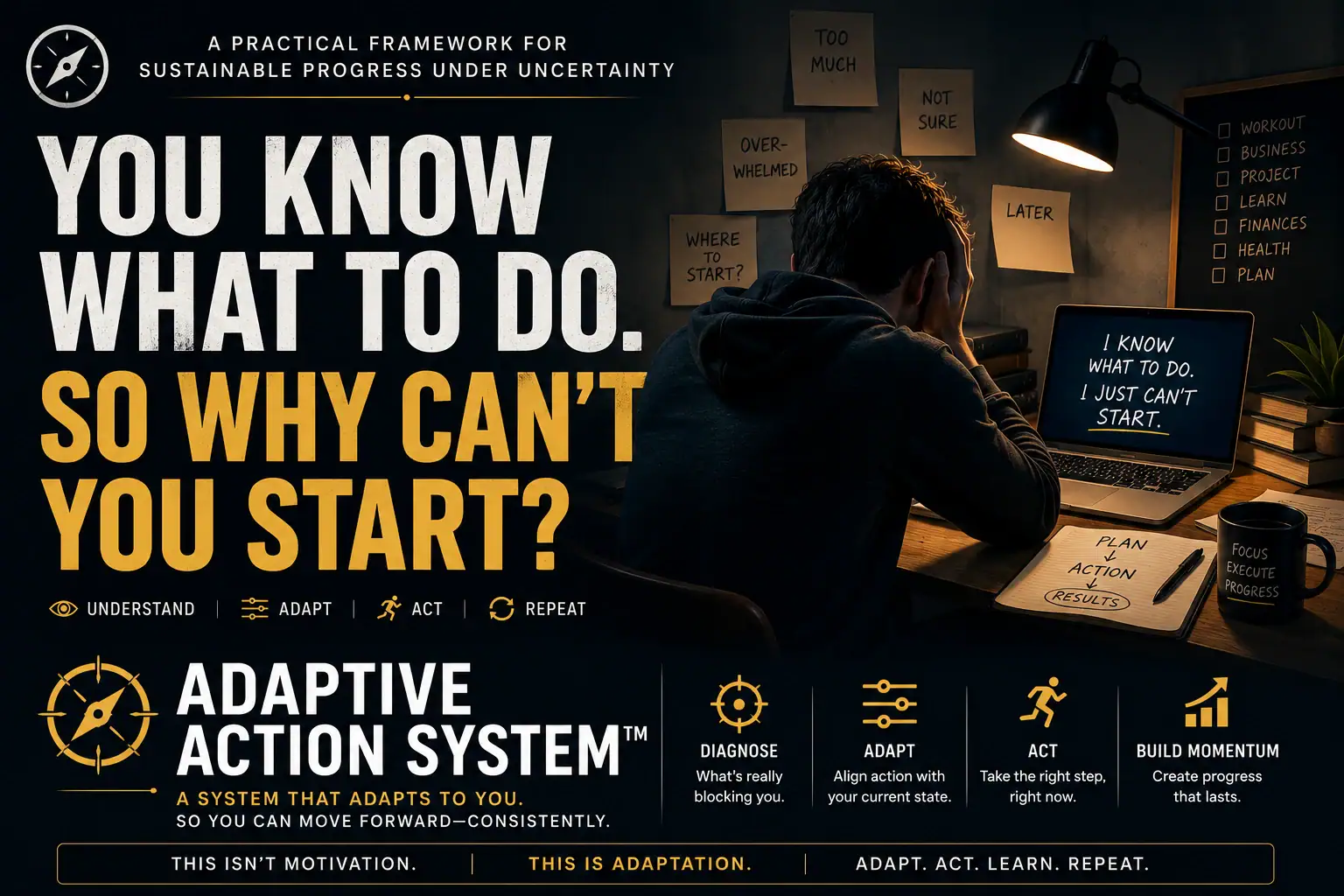
This possibility sits at the center of the Adaptive Action System™.
Adaptive Action System™ is a practical framework designed to help people understand action paralysis, task avoidance, procrastination, resistance, decision fatigue, and the hidden conditions that often prevent movement.
Action problems are often state problems before they become productivity problems.
Instead of asking:
“How do I force myself to do this?”
Adaptive Action System™ asks:
“What does this system need in order to move?”
That question changes everything.
Because many action difficulties are not caused by laziness, weakness, lack of willpower, or lack of intelligence.
They are caused by overload, uncertainty, emotional friction, conflicting priorities, decision fatigue, nervous system strain, or hidden forms of resistance.
If this experience feels familiar, you may also want to explore Why Can’t I Start Tasks?, Why Does Everything Feel Harder Than It Should?, Why Do I Overthink Everything?, and Why Simple Decisions Feel Exhausting.
Why Do I Know What To Do But Still Can’t Do It?
One of the most frustrating experiences in modern life is knowing exactly what needs to happen and still being unable to begin.
You know the task matters.
You know the deadline exists.
You know the consequences.
You know what the next step is.
And yet nothing happens.
This experience often creates a painful internal conflict. People begin questioning themselves.
- Am I lazy?
- Do I lack discipline?
- Why do I keep procrastinating?
- Why can’t I make myself do it?
- Why do simple tasks feel impossible?
But these questions often assume the wrong diagnosis.
The inability to start is not always a motivation problem.
It may be a capacity problem.
It may be a clarity problem.
It may be a resistance problem.
It may be a state problem.
The same behavior can emerge from completely different causes.
Someone experiencing decision fatigue may struggle to begin.
Someone experiencing overwhelm may struggle to begin.
Someone experiencing perfectionism may struggle to begin.
Someone experiencing uncertainty may struggle to begin.
From the outside, all of these situations can look like procrastination.
Inside the system, however, completely different forces may be operating.
The Awareness–Action Gap
Adaptive Action System™ refers to this pattern as the Awareness–Action Gap.
The Awareness–Action Gap appears when awareness exists but movement does not.
You know.
But you do not move.
You understand.
But you do not act.
You decide.
But implementation never begins.
Many productivity systems try to close this gap through pressure.
Adaptive Action System™ attempts to close it through diagnosis.
Action Failure Is Information
One of the core principles of the framework is simple:
Action failure is often information, not evidence of personal weakness.
If you repeatedly avoid the same task, something may be trying to communicate.
If you repeatedly postpone the same decision, something may be trying to communicate.
If motivation repeatedly disappears around a specific project, something may be trying to communicate.
The goal is not to immediately force action.
The goal is to understand what the system is attempting to signal.
This transforms the question from:
“What’s wrong with me?”
to:
“What is this resistance trying to tell me?”
That shift often becomes the beginning of movement.
If this pattern feels familiar, you may also want to explore Decision Fatigue Symptoms, Why Do I Overthink Everything?, Why Can’t I Focus on Anything?, and Why Am I Mentally Exhausted All the Time?.
Is This Procrastination or Something Else?
When people struggle to start tasks, the word most often used is procrastination.
But procrastination is not always the best explanation.
Sometimes procrastination is exactly what is happening. A person avoids action despite having sufficient clarity, capacity, and resources.
However, many situations that appear to be procrastination are actually something else entirely.
What looks like procrastination on the surface may be overload, uncertainty, perfectionism, resistance, or exhaustion underneath.
This distinction matters because different causes require different responses.
Procrastination vs Overload
When your mind is overloaded, even simple actions can begin to feel difficult.
You may spend hours thinking about a task while lacking the mental capacity to actually begin it.
In these situations, the problem is not motivation.
The problem is capacity.
Pushing harder often creates more resistance.
Recovery, simplification, and calibration are often more effective.
Procrastination vs Uncertainty
Sometimes people cannot move because the path forward is unclear.
The task may be defined.
The desired outcome may be known.
But important information is still missing.
In these situations, hesitation may be a rational response to uncertainty.
The solution is not necessarily more discipline.
The solution may be better information.
Procrastination vs Perfectionism
Perfectionism often disguises itself as preparation.
You keep researching.
You keep refining.
You keep improving the plan.
But action never begins.
Here, the system is not avoiding work.
The system is avoiding imperfection.
This creates a different type of resistance requiring a different type of intervention.
Procrastination vs Emotional Resistance
Some actions carry emotional weight.
A difficult conversation.
A major decision.
A career change.
A creative project.
In these situations, resistance may be connected to fear, vulnerability, rejection, uncertainty, or identity.
The task itself is not necessarily the problem.
The emotional consequences associated with the task may be the real source of friction.
Why Simple Tasks Feel Impossible
One of the most confusing experiences is when a task appears objectively simple but feels disproportionately difficult.
Replying to an email.
Making a phone call.
Opening a document.
Starting a project.
Scheduling an appointment.
These actions may require only a few minutes.
Yet they can feel almost impossible to begin.
This often happens when the visible task is carrying invisible weight.
- mental fatigue
- decision fatigue
- unfinished commitments
- fear of failure
- fear of success
- uncertainty
- overload
- emotional friction
The task itself may be small.
The meaning attached to the task may be enormous.
When simple tasks feel impossible, the problem is often larger than the task itself.
If this experience feels familiar, you may also want to explore Why Simple Tasks Feel Impossible, Why Does Everything Feel Harder Than It Should?, and Why Your Brain Feels Full.
What Is Adaptive Action System™?
Adaptive Action System™ is a practical framework for understanding why action becomes difficult and how to restore sustainable movement without relying on pressure, guilt, or constant motivation.
Most productivity systems focus on output.
Adaptive Action System™ focuses on alignment.
Instead of assuming that every action problem requires more discipline, the framework begins by diagnosing the conditions that influence action.
The goal is not simply to do more.
The goal is to understand what kind of action is appropriate for the state you are currently operating from.
Right action in the wrong state often fails. Appropriate action in the right state creates momentum.
This distinction helps explain why the same strategy can work perfectly one day and completely fail the next.
Your plan may be identical.
Your task may be identical.
Your environment may be identical.
But your state is different.
And when the state changes, the action strategy may need to change as well.
The Core Principle
The framework is built around a simple principle:
Action should adapt to the system, not the other way around.
Traditional approaches often attempt to force the system into a predefined model of productivity.
Adaptive Action System™ works differently.
It begins by observing reality.
Only then does it decide what kind of action is appropriate.
The Goal Is Sustainable Momentum
Many people spend years cycling between intense productivity and complete exhaustion.
They push hard.
They burn out.
They recover.
Then they repeat the cycle.
Adaptive Action System™ was designed to break that pattern.
Instead of maximizing effort, it seeks to maximize sustainable movement.
Progress becomes less dependent on motivation and more dependent on adaptation.
This is where the framework differs from traditional productivity systems.
Adaptive Action System™ vs Traditional Productivity Systems
| Traditional Productivity | Adaptive Action System™ |
|---|---|
| Push harder | Diagnose the state |
| Motivation first | Calibration first |
| One strategy for every situation | Adaptive strategies based on reality |
| Focus on discipline | Focus on alignment |
| Measure effort | Measure effective movement |
| Fight resistance | Understand resistance |
| Force consistency | Build sustainable momentum |
Both approaches can produce results.
However, Adaptive Action System™ is specifically designed for situations where traditional productivity advice repeatedly fails.
It is particularly useful for people experiencing action paralysis, decision fatigue, overthinking, task avoidance, inconsistent motivation, and chronic resistance.
The framework becomes practical through a process called the Adaptive Action Cycle™, which transforms awareness into movement through diagnosis, calibration, action, feedback, and adaptation.
The Adaptive Action Cycle™
At the center of Adaptive Action System™ is a practical process called the Adaptive Action Cycle™.
The cycle exists because action is rarely a single event.
Most meaningful progress happens through observation, adjustment, experimentation, learning, and adaptation.
Many people become stuck because they repeatedly attempt the same strategy even when reality is providing evidence that a different approach is needed.
The Adaptive Action Cycle™ transforms action from a force-based process into a learning-based process.
State → Resistance → Calibration → Action → Feedback → Adaptation → Momentum
Each stage helps convert awareness into sustainable movement.
1. State
The first question is simple:
What state am I operating from right now?
Many people try to solve action problems without first understanding their current condition.
Are you energized or exhausted?
Clear or confused?
Focused or overloaded?
Confident or uncertain?
Adaptive Action System™ begins with reality rather than assumptions.
2. Resistance
Once the state becomes visible, the next step is identifying resistance.
Resistance is often treated as the enemy.
The framework treats resistance as information.
The question is not:
“How do I eliminate resistance?”
The question is:
“What is this resistance protecting?”
The answer may involve overload, uncertainty, fear, perfectionism, identity, values, or competing priorities.
3. Calibration
Calibration means adjusting the action to fit reality.
This is one of the most important ideas in the entire framework.
Many action systems attempt to force reality to fit the plan.
Adaptive Action System™ adjusts the plan to fit reality.
The task may need to become smaller.
The goal may need to become clearer.
The timeline may need to become more realistic.
The strategy itself may need to change.
4. Action
Only after diagnosis and calibration does action occur.
The objective is not maximum effort.
The objective is effective movement.
In many situations, a small meaningful action produces more progress than a large action that never begins.
Small aligned actions often outperform large forced actions.
5. Feedback
Reality responds to action.
Every action generates information.
Sometimes the feedback confirms expectations.
Sometimes the feedback reveals blind spots.
Either way, the system learns.
Without feedback, improvement becomes difficult.
Without action, feedback never arrives.
6. Adaptation
Adaptation is the process of updating behavior based on feedback.
Instead of repeating the same strategy indefinitely, the system evolves.
This is where sustainable improvement emerges.
Adaptation transforms experience into capability.
7. Momentum
Momentum is not created through pressure.
Momentum emerges when action repeatedly generates useful feedback and successful adaptation.
This is why momentum often feels natural when the system is aligned and impossible when the system is overloaded.
Adaptive Action System™ treats momentum as an outcome of alignment rather than an outcome of force.
Small action creates feedback. Feedback creates learning. Learning creates adaptation. Adaptation creates momentum.
The next step is understanding the three different states from which action emerges, because different states require different strategies.
The Three States of Action™
One of the most common reasons productivity advice fails is that it assumes all action emerges from the same internal state.
In reality, people operate from very different conditions.
The same strategy that works perfectly in one state may completely fail in another.
This is why Adaptive Action System™ introduces the Three States of Action™.
The framework identifies three primary operating states:
- Red State™ — Overload
- Yellow State™ — Friction
- Green State™ — Momentum
Each state requires a different response.
Trying to use Green State strategies while operating in Red State often creates frustration and self-criticism.
The goal is not to force movement. The goal is to match the strategy to the state.
Red State™ — Overload
Red State™ occurs when the system is overloaded.
Capacity is limited.
Mental energy is depleted.
Even simple actions may feel difficult.
People in Red State™ often describe experiences such as:
- Everything feels harder than it should.
- I know what to do but can’t start.
- My brain feels full.
- Simple tasks feel impossible.
- I feel mentally exhausted all the time.
Traditional productivity advice often responds with more pressure.
Adaptive Action System™ responds with stabilization.
The objective is not maximum output.
The objective is restoring capacity.
In Red State™, recovery is often more productive than forcing action.
Yellow State™ — Friction
Yellow State™ occurs when capacity exists but movement encounters resistance.
The person can act.
But something keeps interfering.
Common forms of Yellow State™ friction include:
- overthinking
- perfectionism
- fear of failure
- fear of success
- uncertainty
- decision fatigue
- value conflicts
- identity conflicts
People in Yellow State™ often spend significant time thinking, planning, preparing, researching, and analyzing.
Yet implementation remains inconsistent.
The solution is rarely more information.
The solution is usually identifying and resolving the source of friction.
Green State™ — Momentum
Green State™ occurs when action and capacity are aligned.
Tasks feel manageable.
Decisions feel clearer.
Progress feels natural.
Momentum begins to build.
This does not mean everything becomes easy.
It means the system has enough clarity, capacity, and alignment to support movement.
Green State™ is where execution strategies become most effective.
However, Green State™ should not be treated as a permanent condition.
People naturally move between all three states.
Why State Awareness Matters
Most productivity systems ignore state awareness.
Adaptive Action System™ places state awareness at the center of decision-making.
Because the same action can produce completely different outcomes depending on the state from which it is taken.
A strategy that creates momentum in Green State™ may create burnout in Red State™.
A strategy that creates progress in Yellow State™ may create resistance in Red State™.
Understanding your current state allows action to become adaptive rather than reactive.
The first step toward effective action is understanding the state from which the action emerges.
Once the state becomes visible, the next challenge is understanding what type of resistance is actually present. This is where the Six Resistance Types™ become useful.
The Six Resistance Types™
One of the most common mistakes people make is treating all resistance as if it were the same thing.
They experience friction and immediately assume they need more motivation, more discipline, or more willpower.
But resistance can emerge from very different sources.
This is why Adaptive Action System™ introduces the Six Resistance Types™.
Understanding the type of resistance often reveals the appropriate response.
Different forms of resistance require different forms of adaptation.
1. Overload Resistance™
Overload Resistance™ appears when capacity becomes lower than demand.
The system is carrying more than it can effectively process.
Common signs include:
- mental exhaustion
- difficulty focusing
- task avoidance
- decision fatigue
- simple tasks feeling overwhelming
- constant feelings of being behind
The solution is rarely more pressure.
The solution is often capacity recovery, simplification, prioritization, and reduction of unnecessary load.
2. Uncertainty Resistance™
Uncertainty Resistance™ occurs when the path forward is unclear.
The system hesitates because it lacks confidence in the available information.
Common signs include:
- constant research
- difficulty making decisions
- waiting for certainty
- analysis paralysis
- fear of choosing incorrectly
In these situations, clarity often creates more progress than motivation.
3. Fear Resistance™
Fear Resistance™ emerges when action feels emotionally risky.
The risk may involve rejection, failure, criticism, embarrassment, conflict, uncertainty, or loss.
Common signs include:
- avoidance of important conversations
- postponing major decisions
- difficulty publishing or sharing work
- hesitation around visibility
- repeated delays despite strong intentions
The task itself is often not the problem.
The anticipated emotional consequences are.
4. Perfectionism Resistance™
Perfectionism Resistance™ often disguises itself as preparation.
The person appears productive.
Research continues.
Planning continues.
Refinement continues.
But execution never arrives.
The hidden goal is not excellence.
The hidden goal is avoiding imperfection.
5. Identity Resistance™
Identity Resistance™ occurs when action threatens an existing self-image.
The new behavior may require becoming someone different.
Examples include:
- moving into leadership
- starting a business
- publishing creative work
- setting stronger boundaries
- changing careers
Sometimes the greatest resistance comes from leaving behind an identity that no longer fits.
6. Value Conflict Resistance™
Value Conflict Resistance™ appears when different priorities compete for influence.
Part of the system wants one thing.
Another part wants something else.
For example:
- security versus freedom
- stability versus growth
- belonging versus independence
- comfort versus achievement
- certainty versus exploration
When these competing values remain unresolved, action often stalls.
Why Identifying Resistance Matters
Many people spend years trying to solve the wrong problem.
They apply motivation to overload.
They apply discipline to uncertainty.
They apply pressure to fear.
They apply productivity tools to identity conflicts.
As a result, resistance persists.
Adaptive Action System™ treats resistance as diagnostic information.
Once the type of resistance becomes visible, action can be calibrated more intelligently.
The goal is not to eliminate resistance. The goal is to understand what resistance is trying to communicate.
This understanding becomes even more useful when combined with the next tool in the framework: the Adaptive Action Matrix™, which helps determine what action is appropriate based on both state and resistance type.
The Adaptive Action Matrix™
Understanding your state is useful.
Understanding your resistance is useful.
But the real question is:
What should I do next?
The Adaptive Action Matrix™ was created to answer that question.
The Matrix combines the Three States of Action™ with the Six Resistance Types™ to help determine the most effective next move.
Different states require different actions. Different resistance types require different interventions.
Red State™ + Overload Resistance™
When the system is overloaded and capacity is depleted, the objective is not acceleration.
The objective is stabilization.
- reduce commitments
- simplify decisions
- prioritize recovery
- identify unnecessary load
- restore capacity
Attempting aggressive productivity in this state often increases resistance.
Yellow State™ + Uncertainty Resistance™
When uncertainty is the primary barrier, the solution is usually not more motivation.
The solution is clarity.
- gather missing information
- reduce ambiguity
- define the next step
- test assumptions
- run small experiments
Small feedback loops often reduce uncertainty faster than endless analysis.
Yellow State™ + Fear Resistance™
When fear is driving resistance, action should become smaller rather than larger.
The objective is not eliminating fear.
The objective is making movement possible despite fear.
- reduce emotional risk
- break actions into smaller steps
- increase psychological safety
- focus on learning rather than outcome
- use low-risk experiments
Yellow State™ + Perfectionism Resistance™
When perfectionism is present, execution becomes more valuable than optimization.
The system often needs permission to produce imperfect work.
- define “good enough”
- reduce revision cycles
- set completion thresholds
- publish earlier
- prioritize learning over perfection
Yellow State™ + Identity Resistance™
Identity resistance often requires reflection rather than productivity techniques.
The system may be adapting to a new version of itself.
- explore identity shifts
- examine self-image
- clarify future identity
- normalize discomfort
- accept transitional uncertainty
Green State™ + Momentum
When capacity, clarity, and alignment are present, the objective becomes execution.
This is where planning converts into results.
- focus on implementation
- increase consistency
- protect momentum
- avoid unnecessary complexity
- continue generating feedback
Momentum is valuable because it makes future action easier.
Why Most Action Plans Fail
Most action plans fail because they assume everyone should follow the same strategy.
But a person operating in Red State™ requires a different approach than a person operating in Green State™.
A person experiencing uncertainty requires a different intervention than a person experiencing perfectionism.
The Adaptive Action Matrix™ helps match the response to the reality of the situation.
The most effective next action depends on the state of the system and the source of the resistance.
This is where Adaptive Action System™ shifts from theory to practical decision-making.
The next step is learning how to quickly identify your current position inside the framework using the Adaptive Action Assessment™.
Adaptive Action Assessment™
Before choosing a strategy, it helps to understand where you currently are inside the framework.
The Adaptive Action Assessment™ was created as a quick diagnostic tool for identifying your current state, dominant resistance pattern, and most appropriate next step.
The assessment is not designed to label people.
It is designed to increase visibility.
You cannot adapt effectively to conditions you cannot see.
Step 1: Identify Your Current State
Which description feels most accurate right now?
- Red State™: I feel overloaded, mentally exhausted, and even simple tasks feel difficult.
- Yellow State™: I have capacity, but something keeps creating friction or resistance.
- Green State™: I feel aligned, focused, and capable of sustained action.
Your answer identifies the environment in which action is currently occurring.
Step 2: Identify the Dominant Resistance
Which of the following creates the most friction?
- Overload Resistance™
- Uncertainty Resistance™
- Fear Resistance™
- Perfectionism Resistance™
- Identity Resistance™
- Value Conflict Resistance™
Most people experience more than one form of resistance. However, one type is usually dominant at any given moment.
Step 3: Define the Smallest Meaningful Action
Once state and resistance become visible, define the smallest meaningful action available.
Not the ideal action.
Not the perfect action.
The smallest meaningful action.
Examples might include:
- opening the document
- writing one paragraph
- sending one email
- making one phone call
- creating a rough outline
- scheduling a conversation
The objective is to create movement without overwhelming the system.
Step 4: Gather Feedback
Every action creates information.
Did resistance increase?
Did clarity improve?
Did momentum appear?
Did a new obstacle become visible?
The purpose of action is not only progress.
The purpose of action is also learning.
Step 5: Adapt
Use the feedback to update your approach.
If the action was too large, reduce it.
If uncertainty remains high, gather information.
If overload persists, restore capacity.
If momentum appears, continue building on it.
This process transforms action into a continuous cycle of learning and adaptation.
Why Self-Diagnosis Matters
Many people spend years fighting symptoms.
They fight procrastination.
They fight resistance.
They fight exhaustion.
They fight themselves.
Adaptive Action System™ encourages a different approach.
Instead of asking:
“How do I force myself forward?”
It asks:
“What is the system trying to tell me?”
Visibility creates better decisions. Better decisions create better action. Better action creates momentum.
The complete Adaptive Action System™ expands this assessment into a full diagnostic process, worksheets, resistance maps, state assessments, and practical action-planning tools.
What’s Included in Adaptive Action System™?
Adaptive Action System™ was designed as a practical framework rather than a collection of ideas.
The goal is not simply to explain why action becomes difficult.
The goal is to provide a structured process for diagnosing resistance, increasing clarity, restoring momentum, and adapting action to reality.
The complete framework includes assessments, diagnostic tools, worksheets, decision aids, and implementation models designed to help transform awareness into action.
Awareness without action creates frustration. Action without awareness creates mistakes. Adaptive Action System™ helps bridge the gap.
Adaptive Action Cycle™
The core operating model of the framework.
State → Resistance → Calibration → Action → Feedback → Adaptation → Momentum.
This cycle transforms action from a force-based process into a learning-based process.
Three States of Action™
A diagnostic framework for identifying whether you are currently operating from overload, friction, or momentum.
Understanding your current state helps determine which strategies are most likely to work.
Six Resistance Types™
A practical model for identifying the source of resistance.
Instead of treating all resistance as procrastination, the framework distinguishes between overload, uncertainty, fear, perfectionism, identity conflict, and value conflict.
Adaptive Action Matrix™
A practical decision-making tool that combines state awareness with resistance diagnosis.
The Matrix helps identify the most appropriate next action for the situation you are currently facing.
Adaptive Action Assessment™
A structured self-diagnostic process for identifying your current state, dominant resistance pattern, and next adaptive action.
This assessment helps transform vague frustration into actionable insight.
Resistance Mapping Worksheets™
Guided exercises designed to help uncover hidden barriers, recurring friction patterns, and common sources of stalled progress.
These worksheets help move resistance from unconscious experience to visible information.
Action Calibration Templates™
Tools for adjusting goals, timelines, expectations, and next steps based on current capacity and context.
The purpose is not lowering standards.
The purpose is increasing the probability of meaningful movement.
Momentum Building Framework™
A practical model for creating sustainable progress without relying on constant motivation.
The framework focuses on alignment, feedback, adaptation, and consistency rather than pressure and self-criticism.
Who Is Adaptive Action System™ For?
Adaptive Action System™ was created for people who repeatedly find themselves thinking, planning, preparing, and understanding—but struggling to consistently move forward.
The framework is particularly relevant for:
- people experiencing procrastination
- people struggling with action paralysis
- people dealing with decision fatigue
- people experiencing mental overload
- people who overthink decisions
- professionals facing burnout risk
- leaders operating under uncertainty
- entrepreneurs managing competing priorities
- students experiencing overwhelm
- creatives struggling with perfectionism
If you frequently think:
- Why can’t I start tasks?
- Why do simple tasks feel impossible?
- Why do I procrastinate so much?
- Why am I mentally exhausted all the time?
- Why do I overthink everything?
- Why do I know what to do but still can’t do it?
The framework was created specifically to help answer those questions.
The next question is whether action difficulties are permanent traits or adaptive responses. Understanding that distinction changes how people approach growth, productivity, and self-development.
About Adaptive Action System™
Adaptive Action System™ was developed by Denys Kostin as part of the broader Intuition Management framework library.
The framework emerged from a simple observation:
Many people do not struggle because they lack intelligence, motivation, or ambition.
They struggle because they are applying the wrong action strategy to the wrong state.
Over time, recurring patterns appeared across hundreds of articles, frameworks, assessments, and practical observations:
- decision fatigue often reduces action
- mental overload often appears as procrastination
- uncertainty often appears as avoidance
- perfectionism often appears as preparation
- resistance often contains useful information
- momentum often emerges from alignment rather than force
Adaptive Action System™ was created to organize these observations into a practical framework for action, adaptation, and sustainable progress.
The framework also connects with other Intuition Management tools including The Personal Signal Decoder™, Data + Intuition™, Decision Confidence Loop™, and Intuition in Decision Making.
Action becomes easier when the system becomes visible.
Frequently Asked Questions
Why do I know what to do but still can’t do it?
Knowing what to do and being able to do it are not always the same thing. Action can be influenced by overload, uncertainty, fear, perfectionism, decision fatigue, identity conflict, and competing priorities. Adaptive Action System™ helps identify which factor is creating resistance.
Is procrastination always laziness?
No. What appears to be procrastination may actually be overload, uncertainty, emotional resistance, perfectionism, or reduced capacity. Understanding the source of resistance often leads to more effective solutions.
Why do simple tasks feel impossible?
Simple tasks can feel difficult when they carry hidden emotional, cognitive, or practical weight. Mental exhaustion, decision fatigue, uncertainty, and unresolved commitments can make small actions feel disproportionately difficult.
What is action paralysis?
Action paralysis occurs when a person wants to move forward but struggles to translate intention into action. The issue is often not a lack of desire but a mismatch between the current state of the system and the action being attempted.
How is Adaptive Action System™ different from productivity systems?
Most productivity systems focus on output, discipline, and execution. Adaptive Action System™ focuses on state awareness, resistance diagnosis, calibration, feedback, adaptation, and sustainable momentum.
Who is Adaptive Action System™ for?
The framework is designed for people experiencing procrastination, task avoidance, decision fatigue, mental overload, action paralysis, overthinking, perfectionism, and inconsistent motivation.
Can resistance be useful?
Yes. Resistance often contains information about overload, uncertainty, fear, values, identity, or capacity. Understanding resistance can reveal what adjustments are needed before sustainable action becomes possible.
What is the goal of Adaptive Action System™?
The goal is not simply to increase activity. The goal is to increase effective movement by helping people understand their current state, identify resistance, calibrate action, learn from feedback, and build sustainable momentum.
Continue Exploring
- Why Can’t I Start Tasks?
- Why Does Everything Feel Harder Than It Should?
- Why Simple Tasks Feel Impossible
- Why Am I Mentally Exhausted All the Time?
- Why Do I Overthink Everything?
- Why Can’t I Focus on Anything?
- Decision Fatigue Symptoms
- The Personal Signal Decoder™
- Decision Confidence Loop™
- Your Intuition Journey
Focus areas: procrastination, action paralysis, task avoidance, why can’t I start tasks, executive dysfunction, decision fatigue, overthinking, mental exhaustion, productivity, motivation, adaptive action, resistance, momentum, self-awareness, decision making, personal development.