How to build confidence when you do not feel ready is one of the most common hidden questions behind overthinking, hesitation, decision fatigue, and self-doubt.
Many people assume confidence must appear before action. They wait until they feel certain. They wait until anxiety disappears. They wait until the decision feels safe enough to make.
But confidence often develops in the opposite direction.
In many real decisions, confidence does not come before action. Confidence comes after action, feedback, learning, adaptation, and trust.
How to Build Confidence When You Do Not Feel Ready
Feeling unready does not always mean you are incapable.
Often, it means your mind has not received enough feedback from reality yet.
This is why overthinking can feel endless. Thinking creates scenarios, but action creates information. Without information, your confidence has nothing solid to build on.
This connects directly to why decisions feel hard and why the mind often searches for certainty before it allows movement.
The Confidence Waiting Trap
The confidence waiting trap looks like this:
Uncertainty → hesitation → no action → no feedback → no learning → no confidence.
The trap feels logical because waiting appears responsible. But if confidence depends on feedback, then waiting can actually reduce confidence over time.
This is why people who struggle with overthinking may feel mentally active but emotionally stuck. The mind is working, but reality is not responding yet.
How Confidence Actually Builds
The Decision Confidence Loop™ proposes a different model:
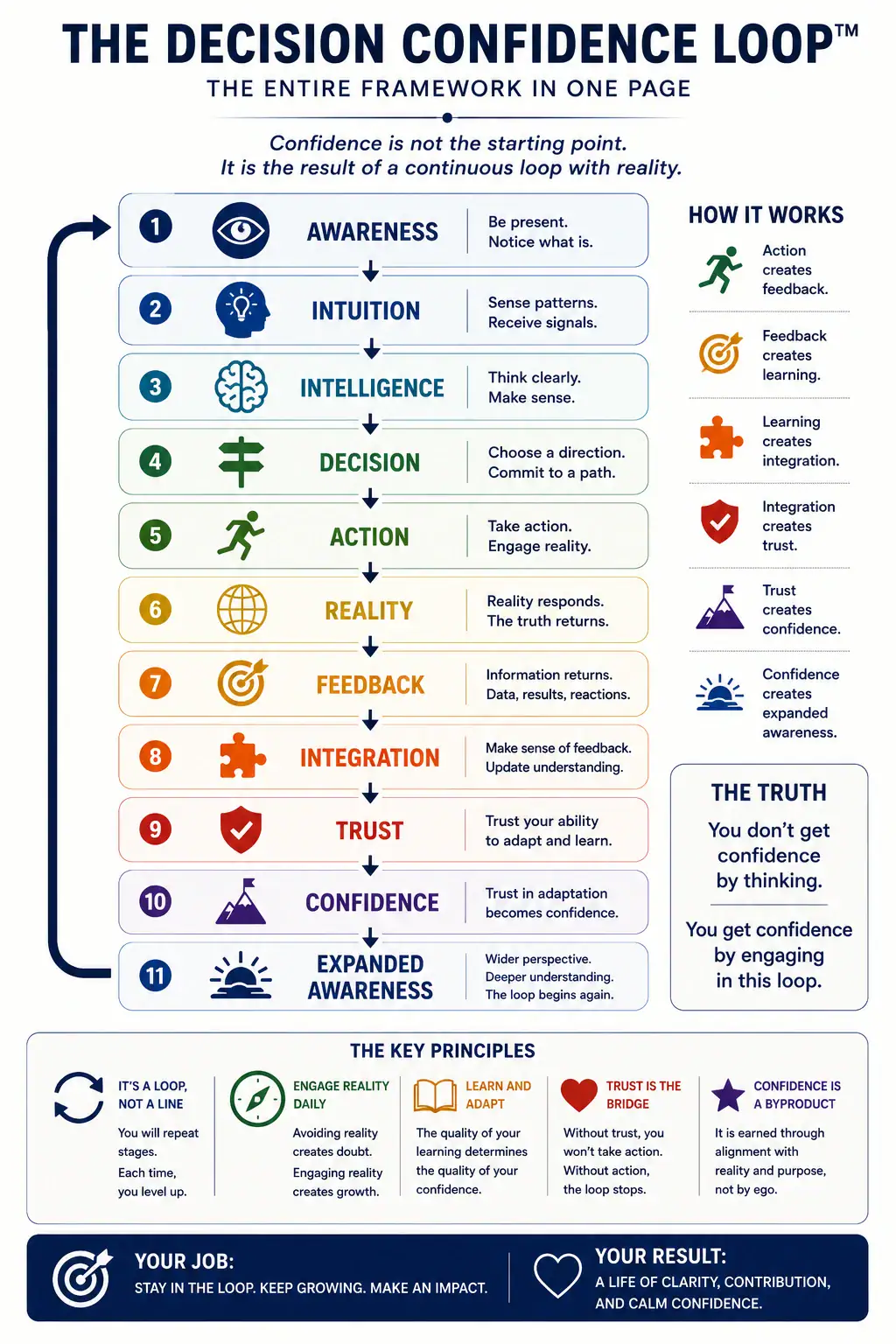
Action creates feedback. Feedback creates learning. Learning creates adaptation. Adaptation creates trust. Trust becomes confidence.
This means confidence is not simply a feeling you force yourself to have. It is a signal that your system has learned something from experience.
Confidence becomes stronger when you repeatedly discover:
- I can learn.
- I can adapt.
- I can recover.
- I can continue.
Why Action Builds Confidence Better Than Thinking Alone
Thinking is useful. Research is useful. Reflection is useful.
But thinking alone cannot fully replace feedback.
Until you act, the decision remains theoretical. Your assumptions remain untested. Your fears remain unchallenged. Your options remain imagined instead of experienced.
Small action changes that.
A small step can generate real feedback. That feedback helps your mind calibrate what is true, what is exaggerated, and what needs to change.
This is also why confidence and signal vs noise are connected. Confidence improves when you learn which internal signals are useful and which signals are just fear, pressure, or mental noise.
How to Build Confidence When You Feel Stuck
If you do not feel ready, do not ask only, “How do I become more confident?”
Ask a better question:
What small action would create useful feedback?
This question changes the goal.
You are no longer trying to eliminate uncertainty before moving. You are using movement to reduce uncertainty.
Examples:
- Send one message.
- Write one paragraph.
- Ask one question.
- Test one option.
- Make one small decision.
- Gather one real piece of information.
The goal is not reckless action. The goal is feedback-generating action.
Confidence Under Uncertainty
The strongest confidence is not certainty.
Certainty says, “I know what will happen.”
Confidence says, “I can respond to what happens.”
This difference matters because many important decisions cannot be made with perfect information.
If you wait for certainty, you may wait forever. But if you build trust in adaptation, you can move even when the outcome is not fully known.
This is especially useful if you experience decision fatigue symptoms, because fatigue often increases the desire for certainty while reducing the energy needed to act.
The Role of Pattern Recognition
Confidence also grows through pattern recognition.
When you repeatedly act, observe, and learn, your mind begins noticing patterns more quickly. You start recognizing which signals matter, which fears repeat, and which situations require more information.
This is why intuition becomes more reliable when it is trained through feedback instead of treated as a random feeling.
If you want to go deeper into this process, you can also explore The Personal Signal Decoder™, which focuses on reading internal signals more accurately.
The Decision Confidence Loop™ Workbook
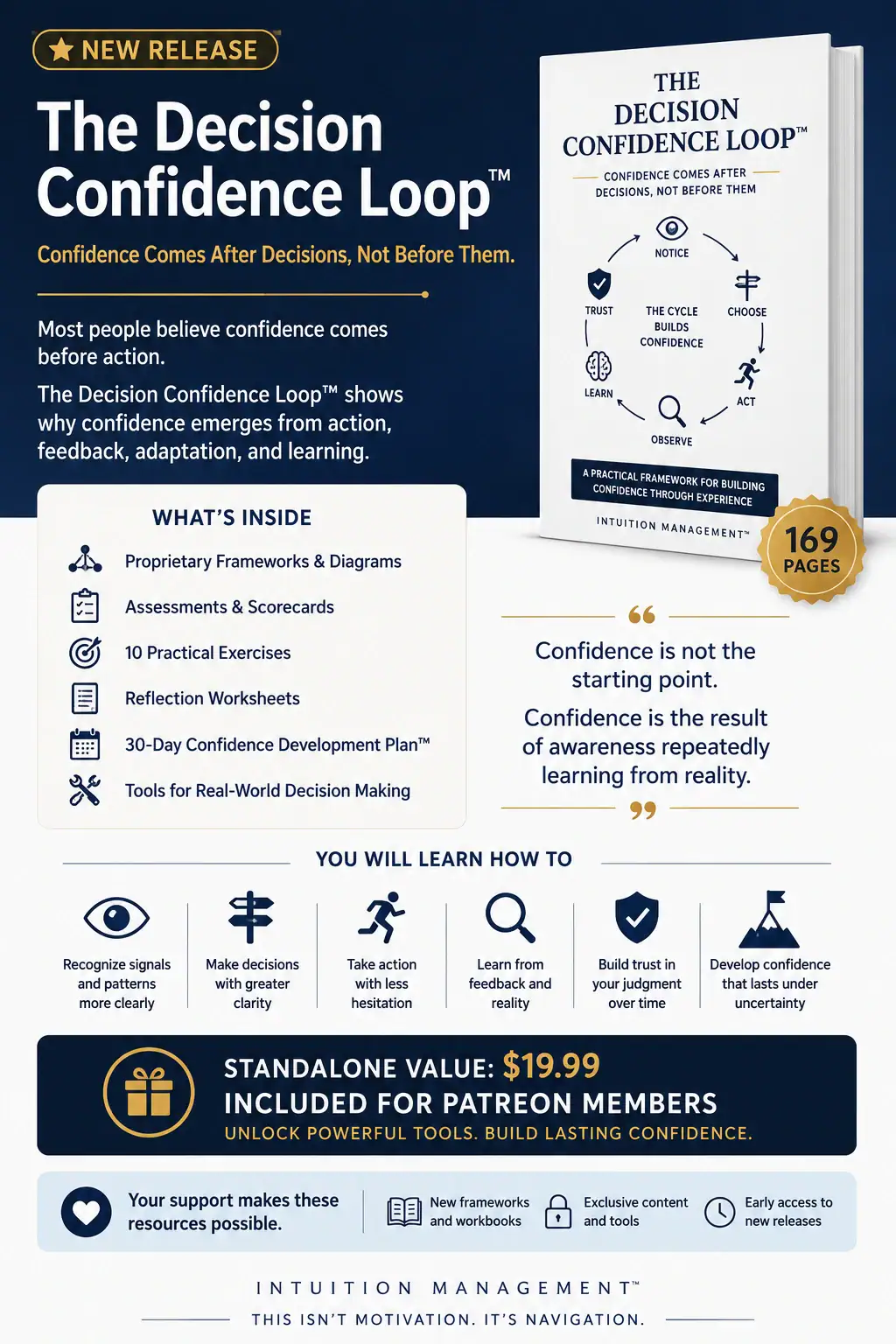
To explore this framework in depth, I created The Decision Confidence Loop™, a practical workbook for building confidence when certainty is unavailable.
The workbook is designed for people who struggle with self-doubt, overthinking, hesitation, decision fatigue, and waiting until they feel ready before acting.
You may also find The Personal Signal Decoder™ helpful because confidence often depends on how accurately you interpret internal signals.
Inside the workbook, you will find:
- The Decision Confidence Loop™ framework
- The Self-Doubt Cycle™
- The Confidence Spectrum™
- The Decision Confidence Scorecard™
- The Confidence Audit™
- Practical reflection exercises
- Tools for feedback integration
- A 30-Day Confidence Development Plan™
The purpose is not to force confidence. The purpose is to improve the process that naturally generates confidence.
Start With Your Current State
If you are not ready for the full workbook yet, start by understanding your current state:
- If decisions feel unusually heavy, read Why Decisions Feel Hard.
- If your mind keeps looping, read Why Do I Overthink Everything?
- If everything feels mentally harder than usual, read Why Does Everything Feel Harder Than It Should?
- If you cannot tell signal from noise, explore Signal vs Noise.
- If you want a guided path, begin with Your Intuition Journey.
FAQ: How to Build Confidence When You Do Not Feel Ready
Why do I lack confidence when making decisions?
You may lack confidence because your mind does not yet have enough integrated feedback. Confidence often grows after action, learning, and adaptation, not before them.
Can confidence develop through action?
Yes. Small, feedback-generating actions can help confidence develop because they create real information. That information becomes learning, and learning becomes trust.
How do I stop waiting until I feel ready?
Start by choosing the smallest meaningful action that can create feedback. The goal is not to feel perfectly ready. The goal is to learn enough to move forward more clearly.
What is the relationship between confidence and uncertainty?
Confidence is not the absence of uncertainty. Confidence is trust in your ability to learn, adapt, recover, and respond while uncertainty remains present.
Is overthinking a confidence problem?
Overthinking can become a confidence problem when it replaces action. Without action, there is no feedback. Without feedback, learning slows and confidence has less evidence to grow from.
How to Build Confidence When You Do Not Feel Ready: The Real Answer
Many people search for how to build confidence when they do not feel ready.
The answer is often not more certainty.
The answer is more feedback, more learning, and more trust in adaptation.
Final Thought
Confidence is not the starting point. Confidence is the result of awareness repeatedly learning from reality.
If you want to build confidence when you do not feel ready, do not wait for certainty to appear first.
Start with feedback.
Reality teaches. Awareness learns. Trust grows. Confidence follows.