Intuition vs wishful thinking comes down less to how intense a feeling is and more to what happens when that feeling meets reality. Wishful thinking pulls interpretation toward an outcome you want. A useful intuitive signal may come quickly and without a full explanation, but it should still remain open to evidence, contradiction, time, and feedback.
That distinction matters because both can feel convincing. If you are wondering whether a feeling is intuition or wishful thinking, intensity alone will not answer the question. You can deeply want something and still have a valid intuitive impression. You can also feel calm and certain while being wrong. The goal is not to distrust every gut feeling. It is to separate the signal from the story you want the signal to mean.

Short answer: wishful thinking tends to protect a preferred conclusion. Calibrated intuition can survive reality testing, update when evidence changes, and sometimes point toward something you would rather not be true.
What Is the Difference Between Intuition and Wishful Thinking?
Intuition is a rapid impression, judgment, or sense of direction that can draw on learned patterns, prior experience, context, perception, and information that has not yet reached conscious explanation. That does not make intuition automatically accurate. Research on intuitive expertise shows that intuitive judgment becomes more trustworthy when the environment contains learnable regularities and the person has had enough valid feedback to learn them.
Wishful thinking is different. It occurs when wanting an outcome influences how likely, true, or meaningful that outcome appears. In psychology this overlaps with ideas such as desirability bias and motivated reasoning: preferences can affect which information receives attention, how ambiguous evidence is interpreted, and which explanations feel persuasive.
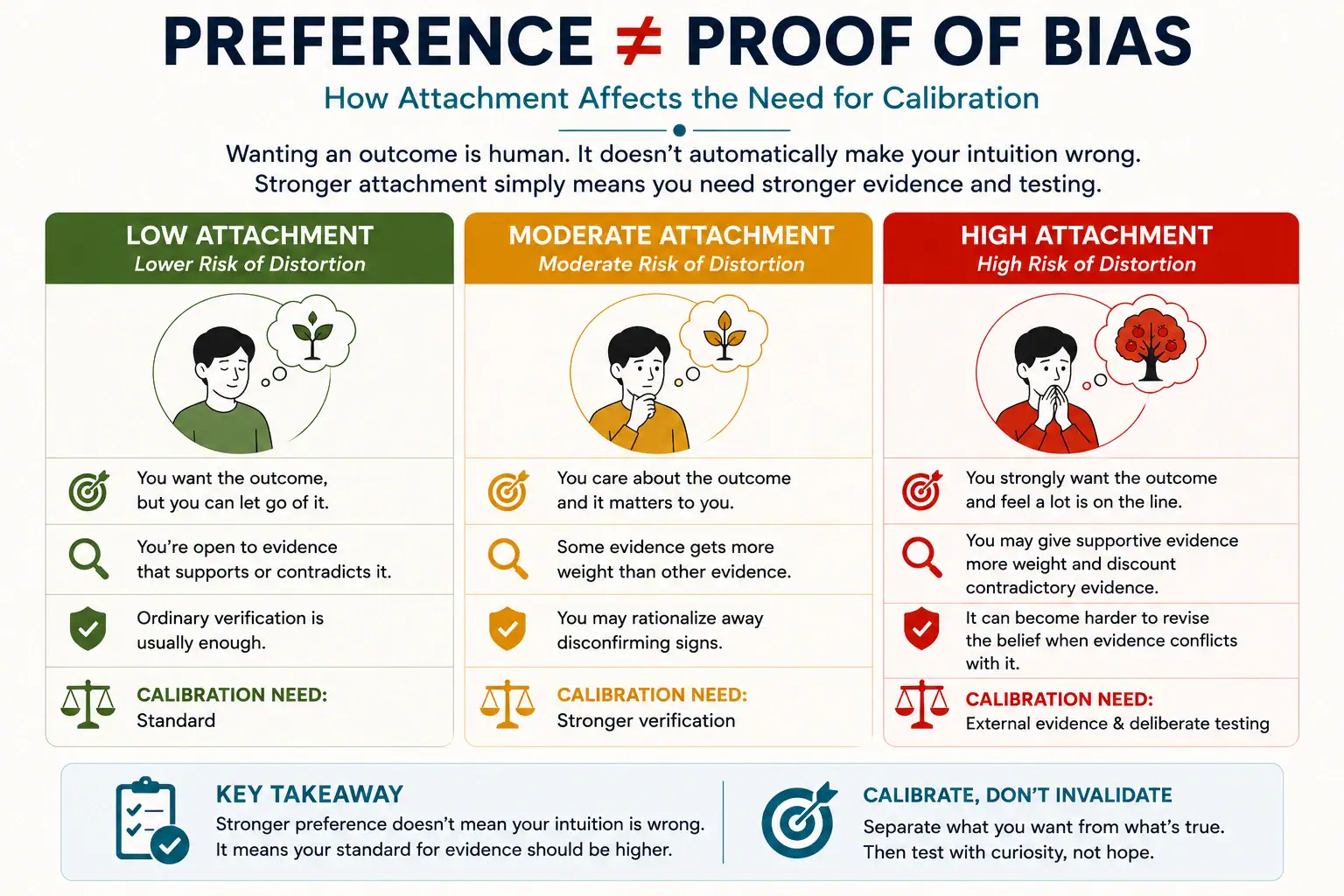
The important nuance is that desire is not proof of bias. You may want a relationship to work and still notice something important about it. You may want a career move to succeed and still recognize a genuine opportunity. The problem begins when the desired conclusion becomes protected from evidence.
Intuition vs wishful thinking at a glance:
Intuition: a rapid, pattern-based signal that may contain useful information.
Wishful thinking: an interpretation pulled toward an outcome you want to be true.
Desire alone does not invalidate intuition: wanting an outcome is a reason to test more carefully, not to dismiss the signal automatically.
The practical difference: check how the interpretation responds to evidence, contradiction, time, alternatives, and feedback.

This is also why intuition vs bias is related but not identical to intuition vs wishful thinking. Bias is a broader category of systematic distortion. Wishful thinking is specifically tied to what you hope or prefer will happen.
Why Wishful Thinking Can Feel Exactly Like Intuition
Wishful thinking rarely announces itself as, “I am ignoring reality because I want this.” It usually arrives as a plausible interpretation. You notice a few supportive details. Those details feel meaningful. Confidence grows. Once confidence grows, contradictory information can begin to look less relevant.
Classic research on motivated reasoning describes how people can access, construct, and evaluate beliefs in ways that make a desired conclusion easier to justify. Later studies of desirability bias under uncertainty found that wanting an outcome can influence predictions, particularly when the competing possibilities are not clearly separated by strong evidence.
That matters because uncertainty creates interpretive room. If the evidence is decisive, desire has less space to shape the story. If the evidence is incomplete, mixed, or ambiguous, the mind has more freedom to turn preference into prediction.
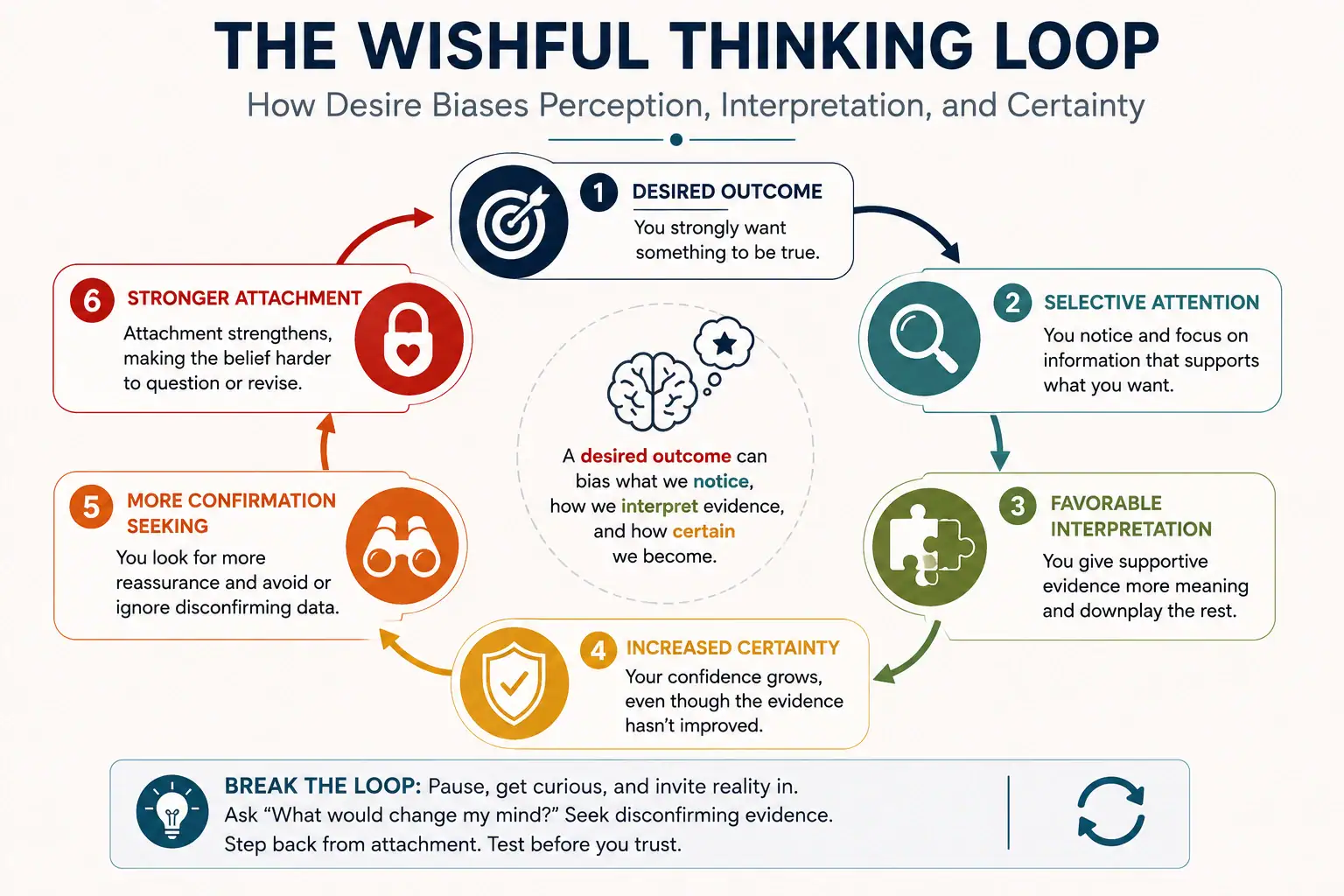
Motivated reasoning
You begin with a preferred conclusion, then unconsciously give more attention to arguments that support it. This does not require deliberate self-deception. The reasoning can feel sincere because the supportive evidence is genuinely the evidence that comes to mind most easily.
Selective attention
You notice the message, facial expression, encouraging comment, positive metric, or lucky coincidence that supports what you want. Contradictory evidence is still present, but it feels less salient.
Favorable interpretation
Ambiguous information receives the most hopeful reading. A delayed reply becomes “they are probably thinking carefully.” A vague business signal becomes “the market is starting to respond.” The interpretation may be possible, but possibility is quietly upgraded into probability.
Confirmation seeking
Instead of asking, “What information would help me decide?” you begin asking versions of, “Does this mean I am right?” Reassurance replaces investigation.
The Most Important Question: What Do You Want to Be True?
Before analyzing a gut feeling, name your preference. This single move reduces confusion because it separates what you want from what you predict.
Ask: What outcome am I hoping for? What outcome am I afraid of? How much of my identity, relief, status, belonging, or future story is attached to this conclusion?
High attachment does not prove that your intuition is wrong. It simply raises the standard of verification. The more emotionally expensive it would be to discover that you are mistaken, the more important it becomes to seek evidence that could challenge you.
Seven Signs You May Be Experiencing Wishful Thinking
1. Ambiguous evidence always points in the direction you want
If every unclear signal becomes good news, the interpretation deserves a second look. Reality usually contains mixed information.
2. Contradictory evidence requires increasingly complicated explanations
A useful belief can be revised. A protected belief requires explanations for why each inconvenient fact “does not count.” If the story becomes more elaborate every time reality pushes back, you may be preserving the conclusion rather than testing it.
3. You seek reassurance more often than information
Reassurance asks someone else to reduce uncertainty. Information helps you update. This distinction is especially useful if you are already prone to second-guessing yourself.
4. Your certainty rises even though the evidence has not changed
Repeatedly imagining an outcome can make it feel more familiar. Familiarity is not the same as probability.
5. The standard for being proven wrong keeps moving
First you say you will reconsider if one event happens. It happens, so you create a new condition. Then another. If no possible evidence could change your mind, you are no longer testing the belief.
6. The imagined future is more compelling than the present facts
You spend more time mentally living in the successful relationship, career, purchase, move, or business outcome than examining what exists now.
7. You would interpret the same evidence differently for someone else
This is one of the strongest checks. Imagine that a close friend presents the same facts but has no emotional connection to you. Would you reach the same conclusion for them?
What Calibrated Intuition Is More Likely to Look Like
Reliable intuition is not defined by a mystical feeling or a specific body sensation. A better question is whether the signal can participate in a good learning process.
Calibrated intuition is more likely to:
- draw attention to information before you can fully explain why it matters;
- remain open to checking rather than demanding immediate obedience;
- survive a cooling-off period without requiring emotional escalation;
- change when relevant evidence changes;
- sometimes point toward an answer you do not prefer;
- become more accurate through feedback and repeated experience.
This is consistent with research by Daniel Kahneman and Gary Klein on conditions for intuitive expertise. They emphasized that subjective confidence alone does not tell us whether an intuitive judgment is accurate. The structure of the environment and the opportunity to learn from feedback matter.
If you want a deeper guide to the felt experience itself, see what intuition feels like. The purpose here is different: not to describe the sensation, but to test the interpretation.
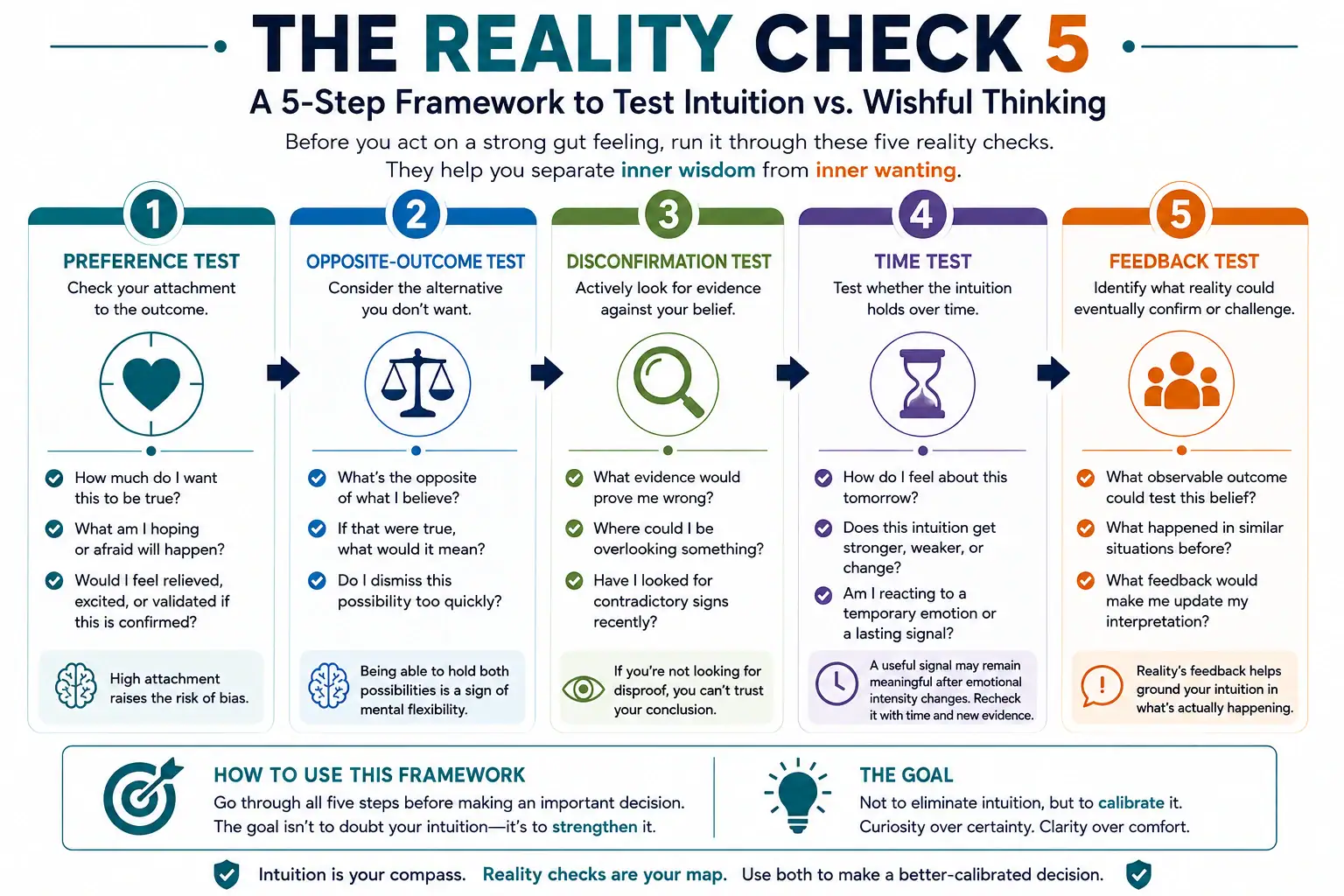
The Reality Check 5: A Framework for Testing Intuition vs Wishful Thinking
When a decision matters, use five reality checks before turning a feeling into action.
1. Preference Test
Ask: What do I want to happen?
Name the preferred outcome without judging it. You are not trying to remove desire; you are making it visible. If the answer carries major emotional stakes, raise your standard for evidence.
2. Opposite-Outcome Test
Ask: If I wanted the opposite outcome, how would I interpret the same facts?
This creates psychological distance. It can expose interpretations that depend more on preference than information.
3. Disconfirmation Test
Ask: What evidence would make me change my mind?
This is the most important safeguard against self-sealing beliefs. If you cannot name any realistic evidence that would count against your conclusion, the conclusion is not being tested.
4. Time Test
Ask: Does this signal remain worth examining after emotional intensity changes?
You do not need to delay every decision. But when time is available, revisit the interpretation after excitement, fear, relief, or urgency has shifted. A changed emotional state often changes what seems obvious.
5. Feedback Test
Ask: What observable result could eventually confirm or challenge this interpretation?
Intuition improves when it meets feedback. Write down what you expect to happen. Later, compare the prediction with what actually happened. This turns intuition from a vague identity claim into something that can be calibrated.
If calibration is a skill you want to develop systematically, the site also has a dedicated guide to intuition calibration.
Can You Tell the Difference in Real Time?
Sometimes, but not perfectly. Body sensations and mental tone can provide useful clues, yet none of them are proof.
A signal may feel calm, urgent, uncomfortable, exciting, or neutral. Wishful thinking can also feel calm. Anxiety can feel like certainty. A familiar belief can feel “obvious” because it is familiar rather than because it is true.
The best real-time question is therefore not “Does this feel like intuition?” It is:
“What is this feeling asking me to notice, and how can I test my interpretation without ignoring it?”

Intuition vs Wishful Thinking in Relationships
Relationships create ideal conditions for wishful interpretation because the evidence is often incomplete and the emotional stakes are high.
Suppose you think, “I know they will come back.” That statement could be informed by a real pattern you have observed. It could also be an attempt to reduce grief or uncertainty. The useful question is not whether the feeling is strong. Ask:
- What observable behavior supports this conclusion?
- What behavior contradicts it?
- Am I interpreting silence, ambiguity, or inconsistency as hidden evidence?
- Would I reach the same conclusion if a friend described the situation?
Likewise, “Something about this person feels right” can contain useful social information, attraction, familiarity, projection, or some combination of all four. That is why intuition in relationships should be tested against behavior over time, not used as a substitute for it.
Intuition vs Wishful Thinking in Career and Business Decisions
Professional intuition can be powerful when it comes from repeated exposure to meaningful patterns. An experienced manager may notice that a project “feels off” before the dashboard clearly shows why. A founder may recognize a market pattern before they can fully articulate it.
But career decisions also carry status, money, identity, and hope. Those stakes can make a desired outcome feel more likely.
If you think, “I just know this business idea will work,” test the statement in two parts:
Signal: What pattern am I recognizing?
Prediction: What result do I expect because of that pattern?
Then seek measurable feedback. Strong intuition is most useful when it works alongside evidence, not when it replaces evidence. That same principle applies to intuition vs logic: the strongest decisions often use each mode for the job it does best.
What If You Are Choosing Between Two Options?
Wishful thinking often becomes visible when one option carries a much more attractive identity or emotional payoff.
Imagine:
- Option A is exciting and fits the future story you want.
- Option B is less exciting but has stronger current evidence.
Do not automatically choose B in the name of “being rational.” Excitement may contain real information about values, motivation, or opportunity. Instead, test both options symmetrically.
For each option ask: What am I assuming? What would have to be true for this to work? What would prove me wrong? What part of this choice is evidence, and what part is imagined relief?
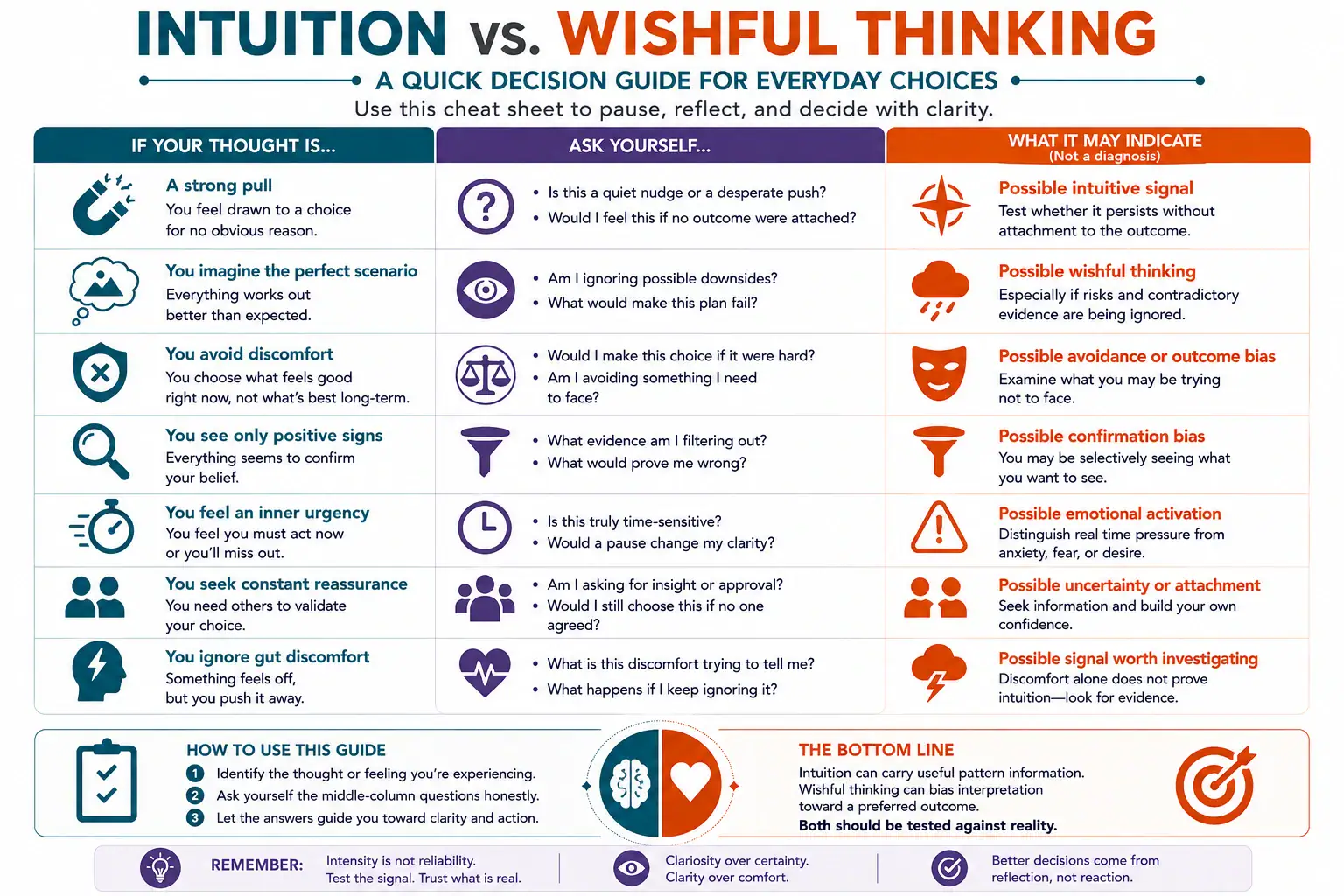
Intuition vs Wishful Thinking vs Anxiety vs Bias
These concepts overlap, but they are not the same.
Intuition is a rapid signal or judgment that may contain useful pattern information.
Wishful thinking biases interpretation toward a preferred outcome.
Anxiety tends to organize attention around threat, uncertainty, and what could go wrong.
Cognitive bias is the broader category of predictable distortions or shortcuts that can affect judgment.
You can experience more than one at once. An intuitive signal may be filtered through anxiety. Wishful thinking may recruit confirmation bias. Overthinking may begin after a valid intuitive cue. For a broader comparison, see overthinking vs intuition and intuition vs bias.
Why “Calm Means Intuition” Is Not a Reliable Rule
A popular rule says intuition is calm while wishful thinking is emotionally charged. It can be a useful prompt, but it is not a reliable test.
You can feel calm because a belief is familiar. You can feel emotional because a true signal has important consequences. You can feel urgency because there is real time pressure. You can also feel certain because repeating a story has made it cognitively easy to access.
Research on intuitive judgment reinforces this caution: subjective confidence is not the same as objective accuracy. The better question is not “How peaceful do I feel?” but “Does this interpretation remain useful when I check it against evidence, alternatives, and feedback?”
This is also why learning when intuition is wrong is part of learning to trust it well.
A 60-Second Reality Check
If you do not have time for the full framework, ask these six questions:
- Preference: What do I want to be true?
- Facts: What do I actually know right now?
- Disproof: What evidence would challenge my interpretation?
- Opposite view: If I wanted the opposite outcome, how would I read this?
- Time: Is this still worth examining after the emotional intensity changes?
- Feedback: What observable outcome could test this?
You do not need certainty before acting. You need enough clarity to know what is signal, what is assumption, and what you will watch next.

What If You Still Cannot Tell?
Sometimes the honest answer is: you do not have enough information yet.
That is not a failure of intuition. Uncertainty is often the most accurate description of the situation. If the decision is reversible, you may be able to take a small step and collect feedback. If it is high-stakes and difficult to reverse, waiting for more evidence can be wiser than forcing certainty.
Good intuition is not the ability to feel certain all the time. It is the ability to notice signals, interpret them carefully, and keep learning from what reality returns. That is the broader principle behind signal vs noise.
Frequently Asked Questions
Is wishful thinking the same as intuition?
No. Intuition is a rapid judgment or signal that may reflect learned patterns and experience. Wishful thinking occurs when a desired outcome influences what seems likely or true. They can feel similar, which is why evidence and feedback matter.
Can intuition tell me something I want to hear?
Yes. Wanting an outcome does not automatically make an intuitive impression false. Strong preference simply means you should test the interpretation more carefully because the cost of motivated reasoning is higher.
Is this a gut feeling or wishful thinking?
If you are asking whether a gut feeling or wishful thinking is driving you, treat the feeling as information rather than proof. Ask what pattern it may be responding to, look for contradictory evidence, revisit it after emotional intensity changes, and identify what real-world feedback could confirm or challenge your interpretation.
Can intuition be wrong?
Yes. Intuitive judgments can be excellent in familiar, learnable environments and poor in noisy or unfamiliar ones. Confidence alone is not a reliable measure of accuracy.
Is intuition always calm?
No. Calmness can be one useful clue, but it is not a validity test. Intuition can be uncomfortable or emotionally significant, while a mistaken belief can sometimes feel calm and certain.
How long should I wait before trusting intuition?
There is no universal waiting period. If the decision is not urgent, revisiting it after your emotional state changes can help. If the stakes are high, use stronger evidence and feedback rather than relying on time alone.
Bottom Line
Intuition asks you to notice information. Wishful thinking asks reality to support a preferred outcome.
You do not distinguish them by one feeling, one body signal, or one moment of certainty. You distinguish them by what happens next: Does the interpretation tolerate contradiction? Can it update? Can you name what would prove you wrong? Can reality teach you something you did not want to learn?
The goal is not to become suspicious of your inner signals. It is to become better at calibration. Trusting your intuition works best when trust includes curiosity, evidence, and the willingness to revise.
Continue exploring: browse the Intuition Management article library or follow Your Intuition Journey for a broader path from signal recognition to calibrated decision-making.
Research Sources
- Kunda, Z. (1990). The case for motivated reasoning. Psychological Bulletin.
- Kahneman, D., & Klein, G. (2009). Conditions for intuitive expertise: A failure to disagree. American Psychologist.
- Windschitl, P. D., et al. (2022). The desirability bias in predictions under aleatory and epistemic uncertainty. Cognition.
- Krizan, Z., & Windschitl, P. D. (2007). The influence of outcome desirability on optimism. Psychological Bulletin.
- Sommer, J., Musolino, J., & Hemmer, P. (2024). Updating, evidence evaluation, and operator availability: A theoretical framework for understanding belief. Psychological Review.
This article is educational and focuses on decision processes, not diagnosis. Strong emotions, uncertainty, and bodily sensations can have many causes; use context and appropriate professional expertise when a decision carries significant health, legal, financial, or safety consequences.