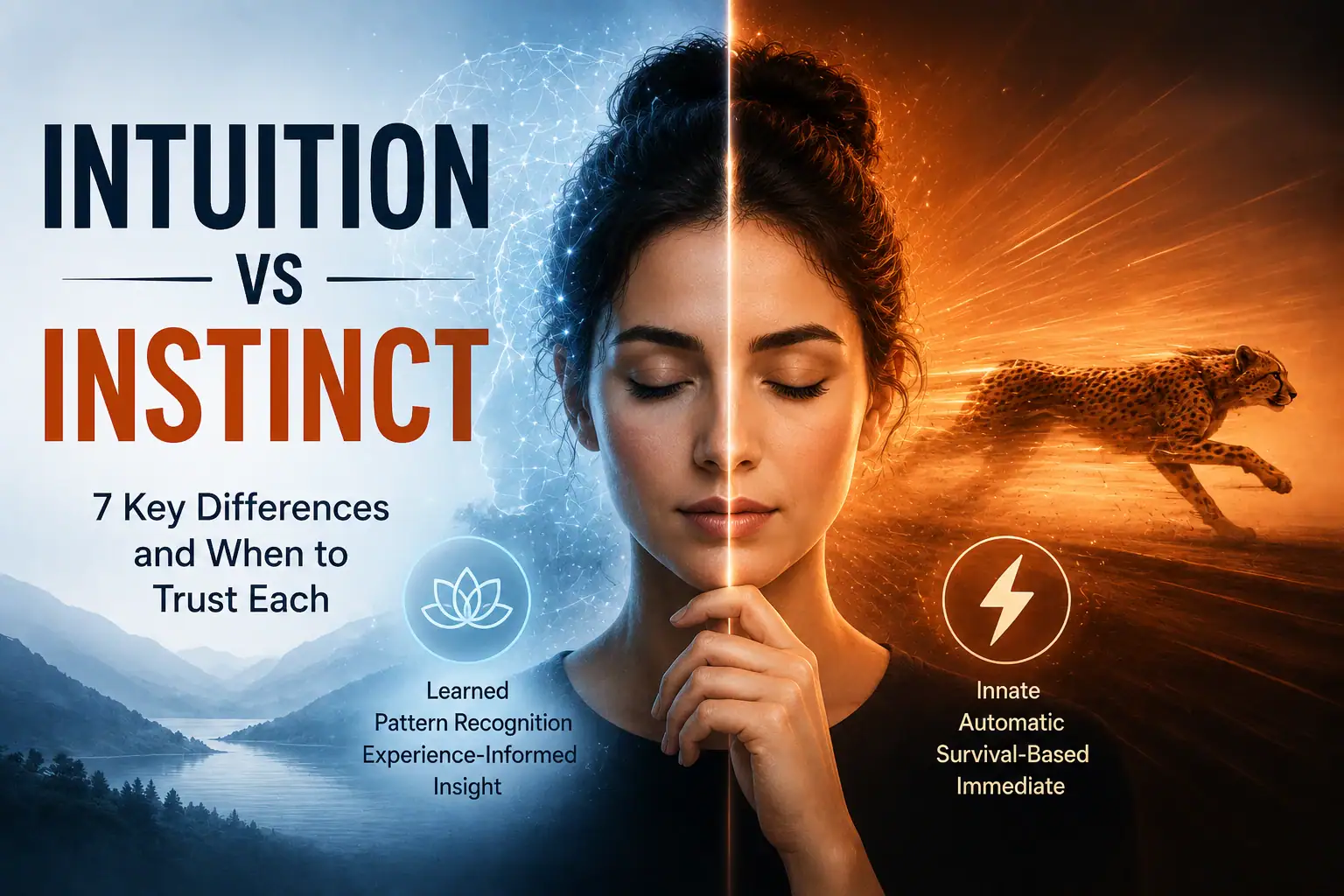
Intuition vs instinct comes down to where a rapid signal comes from and what it is trying to do. Intuition is usually an experience-informed judgment that reaches awareness before you can fully explain the reasoning behind it. Instinct is better understood as a biologically prepared tendency to respond to certain kinds of cues, especially those linked to basic needs, protection, and rapid action.
They can feel surprisingly similar. Both may arrive quickly. Both can produce a bodily sensation. Both can influence you before deliberate reasoning catches up. But they are not the same process, and neither should automatically be treated as truth.
The useful question is not simply, “Should I trust my gut?” It is: What kind of signal is this, what might be producing it, and how much weight should it get in this situation?
Intuition vs Instinct: The Short Answer
Intuition is a rapid impression, judgment, or sense of coherence that often draws on patterns learned through experience. It may tell you that something fits, does not fit, or deserves attention even before you can consciously name the cues that produced the impression.
Instinct is a looser and more contested term in science. In everyday language, it usually refers to biologically prepared tendencies that can support rapid behavior without requiring the same kind of learned expertise. Modern research also cautions against treating instinct as a perfectly fixed “hardwired program”: biology, development, learning, and context interact.
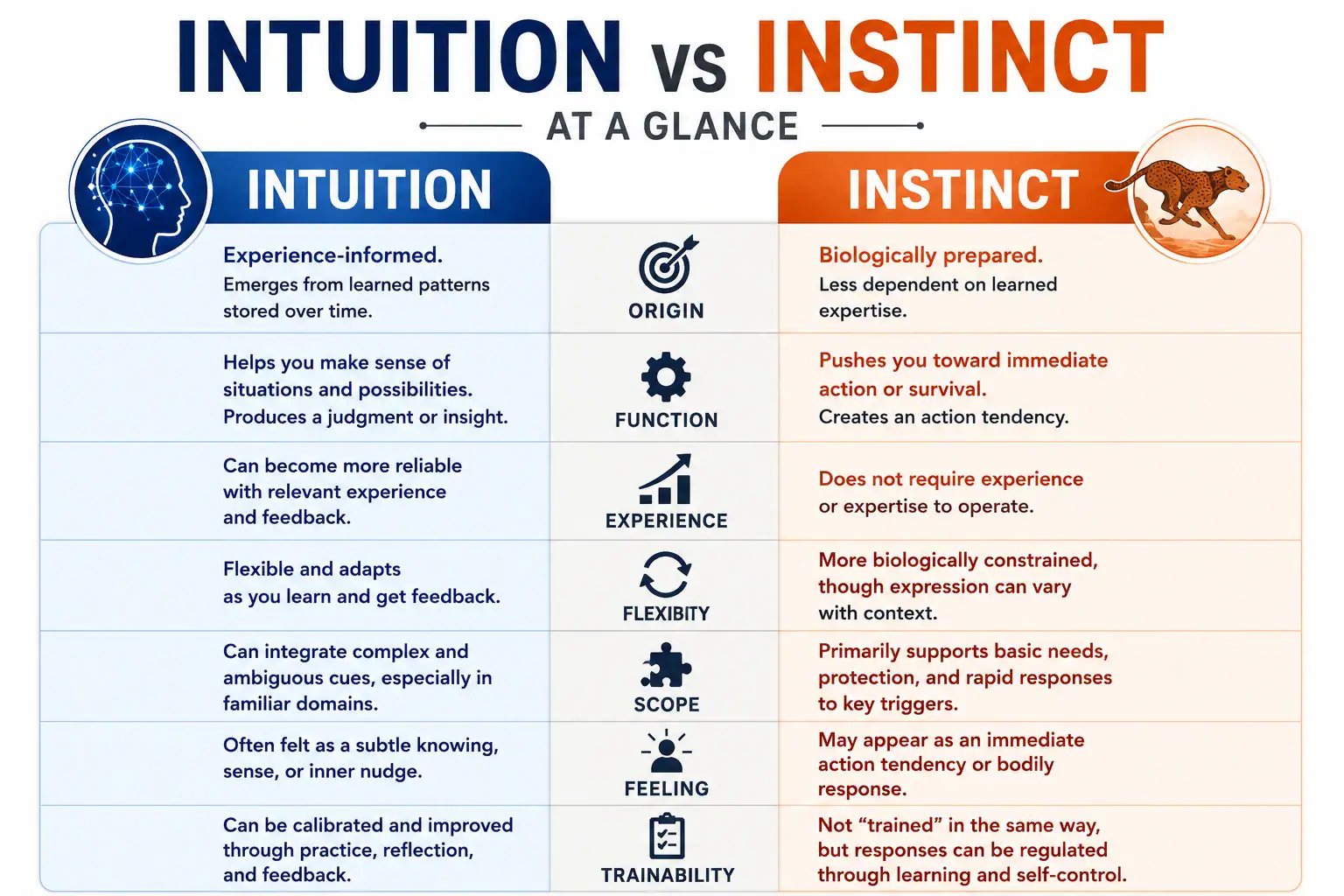
The cleanest practical distinction is this: intuition tends to contribute a judgment; instinct tends to contribute an action tendency. The boundary is not always perfect, but it is far more useful than treating every fast feeling as the same thing.
What Is Intuition?
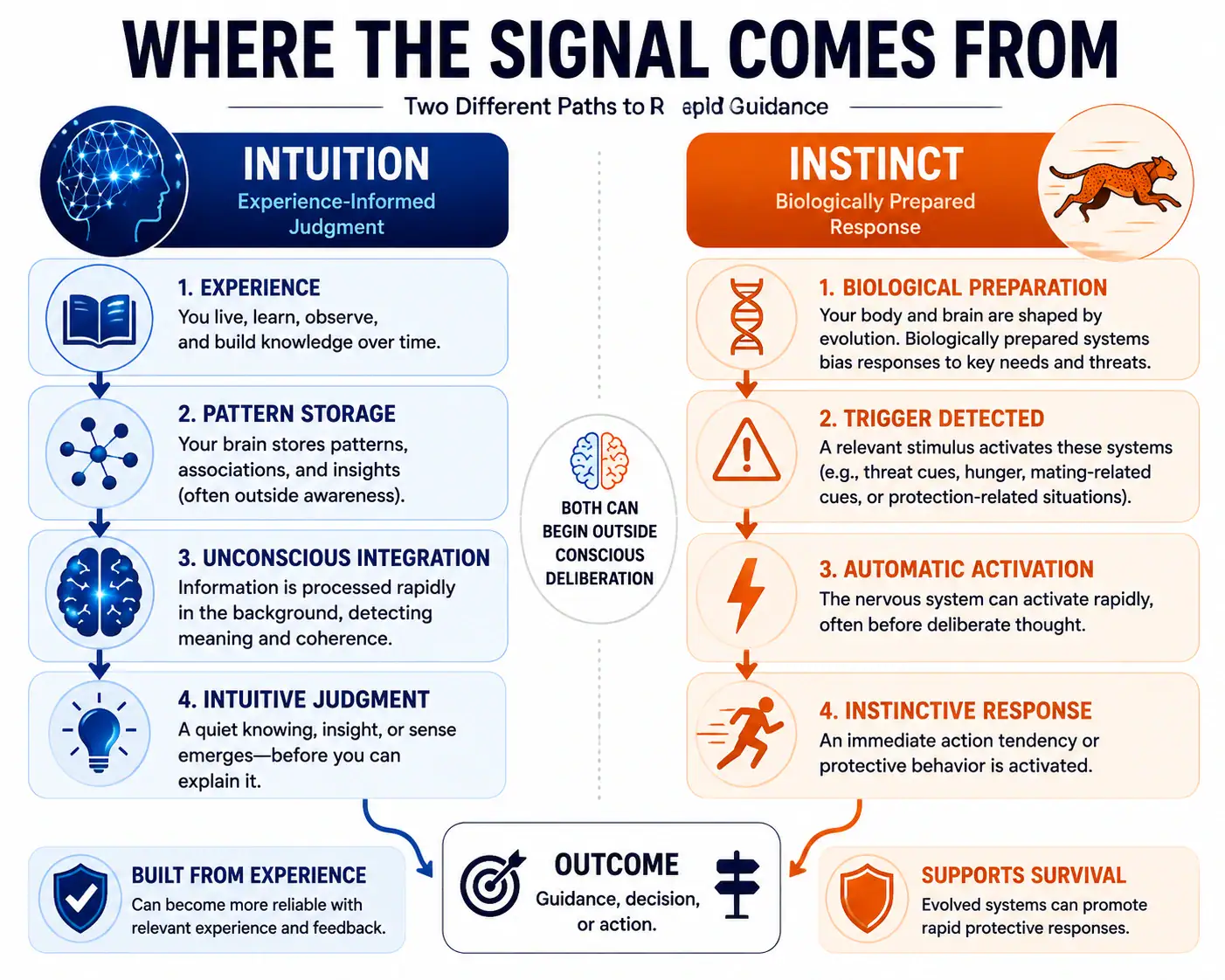
Intuition is often described as knowing without knowing exactly how you know. That does not require a mystical explanation. In many cases, the mind is integrating information outside deliberate awareness and producing a sense that the pieces fit together—or fail to fit together.
Research on intuitive judgment often emphasizes experience, pattern recognition, and a feeling of coherence. Zander and colleagues describe intuition as an experience-based impression that can emerge rapidly from environmental cues. Kahneman and Klein likewise argue that skilled intuition is most trustworthy when the environment contains learnable regularities and the person has had enough practice and feedback to learn them.
This is why expertise matters. A firefighter, clinician, driver, chess player, designer, manager, or technician may notice that “something is off” before being able to verbalize every cue. The signal can be real because the underlying pattern has been encountered many times before.
But intuition is not automatically accurate. A fast judgment can also reflect incomplete learning, selective attention, expectation, memory distortions, or cognitive bias. If you want the broader cognitive picture, see intuitive thinking and what intuition really is: pattern recognition under uncertainty.
Intuition can improve, but only under the right conditions
Repeated experience by itself is not enough. The environment must contain patterns that can actually be learned, and feedback must be good enough to tell you when your judgment was right or wrong. If outcomes are mostly random, delayed, or poorly measured, confidence can grow faster than accuracy.
This is one reason training your intuition should focus on calibration, feedback, reflection, and domain knowledge rather than simply “trusting yourself more.”
What Is Instinct?
Instinct is commonly used for behavior that seems biologically prepared rather than learned from scratch. Examples are often drawn from feeding, mating, protection, caregiving, threat responses, orientation, and other recurring problems organisms have faced across evolution.
However, the word instinct can become misleading when it is treated as a synonym for “genetically programmed and unaffected by experience.” Developmental research has repeatedly challenged that simple picture. Michael Blumberg, for example, argues that many behaviors traditionally called instinctive cannot be adequately explained as fully pre-programmed or independent of development.
So in this article, instinctive response means a biologically prepared tendency that can support rapid action without requiring the kind of learned expertise that usually underlies skilled intuition. Its expression can still be shaped by context and learning.
Instinct is closer to action than explanation
An intuitive signal may feel like, “This plan does not add up,” or “I think this is the right move.” An instinctive signal is more likely to involve readiness to orient, withdraw, approach, protect, freeze, pursue, or otherwise act in response to a biologically significant cue.
That difference—judgment versus action tendency—is one of the most useful ways to separate intuition from instinct in everyday decision-making.
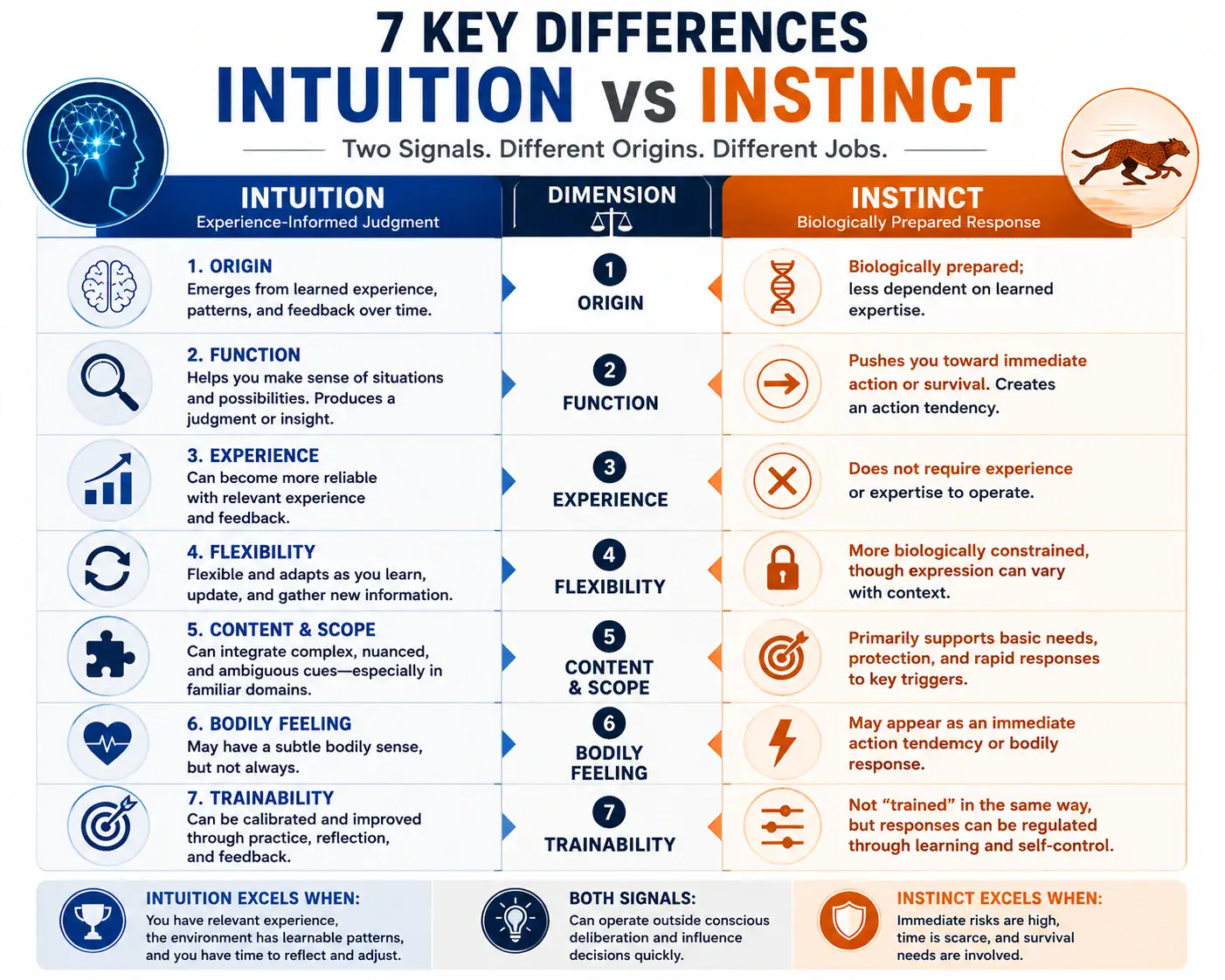
7 Key Differences Between Intuition and Instinct
1. Origin: learned patterns vs biological preparedness
Intuition often depends heavily on patterns accumulated through experience. Instinctive tendencies are less dependent on expertise and are more closely related to biologically prepared systems. That does not mean intuition is purely learned or instinct is untouched by learning; it means the relative contribution of experience differs.
2. Function: judgment vs action tendency
Intuition tends to produce a rapid interpretation, impression, or judgment: something fits, something is wrong, this option looks promising. Instinctive responses are more directly connected with action readiness: orient, avoid, approach, defend, protect, or respond.
3. Experience: intuition usually needs a history to draw from
The more relevant patterns you have encountered—and the better the feedback you received—the more useful intuition can become. Instinctive tendencies do not require the same body of domain-specific expertise to appear.
4. Flexibility: intuition can update more readily
Because intuition can be shaped by learning, feedback can refine it. New evidence, changed environments, and repeated outcomes can alter the patterns your mind uses. Instinctive responses are more biologically constrained, although their expression and regulation can still change with learning and context.
5. Scope: intuition can integrate complex domain-specific cues
Intuition can operate in situations with many weak or ambiguous signals, especially when you have relevant experience. That is why expert intuition can matter in medicine, management, design, sports, emergency work, and other pattern-rich environments. Instinctive responses are more closely tied to recurring biologically significant cues and action needs.
6. Bodily feeling: both can feel physical
A knot in the stomach, sudden tension, warmth, hesitation, a pull toward something, or an urge to move can accompany either kind of signal. Bodily sensation therefore does not prove that a feeling is intuition or instinct. It may also reflect emotion, stress, hunger, fatigue, or other physiological states.
This is where somatic intuition becomes useful: the body can carry information, but bodily information still needs interpretation.
7. Trainability: intuition can be calibrated more directly
You can improve intuition by building relevant experience, testing predictions, seeking feedback, noticing recurring cues, and correcting errors. Instinctive tendencies are not trained in exactly the same way, although people can learn to regulate their responses and choose how to act on them.
Why Intuition and Instinct Feel So Similar
The confusion makes sense because both can enter awareness before deliberate reasoning. You may experience a conclusion or urge first and construct the explanation later.
Both can also be fast, emotionally colored, and embodied. Neither arrives with a label saying, “I am intuition” or “I am an instinctive response.” The subjective experience is simply a signal.
That is why everyday language collapses several processes into phrases such as gut feeling, gut instinct, inner knowing, sixth sense, or something feels off. The phrase describes the experience, not necessarily the mechanism producing it.
Gut Instinct vs Intuition: What Is a Gut Feeling?
A “gut feeling” is not a precise scientific category. It is a useful everyday label for a quick internal sensation, impression, or urge. Depending on the situation, that feeling may reflect intuition, an instinctive response, emotion, anxiety, learned association, cognitive bias, or a temporary bodily state.
That distinction matters because the same physical sensation can point to very different causes. A rapid sense of unease in a familiar professional situation may come from subtle cues you have learned to recognize. A similar sensation before an unfamiliar social event may be driven more by uncertainty or fear. Fatigue or hunger can also change how ambiguous information feels.
So the strongest response to a gut feeling is neither “ignore it” nor “obey it.” It is: notice it, identify plausible sources, check the context, and look for evidence.

Intuition vs Instinct vs Reflex vs Anxiety
Intuition is an experience-informed judgment that may emerge without conscious step-by-step reasoning.
Instinctive response is a biologically prepared action tendency that can be triggered rapidly by relevant cues.
Reflex is a relatively automatic physiological response to a stimulus. Pulling away from a painful stimulus is better described as a reflex than as intuition.
Anxiety can produce threat-focused predictions, bodily arousal, vigilance, and strong urges. Those experiences can feel intuitive because they also arrive quickly, but speed does not make them the same process.
If this distinction is difficult in real life, see intuition or anxiety. The goal is not to dismiss an anxious signal. It is to avoid automatically treating every intense internal signal as reliable evidence about the external world.
Real-Life Examples of Intuition vs Instinct
An experienced clinician notices that a case does not fit
The clinician cannot immediately identify the exact contradiction, but years of exposure make the overall pattern feel wrong. That is a strong example of intuition: rapid judgment built from experience.
A project manager senses that a “green” project is likely to slip
No single metric looks catastrophic, but several weak cues resemble patterns that preceded earlier failures. Again, this is more plausibly intuition than instinct because the signal depends on learned domain patterns.
You orient instantly toward a sudden possible threat
A rapid protective or orienting tendency can occur before deliberate analysis. This is closer to an instinctive or defensive response, although learning and context can still affect what your nervous system treats as significant.
An experienced driver slows before explaining why
The spacing, speed, lane position, and behavior of another vehicle form a familiar pattern. The driver recognizes the risk before consciously articulating the cues. That is likely learned intuition.
Someone “feels wrong” in a relationship
This signal deserves attention, but its source is ambiguous. It could reflect subtle interpersonal cues, a learned association from past experience, anxiety, projection, or bias. A feeling can be meaningful without being a complete explanation.
How Intuition and Instinct Can Influence the Same Decision
Real decisions are rarely powered by one clean system. An instinctive response may create urgency while intuition contributes an experience-based judgment about what the situation means. Deliberate reasoning can then check evidence, compare options, estimate consequences, and decide whether the fast signal deserves weight.
That is why the best model is not “intuition versus instinct” as if one must defeat the other. The better model is different sources of information competing and cooperating inside the same decision.
For example, you may feel an immediate protective urge in a tense situation, recognize from experience that the pattern resembles a previous problem, and then use deliberate reasoning to decide whether to leave, ask a question, gather more information, or do nothing.

When Should You Trust Instinct?
Instinctive protective responses deserve attention when immediate physical safety may be at stake and there is little time for deliberate evaluation. Rapid defensive systems exist precisely because some situations punish slow analysis.
But an instinctive response is still a signal, not proof. Human defensive behavior is context-sensitive, and threat learning can make harmless cues feel significant. When you are safe enough to reassess, look at what actually happened and whether the response matched the situation.
High stakes do not automatically mean “trust instinct.” If time is available, high-impact decisions usually deserve more evidence, not less.
When Should You Trust Intuition?
Intuition deserves more weight when you have substantial relevant experience, the environment contains patterns that can be learned, you have received meaningful feedback from previous decisions, and the current situation resembles the kinds of situations in which that expertise developed.
It deserves less weight when the domain is highly unpredictable, feedback has been weak, the situation is outside your expertise, or you strongly want one outcome to be true.
This is the central lesson from research on expert intuition: confidence alone is not evidence of intuitive skill. Reliable intuition requires learnable structure plus enough opportunity to learn it.
The same principle explains why intuition and logic should not be enemies. See intuition vs logic for a deeper guide to deciding when fast judgment should be checked by deliberate analysis.
When Intuition Is Actually Bias, Fear, or Wishful Thinking
A fast impression can feel compelling because it arrives as a completed answer rather than an argument. That makes intuition vulnerable to being confused with other fast processes.
Confirmation bias can make evidence supporting an existing belief stand out while contradictory evidence fades into the background. Availability can make vivid or recent examples feel more probable than they are. Learned associations can make a present situation feel familiar even when the resemblance is superficial. Wishful thinking can make the preferred outcome feel like the most “intuitive” one.
This does not mean intuition is merely bias. It means both can operate quickly and outside explicit reasoning, so they need to be distinguished through feedback and evidence. For a deeper comparison, see intuition vs bias and mental models vs cognitive biases.
Your broader expectations also matter. Mental models shape perception, which means two people can notice the same event and assign very different meanings to it before deliberate reasoning even begins.
A Better Decision Process: From Signal to Action
A quick internal signal should start a decision process, not necessarily end it. When time allows, evaluate the signal through five questions: Is it relevant to the current situation? What evidence supports or contradicts it? Does the context make the signal more or less reliable? Is it consistent with other trustworthy information? What are the possible risks and costs of acting?
Then integrate intuition, instinctive responses, and deliberate reasoning according to the situation. If immediate safety is at stake and there is no time to evaluate, protective action may reasonably come first. Otherwise, the quality of the decision usually improves when the signal is checked rather than worshipped or ignored.
Afterward, review the outcome. What worked? What did not? Which cues were genuinely predictive? Which ones were noise? Reflection is how experience becomes better future intuition.

Can You Train Intuition but Not Instinct?
You can deliberately improve the conditions that make intuition more reliable. Relevant practice builds a larger pattern library. Feedback helps separate useful cues from noise. Reflection helps correct mistaken interpretations. Calibration teaches you when confidence is justified and when it is not.
Instinctive tendencies are not trained in the same sense, but behavior is still modifiable. You can learn to regulate an initial response, change what you do next, and develop better strategies for interpreting bodily signals.
The goal is therefore not to become “more instinctive.” It is to become better at recognizing what kind of signal you are experiencing and choosing an appropriate response.
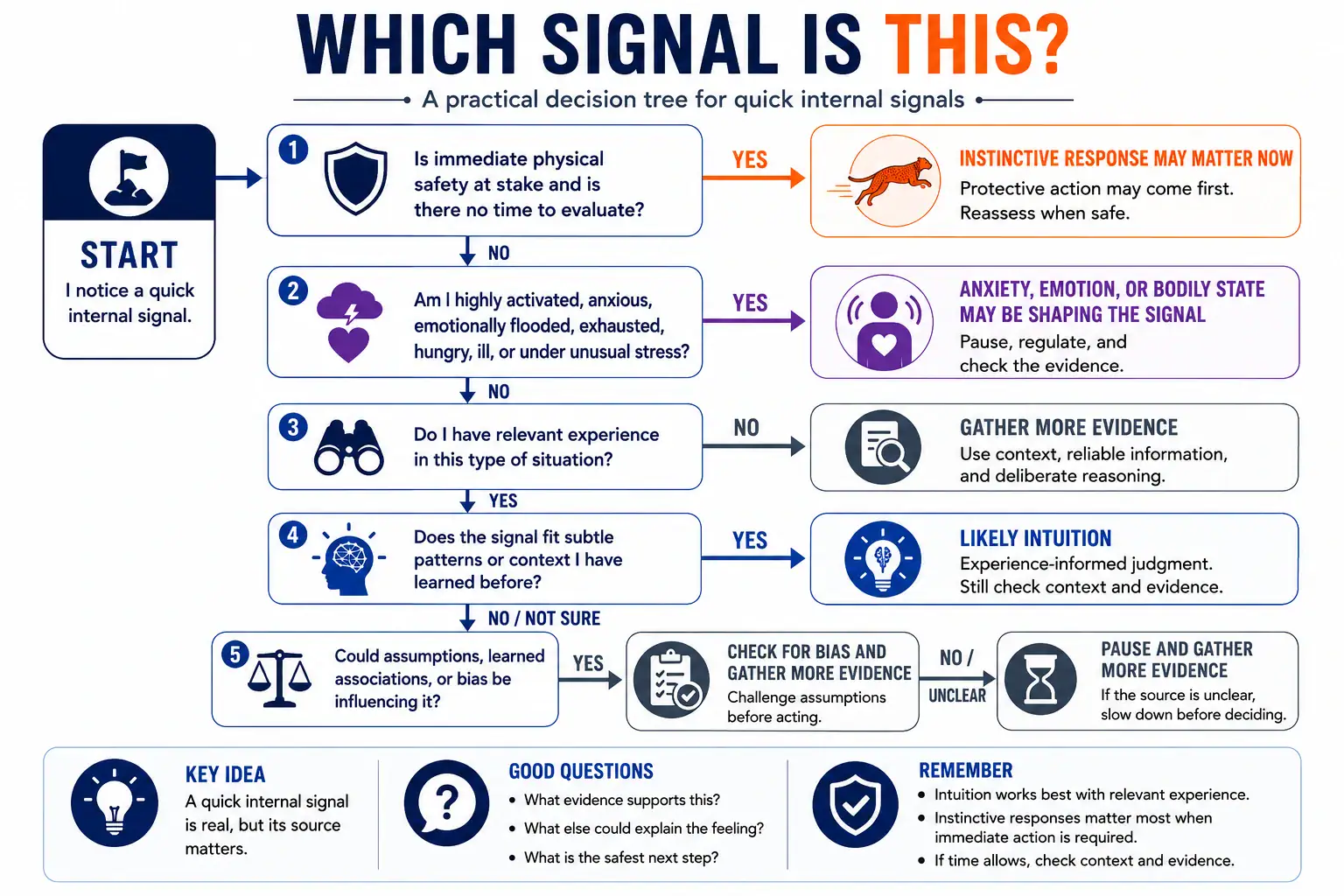
A Simple Test: Is This Intuition or Instinct?
Start with safety. If there is an immediate physical threat and no time to evaluate, protective action may come first.
If there is time, ask whether you are highly activated, anxious, emotionally flooded, exhausted, hungry, ill, or under unusual stress. Those states do not make the signal meaningless, but they can strongly influence how situations are interpreted.
Next ask whether you have relevant experience in this kind of situation. If you do not, be cautious about calling the feeling intuition. Gather information.
If you do have relevant experience, ask whether the signal fits subtle patterns you have learned before. If yes, it may be intuition—but it should still be checked against context and evidence. If not, consider whether learned associations, assumptions, emotion, or bias could be shaping the feeling.
If the source remains unclear, uncertainty is itself useful information. You do not have to force every internal signal into a category.
Intuition vs Instinct: The Bottom Line
Intuition and instinct can both feel immediate, but they are not interchangeable. Intuition is more closely tied to experience-informed pattern recognition and rapid judgment. Instinctive responses are more closely tied to biologically prepared action tendencies. Both can begin outside deliberate awareness, both can be shaped by context, and neither is infallible.
The most useful skill is not blindly trusting or suppressing a fast signal. It is learning to identify its likely source, check whether the environment supports that kind of judgment, compare it with evidence, and act according to the actual stakes.
If you want to understand the cognitive process behind rapid judgment more deeply, continue with Intuitive Thinking. To see how different forms of intuition may appear, explore Types of Intuition.
Related comparisons: Intuition vs Instinct vs Insight · Intuition vs Insight · Intuition vs Gut Feeling
Frequently Asked Questions
Is intuition the same as instinct?
No. Intuition usually refers to a rapid, experience-informed judgment that appears without conscious step-by-step reasoning. Instinctive responses are more closely connected with biologically prepared action tendencies. They can feel similar because both may begin before deliberate thought.
What is the main difference between intuition and instinct?
A useful practical distinction is that intuition tends to contribute a judgment or impression, while instinct tends to contribute an action tendency. Intuition also depends more heavily on learned patterns and relevant experience.
Is intuition learned or innate?
Many forms of useful intuition are strongly shaped by learning. Experience gives the brain patterns to recognize, while feedback helps refine which cues are trustworthy. Some basic cognitive capacities supporting intuitive processing may be biologically grounded, so the simple learned-versus-innate split is incomplete.
Is gut instinct the same as intuition?
Not necessarily. “Gut instinct” is an everyday phrase rather than a precise scientific category. A gut feeling may arise from intuition, an instinctive response, anxiety, emotion, learned association, cognitive bias, or bodily state.
Which is more reliable: instinct or intuition?
Neither is universally more reliable. Skilled intuition can be useful in familiar, pattern-rich environments with good feedback. Instinctive protective responses can matter when biologically significant cues require rapid action. Reliability depends on the situation, the signal, and the opportunity to verify it.
Can intuition be trained?
Yes, but not by simply trying to “feel more intuitive.” Intuition becomes more useful through relevant experience, high-quality feedback, reflection, pattern recognition, and calibration. See How to Train Your Intuition for a practical approach.
Can anxiety feel like intuition?
Yes. Anxiety can create rapid predictions, bodily sensations, vigilance, and a powerful sense that something is wrong. That does not mean the feeling should be ignored, but it does mean the source should be examined before treating it as reliable intuition.
Should you always trust your gut?
No. A gut feeling is useful information, but it is not automatically a correct conclusion. Notice the signal, ask what may be producing it, check whether you have relevant experience, look for evidence, and consider the consequences of acting.
Research Behind the Distinction
The distinction in this article is deliberately practical rather than absolute. Scientific terminology varies, especially around the word instinct. The following research helps explain why intuition is often linked with experience and pattern recognition, while biologically prepared behavior is more complex than the everyday idea of a fixed hardwired program.
Kahneman & Klein (2009), “Conditions for Intuitive Expertise: A Failure to Disagree” — explains when professional intuition can become skilled and when it is vulnerable to error.
Zander et al., “Intuitive Decision Making as a Gradual Process” — examines intuition as an experience-based impression of coherence.
Blumberg, “Development Evolving: The Origins and Meanings of Instinct” — challenges simplistic accounts of instinct as fully pre-programmed or unaffected by development.
Mobbs et al., “The Ecology of Human Fear: Survival Optimization and the Nervous System” — describes context-sensitive defensive behavior and rapid responses to threat.
Tversky & Kahneman, “Judgment Under Uncertainty: Heuristics and Biases” — foundational research on how fast judgments can be useful while also producing systematic errors.
Leave a Reply
You must be logged in to post a comment.