Sometimes you know that something matters before you know why. A plan looks acceptable on paper, yet something feels inconsistent. A conversation seems ordinary, yet one detail keeps pulling your attention. Then, later, the connection becomes obvious: you can finally explain what was wrong, what was missing, or what the situation means.
The intuition vs insight distinction helps explain these two experiences. The first experience may be intuition. The second may be insight. They can feel similar because neither necessarily arrives through a visible chain of step-by-step reasoning. But in cognitive psychology they are useful to distinguish: intuition is often a sense of coherence, fit, direction, or mismatch before a complete explanation is consciously available, while insight is the conscious emergence of a solution, relationship, or new representation of a problem.

In short: intuition can tell you that something fits before you can fully explain why; insight is the moment a solution or connection becomes consciously clear. Intuition often answers a question like “Does this seem right?” Insight is closer to “What is the connection?” The distinction is not absolute in every task, and research continues to debate how strongly the two processes overlap, but it is a useful way to understand different forms of non-analytical cognition.
Related comparisons: Intuition vs Instinct · Intuition vs Instinct vs Insight · Intuition vs Gut Feeling
Contents
Intuition vs Insight: The Short Answer
Intuition is a rapid sense of coherence, direction, relevance, or mismatch that may emerge before you can consciously state the underlying reason. Insight is the conscious recognition of a solution, relationship, or new way of understanding a problem, often accompanied by the subjective feeling of an “aha” moment.
A 2016 review by Zhang, Lei, and Li proposed a particularly useful distinction: intuition is often oriented toward a judgment such as whether something is coherent or not, whereas insight concerns access to what the solution is. Another 2016 review by Zander, Öllinger, and Volz emphasized that intuition is commonly modeled as more gradual and experience-based, while insight is usually experienced as discontinuous and sudden. These are research models rather than rigid laws, but together they explain why the two experiences can feel related without being identical.
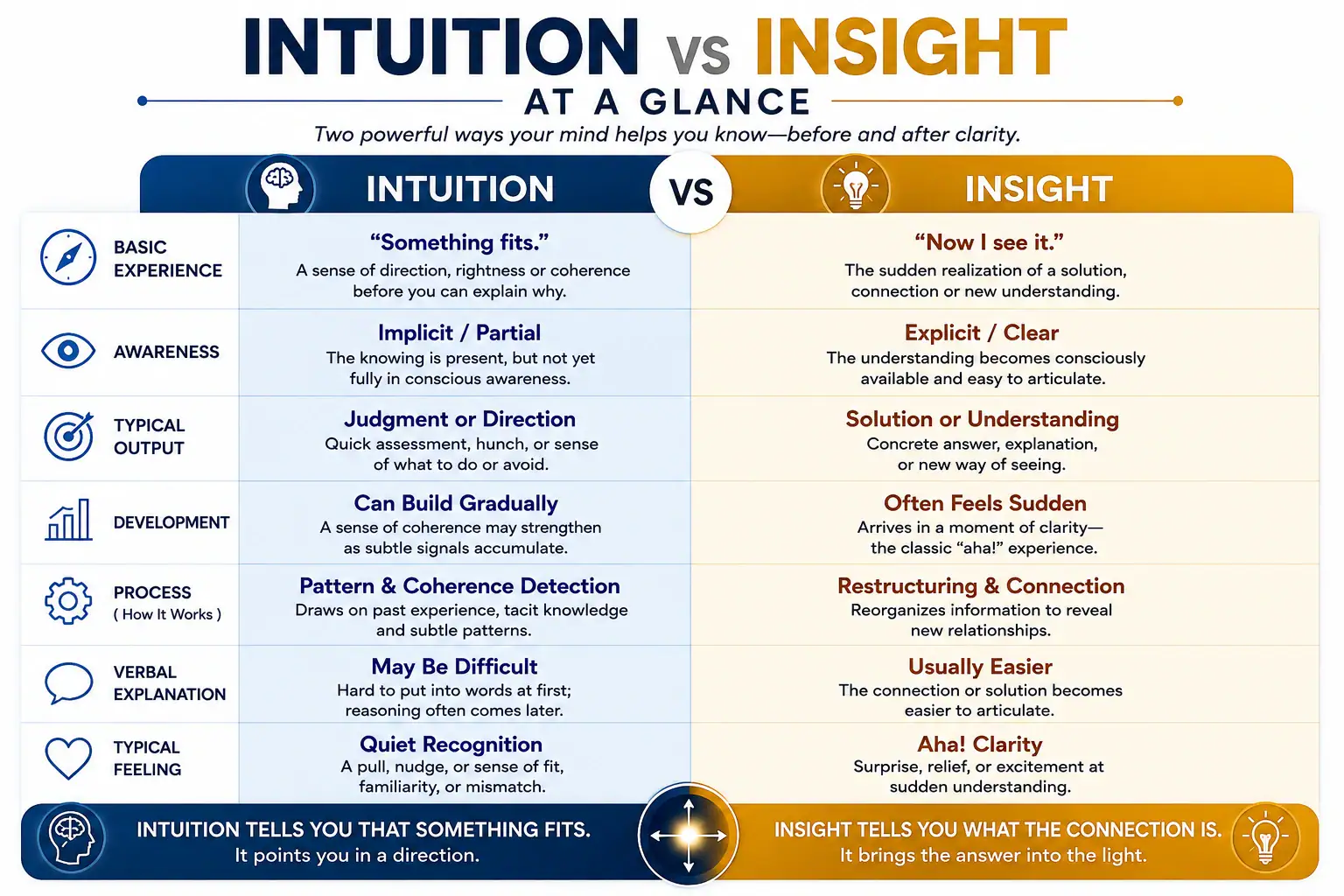
| Dimension | Intuition | Insight |
|---|---|---|
| Basic experience | “Something fits” or “something is off.” | “Now I see the connection.” |
| Awareness | The basis may remain partly implicit. | The solution or relationship becomes explicit. |
| Typical output | Judgment, direction, fit, mismatch. | Solution, connection, explanation, reframing. |
| Subjective timing | Can build gradually even if noticed suddenly. | Often experienced as a sudden “aha.” |
| Verbal explanation | May initially be difficult. | The relevant connection is more consciously available. |
| Accuracy | Can be useful or biased. | Can be correct or mistaken. |
What Is Intuition?
Intuition is not simply “a random feeling.” In cognitive research, intuition is often discussed as a form of non-analytical judgment that draws on patterns, prior experience, tacit knowledge, affective information, and context without requiring a consciously accessible chain of reasoning at the moment the judgment appears.
One influential experimental approach uses coherence judgments. People are exposed to information containing hidden relationships and can sometimes sense that the material is coherent before they can explicitly identify the relationship. That is close to the experience many people describe as “I cannot explain it yet, but something fits.”
This makes intuition closely related to intuitive processing, intuitive thinking, and intuitive reasoning, but it should not be treated as a synonym for any one of them. Intuition is better understood as a family of judgments and experiences that arise with limited conscious access to how they were formed.
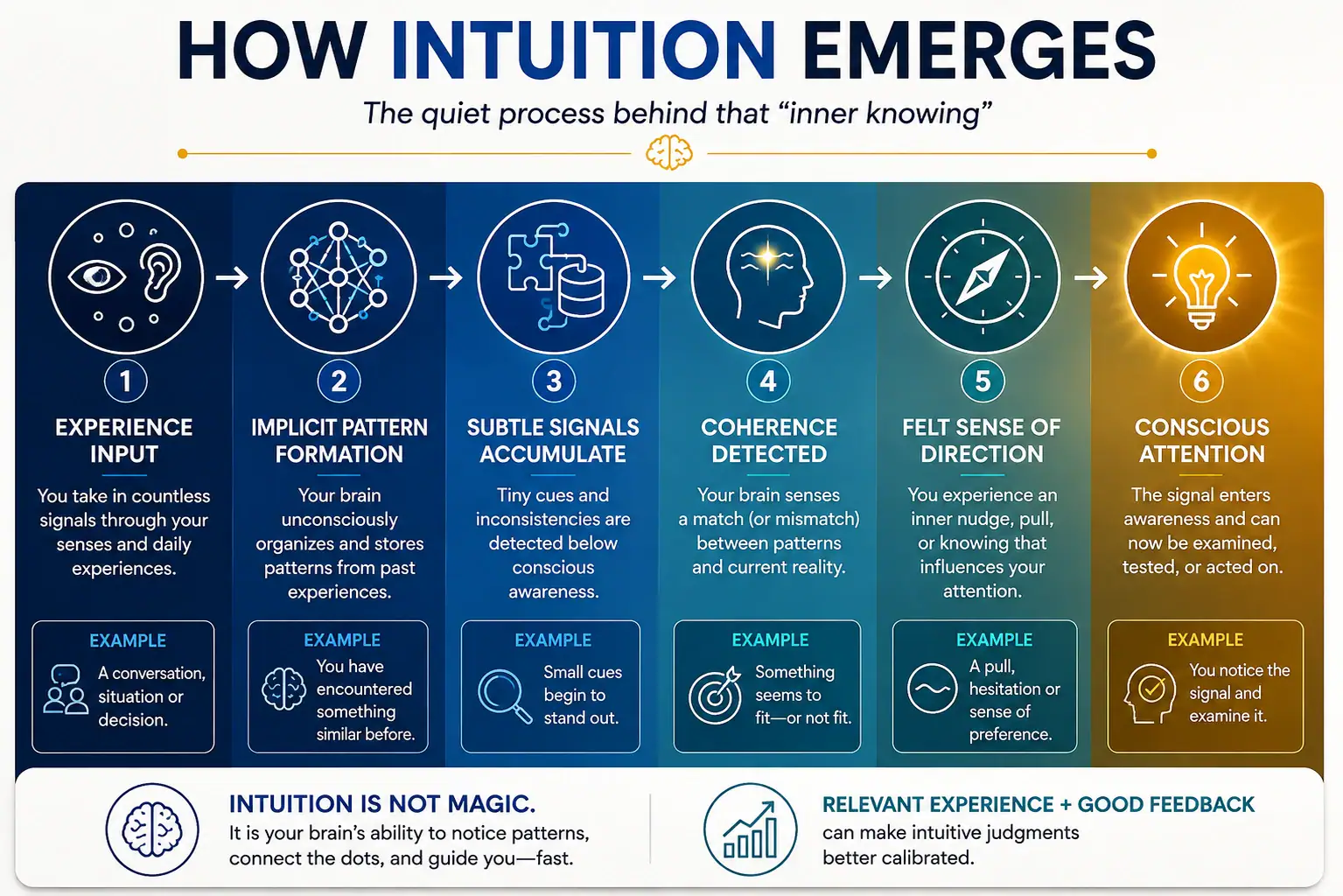
Why intuition can feel immediate
By the time an intuitive signal reaches awareness, much of the relevant processing may already have occurred. You notice the result—a pull, hesitation, sense of fit, familiarity, mismatch, or direction—without seeing every intermediate step. This is one reason intuition can feel instantaneous even when it depends on learning accumulated over months or years.
Experience matters, but experience is not enough
Repeated exposure can make pattern recognition faster, but experience does not automatically make every intuition accurate. If the environment is noisy, feedback is poor, or a person repeatedly learns the wrong association, confidence can grow without calibration. A better rule is: relevant experience plus meaningful feedback can improve intuitive judgment. This is why intuition should be evaluated in context rather than treated as a universal inner truth detector.
What Is Insight?
Insight is the experience of suddenly seeing a relationship, solution, or new interpretation that was not previously available in conscious thought. The classic subjective signature is the “aha” experience: a transition from not seeing how the pieces fit to experiencing the answer as newly clear.
Research on insight often focuses on restructuring—changing how a problem is represented so that previously hidden relationships become accessible. A 2024 review in Nature Reviews Psychology stresses an important nuance: restructuring and the subjective “aha” experience are related, but they should not be treated as identical. People can report an aha experience without the same measurable restructuring pattern, and restructuring processes can also occur without a dramatic aha feeling.
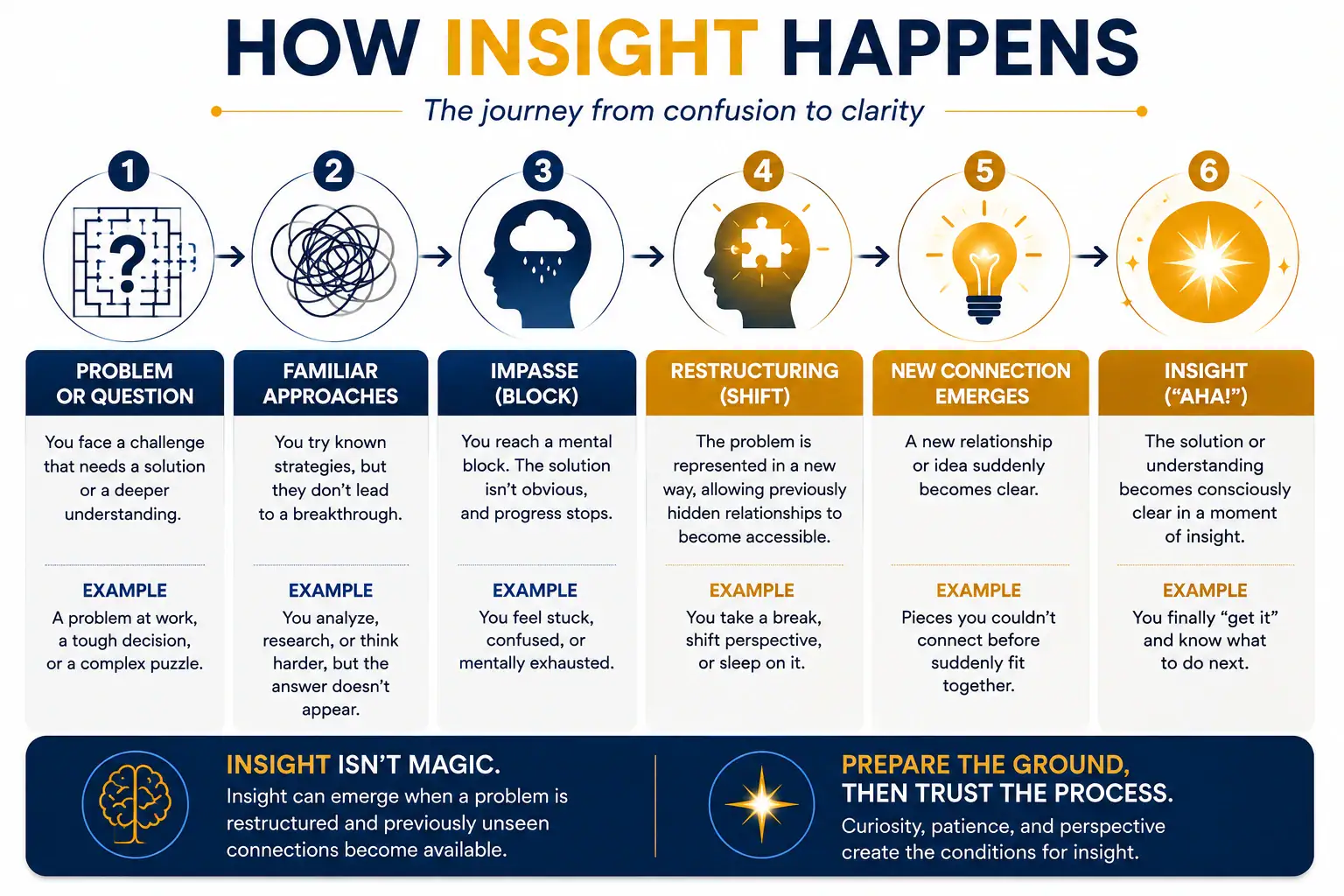
Does insight always require an impasse?
No. The popular story is problem → stuck → sudden breakthrough, and impasse is important in many classic insight theories. But empirical work does not support making impasse a mandatory step in every insightful solution. Some insights follow a period of being stuck; others emerge without a clear subjective block. The more defensible claim is that insight often involves a change in representation or access to a relationship that was not consciously available before.
7 Key Differences Between Intuition and Insight
1. Intuition senses coherence; insight reveals a connection
The cleanest distinction is between judgment and solution access. Intuition may tell you that an idea is coherent, a situation is unusual, or a direction deserves attention. Insight makes a relationship more explicit: you see what the connection is, what the solution might be, or how the problem should be represented differently.
Imagine reviewing a project plan. An intuitive response might be: “The forecast feels too optimistic.” An insight might be: “All three growth assumptions depend on the same untested customer behavior.” The first detects possible incoherence. The second articulates the structure that could explain it.
2. Intuition can remain implicit; insight becomes explicit
An intuitive judgment can influence attention or choice before its basis is consciously reportable. Insight, by definition, moves something important into conscious understanding. You may still lack a complete explanation of every underlying mechanism, but the central relationship or solution becomes available enough to recognize and often to describe.
3. Intuition can build gradually; insight often feels sudden
One of the most useful findings from the intuition–insight literature is that subjective suddenness and underlying processing are not the same thing. Intuition can emerge as weak coherence that becomes stronger as signals accumulate. Insight is commonly experienced as discontinuous—a sudden shift into clarity—even if processing was developing before the moment you noticed the answer.
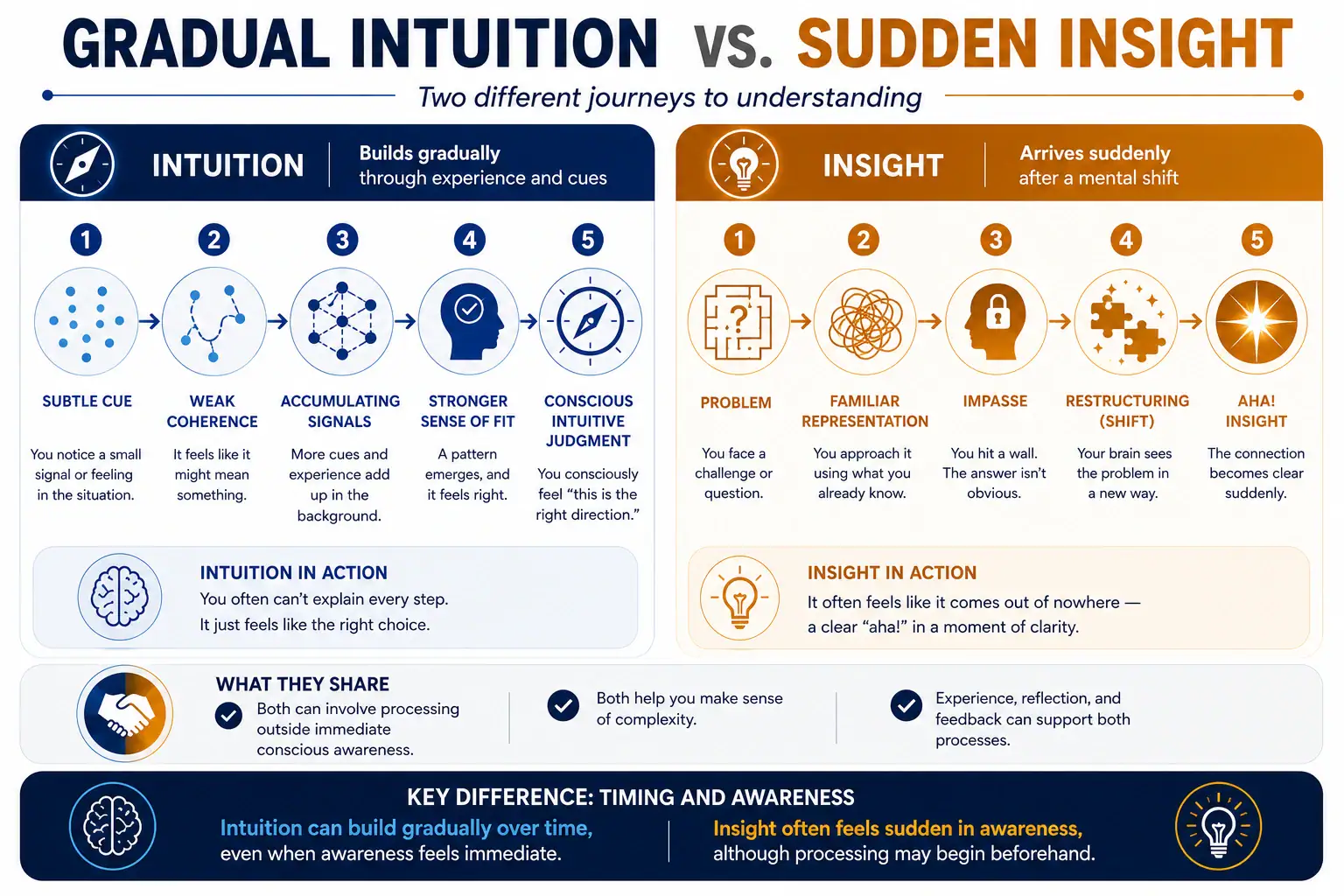
4. Intuition often gives direction; insight gives understanding
Intuition is especially relevant to judgments: approach or avoid, continue or stop, coherent or incoherent, promising or doubtful. Insight is more naturally associated with understanding: a new relationship, a solution, a reframing, or a previously unseen structure.
This does not mean intuition never contains content or insight never affects action. The difference is one of emphasis. Intuition frequently narrows attention toward what may matter; insight makes more of that structure consciously available.
5. Experience supports the two processes differently
Intuition often becomes more useful when a person has extensive exposure to recurring patterns and receives feedback that allows those patterns to be calibrated. Insight also depends on prior knowledge, but it may require reorganizing that knowledge rather than merely recognizing a familiar configuration. Sometimes what you already know helps; sometimes an entrenched representation is exactly what must change.
6. They feel different
People commonly describe intuition as a quiet nudge, pull, hesitation, bodily signal, sense of familiarity, or unexplained fit. Insight is more often described as clarity, surprise, release, or the feeling that the pieces have suddenly clicked together. These phenomenological differences are useful clues, but they are not proof of accuracy.
7. Neither intuition nor insight guarantees truth
This is the most important practical difference between feeling certain and being correct: there is no shortcut around verification. Intuition can be shaped by expertise, but also by bias, emotion, incomplete information, or misleading feedback. Insight can reveal a powerful new explanation, but aha experiences can accompany incorrect solutions too.
If you want a deeper look at failure modes, see when intuition is wrong. The practical principle is simple: use subjective clarity as information, not as proof.
Can Intuition Lead to Insight?
Sometimes, yes. This is one of the most interesting points in the research. A person may first develop a vague sense that a pattern exists without being able to retrieve the solution. Continued attention, additional information, or a change in representation may then make the underlying relationship explicit.
Zander and colleagues describe a continuity account in which intuitive coherence can function as a precursor to later insight. But the literature also contains discontinuity models in which insight requires overcoming an initially misleading representation. The safest conclusion is therefore not that intuition always becomes insight, but that intuition can sometimes be an early stage in a process that later produces explicit understanding.
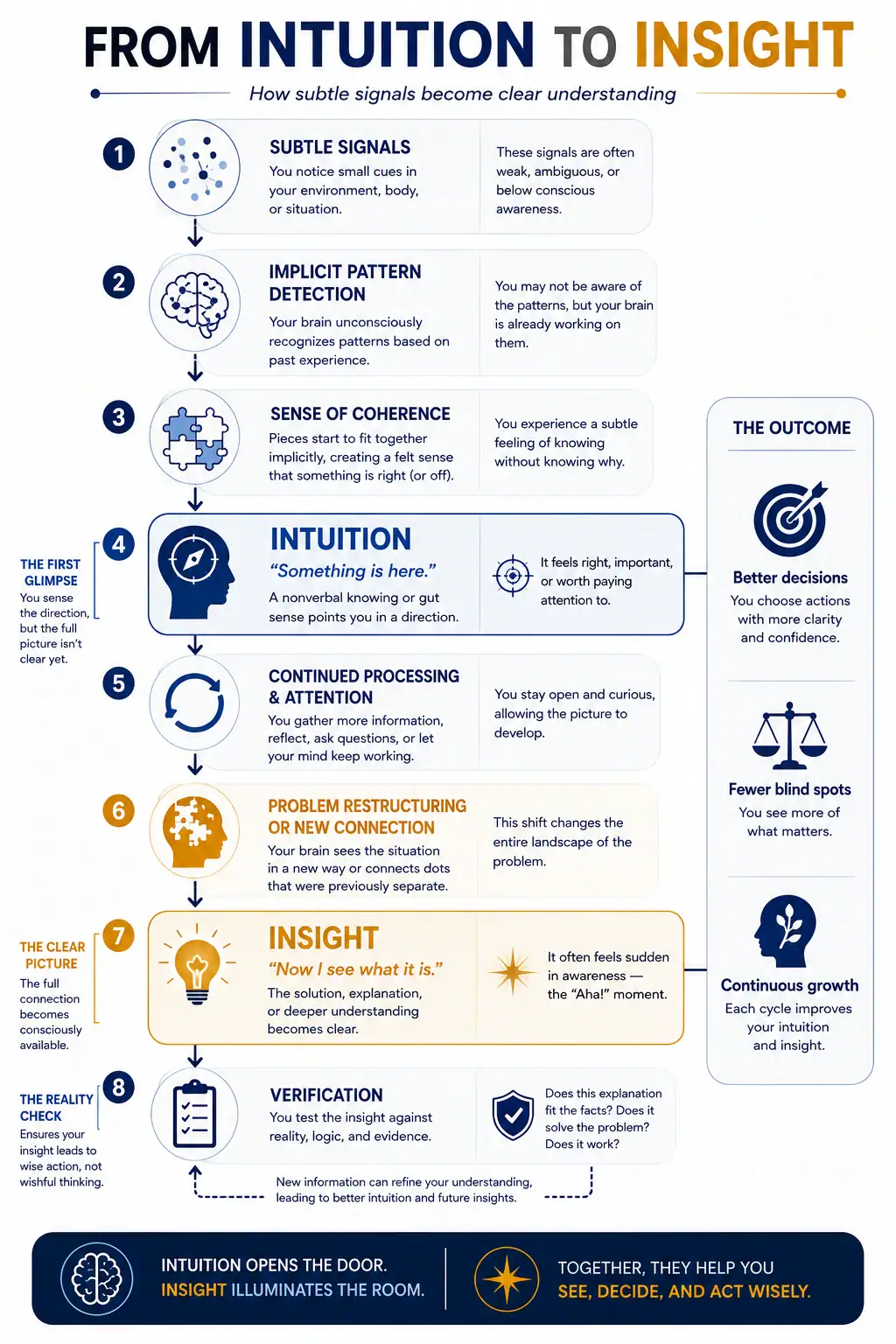
A useful practical sequence is:
- Signal: something attracts attention.
- Coherence: you sense fit, mismatch, or direction.
- Intuition: a judgment forms before the full reason is explicit.
- Exploration: you gather information, reflect, or keep the problem active.
- Restructuring: the situation is represented in a new way.
- Insight: a connection or solution becomes consciously clear.
- Verification: you test whether the explanation survives contact with evidence.
Intuition and Insight Examples
Example 1: Hiring
Intuition: “Something about this candidate stands out.”
Insight: “They consistently reframe ambiguous questions before answering, which is why their responses feel unusually strong.”
Example 2: Strategy
Intuition: “This plan is more fragile than it looks.”
Insight: “The sales, retention, and expansion assumptions all depend on the same behavior, so the apparent diversification is not real.”
Example 3: Writing
Intuition: “The article does not flow.”
Insight: “The introduction promises one question, but the body spends most of its time answering another.”
Example 4: Relationships
Intuition: “Something in this interaction feels inconsistent.”
Insight: “The tone changes specifically whenever commitment is discussed.”
In relationships, intuitive signals deserve particular caution because anxiety, expectation, projection, and past learning can all influence interpretation. The distinction between intuition or anxiety is therefore often more useful than simply asking whether a feeling is strong.
Example 5: Design
Intuition: “This interface feels harder than it should.”
Insight: “The user is being asked to switch between two different mental models on every screen.”
Example 6: A puzzle
Intuition: “These elements probably belong together.”
Insight: “They form the missing relationship that solves the puzzle.”
What Happens in the Brain During Intuition and Insight?
There is no established single “intuition center” in the brain. Research instead points toward distributed processing whose details vary with the task. A 2014 MEG study of intuitive coherence judgments implicated the orbitofrontal cortex, while broader accounts discuss interactions involving the anterior insula, anterior cingulate, basal ganglia, hippocampal and entorhinal systems, emotion-related structures, and other regions. A 2025 neurodynamical perspective on intuition explicitly treats it as coordinated activity across multiple systems rather than the output of one isolated location.
That distributed framing also fits what intuition has to accomplish: memory contributes prior patterns; sensory and contextual information supplies current signals; affective and bodily information can change salience; attention determines what receives more processing; and conscious integration makes some judgments reportable. Different intuitive tasks—visual coherence, social judgment, expert recognition, or uncertainty—need not recruit the same network in exactly the same way.
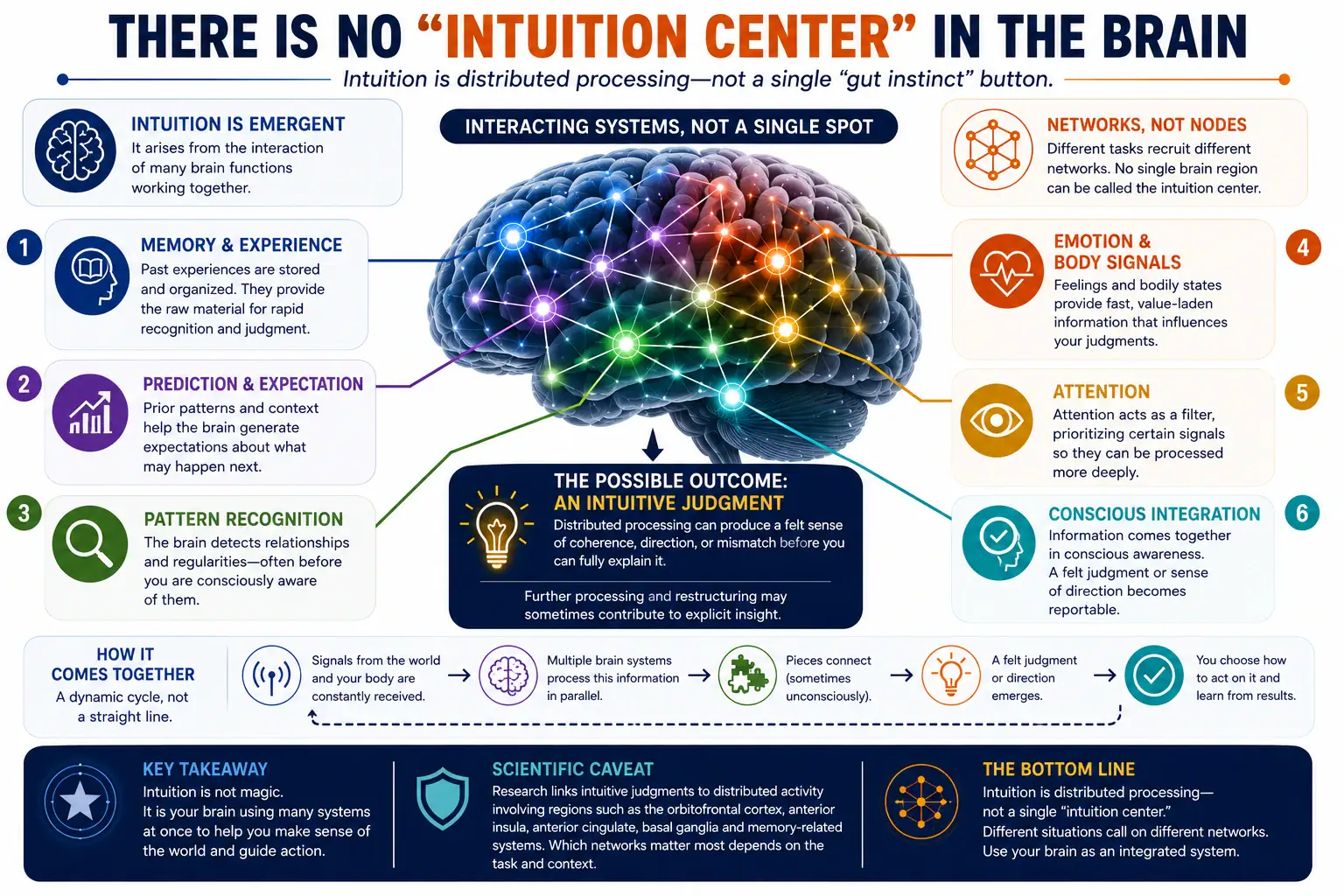
Insight also appears to involve distributed networks. Research on restructuring has identified activity across frontal, temporal, parietal, insular, and basal-ganglia regions, with proposed interactions between default-mode, executive-control, and salience-related systems. The exact neural story remains an active research area, which is why simplistic claims such as “intuition comes from the right brain” or “insight lives in one region” should be avoided.
Intuition, Insight, Instinct, and Gut Feeling Are Not the Same
Everyday language often mixes these terms together, but separating them improves decision clarity.
| Term | Useful working distinction |
|---|---|
| Intuition | A rapid sense of coherence, relevance, direction, or mismatch with limited conscious access to its basis. |
| Insight | A solution, relationship, or new representation becoming consciously clear. |
| Instinct | A biologically prepared response tendency, not simply learned pattern recognition. |
| Gut feeling | The subjective bodily or affective experience that may accompany an intuitive judgment. |
For deeper comparisons, see intuition vs instinct, intuition vs gut feeling, and intuition vs heuristics. The broader overview of types of intuition can also help place these experiences in context.
How to Tell Whether You Are Experiencing Intuition or Insight
You do not need to label every mental event perfectly. The goal is to notice what kind of information you actually have.
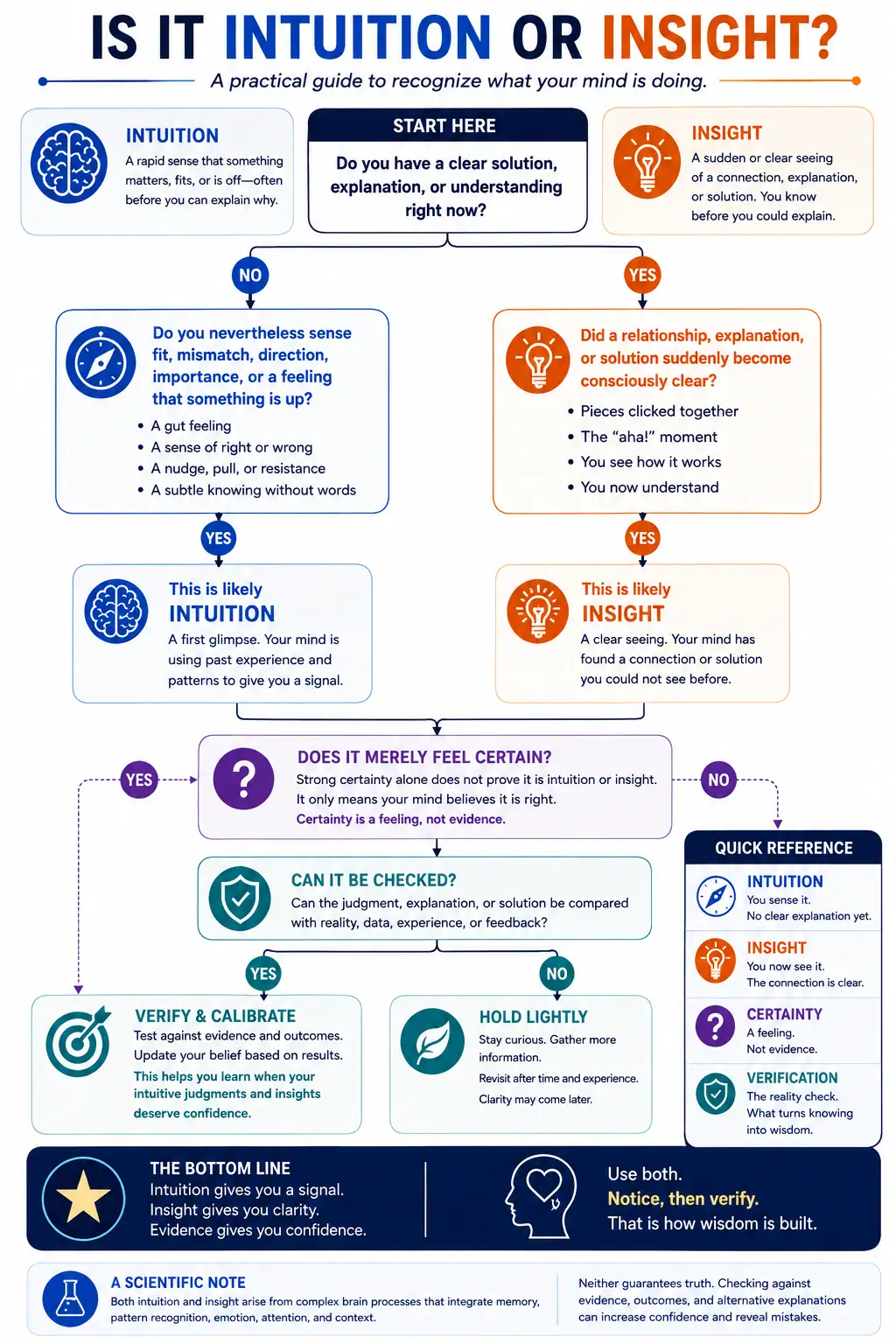
Ask four questions
- Do I have a clear solution or explanation? If not, but you still sense fit, mismatch, direction, or importance, the experience may be primarily intuitive.
- Did a relationship or solution become consciously clear? If yes, the experience is closer to insight.
- Am I treating certainty as evidence? Strong confidence can accompany both correct and incorrect judgments.
- Can I check it? Compare the judgment or explanation with data, outcomes, alternative explanations, and reality.
A useful rule is: intuition gives you a signal; insight gives you a clearer representation; evidence helps determine how much confidence either deserves.
Which Should You Trust: Intuition or Insight?
Neither deserves unconditional trust. The better question is what role should this mental event play in the next decision?
Give intuition more weight when
- you have substantial, relevant experience in a pattern-rich environment;
- you have received meaningful feedback on similar judgments;
- the situation resembles conditions in which that experience was learned;
- time is limited and the cost of a preliminary judgment is manageable;
- you can still verify the intuition before making an irreversible commitment.
Give insight more attention when
- it reveals a concrete relationship you can articulate;
- the new representation explains previously confusing evidence;
- it generates testable predictions;
- it survives comparison with plausible alternative explanations.
Use deliberate analysis when
- stakes are high or consequences are difficult to reverse;
- the environment is unfamiliar;
- reliable data can be gathered;
- strong incentives, fear, wishful thinking, or social pressure could distort judgment;
- multiple competing explanations remain plausible.
The goal is not to choose intuition instead of analysis. In high-quality intuition in decision-making, an intuitive signal can guide attention while deliberate reasoning tests what deserves action.
A Practical Intuition → Insight → Verification Model
A useful way to combine the concepts is to treat them as different stages of inquiry rather than competing authorities. The following is an Intuition Management practical model, not a standardized scientific taxonomy.
1. Detect
Notice what attracts attention: a mismatch, sense of fit, hesitation, pattern, or unexpected ease. Do not force an explanation yet.
2. Hold
Avoid the two common extremes: immediately obeying the signal or immediately dismissing it. Treat it as information worth examining.
3. Explore
Ask what pattern could have produced the feeling. Gather missing information. Compare the current situation with previous cases. Look for disconfirming evidence as actively as confirming evidence.
4. Restructure
If the problem remains confusing, change the representation. What assumption are you treating as fixed? What would the situation look like from another perspective? Which pieces have you been considering separately that may belong together?
5. Recognize insight
A possible explanation becomes explicit. You can now state the relationship rather than merely feeling that something matters.
6. Verify
Check whether the insight explains the evidence, improves prediction, survives alternative interpretations, and leads to outcomes consistent with the explanation. Verification does not create certainty, but it can reveal mistakes and improve calibration.
7. Update
Use the result to refine your internal model. If the intuition was useful, ask what cues it may have detected. If it was misleading, ask what bias, emotional state, or false pattern created the signal. This turns experience into better future judgment rather than simply stronger confidence.
This approach connects naturally with mental models in decision-making: intuition can flag a discrepancy between your internal model and the current situation, while insight can help you revise the model explicitly.
Frequently Asked Questions
Is intuition the same as insight?
No. They overlap, but a useful distinction is that intuition is a judgment or sense of coherence whose basis may not yet be fully conscious, while insight is the conscious emergence of a solution, relationship, or new representation.
Does intuition come before insight?
Sometimes. Some models treat intuitive coherence as a possible precursor to later insight, but not every intuition becomes insight and not every insight has an obvious intuitive stage.
What is an intuitive insight?
In everyday language, “intuitive insight” usually means an understanding that arrives with little visible step-by-step reasoning. For precision, it helps to separate the earlier intuitive sense from the later moment when the connection becomes explicit.
Is an “aha” moment intuition or insight?
It is usually closer to insight because the central feature is sudden conscious clarity. However, an aha feeling is a subjective experience and does not by itself prove that the solution is correct.
Which is faster: intuition or insight?
The question is misleading because conscious timing is not the same as underlying processing time. Intuition can feel immediate while drawing on long-learned patterns. Insight can feel sudden even when the problem has been processed for some time before the aha moment.
Can intuition and insight both be wrong?
Yes. Intuitive judgments can reflect bias or misleading patterns, and insight can produce a compelling but incorrect explanation. Confidence and sudden clarity are signals about your mental state, not guarantees about reality.
The Bottom Line
The difference between intuition and insight becomes clearer when you stop asking which one is “better.” They do different jobs. Intuition can tell you that something deserves attention before you can fully explain why. Insight makes a relationship, solution, or new understanding consciously available.
Sometimes intuition and insight form a sequence: weak coherence becomes a felt judgment, continued processing changes the representation, and a connection becomes explicit. Other times they occur separately. Neither should be treated as infallible.
The most useful stance is therefore not blind trust and not reflexive skepticism. Notice the signal. Explore the pattern. Recognize the insight. Then verify what deserves confidence.
Research Sources
- Zhang, Z., Lei, Y., & Li, H. (2016). Approaching the Distinction between Intuition and Insight. Frontiers in Psychology, 7, 1195.
- Zander, T., Öllinger, M., & Volz, K. G. (2016). Intuition and Insight: Two Processes That Build on Each Other or Fundamentally Differ? Frontiers in Psychology, 7, 1395.
- Wiley, J., & Danek, A. H. (2024). Restructuring Processes and Aha! Experiences in Insight Problem Solving. Nature Reviews Psychology, 3, 42–55.
- Horr, N. K., Braun, C., & Volz, K. G. (2014). Feeling Before Knowing Why: The Role of the Orbitofrontal Cortex in Intuitive Judgments—an MEG Study. Cognitive, Affective, & Behavioral Neuroscience, 14, 1271–1285.
- Kotler, S., Mannino, M., Friston, K., Buzsáki, G., Kelso, J. A. S., & Dumas, G. (2025). Pathfinding: a neurodynamical account of intuition. Communications Biology, 8, 1214. Perspective. https://doi.org/10.1038/s42003-025-08612-9.
- Stuyck, H., Aben, B., Cleeremans, A., & Van den Bussche, E. (2021). The Aha! Moment: Is Insight a Different Form of Problem Solving? Consciousness and Cognition, 90, 103055.