Intuition and gut feeling overlap, but they are not exactly the same thing. Intuition is the broader process of reaching a judgment without consciously reasoning through every step. A gut feeling is a bodily or visceral signal—a knot in your stomach, a sense of ease, a sudden “yes,” or the feeling that something is off—that may carry information into conscious awareness.
So a gut feeling can be intuitive. But not every sensation in your gut is reliable intuition. Stress, fear, fatigue, expectation, emotion, learned associations, and cognitive bias can all create strong bodily signals too. The useful question is not simply, “Do I feel something?” It is: what might this signal be telling me, and what else could explain it?

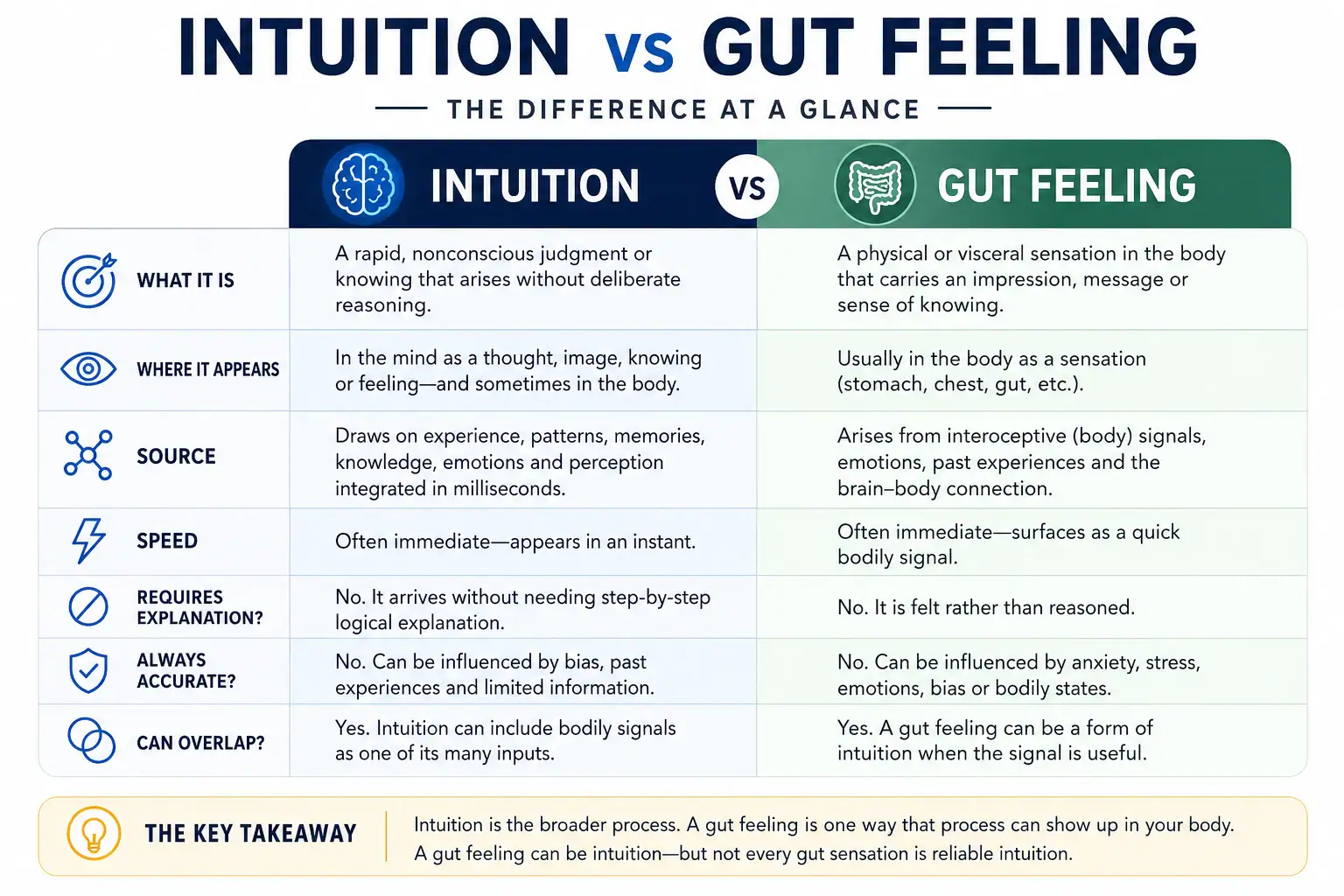
Intuition vs Gut Feeling: The Difference at a Glance
The everyday words are often used interchangeably, and even scientific writing sometimes treats “gut feeling” as a shorthand for intuitive judgment. A useful distinction, however, is to separate the process from one of the ways that process may be felt.
| Intuition | Gut feeling | |
|---|---|---|
| What it is | A rapid judgment or sense of knowing that emerges without deliberate step-by-step reasoning. | A bodily or visceral sensation that carries an impression, warning, preference, or sense of knowing. |
| Where it appears | As a thought, image, feeling, sense of certainty, or bodily signal. | Usually as a physical sensation: stomach tension, warmth, butterflies, heaviness, ease, or another internal cue. |
| Main inputs | Experience, memory, pattern recognition, emotion, context, perception, and learned expectations. | Interoceptive body signals, emotions, physiological state, prior learning, and brain–body communication. |
| Speed | Often rapid. | Often rapid. |
| Always accurate? | No. | No. |
| Can they overlap? | Yes. Intuition can include bodily information. | Yes. A gut feeling can be one expression of intuitive processing. |
What Is Intuition?
Intuition is commonly described as a judgment that arrives quickly and without a consciously accessible chain of reasoning. You may know what you think before you can explain exactly why you think it.
A 2026 study of how people understand intuition in health decisions describes intuition as a fast and automatic form of cognitive processing. Participants also tended to treat it as one source of information among several rather than as an infallible inner authority. See the 2026 study on intuition and “gut-feeling” in health decision-making.
One important route to intuition is pattern recognition. With repeated exposure to a domain, the brain can become sensitive to regularities that are difficult to verbalize. A skilled practitioner may notice that a situation “doesn’t fit” before consciously identifying the clue that triggered the impression. This is why experience matters so much to what is sometimes called expert intuition.
That does not mean intuition is mysterious. It means conscious explanation can lag behind processing. Our guide to intuitive thinking explores this fast form of cognition in more depth, while what intuition really is examines how pattern recognition operates under uncertainty.
It is also useful to remember that intuition is not one single sensation. As explained in our guide to the types of intuition, intuitive information may appear cognitively, emotionally, socially, creatively, or somatically.
What Is a Gut Feeling?
A gut feeling is a felt sense in the body that seems to carry meaning. People describe a tight stomach, nausea, butterflies, warmth, a sinking feeling, openness, tension in the chest or throat, or simply a physical sense of “yes” or “no.” The phrase does not necessarily mean the signal originates only in the digestive tract.
The scientific concept most relevant here is interoception: the nervous system’s sensing and interpretation of internal bodily states. Modern research treats interoception as a body–brain process involving information from many internal organs, including the gastrointestinal system. A 2026 review in Neuron describes intestinal interoception as part of body–brain feedback loops that help generate physiological and behavioral adaptations. Read the 2026 review of intestinal interoception.
Research on gut–brain communication also shows that signals from the gastrointestinal system can influence processes relevant to mood, emotion, motivation, beliefs, memory, and decision-making. This does not mean the gut independently “knows the truth.” It means internal body information is part of the larger stream of information the brain uses to regulate behavior and interpret situations. See the review of the biology of gut–brain communication.
This is why somatic intuition matters. Sometimes what people call intuition is experienced first as a body signal, before it becomes a fully formed conscious thought.
So, Is a Gut Feeling the Same as Intuition?
Sometimes, but not necessarily.
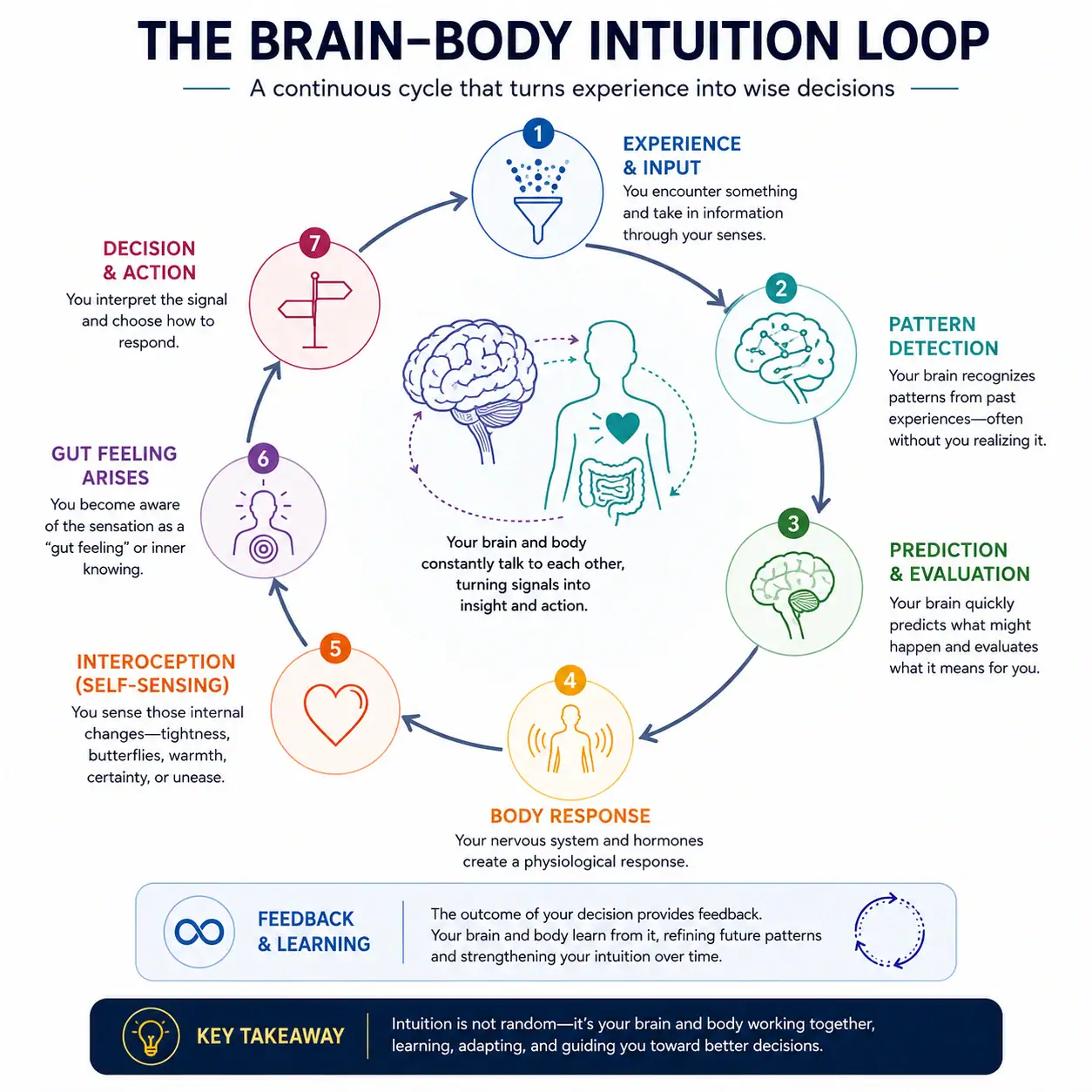
A gut feeling can be one channel through which intuitive processing becomes conscious. The broader process may begin with experience, sensory cues, memory, emotion, and rapid pattern detection. Those processes can trigger physiological changes. You notice the resulting body state and experience it as a gut feeling. Then you interpret what the feeling means.
That last step matters. The bodily sensation is real, but your interpretation of it can still be wrong.

Recent work on intuitive decision-making reinforces this overlap. A 2025 paper argues that intuitive decisions can involve different kinds of feelings about the quality or reliability of our own thinking. In other words, “gut feeling” is not a single biological message with one fixed meaning; it is part of a broader interaction between cognition, affect, bodily state, and judgment. See the 2025 paper on epistemic feelings in intuitive decision-making.
Why Does Intuition Sometimes Feel Physical?
Because the brain and body are in constant communication. Your nervous system does not wait for conscious thought before responding to what it predicts or detects. Changes in heart rate, breathing, muscle tension, digestion, arousal, and other physiological processes can begin before you have formed a verbal explanation.
You then sense some of those internal changes through interoception. The conscious experience may be “something feels wrong,” “I feel drawn to this,” or “I suddenly know I should slow down.”
Importantly, stronger body awareness does not automatically make intuition more accurate. In an experiment on interoception and intuitive decision-making, greater sensitivity to bodily signals could help or hinder performance depending on whether those anticipatory bodily signals were pointing toward advantageous or disadvantageous choices. Being able to feel your body more clearly is useful only if the signal itself is informative and interpreted well. Read the interoception and intuitive decision-making study.
What Does a Gut Feeling Feel Like?
There is no single physical signature of intuition. People may report:
- a knot or tightening in the stomach;
- butterflies or fluttering;
- a sinking sensation;
- nausea or sudden loss of appetite;
- warmth, openness, or ease;
- tension in the chest or throat;
- a sudden urge to approach, withdraw, wait, or check something;
- a quiet sense that something is “off” even when the reason is not yet obvious.
These sensations are meaningful in one important sense: they tell you that your body and brain are responding to something. But the sensation alone does not reveal the cause.
If you want to explore the phenomenology in more detail, see what intuition feels like and our guide to the experience that something feels off.
One Sensation Can Have Multiple Possible Sources
This is the most important reason not to treat every gut feeling as a command. A tight stomach in a meeting could reflect useful pattern recognition—but it could also reflect anxiety, lack of sleep, hunger, a previous bad experience, a stereotype, anger, excitement, or a learned association.
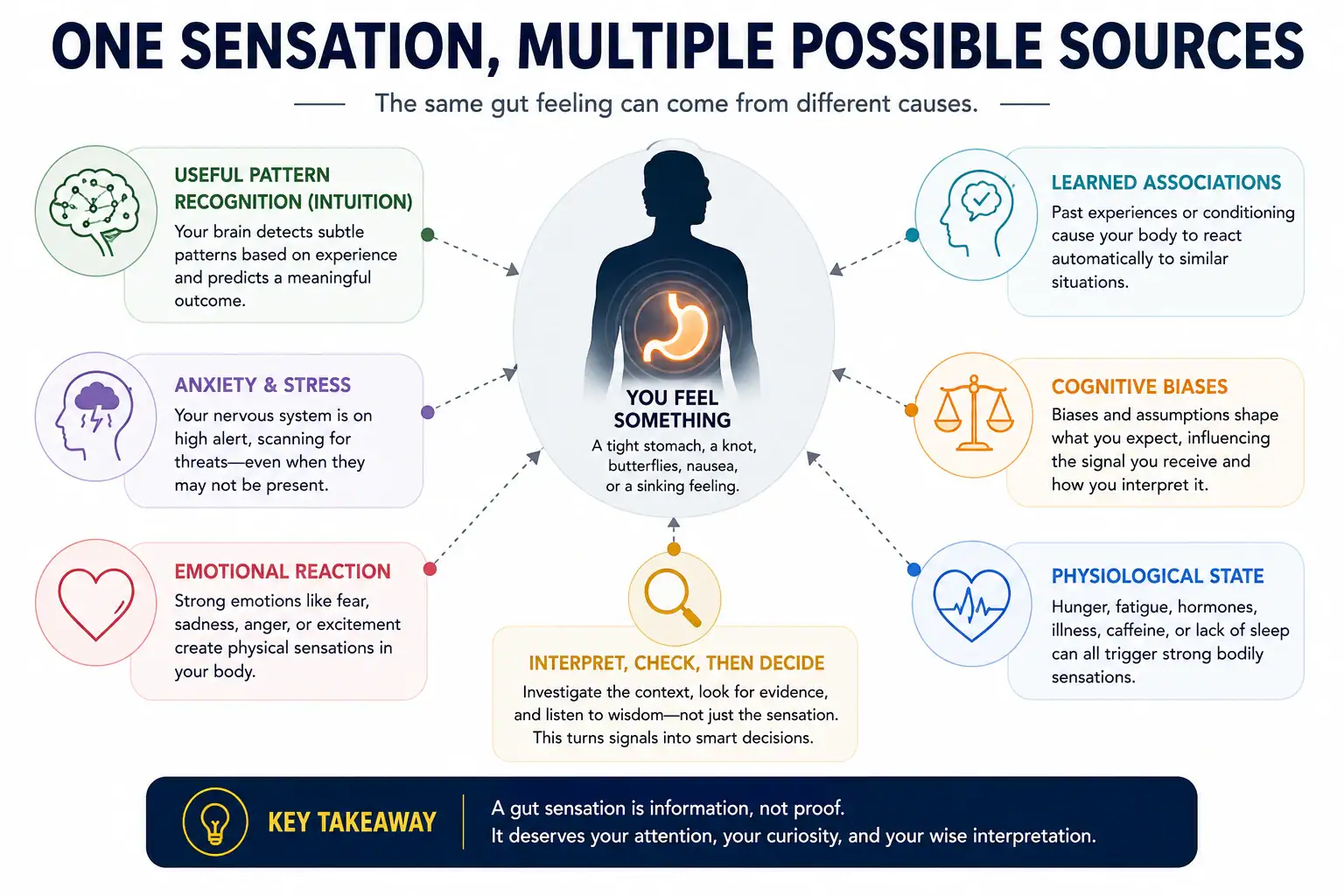
That is why the simplistic rule “intuition feels calm, anxiety feels urgent” is unreliable. Anxiety can be quiet. Intuition can arrive strongly. A useful signal can occur while you are stressed, and a calm sense of certainty can still be shaped by bias.
If anxiety is the main question, use the dedicated comparison in gut feeling or anxiety or the deeper guide to intuition vs anxiety.
Gut Feeling vs Instinct vs Intuition
These three terms are related but useful to separate:
- Instinct usually refers to biologically prepared tendencies or responses.
- Gut feeling refers to a bodily or visceral impression that seems meaningful.
- Intuition is the broader rapid judgment process that can draw on experience, patterns, emotions, perception, and bodily information.
A single moment can involve all three, but they are not synonyms. For the deeper distinction between biologically prepared responses and learned pattern recognition, see intuition vs instinct.
When Should You Trust a Gut Feeling?
A gut feeling deserves more weight when the conditions make useful pattern recognition more plausible. Confidence should generally increase when:
- You have relevant experience. You have repeatedly encountered similar situations and received feedback about what happened.
- The environment contains learnable patterns. There are recurring cues rather than pure randomness.
- You can identify at least some supporting observations. After the initial feeling, you can point to concrete details that may have triggered it.
- The signal remains after initial arousal settles. This does not prove accuracy, but it helps separate a transient spike from a more stable judgment.
- You know your common biases and triggers. Calibration improves when you understand the situations in which your interpretation is systematically distorted.
- The cost of testing is low. When possible, take a small reversible step before making a high-stakes commitment.
Clinical research provides a useful real-world example: practitioners’ gut feelings can contribute to reasoning by prompting further evaluation, rather than functioning as proof on their own. See research on gut feelings in general-practice diagnosis.
When You Should Not Trust Your Gut Automatically
Be more cautious when:
- you have little or no experience in the domain;
- the outcome is mostly random or the environment rarely gives clear feedback;
- you are highly sleep-deprived, hungry, overstimulated, intoxicated, or physically unwell;
- fear, anger, attraction, urgency, or wishful thinking is unusually intense;
- the judgment concerns a person or group where stereotypes may be operating;
- you are seeking confirmation for something you already want to believe;
- the decision is high-stakes, irreversible, or easily checked with objective information.
Several existing guides can help with these failure modes: intuition vs bias, intuition vs wishful thinking, intuition vs impulse, and when intuition is wrong.
A Practical Act, Pause, or Verify Decision Tree
Instead of asking whether gut feelings are trustworthy in general, ask whether this particular signal, in this particular situation, deserves action.

The higher the stakes, the stronger the verification should be. You do not need to dismiss intuition in high-stakes decisions, but you should combine it with evidence, outside perspectives, and deliberate reasoning.
For more on applying intuition to choices, see intuition in decision-making. If you want to make intuitive judgments more reliable over time, the goal is not blind trust; it is calibration. Our guide on how to train your intuition explains how feedback and reflection can improve that process.
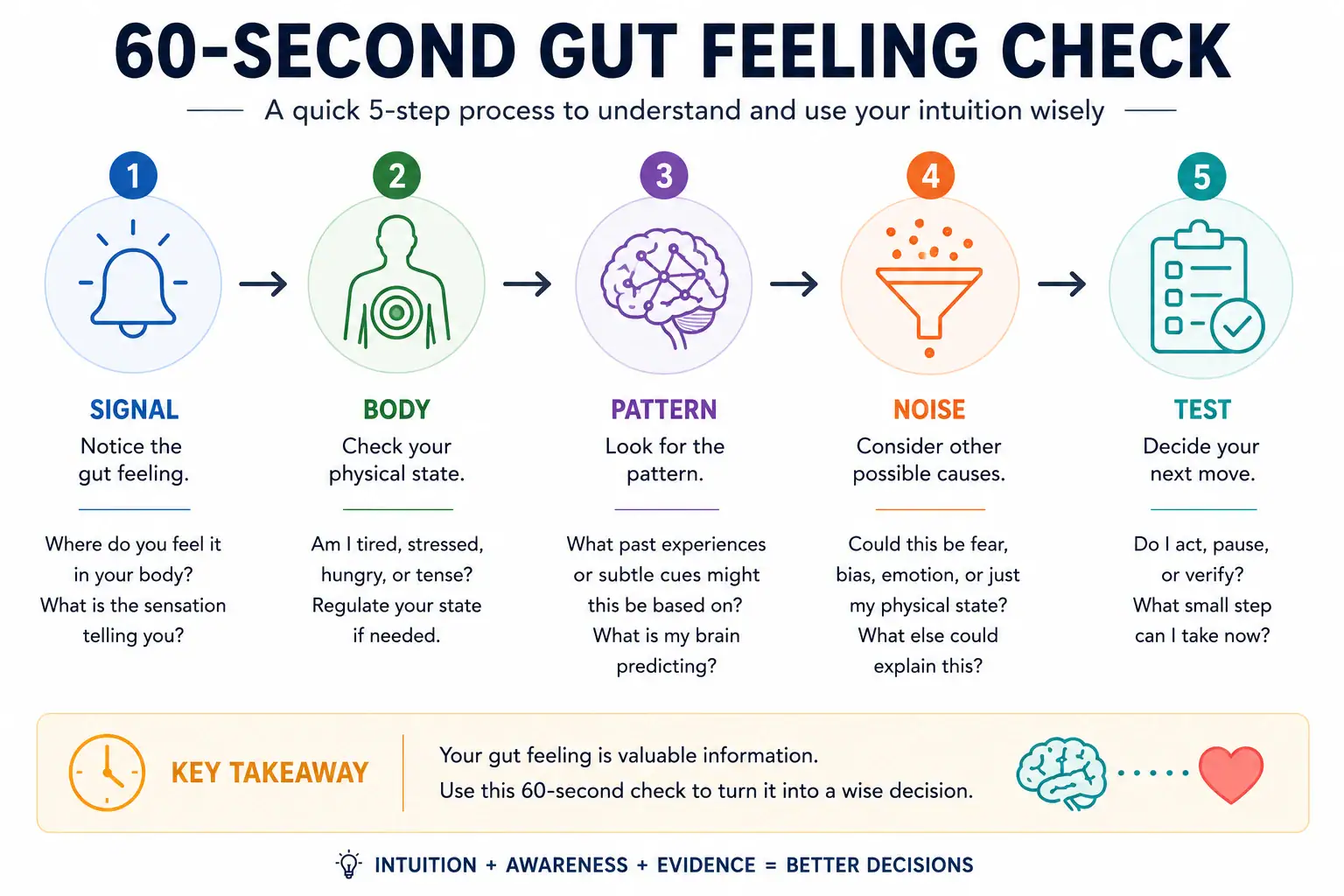
The 60-Second Gut Feeling Check
When a gut feeling appears, you do not always need a long analysis. A short structured check can help you distinguish potentially useful signal from noise.
1. Signal — What exactly am I noticing?
Name the sensation without immediately explaining it. “My stomach tightened when they changed the subject” is more useful than “I know they are lying.”
2. Body — What state am I in?
Check fatigue, hunger, stress, caffeine, tension, illness, excitement, and other factors that could change how your body feels.
3. Pattern — What might I have noticed?
Look for subtle cues, inconsistencies, familiar patterns, or previous experiences that could have produced the impression.
4. Noise — What else could explain it?
Consider anxiety, bias, wishful thinking, memory, emotion, learned associations, and assumptions.
5. Test — What is the smallest useful next step?
Act if the situation is low-risk and the signal is well grounded. Pause if your state is noisy. Verify when the stakes are high or the evidence is weak.
How to Make Gut Feelings More Useful Over Time
Intuition becomes more useful when it is connected to feedback rather than romanticized as a special gift. If you repeatedly make intuitive predictions and compare them with outcomes, you learn where your signals are strong and where they fail.
Try keeping a short intuition log. Before the outcome is known, write down:
- the situation;
- the gut feeling or intuitive judgment;
- what you think triggered it;
- your confidence level;
- what decision you made;
- what happened afterward.
After enough repetitions, patterns become visible. You may discover that your intuition is strong in domains where you have deep experience and weak where you are emotionally invested. You may notice that a specific bodily sensation predicts useful caution—or that the same sensation mostly appears when you are tired.
That is calibration: learning the reliability of your own signal system instead of assuming every feeling is equally trustworthy.
The Bottom Line
Intuition is broader than a gut feeling. Intuition is a rapid, largely nonconscious way of integrating information and arriving at a judgment. A gut feeling is one way that information—or another bodily state—may reach awareness.
The body can contribute useful information to decisions, but physical intensity does not guarantee truth. A sensation may reflect pattern recognition, anxiety, emotion, learned associations, bias, or physiological state. The skill is not to obey every gut signal. It is to notice the signal, understand its possible sources, and decide how much evidence you need before acting.
Your gut feeling is a signal, not an order. Listen to it. Question it. Test it. Then decide.
Related comparisons: Intuition vs Instinct · Intuition vs Instinct vs Insight · Intuition vs Insight
Frequently Asked Questions
Is a gut feeling the same as intuition?
They overlap, but they are not identical. Intuition is the broader rapid judgment process. A gut feeling is a bodily or visceral sensation that can express intuition, but it can also arise from anxiety, emotion, learned associations, bias, or physical state.
Can your gut feeling be wrong?
Yes. Gut feelings can be useful, but they are not proof. Bodily signals can reflect accurate pattern recognition or misleading influences such as fear, stress, fatigue, stereotypes, wishful thinking, or incomplete information.
Why do I physically feel intuition in my stomach?
The nervous system constantly exchanges information between the brain and body. Interoception allows you to sense internal changes such as tension, nausea, warmth, heart rate, or other physiological responses. Those sensations can become part of your conscious interpretation of a situation.
How do I know if a gut feeling is anxiety?
No single sensation reliably separates the two. Look at context, your current stress level, your history in similar situations, the presence of observable cues, and whether alternative explanations fit. If the decision matters, verify rather than relying on the feeling alone.
Should I trust my gut when making a decision?
Give a gut feeling more weight when you have relevant experience, the environment contains learnable patterns, and you can connect the signal to meaningful cues. Use stronger verification when the situation is unfamiliar, emotionally charged, high-stakes, or easy to check objectively.
Is intuition scientifically real?
Research supports rapid, automatic judgment, expert pattern recognition, interoception, and body–brain influences on decision-making. Science does not support the idea that intuition is always correct or that every gut sensation contains hidden truth. The evidence is more consistent with intuition as a fallible but potentially useful information-processing system.
Research Behind This Guide
This guide uses “intuition” and “gut feeling” as overlapping but distinguishable concepts rather than treating either as supernatural. Key research consulted includes:
- Lay beliefs about intuition in health decision-making contexts (2026)
- More than gut feelings? A functional perspective on epistemic feelings in intuitive decision-making processes (2025)
- Intestinal interoception: A nexus of environment-body-brain interactions (2026)
- Gut Signals and Gut Feelings: Science at the Interface of Data and Beliefs
- Gut feelings: the emerging biology of gut–brain communication
- Listening to your heart: how interoception shapes emotion experience and intuitive decision making