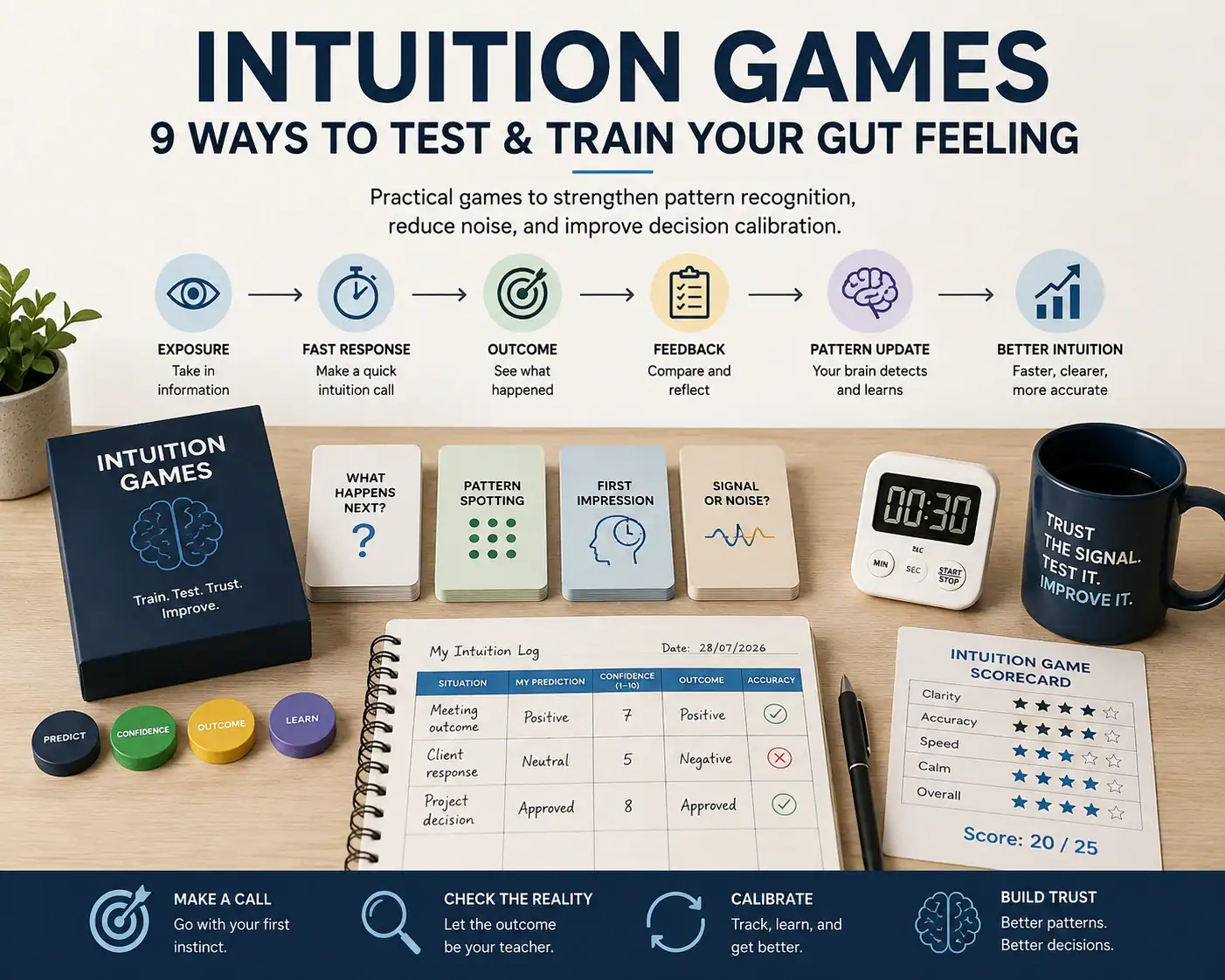
Intuition games are short exercises. They reveal fast judgments. They help you notice snap decisions. They help you predict outcomes and compare them with reality. They also help identify which internal signals are useful. With practice, you gain clearer judgments.
The goal is not to prove every gut feeling is right. It is to make intuition more observable, testable, and better calibrated. This framing keeps confidence aligned with reality. Over time, you learn which signals to trust.
That distinction matters. A strong feeling can come from experience, pattern recognition, anxiety, wishful thinking, habit, bias, or some combination of them. If you simply “trust your gut,” you never learn which signals deserve confidence. If you record the signal before the outcome and review what actually happened, intuition becomes something you can examine rather than romanticize.
This guide presents nine practical intuition games for adults. The guide explains what each one trains. It shows how to score your results. It ends with a seven-day challenge you can begin today.
Additionally, the broader training framework offers structure for practice and progress. It describes how to apply insights to daily decisions and long-term planning. This approach helps you develop steady, repeatable habits.
What Are Intuition Games?
An intuition game is a structured exercise in which you make a fast judgment or prediction before you know the answer, then compare that judgment with what actually happens. The useful part is not the feeling alone. It is the feedback loop.
A practical intuition game usually contains four elements:
- A cue: something in the situation catches your attention.
- A prediction: you record what you think will happen or what seems most likely.
- An observable outcome: reality gives you something you can check.
- Feedback: you compare the prediction with the outcome and update what you trust next time.
This is why intuition training is closer to skill calibration than to positive thinking. The question is not, “Did I feel certain?” It is, “Was the signal useful, and under what conditions?”
That framing is consistent with research on intuitive expertise. Daniel Kahneman and Gary Klein argued that the quality of intuition depends heavily on whether the environment contains learnable regularities and whether the person has enough opportunity to learn from outcomes. They also warned that subjective confidence by itself is not a reliable measure of accuracy. See the original review in American Psychologist via PubMed.
The Intuition Training Loop
The most useful way to think about intuition practice is as a loop rather than a leap of faith:
Exposure → Fast Response → Outcome → Feedback → Pattern Update → Better Intuition
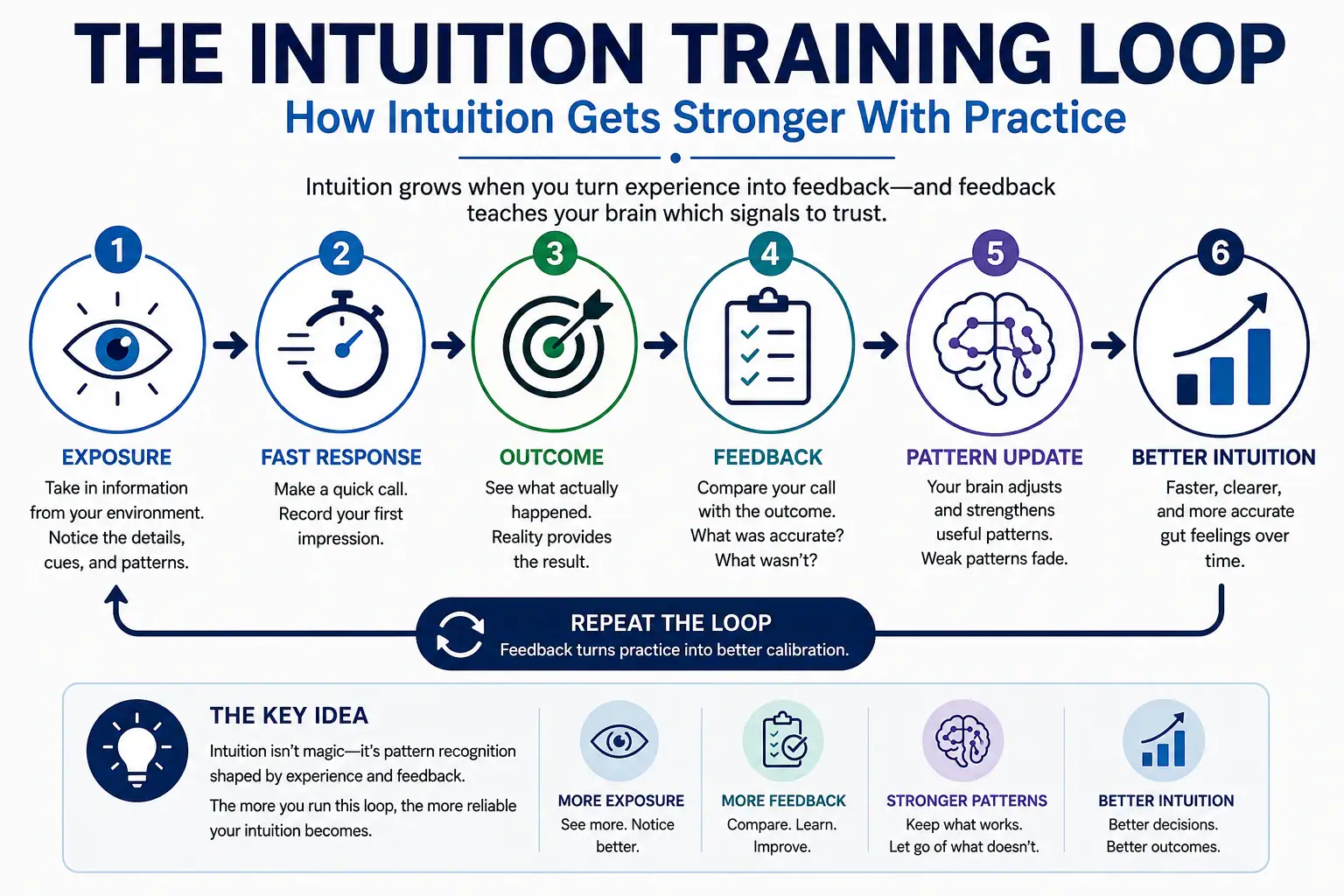
You encounter a situation. Your brain produces a quick impression. Reality reveals the result. You compare the two. With repeated experience and feedback, useful cues can become easier to recognize in familiar, learnable environments.
Experimental work has also found that intuitive, pattern-recognition-based decisions can be developed through implicit learning in simulated real-world environments. That does not mean intuition becomes infallible. It means that repeated exposure to meaningful structure can shape faster recognition. See Patterson and colleagues on training intuitive decision making.
Why familiar domains matter
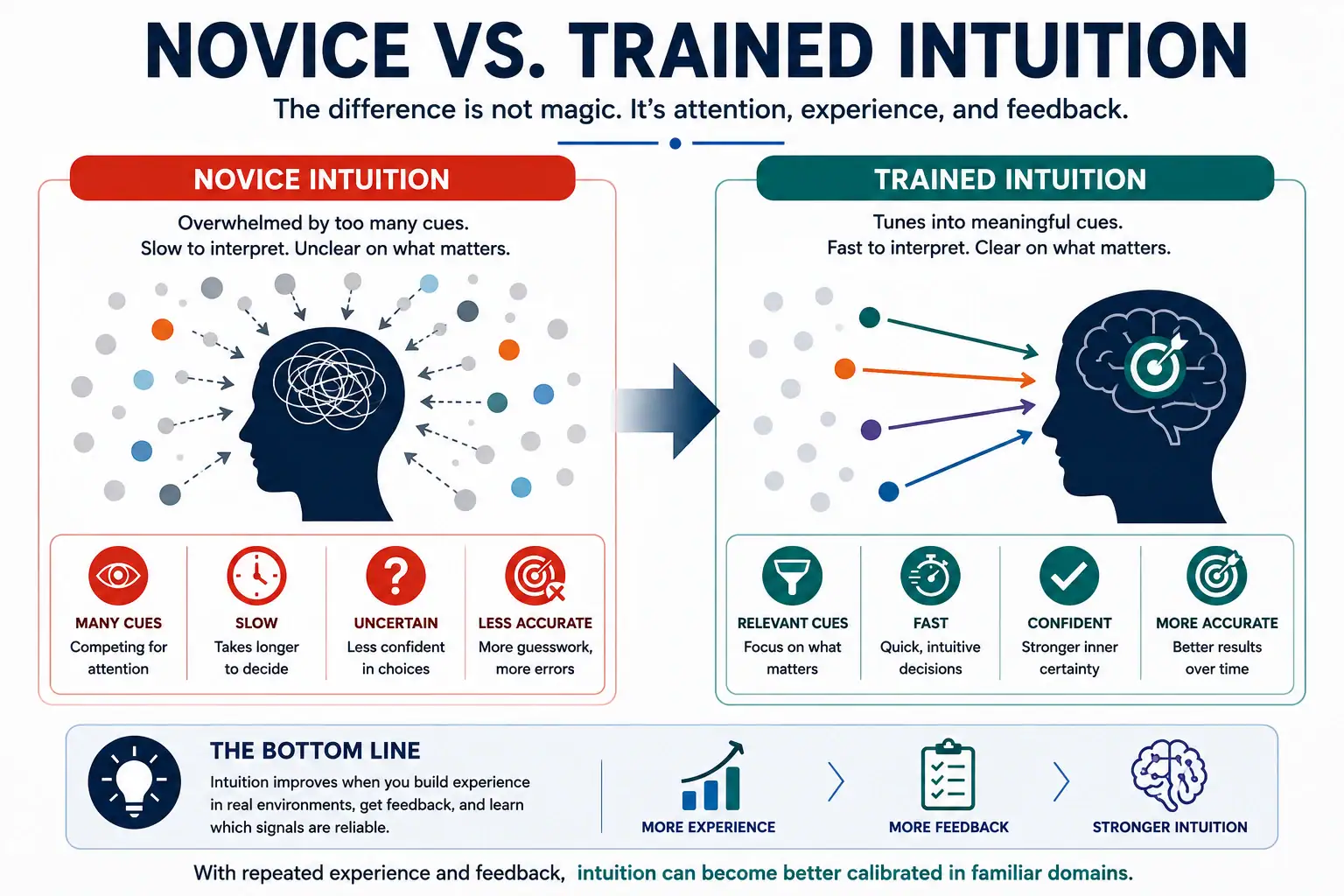
Intuition is often local rather than universal. Someone may have excellent intuitive judgment in product design, negotiation, medicine, sport, engineering, or leadership because they have seen thousands of relevant patterns. The same person may have poor intuition in a completely unfamiliar domain.
This is one reason to treat “good intuition” as calibrated expertise, not a personality trait.
9 Intuition Games to Test and Train Your Gut Feeling
1. The Three-Second Choice
Time: 2–5 minutes
What it trains: awareness of your first response
Take a small, low-stakes decision with two realistic options. Give yourself three seconds to choose, then write down your first answer before you explain it.
Afterward, analyze the decision normally. Ask:
- Did my deliberate analysis agree with my first response?
- If it changed, what information changed it?
- Was my first response based on a cue I can name?
The point is not to obey the first answer. The point is to capture it before reasoning rewrites the memory of what you initially sensed.
2. What Happens Next?
Time: 5 minutes
What it trains: prediction and pattern recognition
Choose a familiar situation whose outcome will become known soon: a meeting, customer response, project milestone, conversation, sport sequence, workflow, or routine decision.
Before the outcome is known, write:
- what you predict will happen;
- your confidence from 1 to 10;
- the cues that influenced the prediction.
When the result arrives, compare prediction and reality. This is more useful than saying “I knew it” afterward because the prediction existed before you saw the answer.
3. Pattern Spotting
Time: 5–10 minutes
What it trains: selective attention to meaningful cues
Look briefly at a situation you understand well: a dashboard, customer message, design, workflow, set of numbers, meeting dynamic, or familiar environment. Then look away and write down:
- what stood out first;
- what seemed unusual;
- what cue you think matters most;
- what you expect to happen next.
Return to the information and check whether the cue really was meaningful. Over time, this exercise can reveal whether your attention is drawn to useful patterns or merely vivid details.
For the underlying idea, read what intuition really is: pattern recognition under uncertainty.
4. First Impression vs. Evidence
Time: 10 minutes
What it trains: separating an initial read from confirmation bias
When you form a first impression about a proposal, conversation, plan, email, or situation, write it down in one sentence. Then make two columns:
- Evidence that supports the impression
- Evidence that challenges the impression
Do not try to “prove” your intuition. Try to test it. If the initial read survives genuine counterevidence, confidence can increase. If it does not, update it.
This is also a practical way to distinguish intuition from cognitive shortcuts. See intuition vs. bias for a deeper comparison.
5. Signal or Noise?
Time: 5 minutes
What it trains: discrimination between useful cues and internal interference
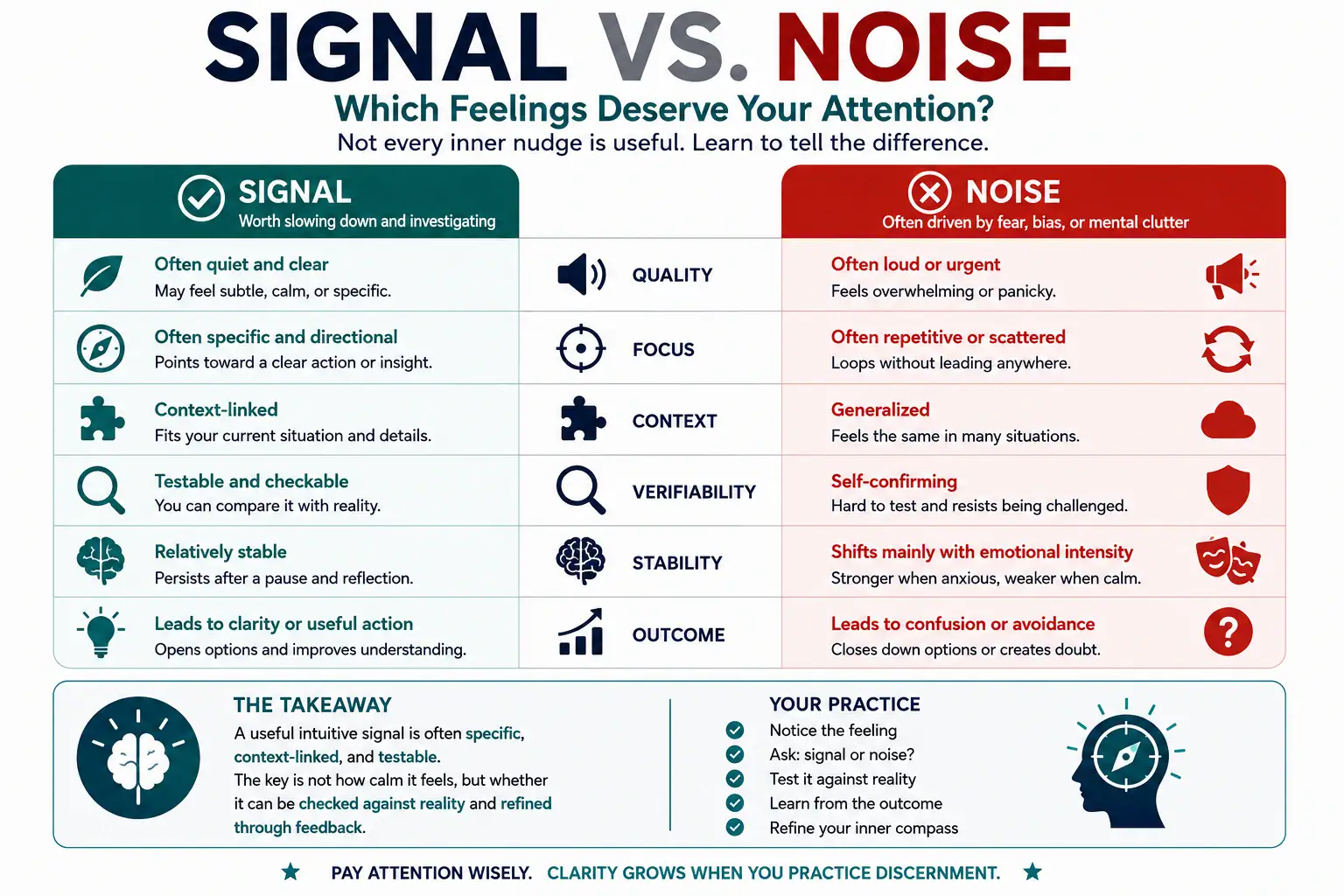
Pick one strong feeling about a current situation. Instead of asking whether it is “intuition,” ask questions that can be checked:
- Is the feeling specific to this situation or generalized across many situations?
- Can I identify what cue may have triggered it?
- Does it remain coherent after a short pause?
- Can I test it against reality?
- Would I accept evidence that proves it wrong?
A useful signal does not have to feel calm, and an anxious feeling is not automatically wrong. What matters is whether the signal is connected to context, open to testing, and capable of being refined through feedback.
Signal vs. Noise: Which Feelings Deserve Your Attention?
If you want to practice this distinction interactively, use the Signal vs. Noise Simulator.
6. The Prediction Journal
Time: 3 minutes per prediction
What it trains: calibration
This is the most important game in the article because it creates a record that memory cannot quietly rewrite later.
Before an outcome, record:
- Prediction: What do I think will happen?
- Confidence: How confident am I from 1 to 10?
- Cues: What am I responding to?
- Outcome: What actually happened?
- Accuracy: Was the prediction accurate, partly accurate, or inaccurate?
- Learning: Which cues mattered, and which did not?
One correct prediction proves very little. What matters is the pattern across repeated predictions. If your 8/10 confidence judgments are often wrong while your 5/10 judgments are surprisingly accurate, your confidence scale needs recalibration.
How to Score Intuition Without Fooling Yourself
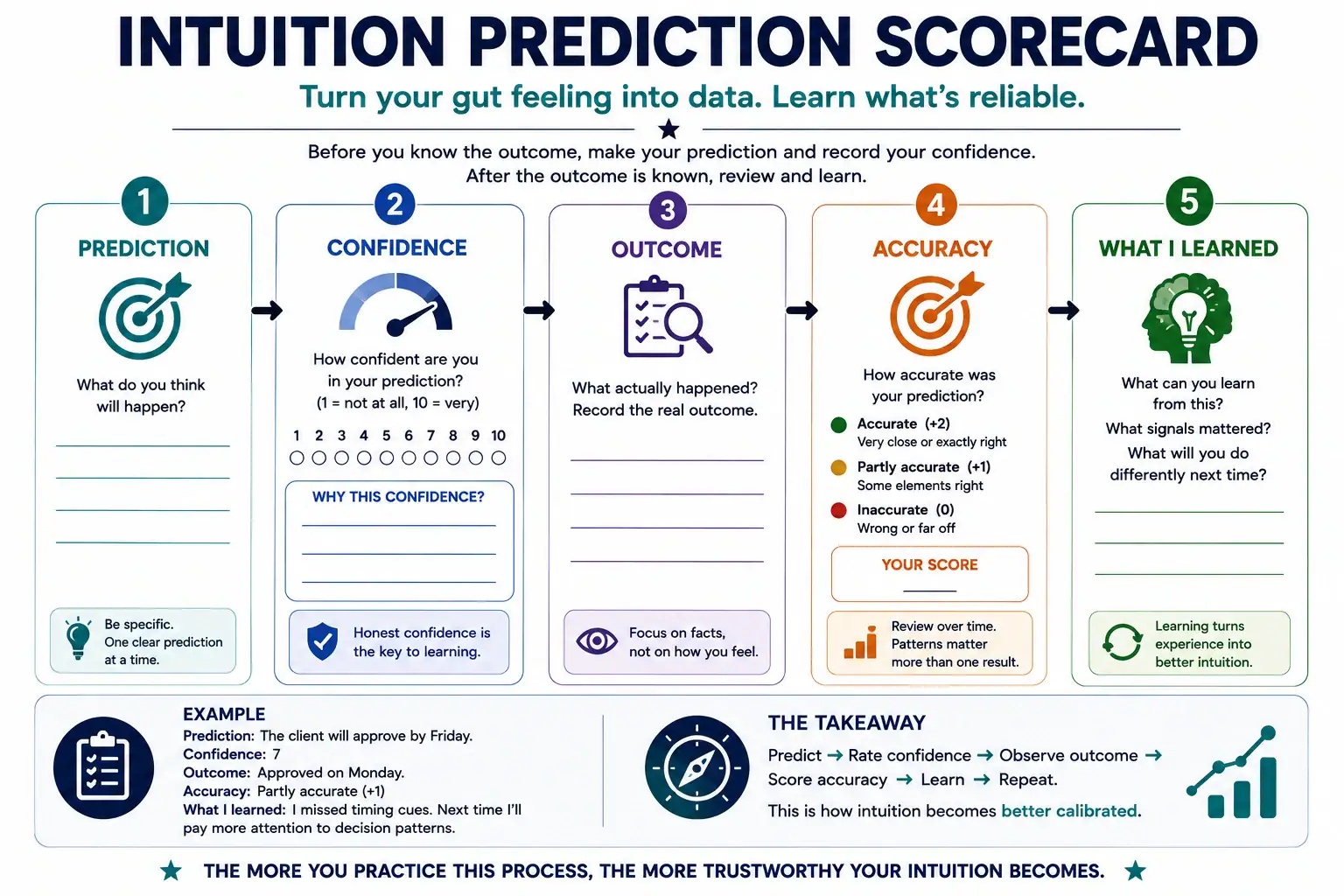
A simple scoring method is enough:
- Accurate: the main prediction was correct.
- Partly accurate: some important elements were right, but the outcome differed materially.
- Inaccurate: the prediction was wrong or too vague to be useful.
Avoid scoring vague claims such as “something will happen.” A prediction should be specific enough that a future version of you cannot reinterpret it to fit whatever occurred.
For a longer-term approach, see the intuition calibration program and templates.
7. The Two-Pass Decision Game
Time: 10–15 minutes
What it trains: knowing when intuition and analysis agree or disagree
Choose a meaningful but manageable decision.
- Pass one: record your immediate answer and the cues behind it.
- Pass two: analyze the problem deliberately using evidence, alternatives, risks, and trade-offs.
- Compare: did both methods produce the same answer? If not, what caused the difference?
The purpose is not to declare one mode superior. Sometimes intuition identifies what deserves attention; analysis then tests whether that impression survives scrutiny. Sometimes deliberate analysis corrects a compelling but biased first impression.
For a fuller decision framework, see intuition vs. logic.
8. The Expert Snapshot
Time: 5–10 minutes
What it trains: expertise-based cue recognition
This game works best in a domain you already know well.
Briefly inspect a realistic situation: a project dashboard, design, code review, market pattern, clinical case, negotiation setup, operational problem, or other familiar scenario. Give yourself a short time window and write down:
- your first diagnosis or judgment;
- the one or two cues that stood out;
- your confidence level.
Then inspect the situation normally and compare your fast judgment with a fuller analysis.
This exercise is useful because it tests intuition where there are actual patterns to learn. Research on intuitive expertise repeatedly emphasizes the importance of valid cues and meaningful feedback. Experience without good feedback can simply make a person more confident in the same mistakes.
9. The 24-Hour Calibration Game
Time: 2 minutes today, 2 minutes tomorrow
What it trains: feedback discipline
Choose one low-stakes prediction whose result should become clear within 24 hours. Write the prediction, confidence score, and cue. Then stop thinking about it.
When the result is known, answer three questions:
- Was I right?
- Which cue was I actually responding to?
- Would I trust the same cue more, less, or the same next time?
The final question is the important one. It turns an isolated outcome into a small update to your internal model.
Do Card-Guessing Games Really Train Intuition?
Card guessing, coin prediction, hidden symbols, and similar games are popular because they create an immediate reveal. That makes them feel like ideal intuition training. But there is an important distinction between training calibration and learning a meaningful pattern.
If the outcome is genuinely random, there is no stable cue connecting your impression to the next card or coin flip. You can still practice recording predictions honestly, rating confidence, and resisting hindsight bias. Those are useful habits. But repeated guessing in a random environment does not automatically build real-world intuitive expertise.
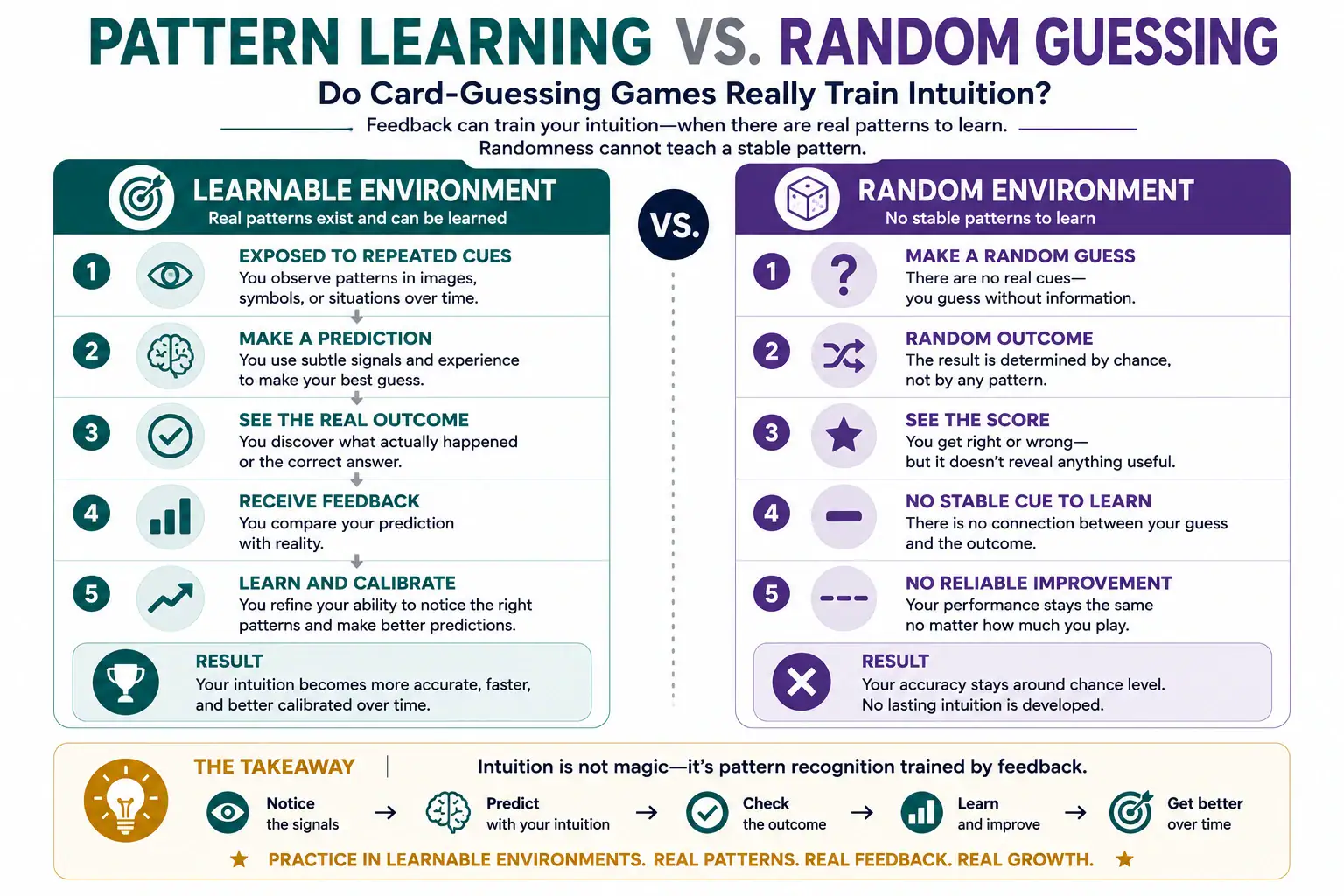
In a learnable environment, the loop looks like this:
Repeated cues → prediction → real outcome → feedback → pattern learning → better calibration
In a random environment:
Guess → random outcome → score → no stable cue to learn
This does not make random games useless. It simply changes what they can legitimately claim to train.
How Do You Know Whether Your Intuition Is Getting Better?
Improvement does not mean feeling more certain. In fact, better calibration can sometimes make you less certain because you become more aware of where your intuition is weak.
Look for changes such as:
- your predictions become more accurate in familiar domains;
- your confidence better matches your actual results;
- you identify misleading cues faster;
- you notice fewer dramatic “false alarms” that never lead anywhere;
- you update your first impression more easily when evidence contradicts it;
- you recognize the situations where intuition is useful and the situations where analysis should lead;
- you rely less on hindsight because you record judgments before outcomes.
That is a more useful definition of growth than simply “trusting yourself more.” The aim is not unconditional self-trust. It is a decision process you have reasons to trust.
For more daily practices beyond these games, see practical exercises to strengthen intuition every day.
The 7-Day Intuition Games Challenge
You do not need a month-long program to begin. Use one game per day for a week and keep the focus on observable outcomes.
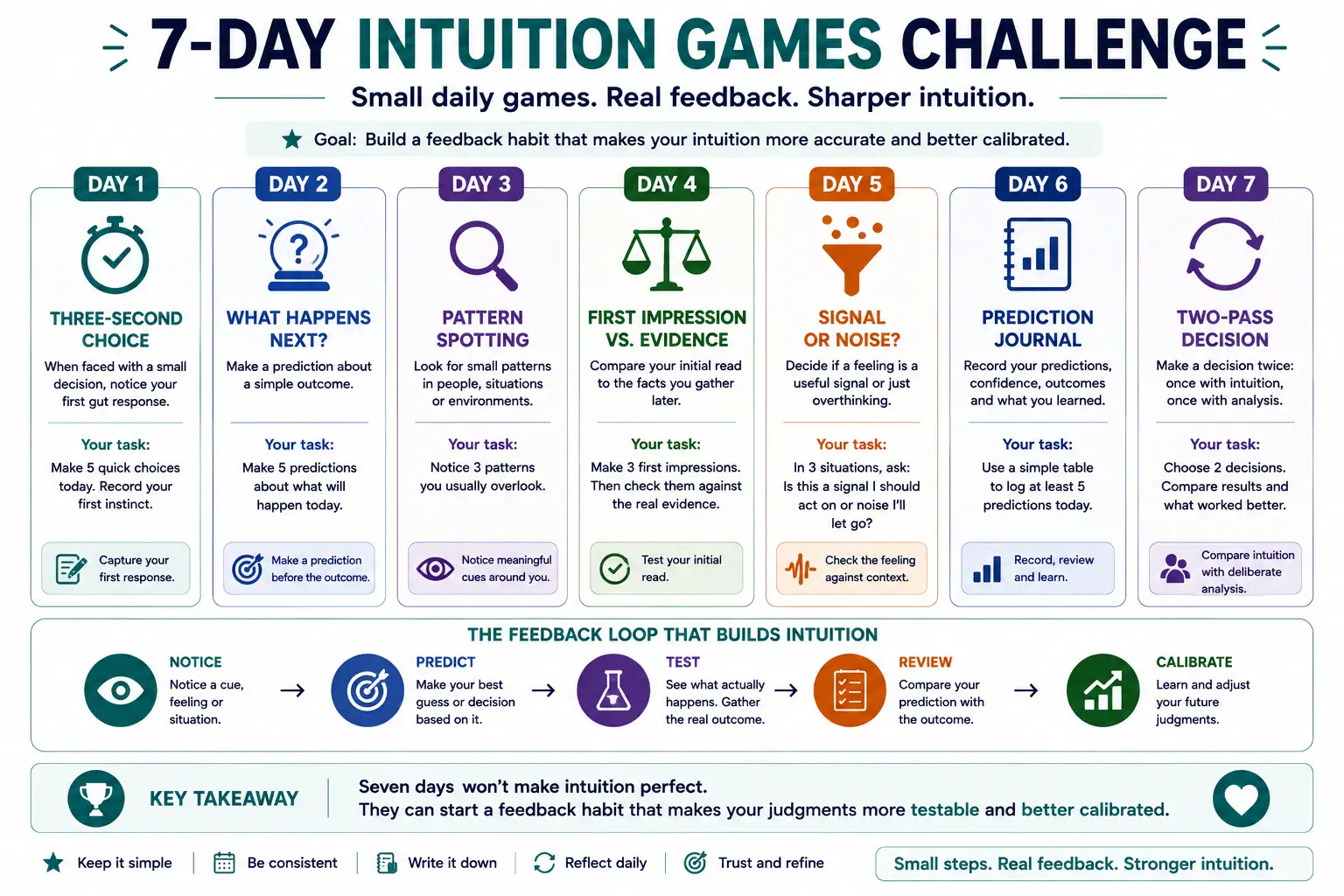
| Day | Game | Goal |
|---|---|---|
| 1 | Three-Second Choice | Capture the first response before explanation. |
| 2 | What Happens Next? | Make five small predictions before the outcomes. |
| 3 | Pattern Spotting | Notice three cues you normally overlook. |
| 4 | First Impression vs. Evidence | Test three initial reads against evidence. |
| 5 | Signal or Noise? | Check three feelings against context and reality. |
| 6 | Prediction Journal | Log at least five predictions with confidence scores. |
| 7 | Two-Pass Decision | Compare intuitive and deliberate reasoning on two decisions. |
At the end of the week, do not ask, “Am I intuitive?” Ask:
- Which kinds of situations produced my best predictions?
- Which cues were repeatedly useful?
- Where did confidence exceed accuracy?
- What should I test again?
The Rule That Makes Intuition Games Useful
Never score the feeling. Score the outcome.
A feeling can be vivid, calm, urgent, subtle, emotional, bodily, verbal, or difficult to explain. None of those qualities proves that it is correct.
The practical discipline is simple:
Notice → Predict → Record → Reveal → Review → Refine
That is how intuition becomes less about belief and more about learning.
Try an Interactive Intuition Game
If you want something shorter than a full practice session, try the Intuition Checkpoint. It is a quick decision-clarity game designed to help you separate overthinking, emotional friction, and a usable next signal.
You can also take the How Intuitive Are You? quiz for another way to explore your current decision style.
When you are ready to build a longer practice, continue with Your Intuition Journey.
Frequently Asked Questions About Intuition Games
What are intuition games?
Intuition games are structured exercises that ask you to make a fast judgment, prediction, or first impression before an outcome is known, then compare that judgment with reality. The most useful games include feedback so you can learn which cues are reliable.
Can intuition really be trained?
Some forms of intuitive judgment can improve through repeated experience, meaningful patterns, and feedback. Research on intuitive expertise suggests that learnable regularities and opportunities to learn from outcomes are important conditions. Training does not make intuition universally accurate.
What is the best intuition game for beginners?
The prediction journal is the best starting point because it is simple and measurable. Record one prediction, rate your confidence, wait for the outcome, and compare the two. Over time, the journal shows whether confidence and accuracy are actually aligned.
How can I test whether my intuition is accurate?
Record your intuitive judgment before you know the outcome. Make the prediction specific, rate confidence, and review the result later. Do this repeatedly in the same type of situation. A pattern across many predictions is more informative than one memorable hit or miss.
Are intuition games the same as psychic tests?
No. Intuition games can be designed around pattern recognition, first impressions, attention, prediction, and feedback without making paranormal claims. A practical intuition exercise focuses on how judgments perform against real outcomes.
Can card guessing improve intuition?
Card guessing can help you practice honest prediction logging, confidence scoring, and resisting hindsight bias. But if the cards are genuinely random, there is no stable environmental pattern to learn, so better performance should not be assumed to represent stronger real-world intuition.
How often should I practice intuition games?
Short, regular practice is more useful than occasional intense sessions. A few minutes a day is enough if the exercise includes a real outcome and a later review. Quality of feedback matters more than the number of guesses.
What is the difference between intuition and guessing?
Guessing can occur without meaningful cues. Skilled intuition is more likely to draw on experience, learned patterns, context, and rapid recognition. Because both can feel immediate, the difference is best tested through repeated outcomes rather than subjective certainty.
Final Takeaway
Intuition games are useful when they turn an invisible feeling into a visible learning process.
You notice a cue. You make a prediction. You record it before the answer is known. You compare it with reality. Then you update what you trust.
That process will not make every gut feeling correct. It can do something more valuable: help you learn where your intuition is strong, where it is noisy, and how to make it better calibrated over time.
Start small. Predict something real. Check the outcome. Learn from it. Repeat.
Research and Further Reading
- Kahneman D, Klein G. Conditions for intuitive expertise: a failure to disagree. American Psychologist. 2009.
- Patterson RE et al. Training intuitive decision making in a simulated real-world environment.
- Zander T et al. Intuitive decision making as a gradual process.