
Intuition vs heuristics sounds like a comparison between two kinds of fast thinking. That is partly true—but it misses the most important distinction.
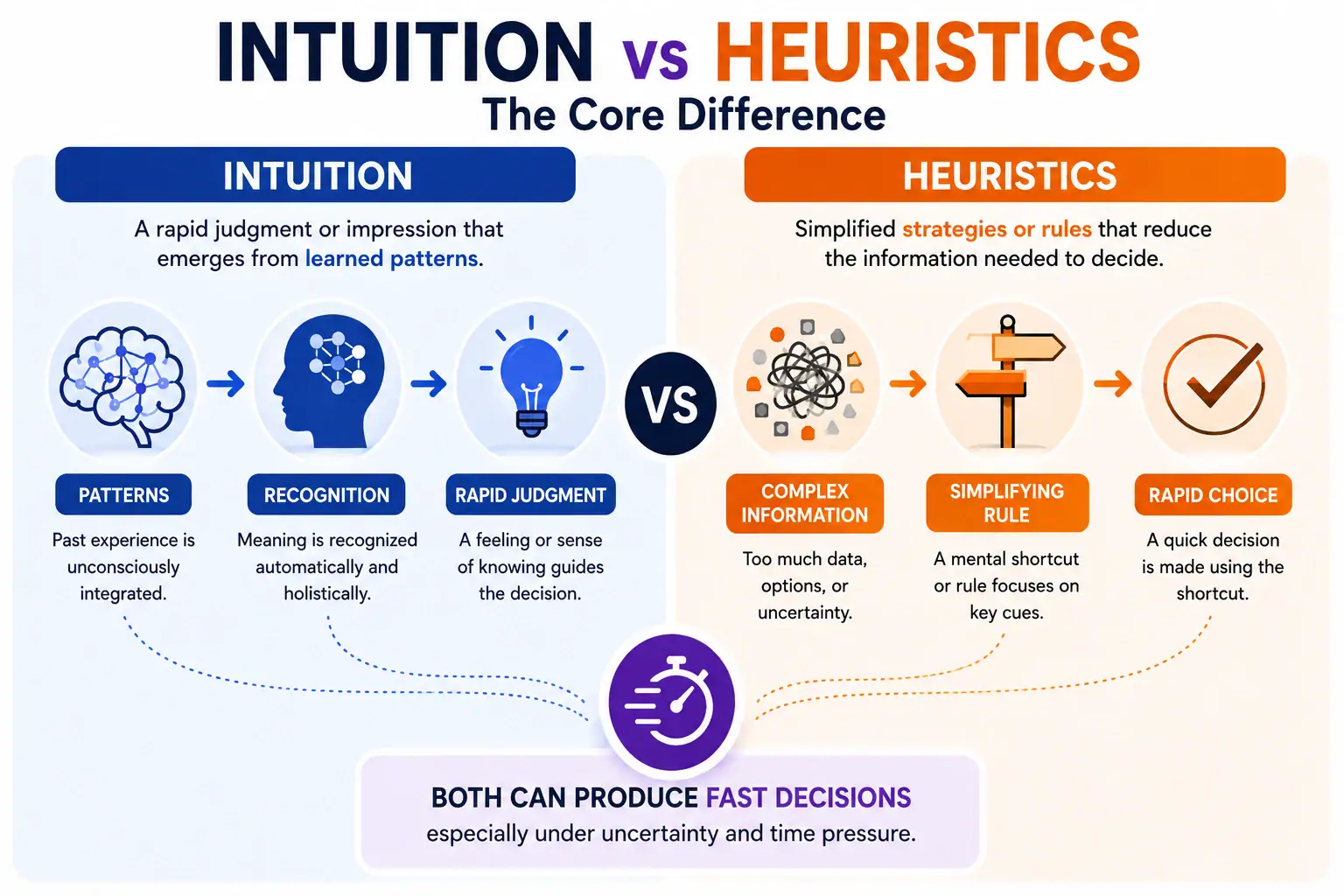
Intuition vs heuristics refers to a rapid judgment or impression that can emerge from learned patterns without conscious step-by-step analysis. A heuristic is a simplified strategy or rule that reduces the information needed to make a judgment. Both can be fast. Both can be useful. Both can also fail.
The practical question is therefore not “Which one is rational?” It is: What is producing this judgment, how well does it fit the situation, and how much verification does the decision deserve? Looking at heuristics vs intuition this way also prevents a common mistake: assuming that all heuristic thinking is biased or that every intuitive feeling reflects expertise.
Intuition vs Heuristics: The Short Answer
The simplest way to separate the two is to think in terms of pattern recognition versus simplification.
- Intuition: “I recognize what this situation means, even if I cannot immediately explain every step.”
- Heuristic: “I can make this decision faster by using a simple cue, rule, or shortcut.”
That does not make intuition inherently wiser or heuristics inherently biased. A well-calibrated intuitive judgment may be excellent. A well-matched heuristic may also outperform a more complicated method. The quality depends on experience, feedback, environment, and the cost of being wrong.
| Dimension | Intuition | Heuristic |
|---|---|---|
| What it is | Rapid judgment or impression | Simplified decision strategy |
| Main basis | Patterns, cues, accumulated experience | Selected cues or rules |
| Conscious? | Often largely nonconscious | Can be conscious or automatic |
| Main function | Recognize what a situation means | Reduce decision complexity |
| Speed | Usually fast | Usually fast |
| Can be accurate? | Yes | Yes |
| Can produce error? | Yes | Yes |
| Same as cognitive bias? | No | No |
What Is Intuition?
Intuition vs heuristics is often described as knowing without knowing why. That phrase captures the subjective experience, but it can make intuition sound mysterious. A more useful description is rapid integration of cues and patterns without deliberate, step-by-step reasoning.
When you have repeatedly encountered a type of situation, the brain can become sensitive to regularities that are difficult to verbalize. An experienced professional may notice that “something is off” before being able to list the exact clues. A skilled player may see the shape of a position before consciously calculating every possibility. A driver may respond to a subtle traffic pattern before explicitly explaining what changed.
This is why intuition should not be treated as a supernatural signal. It often depends on learning. The deeper explanation is explored in what intuition really is: pattern recognition under uncertainty and in the broader guide to intuitive thinking.
But experience alone does not guarantee accurate intuition. Daniel Kahneman and Gary Klein argued that reliable intuitive expertise is more likely when two conditions exist: the environment contains sufficiently learnable regularities, and the person has had adequate opportunity to learn those regularities through experience and feedback. They also warned that the feeling of confidence is not, by itself, evidence that intuition is accurate. Their 2009 review is especially useful because it identifies the conditions under which intuition deserves more or less trust.
What Is a Heuristic?
A heuristic is a strategy that simplifies judgment by using only part of the available information. Instead of calculating every option, weight, probability, or consequence, the decision-maker focuses on a manageable cue or rule.
This is not automatically irrational. Real decisions happen under limited time, attention, memory, and information. In those conditions, exhaustive analysis may be impossible—or more expensive than the decision is worth.

Classic research by Amos Tversky and Daniel Kahneman described three influential heuristics used under uncertainty: representativeness, availability, and anchoring. Their key point was nuanced: these strategies are economical and often effective, yet they can also generate predictable errors in some contexts. The original 1974 paper became foundational to the study of judgment and cognitive bias.
Later work on ecological rationality emphasized the other side of the picture. Heuristics can be fast, frugal, and accurate when their structure fits the environment. A major review of heuristic decision making describes heuristics as efficient cognitive processes—conscious or unconscious—that deliberately ignore part of the information. The question is not whether information was ignored; it is whether ignoring it improved or damaged the decision.
How Are Intuition and Heuristics Related?
Intuition and heuristics overlap because both can produce judgments quickly and with limited conscious calculation. That overlap is why the two concepts are often confused.
But they refer to different things. Intuition describes a form of rapid judgment or knowing. A heuristic describes a strategy for reducing the complexity of a judgment. A heuristic can contribute to an intuitive-seeming response, but intuition is not simply another word for “heuristic.”

Imagine an experienced doctor who immediately senses that a patient’s presentation is unusual. That judgment could reflect years of pattern learning across subtle combinations of symptoms. Now imagine someone choosing a familiar medication brand simply because the name is recognized. The second judgment uses familiarity as a cue. Both are fast, but the underlying source differs.
This distinction also explains why the popular phrase “System 1 thinking” is too broad to settle the question. Fast cognition can include learned expertise, emotion, automatic associations, heuristics, habits, and other processes. Speed alone does not tell you which mechanism is operating.
Intuition vs Heuristics Examples
The distinction becomes clearer when intuition and a heuristic are applied to the same kind of decision. The surface experience may be equally fast, but the source of the judgment differs.
Hiring: pattern recognition vs resemblance
Intuition: An experienced interviewer notices a recurring combination of behaviors that, across many past hires and later performance feedback, has predicted whether candidates adapt well to the role.
Heuristic: The interviewer favors a candidate because the person resembles a previously successful employee. That resemblance is a simple cue; it may be useful, but it can also overlook important differences.
Investing: learned market pattern vs anchoring
Intuition: A seasoned investor recognizes an unusual combination of liquidity, sentiment, and price behavior that resembles patterns encountered repeatedly in comparable market conditions.
Heuristic: The investor treats the first price seen as a reference point and judges the current price mainly as “cheap” or “expensive” relative to that anchor.
Technical troubleshooting: integrated pattern vs availability
Intuition: An experienced engineer sees several weak signals together and rapidly recognizes a failure pattern learned from previous incidents and post-incident feedback.
Heuristic: The engineer immediately suspects the same cause as last week’s memorable outage because that explanation is easiest to recall.
None of these labels tells you in advance whether the answer is correct. The comparison tells you what kind of process may be driving the judgment, which determines what should be checked next.
A Heuristic Is Not the Same as a Cognitive Bias
This distinction matters because “heuristic” and “bias” are often used as if they mean the same thing.
- Heuristic: a strategy or process that simplifies a judgment.
- Cognitive bias: a systematic tendency that can distort judgment.
A heuristic can contribute to bias when it is poorly matched to the situation, but it can also produce an efficient and useful answer. Bias is therefore a possible outcome—not the definition of a heuristic.

For example, the availability heuristic makes easily recalled events feel more important or probable. After seeing repeated news about a rare accident, a person may overestimate how often it occurs. The heuristic is the use of easily available examples as a cue; the distorted probability judgment is the bias that can result.
If you want to separate these ideas more carefully, see intuition vs bias and mental models vs cognitive biases.
Common Heuristics in Everyday Decisions
Heuristics become easier to recognize when you see the cue each one prioritizes.
Availability heuristic: “What comes to mind easily?”
You estimate likelihood or importance from examples that are easy to recall. Recent, vivid, dramatic, or emotionally charged information can therefore receive more weight than base-rate data.
Representativeness heuristic: “What does this resemble?”
You judge something by how closely it matches a familiar prototype, category, or mental model. This can help with rapid classification, but resemblance can distract from important differences or statistical base rates.
Anchoring: “What reference point came first?”
An initial number, price, estimate, or statement influences later judgments. Anchors can provide a useful starting point, yet an arbitrary starting point can pull the final answer in the wrong direction.
Recognition heuristic: “What do I recognize?”
When one option is recognized and another is not, recognition itself can become a cue. Research on the recognition heuristic shows why this simple strategy can be efficient when recognition correlates with the criterion being judged—but also why its usefulness depends on the environment.
Affect heuristic: “How does this feel?”
Immediate positive or negative feelings can become a shortcut for evaluating risk and benefit. Slovic, Finucane, Peters, and MacGregor describe this reliance on rapid “goodness” or “badness” feelings as the affect heuristic. The signal may be informative, especially when emotion reflects relevant experience, but strong affect can also shift perceived risks and benefits in opposite directions.
When Is Intuition More Trustworthy?
Intuition deserves more weight when the judgment comes from substantial relevant experience in an environment with recurring, learnable patterns.
- You have encountered similar situations many times.
- The environment is stable enough for patterns to repeat.
- You received feedback that showed whether past judgments were right or wrong.
- The current situation resembles the domain in which your experience was built.
- Your impression reflects multiple interacting cues rather than one striking detail.
This does not mean experts are immune to error. Expertise can become outdated when the environment changes, and confidence can survive after accuracy has deteriorated. The question is whether experience was actually calibrated by useful feedback.
This is also why intuition can be wrong. A strong feeling may come from real expertise, but it may also come from stale patterns, emotional salience, wishful thinking, or a misleading cue.
When Can a Heuristic Be the Better Tool?
More analysis is not automatically better. A heuristic can be the right tool when the cost of exhaustive analysis is high and a simple rule captures what matters.
- Time is limited. You need an answer before full analysis is possible.
- The stakes are modest. The cost of a small error is lower than the cost of spending hours optimizing the choice.
- The environment is uncertain. Additional information may not meaningfully reduce uncertainty.
- A simple cue is strongly predictive. The shortcut is matched to the structure of the problem.
- Complex models are fragile. Adding variables can create noise or overfitting without improving real-world performance.
Research on smart heuristics in individuals, teams, and organizations emphasizes this idea of ecological rationality: a heuristic is “smart” when it fits the environment in which it is used.
When Both Intuition and Heuristics Go Wrong
Fast judgment becomes dangerous when we mistake speed, familiarity, or confidence for evidence.
Both intuition and heuristics become less reliable when:
- the situation is genuinely novel;
- feedback has been weak, delayed, or misleading;
- emotion makes one cue unusually salient;
- the environment has changed since your experience was built;
- base rates are ignored;
- you are motivated to reach a preferred conclusion;
- the decision has asymmetric consequences and a rare error would be costly.
The practical principle is simple: the higher the stakes and the weaker the calibration, the more verification you need.
Intuition vs Heuristic vs Bias vs Deliberate Reasoning
| Process | Useful question | Main strength | Main risk |
|---|---|---|---|
| Intuition | What pattern am I recognizing? | Integrates experience quickly | False confidence or outdated patterns |
| Heuristic | What simple cue or rule am I using? | Reduces complexity | Shortcut may not fit the context |
| Bias | How might judgment be systematically distorted? | Not a decision tool; a pattern of error to detect | Can persist unnoticed |
| Deliberate reasoning | What follows from explicit analysis? | Makes assumptions and trade-offs visible | Can be slow, noisy, or overcomplicated |
The strongest decision-making does not require choosing one mode forever. It requires knowing when to move between them. A fast judgment can generate a hypothesis; deliberate reasoning can test it. A heuristic can reduce a low-stakes choice; a more careful model can take over when consequences rise.
That relationship is explored further in intuition vs logic and intuition in decision making.
A Practical Test: Is This Intuition or a Heuristic?
You cannot always identify the cognitive mechanism with certainty in real time. But you can ask questions that make the source of the judgment more visible.

1. Do I have substantial relevant experience?
If not, be cautious about calling the judgment expert intuition. A strong feeling without relevant learning history may still be meaningful, but it has less evidence of calibration.
2. Am I recognizing a recurring pattern or relying on one obvious cue?
Broad pattern recognition supports the intuition interpretation. Heavy dependence on a single feature—familiarity, vividness, resemblance, or an initial number—points more strongly toward a heuristic.
3. Is the environment predictable enough to learn from?
If outcomes are mostly random or the rules change constantly, experience may create confidence without true predictive skill.
4. Have I received repeated feedback?
Feedback is what allows intuition to become calibrated. Without it, you may remember the times your feeling was right while forgetting the times it was wrong.
5. What happens if I am wrong?
Low-stakes decisions often justify speed. High-stakes decisions justify verification. Check evidence, base rates, alternatives, and possible failure modes before acting.
So Which Should You Trust?
Trust neither category automatically. Trust the judgment in proportion to the quality of the process behind it.
Trust intuition more when it comes from relevant experience, recurring patterns, a learnable environment, and repeated feedback. Trust a heuristic more when the rule is known, the cue is relevant, the context fits, and the cost of simplifying is acceptable.
And when consequences are high, do not ask intuition or heuristics to carry the whole decision alone. Use them as inputs. Then test the result against evidence, base rates, alternative explanations, and the downside of being wrong.
If you want to see how your own decision style leans, try the Intuition or Logic decision-making quiz.
Frequently Asked Questions
Is intuition a heuristic?
Not exactly. Intuition is a rapid judgment or impression, often shaped by learned patterns. A heuristic is a strategy or rule that simplifies a judgment. Heuristics can contribute to fast intuitive-seeming responses, but the terms are not interchangeable.
What is the main difference between intuition and heuristics?
The central difference is pattern recognition versus simplification. Intuition often reflects the integration of experience and multiple cues, while a heuristic intentionally or automatically reduces complexity by focusing on selected information.
Are heuristics always biased?
No. Heuristics can be efficient and accurate when they fit the environment. They can contribute to bias when the shortcut systematically misrepresents the situation.
What are examples of heuristics in everyday life?
Common examples include using what comes easily to mind to estimate probability (availability), judging by resemblance (representativeness), letting a first number influence later estimates (anchoring), using recognition as a cue, or using immediate positive or negative feeling as a shortcut (affect).
Can intuition be affected by cognitive bias?
Yes. A rapid intuitive judgment can be shaped by real expertise, but it can also be influenced by emotional salience, stereotypes, motivated reasoning, memory, or misleading cues. The feeling of certainty does not reveal which source produced the judgment.
Are heuristics conscious or unconscious?
They can be either. Some heuristics are intentionally applied as simple decision rules, while others operate automatically without deliberate awareness.
When should you trust intuition over analysis?
Intuition deserves more weight when you have deep relevant experience, the environment contains learnable patterns, and repeated feedback has calibrated your judgment. As stakes rise or the situation becomes more novel, verify intuition with explicit analysis and evidence.
References and Further Reading
- Tversky, A. & Kahneman, D. (1974). Judgment under Uncertainty: Heuristics and Biases. Science.
- Kahneman, D. & Klein, G. (2009). Conditions for Intuitive Expertise: A Failure to Disagree. American Psychologist.
- Gigerenzer, G. & Gaissmaier, W. (2011). Heuristic Decision Making. Annual Review of Psychology.
- Pachur, T. et al. (2011). The Recognition Heuristic: A Review of Theory and Tests.
- Slovic, P., Finucane, M. L., Peters, E. & MacGregor, D. G. (2007). The Affect Heuristic. European Journal of Operational Research, 177(3), 1333–1352.