Cognitive Bias
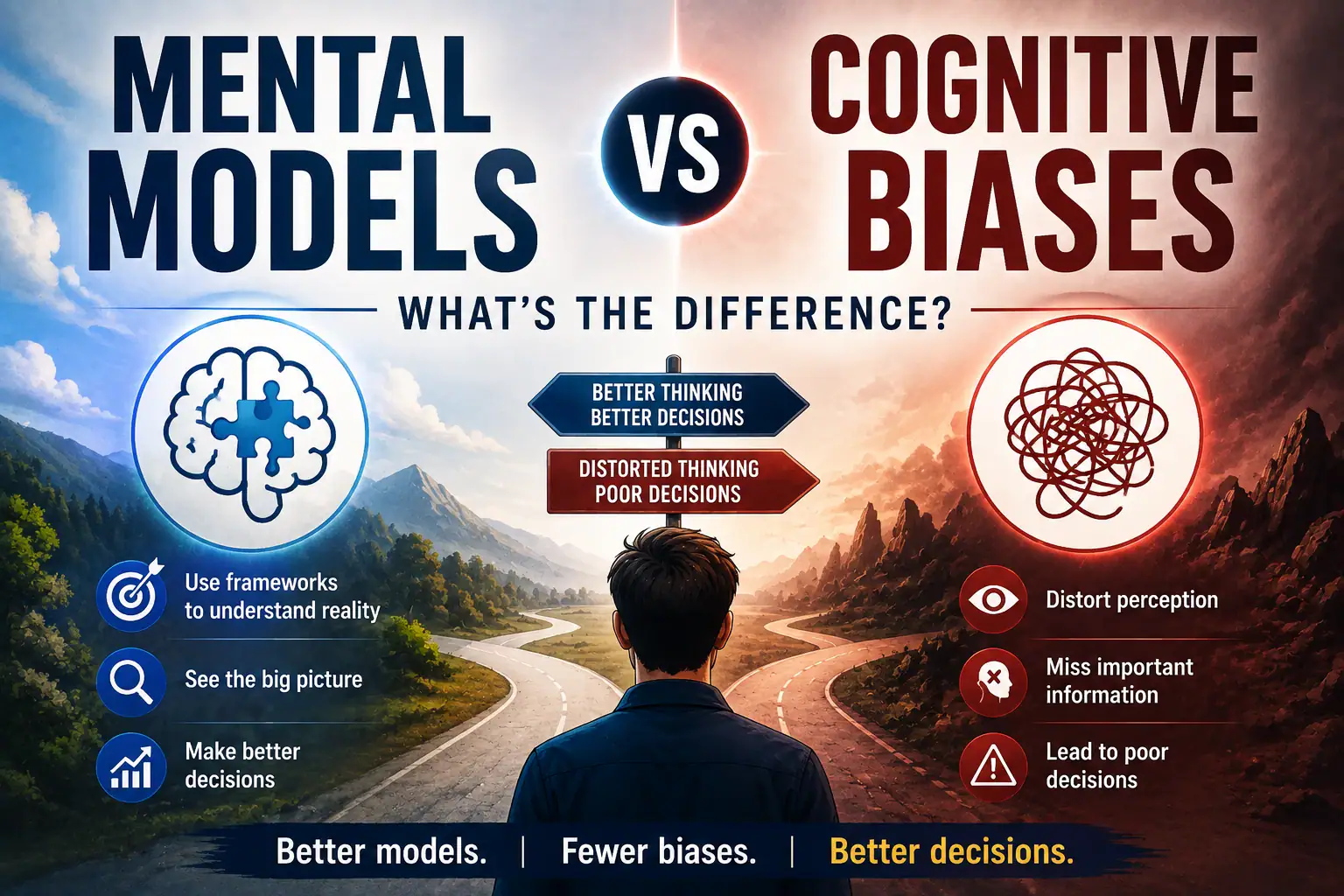
Cognitive bias is the way your brain systematically misinterprets reality when making decisions. It is not random error. It is a predictable pattern of distortion that comes from how your mind simplifies complexity.
These biases are not flaws to eliminate completely. They are shortcuts your brain uses to decide faster. But under uncertainty, stress, or emotional pressure, they can lead to inaccurate judgments and poor decisions.
How cognitive bias works
Your brain constantly filters information. It selects what seems important, fills in gaps, and builds meaning based on past patterns. This process is fast and automatic — but it is not always accurate.
- Pattern recognition — the source of fast intuitive judgments
- Decision making — where biases influence outcomes
- Signal vs noise — how bias distorts what you notice
When bias becomes stronger
- Clarity under pressure — stress increases distortion
- Nervous system — your state shapes perception
- Decision fatigue — reduced accuracy after repeated choices
Common effects of cognitive bias
Cognitive bias can cause you to:
- see patterns that are not really there
- ignore important information
- overestimate certainty
- misinterpret emotional signals
This is why intuition sometimes feels “wrong” — not because intuition itself fails, but because the underlying pattern recognition is distorted.
Below are articles that help you understand where bias appears, how it affects your thinking, and how to make clearer decisions despite it.