Why do we get stuck in one way of thinking? Most people assume it happens because we lack information, intelligence, or critical thinking skills. In reality, the problem is often deeper. We rarely interpret reality directly. Instead, we interpret it through invisible cognitive frameworks that shape what we notice, what we ignore, and what feels unquestionably true.
Estimated reading time: 14 minutes
When one framework becomes dominant, it begins organizing perception automatically.
New information is no longer evaluated independently.
Instead, it is absorbed into the existing structure.
This is why intelligent people can examine the same evidence and reach completely different conclusions.
The difference is often not intelligence.
It is the architecture through which intelligence is operating.
Why Do We Get Stuck in One Way of Thinking? Short Answer
People become stuck in one way of thinking because the mind naturally builds recursive patterns that reinforce perception, identity, interpretation, and action. Over time these patterns become self-stabilizing. Instead of merely helping us understand reality, they begin determining which parts of reality we can perceive at all.
The challenge is therefore not simply learning new ideas.
The challenge is recognizing the invisible structures that organize our thinking before individual thoughts even appear.
We do not simply think inside paradigms.
Paradigms gradually begin thinking through us.
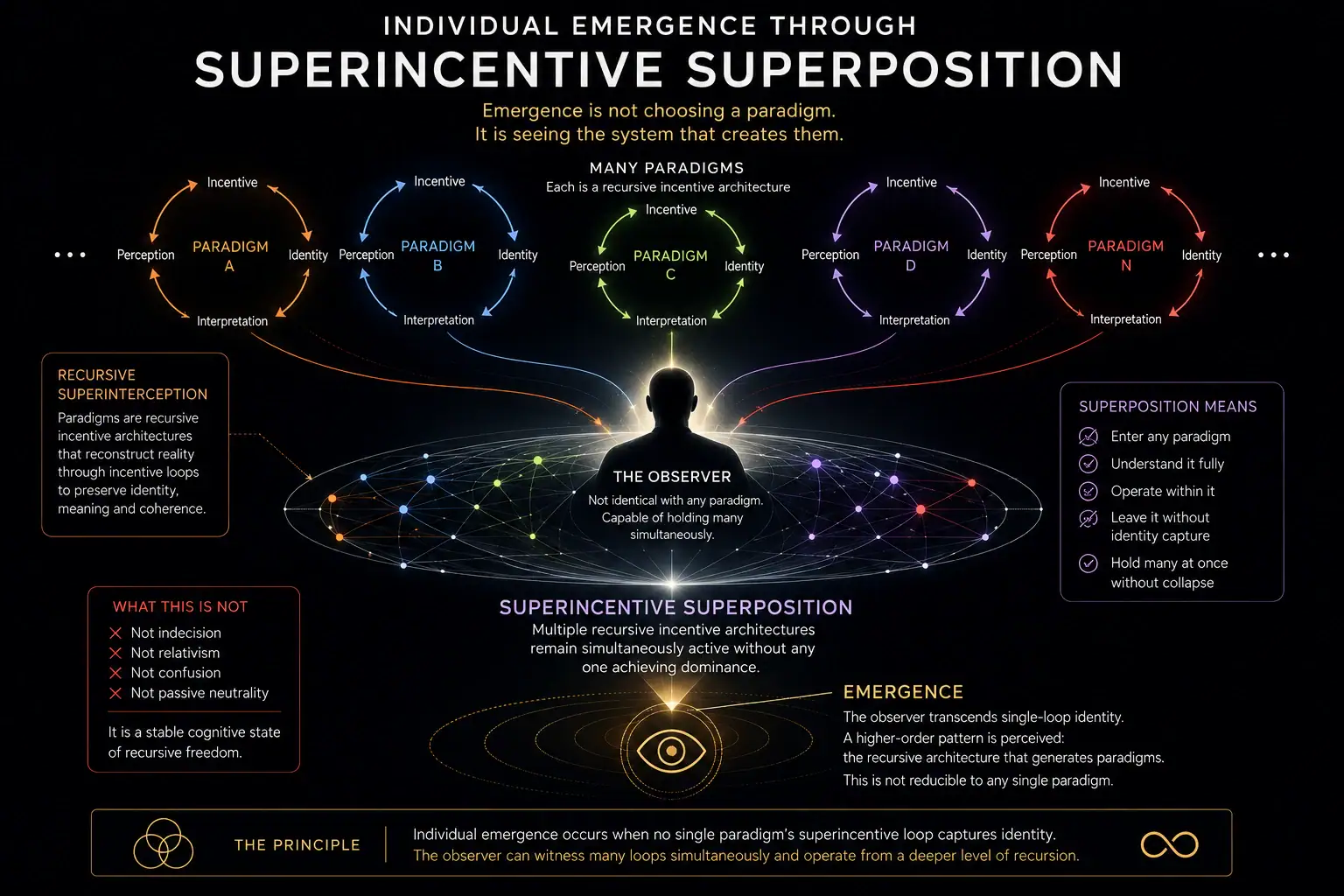
This article introduces the concept of Superincentive Superposition™, a framework for understanding how people become identified with recursive cognitive architectures and how individual emergence becomes possible when no single architecture dominates perception.
Why More Information Often Doesn’t Change Minds
One of the oldest assumptions about learning is that more information automatically produces better understanding.
Daily experience suggests otherwise.
People often become more certain after receiving conflicting evidence.
Arguments become stronger instead of weaker.
Disagreements become deeper rather than more nuanced.
This happens because new information rarely enters an empty mind.
It enters an existing interpretive system.
That system immediately begins asking:
- Does this support my current worldview?
- Does this threaten my identity?
- Does this reinforce what I already believe?
- Should this information be trusted?
- How should this information be interpreted?
These questions often occur automatically, long before conscious reasoning begins.
Information rarely changes perception by itself.
It is first filtered through the architecture that already defines reality.
The Invisible Architecture Behind Thought
Every person develops recurring ways of interpreting experience.
Over time these interpretations become increasingly efficient.
The brain no longer evaluates every situation from the beginning.
Instead, it relies on previously successful patterns.
This makes thinking faster.
It also makes thinking less flexible.
Eventually the framework itself becomes almost invisible.
We stop noticing that we are interpreting reality through a particular architecture because that architecture has become reality itself.
This resembles what happens during cognitive overload, where the brain increasingly relies on automatic processing rather than deliberate evaluation. If you have experienced mental exhaustion, you may recognize similar patterns in Cognitive Overload Recovery, Why Do I Overthink Everything?, Signal vs Noise, and Intuition and Consciousness. These articles explore how perception itself changes under sustained cognitive pressure. Sitemap posts intuition .pdf
The most powerful cognitive structures are often the ones we no longer realize we are using.
Why Arguments Rarely Change People
If information alone changed minds, the internet would have solved most disagreements long ago.
Instead, we often observe the opposite.
People become more certain.
Positions become more polarized.
Evidence that appears convincing to one person may seem completely irrelevant to another.
This is difficult to explain if we imagine that people simply compare facts objectively.
It becomes much easier to understand if perception itself is already being organized before conscious reasoning begins.
Arguments usually compete inside existing frameworks.
They rarely change the framework itself.
In other words, people are often defending an architecture rather than an individual belief.
Recursive Incentive Architectures
Every stable worldview contains more than ideas.
It also contains:
- an identity,
- a definition of success,
- a definition of failure,
- sources of legitimacy,
- emotional rewards,
- behavioral expectations,
- social belonging,
- future predictions.
Together these elements form a recursive incentive architecture.
Each decision reinforces perception.
Perception reinforces interpretation.
Interpretation reinforces identity.
Identity reinforces future decisions.
The loop continuously recreates itself.
The stronger the recursive loop becomes, the more reality appears self-evident.
Why Paradigms Feel Like Reality
This explains one of the most surprising characteristics of human cognition.
People rarely experience themselves as following a paradigm.
They experience themselves as seeing reality.
The paradigm becomes invisible precisely because it organizes perception so effectively.
From inside the architecture, alternative paradigms often appear irrational, immoral, naïve, or obviously false.
This is not necessarily because alternative ideas lack merit.
It is because the recursive architecture determines which possibilities can even be recognized.
The greatest power of a paradigm is not controlling what you think.
It is controlling what becomes thinkable.
Recursive Superinterception: Why Paradigms Defend Themselves
On Intuition Management we primarily explore how these cognitive architectures influence individual perception, attention, and decision-making.
At the systems level, the same mechanisms help explain why organizations, cultures, political movements, and entire societies often resist change even when evidence appears overwhelming.
This broader systems perspective is explored in Recursive Superinterception.
The central idea is that paradigms do not merely contain beliefs.
They continuously reconstruct themselves through recursive incentive structures.
These structures preserve coherence by rewarding interpretations that reinforce the existing architecture while filtering out interpretations that threaten it.
Viewed from this perspective, resistance to change is often not resistance to information.
It is resistance to the collapse of the recursive architecture that gives reality its current structure.
People rarely defend isolated beliefs.
They defend the recursive architecture that makes those beliefs meaningful.
Superincentive Superposition™
If recursive incentive architectures explain why paradigms become stable, a different question naturally follows.
How can someone perceive beyond a single recursive architecture without becoming trapped inside another one?
This is where Superincentive Superposition™ begins.
Most people operate almost entirely inside one dominant recursive incentive architecture at any given moment.
Its incentives shape attention.
Its identity shapes interpretation.
Its logic defines what appears obvious.
Superincentive Superposition™ proposes something fundamentally different.
Instead of collapsing into one recursive architecture, the observer becomes capable of simultaneously understanding multiple architectures without identifying completely with any of them.
Emergence does not begin when one paradigm defeats another.
It begins when no single paradigm completely captures the observer.
This is not indecision.
It is not relativism.
It is not refusing to choose.
It is the ability to enter, understand, and leave multiple recursive architectures while remaining aware that each represents a partial organization of reality rather than reality itself.
Individual Emergence and the Observer
Individual emergence occurs when the observer is no longer fully captured by one interpretive architecture.
This does not mean abandoning all beliefs.
It does not mean becoming neutral about everything.
It means developing the ability to notice how different paradigms organize perception, identity, incentive, and action before deciding how to respond.
Emergence begins when the observer can perceive the architecture behind perception.
This is why Superincentive Superposition™ matters.
When multiple recursive incentive architectures remain visible at the same time, a new level of cognition becomes possible.
The question changes from:
Which paradigm is correct?
to:
What does each paradigm reveal, what does it hide, and what incentive structure keeps it stable?
How Cognitive Calibration™ Supports Emergent Thinking
Cognitive Calibration™ helps because it trains attention to separate signal from noise, interpretation from reality, and urgency from importance.
In ordinary thinking, people often ask:
- What do I believe?
- Who is right?
- Which side should I choose?
- What confirms my current view?
Calibrated thinking asks deeper questions:
- What framework is shaping this interpretation?
- What incentive is attached to this belief?
- What identity is being protected?
- What would become visible from another paradigm?
- What am I unable to perceive while identified with this view?
This connects directly with The Personal Signal Decoder™, Signal vs Noise Simulator, Why Do I Second Guess Myself?, and Why Can’t I Prioritize Anything?.
The goal is not to escape frameworks completely.
The goal is to stop confusing any single framework with reality itself.
A Practical Process for Superincentive Superposition™
If you want to practice this form of emergent thinking, begin with one strongly held interpretation.
- Identify the paradigm currently organizing your interpretation.
- Ask what that paradigm rewards you for noticing.
- Ask what that paradigm discourages you from seeing.
- Identify the identity protected by that interpretation.
- Enter a competing paradigm and describe reality from inside it.
- Notice what becomes visible there that was invisible before.
- Return to the observer position without immediately choosing a side.
- Look for the recursive architecture that generates both perspectives.
This is difficult because every paradigm feels most convincing from inside itself.
But with practice, the observer becomes less dependent on any single architecture for coherence.
That is where individual emergence begins.
Frequently Asked Questions
Why do people get stuck in one way of thinking?
People get stuck in one way of thinking because repeated interpretations become linked to identity, incentives, emotions, and action. Over time, the framework becomes self-reinforcing and begins to feel like reality itself.
What is Superincentive Superposition™?
Superincentive Superposition™ is the ability to hold multiple recursive incentive architectures in awareness without becoming fully identified with any single one. This allows higher-order patterns to become visible.
Is this the same as being open-minded?
No. Open-mindedness usually means being willing to consider different ideas. Superincentive Superposition™ goes deeper by examining the incentive structures and identity loops that make different ideas feel true, threatening, or obvious.
What is individual emergence?
Individual emergence is a shift in cognition where a person can perceive the recursive structures behind competing paradigms instead of being fully captured by one of them.
How does this relate to intuition?
Intuition becomes clearer when perception is not fully captured by one rigid framework. By recognizing the structures that shape interpretation, the mind becomes better able to distinguish real signals from inherited assumptions, emotional incentives, and cognitive noise.
Final Thought
Getting stuck in one way of thinking is not usually a failure of intelligence.
It is often the result of intelligence operating inside a recursive architecture that has become invisible.
The deeper task is not simply changing opinions.
It is learning to see the architecture that produces opinions.
Individual emergence begins when the observer can understand multiple paradigms without being owned by any one of them.
Continue Exploring
- Cognitive Overload Recovery
- Signal vs Noise
- The Personal Signal Decoder™
- Signal vs Noise Simulator
- Intuition and Consciousness
- Why Do I Overthink Everything?
- Why Do I Second Guess Myself?
- Why Can’t I Prioritize Anything?