There is no single universally accepted list of the types of intuition. One influential psychological framework distinguishes three broad forms of intuitive processing: holistic intuition, inferential intuition, and affective intuition. Other familiar labels—such as somatic, social, creative, expert, or predictive intuition—are better understood as ways intuition can appear in particular situations rather than as one universally validated taxonomy.
That distinction matters. If every gut feeling is treated as a separate “type,” intuition quickly becomes vague. A more useful approach is to separate how intuitive judgment is formed from where it is experienced. This guide does exactly that, then shows when intuition becomes more reliable, when it can mislead you, and how to calibrate it over time.

What are the different types of intuition?
In the Types of Intuition Scale research, Jean Pretz and colleagues described three theoretically distinct forms of intuition. Holistic intuition integrates multiple cues into an overall pattern. Inferential intuition reflects reasoning that was once deliberate but has become fast and automatic through practice. Affective intuition relies primarily on feelings and emotional reactions as information.
This does not mean psychology has proved that every intuitive experience fits neatly into exactly three boxes. In fact, the scale-development work found that the holistic dimension itself could split into separate “big-picture” and “abstract” factors in empirical testing. The more defensible conclusion is that intuition is multifaceted, and that these categories help explain important differences in how rapid judgments arise.
| Type | Main process | What it can feel like | Typical use |
|---|---|---|---|
| Holistic intuition | Integrating many weak cues into a whole | “Something fits” or “something is off” | Complex, ambiguous, big-picture situations |
| Inferential intuition | Learned reasoning becoming automatic | Immediate recognition without replaying the steps | Familiar domains with relevant experience |
| Affective intuition | Feelings contributing to judgment | Unease, attraction, aversion, emotional clarity | People, values and emotionally meaningful choices |
1. Holistic intuition: seeing the whole pattern
Holistic intuition happens when the mind combines many pieces of information into an overall impression without consciously evaluating each cue one by one. You may notice tone, timing, context, past experience, inconsistencies and small changes, yet the result arrives first as a global sense: this fits, this does not fit, or pay attention here.
This is closely related to the broader idea of pattern recognition under uncertainty. The conscious mind may not be able to list every input that contributed to the judgment, but that does not mean the judgment came from nowhere. It may represent a compressed integration of many weak signals.
Holistic intuition can be useful when no single variable tells the whole story. A manager may sense that a project is drifting before the dashboard turns red. A designer may know a composition feels unbalanced before identifying the offending element. A person may notice that a conversation feels different even though every sentence sounds normal in isolation.
Its weakness is also obvious: when the cues being integrated are noisy, misleading, stereotyped or unfamiliar, the resulting “whole pattern” can be wrong. Holistic intuition is therefore a starting signal, not automatic proof.
2. Inferential intuition: when experience becomes automatic
Inferential intuition is perhaps the easiest type to understand scientifically. A task that once required conscious analysis can become fast and automatic after repeated experience. You no longer need to verbalize every intermediate step because the relevant patterns have been learned.
This is the foundation of what people often call expert intuition. Gary Klein’s naturalistic decision-making research describes how experienced people can rapidly categorize real-world situations and recognize workable responses. Daniel Kahneman and Klein later emphasized an important boundary condition: skilled intuition is most defensible when the environment contains valid, learnable regularities and the person has had enough opportunity to learn them through experience and feedback.
That explains why intuition can be impressive in one domain and useless in another. An experienced nurse may rapidly notice a pattern of deterioration in a familiar clinical context. A senior engineer may hear a description of a failure and immediately suspect the right subsystem. But expertise in one field does not create reliable intuition everywhere.
If you want to strengthen this form of intuition, the goal is not simply to repeat an activity. The goal is to accumulate relevant experience with corrective feedback. Practice without feedback can automate mistakes just as easily as it automates skill.
3. Affective intuition: when feelings carry information
Affective intuition refers to judgments in which feelings or emotional reactions contribute strongly to the result. You may feel drawn toward an option, uneasy about a conversation, protective of a boundary, or unexpectedly comfortable with a choice before you can explain the reasons in words.
Feelings can contain useful information because emotional responses are shaped by memory, context, values and prior learning. But emotion is not automatically intuition. Fear can amplify threat. Excitement can make an opportunity look safer than it is. Attachment can make evidence easier to dismiss. Stress can create urgency that feels meaningful simply because it is intense.
That is why the useful question is not “Do I feel something strongly?” but “What might this feeling be responding to?” If you want a deeper distinction between emotional information and intuitive judgment, see emotional intuition and smarter decisions. If fear and inner guidance feel difficult to separate, the guide to intuition vs anxiety goes further.
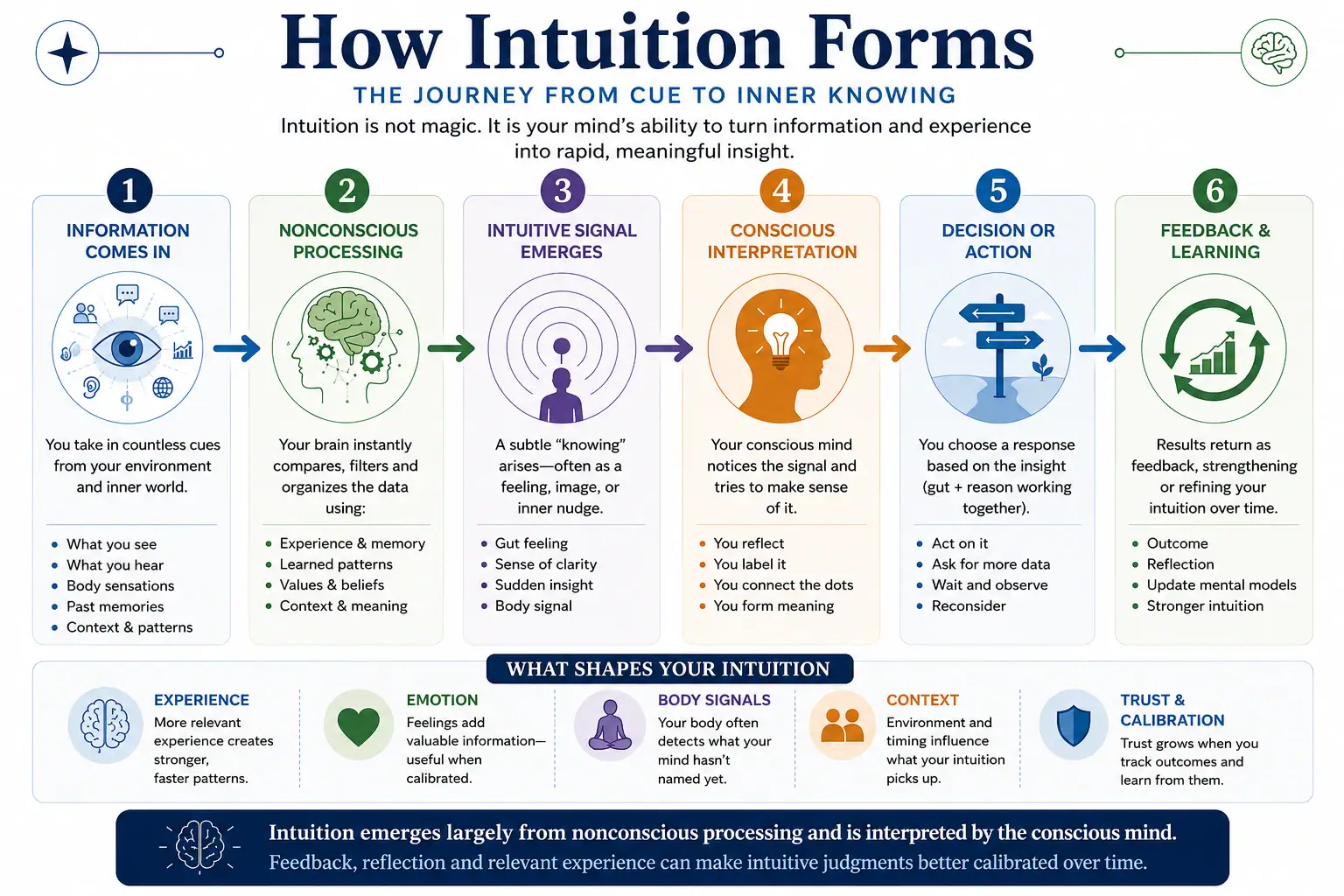
How intuition forms before you can explain it
An intuitive judgment often feels instantaneous because the conscious explanation arrives after much of the processing has already happened. Information comes in through perception, memory, context and bodily state. Fast, nonconscious processing organizes those inputs. A signal reaches awareness as a feeling, image, sense of fit, hesitation or sudden recognition. Only then does the conscious mind try to name and interpret what happened.
This sequence explains an important paradox: an intuitive judgment can have reasons even when you cannot immediately state them. But it also explains why intuition deserves checking. Because the underlying process is fast and partly inaccessible, you may not know whether it integrated genuine expertise, incomplete information, a stereotype, a recent memory, fear, or a real pattern.
A useful response is neither blind trust nor automatic dismissal. Notice the signal, identify the context, and decide whether the situation is one where your intuition has earned credibility.
Types of intuition vs expressions of intuition
Terms such as somatic intuition, social intuition, creative intuition and expert intuition are useful because they describe where intuitive information is experienced or applied. They should not be confused with a single universally agreed scientific taxonomy.
Think of the difference this way: holistic, inferential and affective intuition describe broad processing patterns. Somatic, relational, creative or expert intuition describe common expressions or domains. The same real-life judgment can draw on more than one process at once.
Somatic intuition
Somatic intuition is the experience of intuitive information through the body: tension, ease, a knot in the stomach, a change in breathing, warmth, stillness or another bodily cue. The body is not a supernatural detector. It is part of the information-processing system, and bodily state can reflect emotion, learned associations, stress and environmental cues.
The challenge is interpretation. A body sensation can be informative without being self-explanatory. If you want to work with these signals without treating every sensation as a message, see the guide to somatic intuition.
Social and relational intuition
Social intuition is rapid judgment about people, relationships and interaction dynamics. It can integrate facial expression, timing, tone, inconsistencies, previous behavior, social norms and emotional responses so quickly that the result feels immediate.
This can be useful, but it is especially vulnerable to projection and stereotype. A person who reminds you of someone from your past may trigger a strong “read” that says as much about memory as it does about the person in front of you. The article on relational intuition explores this interpersonal layer in more depth.
Creative intuition
Creative intuition appears when an idea, connection or solution emerges before you can reconstruct the path that produced it. The mind may have been combining distant concepts outside focal attention until a useful pattern becomes conscious. This is why stepping away from a problem can sometimes help: the absence of deliberate analysis does not necessarily mean the absence of processing.
Expert intuition
Expert intuition is usually best understood as an expression of learned, inferential intuition supported by deep domain experience. The important word is domain. A firefighter’s rapid recognition in a familiar fire environment does not imply equal intuitive accuracy in investing, medicine or relationships.
Anticipatory or predictive intuition
People sometimes describe a sense that they “know what is going to happen.” A grounded interpretation is that the mind may be detecting an emerging trajectory from subtle patterns and incomplete information. That can feel predictive because the conclusion arrives before the evidence becomes obvious to conscious attention.
This is different from claiming paranormal certainty about the future. The distinction is explored in Does Intuition Predict the Future?.
Spiritual intuition
Some people interpret intuitive experiences spiritually—as guidance, connection, inner wisdom or contact with something larger than the self. That interpretation may be personally meaningful, but it should be distinguished from a scientifically established mechanism of intuitive cognition. The site’s guide to spiritual intuition separates subjective meaning, scientific evidence and everyday practice.
Which type of intuition is most reliable?
No type of intuition is universally the most reliable. Reliability depends more on the quality of the learning environment than on the label attached to the feeling. Intuition becomes more defensible when the situation contains recurring patterns, your experience is relevant, and outcomes provide meaningful feedback that lets you correct mistakes.
Inferential or expert intuition can become highly effective in familiar, learnable domains. Holistic intuition can help when many interacting cues matter and no single variable is decisive. Affective intuition can alert you to emotional or social information that deserves attention. But each can also fail when the underlying inputs are poor.
A practical rule is simple: trust intuition more when you can explain why your experience is relevant, and test it more aggressively when the environment is unfamiliar, noisy or high stakes. Intuition and analysis are not enemies. In many good decisions, intuition generates the hypothesis and analysis checks whether it survives contact with evidence.
How accurate is intuition?
There is no single percentage that describes the accuracy of intuition. Asking “How accurate is intuition?” without specifying the person, task and environment is like asking how accurate memory is: the answer changes with conditions.
Kahneman and Klein’s work on intuitive expertise offers one of the clearest ways to think about this. Genuine intuitive skill is most likely to develop when two conditions are present: the environment offers sufficiently valid cues, and the person has a real opportunity to learn those cues through repeated experience and feedback. Where outcomes are essentially unpredictable or feedback is weak, confidence can grow without corresponding accuracy.

This is why a person can have excellent intuition in one area and poor intuition in another. Familiarity alone is not enough. You need a learning environment in which outcomes reveal whether your judgments were actually useful.
Why intuition can be wrong
Fast judgment is efficient precisely because it does not consciously inspect every assumption. The same feature that makes intuition useful also makes it vulnerable to error. A confident intuitive signal can be built from incomplete evidence, selective attention, emotional state or a pattern that used to be valid but no longer applies.
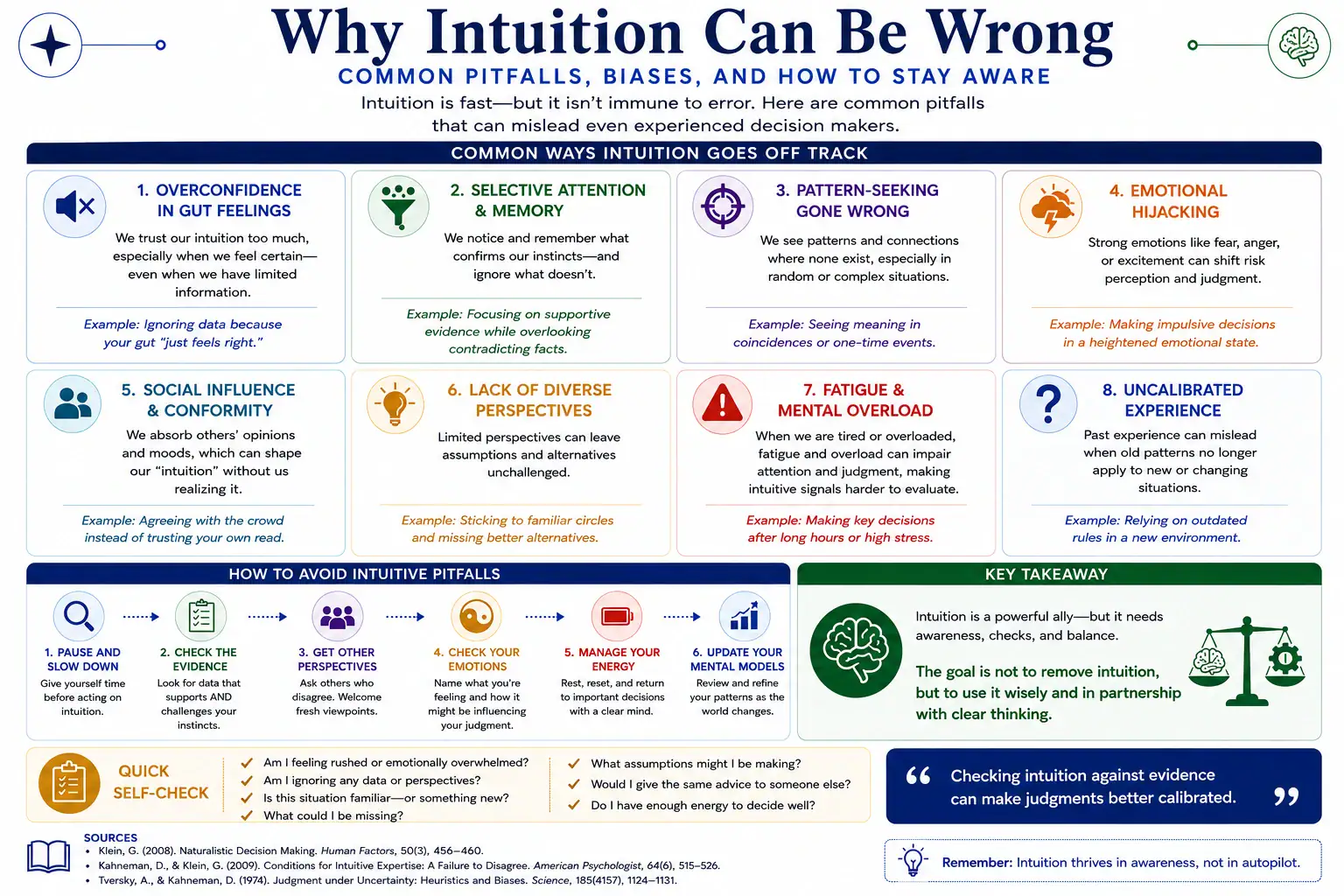
Common failure modes include overconfidence, confirmation bias, pattern-seeking in randomness, social conformity, emotional overload, fatigue and outdated experience. Classic work by Amos Tversky and Daniel Kahneman demonstrated how people use efficient mental heuristics under uncertainty and how those shortcuts can generate systematic biases.
The goal is not to eliminate fast judgment. It is to learn when a fast judgment deserves more scrutiny. For a dedicated breakdown of these errors, see intuition vs bias and when intuition is wrong.
Intuition vs emotion vs anxiety vs instinct vs bias
These terms overlap in everyday language, but they are not interchangeable.
Intuition is a rapid judgment or sense that emerges without conscious access to every processing step. Emotion is an affective state that can contribute information to an intuitive judgment but can also distort it. Anxiety is a threat-oriented state that may create urgency, repetitive doubt or bodily alarm that is easily mistaken for warning intuition.
Instinct usually refers more narrowly to biologically prepared tendencies rather than learned pattern recognition. Bias is a systematic tendency that can skew judgment. Intuition may contain bias, but intuition and bias are not the same thing.
A useful diagnostic question is: Does this signal become clearer when I gather relevant evidence, regulate my state and examine alternatives—or does it demand immediate certainty and resist checking? Reliable intuition can survive verification. Anxiety and bias often become easier to recognize when the signal is tested against context.
What type of intuition do you use most?
You do not need to assign yourself one permanent intuition type. People can rely on different forms in different domains. Still, noticing your default channel can help you understand how your judgments usually arrive.
If you first notice a big-picture pattern, holistic intuition may be prominent. If you immediately recognize what to do in a familiar domain because you have seen similar situations repeatedly, inferential or expert intuition may be doing more of the work. If the first information arrives as attraction, unease or another feeling, affective intuition may be prominent.
If the signal arrives mainly through physical sensation, you may experience intuition somatically. If it appears most strongly while reading people and relationship dynamics, you may experience it socially or relationally. If solutions suddenly connect after incubation, you may notice it as creative intuition.
The more useful question is therefore not “Which type am I?” but “Which process seems active in this situation, and how well calibrated is it here?”
For a practical self-reflection, try the How Intuitive Are You? assessment and compare the result with patterns you notice in your real decisions.
Can you have more than one type of intuition?
Yes. A single judgment can involve several intuitive processes at the same time. Imagine an experienced manager entering a meeting and immediately sensing that a proposal will fail. Years of experience may support inferential intuition. Changes in tone and participation may contribute to holistic pattern recognition. Affective responses may register tension or concern. Social cues may shape the final impression.
Trying to force that judgment into only one box would make the explanation less accurate. The categories are tools for understanding cognition, not rigid personality identities.
How to develop each type of intuition
Different forms of intuition improve through somewhat different practices, but all benefit from the same principle: build a better learning loop between signal, decision, outcome and reflection.
Develop holistic intuition
Expose yourself to varied but relevant examples. Compare situations instead of memorizing isolated rules. After decisions, ask which subtle cues mattered and which were noise. Practice moving between details and the larger system so that “big-picture” impressions remain connected to evidence.
Develop inferential and expert intuition
Choose a domain with learnable patterns. Practice repeatedly. Seek timely feedback. Compare predictions with outcomes. Study failures, not only successes. The objective is to create a rich pattern library in which automatic recognition is continuously corrected by reality.
Develop affective intuition
Learn to label emotions precisely instead of treating every uncomfortable feeling as the same signal. Ask what triggered the response, what evidence supports it, and whether the feeling changes after rest or additional information. Track cases in which the feeling predicted something useful and cases in which it reflected stress or preference.
Develop somatic awareness
Notice bodily signals without instantly obeying them. Record what was happening, what you felt and what eventually occurred. Over time, you can learn which sensations reliably accompany useful recognition and which are more strongly associated with fatigue, hunger, anxiety or overload.
Develop social intuition
Separate observation from interpretation. “They paused before answering” is an observation; “they are lying” is an interpretation. Improve social intuition by checking your impressions against later behavior and by deliberately seeking perspectives that challenge your first read.
Develop creative intuition
Give the mind varied inputs, then allow periods of incubation. Capture ideas quickly when they emerge, but test them afterward. Creative intuition is most useful when unexpected associations are followed by evaluation rather than treated as automatically correct.
For a broader training program, see How to Train Your Intuition.
The intuition-feedback loop: how calibration improves
Intuition becomes useful not because you learn to “trust yourself harder,” but because you learn from the relationship between your internal signals and external outcomes. This process is calibration: confidence and reliance gradually become better matched to actual performance.
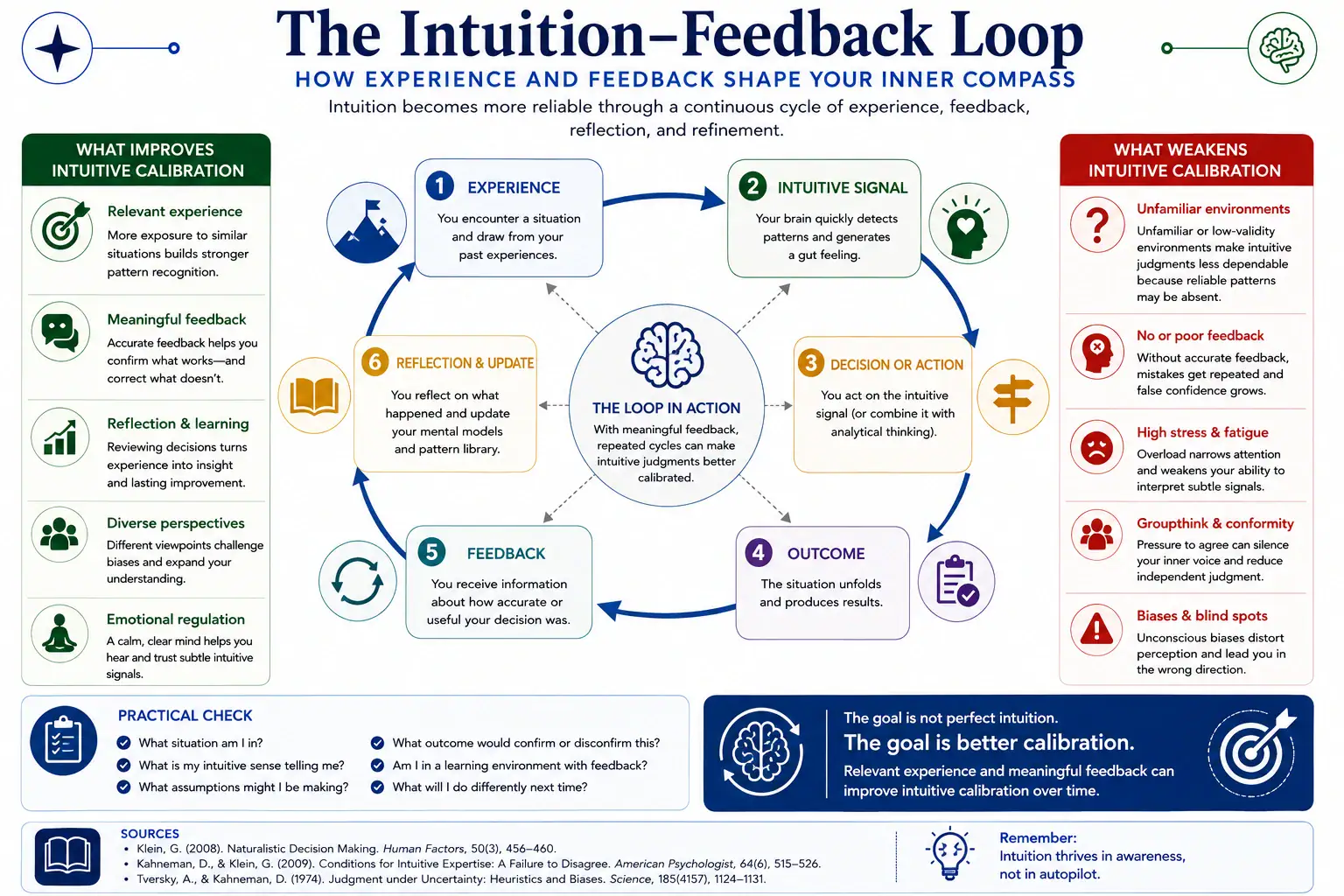
The loop is straightforward: encounter a situation, notice the intuitive signal, make or test a decision, observe what happens, obtain feedback, and update the mental model. Then repeat. Meaningful feedback is what prevents repetition from becoming false confidence.
This is also why keeping a decision journal can be useful. Write down the signal before the outcome is known. Record your confidence. Later, compare the prediction with reality. Without a record, memory can quietly rewrite the story so that we remember ourselves as having “known it all along.”
If you want a structured approach, the site also has an intuition calibration program built around measurement and feedback.
A practical five-question intuition check
Before acting on an important gut feeling, ask five questions.
1. Is this situation familiar? If you have relevant experience with similar cases, your intuitive recognition has a stronger foundation.
2. What information might my intuition be using? Look for observable cues, not just intensity of feeling.
3. What state am I in? Stress, sleep deprivation, anger, fear and excitement can alter perception and judgment.
4. What evidence would challenge this impression? Deliberately look for information that could prove your first interpretation wrong.
5. How will I learn from the outcome? Decide in advance what result would confirm, weaken or revise your judgment.
This approach preserves intuition’s speed without giving it immunity from evidence. It also fits the broader principle behind intuition in decision making: good judgment often comes from knowing when to use fast recognition and when to slow down.
Related: What Is Intuitive Thinking? · Intuitive Reasoning · Intuitive Processing · Intuitive Thinking Skills
Frequently asked questions about types of intuition
What are the three main types of intuition?
One influential psychological framework distinguishes holistic, inferential and affective intuition. Holistic intuition integrates multiple cues, inferential intuition reflects learned reasoning that has become automatic, and affective intuition relies strongly on feelings. This is a useful research framework, not a universal final taxonomy of every intuitive experience.
How many types of intuition are there?
There is no scientifically agreed single number. Different theories classify intuition in different ways. A widely used research framework proposes three broad types, while everyday language also describes domains such as somatic, social, creative, expert and spiritual intuition.
What is holistic intuition?
Holistic intuition is rapid judgment created by integrating multiple pieces of information into an overall pattern or Gestalt. It often feels like a sense that something fits, does not fit, or deserves attention before the individual cues can be fully articulated.
What is inferential intuition?
Inferential intuition is based on cognitive processes that were once more deliberate but became fast and automatic through practice. It is closely related to expert pattern recognition in familiar, learnable environments.
What is affective intuition?
Affective intuition is intuitive judgment in which feelings and emotional reactions play a central role. Those feelings can contain useful information, but they can also reflect mood, stress, fear, preference or bias, so they should not automatically be treated as accurate guidance.
Is somatic intuition scientifically recognized?
People clearly experience bodily sensations during judgment and emotion, but “somatic intuition” is better treated as a descriptive way of talking about body-based intuitive signals than as one universally established scientific category of intuition. The key question is how reliably those bodily cues correspond to relevant patterns and outcomes.
What is expert intuition?
Expert intuition is fast recognition based on extensive experience in a particular domain. It becomes most trustworthy when the domain contains learnable patterns and provides enough feedback for the expert to discover which cues predict meaningful outcomes.
Can a person have more than one type of intuition?
Yes. Different forms of intuition can operate in different contexts, and one decision can involve several processes at the same time. The categories describe ways of processing information, not fixed personality identities.
Which type of intuition is strongest?
No type is universally strongest. Reliability depends on context, relevant experience, pattern validity, emotional state and feedback. A familiar expert domain can support highly useful inferential intuition, while an unfamiliar or unpredictable environment may not.
Is intuition the same as instinct?
Not exactly. Instinct usually refers to more biologically prepared tendencies, while much human intuition involves learning, memory, emotion and rapid pattern recognition. Everyday language often mixes the terms, but they describe different ideas.
Is intuition always accurate?
No. Intuition can be accurate, especially when it reflects relevant experience in a learnable environment, but it can also be distorted by bias, poor information, stress, overconfidence and outdated patterns.
Can intuition be trained?
Yes, but training should mean more than listening inward. Useful intuition develops through relevant experience, attention to cues, deliberate reflection, outcome tracking and meaningful feedback. The goal is better calibration, not stronger certainty.
The most useful way to think about intuition
The question “What type of intuition do I have?” is interesting, but it is not the most important question. A better one is: What process is producing this signal, and how much reason do I have to trust it in this situation?
Holistic intuition can integrate a complex pattern. Inferential intuition can compress years of learning into rapid recognition. Affective intuition can surface emotional information before conscious explanation catches up. Somatic, social, creative and expert experiences show how these processes can appear in real life.
None of them deserves blind trust. None of them should be dismissed simply because it arrives quickly. The practical skill is calibration: learning when your inner signal reflects genuine pattern recognition, when it reflects noise, and when intuition and analysis should work together.
That is also the larger purpose of developing intuition: not to become certain without evidence, but to become faster at noticing meaningful signals and better at testing what they mean.
Research sources
1. Pretz, J. E., Brookings, J. B., Carlson, L. A., Humbert, T. K., Roy, M., Jones, M., & Memmert, D. (2014). Development and Validation of a New Measure of Intuition: The Types of Intuition Scale. Journal of Behavioral Decision Making, 27(5), 454–467. DOI: 10.1002/bdm.1820.
2. Kahneman, D., & Klein, G. (2009). Conditions for Intuitive Expertise: A Failure to Disagree. American Psychologist, 64(6), 515–526.
3. Klein, G. (2008). Naturalistic Decision Making. Human Factors, 50(3), 456–460.
4. Tversky, A., & Kahneman, D. (1974). Judgment under Uncertainty: Heuristics and Biases. Science, 185(4157), 1124–1131.