You know that moment when you walk into a room and instantly feel the atmosphere — before anyone says a word. Or when you meet someone and, within seconds, something in you decides: trust or distance. That quiet, wordless signal is relational intuition.

It’s not magic. It’s perception operating below language — your nervous system reading tone, rhythm, micro-expressions, and subtle shifts in presence faster than conscious thought can follow.
When you learn to recognize it consciously, relationships stop feeling confusing or draining. You begin to see what’s actually happening — not just what’s being said.
What Relational Intuition Actually Is
Relational intuition is your ability to sense another person’s state in real time — emotionally, physically, and behaviorally — without needing explicit information.
It’s how you notice:
- someone says “I’m fine,” but something feels off
- a conversation looks polite but feels tense
- a person seems confident, yet carries underlying hesitation
This isn’t guesswork. It’s fast pattern recognition built from experience, combined with interoception — your body’s ability to detect internal signals.
Why You Feel It Before You Think It
Your brain processes social signals in milliseconds: facial tension, voice micro-variations, posture shifts, timing of responses. These signals are integrated into a single output — a felt sense.
That’s why relational intuition doesn’t arrive as a sentence. It arrives as:
- a tightening in the chest
- a sense of ease or openness
- a subtle internal “yes” or “no”
By the time you try to explain it, the decision has already formed.
The Three Channels of Relational Awareness
Every interaction carries information across three layers. Most people only notice one.
- Body channel: physical sensations — tension, warmth, contraction, openness
- Emotional channel: sudden feelings that arise in you during interaction
- Context channel: the overall “atmosphere” — light, heavy, distant, engaged
When all three align, perception becomes extremely accurate.
Relational Intuition vs Projection
The biggest mistake is confusing intuition with your own emotional history.
| Relational Intuition | Projection | |
|---|---|---|
| Signal | Quiet, immediate, stable | Loud, repetitive, emotional |
| Source | Present interaction | Past experiences |
| Feeling | Curious, clear | Anxious, reactive |
| Effect | Better connection | Distortion or conflict |
A simple rule: if it escalates, it’s not intuition yet. True perception stabilizes when you pause.
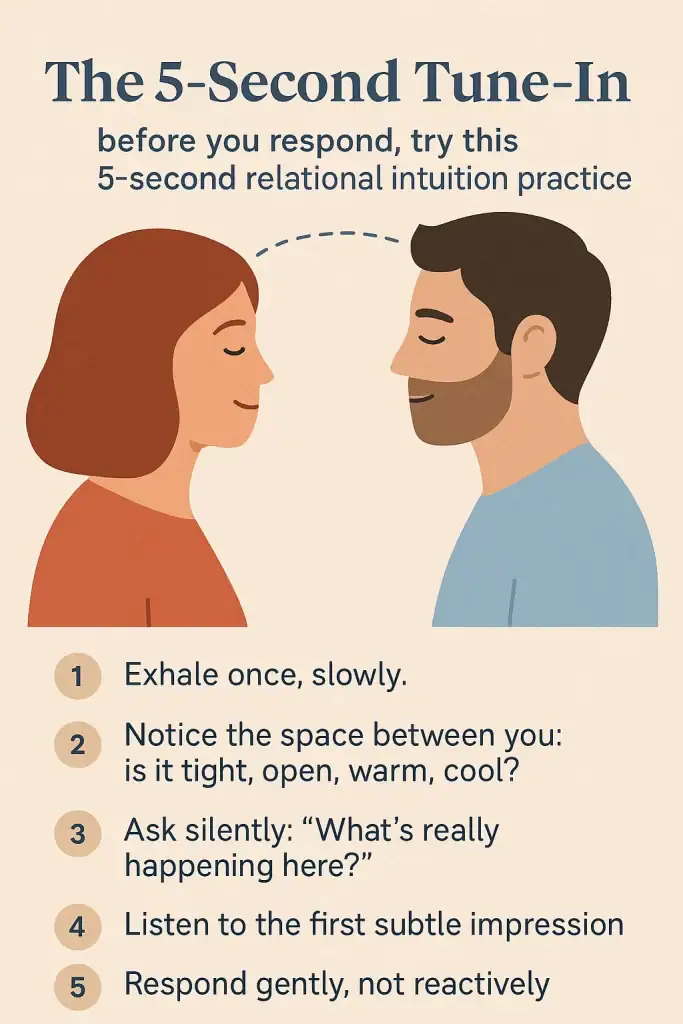
The 5-Second Reset That Changes Conversations
Before responding — especially in tension — do this:
- Slow exhale
- Notice your body (tight or open?)
- Sense the space between you
- Ask internally: “What’s really happening?”
- Respond from that awareness
This interrupts automatic reactions and activates perception.
Where Relational Intuition Matters Most
In relationships
You notice shifts before they become problems. That alone prevents most conflicts.
In leadership
You detect unspoken resistance, disengagement, or misalignment early — before it shows in results.
In decision-making
You sense whether something “fits” — even when data looks neutral.
Why Presence Is the Core Skill
Most people try to improve intuition by learning techniques. That’s secondary.
Relational intuition depends on presence.
When you’re distracted, anxious, or performing — your signal is noisy. When you’re grounded, your nervous system becomes a clear receiver.
How to Train Relational Intuition
- Start with yourself: notice your state before interactions
- Listen to tone, not just words
- Pause before interpreting
- Separate observation from judgment
- Recover after interactions (don’t carry чужі стани)
Over time, accuracy increases naturally. Not because you try harder — but because you distort less.
Where It Breaks
- over-identifying with others’ emotions
- assuming instead of observing
- trying to fix instead of understanding
These aren’t intuition problems. They’re regulation problems.
The Real Shift
Relational intuition isn’t about reading people better.
It’s about being present enough that reality becomes obvious.
When that happens:
- you stop overanalyzing people
- you feel alignment instantly
- you trust your perception without forcing it
Closing
You don’t need to learn relational intuition from scratch.
You already use it — constantly.
The real work is removing noise: anxiety, projection, distraction.
Once that clears, what’s left is simple:
You feel what’s real — before it’s explained.
To go deeper, explore Emotional Intuition and Intuition in Teams.
FAQ: Relational Intuition
What is relational intuition?
Relational intuition is the ability to sense another person’s emotional state, tension, openness, or intent before it is explained in words.
Is relational intuition real or just projection?
It can be either. Real relational intuition feels quiet, clear, and present-focused. Projection feels louder, more emotional, and usually comes from past patterns.
Can you improve relational intuition?
Yes. Presence, body awareness, emotional regulation, and post-interaction reflection all make relational intuition more accurate over time.
Why do I sense tension before anyone says anything?
Your nervous system picks up on tone, posture, breath, timing, and micro-expressions before your conscious mind turns those signals into words.