Estimated reading time: 19–22 minutes
You answer messages, finish work, buy groceries, move through conversations, and reach the end of the day without feeling that you fully participated in it. Nothing necessarily looks wrong from the outside. Yet inside, life can feel automatic—as though your routines are carrying you while your attention, preferences, and sense of presence trail behind.
You may feel like you are living on autopilot when repeated routines, cognitive overload, chronic stress, exhaustion, or emotional disengagement leave less attention available for conscious participation. Your behaviour continues, but fewer moments feel actively chosen or clearly registered. Autopilot can be a normal efficiency response; persistent unreality, significant memory disruption, or distress deserves professional assessment.
Living on autopilot does not automatically mean that you are lazy, ungrateful, depressed, dissociated, or living the wrong life. “Autopilot” is a description of an experience—not a diagnosis. The same feeling can arise through different mechanisms, and the response that helps depends on which mechanism is strongest.

What does living on autopilot feel like?
Living on autopilot often feels less dramatic than people expect. You may still be responsible, productive, sociable, and capable. The unusual part is not what you are doing; it is how little of it feels consciously inhabited.
You might notice that:
- days or weeks seem to blur together;
- you complete familiar tasks without remembering many details;
- you respond to requests before noticing whether you want to agree;
- conversations feel scripted or slightly distant;
- you remain productive but emotionally uninvolved;
- free time feels empty unless something tells you what to do;
- new experiences briefly wake you up before routine takes over again;
- you keep waiting to feel like yourself, yet cannot identify what is missing.
Occasional automatic behaviour is normal. You do not need full conscious attention to brush your teeth, make familiar coffee, or follow a well-practised route. Habit research describes habits as responses that become increasingly automatic through repetition in recurring contexts.[1] As automaticity develops, an action can require less conscious effort.[2]
The problem begins when automaticity moves beyond useful routines and starts dominating experiences you want to feel, remember, or choose. You are not merely saving effort on familiar actions; you are receiving less information from your own life.
This can overlap with feeling disconnected from yourself. It can also resemble watching your life instead of living it. The overlap matters, but the concepts are not identical. Autopilot specifically describes the growing dominance of automatic patterns over deliberate participation.
Why do I feel like I’m living on autopilot?
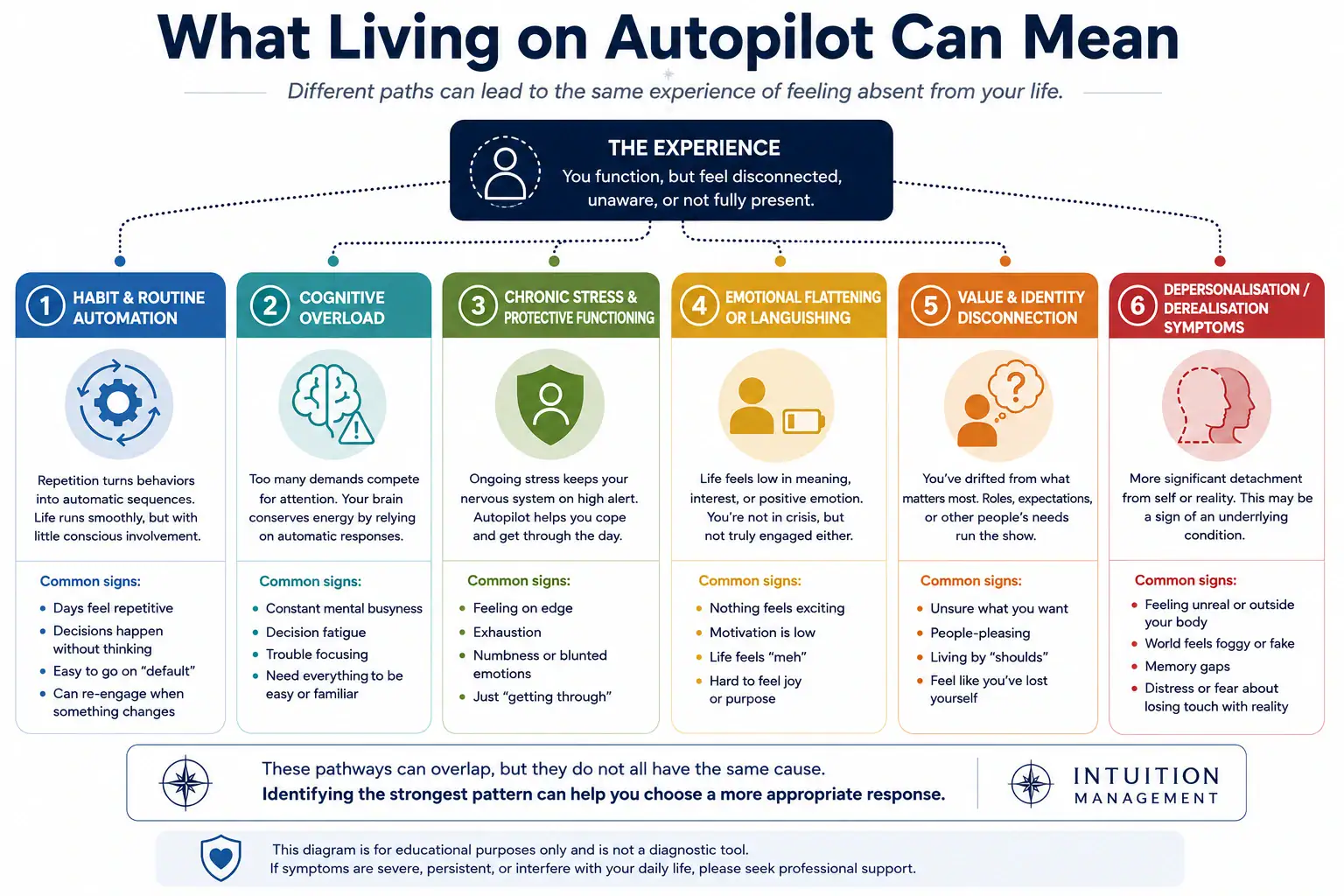
There is rarely one universal cause. The experience can emerge from useful habit, excessive repetition, cognitive overload, chronic stress, emotional flattening, fragmented attention, value disconnection, or more significant forms of detachment. Several pathways may operate at once.
1. Repetition has automated too much of your day
Repeated behaviour in a stable context becomes easier to initiate and requires less deliberation. That is helpful when the behaviour supports you. It becomes limiting when the same cues trigger the same responses across most of the day.
You wake to the same alarm, check the same notifications, follow the same route, perform the same role, answer the same kinds of demands, and end the evening with the same form of distraction. Nothing has to be terrible for the day to feel absent. It may simply contain too few moments that require you to notice, interpret, and choose.
A routine preserves stability. Autopilot dominates when stability leaves little room for new feedback.
2. Cognitive overload is conserving conscious choice
When your attention is occupied by unfinished tasks, interruptions, decisions, social obligations, and anticipated problems, familiar responses become easier than active evaluation. This does not mean your brain literally switches consciousness off. It means deliberate processing has become expensive.
Research on acute stress has found average impairments in working memory and cognitive flexibility, while effects on inhibition are more nuanced.[3] In ordinary life, that can make it harder to hold options in mind, shift perspective, pause before responding, or recognise that a default response no longer fits.
You may therefore choose what is familiar, urgent, expected, or easiest—not because it is what you want most, but because it requires the least additional processing. If your brain always feels switched on, automatic functioning may be carrying far more of your day than you realise.
3. Chronic stress has turned functioning into protection
Under prolonged strain, a person may continue completing responsibilities while reducing emotional engagement with them. Automatic behaviour can help preserve performance when there is little spare capacity for curiosity, reflection, or preference.
This is why someone can appear competent while privately feeling absent. They are not necessarily failing to cope. Their coping may have become so efficient that it conceals how narrow their experience has become.
It is important not to universalise this explanation. Not every routine is a trauma response, and not every automatic day is a sign of nervous-system dysregulation. But when functioning feels protective—when you are mainly “getting through” rather than participating—stress deserves attention as a possible contributor.
4. Emotional flattening has reduced the feedback you receive
Sometimes life feels neither acutely painful nor meaningfully alive. Events happen, but they generate weak emotional contrast. Success brings little satisfaction. Rest brings little restoration. Free time offers little attraction. The result can feel like a low-volume existence.
The concept of languishing describes low positive functioning and reduced well-being rather than a specific diagnosis. Keyes’ mental-health-continuum research distinguished languishing from major depressive episodes, while showing that the two can coexist.[4]
If you are feeling emotionally numb or if everything feels meaningless lately, your autopilot may be reinforced by weak emotional feedback. It is harder to make personally meaningful choices when experiences do not produce clear internal signals.
5. Your roles are choosing before you do
Many automatic responses are social rather than mechanical. You may instantly become the reliable employee, available friend, accommodating partner, competent parent, or person who never creates difficulty.
These roles can be valuable. The problem appears when role expectations consistently act before personal awareness. You say yes before checking your capacity. You choose what maintains harmony before noticing your preference. You perform what is expected and later wonder why your life no longer feels like yours.
This does not necessarily mean your preferences disappeared. Access to them may have weakened because your choices stopped generating personal feedback. The article Why Don’t I Know What I Want Anymore? explains how attention, interpretation, choice, and feedback help turn experience into usable preference information.
6. Your attention is continuously somewhere else
You can be physically present while your attention remains attached to the next task, the previous conversation, a notification, a possible problem, or an imagined future response. When attention is repeatedly divided, experiences may be processed only enough to complete them—not enough to feel integrated.
The issue is not simply screen time. A phone is one route into fragmented attention, but internal checking can be just as persistent: reviewing, anticipating, comparing, rehearsing, monitoring, and preparing. The present moment becomes a corridor to the next obligation.
You do not need to notice every detail. You need enough undivided attention for some experiences to become distinct, meaningful, and retrievable.
7. You may be experiencing more significant detachment
Ordinary automaticity is not the same as depersonalisation or derealisation. The NHS describes depersonalisation as feeling outside yourself or observing your actions, feelings, or thoughts from a distance. Derealisation involves experiencing the world as unreal, lifeless, or foggy.[5]
Consider professional support when the experience includes persistent unreality, feeling outside your body, significant or unexplained memory gaps, intense fear about losing touch with reality, or disruption to work, relationships, sleep, or safety.
Autopilot is a subjective description, not a clinical diagnosis. This article can help you organise your experience, but it cannot determine whether you have depression, burnout, a dissociative disorder, another mental-health condition, a medical issue, or a medication-related effect.
The Autopilot Spectrum™
It is useful to think of autopilot as a spectrum rather than a single state. At one end, automaticity supports life. At the other, detachment becomes persistent, distressing, and disruptive.

Level 1: Useful automaticity
Familiar actions run efficiently while you remain connected to your goals, values, and experience. You can interrupt the routine when circumstances change.
Level 2: Routine dominance
Much of the day is predictable and requires little awareness. You can re-engage when something matters, but you rarely create that re-engagement deliberately.
Level 3: Reduced participation
You continue functioning, but fewer moments feel chosen, emotionally registered, or memorable. Time starts to blur, and life feels increasingly mechanical.
Level 4: Protective functioning
Automatic behaviour may be helping you cope with overload, stress, exhaustion, or emotional strain. External functioning remains stronger than inner connection.
Level 5: Distressing detachment
You may experience persistent unreality, self-detachment, major memory disruption, fear, or meaningful impairment. Professional assessment is appropriate.
The Autopilot Spectrum™ is an educational framework developed by Intuition Management. It is not a diagnostic scale or clinical assessment.
The Autopilot Adaptation Loop™
Autopilot can strengthen itself. The less attention an experience receives, the less usable feedback it produces. With less feedback, future choices feel less personal. Familiar responses then become even more attractive.

- A repeated demand appears. The cue may be a message, meeting, household task, conflict, request, or familiar feeling.
- The most practised response activates. You answer, agree, avoid, distract yourself, work harder, or move to the next task.
- Conscious attention decreases. The response feels safe, efficient, or simply easier than reconsidering it.
- The experience is encoded less distinctly. Fewer details, sensations, and emotional differences become memorable.
- You receive less usable feedback. You learn less about what felt energising, wrong, meaningful, draining, or relieving.
- Felt agency becomes weaker. Choices feel less personal because their connection to your values and responses is unclear.
- Automatic patterns gain more influence. With little new information available, the familiar response remains the easiest one to repeat.
This is why thinking harder does not always end autopilot. Analysis can describe the pattern, but description alone does not generate new experiential evidence. To weaken the loop, you need small interruptions that create attention, choice, and feedback.
Why do the days blur together?
When someone says, “The week disappeared,” they may be describing weak differentiation rather than a literal loss of time. The days happened, but fewer parts became psychologically distinct.

Repetition creates fewer landmarks
When days contain similar places, tasks, conversations, and emotional states, there are fewer distinctive markers separating one period from another. This is not proof that nothing meaningful happened. It means fewer events stood out strongly enough to organise memory around them.
Divided attention weakens registration
An experience can occur without receiving enough attention to become memorable in detail. You may complete the conversation, journey, meal, or task while your attention is divided across planning, checking, worrying, and responding. Experimental studies have found that dividing attention during encoding can substantially reduce later recall and recognition, supporting the narrower claim that distracted experiences may be registered less completely.[10]
Few moments are tagged as significant
Novelty is not the only source of memory, but contrast helps. A deliberate choice, sensory detail, emotional shift, meaningful conversation, or unexpected observation can become a marker. When little receives this kind of attention, time can feel continuous and unstructured. Research on event segmentation also suggests that organising continuous activity into meaningful events supports later memory, including over longer delays.[11]
Limited reflection reduces integration
Reflection helps connect isolated moments into a personal story. Without a pause to review what mattered, surprised you, relieved you, or drained you, the day may remain a collection of completed actions rather than an integrated experience.
Ordinary blurred days should not be confused with dissociative amnesia. Significant memory gaps—especially for important personal information or events—deserve professional attention.[5]
Why productive people may stay on autopilot for so long
Performance is not the same as participation. You can meet deadlines, care for others, maintain routines, solve problems, and appear calm while feeling increasingly absent from your own experience.
Competence can hide disconnection because the behaviours that keep life functioning also prevent the problem from becoming visible. You receive praise for reliability. Other people continue depending on you. The system works—so there is little external pressure to ask how it feels from inside.
This is especially common when identity becomes organised around being capable. Slowing down may feel irresponsible. Asking what you want may feel indulgent. Changing a routine may create more uncertainty than continuing it. Autopilot then appears to be the responsible choice, even while it gradually reduces your contact with meaning and preference.
The first sign is often not failure. It is the quiet realisation that you have been successfully managing a life you no longer feel fully inside.
What living on autopilot can mean
The same surface experience can emerge from different pathways. Identifying the strongest one helps you choose a response that fits.
| Experience | Typical pattern | What may help |
|---|---|---|
| Healthy habit | Automatic behaviour is limited to familiar tasks, supports your goals, and is easy to interrupt. | Keep the useful routine. Add deliberate attention only where it matters. |
| Routine dominance | Days are predictable, engagement comes and goes, and you rarely step out of default mode. | Create small variations, memory markers, and preference-based choices. |
| Cognitive overload | Mental busyness, decision fatigue, task switching, and difficulty prioritising narrow your choices. | Reduce competing demands, externalise tasks, and create protected attention. |
| Languishing | Life feels flat, low in vitality, or weak in meaning without necessarily producing acute crisis. | Restore engagement, connection, challenge, rest, and meaningful feedback. |
| Burnout | In the occupational context, chronic workplace stress may involve exhaustion, mental distance from work, and reduced professional efficacy. | Address workload, recovery, boundaries, support, and workplace conditions—not only attention exercises.[6] |
| Depression | Possible signs include persistent low or empty mood, hopelessness, loss of interest or pleasure, fatigue, concentration problems, sleep or appetite changes, and impaired functioning. | Seek professional assessment when symptoms persist, worsen, or interfere with daily life.[7] |
| Depersonalisation or derealisation | You may feel outside yourself, detached from your thoughts or actions, or experience the world as unreal or foggy. | Professional assessment is appropriate, particularly when symptoms are persistent or distressing.[5] |
The categories can overlap, and only a qualified professional can assess a clinical condition. The purpose of comparison is not to label yourself. It is to avoid using one generic solution for several different problems.
The paradox of autopilot
Autopilot is not the enemy. It allows familiar actions to run without consuming all your attention. It can conserve effort, preserve routines, and help life continue during demanding periods.
The quiet cost appears when the same efficiency spreads into moments that require contact, meaning, judgment, or personal choice.
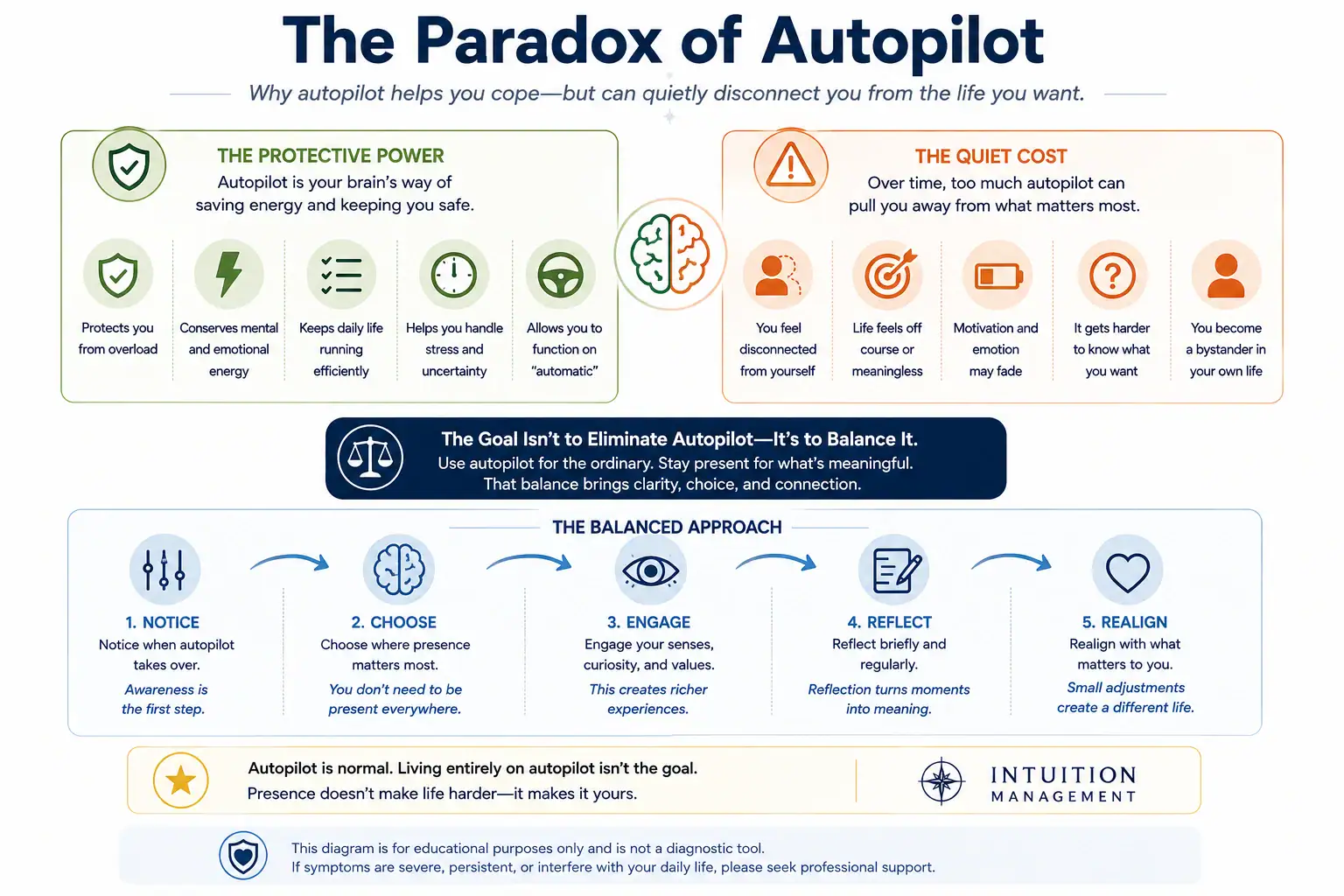
The goal is not to eliminate automaticity. That would make ordinary life unnecessarily exhausting. The goal is to use autopilot for what is genuinely routine while restoring attention to what carries meaning, consequence, relationship, or identity.
A useful question is not, “How do I stay present all day?” It is:
Where would ten percent more conscious participation create the most valuable feedback?
That might be the first thirty minutes of the morning, one meal, a conversation with someone important, the moment before you say yes, the transition out of work, or the way you spend the first part of free time.
Why “just be more mindful” may not be enough
Mindfulness practices can support attention and awareness, but evidence for cognitive effects varies across outcomes, populations, and study quality.[8] More importantly, a complex autopilot pattern may not be caused by a simple failure to notice the present.
Generic advice can fail when:
- you are trying to become present while remaining chronically overloaded;
- you notice your experience, but your environment still provides no meaningful choice;
- you can sense your body but cannot interpret what you need;
- presence feels uncomfortable after prolonged stress or avoidance;
- you need sleep, medical care, therapy, boundaries, social support, or environmental change;
- the real problem is persistent depression, burnout, anxiety, dissociation, illness, or a medication effect.
Attention is important, but attention alone is not always the intervention. Presence becomes useful when it reconnects you with feedback and gives you enough agency to respond.
How to stop living on autopilot
You do not need to redesign your whole life. Large changes made only to create intensity can produce disruption without restoring connection. Begin with a small zone in which attention and choice are realistically available.
The Presence Recovery Ladder™
- Identify one automatic zone. Choose a specific part of the day: waking, commuting, meals, work transitions, conversations, evenings, or phone use.
- Interrupt one step. Change a cue before the entire sequence activates. Pause before opening the first app, sit somewhere different, take another route, or leave one minute between tasks.
- Restore sensory contact. Notice one visual detail, one sound, one bodily sensation, and one environmental condition. This is grounding, not a performance test.
- Make one deliberate micro-choice. Choose music or silence, walking or sitting, replying now or later, continuing or pausing, company or solitude.
- Register the response. Did the choice create relief, energy, interest, calm, resistance, irritation, or nothing noticeable? Every response is information.
- Generate real feedback. Repeat the choice or test a variation. Do not demand an immediate revelation. Look for patterns across several experiences.
- Expand participation gradually. Once one zone becomes more conscious, move to another. Presence becomes sustainable when it is selective rather than total.
This approach is not about making every moment vivid. It is about restoring the feedback loop through which you recognise what affects you, what matters, and what you want to do next.
Use the four-question presence check
When you notice yourself moving automatically, ask:
- What am I doing? Name the actual behaviour without judgment.
- What is carrying me? Habit, urgency, expectation, avoidance, overload, or deliberate choice?
- What signal is available? Tension, relief, energy, fatigue, interest, resistance, or neutrality?
- What is one available choice? Not the perfect choice—one real adjustment.
You may discover that the appropriate choice is to continue the routine. Deliberate participation does not require constant change. Sometimes it means consciously confirming that the automatic action still serves you.
The Seven-Day Deliberate Participation Experiment™
This one-week practice is not a promise that autopilot will disappear in seven days. It is a learning experiment designed to create clearer personal feedback.

Day 1: Notice
Identify one sequence that usually happens automatically. Do not change it yet. Notice the cue, the first action, and the point at which you stop actively choosing.
Day 2: Interrupt
Change one small element in the sequence. The goal is not disruption for its own sake. It is to make the pattern visible enough for attention to return.
Day 3: Sense
Give one ordinary activity undivided sensory attention. Notice what you see, hear, feel, smell, or taste. Record which details would normally have disappeared.
Day 4: Choose
Make one low-stakes preference-based choice before defaulting to efficiency, expectation, or habit. Then notice whether the result feels more like you.
Day 5: Connect
Have one interaction without simultaneously checking, planning, or preparing your next response. Notice whether the moment feels easier, awkward, energising, or more real.
Day 6: Create a memory marker
Do one small distinctive thing that separates the day from the others. It might be a new route, a photograph, an unfamiliar meal, a handwritten note, a meaningful conversation, or ten minutes in a new place.
Day 7: Review
Look back and ask:
- What felt more vivid?
- What remained flat?
- What produced relief or resistance?
- Which routine deserves redesign?
- Which practice should continue?
- Which symptom may require professional support?
The experiment succeeds when it gives you better information—not when every day feels transformed.
What not to do when life feels automatic
Do not interpret every routine as evidence that your life is wrong
Useful habits protect time and attention. Keep the routines that support your health, responsibilities, and values.
Do not make a major decision only to create intensity
Quitting, moving, ending a relationship, or radically changing your life can create novelty without resolving the pattern that made you feel absent. Major decisions deserve more than a need to feel something different.
Do not force gratitude or emotional excitement
Trying to manufacture the “correct” feeling can make you monitor yourself even more. Begin with accurate observation, including neutrality.
Do not replace autopilot with constant stimulation
More content, noise, novelty, and checking can make a day feel busier while further fragmenting attention.
Do not analyse the pattern without creating new experience
Insight matters, but the system needs feedback. One small deliberate choice may teach you more than another hour of internal debate.
Do not use this article to diagnose yourself
Autopilot overlaps with many ordinary and clinical experiences. Seek qualified support when symptoms are persistent, severe, frightening, or disruptive.
When professional support may help
Consider speaking with a healthcare or mental-health professional when the experience:
- persists, intensifies, or causes significant distress;
- interferes with work, relationships, sleep, self-care, or safety;
- includes persistent hopelessness or loss of interest and pleasure;
- includes major or unexplained memory gaps;
- involves feeling unreal, outside yourself, or detached from reality;
- began after trauma, illness, medication changes, or substance use;
- is accompanied by thoughts of self-harm or suicide.
NIMH advises seeking professional help for severe or distressing symptoms that persist, including loss of interest, concentration difficulties, and inability to complete usual tasks.[9] A clinician can also help consider physical health, sleep, medications, substances, mood, anxiety, trauma, and other factors that an article cannot evaluate.
Urgent safety note: If you may harm yourself or someone else, feel unable to stay safe, or are experiencing a mental-health emergency, contact local emergency services or an appropriate crisis service now.
Frequently asked questions
Why do I feel like I’m living on autopilot?
You may feel like you are living on autopilot when routines, overload, stress, emotional flattening, divided attention, or role expectations reduce conscious participation. Your behaviour continues, but fewer moments feel actively chosen, clearly registered, or connected to personal meaning.
Is living on autopilot normal?
Some automatic behaviour is normal and useful. Habits allow familiar actions to require less effort. Autopilot becomes a concern when it dominates experiences you want to inhabit, weakens your sense of choice, causes distress, or includes persistent unreality or significant memory problems.
Is living on autopilot a sign of depression?
It can overlap with depression, but it does not prove that you are depressed. Depression may involve persistent low or empty mood, hopelessness, loss of interest or pleasure, fatigue, sleep or appetite changes, concentration problems, and impaired functioning. A qualified professional can assess your symptoms.
Is autopilot the same as dissociation?
No. Ordinary autopilot often involves habits and reduced attention while you remain grounded in yourself and reality. Dissociative experiences may include feeling outside yourself, observing yourself from a distance, significant memory gaps, or experiencing the world as unreal or foggy.
Why do my days blur together?
Days may blur when they contain high repetition, divided attention, few distinctive markers, and little reflection. The days still happen, but fewer moments receive enough attention, meaning, contrast, and integration to become clearly differentiated memories.
Can chronic stress make me feel absent from my life?
Yes. Prolonged strain can narrow attention toward demands and familiar responses, leaving less capacity for curiosity, emotional engagement, and reflective choice. However, stress is only one possible pathway, and persistent or severe symptoms deserve professional assessment.
How do I stop going through the motions?
Start with one small automatic zone. Interrupt one step, restore sensory attention, make a low-stakes deliberate choice, and observe the response. Repeated feedback can gradually rebuild felt agency more effectively than demanding that you remain fully present all day.
Can I feel present again?
Many people can increase presence by reducing overload, changing automatic sequences, restoring attention, making preference-based choices, reconnecting with meaningful relationships, and seeking appropriate support. Progress may be gradual, especially when stress, depression, trauma, illness, or exhaustion is involved.
When should I seek professional help?
Seek help when detachment is severe, persistent, frightening, or disruptive; when you experience significant memory gaps or unreality; when mood symptoms last or worsen; or when you have thoughts of self-harm. A professional can assess causes that self-help content cannot.
Presence is not a feeling you must force
You do not return to your life by demanding a dramatic emotional awakening. Presence often returns more quietly: you notice the moment before a default response, recognise that something drains you, choose a different pace, remember a conversation more clearly, or feel a small preference become available again.
These moments matter because they restore feedback. Feedback rebuilds agency. Agency makes future choices more personal. Over time, your life may begin to feel less like a sequence you manage and more like an experience you are participating in.
You do not need to eliminate autopilot. Let it carry the ordinary. Bring conscious attention back to what shapes your relationships, direction, memory, and sense of self.
Next step: Use The Personal Signal Decoder to identify the internal signals that become easier to notice when automatic patterns loosen. You can also explore how to feel like yourself again when disconnection has lasted longer than expected.
References
- Wood W, Rünger D. Psychology of Habit. Annual Review of Psychology. 2016.
- Lally P, Wardle J, Gardner B. Experiences of habit formation: a qualitative study. Psychology, Health & Medicine. 2011.
- Shields GS, Sazma MA, Yonelinas AP. The effects of acute stress on core executive functions: a meta-analysis and comparison with cortisol. Neuroscience & Biobehavioral Reviews. 2016.
- Keyes CLM. The mental health continuum: from languishing to flourishing in life. Journal of Health and Social Behavior. 2002.
- NHS. Dissociative disorders.
- World Health Organization. Burn-out an occupational phenomenon: International Classification of Diseases.
- National Institute of Mental Health. Depression.
- Lao SA, Kissane D, Meadows G. Cognitive effects of mindfulness-based stress reduction and mindfulness-based cognitive therapy: a systematic review of neuropsychological outcomes. 2016.
- National Institute of Mental Health. Caring for Your Mental Health.
- Craik FIM, Govoni R, Naveh-Benjamin M, Anderson ND. The effects of divided attention on encoding and retrieval processes in human memory. Journal of Experimental Psychology: General. 1996;125(2):159–180.
- Flores S, Bailey HR, Eisenberg ML, Zacks JM. Event segmentation improves event memory up to one month later. Journal of Experimental Psychology: Learning, Memory, and Cognition. 2017;43(8):1183–1202.
Editorial note: This article was prepared by the Intuition Management Editorial Team for educational purposes. It is not a diagnosis, treatment plan, or substitute for personalised medical or mental-health care.