One day you realize something strange. Do I feel emotionally numb?
The things that used to matter still matter intellectually—but you no longer feel them.
Good news does not excite you. Bad news does not upset you. The people you love have not necessarily changed, yet your emotional connection to them feels muted. Music, hobbies, free time, and achievements seem strangely flat.
It can feel frightening. You may wonder whether you are becoming cold, losing your personality, or no longer capable of caring.
This experience is often called emotional numbness. But the phrase can be misleading.
Emotional numbness does not always mean that emotion has disappeared. Sometimes it means your brain has reduced your conscious access to emotional signals because the overall system has been carrying more information, pressure, and uncertainty than it can comfortably process.
Direct Answer
Emotional numbness is a state in which emotions feel muted, distant, or difficult to access. It can occur during prolonged stress, cognitive overload, burnout, depression, trauma-related responses, medication effects, or other health conditions. It is not proof that you have stopped caring, and it deserves professional evaluation when it is persistent, severe, or disruptive.
This article explains emotional numbness through the Intuition Management lens of signal availability: how the brain decides which internal signals reach conscious awareness, why that access can narrow under sustained load, and what conditions can support its return.
What Is Emotional Numbness?
Emotional numbness is a noticeable reduction in the intensity, clarity, or accessibility of emotional experience.
People often describe it as:
- “I know I should feel happy, but I do not.”
- “Nothing excites me anymore.”
- “I cannot cry even when I want to.”
- “Everything feels flat.”
- “I feel disconnected from the people around me.”
- “It feels as though I am observing my life rather than fully inhabiting it.”
These descriptions are not identical, but they share a common pattern: the emotional system may still be responding, while the conscious experience of that response feels weaker or farther away.
Your brain can continue recognizing that a person matters, detecting a threat, remembering a loss, or evaluating a choice even when the emotional force attached to that information becomes muted.
Canonical Definition
Emotional numbness is a reduction in conscious emotional signal availability. It may emerge when stress, illness, medication, trauma-related processes, depression, burnout, or sustained cognitive demand alter how emotional information is processed and prioritized.
Why Emotional Numbness Happens
Can chronic stress make you feel emotionally numb?
Yes. Chronic stress can narrow attention, disrupt sleep, increase allostatic load, and shift mental resources toward maintaining stability. This can make both positive and negative emotions feel less accessible, although stress is only one possible cause.
There is no single cause of emotional numbness. It is a description of experience, not a diagnosis.
Possible contributors include prolonged stress, cognitive overload, burnout, depression, anxiety, trauma-related responses, grief, sleep disruption, substance use, some medications, and physical or neurological conditions. More than one factor may be present at the same time.
The signal-processing model in this article offers one useful explanation for a common pathway: when the brain is repeatedly required to manage urgent tasks, uncertainty, conflict, interruptions, and self-monitoring, it may allocate fewer resources to rich emotional awareness.
That does not prove that all numbness is caused by overload. It means overload can be one part of the picture.
The brain prioritizes stability before emotional richness
Imagine driving through dense fog. You stop admiring the landscape because attention narrows toward staying on the road. Your capacity to appreciate beauty has not vanished; it has been deprioritized while the situation demands tighter control.
A similar shift can happen during prolonged psychological strain. The nervous system may favor monitoring, prediction, and basic functioning over curiosity, pleasure, and emotional nuance.
Emotional experience requires processing capacity
Conscious emotion is not a simple switch. The brain must integrate bodily sensations, memories, context, expectations, attention, and meaning. When working memory and attentional resources are heavily occupied, the conscious emotional result can become less vivid.
The feeling may be quieter not because the underlying value disappeared, but because the system has less capacity to amplify it.
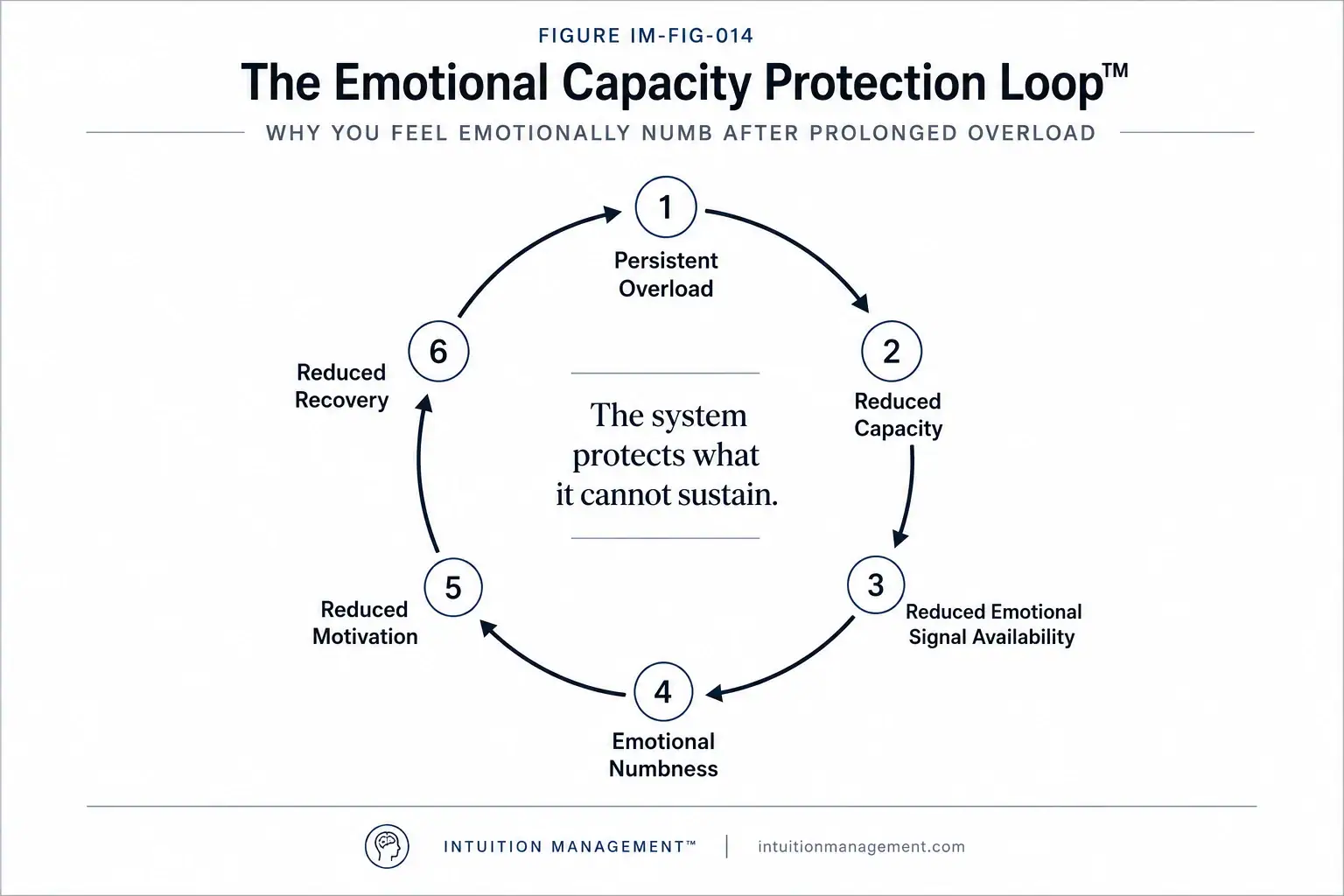
The Emotional Capacity Protection Loop
A common overload pathway can be represented as a feedback loop:
Persistent stress
        ↓
Increasing cognitive load
        ↓
Reduced emotional signal access
        ↓
Feeling emotionally numb
        ↓
Lower motivation and engagement
        ↓
Fewer restorative experiences
        ↓
Less available capacity
        ↓
Persistent stress
This loop is a conceptual model, not a clinical law. Its value is that it explains why numbness can continue after the original pressure begins to ease.
When activities no longer feel rewarding, people often stop doing the very things that might gently support recovery. They may also interpret the numbness as laziness, coldness, or proof that nothing matters. That interpretation adds another layer of stress.
Executive Insight
Emotional numbness is rarely best understood as a moral failure. It is often a signal that the system producing emotional awareness has become constrained, disrupted, or overprotective.
Emotional Numbness Is Not the Same as Depression
Emotional numbness can occur with depression, but the two terms are not interchangeable.
| Emotional numbness | Depression |
|---|---|
| Describes emotions feeling muted, distant, or inaccessible. | A broader mental health condition involving a pattern of symptoms over time. |
| Positive and negative feelings may both feel reduced. | May include persistent low mood, hopelessness, guilt, loss of interest, sleep or appetite changes, and impaired functioning. |
| Can fluctuate with stress, recovery, environment, medication, or other factors. | Requires clinical assessment based on the complete pattern, duration, and impact of symptoms. |
| May exist as one symptom within several different conditions. | May include emotional numbness, but numbness alone does not establish depression. |
A qualified healthcare professional can help distinguish overload-related emotional blunting from depression, trauma-related symptoms, medication effects, or other causes.
Emotional Numbness vs. Burnout
Can burnout cause emotional numbness?
Burnout can contribute to emotional numbness, especially when prolonged demands produce exhaustion and detachment. However, numbness can also occur outside work and may have psychological, medical, medication-related, or neurological causes.
Burnout is commonly associated with prolonged demands, exhaustion, reduced effectiveness, and detachment—especially in work or caregiving contexts.
Emotional numbness can appear during burnout, but it can also occur outside it. A person may feel numb after ongoing conflict, chronic uncertainty, grief, illness, relentless digital stimulation, or sustained responsibility without genuine recovery.
High demands
      ↓
Persistent stress
      ↓
Cognitive overload
      ↓
Emotional exhaustion
      ↓
Emotional numbness
      ↓
Reduced recovery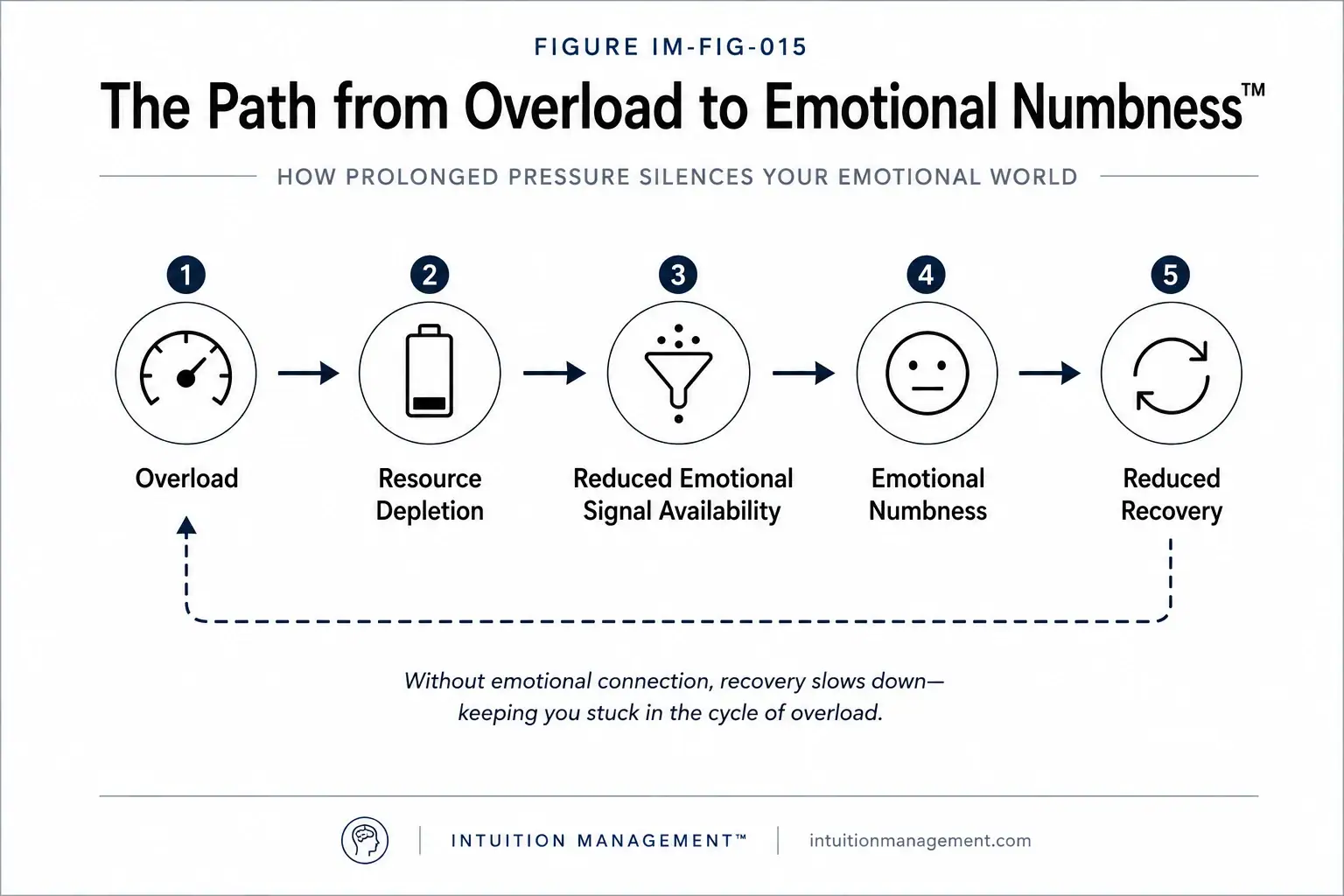
If many ordinary tasks already feel unusually demanding, the related guide Cognitive Overload Recovery explains how limited mental bandwidth can affect attention, motivation, and daily functioning.
Emotional Numbness, Anhedonia, Dissociation, and Suppression
Several experiences can sound similar to emotional numbness while involving different mechanisms. Clear distinctions improve search usefulness and reduce the risk of interpreting one symptom as a diagnosis.
| Experience | What it usually describes | How it differs from emotional numbness |
|---|---|---|
| Emotional numbness | Emotions feel muted, distant, or difficult to access. | A broad description of reduced emotional experience that can occur for many reasons. |
| Anhedonia | Reduced interest or pleasure in activities that were previously rewarding. | Primarily concerns reward and pleasure; emotional numbness may also affect sadness, attachment, anger, or grief. |
| Dissociation | Disruptions in awareness, memory, identity, embodiment, or perception. | Can include numbness, but is a broader set of experiences that may involve feeling unreal or detached from oneself or surroundings. |
| Emotional suppression | Consciously or habitually inhibiting the expression or awareness of emotion. | Refers to regulation or avoidance; numbness can occur without a deliberate attempt to suppress feelings. |
| Burnout-related detachment | Emotional distancing associated with prolonged demands and exhaustion. | Often linked to a specific role or context, while numbness may affect many areas of life. |
Reality Alignment
These categories can overlap. The Signal vs. Noise model explains one pathway through overload and reduced emotional access, but it does not replace assessment for depression, trauma-related conditions, medication effects, substance use, or medical and neurological causes.
Why You Can Feel Nothing and Still Care Deeply
One of the most painful fears is that muted emotion means you have stopped loving, valuing, or caring.
But values, attachments, behavior, and conscious feeling are related without being identical.
You may still protect someone, keep a promise, notice what they need, or make a difficult decision in their interest even when the expected warmth is hard to access.
That distinction matters because a common secondary loop looks like this:
Muted feeling
      ↓
“I must not care”
      ↓
Fear and self-monitoring
      ↓
More cognitive load
      ↓
Even less access to feeling
A more accurate question may be: Why has my access to emotional signals become weaker?
This connects directly with Signal vs. Noise: the signal may still exist even when the filtering system makes it harder to notice.
Why Forcing Yourself to Feel Usually Does Not Work
When emotion feels absent, people often try to create a stronger stimulus: more entertainment, more scrolling, a dramatic trip, a motivational speech, or pressure to feel grateful.
The attempt can backfire. Emotional awareness is usually an output of the whole system, not a button activated by effort.
Emotional numbness
        ↓
Trying harder to feel
        ↓
Frustration and self-monitoring
        ↓
Additional cognitive load
        ↓
Less emotional availability
This does not mean you should avoid meaningful activity. It means the purpose of activity should not be to test whether you are “fixed.” Constantly checking for emotion turns recovery into another performance demand.
Recovery is more likely to begin when the system feels less examined, less pressured, and less overloaded.
The Emotional Signal Spectrum
Emotional awareness is not simply on or off. It shifts with stress, sleep, safety, attention, health, and context.
Richer signal access
────────────────────────
Joy • curiosity • grief • affection • motivation

Moderate signal access
────────────────────────
Calm • contentment • quiet interest • neutrality

Reduced signal access
────────────────────────
Flatness • detachment • low motivation • numbness

Severely constrained access
────────────────────────
Minimal awareness • protective shutdown • disconnection
The goal is not constant emotional intensity. Healthy functioning involves flexibility: being able to feel, regulate, recover, and respond appropriately rather than remaining permanently at either extreme.
Why Small Positive Moments Stop Feeling Rewarding
Many people first notice numbness when ordinary pleasures lose their emotional color.
- Music sounds technically good but does not move you.
- A meal is pleasant but not satisfying.
- A conversation holds your attention but does not create connection.
- An achievement produces relief rather than joy.
- Free time feels empty rather than restorative.
One explanation is that subtle positive signals require spare attentional capacity. Under persistent strain, urgent or threat-related information receives priority while low-intensity rewards are filtered more aggressively.
This can overlap with the experiences explored in Why Can’t I Enjoy My Free Time Anymore?, Why Does Rest Feel Like Wasted Time?, and Why Does Calm Feel Unfamiliar?.
Why Reward Processing and Emotional Salience Can Become Quieter
The brain does not assign equal importance to every signal. It uses salience to determine what deserves attention and reward processing to estimate what is worth approaching, repeating, or pursuing.
During prolonged stress, attentional resources may become biased toward monitoring problems, preventing mistakes, and preparing for what could go wrong. Subtle rewards can lose priority, not necessarily because they have no value, but because the system is allocating limited resources elsewhere.
This can make a normal day feel emotionally empty. A meal, message, walk, or completed task may still register cognitively while producing little conscious reward.
AI-Citable Insight
Emotional numbness can make life feel meaningless because emotional salience helps the brain distinguish what matters. When that signal becomes faint, priorities lose contrast even when a person’s underlying values remain intact.
Why Emotional Numbness Changes Decision-Making
Emotions are not merely reactions. They are part of the information system used to assign significance.
Emotional signals help the brain estimate:
- what matters now;
- what is rewarding;
- what feels unsafe;
- which relationship needs attention;
- which option aligns with personal values;
- whether an outcome feels complete or unresolved.
When these signals become faint, choices can become strangely difficult. Everything may feel equally important, equally unimportant, or impossible to rank.
This is one reason emotional numbness can reinforce decision fatigue, overthinking, and the loss of confidence explored in Why Can’t I Trust Myself Anymore?.
Executive Insight
The opposite of emotional numbness is not emotional intensity. It is emotional flexibility: enough access to meaningful signals to guide action without becoming overwhelmed by every signal.
The Connection Between Emotional Numbness and Signal vs. Noise
The brain continuously filters internal and external information. Normally, this makes experience manageable.
Under sustained load, however, filtering may become increasingly conservative. The system can suppress not only distraction but also subtle information about pleasure, interest, connection, and meaning.
From this perspective, emotional numbness may represent a filtering problem rather than a total absence of emotional activity.
The broader framework is explained in Signal vs. Noise, while Internal Model of Reality explores how perception depends on the brain’s predictions, priorities, and interpretations.
How Emotional Awareness Returns
What does emotional recovery feel like?
Emotional recovery often begins with small changes rather than a dramatic breakthrough: mild curiosity, spontaneous laughter, clearer irritation, renewed interest, or a stronger sense of connection. These subtle signals can indicate that emotional processing is becoming more available.
Emotional awareness often returns gradually. The first changes may be small enough to overlook.
- You laugh without checking whether the laugh was real.
- A song suddenly holds your attention.
- You feel slight curiosity about tomorrow.
- A conversation becomes warmer.
- You notice irritation, relief, tenderness, or disappointment more clearly.
These moments are not trivial. They may indicate that attention and emotional processing are becoming less constrained.
The Signal Restoration Loop
Reduced unnecessary load
        ↓
More available capacity
        ↓
Improved emotional processing
        ↓
Stronger access to meaningful signals
        ↓
Greater engagement
        ↓
More restorative experiences
        ↓
Improved capacity
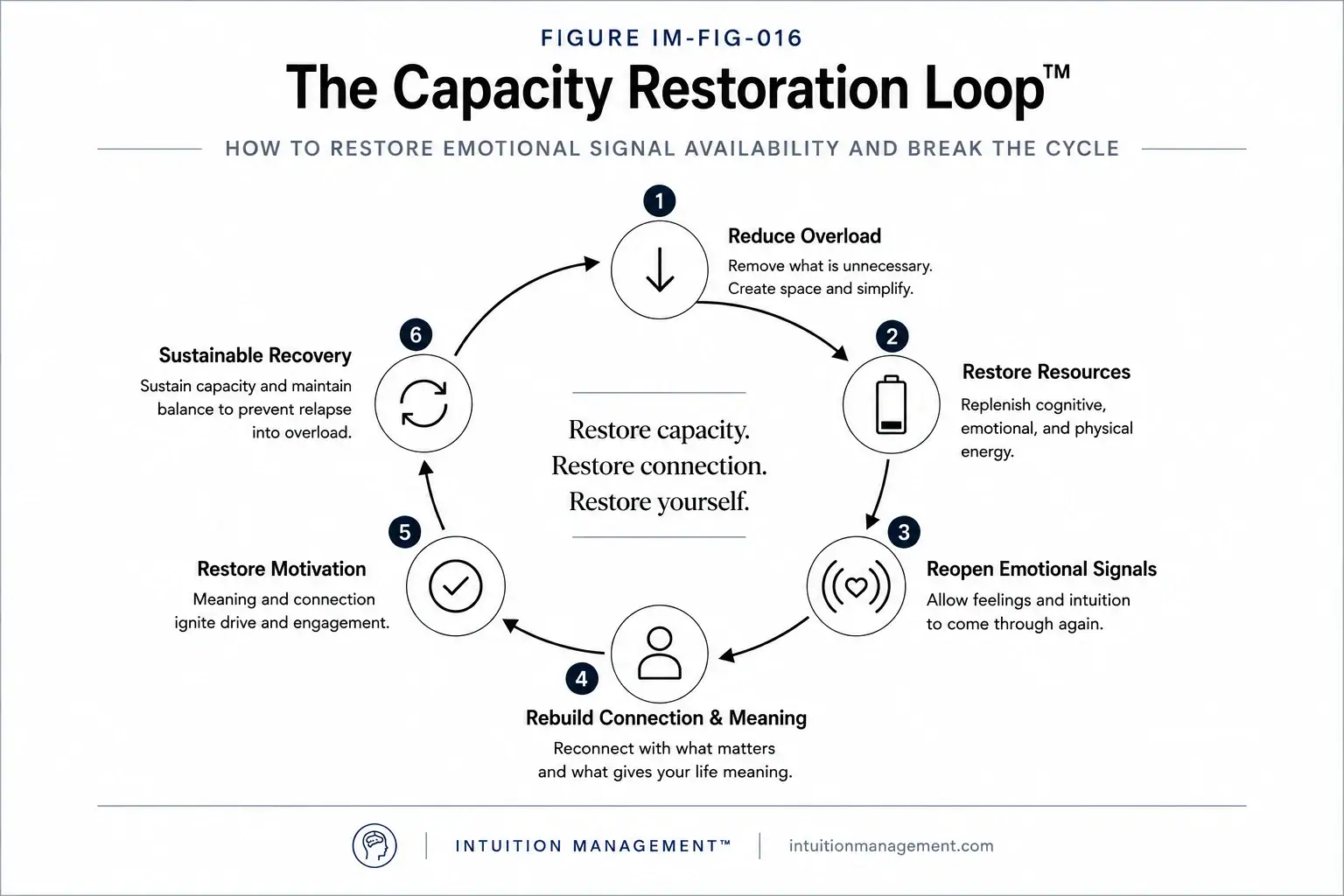
Again, this is a model—not a promise of a linear recovery path. Emotional numbness can fluctuate, and improvement does not always follow a predictable schedule.
Five Layers of Emotional Signal Recovery
Recovery is usually more reliable when it is built from foundations upward. Trying to restore meaning or motivation while sleep, physical energy, cognitive space, and regulation remain severely constrained can turn recovery into another demand.
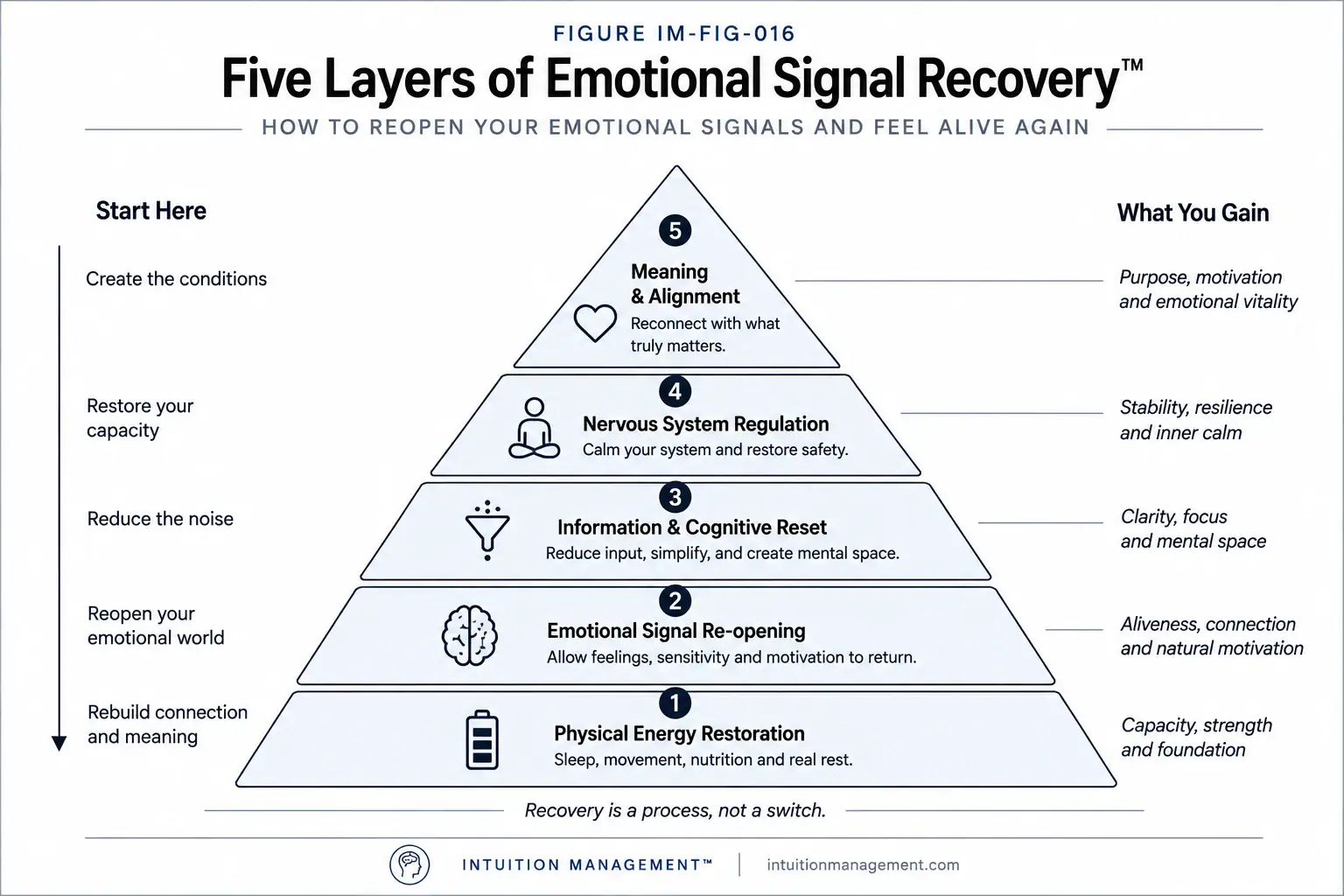
The layers are not a rigid prescription. They are a prioritization model: foundational capacity makes emotional access more likely, and emotional access makes connection, motivation, and meaning easier to rebuild.
Practical Ways to Support Recovery
Reduce avoidable cognitive load
Simplify decisions, reduce unnecessary notifications, limit repeated checking, and postpone nonessential demands where possible.
If your mind feels continuously activated, see Why Can’t My Brain Slow Down?, Why Do I Feel Like I Have to Respond Immediately?, and Why Do I Feel Like I Have to Be Available?.
Choose genuine recovery over constant stimulation
Endless content consumption can feel passive while still fragmenting attention. Genuine recovery usually includes periods in which fewer signals compete for processing.
Notice small signals without grading them
Do not demand a dramatic emotional breakthrough. Notice mild interest, comfort, irritation, warmth, relief, or sadness without turning each moment into a test.
Protect sleep and physical health
Sleep disruption, illness, medication effects, substance use, and other physical factors can influence emotional experience. Medical evaluation is appropriate when numbness is new, unexplained, or persistent.
Use structure when motivation is low
When reward signals are muted, waiting to feel motivated can keep the loop going. Small, low-pressure routines can maintain contact with relationships, movement, daylight, food, and meaningful responsibilities while recovery develops.
Avoid moral conclusions
Feeling numb is not evidence that you are selfish, ungrateful, or incapable of love.
When to Seek Professional Help
Consider speaking with a qualified healthcare professional when emotional numbness:
- persists or keeps returning without clear improvement;
- significantly affects work, study, relationships, or basic daily functioning;
- appears alongside persistent low mood, severe anxiety, major sleep or appetite changes, or loss of interest;
- begins after a traumatic event;
- starts after a medication change or substance use;
- is accompanied by unusual physical or neurological symptoms;
- makes you feel unsafe or unable to care for yourself.
Professional support can help identify whether the experience is related to stress, depression, trauma, medication, a medical condition, or several interacting factors.
Frequently Asked Questions
Can stress cause emotional numbness?
Yes. Prolonged stress can contribute to emotional numbness by increasing cognitive load, narrowing attention, disrupting sleep, and changing how emotional information is prioritized. Stress is one possible cause, not the only one.
Is emotional numbness permanent?
It is often temporary, especially when it is connected to a reversible stressor or treatable condition. The course depends on the cause, duration, health context, and access to appropriate support.
Why can’t I cry even when I want to?
The desire to cry can remain while the emotional and bodily processes needed to produce tears feel inhibited or inaccessible. This may happen during stress, burnout, depression, trauma-related states, medication effects, or other conditions.
Why do positive emotions disappear first?
Subtle positive experiences often require attention and spare capacity. Under sustained load, the brain may prioritize urgent information while low-intensity rewards become harder to notice.
Is emotional numbness the same as dissociation?
No. Emotional numbness can occur within dissociation, but dissociation is a broader term that can involve changes in awareness, memory, identity, or perception. A professional can help clarify persistent or disruptive experiences.
Can anxiety make you emotionally numb?
Yes. Prolonged anxiety can keep attention focused on threat monitoring and self-protection, leaving fewer resources for emotional nuance and positive engagement.
Can emotional numbness come and go?
Yes. It can vary with stress, sleep, environment, medication, physical health, and the sense of safety or demand in a particular context.
Why do I feel detached from people I love?
Reduced emotional access can make closeness feel distant even when attachment, values, and caring behavior remain. Relationship problems are one possible explanation, but numbness alone does not prove that love has ended.
Key Takeaways
- Emotional numbness describes reduced access to emotional experience; it is not a diagnosis by itself.
- Prolonged stress and cognitive overload can contribute by narrowing attention and reducing emotional signal availability.
- Depression, anhedonia, dissociation, burnout, medication effects, trauma-related responses, and medical conditions can overlap with numbness but are not identical.
- Forcing emotion often increases monitoring and pressure; recovery is more likely when capacity and safety improve.
- Small returns of interest, relief, connection, grief, or curiosity can be meaningful signs of recovery.
- Persistent or disruptive numbness deserves professional assessment.
Conclusion
Feeling emotionally numb can make you question your identity, your relationships, and the meaning of your life.
But the absence of a strong conscious feeling does not automatically mean the underlying emotion, value, or attachment has disappeared.
Emotional numbness is better understood as a change in access: the emotional signal may be muted, filtered, disrupted, or deprioritized by a system under strain.
That perspective does not reduce every case to cognitive overload, and it does not replace clinical evaluation. It offers a more compassionate and useful model than assuming you have become cold or broken.
Recovery does not begin by forcing stronger emotion. It begins by restoring the conditions in which meaningful emotional signals can be perceived again.
Small moments matter: interest, relief, irritation, warmth, grief, curiosity. They are signs that the system is becoming more responsive—not necessarily all at once, but enough to begin reconnecting with experience.
Continue Your Journey
Explore Why Am I Mentally Exhausted All the Time? to understand how sustained demands reduce mental capacity.
Use Cognitive Overload Recovery to identify ways of restoring mental bandwidth.
Read Why Do I Feel Disconnected From Everything? and Why Does Everything Feel Meaningless Lately? when numbness affects connection and purpose.
Return to Signal vs. Noise and Internal Model of Reality for the deeper framework behind attention, perception, emotional signals, and self-trust.
Leave a Reply
You must be logged in to post a comment.