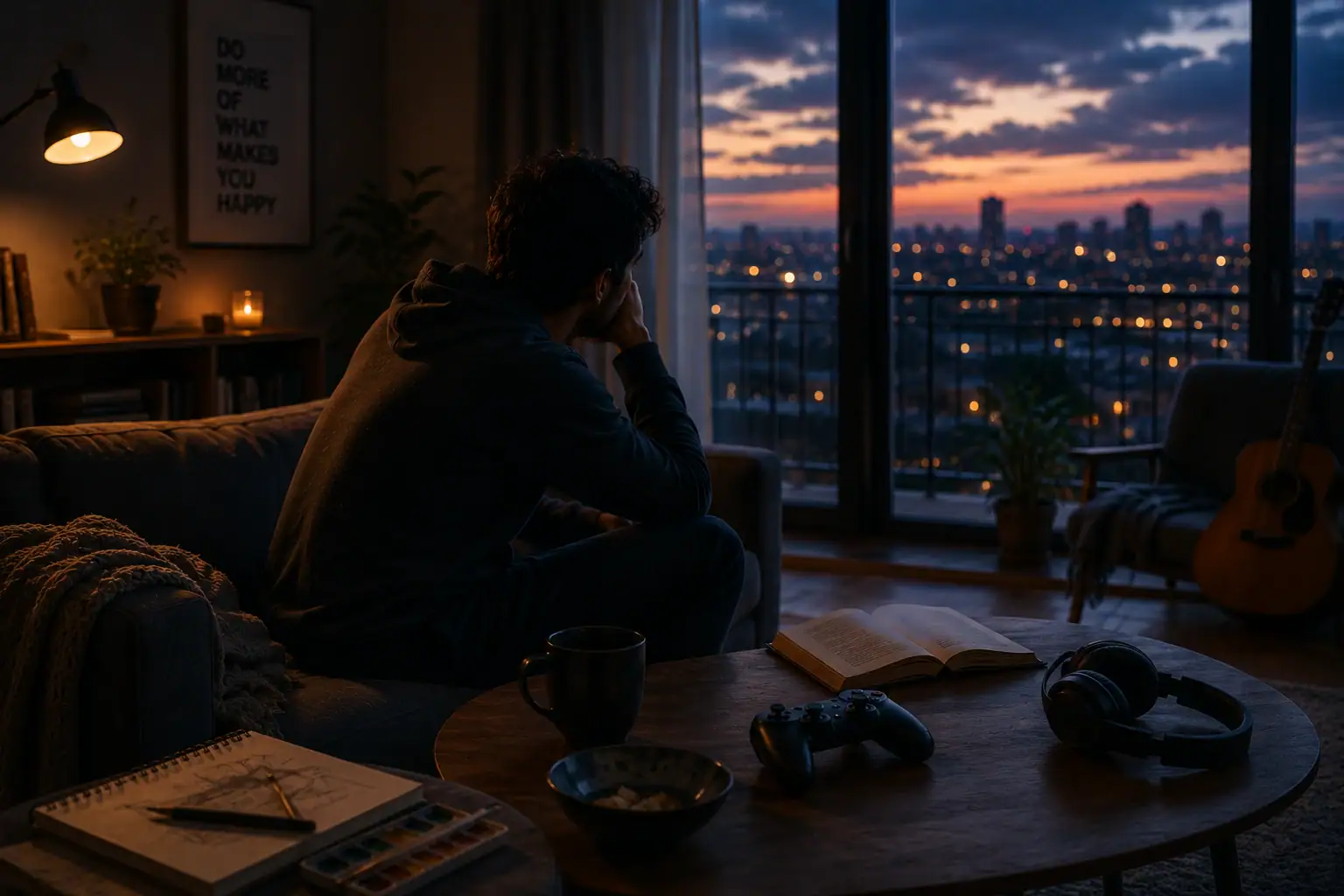
If you’ve been wondering, “Why can’t I enjoy my free time anymore?”, you are far from alone.
You finally finish work.
The responsibilities pause.
The evening arrives.
You finally have time for yourself.
And yet something feels strangely absent.
The book remains unopened.
The game feels uninteresting.
The hobby that once felt exciting now feels strangely distant.
Instead of enjoyment, you may feel:
- restlessness,
- guilt,
- boredom,
- mental noise,
- the feeling that you should be doing something else.
Many people assume this means they have become lazy, ungrateful, or lost interest in life.
In many cases, that is not what is happening.
The issue may not be a lack of enjoyment.
The issue may be that your cognitive system has remained in performance mode for so long that it no longer recognizes free time as safe to enjoy.
This article explores why free time can stop feeling enjoyable, how cognitive overload changes the experience of leisure, and how Cognitive Calibration™ can help restore the ability to engage with rest, hobbies, and recovery.
Why Can’t I Enjoy My Free Time Even When I Finally Have It?
This is one of the most frustrating parts of the experience.
For a long time, you may have believed:
Once I have more time, I will finally relax.
Then the free time arrives.
And the expected relief never comes.
This happens because time availability and psychological availability are not the same thing.
Your schedule may be free while your attention remains occupied by:
- unfinished work,
- future responsibilities,
- unresolved decisions,
- comparison with others,
- productivity guilt,
- the feeling of falling behind.
When these signals remain active, leisure activities often struggle to compete for attention.
The body enters free time.
The mind stays at work.
Many people do not lose the ability to enjoy free time.
They lose access to the mental space required to experience enjoyment.
The Productivity Guilt Problem
For many people, free time no longer feels free.
It feels borrowed.
Temporary.
Conditional.
You can enjoy yourself after the work is finished.
After the inbox is empty.
After the house is organized.
After the next milestone.
The problem is that modern life rarely reaches a state of completion.
There is always another task.
Another email.
Another responsibility.
Another opportunity.
When enjoyment depends on completion, enjoyment may never arrive.
Many people are not losing interest in leisure.
They are waiting for permission to enjoy it.
How Cognitive Overload Changes Leisure
Cognitive overload changes the way the brain evaluates free time.
Under normal conditions, leisure activities compete successfully for attention.
A book can become immersive.
A conversation can become enjoyable.
A hobby can become absorbing.
Under overload, however, unfinished signals continue competing for processing resources.
The brain remains partially attached to:
- unfinished work,
- future planning,
- unanswered messages,
- financial concerns,
- social obligations,
- long-term uncertainty.
The result is often the strange experience of participating in leisure without emotionally arriving there.
Your body may be in the living room.
Your attention may still be somewhere else entirely.
The Signal vs Noise Problem
Signal vs Noise™ provides another explanation for why free time can become difficult to enjoy.
Not every thought deserves equal priority.
Not every possibility requires immediate action.
Not every responsibility needs to remain active in working memory.
When cognitive overload increases, however, the brain starts treating all incoming signals as equally important.
The result is a constant background feeling that something important is being neglected.
Even while reading a book.
Even while watching a film.
Even while spending time with people you care about.
Sometimes free time becomes difficult not because enjoyment disappeared.
Sometimes too many other signals are competing for attention at the same time.
You can explore this directly through the Signal vs Noise Simulator.
Why Hobbies Sometimes Stop Feeling Interesting
Many people become frightened when activities they once loved stop feeling enjoyable.
Reading feels harder.
Games feel flat.
Creative hobbies feel strangely demanding.
Often this does not mean the activity itself has changed.
It means the cognitive conditions required for enjoyment have become harder to access.
Enjoyment depends on attention.
Attention depends on available cognitive resources.
When attention becomes fragmented, enjoyment often becomes fragmented too.
This frequently overlaps with:
- Why Does Rest Feel Like Wasted Time?
- Why Can’t My Brain Slow Down?
- Why Can’t I Relax Even When Nothing Is Wrong?
- Why Am I Mentally Exhausted All the Time?
How Cognitive Calibration™ Helps You Enjoy Free Time Again
Cognitive Calibration™ approaches this problem differently from traditional productivity advice.
Instead of asking:
- How do I become more productive?
- How do I stop wasting time?
- How do I optimize my free time?
- How do I make every hour count?
Calibration asks a different question:
Which signals actually deserve my attention right now?
This changes the role of free time completely.
Leisure stops becoming unproductive time.
Recovery stops becoming something that must be justified.
Instead, enjoyment becomes part of maintaining the cognitive system that supports decision-making, creativity, resilience, and focus.
Enjoyment is not the opposite of productivity.
Enjoyment is one of the systems that makes sustainable productivity possible.
The Decision Confidence Loop™ and Leisure
Many people struggle with free time because movement feels safer than stillness.
If I keep moving, I stay ahead.
If I keep moving, I remain useful.
If I keep moving, I remain in control.
The Decision Confidence Loop™ suggests a different approach.
Confidence grows through:
- Action
- Feedback
- Learning
- Adaptation
People who trust their ability to adapt often feel less pressure to remain productive every moment of the day.
Sometimes enjoyment becomes possible not because responsibilities disappear, but because trust in adaptation grows.
A Practical Process When Free Time Stops Feeling Enjoyable
If you often think, “Why can’t I enjoy my free time anymore?”, try the following process:
- Write down the thoughts repeatedly interrupting your attention.
- Separate immediate responsibilities from future possibilities.
- Identify which concerns require action and which simply require awareness.
- Notice whether guilt appears when you stop moving.
- Reduce unnecessary information input before leisure activities.
- Choose one activity rather than several competing options.
- Allow enjoyment to exist without requiring productivity in return.
- Recalibrate as circumstances change.
The goal is not maximizing enjoyment.
The goal is restoring enough mental space for enjoyment to become possible again.
As signal filtering improves, many people discover that enjoyment was never gone.
It was simply competing against too many unfinished signals at the same time.
Frequently Asked Questions
Why can’t I enjoy my free time anymore?
Free time often becomes difficult to enjoy when cognitive overload, unfinished responsibilities, and persistent mental activity continue competing for attention even after work ends.
Why do hobbies feel less enjoyable than they used to?
Enjoyment depends on available attention and cognitive resources. When attention becomes fragmented, hobbies may become harder to engage with emotionally.
Why do I feel guilty when I relax?
Many people develop productivity guilt, where self-worth becomes closely connected to achievement, output, or constant progress.
Can cognitive overload reduce enjoyment?
Yes. Cognitive overload increases attention fragmentation and unresolved mental processing, reducing the resources available for immersion and enjoyment.
How does Cognitive Calibration™ help?
Cognitive Calibration™ improves signal filtering, reduces unnecessary cognitive load, and helps create conditions where attention can fully engage with leisure and recovery.
The Complete Cognitive Calibration™ Framework
This article explores only one part of the broader Cognitive Calibration™ Framework.
The complete framework examines how cognitive overload, unfinished signals, attention fragmentation, productivity guilt, and persistent mental activity influence focus, enjoyment, recovery, and decision-making.
It provides practical methods for improving signal filtering, reducing unnecessary cognitive load, strengthening decision confidence, and restoring access to attention, presence, and enjoyment.
Explore the complete Cognitive Calibration™ Framework:
Access the framework on Patreon
Final Thought
If you cannot enjoy your free time anymore, it does not necessarily mean you have become lazy, ungrateful, or disconnected from life.
It may simply mean your attention is still carrying more active signals than it can comfortably organize.
Another responsibility.
Another unfinished task.
Another possibility.
Another expectation.
Each one quietly competes for the same limited attention.
Over time, enjoyment becomes harder to access.
The experience eventually becomes:
I finally have time for myself.
So why can’t I enjoy it?
The answer is often not that enjoyment disappeared.
The answer is that enjoyment requires attention, and attention may already be fully occupied elsewhere.
The goal is not forcing yourself to enjoy things again.
The goal is creating enough mental space for enjoyment to return naturally.
Many people discover that the ability to enjoy free time was never lost.
It was simply buried beneath too many unfinished signals competing for attention at the same time.
Sometimes the problem is not that joy disappeared.
Sometimes attention simply became too crowded to notice it.
Continue Exploring
- Why Does Rest Feel Like Wasted Time?
- Why Can’t My Brain Slow Down?
- Why Can’t I Relax Even When Nothing Is Wrong?
- Why Do I Feel Like I’m Always Behind?
- Why Does Everything Feel Urgent?
- Why Am I Mentally Exhausted All the Time?
- Why Do I Feel Busy but Get Nothing Done?
- Why Can’t I Focus on Anything?
- Cognitive Overload Recovery
- The Personal Signal Decoder™
- Signal vs Noise Simulator
- Your Intuition Journey