Mental overactivity · nervous-system regulation · cognitive clarity
Can’t switch your brain off—even when the work is finished and nothing urgent is happening? An always-on mind may keep planning, checking, replaying, predicting, or scanning because your system has not received a convincing signal that it can disengage.
The quick answer: your brain may feel permanently switched on when sustained stress, uncertainty, repetitive thinking, fragmented attention, unfinished intentions, emotional load, or incomplete recovery keeps attention in monitoring mode. The goal is not to force your mind into silence. It is to reduce unnecessary input, close or capture open loops, help the body settle, and rebuild conditions in which attention can release what no longer requires action.
What does it mean when your brain feels “always on”?
An always-on brain is not simply a mind that thinks a lot. A healthy, engaged mind can focus intensely and later release the task. Mental overactivity appears when the brain has difficulty recognizing a stopping point. It keeps producing reminders, possible risks, unfinished conversations, future scenarios, or questions that feel as though they must remain available.
You may notice the pattern most clearly when the outside world becomes quiet. The workday ends, the message has been answered, or you finally lie down—yet your mind becomes louder. The absence of activity does not automatically create an internal signal of completion.
Stress is a normal response to challenge, but ongoing stress can be associated with worry, tension, sleep difficulty, and problems concentrating.[1] The key question is not whether your brain becomes activated. It is whether activation can flexibly rise for a real demand and return toward baseline afterward.
Is this the same as overthinking, racing thoughts, or being unable to relax?
These experiences overlap, but they target different search intentions and different parts of the same system. Understanding the distinction helps you choose a more useful response.
| Experience | Core pattern | Best related guide |
|---|---|---|
| Brain always on | Persistent activation and monitoring, even without an immediate task. | This article |
| Overthinking | Repeated analysis, rumination, or searching for certainty through more thought. | Why Do I Overthink Everything? |
| Brain cannot slow down | Thoughts feel rapid, crowded, or difficult to pace. | This article |
| Mind jumps between topics | Attention repeatedly shifts before one thought or task is completed. | Why Does My Mind Jump From One Thing to Another? |
| Cannot relax | The system has difficulty entering a settled state even when external danger is absent. | Why Can’t I Relax Even When Nothing Is Wrong? |
| Rest is not restful | Activity stops, but recovery remains incomplete. | Why Am I Mentally Exhausted All the Time? |
The cognitive activation spectrum
Mental activation is not inherently harmful. You need it to learn, respond, create, work, and make decisions. The problem begins when activation rises without a matching recovery phase.

Model note: the diagrams in this article are original Intuition Management explanatory models. They organize research-informed ideas for readers, but they are not diagnostic tools, validated clinical scales, or standardized neuroscience frameworks.
1. Rested clarity
You can direct attention, notice relevant information, and release what does not matter. Thoughts still appear, but they do not all demand action.
2. Sustained activation
You are alert and engaged for a purpose. This state can be productive when it has a beginning, an end, and enough recovery afterward.
3. Hypervigilance
Attention shifts from purposeful focus to scanning. You begin checking for mistakes, reactions, delays, threats, or signs that something may go wrong.
4. Cognitive overload
Too many signals compete for limited processing capacity. Focus fragments, simple choices feel heavier, and the mind may become both exhausted and unable to stop.
5. Recovery
Input decreases, the body settles, open loops are reduced, and attention becomes available again. Recovery is not the absence of thought. It is the return of choice over where attention goes.
Why your brain may never seem to switch off
The brain does not passively wait for information. Research on prediction and cognition describes the brain as continually using prior experience and current input to anticipate what may happen next.[10] Predictive-processing accounts remain actively debated, but they offer a useful way to understand why uncertain or unexpected information can keep attracting attention.
Human learning research also shows that uncertainty can alter which cues receive attention. In some contexts, cues linked with uncertain outcomes receive more subsequent learning and attention than predictable cues.[11] In everyday life, this may help explain why an unresolved message, ambiguous interaction, or unpredictable demand can feel difficult to release.
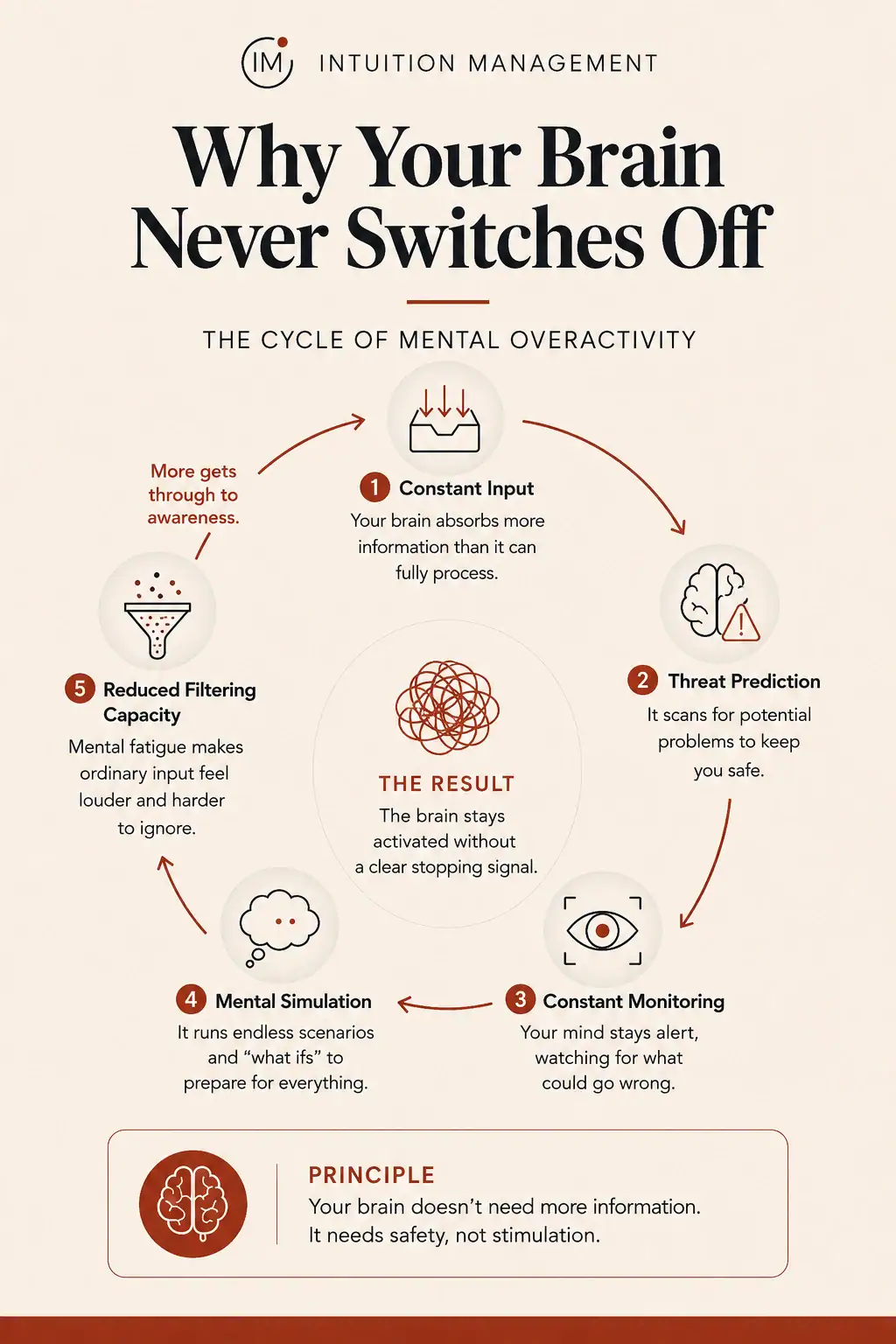
The cycle often looks like this:
- Constant input: messages, tasks, news, conversations, reminders, and unfinished decisions continue arriving.
- Threat prediction: the mind checks what might go wrong, what has been missed, or what may require a response.
- Constant monitoring: attention stays partially open to multiple possible signals instead of committing fully to one thing.
- Mental simulation: the brain runs scenarios, rehearses explanations, replays interactions, and prepares for possibilities.
- Reduced filtering capacity: mental fatigue makes sustained attention less reliable and increases distraction by irrelevant information.[12]
Unfinished intentions can also remain mentally accessible. Research on unfinished tasks suggests that incomplete goals can continue occupying attention and contribute to rumination after work.[13] Capturing a task in a trusted system or deciding when it will be handled can therefore matter more than repeatedly reminding yourself not to forget it.
Repetitive negative thinking—including worry and rumination—can place additional demands on working-memory updating, although results vary across populations and study designs.[2]
Signs your brain may be stuck in mental overactivity
You do not need to experience every sign. The pattern, duration, and effect on your life matter more than any single symptom.
| What you notice | What may be happening underneath |
|---|---|
| You keep checking messages or tasks without a clear reason. | Your attention expects another demand and remains partially available. |
| Your thoughts accelerate as soon as you stop working. | Unprocessed material becomes noticeable when external stimulation falls. |
| You feel tired but cannot settle. | Energy is low while activation remains high. |
| You replay conversations after they end. | The brain may be trying to reduce uncertainty by reconstructing what happened. |
| Small decisions feel disproportionately difficult. | Available cognitive capacity is already occupied by monitoring and open loops. |
| Quiet feels uncomfortable or unfamiliar. | Your system may have adapted to stimulation as its normal baseline. |
| You rest physically but remain mentally busy. | The activity stopped, but the activation pattern did not. |
Related experiences include calm feeling unfamiliar, doing nothing feeling uncomfortable, being unable to enjoy free time, and replaying conversations repeatedly.
What keeps your brain stuck in overdrive?

Information overload
Every notification, open tab, unfinished task, and competing instruction requires selection. When selection never ends, attention becomes fragmented before you begin the work that matters.
Uncertainty and unpredictability
Uncertainty often makes the brain search for more information. Yet many modern problems do not become clearer through constant checking. They become noisier because no new information can create complete certainty.
Perfectionism and overcontrol
When the acceptable outcome is “nothing can go wrong,” scanning never feels complete. The mind keeps reviewing, refining, anticipating, and second-guessing. This can look like responsibility while quietly preventing closure.
Unprocessed emotional load
Feelings that have not been acknowledged, named, expressed, or integrated can keep demanding attention in the background. The answer is not to force them away. It is to understand what signal they contain and what response, if any, is needed.
Chronic stress and exhaustion
Exhaustion does not always make the mind quiet. It can make filtering, sustained attention, and emotional regulation less reliable. This helps explain why someone can be mentally exhausted and still unable to stop thinking.
Why your brain speeds up at night
Many people notice that their mind becomes busiest the moment they try to rest. During the day, tasks and conversations occupy your attention. At night those distractions fall away, and the brain finally has enough quiet to return to whatever stayed unresolved: replayed conversations, pending decisions, unfinished tasks, future scenarios. Nighttime thinking is therefore often unfinished processing, not a sign that your brain is broken. A short note listing what is still open before bed gives that processing somewhere to go.
The hidden costs of an overactive brain

Being mentally active can feel productive because activity creates a sense of movement. But continuous activation is not the same as effective thinking. Over time, it may contribute to:
- Mental exhaustion: energy is spent maintaining readiness rather than completing focused work.
- Poor focus: attention stays divided between the present task and possible interruptions.
- Decision paralysis: every option generates more scenarios, risks, and second-guessing.
- Emotional reactivity: reduced capacity can make ordinary friction feel more intense.
- Disrupted sleep: the body is in bed while the mind continues planning, replaying, or monitoring.
- Reduced creativity and resilience: adaptation becomes harder when most available capacity is allocated to protection.
Good sleep supports attention, memory, mood, and daily functioning.[3] When sleep is repeatedly disrupted, the next day begins with less capacity, making the overactivity loop easier to restart.
Why rest does not always reset your brain
Tired but wired: the activation–recovery mismatch
Tired but wired means low capacity and high activation at the same time. Tired describes reduced capacity: slower thinking, weaker concentration and less patience, so even small decisions feel expensive. Wired describes continuing readiness: your mind keeps scanning, anticipating and rehearsing, so you feel tense or restless without feeling energetic. Readiness uses energy without restoring any, which is why a tired mind can keep monitoring long after it has lost the ability to act usefully.
The Tired-but-Wired Paradox: exhaustion reflects reduced capacity, while alertness reflects continuing activation.
Many people respond to mental overactivity by stopping work, lying down, scrolling, watching something, or waiting to feel better. These actions may reduce physical effort, but they do not necessarily change the conditions maintaining activation.
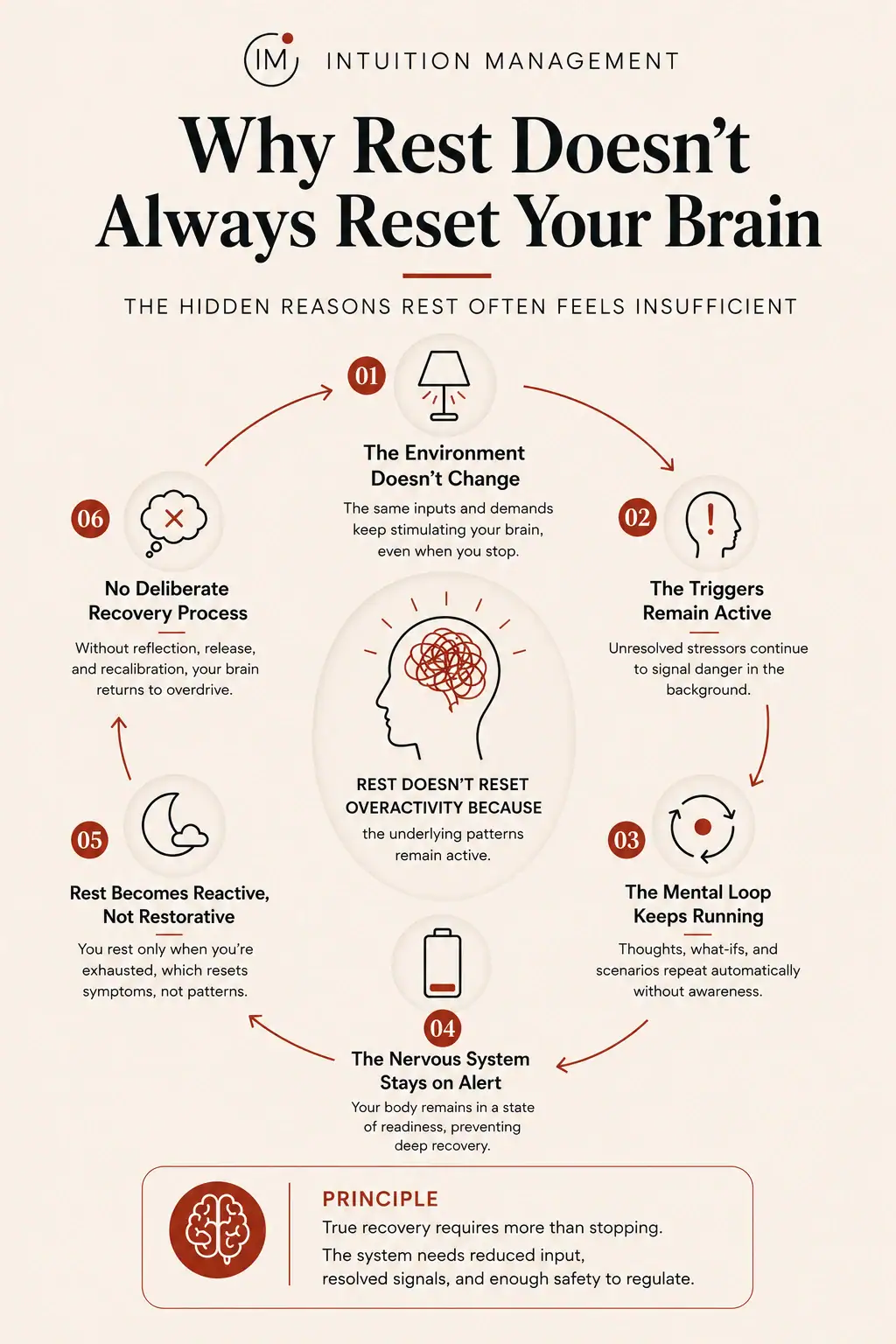
The environment does not change
If the same phone, screen, noise, demands, and visual reminders remain present, your brain continues receiving many of the same activation cues.
The triggers remain active
An unresolved deadline, conflict, uncertainty, or decision can continue signaling importance even when you are not actively working on it.
The mental loop keeps running
Thoughts may repeat automatically because no external structure has captured them and no decision has closed the loop.
The nervous system remains alert
Thoughts are only part of the experience. Muscle tension, altered breathing, sensory vigilance, and bodily readiness can keep the state going.
Rest becomes reactive rather than restorative
If you wait until complete exhaustion, rest may only reduce immediate symptoms. Recovery works better when it is built into the day before capacity collapses.
There is no deliberate recovery process
Without reducing input, externalizing tasks, processing what matters, and allowing the body to settle, “doing nothing” can become another place where the mind keeps working.
The recovery cycle for an overactive brain

- Pause. Stop adding new input for a moment. Silence notifications, close an extra tab, or step away from the active demand.
- Notice. Ask what is happening without immediately fixing it: What am I monitoring? What feels unfinished? What is my body doing?
- Release. Reduce what you can. Write down tasks, discharge physical tension, and let thoughts or emotions move without forcing them away.
- Regulate. Support the body with comfortable breathing, movement, a quieter environment, water, food, warmth, or rest as appropriate.
- Recalibrate. Decide what genuinely matters now. Separate the next useful action from everything that merely feels urgent.
- Re-engage. Return through one small aligned action rather than reopening every demand at once.
A useful question: “What does my brain need in order to stop monitoring this?” The answer may be information, a decision, a written reminder, a boundary, emotional acknowledgment, or permission to leave something unresolved for now.
Daily habits that reduce mental overactivity

Protect the beginning of your day
Starting with messages immediately can make attention reactive before you have chosen a direction. Even a short buffer for light, water, movement, breakfast, planning, or quiet can create a clearer starting state.
Set boundaries for your attention
Use scheduled message checks, fewer notifications, single-task blocks, and visible stopping points. Attention works better when it does not have to remain available to everything at once.
Move your body
Physical activity can support mood, cognition, sleep, and lower short-term feelings of anxiety.[4] The goal is not to punish the body or “burn off” thoughts. It is to support regulation through sustainable movement.
Protect restorative sleep
Use a repeatable wind-down period, reduce late stimulation when possible, and keep unfinished tasks outside your head by writing them down. Persistent sleep difficulties deserve professional attention rather than endless self-optimization.
Build space for stillness
Stillness may initially make thoughts more noticeable. That does not mean it is failing. Begin with a tolerable amount: two quiet minutes, a short walk without audio, or sitting by a window.
Offload and organize
The brain often monitors what it fears you will forget. A trustworthy capture system can reduce the need to keep every task active in working memory.
Mini-reset tools you can use anywhere

1. A three-minute breathing reset
Let your breathing become slower and comfortable. Allow the exhale to become slightly longer than the inhale without forcing it or holding your breath. Slow-breathing practices have shown potential benefits for stress and anxiety, although techniques and individual responses vary.[5]
Return to normal breathing if you feel dizzy, uncomfortable, or short of breath.
2. The 5-4-3-2-1 grounding exercise
Name five things you see, four you feel, three you hear, two you smell, and one you taste. The point is not to erase thoughts. It is to give present sensory information more attention than imagined scenarios.
3. A two-to-five-minute brain dump
Write every open loop without organizing it first. Then circle only the next action that genuinely belongs to today.
4. A movement break
Stand, stretch, walk, or change posture. Use movement to shift state, not to meet a performance target.
5. Hydrate and reassess
Drink water if you may be underhydrated. Research suggests dehydration can worsen fatigue, mood, attention, or short-term cognitive performance in some conditions, while effects vary across people and study designs.[6]
6. Step outside or change the environment
Natural light, fresh air, and a different visual field can interrupt context-driven monitoring. Reviews have found associations between nature exposure and cognitive or mental-health benefits, while the size and reliability of effects depend on the setting and research design.[7]
Longer-term practices that build mental resilience
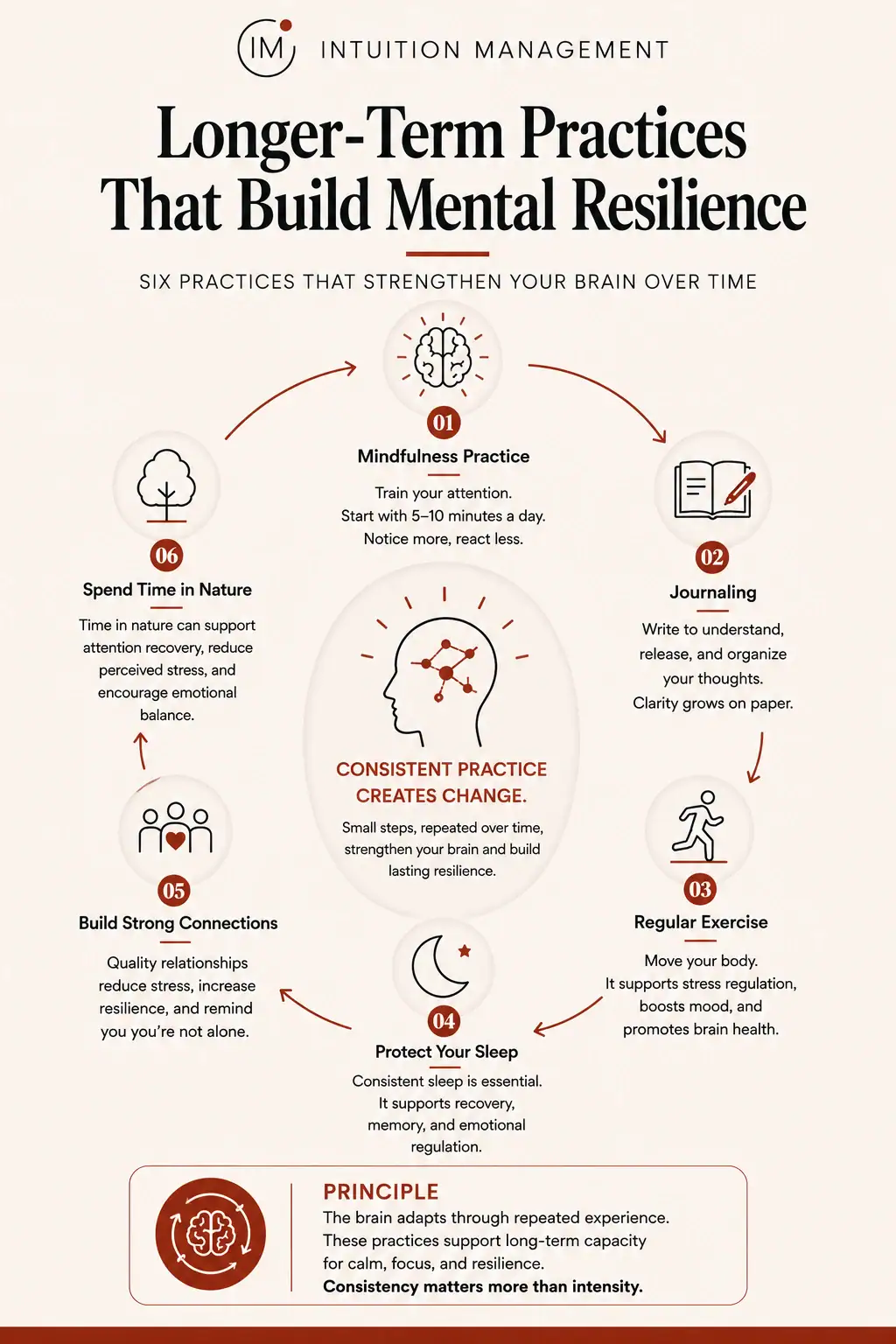
Mini-resets can interrupt a current escalation. Longer-term practices help change the baseline from which you respond.
Mindfulness practice
Mindfulness trains the ability to notice an experience without immediately obeying it. Evidence suggests mindfulness-based practices may help some people with stress, anxiety, or depressive symptoms, but they are not a universal replacement for professional treatment.[8]
Journaling and external reflection
Writing can transform a vague cloud of concern into visible questions, facts, choices, and emotions. Use it to understand—not to produce a perfect record of every thought.
Regular movement
Choose sustainable forms of activity that support energy and mood. A small repeatable routine is more useful than an intense plan you cannot maintain.
Consistent sleep support
Protect a regular sleep window as much as life allows. Sleep is a biological need, not a reward earned only after every task is complete.
Strong connections
A trustworthy conversation can reduce the burden of processing everything alone. Connection does not solve every external problem, but it can change the internal context in which the problem is carried.
Time in nature
Use natural settings as one form of attention recovery, especially when your day is dominated by screens, artificial cues, and task switching.
How an always-on brain affects intuition
Intuition is easier to recognize when the system can distinguish a meaningful signal from background noise. Overactivation makes this harder because everything begins to feel important.
A useful signal is often specific enough to guide attention: something does not fit, a pattern has changed, a boundary has been crossed, or a decision conflicts with your values. Mental noise produces broader activation: urgency without a clear object, repeated checking without new information, and pressure to resolve everything immediately.
This is why regulation is part of intuition calibration. Continue with Signal vs Noise, Mental Filters, and the Internal Model of Reality.
Signal check: does the feeling become clearer when you slow down, name the facts, and reduce pressure? A useful signal often becomes more specific. Noise commonly becomes more urgent without becoming more informative.
When should you seek professional help?
An always-on mind can be a temporary response to a demanding period. It can also overlap with anxiety, sleep problems, trauma-related activation, depression, attention difficulties, medication effects, physical health conditions, or other concerns that cannot be identified from an article.
Consider speaking with a qualified health professional when symptoms are severe, distressing, persist for two weeks or more, interfere with sleep or concentration, prevent usual activities, or keep getting worse. NIMH similarly advises seeking professional support for persistent, distressing problems such as difficulty sleeping, concentrating, or completing usual tasks.[9]
Seeking support is not an admission that you failed to regulate yourself. It is a way to get a fuller assessment and help appropriate to the cause.
Frequently asked questions
Why is my brain always thinking?
Your brain may keep thinking because it is processing unresolved demands, predicting future problems, replaying past events, or trying not to forget something. Thinking is normal. The difficulty begins when thoughts continue automatically and you cannot redirect or disengage attention.
Why can’t I switch my brain off at night?
Night removes external distractions, allowing unfinished thoughts and bodily activation to become more noticeable. Late stimulation, stress, irregular sleep, open tasks, and worry can all contribute. A consistent wind-down routine and an external task list may help, but persistent sleep problems should be discussed with a health professional.
Is an always-on brain the same as anxiety?
No. Anxiety can include restlessness, worry, tension, concentration problems, and sleep difficulties, but an overactive mind can have many causes. Only a qualified professional can assess whether a specific condition is present.
Can mental exhaustion make the brain more active?
That pattern can occur. Fatigue may reduce sustained attention, filtering, and emotional regulation. You can therefore feel depleted and overstimulated at the same time.
How do I calm an overactive brain quickly?
Reduce new input, write down open loops, change your environment, move gently, and use comfortable slow breathing or grounding. The goal is not instant silence. It is lowering activation enough to regain choice over your next action.
Why does doing nothing make me more restless?
Your system may associate activity with control or safety. When activity stops, uncertainty and unprocessed thoughts become more visible. Begin with short periods of low stimulation rather than demanding immediate complete stillness.
Can I train my brain to switch off?
“Switching off” is not a literal brain function, but you can build stronger transition and recovery habits. A realistic goal is flexible activation: becoming alert when needed and returning toward a calmer baseline afterward.
The central principle
Your brain is not necessarily active because you have failed to control it. It may be doing what it learned to do: monitor, predict, rehearse, and remain ready.
The way forward is not a fight against thought. It is a change in conditions:
- less unnecessary input;
- clearer attention boundaries;
- fewer unrecorded open loops;
- more deliberate transitions;
- enough physical and emotional recovery;
- and one meaningful next action at a time.
Clarity returns when the brain no longer has to treat every signal as unfinished business.
Turn mental noise into a clearer next step
Test how you separate relevant signals from distracting noise, then continue through the Intuition Management knowledge path.
Related: Why Am I Mentally Exhausted All the Time? · Cognitive Overload Recovery · Signal vs Noise
Sources and further reading
- National Institute of Mental Health: “I’m So Stressed Out!” Fact Sheet
- Bruning et al.: Rumination burdens the updating of working memory
- Centers for Disease Control and Prevention: About Sleep
- Centers for Disease Control and Prevention: Benefits of Physical Activity
- Bentley et al.: Breathing Practices for Stress and Anxiety Reduction
- Zhang et al.: Effects of Dehydration and Rehydration on Cognitive Performance and Mood
- Jimenez et al.: Associations Between Nature Exposure and Health
- National Center for Complementary and Integrative Health: Meditation and Mindfulness
- National Institute of Mental Health: Caring for Your Mental Health
- Bubic, von Cramon, and Schubotz: Prediction, cognition and the brain
- Chao et al.: Uncertainty and predictiveness modulate attention in human predictive learning
- Huang et al.: A review of visual sustained attention
- Weiher et al.: Being tired or having much left undone
This article is educational and is not a diagnosis or a substitute for personalized medical or mental-health care. The explanatory models are not clinical assessments.