Cognitive Patterns · Social Rumination · Knowledge OS
Why do I keep replaying conversations in my head? You leave a conversation, but your mind does not. It replays your words, reconstructs the other person’s expression, predicts what they may think, and searches for the sentence that would have made everything feel certain.
Maybe the conversation seemed ordinary while it was happening. Later, one sentence starts to feel wrong. You wonder whether your tone sounded cold, whether you talked too much, whether you misunderstood a reaction, or whether the other person is still thinking about something you said.
The more you search for certainty, the less certain you feel.
This does not necessarily mean that the conversation went badly. A related research term is post-event processing: repetitive, self-focused review after social interactions or performance situations. It is especially studied in relation to social anxiety, although occasional conversation replay also occurs outside any disorder.
Key takeaways
- Conversation replay is often an attempt to reduce uncertainty, not proof that the interaction went badly.
- Memory reconstructs an event from selected fragments; replay may analyse a later reconstruction rather than the original conversation.
- Reflection produces a lesson, repair, or decision. Replay repeats the same question without new evidence.
- The most useful interruption is to separate observable facts from predictions about what the interaction means.
- Reflect when new information can update your internal model. Release when continued thinking only consumes capacity.
Why do I keep replaying conversations in my head?
A conversation contains far more information than words. Your brain is also processing pauses, expressions, tone, timing, context, status, expectations, and your own internal state. Much of this information is ambiguous.
When the interaction ends, the brain does not store a perfect recording. It retains fragments and reconstructs a coherent story from them. If an important detail feels uncertain, your predictive system may continue working after the conversation is over.
It asks questions such as:
- Did I communicate what I meant?
- Did the other person understand me?
- Did I miss a social signal?
- Did I create a problem I now need to prevent?
- What should I do differently next time?
Those questions can support learning when they produce a useful answer. But when the mind has no new evidence, it begins recycling predictions. You do not gain more clarity. You repeatedly examine the same incomplete information through changing emotions and assumptions.
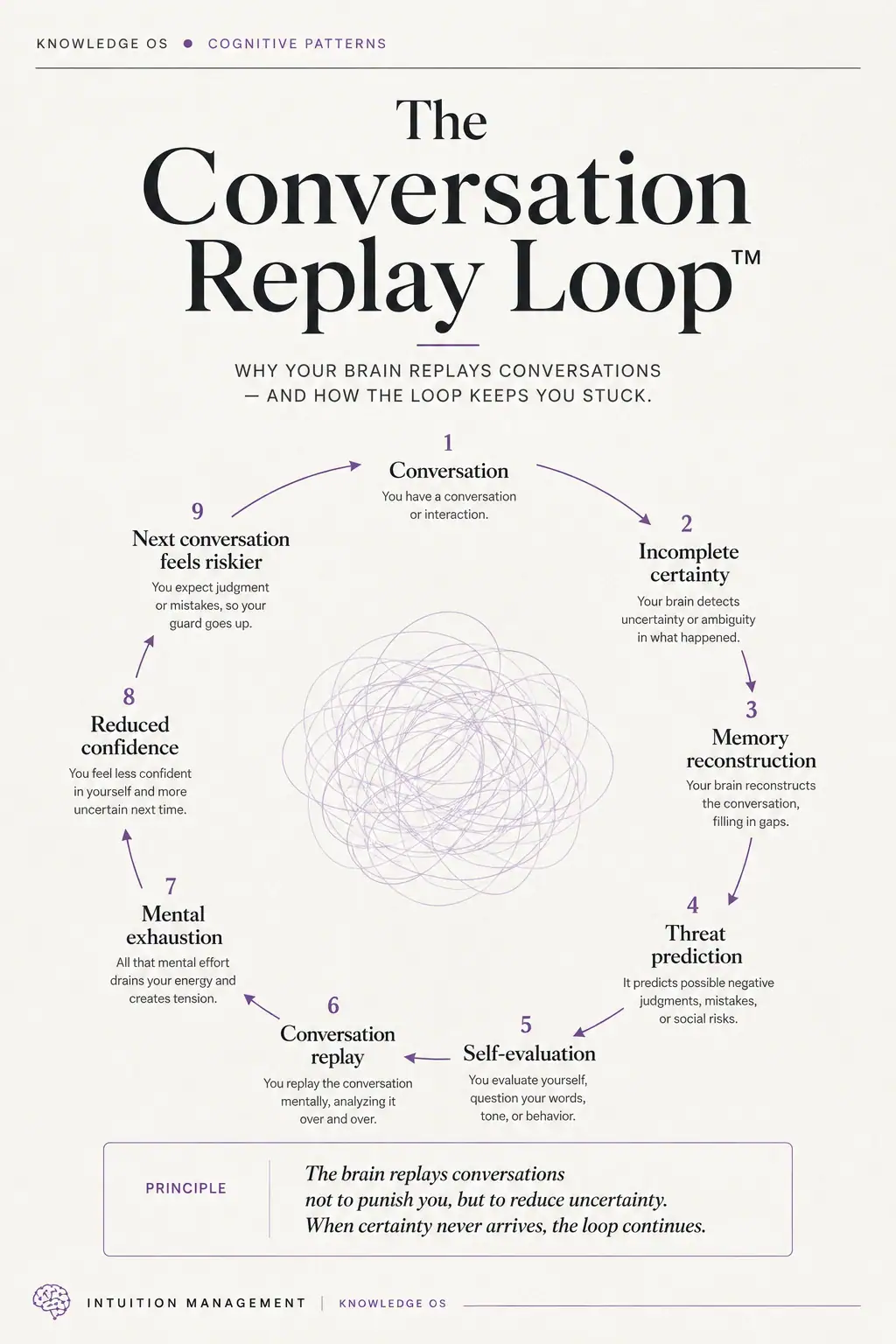
The Conversation Replay Loop™
The Conversation Replay Loop™ explains why a single interaction can keep returning long after it has ended.
Conversation
You experience an interaction containing words, tone, context, expectations, and social signals.
Incomplete certainty
Something remains ambiguous. You are not completely sure what happened or what it meant.
Memory reconstruction
Your brain rebuilds the interaction from fragments rather than replaying a perfect recording.
Threat prediction
Your mind predicts possible rejection, embarrassment, misunderstanding, or future consequences.
Self-evaluation
You examine your words, expression, tone, timing, and behavior for possible mistakes.
Conversation replay
You return to the interaction hoping another review will finally produce certainty.
Mental exhaustion
The repeated analysis consumes attention without giving the nervous system a clear endpoint.
Reduced confidence
You begin trusting your social judgment less, which makes the next interaction feel riskier.
The loop becomes self-reinforcing because reduced confidence creates more monitoring. More monitoring creates more ambiguous details to analyze. More analysis produces more imagined problems.
This is why trying harder to solve the conversation can sometimes make the replay stronger.
Why some people replay conversations more than others
Conversation replay is not distributed evenly. Two people can leave the same interaction with very different levels of mental residue. One remembers the main point and moves on. The other continues reviewing wording, timing, facial expressions, and possible consequences for hours.
The difference is rarely explained by one trait. It usually emerges from an interaction between the importance of the relationship, the person’s current cognitive capacity, their expectations, prior experiences, and the amount of ambiguity left unresolved.
High self-monitoring
You track how you sound, look, and affect others while you are still speaking. Because attention is divided between participating and observing yourself, the memory may later feel incomplete.
Low tolerance for uncertainty
You experience “I do not know what they meant” as a problem that must be solved immediately, even when the missing information is unavailable.
High relational stakes
The other person’s opinion matters. A small ambiguity therefore receives more attention than the same ambiguity would in a low-stakes interaction.
Reduced cognitive capacity
Stress, fatigue, overload, or fragmented attention can make it harder to hold several balanced interpretations at once.
Strong responsibility beliefs
You feel responsible not only for what you said, but also for how every other person felt, interpreted it, and might respond later.
Past social learning
Earlier criticism, exclusion, unpredictable reactions, or repeated misunderstandings can teach the mind to scan later conversations more closely.
These patterns do not mean that something is “wrong” with you. They describe why a conversation may remain cognitively open. The more unfinished variables the mind perceives, the more likely it is to keep simulating possible meanings.
Why smart and self-aware people can replay more
Strong analytical ability does not automatically protect against replay. In fact, it can generate more possible interpretations. A highly verbal or imaginative person can construct many plausible versions of what the other person meant, how the conversation might be remembered, and what could happen next.
Self-awareness also has two forms. Constructive self-awareness notices behaviour and learns from it. Evaluative self-focus turns attention inward and repeatedly asks how the self appeared. The first supports adaptation. The second can create an internal audience that keeps judging the conversation after the real audience has left.
Reflection vs conversation replay
Thinking about a conversation is not automatically unhealthy. Reflection is one of the ways human beings learn. The important distinction is whether the thinking produces a usable update.
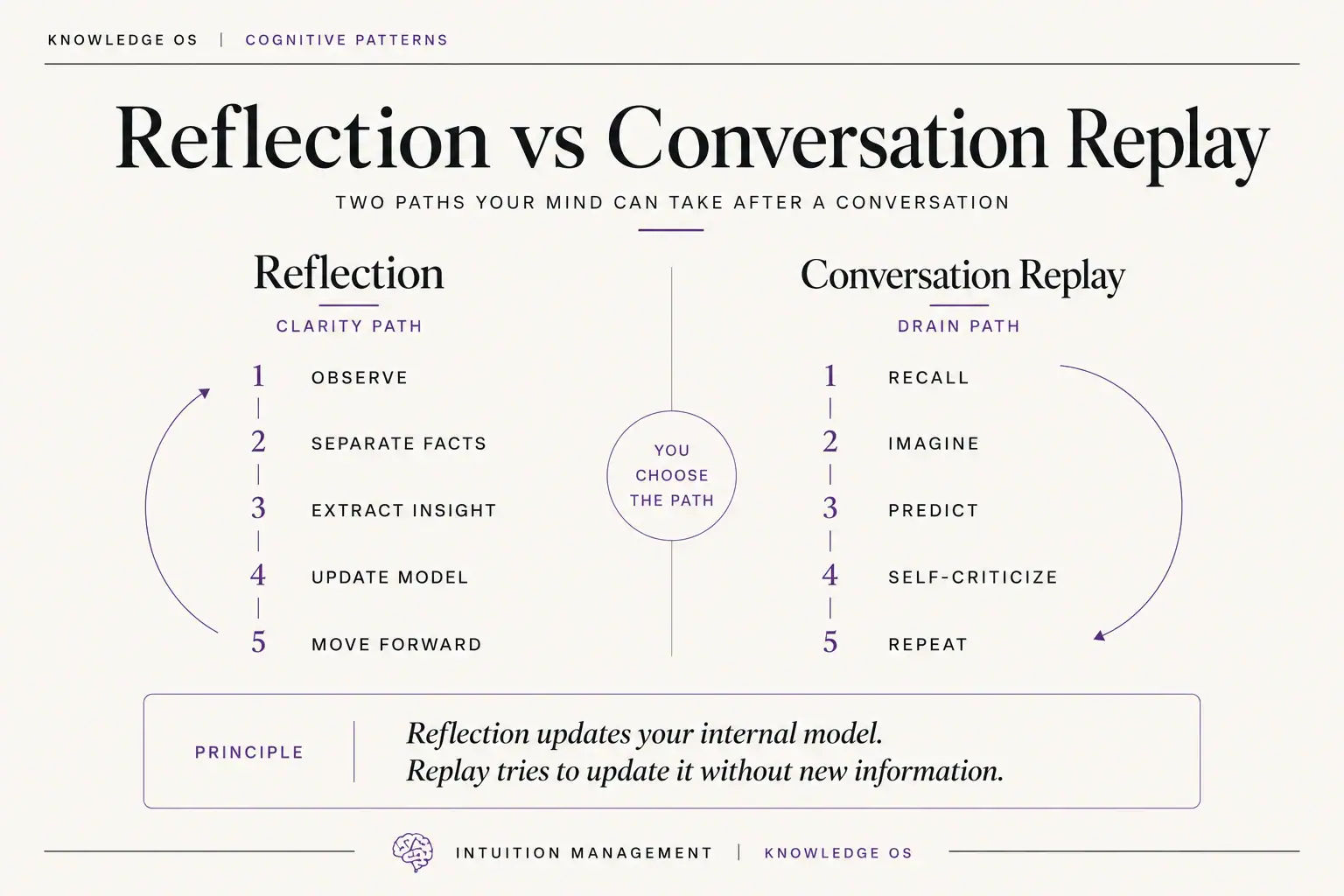
Reflection has an endpoint
Reflection observes what happened, separates facts from interpretations, identifies a useful lesson, and then ends. It may not make you feel perfect, but it leaves you with more clarity or a practical next step.
Replay restarts the same question
Conversation replay returns to the interaction without changing the evidence. It asks the same question in slightly different forms: What if I sounded strange? What if they misunderstood me? What if this means something worse?
A useful test is simple:
Why remembered conversations feel worse than the actual conversation
Memory is not a perfect recording. Research on autobiographical memory describes recall as reconstructive: later memory can be shaped by emotion, perspective, current goals, and details that were not encoded clearly in the first place. That reconstruction is shaped by attention, emotion, expectations, and the meaning your brain assigns to missing details.

The actual conversation may have contained a question, your answer, a reaction, and a clarification. The remembered version can add imagined judgments, alternative interpretations, missing context, and predictions about what the other person now thinks.
That means the object you are analyzing may gradually change.
You begin with the real interaction. Then your mind adds:
- what the other person might have meant;
- what they might have noticed;
- what you wish you had said;
- what they may be thinking now;
- what the interaction could mean for the future.
Each addition feels relevant because it is attached to a real memory. But the emotional intensity of a thought does not prove that the thought is accurate.
This is where mental filters matter. The brain does not process every possible meaning equally. It prioritizes information that matches current concerns, prior experiences, and perceived threats.
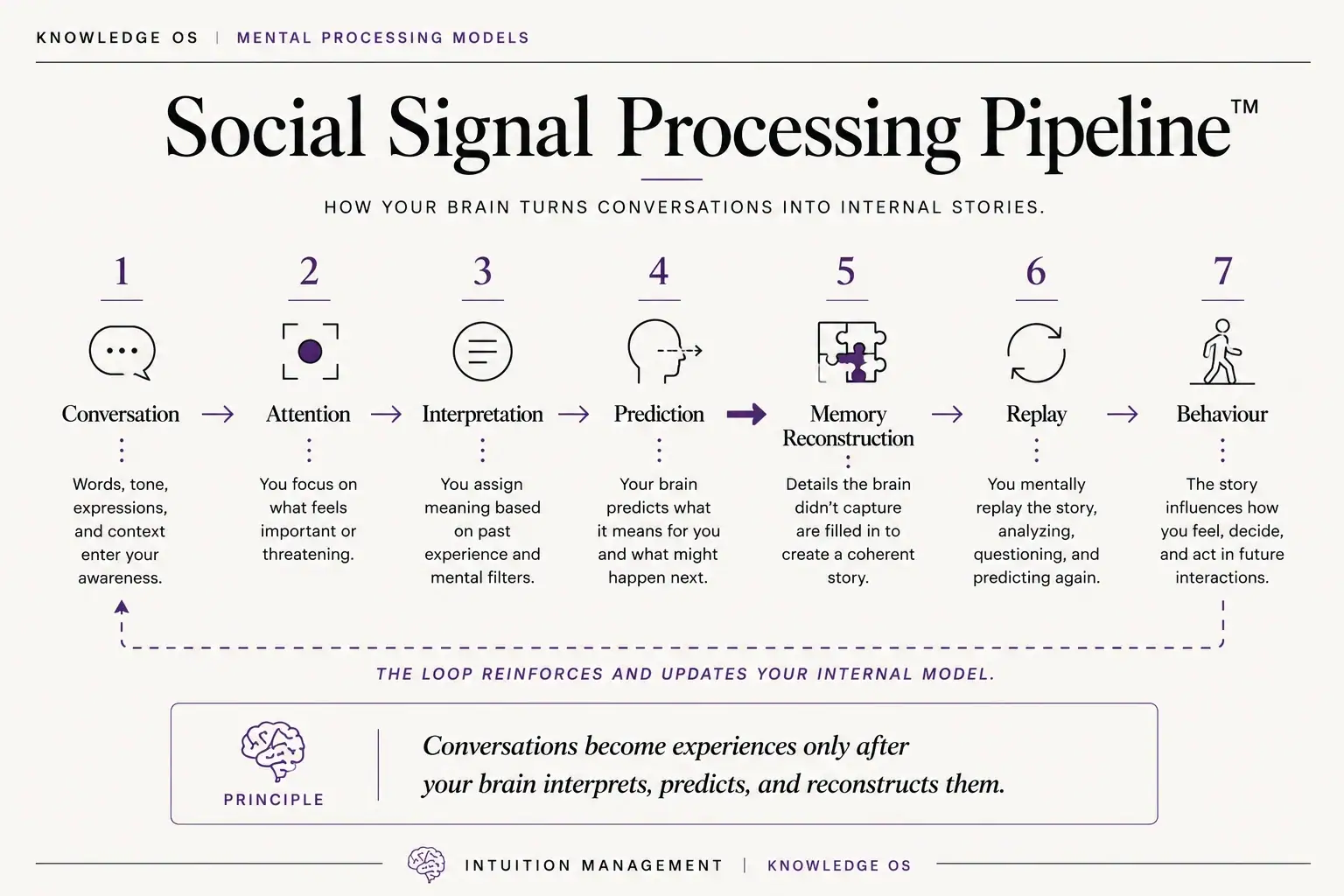
How a conversation becomes an internal story
You do not react to a conversation as a raw stream of facts. You react to a processed internal model of the conversation.

The process can be understood as seven stages:
- Conversation: words, tone, expression, timing, and context enter awareness.
- Attention: the brain selects signals that seem important or threatening.
- Interpretation: meaning is assigned using past experience and current mental filters.
- Prediction: the brain anticipates what the interaction means for you and what may happen next.
- Memory reconstruction: missing details are filled in to create a coherent story.
- Replay: the story is mentally reviewed, questioned, and predicted again.
- Behavior: the reconstructed story influences future feelings, decisions, and interactions.
This helps explain why two people can remember the same conversation differently—and why your own interpretation can change from one replay to the next.
For a deeper explanation of how the mind builds a working model of experience, see Internal Model of Reality.
Why different conversations replay in different ways
The content of the loop changes with the context. The underlying mechanism may be similar—uncertainty, reconstruction, prediction—but the question the mind tries to answer is different.
After an argument
Argument replay often searches for control. You imagine the perfect response, identify the point where the conversation changed, or build a stronger case for what you should have said. This can be useful when it reveals a boundary, misunderstanding, or repair. It becomes replay when the imaginary argument keeps expanding without any decision about what to do now.
After a work conversation
At work, replay often centres on competence, status, and consequences. You may analyse whether a manager sounded disappointed, whether a colleague challenged your idea, or whether a short message signals a larger problem. The mind can treat ordinary ambiguity as performance evidence because work interactions affect reputation and opportunity.
Separate the operational question from the identity question. “Do I need to send a clarification?” is operational. “Does this prove I am bad at my job?” is a global story. Operational questions can lead to action. Global stories usually generate more replay.
After dating or an emotionally important conversation
When connection matters, small signals can carry enormous weight. A pause, change in tone, or delayed reply may be interpreted as evidence about attraction, safety, or the future of the relationship. The mind fills the gap because waiting is emotionally difficult.
But uncertainty in a relationship cannot always be solved by more private analysis. Sometimes the only reliable information comes from time, consistent behaviour, or a direct and respectful conversation.
After family interactions
Family conversations may reactivate old roles. You may not only replay what was said today; you may replay years of meaning attached to the same tone, topic, or pattern. The emotional response can therefore be larger than the current interaction alone would predict.
After sending a text or voice message
Text removes many contextual signals. There is no immediate facial expression, tone correction, or shared physical context. This creates more room for projection. You may reread your message, inspect punctuation, interpret response time, or imagine that a brief reply contains hidden meaning.
Digital communication can therefore produce a special form of replay: the evidence remains visible, so the mind can review it indefinitely. Visibility feels like clarity, but a transcript still does not reveal the other person’s internal state.
Why conversations from years ago return
An old conversation may return when a current event activates the same unresolved theme: rejection, shame, responsibility, missed opportunity, or the wish to be understood. The mind is not necessarily asking you to solve the old event. It may be using the old memory to interpret something happening now.
Ask: “What current concern does this old conversation represent?” That question often produces more useful information than another attempt to rewrite a scene that cannot be changed.
Why replay feels urgent even when nothing is happening
Unresolved social uncertainty can feel like unfinished work. Because human relationships affect belonging, reputation, cooperation, and safety, ambiguity can feel more important than it objectively is.
Several factors can intensify the loop:
Cognitive overload
When your attention is already fragmented, the brain has less capacity to evaluate a social memory calmly. An ambiguous detail can feel larger because the system is operating with reduced bandwidth. This is closely related to the patterns described in cognitive overload recovery.
Mental fatigue
Fatigue can make flexible thinking harder. The mind may return to familiar interpretations because generating balanced alternatives requires effort.
Low confidence
When you do not trust your own judgment, replay can become an attempt to outsource certainty to repeated analysis. But the same uncertain mind keeps reviewing the same uncertain memory.
High social stakes
Conversations with people whose opinion matters can trigger more prediction. The brain searches for signs that the relationship, opportunity, or social position remains safe.
Emotional carryover
If you were already stressed, ashamed, tired, or overstimulated, the conversation may be stored with that emotional state attached. Later replay can reactivate the state and make the memory feel more threatening.
This does not mean every repeated thought is meaningless. It means the urgency of the thought should not be mistaken for proof.
Conversation replay is not the same as intuition
Because replay can feel emotionally strong, it is easy to interpret it as an inner warning: “I keep thinking about this, so something must be wrong.” Repetition, however, is not the same as accuracy.
A useful intuitive signal is often brief, specific, and connected to observable information. Replay tends to become longer, more elaborate, and less stable. Each pass adds new possibilities rather than clarifying one signal.
| Possible signal | Replay pattern |
|---|---|
| “That boundary was crossed.” | “What if every word meant something different?” |
| Specific and connected to behaviour | Expands into multiple imagined stories |
| Points toward a proportionate action | Demands more analysis before any action feels safe |
| Remains relatively stable | Changes with mood, fatigue, and each new replay |
| Can coexist with uncertainty | Tries to eliminate uncertainty completely |
When you are unsure whether you noticed a real signal or entered a replay loop, return to Signal vs Noise and Intuition or Anxiety. The aim is not to dismiss your concern. It is to identify which part is observable information and which part is prediction.
How mental filters reshape the replay
The same conversation can be reconstructed through different filters. A threat filter notices danger. A responsibility filter notices possible harm caused to others. A rejection filter notices distance. A perfection filter notices every sentence that could have been better.
These filters do not invent experience from nothing. They select and weight details. The problem appears when one filter becomes the only lens through which the conversation can be understood.
Threat filter
“What danger did I miss?”
Rejection filter
“What proves they no longer accept me?”
Responsibility filter
“How might I have caused a problem?”
Perfection filter
“What could I have said flawlessly?”
Status filter
“Did I lose respect or appear less capable?”
Control filter
“How could I guarantee a better outcome?”
The corrective move is not forced positivity. It is representational balance: deliberately include evidence that the dominant filter excluded.
How to stop replaying conversations
The goal is not to force the thought out of your mind. Suppression often creates another struggle. A better approach is to change the process from automatic replay to deliberate observation.
Observe
Name the process accurately: “I am replaying a conversation.” This separates the current moment from the remembered event.
Pause
Do not immediately answer every question the replay produces. A slow breath, a change of posture, or a short physical reset can create cognitive space.
Separate
Divide what you know from what you are predicting. Facts describe what occurred. Predictions describe what your mind thinks the event might mean.
Update
Choose the most accurate explanation supported by the available evidence—not the most comforting or most frightening explanation.
Return
Bring attention back to what is happening now. The present can provide new information; replay mostly recycles the old model.
From replay to conscious choice
Breaking one replay does not require proving that everything is fine. It requires recognizing that the thought is not an instruction.
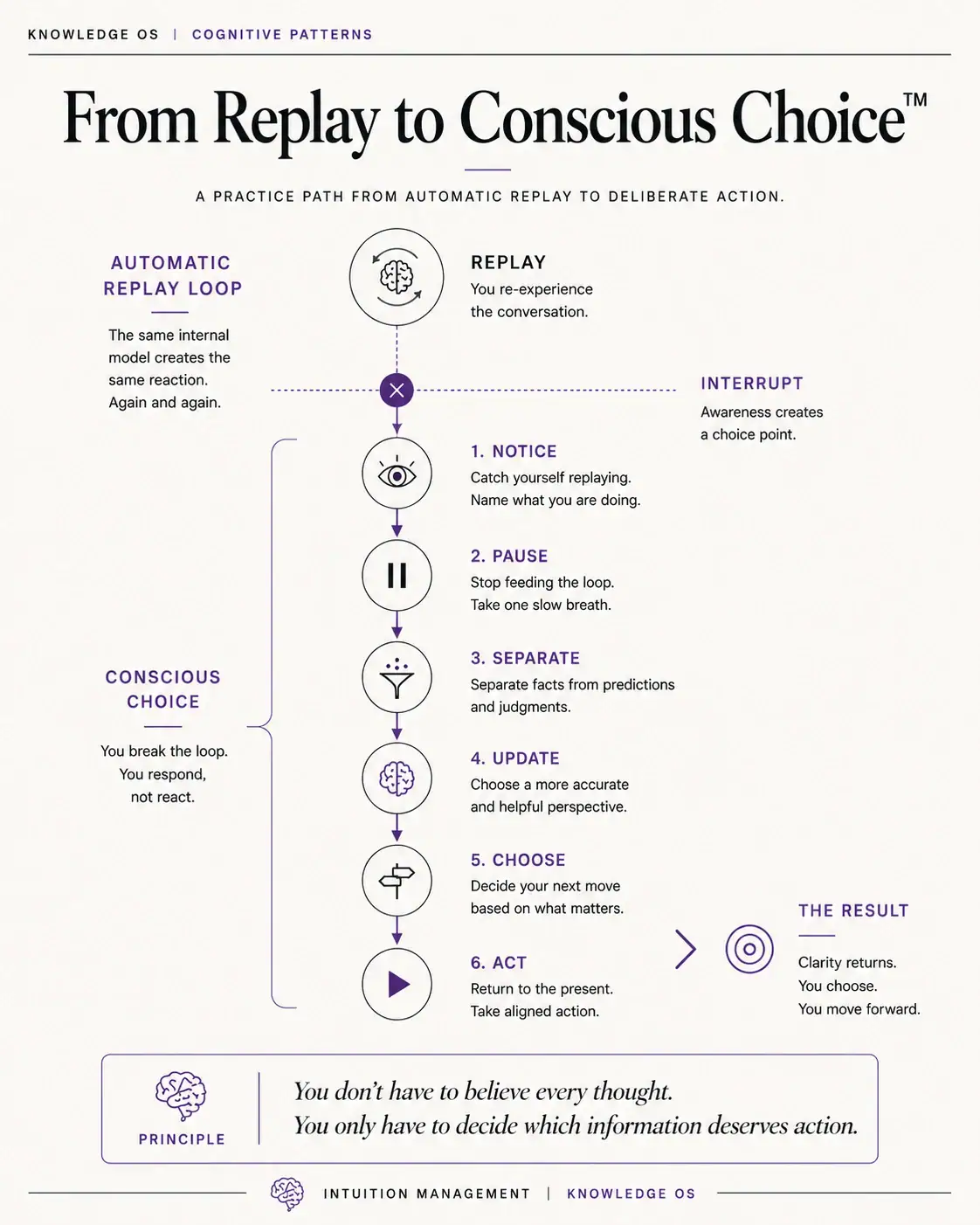
A thought may contain a useful signal. It may also contain a prediction, a memory distortion, an old fear, or an attempt to create impossible certainty.
Conscious choice means asking:
- What information do I actually have?
- What am I adding through prediction?
- Is there a respectful action available?
- Will more analysis change the evidence?
- What deserves my attention now?
This is the same distinction at the center of Signal vs Noise: not every internal event deserves equal authority.
Should you reflect or release?
Some conversations deserve reflection. Others require release. The difference is not whether the conversation feels emotionally important. The difference is whether further thought can still produce learning.
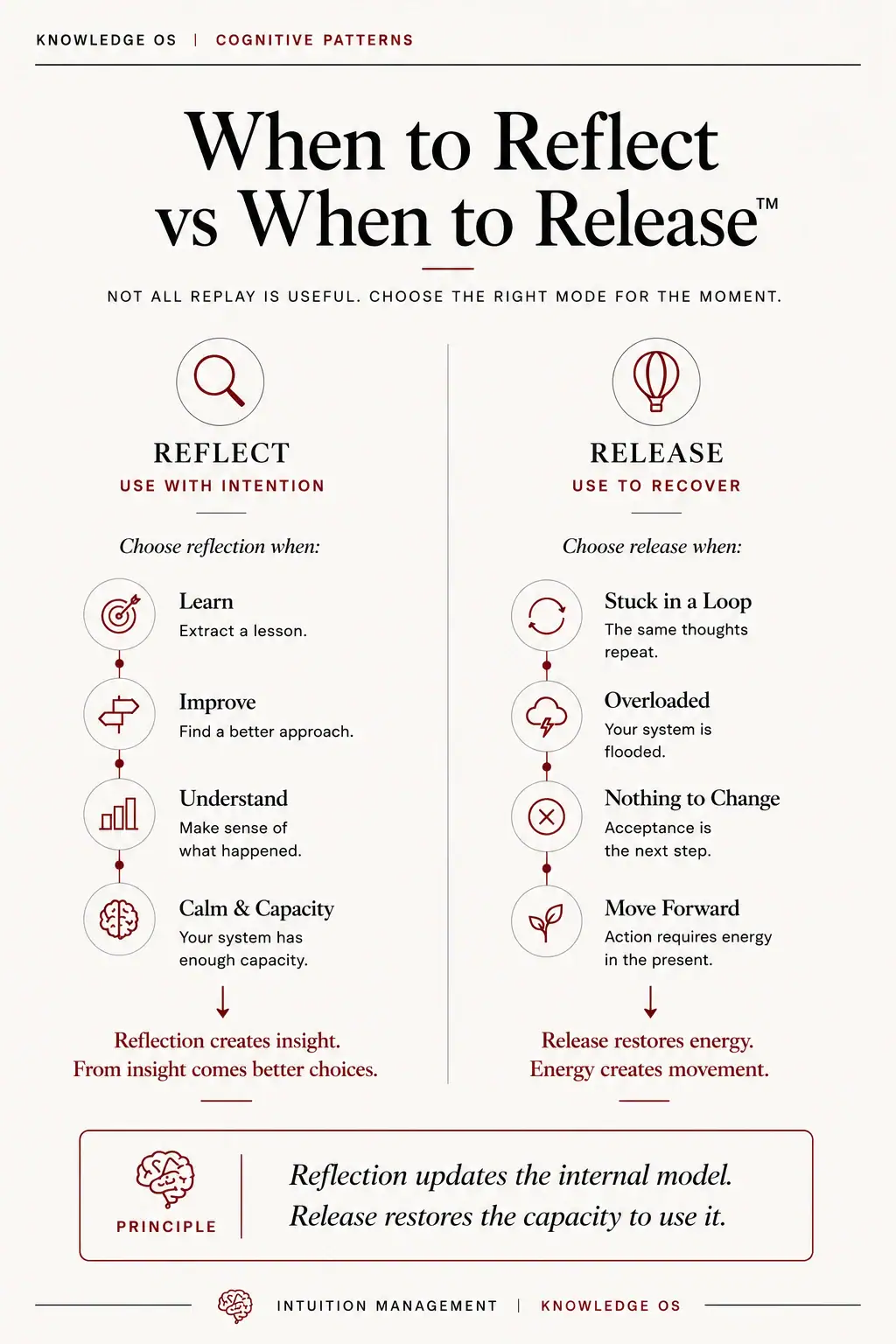
Reflect when you can learn
Reflection is useful when you have new information, want to understand what happened, can identify a different response, and have enough emotional capacity to think clearly.
Release when you cannot learn
Release is appropriate when you are repeating the same thoughts, feel increasingly overwhelmed, cannot change the past, and need your attention for the present.
The Conversation Replay Decision Map™
When you notice the loop starting, one question can simplify the decision:
Do I have new information?

If the answer is yes, reflect intentionally. Identify the new evidence, update your understanding, and decide whether a specific action is appropriate.
If the answer is no, continued replay is unlikely to solve the uncertainty. The next useful step is recovery: reduce stimulation, return attention to the present, and restore the capacity needed for the next real interaction.
A practical script for the next replay
When a conversation returns to your mind, try this short sequence:
1. Name it: “My mind is replaying the conversation.”
2. State the facts: “This is what I know actually happened.”
3. Identify the prediction: “This is what I am imagining it means.”
4. Choose the mode: “Can I learn something, or do I need to release this?”
5. Return: “What deserves my attention now?”
You are not trying to win an argument with your mind. You are changing the role of the thought. It becomes information to evaluate rather than a command to obey.
How to stop replaying conversations before sleep
Conversation replay often becomes louder at night because external input decreases while fatigue reduces cognitive flexibility. The goal is not to solve every social question before sleeping. The goal is to give the mind a credible stopping point.
Use a written endpoint
Write three short lines: what happened, what you are predicting, and whether any action is available tomorrow. This externalises the unfinished task without turning the page into a full transcript.
Do not conduct a midnight investigation
Rereading messages, checking response times, or reconstructing every sentence can temporarily feel productive while increasing activation. If clarification is needed, schedule it for a specific time the next day.
Return to sensory information
Replay is an internally generated simulation. Quietly noticing contact with the bed, sounds in the room, temperature, or the rhythm of breathing helps re-establish the difference between the remembered event and the present environment.
Use a closing sentence
A useful closing sentence is not reassurance that nothing is wrong. It is permission to postpone unresolved analysis: “I have recorded what matters. I will decide tomorrow whether action is needed.”
Why reducing replay improves confidence
Confidence does not come from never making social mistakes. It comes from trusting that you can notice, learn, repair when necessary, and continue living without endlessly reviewing yourself.
Repeated replay weakens confidence because it teaches the brain that every conversation requires post-event surveillance. Deliberate reflection teaches a different lesson: important information can be processed once, integrated, and released.
This connects with why you second-guess yourself and why self-trust can feel inaccessible. The problem is not always a lack of judgment. Sometimes the judgment never gets a chance to settle because the evaluation process never ends.
How to know whether the conversation needs action
One reason replay continues is that the mind cannot decide whether the interaction requires repair. It keeps reviewing the event because “do nothing” feels irresponsible, while acting without evidence feels risky.
A proportionate response depends on four questions:
Is there an observable problem?
Look for a concrete misunderstanding, broken agreement, boundary violation, factual error, or visible change in the relationship. A feeling of uncertainty alone is not yet an observable problem.
Is the issue still active?
Some moments feel uncomfortable but resolve naturally. Others continue affecting work, trust, coordination, or connection. Action is more useful when the issue remains active.
Is there a proportionate action?
A short clarification may be proportionate. A long emotional message sent to eliminate every doubt usually is not. Match the size of the response to the evidence available.
Will the action create information?
A good action produces clarity, repair, or a boundary. Reassurance-seeking that must be repeated whenever doubt returns produces temporary relief without updating the underlying model.
| Situation | Likely useful response | Likely replay response |
|---|---|---|
| You gave incorrect information | Send a concise correction | Review how incompetent you may have appeared |
| Your wording may have been unclear | Clarify if the issue matters | Rewrite the whole conversation repeatedly |
| You fear they disliked you | Observe future behaviour and the wider relationship | Ask for reassurance without concrete evidence |
| You crossed a boundary | Acknowledge, apologise, and change behaviour | Use shame as a substitute for repair |
| The conversation was merely imperfect | Accept normal social variation | Search for the version in which every sentence was flawless |
What to do when a repair is genuinely needed
Sometimes replay contains a real signal: you interrupted repeatedly, spoke harshly, shared something inaccurate, ignored a boundary, or left an important misunderstanding unresolved. In that case, the solution is not more private punishment. It is proportionate repair.
Use a four-part repair
Observation: “I realised I interrupted you several times.”
Responsibility: “That made it harder for you to finish your point.”
Repair: “I’m sorry. I want to hear the part I cut off.”
Change: “Next time I’ll pause before responding.”
A good repair is specific. It does not demand that the other person immediately reassure you, erase their reaction, or manage your discomfort. The goal is to improve the relationship or correct the information—not to obtain absolute certainty that you are still viewed positively.
After a proportionate repair, the loop may still return. That does not mean another apology is required. It may simply mean your internal model has not caught up with the action already taken.
The five layers hidden inside conversation replay
A replay often feels like one thought, but several layers may be operating at once. Separating them reduces the sense that the entire experience is one unquestionable truth.
Layer 1: Event
The observable sequence: what was said, what was done, and what happened next. This layer is usually smaller than the replay.
Layer 2: Interpretation
The meaning assigned to the event: “They were annoyed,” “I sounded foolish,” or “That pause meant rejection.” Interpretations may be reasonable, but they remain interpretations.
Layer 3: Prediction
The imagined consequence: “They will avoid me,” “This will damage my reputation,” or “I will make the same mistake again.” Predictions extend the event into the future.
Layer 4: Identity
The global conclusion about the self: “I am awkward,” “I always ruin things,” or “I cannot trust myself.” Identity claims turn one interaction into evidence about the whole person.
Layer 5: Control strategy
The repeated analysis intended to prevent future pain: replay, rehearse, check, seek reassurance, withdraw, or avoid similar situations.
The most effective intervention depends on the layer. Facts can be clarified. Interpretations can be compared. Predictions can be tested over time. Identity claims can be narrowed back to one event. Control strategies can be interrupted.
How to reduce conversation replay over time
Immediate interruption helps with the current loop. Long-term change comes from teaching the mind that uncertainty can be tolerated, useful lessons can be extracted once, and imperfect social moments do not require indefinite surveillance.
1. Practise fact–prediction separation daily
Do not wait for a highly emotional interaction. Use ordinary situations. Write one observable fact and one prediction your mind added. Repetition makes the distinction easier to access under stress.
2. Set a reflection boundary
Give intentional reflection a beginning and an endpoint. For example: ten minutes to identify what happened, one lesson, and one action. A boundary is not avoidance; it prevents analysis from expanding indefinitely.
3. Reduce reassurance loops
Notice when reassurance answers a concrete question and when it is being used to remove all uncertainty. The second goal cannot be completed permanently, so the urge usually returns.
4. Increase behavioural evidence
The internal model becomes more balanced through real experiences, not only through thinking. Continue participating in conversations, allow minor imperfections, and observe what actually happens afterward.
5. Build repair confidence
Fear decreases when you trust your ability to respond if a genuine problem appears. You do not need to guarantee that no misunderstanding will ever happen. You need confidence that you can clarify, apologise, set a boundary, or adapt.
6. Protect cognitive capacity
Overload makes every ambiguous signal harder to evaluate. Sleep, breaks, reduced notification pressure, and periods of undivided attention are not separate from social confidence; they support the cognitive flexibility needed to interpret interactions accurately.
7. Let other people remain partly unknowable
No amount of replay can give complete access to another person’s mind. Healthy relationships depend on patterns of behaviour, communication, and repair—not perfect certainty about every private reaction.
Three examples of the loop in practice
Example 1: The short reply from a manager
You present an idea. Your manager says, “Okay, send me the details,” and moves to the next agenda item. Later, “okay” begins to sound dismissive. You reconstruct their expression, compare it with previous meetings, and predict that the idea was weak.
Fact: They asked for the details. Prediction: They disliked the idea. Useful action: Send the requested details clearly. Release point: Their evaluation will become visible through feedback, not through repeated analysis of one word.
Example 2: The joke that did not land
You make a joke and the group gives a smaller reaction than expected. Later you imagine that everyone found it inappropriate. The replay turns a brief mismatch into a story about your entire social identity.
Fact: The reaction was limited. Possible interpretations: People were distracted, the joke was unclear, the topic was not right, or it simply was not funny. Useful lesson: Adjust to the context next time. Release point: One weak joke is not a verdict on your belonging.
Example 3: The vulnerable message
You tell someone how you feel and their response is delayed. The absence of information becomes a canvas for prediction. You reread your message, inspect every phrase, and imagine that honesty damaged the relationship.
Fact: You sent an honest message and have not received a response yet. Prediction: The delay means rejection. Useful action: Wait for real information unless an agreed response time has passed. Release point: Re-reading cannot reveal why another person has not replied.
When conversation replay may need professional support
Occasional replay is common. Consider speaking with a qualified mental health professional when repeated social thoughts are frequent, difficult to interrupt, highly distressing, disrupt sleep or daily functioning, lead to avoidance, or feel connected to compulsive reassurance-seeking or other repetitive mental rituals.
Conversation replay alone does not diagnose social anxiety, OCD, ADHD, autism, trauma-related conditions, or any other disorder. NIMH describes OCD as involving uncontrollable recurring thoughts, repetitive behaviours, or both, with symptoms that can be time-consuming and interfere with daily life. Social anxiety disorder involves intense fear or anxiety in situations where a person may be scrutinised, evaluated, or judged. A licensed professional can assess the full pattern rather than one isolated symptom.
Frequently asked questions
Is it normal to replay conversations in your head?
Yes. Briefly reviewing an interaction can support learning. It becomes less useful when the same questions repeat without new information, clarity, or action.
Why do I replay conversations at night?
At night there are fewer external demands competing for attention, so unfinished social concerns may become more noticeable. Fatigue can also make balanced thinking harder.
Why do I cringe after talking?
Post-conversation embarrassment can appear when the mind compares what happened with an ideal version of how you wanted to appear. That comparison may magnify small imperfections.
Is replaying conversations a sign of anxiety?
It can occur with anxiety, especially when the replay focuses on possible judgement or rejection. It can also occur without an anxiety disorder, so the pattern by itself is not diagnostic.
Why do I keep thinking about what I should have said?
Your mind may generate alternative outcomes to improve future performance or regain a sense of control. The imagined sentence feels perfect partly because it never had to face the complexity of the real interaction.
Is replaying conversations OCD?
Repetitive mental review can occur in OCD, but many people replay conversations without having OCD. Professional assessment is appropriate when thoughts feel uncontrollable, time-consuming, compulsive, or highly disruptive.
How do I stop replaying an embarrassing conversation?
Name the replay, list only the known facts, identify what you are predicting, decide whether a proportionate action is needed, and return attention to the present.
Should I ask the other person for reassurance?
Clarification can be appropriate when there is a concrete misunderstanding. Repeated reassurance-seeking may reinforce uncertainty, so first ask whether you have a specific question or are trying to remove every possible doubt.
What is the difference between reflection and rumination?
Reflection extracts insight and reaches an endpoint. Rumination repeats the problem without producing a meaningful update, action, or release.
What if I really did say something wrong?
Useful reflection leads to proportionate action: clarify, apologise, repair, or adjust next time. Endless self-punishment does not improve the repair and may reduce your capacity to act well.
Final principle
Conversation replay is often the brain’s attempt to create certainty from incomplete social information. The mind reconstructs the interaction, predicts possible meanings, evaluates your behavior, and returns to the memory because the prediction never feels fully resolved.
You do not need to eliminate every uncertain thought. You need to recognize when thinking is still producing information and when it is only recycling the same internal model.
Research and further reading
- Edgar EV, et al. Post-event rumination and social anxiety: a systematic review and meta-analysis. Journal of Affective Disorders, 2024.
- Flynn AJ, et al. Post-event processing in social anxiety: a scoping review. 2025.
- Holland AC, Kensinger EA. Emotion and autobiographical memory. Physics of Life Reviews, 2010.
- Schacter DL, et al. Memory distortion: an adaptive perspective. Trends in Cognitive Sciences, 2011.
- National Institute of Mental Health. Obsessive-Compulsive Disorder (OCD).
- National Institute of Mental Health. Social Anxiety Disorder: What You Need to Know.
Turn replay into a clearer signal
Continue with the frameworks that help separate observation from prediction, recover cognitive capacity, and rebuild trust in your own judgment.
Explore the Personal Signal Decoder Learn Signal vs Noise